


Abraham runs to receive strangers, then remains before God to plead for a city. Between these acts, the Lord renews Sarah’s promise and reveals the cry rising from Sodom. Abraham must make room at his table, receive a future he cannot produce, teach household justice, and pray for those beyond it. Nearness to God gives him more people to love.
Promise at the tent, judgment beyond it
Genesis 17 has named Sarah as the mother of the covenant son and given that son his name, Isaac. Chapter 18 brings the promise within her hearing. Its setting is Mamre, Brenton’s Mambre, where Abraham had settled and built an altar in Genesis 13:18. The tent door becomes a place of encounter, and the meal under the tree becomes the setting for God’s word. Brenton’s spellings Abraam and Sarrha are retained in the Scripture below; the commentary uses Abraham and Sarah.
Lot, Abraham’s nephew, chose the region around Sodom in chapter 13; Abraham rescued him from captivity in chapter 14. Now an entire city is endangered. Genesis 19 will carry the narrative into judgment and rescue; here Abraham stands before God while the outcome remains concealed.
The welcome that costs real work (Genesis 18:1-8)
1 And God appeared to him by the oak of Mambre, as he sat by the door of his tent at noon. 2 And he lifted up his eyes and beheld, and lo! three men stood before him; and having seen them he ran to meet them from the door of his tent, and did obeisance to the ground. 3 And he said, Lord, if indeed I have found grace in thy sight, pass not by thy servant. 4 Let water now be brought, and let them wash your feet, and do ye refresh yourselves under the tree. 5 And I will bring bread, and ye shall eat, and after this ye shall depart on your journey, on account of which refreshment ye have turned aside to your servant. And he said, So do, as thou hast said. 6 And Abraam hasted to the tent to Sarrha, and said to her, Hasten, and knead three measures of fine flour, and make cakes. 7 And Abraam ran to the kine, and took a young calf, tender and good, and gave it to his servant, and he hasted to dress it. 8 And he took butter and milk, and the calf which he had dressed; and he set them before them, and they did eat, and he stood by them under the tree.
The narrator tells us that God appeared; Abraham sees three men. The reader knows the encounter is holy before its meaning has unfolded within the story. Abraham looks up, runs, bows, and asks that the visitors remain. “Obeisance” means a bow of reverence; “kine” means cattle.
“Pass not by thy servant”: Abraham treats the guests’ stopping as a favor to him. Hospitality becomes reception of another person rather than a host’s display. He offers water, rest, and bread, then provides a meal exceeding the modest offer. The tender calf and fine flour express care; he stands while they eat, available to serve.
The haste belongs to a household. Sarah makes cakes; the servant prepares the calf; Abraham sets out the food. Scripture shows the hands through which his initiative becomes a welcome. At a parish meal, the cooking, cleaning, and quiet expense can disappear behind the name of a prominent organizer. Sharing the work and honoring its workers belong to the love expressed at the table.
The meal is offered and accepted in verse 5. Hospitality respects a guest’s freedom and a household’s safety; providing food or arranging a safe meeting can answer a need. Abraham’s haste challenges the heart that makes another person’s care somebody else’s responsibility whenever help becomes inconvenient.
Hebrews 13:2 recalls that people have entertained angels without knowing it. Matthew 25:35-40 brings the matter before Christ: He identifies Himself with those who need food, welcome, clothing, and care. The stranger’s need has a claim on Christian love before we know whether the encounter will prove extraordinary. Waiting for a person to appear spiritually impressive can become a way of withholding ordinary mercy.
Gems from the Fathers 💎: A ready will
St. John Chrysostom, preaching on Romans 12:13, turns to Abraham and Lot and challenges Christians who meet the needy coldly. He locates generosity in the will before wealth: “the bounteousness came not from excess of wealth, but of the riches of a ready will.”1 Abraham puts his means at the guests’ service. What can ours actually do for someone?
Chrysostom’s sharper sentence reaches the conscience: “But we, who have clear information that it is Christ Whom we take in, do not grow gentle even for this.”1 His rebuke concerns the way the poor are received as well as what they are given. A gift delivered with contempt can deepen the humiliation of needing help. We prepare to receive Christ at the Holy Table by learning to speak without disdain to the person who needs a place at ours.
Gems from the Fathers 💎: The Lord who visits
St. Justin Martyr reads the visitor who speaks as Lord as the divine Son appearing before His birth from the Virgin. This is a Christophany, an appearance of Christ before the Incarnation. Justin writes that “He who appeared to Abraham under the oak in Mamre is God, sent with the two angels in His company”.2 His argument follows the narrative into chapter 19: two angels arrive in Sodom, while Abraham has remained in conversation with the Lord. The Son reveals the Father; His later Incarnation is the unique event in which He truly becomes man.
The Lord addresses a household, accepts its service, gives a promise, and draws His servant into conversation. In Christ, divine nearness reaches its fullness: the eternal Son shares our human life to bring us into communion with God.
Iconography Connection 🖼️
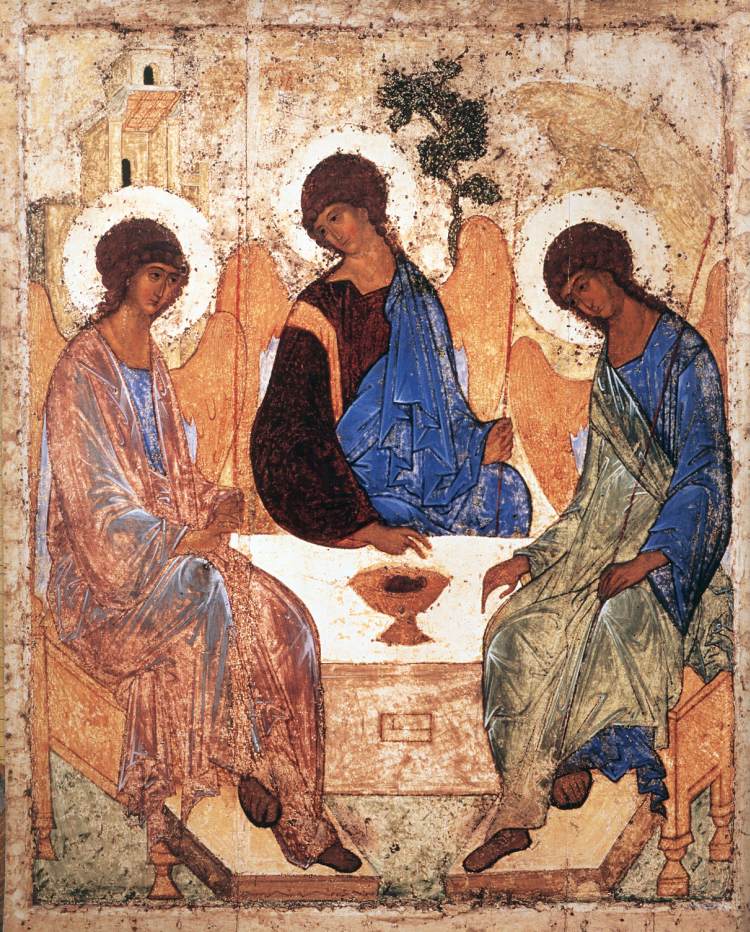 Source: Andrei Rublev, The Holy Trinity, public domain, Wikimedia Commons 🔗.
Rublev’s Russian Orthodox icon receives the Hospitality of Abraham as a contemplation of the Holy Trinity.3 Three winged figures sit around a table with one vessel; a building, tree, and rocky height stand behind them. Abraham and Sarah are absent. Busy service becomes a still image of communion; inclinations and gestures draw attention toward the table. Its cup can carry Christian prayer toward the Eucharist. The icon’s Trinitarian contemplation and Justin’s Christological reading receive the same scene in distinct ways.
The Church’s Voice in Worship ⛪
The Coptic Holy Pascha book appoints Genesis 18:1-23 as the first prophecy at the Great Thursday Liturgy of Blessing of the Water, the Laqan.4 Abraham’s offered water is heard on the day of Christ’s washing of His disciples’ feet. Hands that bring water and prepare a meal can obey the Lord’s humility. The reading continues through Sarah’s promise to Abraham’s first plea: service opens toward listening and prayer.
Sarah’s laughter brought into truth (Genesis 18:9-15)
9 And he said to him, Where is Sarrha thy wife? And he answered and said, Behold! in the tent. 10 And he said, I will return and come to thee according to this period seasonably, and Sarrha thy wife shall have a son; and Sarrha heard at the door of the tent, being behind him. 11 And Abraam and Sarrha were old, advanced in days, and the custom of women ceased with Sarrha. 12 And Sarrha laughed in herself, saying, The thing has not as yet happened to me, even until now, and my lord is old. 13 And the Lord said to Abraam, Why is it that Sarrha has laughed in herself, saying, Shall I then indeed bear? but I am grown old. 14 Shall anything be impossible with the Lord? At this time I will return to thee seasonably, and Sarrha shall have a son. 15 But Sarrha denied, saying, I did not laugh, for she was afraid. And he said to her, Nay, but thou didst laugh.
The question about Sarah turns the encounter toward the person whose future is announced. Abraham has heard the promise; now Sarah hears it at the tent door. The speaker promises his return and her son. God is faithful to the woman He has blessed, as well as to Abraham.
Verse 11 sets the promise beside the bodily facts: both are old, and Sarah has passed the time of childbearing. In Brenton’s wording, she says that the thing has not happened even until now and that her lord is old. She measures the promise against an unfulfilled past and what presently seems possible.
The Lord knows her inward laughter. He asks why she has laughed, restates the difficulty in terms of bearing a child when old, and answers it with a question about Himself: “Shall anything be impossible with the Lord?” Her age is real. Its power to determine God’s promise is what the question challenges. The Lord then repeats the appointed return and the promised son. He places His own faithfulness beside the facts she has counted.
Sarah denies laughing because she is afraid. The Lord’s reply restores the truth: “Nay, but thou didst laugh.” She must acknowledge a private reaction before God. Yet the promised son has just been reaffirmed. Exposure of her doubt does not cancel His word. The God who knows the concealed heart addresses it truthfully while continuing His gracious purpose.
There is great mercy here for someone ashamed of the thoughts that arise during prayer. We may say faithful words while inwardly dismissing any possibility of change. Once that division is recognized, defending an appearance of certainty only leaves us further from the truth. We can bring the doubt into prayer and confession: this is what I really thought; this is where I fear that Your word cannot reach. God’s knowledge makes honesty possible.
Sarah’s particular promise must remain particular. This passage gives no guarantee that every faithful couple will conceive, nor does continued childlessness measure the quality of someone’s faith. Christian hope rests on what God has truly promised, above all His saving life in Christ, while our petitions for particular gifts remain entrusted to His wisdom. The Lord’s power delivers us from making despair into a doctrine; it never licenses us to announce an outcome He has not pledged.
Sarah’s laughter will receive its joyful answer after Isaac’s birth in Genesis 21:6. Faith is being formed over time. The woman who laughs and fears here is not imprisoned within this moment; God’s fulfilled word will give her a different reason to laugh.
Chosen to teach justice and hear the cry (Genesis 18:16-21)
16 And the men having risen up from thence looked towards Sodom and Gomorrha. And Abraam went with them, attending them on their journey. 17 And the Lord said, Shall I hide from Abraam my servant what things I intend to do? 18 But Abraam shall become a great and populous nation, and in him shall all the nations of the earth be blest. 19 For I know that he will order his sons, and his house after him, and they will keep the ways of the Lord, to do justice and judgment, that the Lord may bring upon Abraam all things whatsoever he has spoken to him. 20 And the Lord said, The cry of Sodom and Gomorrha has been increased towards me, and their sins are very great. 21 I will therefore go down and see, if they completely correspond with the cry which comes to me, and if not, that I may know.
Abraham accompanies the departing visitors; his care continues beyond the meal. The Lord’s question about concealing His purpose concerns Abraham’s vocation: he is to become a great nation, and the nations will be blessed in him. His future extends beyond the happiness of his own tent.
Verse 19 explains the moral shape of that future. Abraham is to direct his household in the Lord’s ways, “to do justice and judgment.” The covenant has received a bodily sign in chapter 17; here its obligations reach everyday conduct. A household that bears the promise must learn how to treat people rightly. Religious inheritance includes the manner in which children see authority exercised, disputes settled, workers treated, and inconvenient needs answered.
Teaching the Lord’s ways asks for responsible guidance and an example that makes those ways credible. Parents and servants cannot produce faith by force. A child who hears about justice while watching a parent humiliate someone learns the contradiction vividly. Abraham’s calling presses the adult toward repentance as well as instruction: apologize when wrong, keep promises, refuse favoritism, and explain why another person’s dignity matters before God. The blessing of the nations begins to take recognizable form in the life of a home.
Against this stands Sodom’s increased cry and very great sins. The Lord hears what the city may be able to disregard. A cry is more than a record of broken rules; it directs attention to evil whose effects call for judgment. Chapter 19 will show strangers threatened by collective violence. Prayer for Sodom must keep those endangered people in view. Mercy for sinners includes the desire that their wrongdoing cease, and justice includes concern for those it wounds.
The language of going down to see in verse 21 brings divine judgment within human understanding. This is anthropomorphic language, speech about God in the terms of human action. It portrays a judge who attends to the truth of the cry before acting. It cannot mean that God is ignorant until He travels: the same chapter has already shown Him knowing Sarah’s unspoken laughter. The contrast matters. Nothing is hidden from Him, and nothing is judged carelessly.
These verses console those whose injuries others minimize: God hears the cry. They also restrain the person quick to condemn. Distinguish knowledge from suspicion, investigate fairly, and take the vulnerable seriously. Abraham enters divine counsel as a servant of righteousness, not a spectator enjoying another city’s downfall.
Asking the Judge to spare the city (Genesis 18:22-26)
22 And the men having departed thence, came to Sodom; and Abraam was still standing before the Lord. 23 And Abraam drew nigh and said, Wouldest thou destroy the righteous with the wicked, and shall the righteous be as the wicked? 24 Should there be fifty righteous in the city, wilt thou destroy them? wilt thou not spare the whole place for the sake of the fifty righteous, if they be in it? 25 By no means shalt thou do as this thing is so as to destroy the righteous with the wicked, so the righteous shall be as the wicked: by no means. Thou that judgest the whole earth, shalt thou not do right? 26 And the Lord said, If there should be in Sodom fifty righteous in the city, I will spare the whole city, and the whole place for their sakes.
The men depart, and Abraham remains before the Lord. Chapter 19 identifies Sodom’s arrivals as two angels. Abraham “drew nigh”, bringing others’ peril into prayer. Intercession means prayer for others. It begins here by asking whether the righteous will be swept away with the wicked.
His appeal becomes larger in verse 24. He asks that the whole place be spared for the sake of fifty righteous people within it. He has moved beyond requesting that the innocent be separated from the guilty. He seeks a mercy whose shelter would extend throughout the city. He neither denies Sodom’s sin nor treats everyone within its walls as indistinguishable. The presence of righteousness matters even where evil has become grave.
Verse 25 rests on Abraham’s faith: the Lord judges the whole earth and will do right. He appeals to God’s character, not a mercy superior to God’s. The terrifying question can be spoken because justice belongs to the Judge. Prayer remains reverent while bringing apparent injustice honestly before Him.
The Lord will spare the whole city and place for the fifty. He has disclosed the impending judgment, heard the appeal, and answered. Abraham’s prayer meets divine willingness rather than forcing a reluctant concession. One person’s life before God can concern the good of many others.
Righteousness reaches beyond keeping one’s own conscience untroubled. A truthful person can resist accepted dishonesty; a patient person can interrupt humiliation; someone who prays can carry people others have written off. Our presence guarantees no institution’s survival, but we are called to seek its good before God and make that concern visible.
Earth and ashes, asking again (Genesis 18:27-33)
27 And Abraam answered and said, Now I have begun to speak to my Lord, and I am earth and ashes. 28 But if the fifty righteous should be diminished to forty-five, wilt thou destroy the whole city because of the five wanting? And he said, I will not destroy it, if I should find there forty-five. 29 And he continued to speak to him still, and said, But if there should be found there forty? And he said, I will not destroy it for the forty’s sake. 30 And he said, Will there be anything against me, Lord, if I shall speak? but if there be found there thirty? And he said, I will not destroy it for the thirty’s sake. 31 And he said, Since I am able to speak to the Lord, what if there should be found there twenty? And he said, I will not destroy it, if I should find there twenty. 32 And he said, Will there be anything against me, Lord, if I speak yet once? but if there should be found there ten? And he said, I will not destroy it for the ten’s sake. 33 And the Lord departed, when he left off speaking to Abraam, and Abraam returned to his place.
After the first answer, Abraham calls himself “earth and ashes”. He remembers his creatureliness while using God’s gift of freedom to speak. Humility has a voice. He is small before the Lord, but others still matter; reverence has not extinguished love.
The numbers descend from fifty to forty-five, then forty, thirty, twenty, and ten. Abraham first asks whether a shortage of five would bring destruction upon the whole place. Each answer gives him room to ask about a smaller number. His repeated appeals contain restraint and growing confidence together. Verse 31 expresses the wonder of being able to speak to the Lord; verse 32 marks the final request. At each stage, the Lord says He will not destroy the city if the stated number is found.
Ten is where this conversation ends, not a universal quota explaining when God may show mercy. Scripture gives no symbolic arithmetic by which we can calculate the safety of a city or the success of prayer. Its emphasis falls on the Lord’s repeated willingness to spare and Abraham’s persistence in asking. We need to hear those answers without hurrying past them to the destruction in chapter 19.
The Lord departs, and Abraham returns to his place without control of the result. Genesis 19:29 supplies a crucial connection: God remembers Abraham and brings Lot out of the overthrow. The city is not spared, yet Abraham’s prayer belongs to the account of rescue. Mercy may reach someone in a form the intercessor did not anticipate.
Hebrews 7:25 grounds our intercession in Christ, who always lives to intercede for those approaching God through Him. Abraham pleads as a servant; Christ saves as our living High Priest. First Timothy 2:1-6 joins prayer for all to the one Mediator who gave Himself as a ransom for all. His saving love sustains the prayers of the Church and the saints.
We pray for a city while acknowledging its evil, for an offender while protecting the injured, and for a family member while respecting their freedom. Asking for protection, repentance, and salvation loosens contempt’s grip. Before God, another person’s sins give us no excuse to desire their loss.
Spiritual Fruit 🍇
Let hospitality become shared care. Choose one concrete need that you can help meet this week: a meal for an exhausted household, a ride, or a welcome for someone standing alone after the Liturgy. Decide what you yourself will contribute. If others help, agree on the work and thank them by name. Abraham’s haste is fruitful when it becomes refreshment for the guest rather than exhaustion imposed upon an unseen worker.
Tell God the truth beneath your faithful words. Sarah’s denied laughter gives us a place to begin when we are afraid of admitting doubt. During prayer, name the particular promise of God you struggle to trust, or the desired outcome you have mistaken for a promise. Bring that distinction to confession or a conversation with your father of confession. Honesty lets us ask for faith without pretending to possess it fully, and receive Christ’s help without demanding that He ratify our own timetable.
Teach justice through the next ordinary decision. Verse 19 places the household under the Lord’s ways. When a disagreement arises, give the quieter person time to speak. When you have used authority unfairly, apologize without requiring the injured person to comfort you. Let children and those you serve see that prayer makes an adult answerable to God. A small act of fairness can explain the command more convincingly than another lecture about it.
Pray for someone you are tempted to dismiss. Bring one name before Christ each day, including the needs of anyone that person’s conduct has harmed. Ask for the vulnerable to be protected, the wrong to cease, and the sinner to receive repentance and salvation. Take whatever responsible action is yours to take. Abraham remains before God for a city; his example helps us stay in prayer without making ourselves masters of the outcome.
Lord Jesus Christ, receive the service we offer and cleanse the contempt that spoils it. Bring our hidden doubts into Your truth. Teach our homes Your justice, and hear the cries we have overlooked. As Abraham stood before You, keep us faithful in prayer for others, trusting the mercy through which You save.
Teaching Notes
The welcome that costs real work (Genesis 18:1-8)
- Ask: What changes when Abraham treats the guests’ arrival as a favor to him?
- Watch for: Neither unsafe access nor unequal burdens are requirements of hospitality. The Lord with two angels in the narrative and the icon’s Trinitarian contemplation are distinct readings, not three incarnate divine Persons.
- Show: Let Rublev’s shared table draw attention to communion; then return to the concrete hands that prepare Abraham’s meal.
Sarah’s laughter brought into truth (Genesis 18:9-15)
- Ask: How does the Lord join exposure of Sarah’s laughter to reaffirmation of the promise?
- Watch for: Avoid invented motives or tone, and any suggestion that childlessness proves deficient faith.
Chosen to teach justice and hear the cry (Genesis 18:16-21)
- Ask: How might a household teach the Lord’s justice through its treatment of others?
- Watch for: “Go down and see” describes attentive judgment in human terms, not divine ignorance; household formation does not authorize coercion.
Asking the Judge to spare the city (Genesis 18:22-26)
- Ask: How does Abraham’s request grow from protection of the righteous to mercy for the whole place?
- Watch for: Abraham is not more merciful than God, and intercession does not excuse Sodom’s wrongdoing.
Earth and ashes, asking again (Genesis 18:27-33)
- Ask: What does Genesis 19:29 help us understand about prayer when the requested outcome is not granted?
- Watch for: The descending numbers provide neither numerology nor a universal threshold for mercy.
Sources
Embedded Scripture is from Brenton’s English Septuagint (LXX).
Genesis 17-19 and 21:6; Hebrews 13:2; Matthew 25:35-40; Hebrews 7:25; 1 Timothy 2:1-6. Brenton’s Septuagint 🔗.
St. John Chrysostom, Homilies on Romans, Homily XXI, exposition of Romans 12:13 🔗.
St. Justin Martyr, Dialogue with Trypho, chapter 56, on the Lord and the two angels at Mamre 🔗.
St. Mary Ottawa, Katameros of the Holy Pascha, Great Thursday, Liturgy of Blessing of the Water, printed pp. 421-423 🔗. Genesis 18:1-23 is the appointed subrange, not the complete chapter.
Katameros, Matins prophecies for 9 March 2023, the third Thursday of Great Lent: Genesis 18:17-19:29 🔗. This cycle witness is distinct from the Holy Pascha water-blessing reading.
Rublev’s Holy Trinity: Orthodox identification 🔗; public-domain image 🔗.
Footnotes
-
St. John Chrysostom, Homilies on Romans, Homily XXI, Romans 12:13; NPNF1, vol. 11, trans. J. B. Morris and W. H. Simcox 🔗. ↩ ↩2
-
St. Justin Martyr, Dialogue with Trypho 56; ANF, vol. 1, trans. Marcus Dods and George Reith 🔗. Justin’s pre-Nicene argument identifies the appearing Lord with the Son; it is not an exposition of all later Trinitarian terminology. ↩
-
Orthodox Church in America, “Venerable Andrew Rublev the Iconographer,” identifies his Holy Trinity as the Hospitality of Abraham 🔗. The icon offers a received Trinitarian contemplation, not a literal identification of the three visitors as three incarnate divine Persons. ↩
-
St. Mary Ottawa, Katameros of the Holy Pascha, pp. 421-423, Genesis 18:1-23, under “Liturgy of Blessing of the Water of Great Thursday” 🔗. ↩