


This narration is from a previous version of the study and may include a combined recording of multiple chapters.
Genesis 9 shows that after judgment God does not abandon the world. He blesses Noah, establishes covenant with all flesh, and places the bow in the clouds as a sign that the earth will not again be unmade by flood. Yet the chapter refuses to pretend that the flood has healed human nature. Fear now marks creation, bloodshed must be restrained, and Noah’s own house becomes a scene of drunkenness and shame. The message is clear: the world is preserved by mercy, but man still needs inward renewal.
Why this passage matters
This chapter gives one of Scripture’s clearest foundations for the sanctity of life. Human beings are weighty because they bear the image of God. That truth stands before ethnicity, social class, usefulness, and power. The image is not a prize for the successful or an honor withdrawn from the helpless. It is the reason a wounded human being must be protected.
Genesis 9 also matters because it keeps Noah’s deliverance from being mistaken for the completion of salvation. Noah is delivered through the waters, yet the saved family remains wounded. The chapter therefore prepares us to look beyond Noah to the fuller work of Christ. The world is preserved by mercy, but man still needs inward renewal.
Visual teaching aid: covenant and the bow
Blessing, blood, covenant, bow, and the ongoing wound of sin form the chapter’s movement. The diagram brings these together.
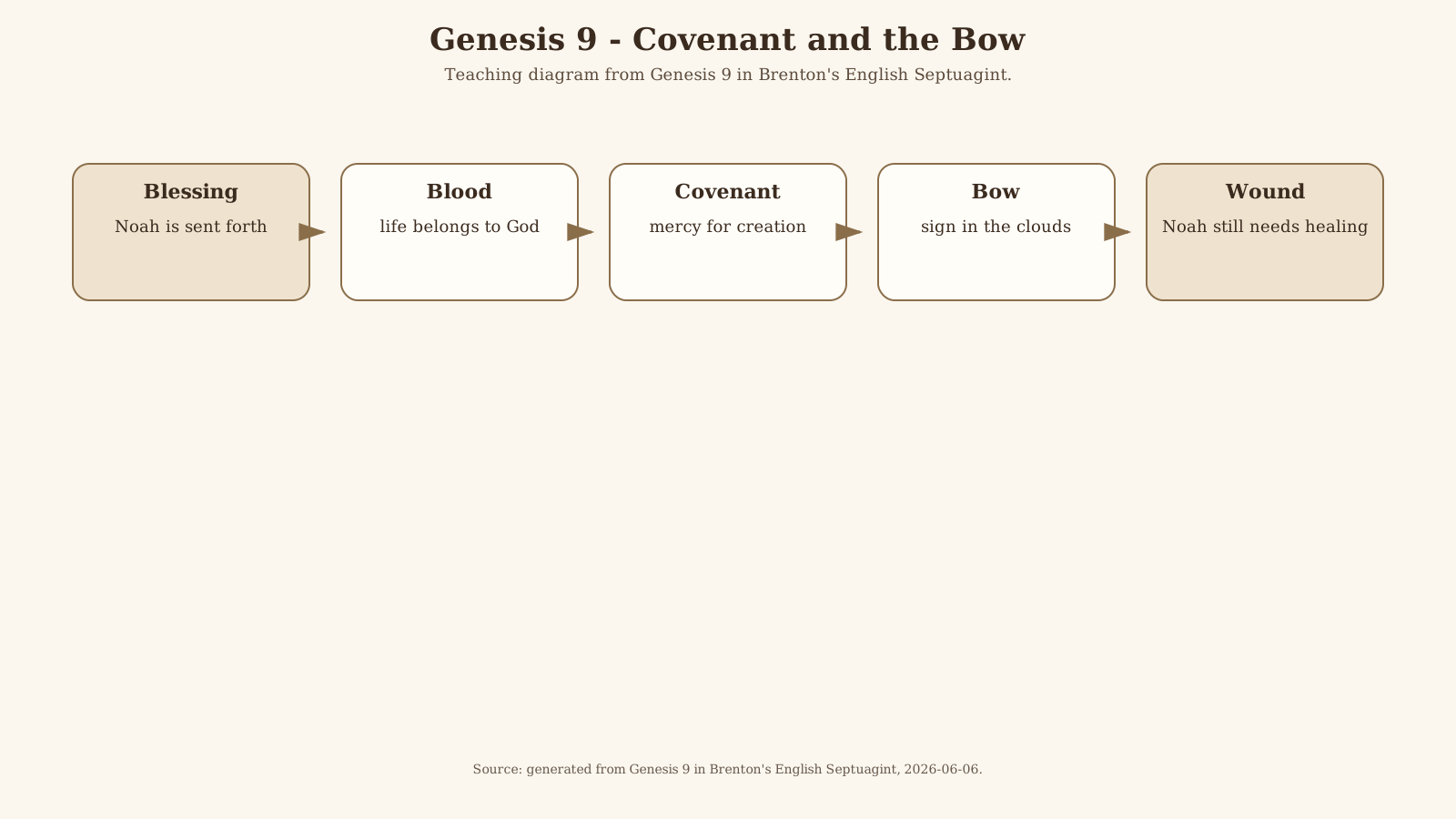 Source: created for this guide from Genesis 9 covenant bow in Brenton’s English Septuagint, 2026-06-06.
Historical and Scriptural Context
Genesis 9 echoes Genesis 1:26-30. Blessing, fruitfulness, and dominion are spoken again, but now within a fallen world. The relation between man and the creatures is marked by fear. Meat is permitted, but blood is forbidden. The earth’s corruption before the flood has already been described in Genesis 6:5-13; after it, God still speaks of the evil bent of the human heart in Genesis 8:21. The waters have changed the world without making humanity sinless.
The covenant with Noah is universal in scope. It is made with Noah, his descendants, the living creatures, and the earth itself. We must not hurry past these creatures as scenery around a human story. God names them as recipients of His promise. The earth on which we live is not disposable, and the lives entrusted to our care are not merely instruments of our convenience.
The last part of the chapter prepares for Genesis 10 and the spread of the nations. The naming of Canaan matters for the wider biblical story, but the passage must never be turned into a racial myth or a defense of slavery.
Blessing returns, but paradise does not (Genesis 9:1-3)
1 And God blessed Noe and his sons, and said to them, Increase and multiply, and fill the earth and have dominion over it. 2 And the dread and the fear of you shall be upon all the wild beasts of the earth, on all the birds of the sky, and on all things moving upon the earth, and upon all the fishes of the sea, I have placed them under your power. 3 And every reptile which is living shall be to you for meat, I have given all things to you as the green herbs.
God blesses Noah and his sons with language that recalls Adam. The earth is still entrusted to man, and history is allowed to continue. Yet the new beginning is not a simple restoration of Eden. The creatures now fear man, and dominion is exercised in a world already scarred by sin.
Notice that blessing comes before the restrictions that follow. God does not begin by telling the survivors that nothing good can come of them. He gives them a future. But the permission to eat is a gift, not a declaration that appetite may rule. The next verses place a boundary around food and a far more searching boundary around the treatment of human life. To receive the world gratefully is also to accept that it is not ours without limit.
Blood and image make life sacred (Genesis 9:4-7)
4 But flesh with blood of life ye shall not eat. 5 For your blood of your lives will I require at the hand of all wild beasts, and I will require the life of man at the hand of his brother man. 6 He that sheds man’s blood, instead of that blood shall his own be shed, for in the image of God I made man. 7 But do ye increase and multiply, and fill the earth, and have dominion over it.
Blood signifies life, and life belongs to God. That is why blood may not be treated casually. When the text turns to human blood, the argument becomes even stronger: man bears the image of God. Violence against human life is therefore never trivial. The passage teaches moral seriousness, not private revenge. Verse 6 is severe: the taking of a human life calls for an answering judgment. It is not permission for an injured person to become an avenger, nor does this brief passage settle every question of criminal punishment.
The reason given is striking. God does not say that man bears His image only before the fall, or only when he is righteous. He gives the image as the reason to guard human life in the very world where murder remains possible. The person we find difficult has not become less human. The sick, the dependent, and the person whose wrongdoing must be restrained are not beyond this reverence. Protection and accountability belong together.
The renewed command to increase in verse 7 surrounds this warning with the purpose of life, not death. Human power is to serve a future in which people may live. For Christians, Colossians 1:15 directs our gaze to Christ as the image of the invisible God. Reverence for the human person is not a rival to devotion to Him. It challenges the contradiction of worshiping Christ while despising those who bear God’s image.
The Church’s Voice in Worship ⛪
The Katameros-derived Holy Pascha table places Genesis 6:5-9:7 as the first prophecy at the Ninth Hour of Tuesday of Holy Pascha. This includes Genesis 9:1-7, not the covenant bow or the vineyard scene.1 Within that reading, the flood story ends here with blessing and the guarding of life. Heard during Holy Pascha, this ending invites us to receive God’s mercy as a summons to guard the life of our neighbor.
The covenant reaches beyond Noah to all flesh (Genesis 9:8-17)
8 And God spoke to Noe, and to his sons with him, saying, 9 And behold I establish my covenant with you, and with your seed after you, 10 and with every living creature with you, of birds and of beasts, and with all the wild beasts of the earth, as many as are with you, of all that come out of the ark. 11 And I will establish my covenant with you and all flesh shall not any more die by the water of the flood, and there shall no more be a flood of water to destroy all the earth. 12 And the Lord God said to Noe, This is the sign of the covenant which I set between me and you, and between every living creature which is with you for perpetual generations. 13 I set my bow in the cloud, and it shall be for a sign of covenant between me and the earth. 14 And it shall be when I gather clouds upon the earth, that my bow shall be seen in the cloud. 15 And I will remember my covenant, which is between me and you, and between every living soul in all flesh, and there shall no longer be water for a deluge, so as to blot out all flesh. 16 And my bow shall be in the cloud, and I will look to remember the everlasting covenant between me and the earth, and between every living soul in all flesh, which is upon the earth. 17 And God said to Noe, This is the sign of the covenant, which I have made between me and all flesh, which is upon the earth.
God repeatedly names the covenant and repeatedly widens its reach. Noah is included, his seed is included, the animals are included, and the earth is included. The promise is not that judgment has vanished from history, but that the flood will not again erase the world. The bow in the cloud becomes the sign that mercy stands over the storm.
The repeated first-person promises carry the weight of the passage. God establishes, sets the sign, and remembers. Noah is not told to keep the earth alive by the strength of his own reassurance. In verses 15-16, the sign is even described in relation to God’s own remembrance and sight. This is not a picture of God needing relief from forgetfulness. It gives Noah a promise of faithful attention: the world’s continuance is held in God’s commitment, not in humanity’s power to make itself secure.
Nor is the promise an assurance that every storm will spare every household. Its stated scope is the preservation of all flesh from another destroying deluge. To tell a grieving person that this covenant guarantees freedom from disaster would ask the text to promise what it does not. Its consolation is more durable: human failure has not made God abandon His creation.
Gems from the Fathers 💎: The true Noah and the new birth
In a related baptismal reading of Noah’s dove, St. Cyril of Jerusalem looks beyond the rescued household toward Christ and His Church. He reports the interpretation as one held by some, not as the only possible meaning. He calls Christ “the true Noe, the Author of the second birth, who draws together into one the wills of all nations”2. The movement is from the preservation of a family to the gathering and renewal of people in Christ. Cyril is interpreting the dove and the flood, not identifying the rainbow itself as a sacrament.
This distinction helps us read the whole story Christianly without flattening it. In 1 Peter 3:20-22, the rescue of eight through water leads to Baptism, which saves through the resurrection of Jesus Christ. Baptism is not merely an outward escape or an encouraging symbol. The risen Christ gives the new life toward which Noah’s rescue points. The continuing need for watchfulness does not mean His gift is unreal; it means the life received is to be lived.
Noah’s vineyard becomes a place of weakness (Genesis 9:18-21)
18 Now the sons of Noe which came out of the ark, were Sem, Cham, Japheth. And Cham was father of Chanaan. 19 These three are the sons of Noe, of these were men scattered over all the earth. 20 And Noe began to be a husbandman, and he planted a vineyard. 21 And he drank of the wine, and was drunk, and was naked in his house.
Noah plants, drinks, and falls into drunkenness. Scripture does not hide the weakness of its righteous men. The point is not to erase Noah’s earlier faithfulness, but to show that a new outward beginning does not by itself heal the passions. After deliverance, vigilance is still required.
The change of scale is unsettling. The man who survived a world-destroying flood becomes vulnerable in his own house. Public courage and private watchfulness are not interchangeable. We can endure a long crisis and then neglect the quieter habits by which we remain sober, truthful, and attentive to those near us. The text tells us what Noah did, not why he drank or what he knew about wine. Neither an invented excuse nor a contemptuous verdict helps us receive its warning.
Gems from the Fathers 💎: Faith before visible reassurance
St. John Chrysostom, preaching on Hebrews 11:7, emphasizes Noah’s trust before the threatened events could be seen. His point concerns Noah’s earlier obedience, not an excuse for the drunkenness narrated here. He describes faith as the disposition that receives God’s word as reliable: “For this is the [part] of a soul sincerely disposed towards Him and judging nothing more reliable than His words, just as Unbelief is the very contrary.”3
Noah’s earlier faith and his later weakness must both remain in view. A fall does not make every earlier act of obedience fraudulent; earlier obedience does not make a later fall harmless. For us, remembering mercy should lead to a humbler return to prayer and repentance, not confidence that temptation is now beneath us.
Ham exposes, while Shem and Japheth cover (Genesis 9:22-24)
22 And Cham the father of Chanaan saw the nakedness of his father, and he went out and told his two brothers without. 23 And Sem and Japheth having taken a garment, put it on both their backs and went backwards, and covered the nakedness of their father; and their face was backward, and they saw not the nakedness of their father. 24 And Noe recovered from the wine, and knew all that his younger son had done to him.
Ham turns his father’s shame into a report. Shem and Japheth refuse that spirit. They walk backward and cover Noah without gazing on his nakedness. The moral contrast is not between ethnic groups, but between dishonor and reverent restraint. The brothers do not claim that their father is clothed when he is not. They take a garment and meet his need. Mercy is not an alternative description of the problem; it is a different way of approaching the person.
There is a quiet echo of Genesis 3:21, where God clothes Adam and his wife after their disobedience. Here the brothers’ garment restores dignity without making Noah’s drunkenness good. The connection is a way of reading the two scenes together, not an explanation stated by the narrator. It asks something practical of us: when another person’s weakness becomes known, are we looking for an audience or for the help that person needs?
Covering shame never means concealing abuse, suppressing truthful testimony, or protecting an offender from accountability. A child, survivor, or witness must not be told to remain silent in order to honor a parent, priest, or other authority. Seek immediate safety when there is danger, report abuse or suspected abuse to the appropriate civil and safeguarding authorities, and comply with reporting duties. The dignity of the harmed person comes first; truthful disclosure to those who can protect and act is not Ham’s contempt. Refusing gossip and reporting harm are compatible acts of love.
Verse 24 says that Noah knew what his younger son had done to him, but does not describe any further act beyond the seeing and telling already narrated. We should not build a detailed account of an unrecorded violation. The explicit contrast is already searching enough: one son circulates the humiliation; two sons act to relieve it. Nor does the story tell us that Noah’s recovery from wine was itself repentance. Sobriety makes truthful reckoning possible; it is not the whole of healing.
Noah’s words open future history (Genesis 9:25-29)
25 And he said, Cursed be the servant Chanaan, a slave shall he be to his brethren. 26 And he said, Blessed be the Lord God of Sem, and Chanaan shall be his bond-servant. 27 May God make room for Japheth, and let him dwell in the habitations of Sem, and let Chanaan be his servant.
28 And Noe lived after the flood three hundred and fifty years. 29 And all the days of Noe were nine hundred and fifty years, and he died.
Canaan is named in Noah’s curse, while Shem is linked to the blessing of the Lord and Japheth to enlargement and dwelling in Shem’s habitations. These words open toward the later biblical story. The chapter then ends with Noah’s death, reminding us that the world has been preserved, but not yet fully healed.
The curse is a hard word, and the passage does not explain why it falls on Canaan rather than on Ham. Its words concern Canaan, not every descendant of Ham; they say nothing about skin color. At the opening of the chapter, God blessed Noah and his sons. Nothing here gives Christians a command to enslave a people, assign inherited moral worth to an ethnicity, or deny the image of God in anyone. The chapter’s own universal reverence for human life forbids reading its conclusion as a license for racial contempt.
Verse 26 also directs attention away from the greatness of a family toward its God: the blessing names the Lord God of Shem. In verse 27, enlargement is joined to dwelling, not merely possession. These words invite a Christian reading of room being made within God’s household, but we should not confuse that typology with a proof that any modern nation has superior status.
Gems from the Fathers 💎: Room in the household
St. Augustine reads Japheth’s enlargement and dwelling in Shem’s habitations as a figure of the nations dwelling in Christ’s churches.4 This is an ecclesial interpretation, concerning the Church, not a division of human beings into permanent racial ranks. We need not adopt every detail of his larger allegory to receive that particular insight.
Ephesians 2:11-22 gives the Christian reality its fuller expression: those once far off are brought near through Christ’s blood, reconciled in one body through the Cross, and made members of God’s household. This gathering is not a change of masters from one ethnicity to another. It is reconciliation in Christ. A parish that welcomes a stranger but still makes him feel permanently inferior has not yet allowed that peace to shape its common life.
Spiritual Fruit 🍇
Receive a future without pretending you are already healed. If a crisis has passed, thank God for the reprieve. Then ask what habits need care now that urgency no longer holds them in place. Keep a modest rule of prayer, speak honestly in confession, and accept needed help rather than allowing yesterday’s courage to become today’s excuse. Where drinking has become dangerous or compulsive, seek medical and addiction support as well as pastoral care. Noah’s vineyard calls for watchfulness, not shame that drives a struggling person further into secrecy.
Let the image of God interrupt contempt. Think of someone whose dependence, failure, or different background has made you impatient. Do not begin by trying to feel warmly toward that person. Begin with a concrete act of reverence: listen without mockery, protect a vulnerable person’s safety, or refuse a joke that makes another’s humiliation entertaining. Accountability remains necessary where harm has been done. It need not be carried out with hatred.
Take up the garment, not the audience. Before forwarding a humiliating story or image, stop. If someone needs protection, bring the truth to those responsible for safeguarding and justice. If no such purpose is served, refuse the pleasure of spreading it. Love can speak firmly to the right person while remaining silent before the merely curious. For those harmed by abuse, seeking protection and telling the truth are not failures of reverence.
Make room in the household. Notice who stands at the edge of parish life because of language, poverty, disability, or unfamiliarity. Offer companionship without making the person a project or demanding gratitude. The welcome described in Ephesians is not simply permission to enter a building. It is belonging in Christ.
The chapter leaves us with both a bow in the cloud and a garment in the house. One tells us that God has not abandoned the earth; the other shows a small, costly mercy human hands can offer. We cannot make ourselves the world’s savior. We can receive the life Christ gives, repent where we have harmed it, and care for the person placed before us.
Lord Jesus Christ, renew in us the life You give in Baptism. Guard us from contempt, steady us after mercy, and teach us to protect the vulnerable without delighting in another’s shame. Make our homes and our parish places of truth, repentance, and welcome. Amen.
Teaching Notes
Blessing returns, but paradise does not (Genesis 9:1-3)
- Ask: Why does God renew blessing while humanity remains wounded?
- Emphasize: Covenant mercy sustains creation after judgment.
- Watch for: Avoid sentimentalizing the rainbow apart from covenant and judgment.
- Connect: Connect Noah’s covenant to God’s patience and the healing prepared in Christ.
- Show: Use the covenant-bow diagram to show renewed blessing after the flood.
Blood and image make life sacred (Genesis 9:4-7)
- Ask: Why must human life be guarded?
- Emphasize: Human dignity rests on the image of God.
- Watch for: Do not reduce this to generic social ethics detached from creation.
- Connect: Read Colossians 1:15 alongside the reverence for human life in Genesis 9:6. The Katameros-derived Pascha appointment includes only Genesis 9:1-7, not the bow.
- Show: Point to the diagram’s image/blood movement.
The covenant reaches beyond Noah to all flesh (Genesis 9:8-17)
- Ask: Why does God speak about all flesh and future generations?
- Emphasize: God’s mercy is wider than one household.
- Watch for: The promise excludes another universal deluge; it does not guarantee that a household will never suffer disaster.
- Connect: Connect all flesh to the later gathering of the nations.
- Show: Show how the bow marks mercy for creation.
Noah’s vineyard becomes a place of weakness (Genesis 9:18-21)
- Ask: Why does the story move from covenant sign to family shame?
- Emphasize: Mercy after disaster does not automatically heal the passions.
- Watch for: Do not excuse Noah’s drunkenness or exploit it.
- Connect: Distinguish Noah’s deliverance from the new birth given in Baptism through Christ’s resurrection (1 Peter 3:20-22). Watchfulness receives grace; it does not replace it.
- Show: Use this scene as a sober contrast to the covenant sign.
Ham exposes, while Shem and Japheth cover (Genesis 9:22-24)
- Ask: What is the difference between exposing shame and covering it in love?
- Emphasize: Love protects dignity without pretending sin is harmless.
- Watch for: Covering shame never means suppressing abuse reports or truthful testimony. Safety, reporting duties, and accountability take priority over protecting a reputation.
- Connect: Connect covering shame to mercy, repentance, and the household of faith.
- Show: Use the family-line movement carefully without ethnic contempt.
Noah’s words open future history (Genesis 9:25-29)
- Ask: How do Noah’s words point beyond the immediate family scene?
- Emphasize: The nations remain under God’s providence and moral order.
- Watch for: Do not turn typology into contempt for peoples.
- Connect: Connect Japheth in the tents of Shem to the Gentiles welcomed into faith.
- Show: Point from the family scene toward the nations table that follows.
Sources
Embedded Scripture is from Brenton’s English Septuagint (LXX).
Genesis 9, Brenton’s English Septuagint. Biblical parallels discussed: Genesis 1:26-30; Genesis 3:21; Genesis 6:5-13; Genesis 8:21; 1 Peter 3:20-22; Colossians 1:15; Ephesians 2:11-22; Hebrews 11:7.
St. John Chrysostom, Homilies on Hebrews, Homily XXIII, §§1, 3. Noah’s faith and the blessings still to come.
St. Cyril of Jerusalem, Catechetical Lectures, XVII.10. The flood and dove in relation to Christ, Baptism, and the Church.
St. Augustine, The City of God, XVI.2. The particular interpretation of Japheth’s enlargement as the nations dwelling in Christ’s churches.
Covenant-bow schematic:
assets/genesis-9-covenant-bow-diagram-lxx.svg, created for this guide from Genesis 9.
Footnotes
-
Katameros-derived Holy Pascha table, Tuesday, Ninth Hour, first prophecy, Genesis 6:5-9:7. This witness derives from the pierresaid Katameros table; it has not been independently confirmed against Coptic Reader. ↩
-
St. Cyril of Jerusalem, Catechetical Lectures, XVII.10, NPNF, Second Series, vol. 7, English translation revised by E. H. Gifford, Noah’s dove and the true Noah. ↩
-
St. John Chrysostom, Homilies on Hebrews, Homily XXIII, §1, on Hebrews 11:7, NPNF, First Series, vol. 14, Oxford translation revised by Frederic Gardiner, Noah’s faith. ↩
-
St. Augustine, The City of God, XVI.2, trans. Marcus Dods, NPNF, First Series, vol. 2, the enlargement of the nations in Christ’s churches. ↩