


Abram lets Lot choose first because his future is entrusted to God. That freedom is tested when Lot is carried away captive and Sodom’s king offers the spoils of victory. Yielding land does not remove the duty to rescue; rescuing others does not remove the need to guard the heart. Between rescue and reward stands Melchizedek, bringing loaves, wine, and blessing. God’s promise becomes freedom to make peace, show mercy without keeping score, and receive success without becoming its servant.
From Egypt to the priestly blessing
Genesis 12 ended with Sarai endangered and Abram rebuked by Pharaoh. Now he returns to his first altar, and faith must become truthful in relationships and possessions. His later name, Abraham, is used in the New Testament.
Chapters 13 and 14 belong together: separation creates the situation to which rescue responds. Promise, captivity, blessing, and refusal examine what makes a person secure. Genesis 15 takes this deeper: after victory and renunciation, Abram still has no son through whom the promise can continue.
Bethel and Ai, Brenton’s Bæthel and Aggai, recall the earlier tent and altar. The watered Jordan region attracts Lot; Abram settles by Mamre at Hebron, Brenton’s Mambre and Chebrom. The war carries the story toward Dan and Damascus. The narrator identifies the salt valley with the sea of salt.
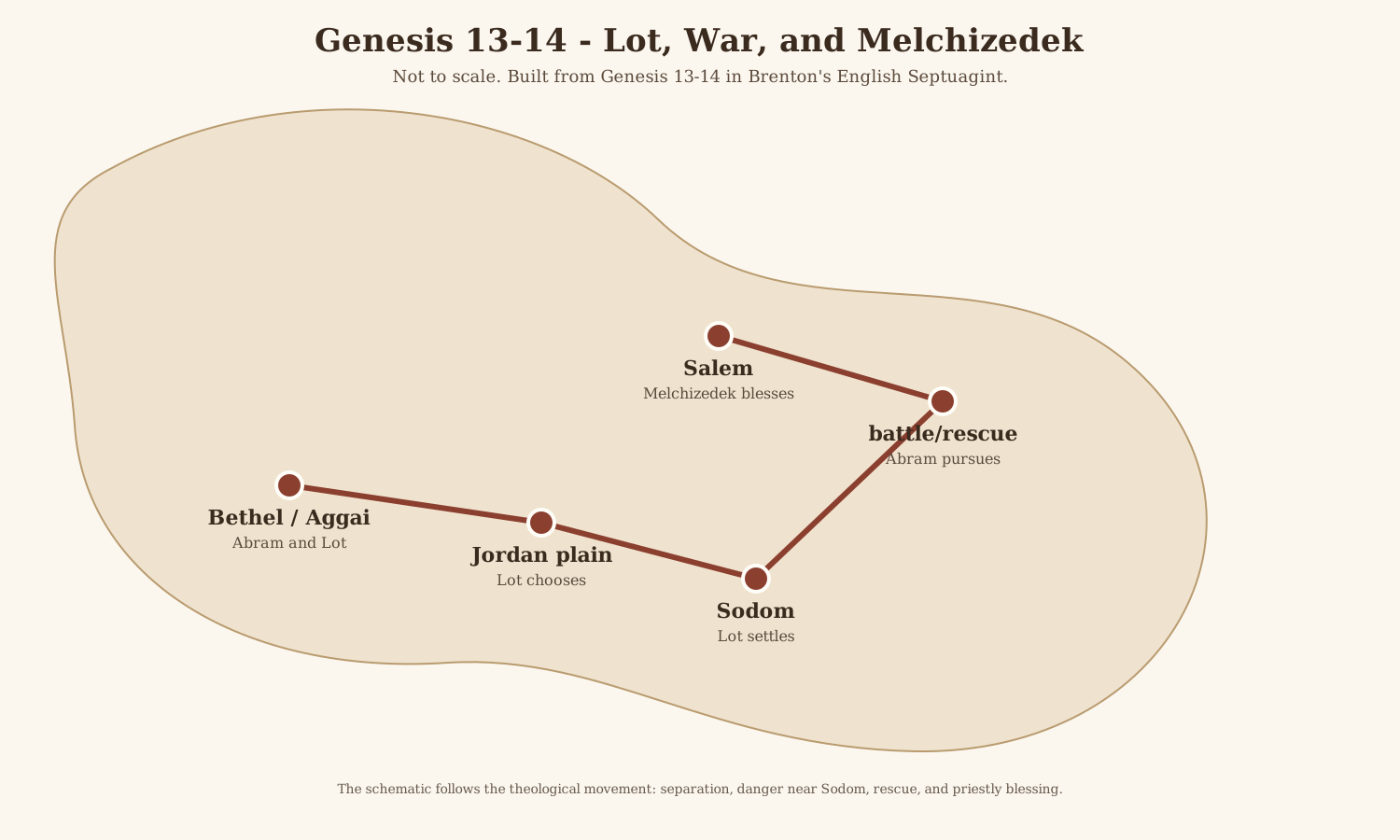 Original narrative schematic based on Genesis 13-14, Brenton LXX; not a geographical map or travel itinerary.
Returning to the place of prayer (Genesis 13:1-4)
1 And Abram went up out of Egypt, he and his wife, and all that he had, and Lot with him, into the wilderness. 2 And Abram was very rich in cattle, and silver, and gold. 3 And he went to the place whence he came, into the wilderness as far as Bæthel, as far as the place where his tent was before, between Bæthel and Aggai, 4 to the place of the altar, which he built there at first, and Abram there called on the name of the Lord.
Abram returns with the household that has come through danger. His wealth is placed beside a return to worship. Egypt has shown how material benefit can accompany moral failure: he was treated well while Sarai was taken into Pharaoh’s house. Riches cannot interpret his soul for us. The revealing fact is that he calls on the Lord.
Verse 4 records prayer, not an explicit confession. Yet the place of earlier communion is still open to the man whose conduct has been rebuked. Mercy makes renewed prayer possible, and truthful prayer must reach the conduct by which others were harmed.
For someone avoiding prayer out of shame, this return offers hope. In the Church, confession gives return truthful form: we name the wrong, receive forgiveness, and undertake amendment. Abram’s earlier altar helps us recognize the difference between hiding from God and letting God restore us.
Making peace and choosing what the eyes desire (Genesis 13:5-13)
5 And Lot who went out with Abram had sheep, and oxen, and tents. 6 And the land was not large enough for them to live together, because their possessions were great; and the land was not large enough for them to live together. 7 And there was a strife between the herdmen of Abram’s cattle, and the herdmen of Lot’s cattle, and the Chananites and the Pherezites then inhabited the land. 8 And Abram said to Lot, Let there not be a strife between me and thee, and between my herdmen and thy herdmen, for we are brethren. 9 Lo! is not the whole land before thee? Separate thyself from me; if thou goest to the left, I will go to the right, and if thou goest to the right, I will go to the left. 10 And Lot having lifted up his eyes, observed all the country round about Jordan, that it was all watered, before God overthrew Sodom and Gomorrha, as the garden of the Lord, and as the land of Egypt, until thou come to Zogora. 11 And Lot chose for himself all the country round Jordan, and Lot went from the east, and they were separated each from his brother. And Abram dwelt in the land of Chanaan. 12 And Lot dwelt in a city of the neighbouring people, and pitched his tent in Sodom. 13 But the men of Sodom were evil, and exceedingly sinful before God.
The difficulty begins with abundance. Both households possess more than the land can sustain together. Verse 6 repeats the limitation; verse 7 reminds us that other peoples inhabit the land. The disagreement has a practical cause that must be addressed, rather than disguised as somebody else’s bad character.
Abram addresses Lot before the herdsmen’s strife becomes their own rupture. Although Lot is his nephew, their brotherhood matters more than pasture. The elder and bearer of the promise offers him first choice. He relinquishes an advantage without relinquishing God’s word. He also proposes separation: peace sometimes requires a changed arrangement rather than enforced closeness while resentment grows.
This generosity is freely chosen. It must never compel an injured person to surrender protection, livelihood, or lawful boundaries. Abram provides for both households. His example can mean surrendering the need to win every point while still agreeing on responsibilities clearly.
Lot lifts his eyes to a landscape compared with the garden of the Lord and the land of Egypt. The descriptions make its attraction intelligible: abundant water promises sustenance. Yet the narrator supplies what a view of fertile land cannot reveal, the grave wickedness of Sodom and its coming overthrow. The danger is a narrowed judgment that sees prosperity vividly while moral surroundings become secondary.
Second Peter 2:7-8 calls Lot righteous and describes his torment at the lawless deeds around him. Sodom’s evil is not his complete identity. Genesis nevertheless exposes a perilous choice: a righteous person can make decisions that wound him and his household. Discernment asks what an attractive opportunity will require of the soul and the habits that sustain faith. A larger income cannot answer that question alone.
Seeing the land at God’s word (Genesis 13:14-18)
14 And God said to Abram after Lot was separated from him, Look up with thine eyes, and behold from the place where thou now art northward and southward, and eastward and seaward; 15 for all the land which thou seest, I will give it to thee and to thy seed for ever. 16 And I will make thy seed like the dust of the earth; if any one is able to number the dust of the earth, then shall thy seed be numbered. 17 Arise and traverse the land, both in the length of it and in the breadth; for to thee will I give it, and to thy seed for ever. 18 And Abram having removed his tent, came and dwelt by the oak of Mambre, which was in Chebrom, and he there built an altar to the Lord.
Lot has lifted his eyes and chosen for himself. Now, after the separation, God tells Abram to look. Both men see land, but Abram’s sight is governed by a promise spoken to him. Faith is not blindness to the visible world. It is learning to receive the visible world under God’s word instead of allowing its immediate attractions to determine our hope.
The renewed promise embraces land and descendants. Dust beyond counting is promised while the son is still awaited. Abram has yielded first choice, yet God’s gift remains. This particular assurance is no financial rule that every generous act returns a larger property. Christian generosity rests on God’s faithfulness even when its earthly cost remains.
Abram is commanded to walk the inheritance before possessing its fulfillment. He moves his tent to Mamre and builds an altar. The promise gives ground for obedience and thanksgiving now, though the future remains beyond his control. Prayer sustains waiting.
Galatians 3:29 describes those belonging to Christ as Abraham’s seed and heirs; Hebrews 11:9-16 reads the patriarchs’ tents in the light of a heavenly country. Land and family belong to the history through which salvation comes. Christian fulfillment is belonging to Christ and receiving God’s enduring home, never a permission to seize a neighbor’s land.
The fertile plain becomes a place of captivity (Genesis 14:1-12)
1 And it came to pass in the reign of Amarphal king of Sennaar, and Arioch king of Ellasar, that Chodollogomor king of Elam, and Thargal king of nations, 2 made war with Balla king of Sodom, and with Barsa king of Gomorrha, and with Sennaar, king of Adama, and with Symobor king of Seboim and the king of Balac, this is Segor. 3 All these met with one consent at the salt valley; this is now the sea of salt. 4 Twelve years they served Chodollogomor, and the thirteenth year they revolted. 5 And in the fourteenth year came Chodollogomor, and the kings with him, and cut to pieces the giants in Astaroth, and Carnain, and strong nations with them, and the Ommæans in the city Save. 6 And the Chorrhæans in the mountains of Seir, to the turpentine tree of Pharan, which is in the desert. 7 And having turned back they came to the well of judgment; this is Cades, and they cut in pieces all the princes of Amalec, and the Amorites dwelling in Asasonthamar. 8 And the king of Sodom went out, and the king of Gomorrha, and king of Adama, and king of Seboim, and king of Balac, this is Segor, and they set themselves in array against them for war in the salt valley, 9 against Chodollogomor king of Elam, and Thargal king of nations, and Amarphal king of Sennaar, and Arioch king of Ellasar, the four kings against the five. 10 Now the salt valley consists of slime-pits. And the king of Sodom fled and the king of Gomorrha, and they fell in there: and they that were left fled to the mountain country. 11 And they took all the cavalry of Sodom and Gomorrha, and all their provisions, and departed. 12 And they took also Lot the son of Abram’s brother, and his baggage, and departed, for he dwelt in Sodom.
The rulers’ names lead to a clear explanation: twelve years of service, revolt in the thirteenth, invasion in the fourteenth. Four kings sweep through the region before confronting five allied rulers. Lot’s household stands inside events larger than his own choices. The fertile settlement offers no shelter from imperial power.
The defeated kings flee; provisions and captives are carried away. Verse 12 returns us to the family: Lot is taken because he dwelt in Sodom. We can trace this consequence without claiming that every captive deserved captivity. The women and people later rescued have their own dignity. Discernment must never become an excuse to blame victims of war or exploitation.
Brenton reads “cavalry” in verses 11 and 16 and “horses” in verse 21. These unusual terms are retained. Provisions, possessions, and captured people show the broader concern: a community has been stripped and carried away. These English terms alone cannot support a theory about the armies or Abram’s reward.
Lot has gained a desirable place and lost his freedom. We cannot foresee every danger, but we can refuse to let apparent advantage silence moral judgment. Even then, we depend on mercy. News of captivity now reaches the relative Lot has left behind.
The peacemaker goes after the captive (Genesis 14:13-16)
13 And one of them that had been rescued came and told Abram the Hebrew; and he dwelt by the oak of Mamre the Amorite the brother of Eschol, and the brother of Aunan, who were confederates with Abram. 14 And Abram having heard that Lot his nephew had been taken captive, numbered his own home-born servants three hundred and eighteen, and pursued after them to Dan. 15 And he came upon them by night, he and his servants, and he smote them and pursued them as far as Choba, which is on the left of Damascus. 16 And he recovered all the cavalry of Sodom, and he recovered Lot his nephew, and all his possessions, and the women and the people.
Abram hears that his nephew has been taken and acts. The separation has changed their dwelling places without extinguishing their bond. The man who would not quarrel over pasture now pursues a powerful coalition to recover his kin. His earlier yielding was therefore the freedom of a person able to act, not indifference disguised as meekness.
The home-born servants, night attack, and pursuit show practical readiness. Mamre, Eschol, and Aunan are Abram’s confederates; the closing verses recognize their portion. Trust employs preparation and others’ help. Abram neither waits for Lot to earn rescue nor rehearses his earlier choice against him.
Verse 16 expands the result beyond one relative: the women and the people are recovered as well. This is the measure of the action. The story leads toward restored persons, not a celebration of Abram’s power. Its battlefield setting does not authorize private vengeance or religious violence. Christian readers must keep the rescue’s purpose distinct from any claim that their own enemies may be attacked in God’s name.
Abram’s merciful rescue helps us recognize Christ, who enters our mortal condition to free us from sin and death. The comparison concerns deliverance, not an identification of salvation with military force. Those rescued by Christ learn to seek another’s restoration. A relative’s repeated mistakes may require boundaries; they cannot erase the person’s dignity or make bitterness the judge of every request for help.
Blessing, loaves, and wine (Genesis 14:17-20)
17 And the king of Sodom went out to meet him, after he returned from the slaughter of Chodollogomor, and the kings with him, to the valley of Saby; this was the plain of the kings. 18 And Melchisedec king of Salem brought forth loaves and wine, and he was the priest of the most high God. 19 And he blessed Abram, and said, Blessed be Abram of the most high God, who made heaven and earth, 20 and blessed be the most high God who delivered thine enemies into thy power. And Abram gave him the tithe of all.
Two kings meet Abram. Sodom’s king appears first, but his offer waits while Melchizedek blesses. Before reward defines victory, the priest names its giver: the Most High God, Maker of heaven and earth, delivered the enemies into Abram’s power. The successful man stands as a receiver before God.
Melchizedek, king of Salem and priest of the Most High God, brings loaves and wine, blesses Abram, and blesses God. Abram gives a tenth of all, acknowledging an authority he has not created by winning. This gift neither purchases blessing nor supplies a complete rule of Christian stewardship. The bearer of promises still receives through another.
Christ, the priest who always lives
Hebrews 7:1-3 reads Melchizedek’s name as “king of righteousness” and Salem as “king of peace.” His genealogy, birth, and death are absent from Genesis. He is “made like the Son of God,” a type: an earlier person or event pointing toward fulfillment in Christ. Melchizedek points toward the Son, whose eternal priesthood is the reality.
Melchizedek need not be literally parentless or Christ appearing in disguise. Hebrews 7:24-25 gives the saving consequence: Christ continues forever, His priesthood is unchangeable, and He always intercedes for those who come to God through Him. Our access rests on the living Savior, rather than an earthly protector or our latest religious performance.
Gems from the Fathers 💎: Righteousness and peace fulfilled in Christ
St. John Chrysostom, preaching on Hebrews 7, explains how the names become realities in Christ. Melchizedek bears the titles; the Lord actually makes us righteous and reconciles us to God. Chrysostom asks, ‘What man is “King of Righteousness and of Peace”? None, save only our Lord Jesus Christ.’1 In the same homily he explains that Melchizedek had parents and died; these facts are simply absent from the recorded account. Christ’s eternity, by contrast, belongs to who He is. The type and its fulfillment are related without being collapsed into one person.
Christ heals our estrangement from God and forms a life that can make peace with others. Communion with the King of peace must bear fruit in the way we treat our brother.
Gems from the Fathers 💎: Bread and wine looking toward the Eucharist
Eusebius of Caesarea connects Genesis 14 with the eternal priesthood of Psalm 110:4, LXX Psalm 109:4, and the Eucharist. In Proof of the Gospel V.3, he writes that the Lord and His priests “perform the spiritual sacrifice according to the customs of the Church, and with wine and bread darkly express the mysteries of His Body and saving Blood.”2 Here “darkly” describes the sacramental expression of the mysteries through bread and wine in the Church’s worship. Eusebius places that worship within the pattern first shown by Melchizedek.
This is genuine early Christian Eucharistic typology. Genesis records loaves, wine, priesthood, and blessing, not the Christian rite’s institution or celebration. In the Eucharist, Christ gives His Body and Blood and the Church receives communion with the enduring High Priest. The earlier figures open toward that fullness. Abram has labored for another’s rescue; he still needs to receive life from God.
The Church’s Voice in Worship ⛪
The Coptic Holy Pascha places Genesis 14:17-20 at the Ninth Hour of Great Thursday, as the third Old Testament reading. The Holy Pascha Katameros prints the priest-king’s meeting with Abram under that exact hour.3 On the day of the Lord’s Supper, the Church hears of loaves, wine, priesthood, and blessing before contemplating their fulfillment in Christ. This joins the reading to worship without claiming that all of Genesis 13-14 is assigned at that hour.
Refusing a reward that would claim the promise (Genesis 14:21-24)
21 And the king of Sodom said to Abram, Give me the men, and take the horses to thyself. 22 And Abram said to the king of Sodom, I will stretch out my hand to the Lord the most high God, who made the heaven and the earth, 23 that I will not take from all thy goods from a string to a shoe-latchet, lest thou shouldest say, I have made Abram rich. 24 Except what things the young men have eaten, and the portion of the men that went with me, Eschol, Aunan, Mambre, these shall take a portion.
Abram’s answer repeats Melchizedek’s divine title: the Most High God, Maker of heaven and earth. Worship now governs his dealings with power. With a solemn declaration, he refuses even the smallest item that would let Sodom’s king claim to have made him rich.
Abram already owns much. He refuses a particular patron’s claim, not created goods themselves. Patronage may carry expectations of allegiance or obligation; here another ruler could claim to be the source of God’s promised future. Some generous-looking offers purchase silence or influence. Their cost is what they require us to surrender.
The final verse is as important as the refusal. Abram allows for the food consumed and the shares of his allies. His personal renunciation does not cancel another person’s due. Holy detachment cannot be financed by denying workers their wages, dependents their necessities, or companions their agreed share. The rich man refusing gain remains responsible for people who have served alongside him. Generosity and justice belong together.
Gems from the Fathers 💎: Humility with a free and courageous heart
In his first homily on First Corinthians, St. John Chrysostom joins Abram’s peace with Lot and refusal of spoils to distinguish greatness from arrogance: “he is indeed exalted who is truly humble; (not the flatterer nor the dissembler;) for true greatness is one thing, and arrogance another.”4 A dissembler conceals his intention; the humble person is neither false nor servile.
Abram yields, rescues, receives blessing, and refuses compromising gain. Each action can grow from a heart that no longer needs possessions or admiration to establish its worth. Humility gives courage the purpose of love and renunciation the discipline of justice.
Spiritual Fruit 🍇
Return to prayer truthfully. If shame has made you postpone confession or avoid the Liturgy, speak to your father of confession, restore a neglected time of prayer, and name the wrong you must amend. Like Abram returning to the altar, begin again through mercy. Let renewed worship make you more truthful with those you have injured.
Let brotherhood weigh more than first choice. Before a household or parish decision becomes a contest of dignity, remember Abram’s appeal to kinship. Identify an advantage you can freely yield and a responsibility you must protect. Seek a clear, peaceful arrangement, praying for freedom to hear another person’s needs without treating them as threats to your worth.
Recover sight before accepting an attractive future. When considering a job, move, or profitable association, examine its demands on honesty, worship, family presence, and care for others. Bring the actual terms to prayer and wise counsel. Lot’s choice warns us against letting advantage become the only thing we see.
Help without keeping the old argument alive. Choose an act that addresses a real need of someone whose decisions have frustrated you: arranging support, sharing a meal, or helping secure safety. Mercy neither finances destructive behavior nor requires exposure to abuse. It refuses the satisfaction of abandoning a person to the consequences. Seek restoration rather than vindication.
Receive Christ’s gift and keep your freedom for service. Approach the Eucharist with repentance and thanksgiving, bringing failures and achievements before the living High Priest. Examine any reward quietly purchasing your conscience. If you decline it, preserve the rights of those entrusted to you. Christ’s enduring intercession gives a steadier foundation than a patron’s approval.
Abram stands before the priest-king with the promise unfinished. We too come to Christ with unfinished obedience. Lord Jesus Christ, our eternal High Priest, free our hearts from greed, make us courageous in mercy, and teach us to receive Your peace and give it to our neighbors. Amen.
Teaching Notes
Central teaching burden: God’s promise frees Abram to yield, rescue, receive, and refuse. Keep these actions together. The schematic follows narrative sequence, not physical routes.
Returning to the place of prayer (Genesis 13:1-4)
- Ask: Why does the return to Abram’s earlier altar tell us more about his spiritual direction than the wealth he brings from Egypt?
- Watch for: Verse 4 records invocation, not an explicit confession; connect return with truthful amendment without inventing Abram’s unrecorded words.
Making peace and choosing what the eyes desire (Genesis 13:5-13)
- Ask: What does Lot see clearly, what does the narrator add, and how does Abram’s appeal to brotherhood change the response to the shortage of land?
- Watch for: Read 2 Peter 2:7-8 before assigning Lot a fixed villain’s identity. Freely chosen generosity must not become pressure on a vulnerable person to abandon safety or necessities.
Seeing the land at God’s word (Genesis 13:14-18)
- Ask: How do the two acts of looking differ, and why does Abram build an altar before the promise has become possession?
- Watch for: Avoid prosperity guarantees and modern territorial entitlement. Hebrews 11:9-16 and Galatians 3:29 direct Christian hope toward God’s inheritance in Christ.
The fertile plain becomes a place of captivity (Genesis 14:1-12)
- Ask: How does the sequence of service, revolt, invasion, and capture change the apparent security of Lot’s choice?
- Watch for: Trace the narrative consequence without blaming every victim of war. Preserve Brenton’s “cavalry” and “horses” without treating these English words as sufficient military evidence.
The peacemaker goes after the captive (Genesis 14:13-16)
- Ask: What does Abram’s action reveal about the difference between making peace and becoming indifferent to another person’s bondage?
- Watch for: Keep the rescue’s purpose central and reject authorization for private vengeance. Mercy can work with wise boundaries and appropriate help.
Blessing, loaves, and wine (Genesis 14:17-20)
- Ask: What does Melchizedek’s blessing say about victory, and how does Hebrews 7:24-25 make Christ’s priesthood good news for someone coming to God today?
- Watch for: Distinguish the historical priest-king, the literary absence of genealogy, and Christ’s eternal reality. Eusebius supplies a Eucharistic typological reading, not evidence that Genesis describes the Christian rite. The verified Pascha assignment covers these four verses only.
Refusing a reward that would claim the promise (Genesis 14:21-24)
- Ask: Why does Abram refuse his own reward while explicitly preserving the consumed provisions and his allies’ shares?
- Watch for: Detachment is neither contempt for creation nor permission to renounce other people’s rights. Name the actual obligations attached to a proposed gift before calling it compromising patronage.
Sources
Embedded Scripture is from Brenton’s English Septuagint (LXX). New Testament references and brief quotations use NKJV.
Genesis 12:10-20; Genesis 13:1-18; Genesis 14:1-24; Genesis 15:1-6. Brenton’s Genesis 13 🔗 and Genesis 14 🔗.
2 Peter 2:7-9; Galatians 3:29; Hebrews 11:9-16; Hebrews 7:1-10, 24-25. Lot’s righteousness, inheritance, and priesthood in Christ.
St. John Chrysostom, Homilies on Hebrews, Homily XII, §§2-3, on Hebrews 7:1-3; NPNF, First Series, vol. 14 🔗.
Eusebius of Caesarea, Proof of the Gospel V.3, translated by W. J. Ferrar (1920), pp. 241-242, on Melchizedek, eternal priesthood, and Eucharistic figures 🔗.
St. John Chrysostom, Homilies on First Corinthians, Homily I, §5, using Genesis 13:8 and 14:21-24 as examples of humble greatness; NPNF, First Series, vol. 12, Oxford translation revised by Talbot W. Chambers 🔗.
St. Mary Coptic Orthodox Church, Ottawa, Holy Pascha Katameros, English edition, printed p. 409, “The Ninth Hour of Great Thursday,” Genesis 14:17-20 🔗.
Footnotes
-
St. John Chrysostom, Homilies on Hebrews, Homily XII, §2; NPNF, First Series, vol. 14 🔗. Quotation punctuation follows the translated text; §3 distinguishes unrecorded human genealogy from Christ’s eternity. ↩
-
Eusebius of Caesarea, Proof of the Gospel V.3, translated by W. J. Ferrar (1920), p. 242 🔗. ↩
-
Holy Pascha Katameros, English edition, printed p. 409, St. Mary Coptic Orthodox Church, Ottawa: Genesis 14:17-20, Ninth Hour of Great Thursday 🔗. ↩
-
St. John Chrysostom, Homilies on First Corinthians, Homily I, §5; NPNF, First Series, vol. 12, Oxford translation revised by Talbot W. Chambers 🔗. ↩