


Abraham has received Isaac back alive, yet the next chapter brings a loss from which no angel intervenes to spare him. Sarah dies. The promise remains, but the woman who shared his wandering must be buried. Abraham rises from mourning to secure a place for her body in the land God has promised; afterward, his servant travels to seek a wife for Isaac. The final sentence returns to the first sorrow: Isaac loves Rebekah and receives comfort after Sarah’s death. God’s fidelity carries the household through bereavement.
These chapters follow Isaac’s binding in Genesis 22 and prepare the next generation’s life in Genesis 25. Brenton’s Sarrha, Abraam, Rebecca, Chebron, and Chanaan correspond to Sarah, Abraham, Rebekah, Hebron, and Canaan; the explanation uses familiar names while retaining the biblical wording.
Geographical Significance ⛰️
Sarah is buried near Hebron, opposite Mamre, within Canaan. The servant goes to Mesopotamia, to Nahor’s city, and returns toward Isaac in the south. The directions matter: Abraham’s relatives can supply a bride, but Isaac must remain in the land to which God called his father.
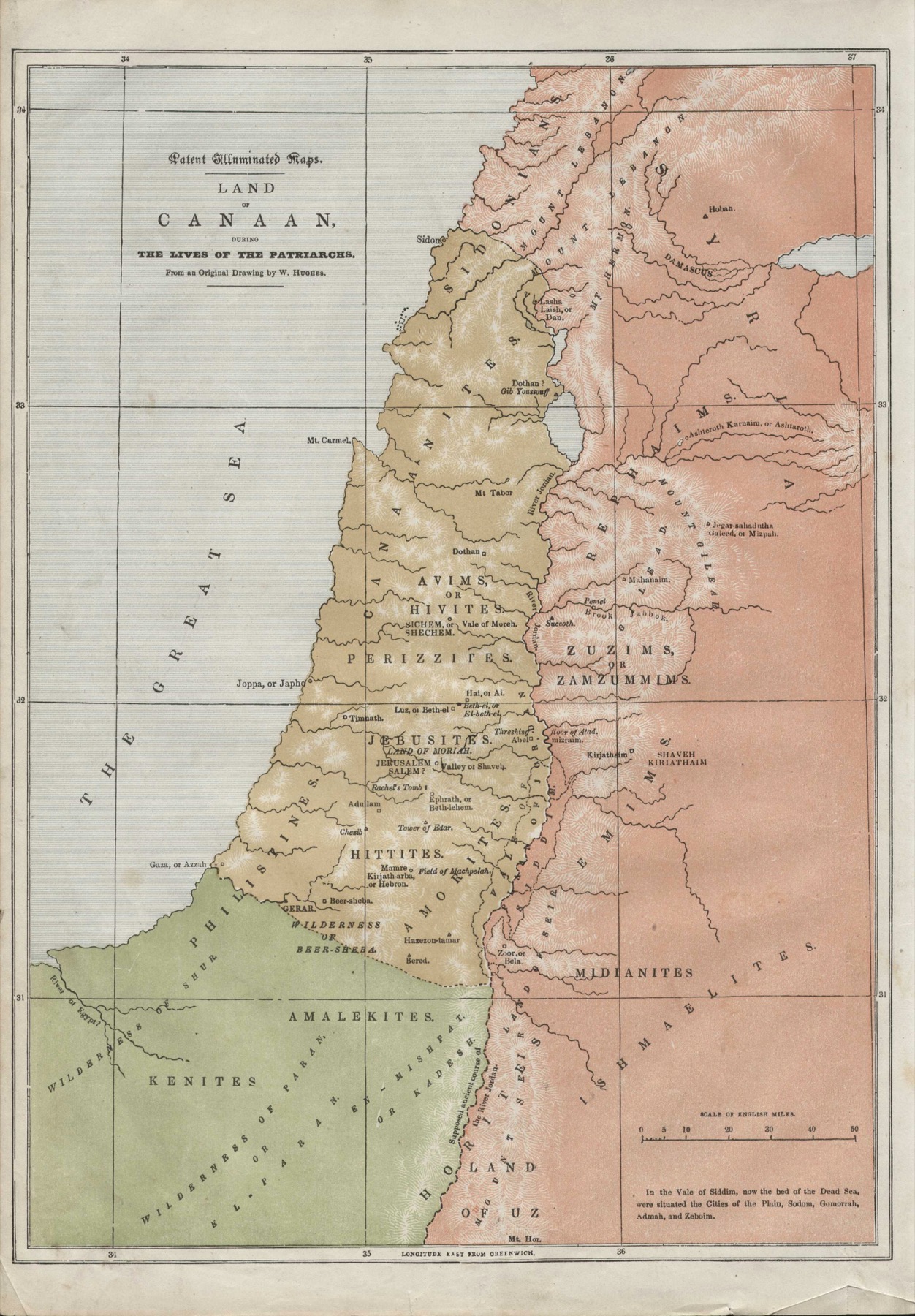 Historical map after W. Hughes, possibly 1838; National Library of Israel, Eran Laor Cartographic Collection; public domain. Source 🔗.
This nineteenth-century map helps locate the household’s life in Canaan; it is neither an archaeological reconstruction nor proof of the servant’s exact route.
Tears within the promise (Genesis 23:1-6)
1 And the life of Sarrha was an hundred and twenty-seven years. 2 And Sarrha died in the city of Arboc, which is in the valley, this is Chebron in the land of Chanaan; and Abraam came to lament for Sarrha and to mourn. 3 And Abraam stood up from before his dead; and Abraam spoke to the sons of Chet, saying, 4 I am a sojourner and a stranger among you, give me therefore possession of a burying-place among you, and I will bury my dead away from me. 5 And the sons of Chet answered to Abraam, saying, Not so, Sir, 6 but hear us; thou art in the midst of us a king from God; bury thy dead in our choice sepulchres, for not one of us will by any means withhold his sepulchre from thee, so that thou shouldest not bury thy dead there.
Sarah’s one hundred and twenty-seven years receive their own notice before the negotiation begins. Her death is the loss of a person, not simply a transition in the genealogy. Abraham comes “to lament for Sarrha and to mourn.” The father of the faithful has tears. Genesis gives no cause of death and never calls it punishment for the binding of Isaac.
Abraham then stands up “from before his dead.” His rising is an action grief requires, not evidence that grief has ended. A body needs burial; a widower must speak to strangers; sorrow has entered the world of land and public obligation. Faith may be seen in the difficult task performed while a person is still weeping. Necessary decisions may come before the heart is ready.
His request joins humility to love. He asks as a stranger and sojourner for a burial possession. The people honor him as “a king from God” and offer their best sepulchres. Dignity can coexist with dependence on others. At Lazarus’s grave, Christ weeps even though He will raise the dead (John 11:25-35). Tears and resurrection faith can dwell in the same heart.
A burial place secured in public (Genesis 23:7-16)
7 And Abraam rose up and did obeisance to the people of the land, to the sons of Chet. 8 And Abraam spoke to them, saying, If ye have it in your mind that I should bury my dead out of my sight, hearken to me, and speak for me to Ephron the son of Saar. 9 And let him give me the double cave which he has, which is in a part of his field, let him give it me for the money it is worth for possession of a burying-place among you. 10 Now Ephron was sitting in the midst of the children of Chet, and Ephron the Chettite answered Abraam and spoke in the hearing of the sons of Chet, and of all who entered the city, saying, 11 Attend to me, my lord, and hear me, I give to thee the field and the cave which is in it; I have given it thee before all my countrymen; bury thy dead. 12 And Abraam did obeisance before the people of the land. 13 And he said in the ears of Ephron before the people of the land, Since thou art on my side, hear me; take the price of the field from me, and I will bury my dead there. 14 But Ephron answered Abraam, saying, 15 Nay, my lord, I have heard indeed, the land is worth four hundred silver didrachms, but what can this be between me and thee? nay, do thou bury thy dead. 16 And Abraam hearkened to Ephron, and Abraam rendered to Ephron the money, which he mentioned in the ears of the sons of Chet, four hundred didrachms of silver approved with merchants.
Abraham bows and names Ephron’s cave at the edge of his field, asking to pay its value. Ephron publicly offers the field as well as the cave. Courtesy, repeated offers, and witnesses lead to the specified payment. Scripture discloses neither Ephron’s private intentions nor comparative prices that would establish an excessive sum. The visible point is the settlement’s public, paid character.
Language insight: “didrachms”
Brenton names “four hundred didrachms of silver approved with merchants.” The Greek term “didrachm” names a double-drachma unit.1 This is the translation’s monetary vocabulary, not proof of payment in minted Greek coins. Keep this rendering distinct from the “shekels” of a Hebrew-based translation. The merchant-approved silver makes the payment recognizable and accountable. Abraham’s faith in God’s gift of the land does not become a claim that he may take another person’s property without payment. A promised inheritance and a present obligation must both be honored.
Abraham’s repeated bowing guards his dignity from becoming entitlement. He accepts the ordinary means of establishing ownership. Funeral arrangements, debts, and inheritance can expose a family’s old resentments. His public dealings offer a different pattern: speak clearly, honor another’s property, and make the arrangement dependable for those who must live with it afterward.
A grave that does not surrender the future (Genesis 23:17-20)
17 And the field of Ephron, which was in Double Cave, which is opposite Mambre, the field and the cave, which was in it, and every tree which was in the field, and whatever is in its borders round about, were made sure 18 to Abraam for a possession, before the sons of Chet, and all that entered into the city. 19 After this Abraam buried Sarrha his wife in the Double Cave of the field, which is opposite Mambre, this is Chebron in the land of Chanaan. 20 So the field and the cave which was in it were made sure to Abraam for possession of a burying place, by the sons of Chet.
Field, cave, trees, and boundaries are named. The property is “made sure” before witnesses; then Sarah is buried. The concluding verse repeats that the field and cave are secured as a burial possession. Such legal detail holds love close to the earth. Abraham honors the body of the woman with whom he shared God’s promise. The first land acquisition Genesis records for him in Canaan is a place for the dead.
The promise of land stands beside the need to buy a grave. Hebrews 11:13-19 interprets the patriarchs’ heavenly hope and Abraham’s confidence that God could raise the dead. Its apostolic reading lets Christians receive this burial within resurrection hope, without claiming that Abraham already articulated every doctrine later revealed through Christ.
Gems from the Fathers 💎: Possession without captivity
St. John Chrysostom, in Homily XXIV on Hebrews 11:13-16, explicitly connects purchased burial places with the patriarchs’ strangerhood and desire for God’s city. He challenges our captivity to possessions: “The first virtue, yea the whole of virtue, is to be a stranger to this world, and a sojourner, and to have nothing in common with things here, but to hang loose from them, as from things strange to us”.2
Chrysostom also describes Abraham’s hospitality, mercy, and patience. Detachment frees him to care for Sarah without treating ownership as his salvation. Christian burial honors the departed body while entrusting the person to the risen Lord.
The Church’s Voice in Worship ⛪
Fr. Jacob Nadian’s Funeral Services, First Book: Laity prints Genesis 23:1-20 followed by Genesis 24:1-67 under “Funeral Services for Women during Passion Week.”3 The complete pairing lets mourners hear Sarah’s burial and the household’s later comfort within the same service. Sorrow is remembered while God’s fidelity opens a future.
Fidelity that leaves room for an honest refusal (Genesis 24:1-9)
1 And Abraam was old, advanced in days, and the Lord blessed Abraam in all things. 2 And Abraam said to his servant the elder of his house, who had rule over all his possessions, Put thy hand under my thigh, 3 and I will adjure thee by the Lord the God of heaven, and the God of the earth, that thou take not a wife for my son Isaac from the daughters of the Chananites, with whom I dwell, in the midst of them. 4 But thou shalt go instead to my country, where I was born, and to my tribe, and thou shalt take from thence a wife for my son Isaac. 5 And the servant said to him, Shall I carry back thy son to the land whence thou camest forth, if haply the woman should not be willing to return with me to this land? 6 And Abraam said to him, Take heed to thyself that thou carry not my son back thither. 7 The Lord the God of heaven, and the God of the earth, who took me out of my father’s house, and out of the land whence I sprang, who spoke to me, and who swore to me, saying, I will give this land to thee and to thy seed, he shall send his angel before thee, and thou shalt take a wife to my son from thence. 8 And if the woman should not be willing to come with thee into this land, thou shalt be clear from my oath, only carry not my son thither again. 9 And the servant put his hand under the thigh of his master Abraam, and swore to him concerning this matter.
Abraham is blessed “in all things,” though Sarah has died. Blessing can coexist with bereavement. He charges his elder household servant to seek Isaac’s wife among his kin. The chapter never names him; identification as Eliezer remains an inference. The hand-under-thigh gesture marks the solemn oath, but its precise symbolic meaning is not explained here.
Two conditions govern the errand: a bride is to come from Abraham’s family, and Isaac is not to return to the country Abraham left. Verse 7 explains the second through God’s call and promise of this land. The household’s future must answer that word. Abraham’s choice of kin belongs to this particular history of the covenant; it is no mandate for Christian ethnic endogamy, meaning marriage only within one’s ethnic group. Nor does the chapter claim that all his relatives are free from idolatry.
What if the woman will not come? Abraham releases the servant from his oath if she refuses. Confidence in God’s angel stands alongside a limit on human authority. Invoking God’s will to compel a marriage contradicts this safeguard. Faithfulness keeps the charge without seizing control of another’s answer.
The Church’s Voice in Worship ⛪
Genesis 24:1-9 is the first prophecy at the Ninth Hour of Wednesday of Holy Pascha. The accompanying exposition in the Ottawa Katameros of Holy Pascha connects Abraham’s household and oath with Christ’s coming from Abraham’s descendants.4 As the Passion approaches, this household’s future is heard within the history of the Incarnation: God prepares the Saviour’s human lineage. The exposition also recalls the servant’s release if the woman refuses. Covenant obedience and restraint before another’s freedom belong together.
A prayer answered through generous labor (Genesis 24:10-21)
10 And the servant took ten camels of his master’s camels, and he took of all the goods of his master with him, and he arose and went into Mesopotamia to the city of Nachor. 11 And he rested his camels without the city by the well of water towards evening, when damsels go forth to draw water. 12 And he said, O Lord God of my master Abraam, prosper my way before me to day, and deal mercifully with my master Abraam. 13 Lo! I stand by the well of water, and the daughters of them that inhabit the city come forth to draw water. 14 And it shall be, the virgin to whomsoever I shall say, Incline thy water-pot, that I may drink, and she shall say, Drink thou, and I will give thy camels drink, until they shall have done drinking—even this one thou hast prepared for thy servant Isaac, and hereby shall I know that thou hast dealt mercifully with my master Abraam. 15 And it came to pass before he had done speaking in his mind, that behold, Rebecca the daughter of Bathuel, the son of Melcha, the wife of Nachor, and the same the brother of Abraam, came forth, having a water-pot on her shoulders. 16 And the virgin was very beautiful in appearance, she was a virgin, a man had not known her; and she went down to the well, and filled her water-pot, and came up. 17 And the servant ran up to meet her, and said, Give me a little water to drink out of thy pitcher; 18 and she said, Drink, Sir; and she hasted, and let down the pitcher upon her arm, and gave him to drink, till he ceased drinking. 19 And she said, I will also draw water for thy camels, till they shall all have drunk. 20 And she hasted, and emptied the water-pot into the trough, and ran to the well to draw again, and drew water for all the camels. 21 And the man took great notice of her, and remained silent to know whether the Lord had made his way prosperous or not.
The servant brings ten camels and his master’s goods to Nahor’s city, waiting by the well at evening. Substantial preparation is joined to dependence: he asks God to prosper the errand and deal mercifully with Abraham. Even his appeal for success concerns the good of the person he serves.
His proposed sign involves a woman’s response to an ordinary request. Giving a stranger a drink is one kindness; offering to water all the camels is a larger, sustained act of hospitality. Rebekah’s beauty is acknowledged, yet the encounter lets us see her character through action. She hastens, empties the pitcher into the trough, runs back, and continues until the animals have drunk. She does this before knowing the household for which the man acts. Her generosity has not been purchased by an impressive introduction.
This prayer belongs to the narrated providence of this mission. It gives no general recipe for divination, where we demand that an arbitrary event decide whom to marry or what to do. Its moral insight is clearer: the servant seeks a person whose kindness becomes work. Neither does Rebekah’s labor prescribe every woman’s duties in marriage. Her act is freely offered hospitality, not a rule authorizing limitless demands on a wife.
Verse 21 arrests the speed of the scene. The servant notices her closely and remains silent, seeking to know whether the Lord has prospered his way. Prayer has not removed his need to attend. When we strongly desire an answer, the silence we resist may be what keeps desire from becoming certainty too soon. A promising encounter still requires truthful knowledge of the person and the circumstances.
Hospitality widens into thanksgiving (Genesis 24:22-33)
22 And it came to pass when all the camels ceased drinking, that the man took golden ear-rings, each of a drachm weight, and he put two bracelets on her hands, their weight was ten pieces of gold. 23 And he asked her, and said, Whose daughter art thou? Tell me if there is room for us to lodge with thy father. 24 And she said to him, I am the daughter of Bathuel the son of Melcha, whom she bore to Nachor. 25 And she said to him, We have both straw and much provender, and a place for resting. 26 And the man being well pleased, worshipped the Lord, 27 and said, Blessed be the Lord the God of my master Abraam, who has not suffered his righteousness to fail, nor his truth from my master, and the Lord has brought me prosperously to the house of the brother of my lord. 28 And the damsel ran and reported to the house of her mother according to these words. 29 And Rebecca had a brother whose name was Laban; and Laban ran out to meet the man, to the well. 30 And it came to pass when he saw the ear-rings and the bracelets on the hands of his sister, and when he heard the words of Rebecca his sister, saying, Thus the man spoke to me, that he went to the man, as he stood by the camels at the well. 31 And he said to him, Come in hither, thou blessed of the Lord, why standest thou without, whereas I have prepared the house and a place for the camels? 32 And the man entered into the house, and unloaded the camels, and gave the camels straw and provender, and water to wash his feet, and the feet of the men that were with him. 33 And he set before them loaves to eat; but he said, I will not eat, until I have told my errand. And he said, Speak on.
The servant gives jewelry and asks about Rebekah’s family and lodging. She is Bethuel’s daughter, of Nahor’s family, and there is provender and room. Kinship and welcome meet; he responds by worshipping the Lord before reporting success to anyone else.
Rebekah runs to her mother’s household. Laban sees the jewelry, hears her report, and comes to the well. His motive is unstated; later conduct should not supply an invented intention here. He offers lodging, provisions, water for the men’s feet, and food. Welcome becomes practical care.
The servant delays eating until he has explained his errand. Hospitality has opened the door, but the family must understand what he seeks. Generosity and candor belong together; gifts should not create obligations people have never knowingly accepted.
The blessing in verse 27 remembers God’s “righteousness” and “truth” toward Abraham. The servant sees more than favorable coincidence: the errand belongs within God’s enduring fidelity. Thanksgiving deepens when it remembers the Giver’s character alongside the desired outcome.
The whole account laid before the household (Genesis 24:34-49)
34 And he said, I am a servant of Abraam; 35 and the Lord has blessed my master greatly, and he is exalted, and he has given him sheep, and calves, and silver, and gold, servants and servant-maids, camels, and asses. 36 And Sarrha my master’s wife bore one son to my master after he had grown old; and he gave him whatever he had. 37 And my master caused me to swear, saying, Thou shalt not take a wife to my son of the daughters of the Chananites, among whom I sojourn in their land. 38 But thou shalt go to the house of my father, and to my tribe, and thou shalt take thence a wife for my son. 39 And I said to my master, Haply the woman will not go with me. 40 And he said to me, The Lord God to whom I have been acceptable in his presence, himself shall send out his angel with thee, and shall prosper thy journey, and thou shalt take a wife for my son of my tribe, and of the house of my father. 41 Then shalt thou be clear from my curse, for whensoever thou shalt have come to my tribe, and they shall not give her to thee, then shalt thou be clear from my oath. 42 And having come this day to the well, I said, Lord God of my master Abraam, if thou prosperest my journey on which I am now going, 43 behold, I stand by the well of water, and the daughters of the men of the city come forth to draw water, and it shall be that the damsel to whom I shall say, Give me a little water to drink out of thy pitcher, 44 and she shall say to me, Both drink thou, and I will draw water for thy camels, this shall be the wife whom the Lord has prepared for his own servant Isaac; and hereby shall I know that thou hast wrought mercy with my master Abraam. 45 And it came to pass before I had done speaking in my mind, straightway Rebecca came forth, having her pitcher on her shoulders; and she went down to the well, and drew water; and I said to her, Give me to drink. 46 And she hasted and let down her pitcher on her arm from her head, and said, Drink thou, and I will give thy camels drink; and I drank, and she gave the camels drink. 47 And I asked her, and said, Whose daughter art thou? tell me; and she said, I am daughter of Bathuel the son of Nachor, whom Melcha bore to him; and I put on her the ear-rings, and the bracelets on her hands. 48 And being well-pleased I worshipped the Lord, and I blessed the Lord the God of my master Abraam, who has prospered me in a true way, so that I should take the daughter of my master’s brother for his son. 49 If then ye will deal mercifully and justly with my lord, tell me, and if not, tell me, that I may turn to the right hand or to the left.
The long retelling makes the prayer and encounter something the household can hear. Abraham’s blessings, Isaac’s inheritance, the oath and its limits, Rebekah’s hospitality, and thanksgiving explain the request. The family is asked to enter a history, not obey an unexplained command.
“I am a servant of Abraam”: his first sentence gives his position. Wealth and gifts matter, but the account chiefly explains who Isaac is, why Abraham sent him, and how God guided the errand. Honest witness names the good received without making the witness indispensable.
The retelling is a summary rather than a verbatim replay. In the narrator’s account, jewelry is given before the question about Rebekah’s family in verses 22-23; in the servant’s account, the question is recounted before the jewelry in verse 47. The difference should be acknowledged. It supplies neither proof that every detail is chronologically identical nor grounds for accusing the servant of manipulation. The main events and purpose are faithfully presented while their telling is shaped for the listeners.
He requests an answer, favorable or unfavorable, so he can turn elsewhere if necessary. “God has guided me” leaves an honest answer possible. Testimony becomes dangerous when its spiritual force removes another person’s freedom to question, discern, or decline.
The household answers, and the servant bows (Genesis 24:50-54)
50 And Laban and Bathuel answered and said, This matter has come forth from the Lord, we shall not be able to answer thee bad or good. 51 Behold, Rebecca is before thee, take her and go away, and let her be wife to the son of thy master, as the Lord has said. 52 And it came to pass when the servant of Abraam heard these words, he bowed himself to the Lord down to the earth. 53 And the servant having brought forth jewels of silver and gold and raiment, gave them to Rebecca, and gave gifts to her brother, and to her mother. 54 And both he and the men with him ate and drank and went to sleep. And he arose in the morning and said, Send me away, that I may go to my master.
Laban and Bethuel acknowledge the Lord’s guidance and agree to the marriage. Their judgment follows the account they have heard. Providence is recognized through the charge, prayer, and encounter rather than a new oracle ordering every participant’s action.
The servant bows to the earth, receiving the answer as a gift rather than proof of his superiority. He gives gifts to Rebekah and her family; the travelers finally eat, drink, and rest. His earlier abstinence served the errand. Faithful service also knows when ordinary rest can be gratefully received.
Family agreement is recorded here; Rebekah’s voice follows when departure becomes disputed. Neither family enthusiasm nor certainty of divine guidance can authorize forced marriage. Authority must leave room for the person whose life will bear the decision.
“I will go”: a departure freely spoken (Genesis 24:55-61)
55 And her brethren and her mother said, Let the virgin remain with us about ten days, and after that she shall depart. 56 But he said to them, Hinder me not, for the Lord has prospered my journey for me; send me away, that I may depart to my master. 57 And they said, Let us call the damsel, and enquire at her mouth. 58 And they called Rebecca, and said to her, Wilt thou go with this man? and she said, I will go. 59 So they sent forth Rebecca their sister, and her goods, and the servant of Abraam, and his attendants. 60 And they blessed Rebecca, and said to her, Thou art our sister; become thou thousands of myriads, and let thy seed possess the cities of their enemies. 61 And Rebecca rose up and her maidens, and they mounted the camels and went with the man; and the servant having taken up Rebecca, departed.
Rebekah’s mother and family ask for about ten days before her departure. The servant requests release without delay because the Lord has prospered his errand. Then they call Rebekah and ask her directly whether she will go with him. Her reply is brief: “I will go.” The immediate issue is departure now after the requested delay, not a modern interview exhaustively documenting every aspect of marital consent. Nevertheless, Scripture makes her spoken willingness audible within a story whose opening oath already allowed the woman to refuse to come.
Blessed with hope for descendants and victory, Rebekah departs with her maidens. The woman who served at the well now leaves home for the son she has not met. Her willingness is a real response within God’s provision.
Gems from the Fathers 💎: The servant and the Church’s Bridegroom
St. John Chrysostom explicitly reads Abraham’s mission as a type, an earlier biblical event that anticipates a greater fulfillment, when preaching on Paul’s care for the Church in 2 Corinthians 11:1-2. The servant sent to seek Isaac’s bride illuminates prophets and apostles sent to bring people to Christ: “For he sent his faithful servant to seek a Gentile maiden in marriage; and in this case God sent His own servants to seek the Church in marriage for His son”.5
This bridal Church includes men and women, married and unmarried; its holiness is renewed fidelity to Christ. Chrysostom compares the servant to God’s messengers, without requiring a hidden meaning for every camel or identification with the Holy Spirit. Christian teaching brings people to the Son. Gathering dependence on oneself forgets the destination.
Love and comfort in Sarah’s household (Genesis 24:62-67)
62 And Isaac went through the wilderness to the well of the vision, and he dwelt in the land toward the south. 63 And Isaac went forth into the plain toward evening to meditate; and having lifted up his eyes, he saw camels coming. 64 And Rebecca lifted up her eyes, and saw Isaac; and she alighted briskly from the camel, 65 and said to the servant, Who is that man that walks in the plain to meet us? And the servant said, This is my master; and she took her veil and covered herself. 66 And the servant told Isaac all that he had done. 67 And Isaac went into the house of his mother, and took Rebecca, and she became his wife, and he loved her; and Isaac was comforted for Sarrha his mother.
Isaac appears near “the well of the vision,” recalling the well associated with Hagar in Genesis 16:13-14. The place brings God’s care for a distressed woman into the background of the household’s next beginning. The verse does not narrate an encounter with Hagar or explain Isaac’s reasons for going there. The connection is an echo of mercy, not permission to supply a missing episode.
Isaac goes into the plain “to meditate” toward evening. Quiet contemplation belongs within this chapter of traveling, speaking, and work. He lifts his eyes toward the camels; Rebekah lifts hers toward him. She alights, asks his identity, and veils herself. The servant’s report completes his trust: the account has reached the son.
Brenton says Isaac goes into the “house of his mother”; the familiar Hebrew-based rendering “tent of Sarah” should not replace that quotation. Rebekah becomes his wife, he loves her, and he is comforted for Sarah. The new bond receives a place in the household’s remembered sorrow. A wife is not a replacement mother or a remedy assigned to cure her husband’s grief. Isaac’s love and comfort are gifts within marriage, while Sarah remains named at its beginning.
Ephesians 5:25-32 gives Christian bridal interpretation its sure center: Christ loves the Church and gives Himself for her, sanctifying and nourishing her. Isaac, received figuratively from death in Hebrews 11:19, now receives a bride; Christians can read this sequence toward the crucified and risen Bridegroom without equating the patriarch with Christ in every detail. Its fulfillment deepens the literal marriage rather than making the two persons disappear. Every Christian spouse must be loved as a person entrusted to one’s care, never used as an illustration while being neglected in daily life.
Spiritual Fruit 🍇
Give grief its truthful voice. Abraham laments before he negotiates. Bring the departed’s name and your actual sorrow before Christ, asking for repose and strength for the next necessary duty. Help a grieving family with a meal, transport, paperwork, or quiet company without demanding that tears cease. The Lord who wept at Lazarus’s grave can receive a broken prayer.
Make care dependable. Field, cave, trees, payment, and witnesses express love’s practical obligations. Review a postponed responsibility: funeral arrangements, a debt, a promise, or an elderly relative’s care. Seek counsel and make the next honest arrangement. Reverence becomes care someone can rely on; resurrection hope strengthens that responsibility.
Pray without making your desire an oracle. The servant prays and attends in silence. Before a consequential decision, name your hope to God, examine character and facts, and seek sober counsel. A striking coincidence or another person’s confidence cannot settle every question. Ask Christ to preserve you from anxious paralysis and certainty that refuses correction.
Leave room for another person’s answer. Abraham allows release from the oath; Rebekah’s household enquires at her mouth. Ask questions you can bear to have answered honestly. Listen without punishment, public pressure, or spiritual threats. If authority has made refusal unsafe, repentance requires changing the conditions, not simply asking again. Service to the Son must honor the person you hope to help.
Keep mercy alive after the decisive day. Rebekah serves before knowing the stranger’s name; Isaac loves after her arrival. Continue an uncelebrated kindness: help someone exhausted, visit a grieving person after the crowds have gone, or keep a household duty without resentment. Receive help where you need it. This family’s future includes generosity and consolation; Christian love learns to give and receive.
Abraham has laid Sarah’s body in the cave, and Isaac lifts his eyes toward the approaching camels. The promised future comes to a household that still remembers its dead. We too can stand before Christ with love unfinished and sorrow still present. Lord Jesus Christ, give rest to our departed, keep our dealings truthful, and lead our homes into the freedom and mercy of Your risen life.
Teaching Notes
Tears within the promise (Genesis 23:1-6)
- Ask: What does Abraham’s lament permit a grieving believer to bring before God?
- Watch for: Genesis gives no cause of Sarah’s death and does not call it punishment for the binding of Isaac.
A burial place secured in public (Genesis 23:7-16)
- Ask: How do the witnesses and merchant-approved payment make Abraham’s care for Sarah dependable?
- Watch for: Keep Brenton’s didrachms; do not infer Ephron’s motives or an inflated price from an unsupported comparison.
A grave that does not surrender the future (Genesis 23:17-20)
- Ask: How do the burial possession and Hebrews 11 together keep grief, responsibility, and hope in view?
- Watch for: Heavenly citizenship must deepen mercy rather than excuse neglect of earthly obligations.
Fidelity that leaves room for an honest refusal (Genesis 24:1-9)
- Ask: Why does Abraham forbid Isaac’s return while releasing the servant if the woman refuses to come?
- Watch for: The unnamed servant, ancient oath, and kinship requirement do not establish an ethnic marriage rule or authorize coercion.
A prayer answered through generous labor (Genesis 24:10-21)
- Ask: What does Rebekah’s freely offered labor reveal that an impressive introduction could not?
- Watch for: This narrated sign is neither a universal decision-making formula nor a prescription for a wife’s unlimited service.
Hospitality widens into thanksgiving (Genesis 24:22-33)
- Ask: Why does the servant worship before presenting his errand, then insist on explaining it before eating?
- Watch for: Laban’s observation of the jewelry is recorded; a hidden motive is not stated here.
The whole account laid before the household (Genesis 24:34-49)
- Ask: What makes a report of God’s help an honest witness rather than pressure for agreement?
- Watch for: The jewelry and family question are narrated in different orders in verses 22-23 and 47; retelling is not a verbatim chronology.
The household answers, and the servant bows (Genesis 24:50-54)
- Ask: How does the servant’s bow after agreement guard him from taking credit for the outcome?
- Watch for: Family agreement is narrated here; it must not erase Rebekah’s voice or justify forced marriage.
“I will go”: a departure freely spoken (Genesis 24:55-61)
- Ask: How do Rebekah’s answer and the oath’s release clause shape the way we exercise spiritual influence?
- Watch for: Verse 58 concerns departure after a requested delay; distinguish its actual context from a modern comprehensive consent procedure.
Love and comfort in Sarah’s household (Genesis 24:62-67)
- Ask: How can a new bond give comfort while preserving love and memory for someone who has died?
- Watch for: A spouse is not a replacement parent. Bridal typology serves the persons’ dignity and Christ’s self-giving love.
Visual and worship use: Locate Hebron and the southern region on the historical map, then contrast the servant’s outward journey with Abraham’s insistence that Isaac remain in Canaan. The verified Pascha reading is Genesis 24:1-9, not the entire paired study. The full pairing is printed for women’s funerals during Passion Week in Fr. Jacob Nadian’s service book; its heading does not establish a universal funeral reading or specify a burial-site-only placement.
Sources
Embedded Scripture is from Brenton’s English Septuagint (LXX). New Testament references follow NKJV.
Lancelot C. L. Brenton, The Septuagint Version of the Old Testament, Genesis 23-24.
Hebrews 11:13-19; John 11:25-35; Ephesians 5:25-32: patriarchal hope, resurrection, and Christ’s bridal love.
St. John Chrysostom, Homilies on Hebrews, Homily XXIV, §§1 and 4, NPNF1, vol. 14: the pilgrim heart and the purchase of burial places. 🔗
St. John Chrysostom, Homilies on Second Corinthians, Homily XXIII, on 2 Corinthians 11:1-2, NPNF1, vol. 12: an explicit Christian interpretation of Abraham’s bridal mission. 🔗
St. Mary Coptic Orthodox Church, Ottawa, Katameros of Holy Pascha, Wednesday Ninth Hour: Genesis 24:1-9, printed pp. 315-316; accompanying exposition, pp. 327-328. The printed prophecy and exposition establish the stated Pascha placement. 🔗
Fr. Jacob Nadian, Funeral Services, First Book: Laity, St. Bishoy Coptic Orthodox Church of Toronto: “Funeral Services for Women during Passion Week,” pp. 100-105, printing both chapters in full. 🔗
Land of Canaan, during the lives of the Patriarchs, after W. Hughes, possibly 1838; National Library of Israel, Eran Laor Cartographic Collection, via Wikimedia Commons. Historical cartography, public domain. 🔗
Footnotes
-
Strong’s Greek 1323, “δίδραχμον,” including Thayer’s lexical entry. 🔗. ↩
-
St. John Chrysostom, Homilies on Hebrews, Homily XXIV, §1, NPNF1, vol. 14 (1889), Oxford translation revised by Frederic Gardiner. 🔗. ↩
-
Fr. Jacob Nadian, Funeral Services, First Book: Laity, “Funeral Services for Women during Passion Week,” pp. 100-105. 🔗. ↩
-
Katameros of Holy Pascha, St. Mary Coptic Orthodox Church, Ottawa, Wednesday Ninth Hour, printed pp. 315-316 and 327-328. 🔗. ↩
-
St. John Chrysostom, Homilies on Second Corinthians, Homily XXIII, on 2 Corinthians 11:1-2, translated by the Rev. J. Ashworth; Oxford translation revised with additional notes by Talbot W. Chambers, NPNF1, vol. 12 (1889). 🔗. ↩