


This narration is from a previous version of the study and may include a combined recording of multiple chapters.
Israel has left Egypt, but Egypt has not ceased to attract Israel. The people have received deliverance, a covenant, and the Lord’s dwelling among them. They still need to learn how to trust Him when food becomes familiar, another person’s calling becomes painful, or the promised land looks dangerous. Numbers tells the truth about life after grace has already begun. It also tells the truth about God: He judges rebellion, hears intercession, gives water to the thirsty, and prepares an inheritance beyond the failure of the generation that first set out.
The book between deliverance and inheritance
The Greek Septuagint title, “Arithmoi,” means “Numbers”; the Hebrew title, “Bemidbar,” means “In the wilderness.” The two names belong together. God counts a people who must learn to live with Him on the road. Their households, duties, gifts, and inheritance matter, but the ordered camp cannot supply the trust that the heart withholds.
Numbers continues Exodus and Leviticus and prepares for Deuteronomy and Joshua. It begins at Sinai in the second year after the exodus and ends in the plains of Moab, at Jordan by Jericho, before the crossing. The account does not give a diary of every wilderness year. Laws, speeches, censuses, journeys, and remembered events stand together. Chapters 7 and 9 return to the first month of the second year, earlier than the second-month census in 1:1. Worship and preparation help explain the journey; they are not interruptions of its meaning.
Two censuses give the book a large-scale shape. Chapter 1 counts the fighting men of the generation that came from Egypt; chapter 26 counts the people being prepared for inheritance after the wilderness judgments. Dennis T. Olson emphasizes this two-generation structure, as Terence E. Fretheim explains in his review of Olson’s Numbers.1 The final chapters answer questions that a new generation must face: who will lead, how worship will continue, how promises will be kept, and how land will sustain both justice and belonging. The second census is therefore more than a replacement roster. The promise has survived the people’s refusal.
Read Israel’s history with reverence. St. Paul speaks of Israel’s experiences as warnings for the baptized Church in 1 Corinthians 10:1-13. He does not give Christians a place from which to mock Israel. He calls those who have received holy gifts to watch their own consent to sin. The Christian reader stands inside the warning and inside the mercy.
The six sections below lead through 35 chapter studies covering all 36 chapters. Chapters 28-29 remain together as one festal calendar; each other chapter has its own study.
Reading the verse numbers and the wording
Numbering convention: The studies follow NKJV chapter and verse numbering for their scope and references. Embedded Scripture is from Brenton’s English Septuagint (LXX), and its source verse labels are retained. Where the frames differ, NKJV comes first, followed by the Brenton reference in parentheses. A note directly before each affected reading explains how to find its contents. The short quotations in this Introduction are selected anchors, not substitutes for the complete chapter readings.
A different verse label can mark the same words; a different tribal order can move whole units; a wording difference can remain even where the labels agree. These must be distinguished. The following guide identifies the principal frame differences encountered in the series:
| NKJV scope | Brenton frame or order | What the reader should expect |
|---|---|---|
| Numbers 1:20-43 | Gad follows Benjamin at Brenton 1:36-37 rather than appearing third at NKJV 1:24-25. | The Judah-through-Benjamin entries appear two verses earlier in Brenton. Match the tribe, not just the verse number. |
| Numbers 10:34-36 | NKJV orders cloud, departure prayer, rest prayer; Brenton orders departure prayer, rest prayer, cloud. | Moses’ two prayers are NKJV 10:35-36 (Brenton 10:34-35). Brenton 10:36 is the cloud, not the second prayer. |
| Numbers 12:16; 13:1-33 | The departure from Hazeroth is Brenton 13:1; the spies’ account is Brenton 13:2-34. | The Numbers 12 study includes the departure with an explicit source-chapter label. In Numbers 13, the renaming is NKJV 13:16 (Brenton 13:17). The eBible transcription uses 12:16 and 13:1-33 for these same contents; the studies retain that wording while identifying the original Brenton frame. |
| Numbers 16:36-50 | Brenton 17:1-15 | The censers and Aaron’s intercession complete the Numbers 16 study. Brenton starts its next chapter with the command about the censers. Nothing is lost at the boundary. |
| Numbers 17:1-13 | Brenton 17:16-28 | The Numbers 17 study begins with the tribal rods, not with the earlier plague. The budding is NKJV 17:8 (Brenton 17:23). |
| Numbers 21:19-22 | Brenton gathers NKJV 21:19-20 into 21:19, then begins the request to Sihon at 21:20. | NKJV 21:21 is Brenton 21:20; NKJV 21:22 is divided across Brenton 21:21-22. The labels agree again from verse 23. |
| Numbers 26:5-51 | Tribal order and some figures differ. Gad follows Zebulun in Brenton; Asher precedes Joseph rather than following Dan. | Brenton 26:28 corresponds to NKJV 26:44 by the Asher family entry. The chapter study gives the complete comparison. Both editions print 601,730 as the total, but Brenton’s listed tribal figures do not add to that total. |
| Numbers 27:3-8 | Brenton 27:3 contains NKJV 27:3-4; Brenton 27:4-6 corresponds to NKJV 27:5-7; Brenton 27:7-8 divides NKJV 27:8. | God’s affirmation of the daughters is NKJV 27:7 (Brenton 27:6). The labels agree again from verse 9. |
| Numbers 28:29-31 | The final clauses of the feast-of-Weeks offerings are divided differently. | The complete unit has the same limits; follow the actual clauses rather than assuming each internal label marks an identical sentence. |
| Numbers 29:40 | Brenton 30:1 | Moses’ report of the offering commands closes the Numbers 28-29 study, with Brenton’s chapter 30 clearly named. |
| Numbers 30:1-16 | Brenton 30:2-17 | The vow laws begin one verse later because Brenton 30:1 contains the preceding offering conclusion. Internally, Brenton 30:4 combines NKJV 30:3 with the first part of 30:4; Brenton 30:5 completes NKJV 30:4. The chapter offset therefore does not make every internal verse an exact counterpart. |
These comparisons describe the editions’ actual contents and divisions. They do not supply an otherwise unverified account of why a scribe, translator, or editor produced a particular difference. Nor should an English contrast automatically become a claim about every Greek manuscript. Significant wording differences, including service ages, census figures, and the language of purification, are explained beside the passages where they matter.
Numbers 1-10: A people gathered around the Lord
Selected reading: Numbers 2:17; Brenton 2:17. The verse label agrees in both frames.
17: And then the tabernacle of witness shall be set forward, and the camp of the Levites shall be between the camps; as they shall encamp, so also shall they commence their march, each one next in order to his fellow according to their companies.
The center of the camp travels with the people. Chapters 1 and 2 count and arrange the tribes; chapters 3 and 4 distinguish the Levites’ responsibilities and the care required in carrying holy things. Their places are gifts and charges, not competing measures of personal worth. The Lord’s nearness requires reverence, and the coverings and assigned duties protect the people who approach Him. A holy boundary is meant to preserve life, not to nourish someone’s importance.
Chapter 5 brings holiness into injury, restitution, and the troubling ordeal of an accused wife. Chapter 6 gives the Nazirite’s consecration and ends with the priestly blessing. The ancient ordeal is not a Christian practice or permission to test, humiliate, or control a spouse. As the series encounters severe laws and judgments, it keeps their historical setting distinct from the commands given to the Church in Christ.
The remaining preparations deserve their own hearing. Chapter 7 names the tribal offerings one by one before Moses hears the Lord’s voice. Chapter 8 orders the lamps and prepares the Levites as a gift to the Lord. Chapter 9 provides a second Passover for the genuinely hindered and teaches the camp to wait or move with the cloud. Chapter 10 gives the silver trumpets and brings the ordered people onto the road. Worship, preparation, mercy, and obedience belong to one life. The ministers serve the Lord; the people follow a Presence they cannot arrange around their preferences.
The Passover bones left unbroken in 9:12 prepare for the Gospel’s witness to Christ in John 19:36. The tabernacle’s central place also helps us hear John 1:1-18: the eternal Word truly comes to dwell among us. These are connections of fulfillment, not instructions to reproduce the wilderness sanctuary in every detail.
The Church’s Voice in Worship ⛪
The Coptic reading index records two passages, Numbers 4:1-16 and 4:17-33, for the Consecration of a Church, under Special > Consecrations > Church > Part 2. These entries derive from Coptic Reader but are not marked as confirmed appointments in the consulted reference. They should be understood at that level of confidence.2 As a reflection, their account of covering and carrying holy things helps us receive a consecrated church with reverence: its vessels are entrusted for the Lord’s worship, never made available for our self-display.
Studies in this section
- Numbers 1 - Census and the Guarded Sanctuary
- Numbers 2 - The Camp Around the Tabernacle
- Numbers 3 - Levites and the Ransom of the Firstborn
- Numbers 4 - Carrying the Holy Things
- Numbers 5 - Cleansing the Camp and Restitution
- Numbers 6 - Nazirites and the Priestly Blessing
- Numbers 7 - Tribal Offerings for the Altar
- Numbers 8 - Lamps and Levite Consecration
- Numbers 9 - Second Passover and the Cloud
- Numbers 10 - Silver Trumpets and Departure from Sinai
Numbers 11-14: The delivered heart under trial
Selected reading: Numbers 14:19; Brenton 14:19. The verse label agrees in both frames.
19: Forgive this people their sin according to thy great mercy, as thou wast favourable to them from Egypt until now.
Appetite, envy, fear, and intercession now stand close together. In chapter 11 the people remember Egypt’s food and forget its bondage. Moses brings his exhaustion to God, and God shares the burden among the elders. Those two voices must be distinguished: accusing the Giver is different from asking Him for help. A servant can admit weakness without making a ministry into proof of personal failure.
Chapter 12 brings the trial inside Moses’ family. Miriam and Aaron challenge his calling; Moses responds to Miriam’s affliction by asking for her healing. Their gifts do not make them immune to envy, and his vindication does not make their humiliation a pleasure he is free to enjoy. The chapter’s description of Moses as faithful in God’s house is taken up in Hebrews 3:1-6: Moses is honored as a servant, while Christ is the Son over the house.
Chapters 13 and 14 distinguish the spies’ report from the people’s response. The fruit confirms the land’s goodness, but the majority turn genuine obstacles into an argument against the promise. Moses then prays the Lord’s mercy for a people who have rejected His gift. Forgiveness does not erase the wilderness sentence, and an admission of sin does not sanctify the next act of self-will. Those who refused to go when commanded now go when forbidden. Repentance learns the obedience required today.
Hebrews 3:7-19 and 4:1-13 bring this history before the Church. The offered rest is real, and so is the danger of hardening the heart while hearing God’s word. A difficult duty must not be allowed to become a verdict that His earlier mercy was deception.
The Church’s Voice in Worship ⛪
At Matins on Tuesday of the fifth week of Great Lent, the first prophecy is one continuous reading, Numbers 10:35-11:35, in the service’s numbering. It begins with Moses’ prayer when the ark sets out: “Rise up, O Lord!” Those opening words are found at NKJV 10:35, corresponding to Brenton 10:34; the rest prayer follows at NKJV 10:36 (Brenton 10:35). The service continues directly into chapter 11.3
As a reflection, the sequence is searching: Israel prays for the Lord to go before it, then complains against the care He gives. During a fast, the story brings our appetite and speech into the light. We may ask for God’s leading while keeping an inward demand that He lead us only where we already wish to go.
Studies in this section
- Numbers 11 - Complaining and the Seventy Elders
- Numbers 12 - Miriam and Aaron Challenge Moses
- Numbers 13 - Spies, the Cluster, and the Promise
- Numbers 14 - Unbelief, Intercession, and Wilderness Judgment
Numbers 15-19: Mercy, intercession, and guarded nearness
Selected reading: Numbers 16:48; Brenton 17:13. Brenton places the censers and plague in chapter 17; this verse belongs to the NKJV chapter 16 account.
13: And he stood between the dead and the living, and the plague ceased.
After the refusal of the land, chapter 15 still speaks of life within it. Offerings, forgiveness for unwitting sin, the severe account of Sabbath-breaking, and visible fringes keep the promise joined to obedience. Mercy gives more than relief from fear. It gives the people something faithful to do.
Korah’s rebellion in chapter 16 makes the desire for religious standing destructive. Yet the account closes with the priest moving toward endangered people. Aaron’s intercession, not rivalry for prominence, reveals the life-giving purpose of his charge. Chapter 17 answers the dispute with a rod that buds, blossoms, and bears almonds. God gives the fruit; Aaron cannot manufacture it. The people’s final fear of approaching the sanctuary receives an answer in chapter 18’s entrusted duties and provision. Holy service carries responsibility before it carries recognition.
Chapter 19 provides cleansing from contact with death before chapter 20 brings the deaths of Miriam and Aaron. This law concerns restoration to worship, not contempt for burial or grief. Hebrews 9:11-28 explicitly compares the heifer’s ashes with Christ’s blood: He cleanses the conscience from dead works for living service to God. Hebrews 9:1-10 also names Aaron’s budding rod among the sanctuary’s signs. The series reads such signs through the New Testament before attempting a separate symbolic meaning for every detail.
Studies in this section
- Numbers 15 - Offerings, Sabbath Breaking, and Tassels
- Numbers 16 - Korah’s Rebellion
- Numbers 17 - Aaron’s Rod Buds
- Numbers 18 - Priestly Duties and Portions
- Numbers 19 - Red Heifer and Cleansing from Death
Numbers 20-21: Water, loss, confession, and the lifted sign
Selected reading: Numbers 21:9; Brenton 21:9. The verse label agrees; Brenton’s “signal-staff” is the implement NKJV calls a “pole.”
9: And Moses made a serpent of brass, and put it upon a signal-staff: and it came to pass that whenever a serpent bit a man, and he looked on the brazen serpent, he lived.
Miriam dies at the beginning of chapter 20; Aaron dies at its end. Between those losses lie thirst, Moses’ failure at the rock, and Edom’s refusal of passage. Water flows even when Moses and Aaron fail to hallow the Lord before the people. The outward success of a task cannot certify every word or impulse of the servant who performs it. Those entrusted with another person’s care must ask how their conduct makes God known.
Chapter 21 carries the people through a hard detour, contempt for their food, serpent bites, confession, healing, the song of the well, and victories over Sihon and Og. The confession is followed by a request for prayer. This differs from chapter 14’s attempt to recover the promise through presumption. Truthful repentance gives the next act back to God.
Christ Himself gives the lifted serpent its Christian meaning in John 3:1-21, especially verses 14-15. The Son of Man is lifted up so that believers may have life. The healing sign directs us to the Savior, not to magical confidence in an object. Christ’s Passion is His sovereign, willing obedience and self-offering. The wounded come before One who freely gives His life to save them.
The Church’s Voice in Worship ⛪
Numbers 20:1-13 is the second prophecy at the Ninth Hour on Wednesday of Holy Pascha, following Genesis 24:1-9 and preceding Proverbs 1:11-35. The Gospel is Matthew 26:3-16, with the plot against Christ, the anointing at Bethany, and Judas’ bargain.4 As a reflection, God’s gift of water beside the failure of His servants prepares us to contemplate a mercy that remains faithful amid human betrayal. The comparison should lead to gratitude and repentance, not a claim that the rubric supplies a single exclusive interpretation.
A further Lenten connection joins these chapters to the wider book. Friday of the sixth week of Great Lent appoints John 3:14-21 as the Matins Gospel and 1 Corinthians 10:1-13 as the Pauline reading at the Liturgy.5 These are readings on the same day, in different services. St. Paul warns against the wilderness sins; the Gospel reveals the life given through the lifted Son. As a reflection, warning and hope belong together: the fast teaches us both to resist the sin and to seek the Savior.
Studies in this section
- Numbers 20 - Meribah, Aaron Dies, and Edom Refuses
- Numbers 21 - Bronze Serpent and Wilderness Victories
Numbers 22-25: A blessing cannot become an excuse
Selected reading: Numbers 24:17; Brenton 24:17. The labels agree, but Brenton has “a man shall spring out of Israel” where NKJV has the rising “Scepter.” The reading below preserves Brenton’s words.
17: I will point to him, but not now; I bless him, but he draws not near: a star shall rise out of Jacob, a man shall spring out of Israel; and shall crush the princes of Moab, and shall spoil all the sons of Seth.
Balaam’s story needs its three chapters. Chapter 22 exposes a divided desire beneath correct religious speech and an anger blind to the warning on the road. Chapter 23 shows repeated attempts to recruit God’s word for Balak’s hostility, answered by blessings that the king cannot buy or reverse. Chapter 24 gives the star oracle and the promise of a coming ruler. In Brenton, 24:7 also speaks of a man who will rule over many nations. The promise points beyond the bargain that occasioned it.
Balaam can speak a true blessing while his own life remains crooked. The later account in Numbers 31:16 identifies his counsel behind Israel’s betrayal, and Revelation 2:14 remembers its idolatry and sexual immorality. A religious gift is therefore neither ownership of God nor exemption from obedience.
Chapter 25 brings the danger from outside the camp to the consent within it. The attempted curse has failed, but the feast of an idol draws Israel into another allegiance. Its judgment and Phinehas’ violent act belong to Israel’s ancient covenant history; they never authorize Christian vigilantism. The Christian reader brings zeal to Christ, whose saving self-offering purifies the heart without making another human being a target. The next chapter counts a people after the plague, showing both the cost of betrayal and the persistence of the promise.
Studies in this section
- Numbers 22 - Balaam, the Donkey, and the Angel
- Numbers 23 - Blessing That Cannot Be Bought
- Numbers 24 - The Star and the Coming King
- Numbers 25 - Baal Peor and Phinehas’ Zeal
Numbers 26-36: Preparing a future we may not possess ourselves
Selected reading: Numbers 35:34; Brenton 35:34. The verse label agrees in both frames.
34: And ye shall not defile the land whereon ye dwell, on which I dwell in the midst of you; for I am the Lord dwelling in the midst of the children of Israel.
The second census includes the brief testimony that Korah’s sons did not die. Judgment on a parent does not imprison every descendant in the parent’s rebellion. Chapter 27 then hears the daughters of Zelophehad and appoints Joshua. Moses, who will not enter the land, asks that the people not be left without a shepherd. He is preparing a good that others will receive. His prayer opens naturally toward Christ’s care for the shepherdless and His promise of pasture in John 10:9-11.
Chapters 28-29 remain one study because they give one festal calendar, from daily offerings to the annual feasts. Days, weeks, months, repentance, and celebration are brought before the Lord. Their repetition prepares us to hear Hebrews 10:1-18, where Christ’s one bodily offering accomplishes what repeated sacrifices could not. The Eucharist is communion in His saving sacrifice, not its repetition. Chapter 30 brings that same accountability into promises made with the lips and into the household consequences of a vow. It is no warrant for coercion of women or for making a harmful promise holy by stubbornly keeping it.
Chapter 31 faces the judgment on Midian and requires the returning soldiers to undergo cleansing. Its commands are not a Christian commission to wage holy war. Chapter 32 asks whether the eastern tribes’ desire for good pasture will weaken their responsibility to the rest of Israel. The agreement preserves provision while requiring solidarity. A comfortable inheritance must not become a reason to abandon someone still on the road.
Chapter 33 gathers the stages into memory; chapter 34 gives the land’s boundaries and those entrusted to distribute it. Chapter 35 makes room for refuge, evidence, and a hearing while guarding the seriousness of bloodshed. The unintentional killer’s release at the death of the anointed high priest offers a Christological reflection beside the New Testament’s promise of refuge in Hebrews 6:18: our hope rests in the saving Priest, not in successful self-defense. The law’s careful distinctions must still be heard before the reflection.
Chapter 36 returns to the daughters’ inheritance and ends at Jordan by Jericho. The promise has acquired household, tribal, and generational responsibilities, but the people have not yet crossed. The book leaves them ready to hear Moses in Deuteronomy and follow Joshua toward the land. Its final direction is hopeful and demanding: receive the gift in a way that allows another person to live within it.
Gems from the Fathers 💎
Origen reads Numbers 33’s itinerary directly in Homilies on Numbers, Homily 27. He begins by resisting the judgment that a difficult list of stages can have no nourishment for the reader: “But we cannot say of the Holy Spirit’s writings that there is anything useless or superfluous in them, even if they seem obscure to some.”6 In 5.2 he interprets the stages as progress after conversion, with faith exercised through successive trials. In 11.1 he also attends to refreshment at Elim. His phrase is tender: “God, who governs souls, has on this journey placed some places of refreshment into the midst of our toils”.7
This is Origen’s spiritual interpretation, not a new geographical reconstruction or a rule that every hardship can be decoded. The itinerary remains Israel’s remembered road. His reading helps us receive consolation without deciding that the struggle is over, and receive a new duty without deciding that earlier consolation was false.
St. Gregory of Nyssa supplies a related, broader teaching in The Life of Moses, Book I, sections 7-10. Because God’s goodness has no limit, participation in Him cannot end in a complacent claim to have exhausted the good. Gregory joins this boundless hope to the Lord’s command to pursue perfection: our inability to encompass God’s goodness is no reason to abandon the good within reach.8 He is offering a framework for growth in God, not commenting here on a census. Applied to Numbers, it helps us distinguish reaching a place from learning to love the Lord who led us there.
Studies in this section
- Numbers 26 - The Second Census and the Preserved Sons of Korah
- Numbers 27 - The Daughters of Zelophehad and a Shepherd for Israel
- Numbers 28-29 - Daily, Festival, and Seasonal Offerings
- Numbers 30 - Vows and Faithful Speech
- Numbers 31 - Judgment on Midian
- Numbers 32 - Reuben, Gad, and Half Manasseh East of Jordan
- Numbers 33 - The Stages of the Journey
- Numbers 34 - The Boundaries of the Inheritance
- Numbers 35 - Cities of Refuge and the Death of the High Priest
- Numbers 36 - Inheritance, Marriage, and the Threshold of the Land
Geographical Significance ⛰️
Sinai, Kadesh, the plains of Moab, and the Jordan give the book its broad orientation. Sinai is the place of preparation around the sanctuary; Kadesh exposes refusal of the land; the later road passes through loss, detours, and healing; Moab brings both Balaam’s blessing and Peor’s betrayal. At the Jordan, inheritance is being prepared before it is possessed. These places should keep the history concrete without implying that every wilderness site has been securely located.
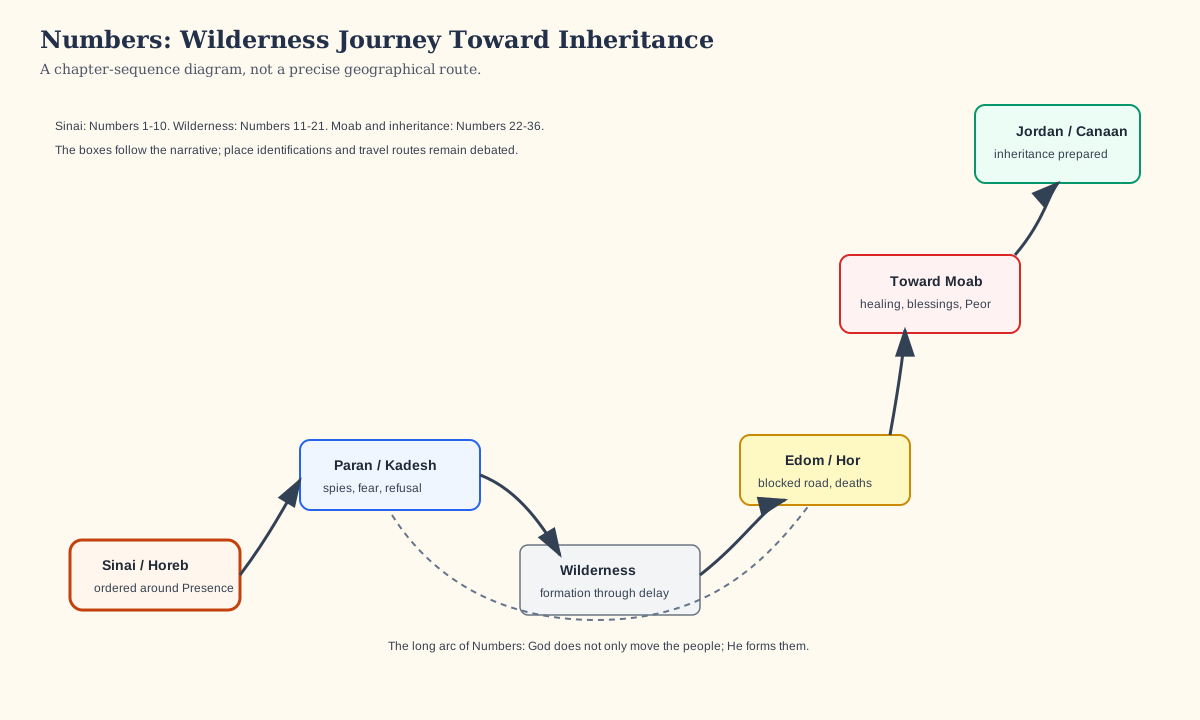 Teaching schematic, Orthodox Bible Study, 2026. Based on the biblical sequence; not a measured map or a settled reconstruction of the wilderness route.
Spiritual Fruit 🍇
Let the center govern the ordinary day. Israel arranges its camp before it begins the march. Protect a sustainable time of prayer and worship, then let it alter one ordinary duty: speak truthfully, repay what is owed, or perform an unseen task without resentment. The Lord’s place at the center becomes visible in the life around it.
Tell the whole truth about Egypt. When a former sin begins to look attractive, remember the bondage along with the pleasure. Bring the actual longing to confession before nostalgia becomes an accusation against present mercy. Gratitude can restore the part of the story appetite has hidden.
Receive correction without making it the end of hope. The sentence in chapter 14 is followed by commands for life in the land. If repentance leaves consequences, take up the next faithful duty rather than demanding that everything immediately feel restored. God’s mercy can sustain obedience while a wound still needs time.
Pray for the person whose recognition hurts. Moses asks for Miriam’s healing after her challenge. Name before Christ someone whose gift you have been measuring against your own. Pray for that person’s fidelity, then do one honest act that helps rather than competes.
Prepare an inheritance another person can receive. Moses asks for a shepherd after him. Share knowledge, welcome a capable successor, make entrusted resources clear, and refuse to use indispensability as leverage. Faithfulness can rejoice in work that will bear fruit after our own part is finished.
Lord Jesus Christ, You remain faithful on the road where our hearts divide. Teach us to receive Your gifts without presumption, to confess without hiding, and to follow without demanding that the way serve our pride. Give rest to the weary and truth to the tempted. Lead us, together, into the life You have prepared.
Teaching Notes
Opening orientation
- Discuss: Why does Numbers begin with an ordered camp yet soon reveal distrust? Distinguish preparation that serves obedience from the belief that religious organization can replace it.
- Watch for: Speaking as though Israel alone failed after deliverance. Read 1 Corinthians 10:1-13 as St. Paul’s warning to the Church.
- Show: The journey schematic for broad orientation, with its limits stated plainly. The six book sections contain 35 studies covering 36 chapters; only chapters 28-29 remain grouped.
Numbers 1-10
- Discuss: What joins the gifts in chapter 7, the Levites in chapter 8, and the Passover and cloud in chapter 9? Keep the answer tied to preparation for life before the Lord.
- Watch for: Making holy service a claim to personal superiority, or using an ancient household law as permission for coercion.
Numbers 11-14
- Discuss: How does Moses’ request for help differ from Israel’s complaint about food? How does chapter 14 show that repentance must affect the next action?
- Watch for: Calling every admission of exhaustion unbelief. A teacher should help the class read Numbers as a mirror, while allowing real need to be brought honestly to God.
- Connect: The Lenten prophecy is one continuous Numbers 10:35-11:35 reading. Find its opening prayer at Brenton 10:34, not at the cloud verse.
Numbers 15-19
- Discuss: How do Aaron’s intercession, the budding rod, and the duties in chapter 18 answer different parts of the same crisis?
- Watch for: Equating ritual contact with death with personal wrongdoing. Hebrews 9:13-14 clarifies the fulfillment in Christ’s cleansing of the conscience.
Numbers 20-21
- Discuss: What can Moses’ failure teach about evaluating a ministry by its result alone? What changes when chapter 21’s confession is followed by prayer?
- Watch for: Treating the serpent as magic or Christ as helpless in His Passion. Let John 3:14-15 govern the Christian interpretation.
- Connect: On Friday of the sixth Lenten week, John 3:14-21 is at Matins and 1 Corinthians 10:1-13 at the Liturgy. Do not call them two readings of the same service.
Numbers 22-25
- Discuss: How can Balaam speak truth and remain disobedient? Why does the failed curse make the consent at Peor more searching?
- Watch for: Confusing spiritual giftedness with holiness or converting Phinehas’ ancient act into a Christian permission for violence.
Numbers 26-36
- Discuss: What do the daughters’ petition, Moses’ prayer for a shepherd, and the refuge laws reveal about responsibility for another person’s future?
- Watch for: Skipping the legal conditions of refuge in order to reach a symbol. Distinguish the chapter’s law, an explicit New Testament fulfillment, and the study’s reflection.
- Connect: Origen’s stages encourage growth and gratitude for refreshment; they are not an explanation of every person’s suffering. Keep Gregory’s boundless hope joined to the attainable obedience of today.
Sources
Scripture and verse frames: Brenton’s Septuagint Version of the Old Testament, Numbers, with its original chapter divisions; eBible’s English Brenton text 🔗, with the distinct digital frame at chapters 12-13 noted above. NKJV supplies the studies’ organizational frame and the New Testament references. For the principal comparisons, see Numbers 10 🔗, 12-13 🔗, 16-17 🔗, 21 🔗, 26 🔗, and 27-30 🔗.
The book’s two titles: “Exploring Numbers,” Grace Communion International archive 🔗, introductory title discussion. Used for the names and their meanings, not as a patristic or Coptic authority.
Two-census structure: Terence E. Fretheim’s review of Dennis T. Olson, Numbers, in Word & World 16.3 (1996), Reviews 🔗. The attribution above is mediated through this review, not a claim to have consulted Olson’s full commentary.
Origen: Homilies on Numbers, Homily 27, especially 1.7, 5.2, and 11.1, in the translation of Thomas P. Scheck, available homily excerpt 🔗. Homily-specific interpretation, not a generic attribution across chapters he does not treat.
St. Gregory of Nyssa: The Life of Moses, Book I, sections 7-10, electronic English and Greek parallel text 🔗. Used as a broader witness to growth in God.
Coptic worship: Coptic Reader 🔗 for the stated Lent, Holy Pascha, and consecration menu paths, consulted through the Coptic reading reference and preserved source evidence. The church-consecration entries remain qualified as stated above. The Coptic Orthodox Church Network’s readings for the sixth-week Lenten Friday 🔗 supply the recorded companion appointments. App links may require selecting the occasion and service.
Footnotes
-
Terence E. Fretheim, review of Dennis T. Olson, Numbers, Word & World 16.3 (1996), discussion of the two census lists, 🔗. ↩
-
Coptic Reader, Special > Consecrations > Church > Part 2, Numbers 4:1-16 and 4:17-33, 🔗. The consulted reading reference records Reader-derived entries without confirmed status. ↩
-
Coptic Reader, Tuesday of the fifth week of Great Lent > Readings > Matins > Prophecies, first prophecy, Numbers 10:35-11:35, 🔗. The service’s opening at 10:35 corresponds to Brenton 10:34. ↩
-
Coptic Reader, Special > Pascha > Wednesday > Ninth Hour, second prophecy, Numbers 20:1-13, 🔗. ↩
-
Coptic Orthodox Church Network, Friday of the sixth week of Great Lent, Matins Gospel John 3:14-21 and Liturgy Pauline reading 1 Corinthians 10:1-13, 🔗. ↩
-
Origen, Homilies on Numbers, Homily 27.1.7, trans. Thomas P. Scheck, 🔗. ↩
-
Origen, Homilies on Numbers, Homily 27.11.1, trans. Thomas P. Scheck, 🔗. The quoted clause belongs to his longer explanation of refreshment at Elim. ↩
-
St. Gregory of Nyssa, The Life of Moses, Book I, sections 7-10, 🔗. ↩