


This narration is from a previous version of the study and may include a combined recording of multiple chapters.
Moses writes down the road. The names in Numbers 33 gather deliverance, thirst, refreshment, rebellion, and burial into one record, ending at Jordan by Jericho. Israel is nearly ready to enter, but it must remember how it arrived. After the eastern tribes’ agreement in Numbers 32, the itinerary recalls the whole people’s passage from Egypt. Its final commands prepare for the defined inheritance of Numbers 34. Memory here is neither a collection of pleasant moments nor an accusation without mercy. It is a testimony kept under the word of the Lord.
Numbers 33:1-4; Greek/Brenton 33:1-4 | The road is written by command
Numbering note: NKJV and Brenton share the chapter and verse labels. Brenton’s “stages” names the successive stations of Israel’s journey. “Ramesses” corresponds to Rameses.
Numbers 33 (Brenton) 1: And these are the stages of the children of Israel, as they went out from the land of Egypt with their host by the hand of Moses and Aaron. 2: And Moses wrote their removals and their stages, by the word of the Lord: and these are the stages of their journeying. 3: They departed from Ramesses in the first month, on the fifteenth day of the first month; on the day after the passover the children of Israel went forth with a high hand before all the Egyptians. 4: And the Egyptians buried those that died of them, even all that the Lord smote, every first-born in the land of Egypt; also the Lord executed vengeance on their gods.
Light from the Word 🕯️
Moses writes the removals and stages “by the word of the Lord.” The people will soon receive land, but a settled life must not make their deliverance disappear from memory. They are people whom God brought out, not people who created themselves. Their identity rests on a gift that precedes their possession.
The departure is dated to the day after Passover. Egypt is burying its firstborn while Israel goes out “with a high hand.” Exodus 14:8 uses the same expression for Israel’s departure. It names their confident freedom here; the confidence must not be separated from the Lord who delivered them. Verse 4 also remembers judgment on Egypt’s gods, as Exodus 12:12 had announced. Israel’s freedom begins with the defeat of a false claim to lordship, not simply with a change of address.
A Christian receives this record without contempt for bereaved people. The text gives the gravity of judgment beside the wonder of deliverance. In gratitude we acknowledge what enslaved us and who rescued us; we do not take pleasure in another person’s loss. The Lord who frees us calls us to belong to Him, not to admire our own escape.
The Church’s Voice in Worship ⛪
Numbers 33 has no direct verse-addressed appointment in the Coptic readings consulted for this study. Matthew 2:13-23 is appointed at the Liturgy for the Feast of the Entrance of the Lord into Egypt, Bashans 24. Its fulfillment of the call out of Egypt offers a Christian reflection on Israel’s road: the incarnate Son enters the country from which Israel was delivered and returns as the One in whom God’s saving purpose reaches its fulfillment. This is a related Gospel appointment, not an appointment of this itinerary. Isaiah 19:1 provides a biblical image of Egypt’s idols shaken before the Lord; no unsourced account of a particular icon or hymn is needed to make that scriptural connection.
Numbers 33:5-37; Greek/Brenton 33:5-37 | Bitter water, springs, and repeated departures
Numbering note: Verse labels agree, but Brenton 33:36 has a fuller sequence than NKJV: it names a departure from the wilderness of Sin and a camp in Pharan, identified as Cades. Brenton’s “Picriæ” corresponds to Marah, “Ælim” to Elim, “Raphidin” to Rephidim, “Gesion Gaber” to Ezion Geber, and “Or” to Hor. Their displayed spellings are retained.
Numbers 33 (Brenton) 5: And the children of Israel departed from Ramesses, and encamped in Socchoth: 6: and they departed from Socchoth and encamped in Buthan, which is a part of the wilderness. 7: And they departed from Buthan and encamped at the mouth of Iroth, which is opposite Beel-sepphon, and encamped opposite Magdol. 8: And they departed from before Iroth, and crossed the middle of the sea into the wilderness; and they went a journey of three days through the wilderness, and encamped in Picriæ. 9: And they departed from Picriæ, and came to Ælim; and in Ælim were twelve fountains of water, and seventy palm-trees, and they encamped there by the water. 10: And they departed from Ælim, and encamped by the Red Sea. 11: And they departed from the Red Sea, and encamped in the wilderness of Sin. 12: And they departed from the wilderness of Sin, and encamped in Raphaca. 13: And they departed from Raphaca, and encamped in Ælus. 14: And they departed from Ælus, and encamped in Raphidin; and there was no water there for the people to drink. 15: And they departed from Raphidin, and encamped in the wilderness of Sina. 16: And they departed from the wilderness of Sina, and encamped at the Graves of Lust. 17: And they departed from the Graves of Lust, and encamped in Aseroth. 18: And they departed from Aseroth, and encamped in Rathama. 19: And they departed from Rathama, and encamped in Remmon Phares. 20: And they departed from Remmon Phares, and encamped in Lebona. 21: And they departed from Lebona, and encamped in Ressan. 22: And they departed from Ressan, and encamped in Makellath. 23: And they departed from Makellath, and encamped in Saphar. 24: And they departed from Saphar, and encamped in Charadath. 25: And they departed from Charadath, and encamped in Makeloth. 26: And they departed from Makeloth, and encamped in Kataath. 27: And they departed from Kataath, and encamped in Tarath. 28: And they departed from Tarath, and encamped in Mathecca. 29: And they departed from Mathecca, and encamped in Selmona. 30: And they departed from Selmona, and encamped in Masuruth. 31: And they departed from Masuruth, and encamped in Banæa. 32: And they departed from Banæa, and encamped in the mountain Gadgad. 33: And they departed from the mountain Gadgad, and encamped in Etebatha. 34: And they departed from Etebatha, and encamped in Ebrona. 35: And they departed from Ebrona, and encamped in Gesion Gaber. 36: And they departed from Gesion Gaber, and encamped in the wilderness of Sin; and they departed from the wilderness of Sin, and encamped in the wilderness of Pharan; this is Cades. 37: And they departed from Cades, and encamped in mount Or near the land of Edom.
Light from the Word 🕯️
The repeated “they departed” and “encamped” carries the chapter’s weight. Each station was inhabited and then left. Neither pain nor refreshment was allowed to become the whole story. At Picriæ, the record recalls the bitter water of Marah in Exodus 15:23; at Elim, it names twelve fountains and seventy palms; at Rephidim, it expressly remembers that the people had no water. The route includes gifts and lack without pretending that either cancels the other.
Many names have no attached episode here. Their silence does not authorize us to invent events or recover exact locations with confidence. Some stations recall stories told elsewhere; others are simply named. The Lord commands that the complete record be kept. Ordinary obedience, prolonged waiting, and time that seems uneventful are not outside His care merely because they do not produce a memorable story.
The “Graves of Lust” recalls the crisis of Numbers 11. Such a name prevents holy memory from becoming sentimental. The place where a desire became destructive belongs in the same record as springs of water. In confession, the corresponding honesty is to remember the sin without erasing the mercy that followed, and to remember the mercy without renaming the sin as wisdom.
Gems from the Fathers 💎: Origen’s stages of conversion
Origen’s Homily on Numbers 27 directly takes up this itinerary. In sections 2.1-2.4, he argues that a road recorded at God’s command must nourish those who read it, and he applies the departure from Egypt to conversion from ignorance and bondage. In sections 5.2-7, he follows the believer through successive temptations and virtues. A trial overcome becomes a stage from which the soul continues toward God. This is his spiritual reading, alongside Israel’s actual journey, not a replacement for it.1
His interpretation has a Christological beginning. In section 3.1, he counts forty-two stages and pairs them with Matthew’s forty-two generations. In section 3.2, the Lord’s descent to us becomes the beginning of our ascent: faith in the Word made flesh opens the departure from slavery. The count and pairing belong to Origen’s exposition. Brenton’s fuller itinerary in verse 36 should not be forced into an identical numbered chart, and the symbolic reading is not a formula for calculating a person’s spiritual rank.
At Elim, Origen sees the Twelve and the seventy disciples in the springs and palms (27.11.1). His immediate concern is the refreshment God gives amid trial: “God, who governs souls, has on this journey placed some places of refreshment into the midst of our toils.”2 Rest prepares the soul to resume the road. Christian thanksgiving therefore includes the friend, word of Scripture, quiet prayer, or act of mercy through which strength was restored. We receive that refreshment gratefully, without demanding that the rest of the road contain no further toil.
Origen’s meanings for individual place names are part of his allegorical method. They are not offered here as independently established Hebrew etymologies. What is most fruitful in his account is the relation between Christ’s coming, conversion, tested faith, and persevering hope.
Numbers 33:38-49; Greek/Brenton 33:38-49 | Aaron’s death remains in the record
Numbering note: NKJV and Brenton share the labels 33:38-49. The source’s geographical descriptions are retained, including its final description of the camp by Jordan.
Numbers 33 (Brenton) 38: And Aaron the priest went up by the command of the Lord, and died there in the fortieth year of the departure of the children of Israel from the land of Egypt, in the fifth month, on the first day of the month. 39: And Aaron was a hundred and twenty-three years old, when he died in mount Or. 40: And Arad the Chananitish king (he too dwelt in the land of Chanaan) having heard when the children of Israel were entering the land— 41: then they departed from mount Or, and encamped in Selmona. 42: And they departed from Selmona, and encamped in Phino. 43: And they departed from Phino, and encamped in Oboth. 44: And they departed from Oboth, and encamped in Gai, on the other side Jordan on the borders of Moab. 45: And they departed from Gai, and encamped in Dæbon Gad. 46: And they departed from Dæbon Gad, and encamped in Gelmon Deblathaim. 47: And they departed from Gelmon Deblathaim, and encamped on the mountains of Abarim, over against Nabau. 48: And they departed from the mountains of Abarim, and encamped on the west of Moab, at Jordan by Jericho. 49: And they encamped by Jordan between Æsimoth, as far as Belsa to the west of Moab.
Light from the Word 🕯️
The itinerary pauses to date Aaron’s death: the first day of the fifth month in the fortieth year after the departure from Egypt. It also gives his age, a hundred and twenty-three. Numbers 20 had narrated the removal of his garments and the succession of Eleazar; this record prevents that death from becoming a passing detail in a list of places. A people preparing to enter the land must remember the priest who will not enter with them.
The route then continues. Remembered loss and present obedience are held together. A parish or family can preserve the memory of someone who carried holy responsibilities without making fidelity to the deceased a refusal of what God now asks. Grief belongs in the story, but it does not need to become the last word of the story.
Hebrews 7:23-25 places mortal priesthood beside Christ’s abiding priesthood. Aaron dies and another receives his ministry; Christ lives always and intercedes for those who come to God through Him. This does not diminish Aaron’s service. It directs the hope that could never finally rest on any mortal servant toward the risen Lord.
The last camps bring Israel to Jordan by Jericho, opposite the land it has not yet entered. Hebrews 11:13-16 speaks of God’s people confessing that they are strangers and pilgrims and seeking a better homeland. The Christian reflection on the itinerary therefore points beyond nostalgia toward hope. A long history of grace is meant to strengthen today’s obedience, not give us permission to stop just before the promised crossing.
Numbers 33:50-56; Greek/Brenton 33:50-56 | Memory must become obedience
Numbering note: NKJV and Brenton share the labels 33:50-56. Brenton’s severe commands concerning the inhabitants and their worship are retained in full.
Numbers 33 (Brenton) 50: And the Lord spoke to Moses at the west of Moab by Jordan at Jericho, saying, 51: Speak to the children of Israel, and thou shalt say to them, Ye are to pass over Jordan into the land of Chanaan. 52: And ye shall destroy all that dwell in the land before your face, and ye shall abolish their high places, and all their molten images ye shall destroy, and ye shall demolish all their pillars. 53: And ye shall destroy all the inhabitants of the land, and ye shall dwell in it, for I have given their land to you for an inheritance. 54: And ye shall inherit their land according to your tribes; to the greater number ye shall give the larger possession, and to the smaller ye shall give the less possession; to whatsoever part a man’s name shall go forth by lot, there shall be his property: ye shall inherit according to the tribes of your families. 55: But if ye will not destroy the dwellers in the land from before you, then it shall come to pass that whomsoever of them ye shall leave shall be thorns in your eyes, and darts in your sides, and they shall be enemies to you on the land on which ye shall dwell; 56: and it shall come to pass that as I had determined to do to them, so I will do to you.
Light from the Word 🕯️
The remembered road ends with a command about the coming land. Israel must remove the inhabitants’ idolatrous worship, destroy the images and pillars, and receive the inheritance according to the size of the tribes and the lot. The land is given by God; its distribution is not left to the strongest claimant. Memory of deliverance is intended to form a people who obey in their new circumstances.
The orders against the inhabitants belong to Israel’s ancient setting and cannot become permission for Christians to attack other people. Ephesians 6:12 directs the Church’s warfare against spiritual evil rather than flesh and blood. The Christian application concerns renouncing idolatry and resisting the passions, while obeying Christ’s command to love human enemies.
The retained corruption will become “thorns in your eyes, and darts in your sides.” Joshua 23:13 and Judges 2:3 carry a similar warning. What is kept as a convenient compromise can later make clear sight and faithful action difficult. The final verse adds an even more searching word: Israel is not exempt from judgment. If the people embrace the corruption being judged, the Lord will deal with them also. Inheritance does not remove accountability.
For us, removing an idol begins with the allegiance that competes with Christ: status that determines our honesty, resentment that directs our relationships, money that decides whom we will sacrifice, or appetite that governs our prayer. We can remember many mercies and still refuse the next act of obedience. The record of grace becomes fruitful when we let it give us courage to surrender what cannot travel with us into communion with God.
Iconography and Visual Teaching 🖼️
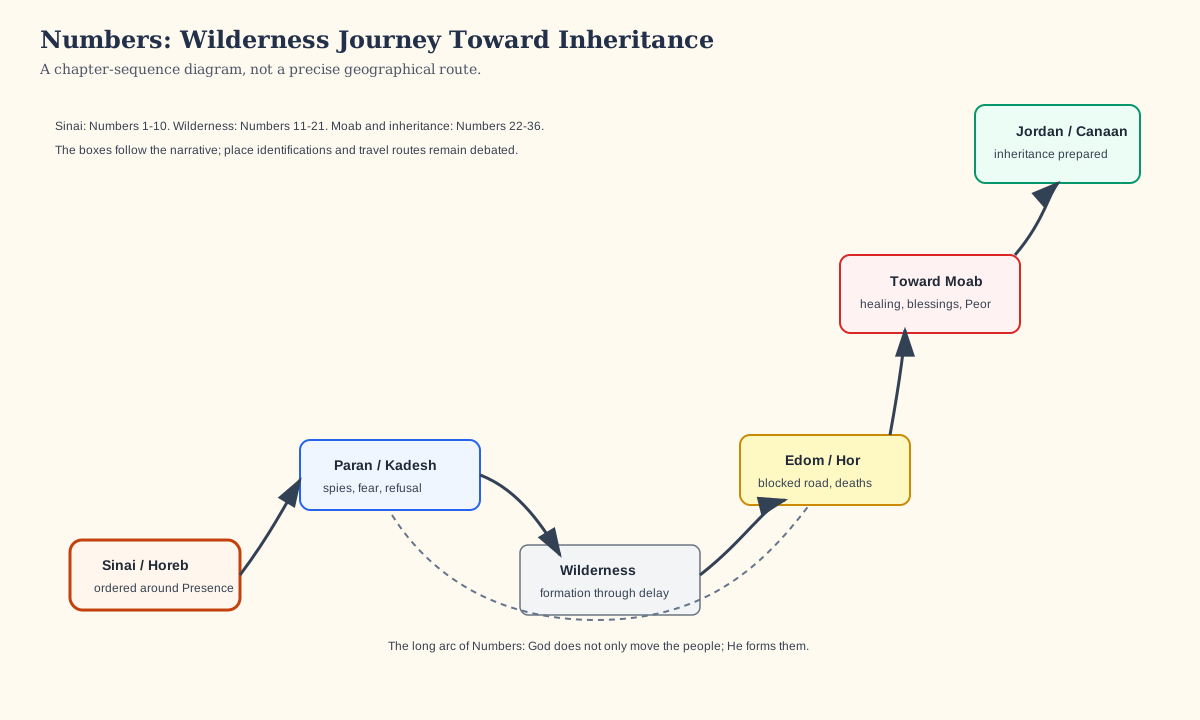
Teaching schematic, Orthodox Bible Study, 2026. Based on Numbers 33. A directional or narrative aid, not a geographical survey.
Spiritual Fruit 🍇
Write a truthful memory before God. Name a deliverance, a failure, a refreshment, and a grief. Give thanks for God’s help in each without forcing a neat explanation of every event. Holy memory can be honest before it is fully understood.
Receive rest without settling into forgetfulness. When strength is restored, let the gift prepare you to resume the duty that remains. A consoling season is neither a reward for superiority nor a promise that temptation has ended.
Remember a departed servant in hope. Pray for someone whose work helped carry you toward Christ. Give thanks for what was entrusted through that person, and entrust the loss to the High Priest who lives and intercedes.
Turn remembered mercy into one present obedience. Identify a compromise whose cost you already know. Bring it to confession and take a concrete step away from it. The Lord has not led you this far merely to let the old slavery acquire a new home.
Lord Jesus Christ, You know the road I have traveled and the stages I cannot yet understand. Preserve gratitude from nostalgia and repentance from despair. Give me rest where I am weary, courage where I am afraid, and freedom to follow You into the obedience before me.
Teaching Notes
Numbers 33:1-4; Greek/Brenton 33:1-4
Discuss
- Ask: Why does arrival at the threshold require a written remembrance of departure?
- Emphasize: Deliverance identifies the people as recipients of God’s gift.
- Watch for: Pleasure in Egypt’s grief or presenting the related Gospel appointment as a reading of Numbers 33.
- Connect: Exodus 12:12; 14:8; Matthew 2:13-23.
Numbers 33:5-37; Greek/Brenton 33:5-37
Discuss
- Ask: How does a record that includes both bitter water and springs teach truthful thanksgiving?
- Emphasize: Origen’s 27th homily is an actual sustained interpretation of this chapter, centered on Christ and conversion.
- Watch for: Turning his forty-two count into a forced count of every encampment clause in Brenton, or his allegorical names into verified etymologies.
- Connect: Numbers 11 and the refreshment described in Origen 27.11.1.
Numbers 33:38-49; Greek/Brenton 33:38-49
Discuss
- Ask: What does Aaron’s dated death contribute to a chapter about continued travel?
- Emphasize: Grief remains in the record, and obedience continues.
- Watch for: Supplying exact routes or archaeological identifications absent from the evidence.
- Connect: Numbers 20; Hebrews 7:23-25; 11:13-16.
Numbers 33:50-56; Greek/Brenton 33:50-56
Discuss
- Ask: Why does remembered deliverance end in a warning to the delivered people themselves?
- Emphasize: The same holiness that judges idolatry also judges Israel’s refusal to obey.
- Watch for: Transferring ancient dispossession commands to modern religious violence.
- Connect: Joshua 23:13; Judges 2:3; Ephesians 6:12.
Sources
Embedded Scripture is from Brenton’s English Septuagint (LXX). New Testament references are read in NKJV. The fuller wording of Brenton 33:36 is preserved; no conjectured manuscript cause is asserted.
Numbers 33 and the biblical parallels discussed above.
Origen, Homilies on Numbers 27, especially 2.1-3.2; 5.2-7; 11.1, translated by Thomas P. Scheck, consulted text 🔗. His reading of the stages is presented as spiritual interpretation rather than a geographical reconstruction.
Coptic Orthodox Katameros, Feast of the Entrance of the Lord into Egypt, Liturgy, Matthew 2:13-23, consulted through lectionary-data 1.3.3 🔗.