


This narration was recorded before the latest revision. The text on this page is current.
Israel stands between the sea ahead and Pharaoh behind. Passover has broken the tyrant’s claim, but Pharaoh still pursues the people he used to own. Exodus 14 exposes the fear that makes slavery seem safer than freedom, then reveals the Lord as deliverer and rear guard. Israel cannot open the sea, yet must walk the way God opens. The far shore prepares the song of chapter 15.
The pursuer and the apparent dead end (Exodus 14:1-9; Greek/Brenton 14:1-9)
A note on numbering. This study follows NKJV chapter and verse numbering and prints Brenton’s English Septuagint with its own verse labels. The numbered passage units here correspond in the two editions, although their wording can differ.
1: And the Lord spoke to Moses, saying, 2: Speak to the children of Israel, and let them turn and encamp before the village, between Magdol and the sea, opposite Beel-sepphon: before them shalt thou encamp by the sea. 3: And Pharao will say to his people, As for these children of Israel, they are wandering in the land, for the wilderness has shut them in. 4: And I will harden the heart of Pharao, and he shall pursue after them; and I will be glorified in Pharao, and in all his host, and all the Egyptians shall know that I am the Lord. And they did so. 5: And it was reported to the king of the Egyptians that the people had fled: and the heart of Pharao was turned, and that of his servants against the people; and they said, What is this that we have done, to let the children of Israel go, so that they should not serve us? 6: So Pharao yoked his chariots, and led off all his people with himself: 7: having also taken six hundred chosen chariots, and all the cavalry of the Egyptians, and rulers over all. 8: And the Lord hardened the heart of Pharao king of Egypt, and of his servants, and he pursued after the children of Israel; and the children of Israel went forth with a high hand. 9: And the Egyptians pursued after them, and found them encamped by the sea; and all the cavalry and the chariots of Pharao, and the horsemen, and his host were before the village, over against Beel-sepphon.
The first shock of the chapter is that the Lord Himself arranges the scene. Israel is not trapped because Moses took a wrong turn. God tells them where to camp, and He openly states why: Pharaoh will think the wilderness has shut them in, he will pursue, and the Lord will be glorified over him. The crisis is not outside divine providence. The Lord’s knowledge of the pursuer is greater than the pursuer’s confidence.
Pharaoh’s question in verse 5 exposes his grief: Israel will no longer serve Egypt. He wants his workforce back. The chosen chariots make his desire visible as organized violence. Divine hardening here belongs to judgment on that persistent refusal of God’s command; it does not make the people’s enslavement morally innocent. Pharaoh’s own words identify the dominion he is trying to recover.
The camping places in verse 2 establish the narrative’s setting, but do not settle an archaeological crossing site. Nor does the passage establish the inherited claim that Israel had no high ground. Its secure contrast is between Pharaoh’s reading of a closed wilderness and God’s power to open a path through the sea.
A half-freed Israel that merely slipped away might still imagine Egypt as an option. The crossing will reveal that freedom is God’s gift, not a bargain with the old master. We should not deliberately manufacture crises to prove faith. Here the command comes from God; an unsafe situation chosen by a human leader is not automatically holy providence.
Fear makes slavery look safer than freedom (Exodus 14:10-14; Greek/Brenton 14:10-14)
10: And Pharao approached, and the children of Israel having looked up, beheld, and the Egyptians encamped behind them: and they were very greatly terrified, and the children of Israel cried to the Lord; 11: and said to Moses, Because there were no graves in the land of Egypt, hast thou brought us forth to slay us in the wilderness? What is this that thou hast done to us, having brought us out of Egypt? 12: Is not this the word which we spoke to thee in Egypt, saying, Let us alone that we may serve the Egyptians? for it is better for us to serve the Egyptians than to die in this wilderness. 13: And Moses said to the people, Be of good courage: stand and see the salvation which is from the Lord, which he will work for us this day; for as ye have seen the Egyptians to-day, ye shall see them again no more for ever. 14: The Lord shall fight for you, and ye shall hold your peace.
When Pharaoh appears, Israel panics. Their cry becomes accusation: were there no graves in Egypt? Why did you bring us here? It is darkly comic and painfully recognizable. Fear immediately rewrites the past. The people who had groaned under cruel bondage now speak as though Egypt had been tolerable. Oppression begins to look safer than freedom the moment freedom becomes costly.
That false remembering is one of the deepest spiritual diagnoses in the chapter. After repentance, confession, baptism, or a real break with sin, the old life often returns first as a memory. Not an honest memory, but a seductive one. The soul remembers the predictability of Egypt and forgets its humiliation. It remembers the food and forgets the chains. It remembers the habits and forgets the death they worked.
This is why Moses’ words are so important: “Stand and see the salvation which is from the Lord.” He does not tell them to engineer their own rescue. He does not tell them to return. He tells them to stop surrendering their imagination to fear. Yet this is not passive fatalism. A few verses later God says, “let them proceed.” The rhythm is exact. First, refuse panic. Second, receive God’s word. Third, move in obedience.
Some Christians misuse “stand still” as if it meant permanent inactivity. Others ignore it and turn faith into frantic effort. Exodus 14 holds both together. Faith becomes still before God’s saving action, and then faith moves when God commands. Stillness without obedience becomes paralysis. Movement without stillness becomes presumption.
“Hold your peace” is addressed to Israel at this particular saving act. It does not forbid the oppressed to name abuse or seek help. Moses first gives courage and directs their attention to the Lord’s salvation. God quiets panic so that His people can receive the command to proceed.
The Lord fights, but Israel still must walk (Exodus 14:15-18; Greek/Brenton 14:15-18)
15: And the Lord said to Moses, Why criest thou to me? speak to the children of Israel, and let them proceed. 16: And do thou lift up thy rod, and stretch forth thy hand over the sea, and divide it, and let the children of Israel enter into the midst of the sea on the dry land. 17: And lo! I will harden the heart of Pharao and of all the Egyptians, and they shall go in after them; and I will be glorified upon Pharao, and on all his host, and on his chariots and his horses. 18: And all the Egyptians shall know that I am the Lord, when I am glorified upon Pharao and upon his chariots and his horses.
Verses 15-18 are among the chapter’s most important. The Lord rebukes mere crying if it is not joined to obedience: “Why criest thou to me? … let them proceed.” The sea will not part because Israel produces courage. It will part because God acts. Yet Israel still has to step into the path God opens.
Here the Orthodox balance of grace and synergy becomes very clear. Israel contributes nothing to the miracle itself. No human strength parts the sea. But once the way is opened, the people must truly cross. They do not remain on the shore admiring salvation from a distance. They participate in it by obedience.
This is exactly why St Paul can later say that the fathers were “baptized into Moses in the cloud and in the sea” (1 Corinthians 10:1-2). Baptism is not a decorative religious symbol. It is passage. It is exodus. It is rupture with the old master. It is entrance into a new mode of life. Romans 6 deepens the same logic: through baptism we pass into Christ’s death and rise to newness of life. The Red Sea is not the fullness of baptism, but it is one of its clearest Old Testament shapes.
Prayer is not being dismissed. Moses has already stood with a terrified people, and now the Lord gives him an action to take. The rebuke tests whether crying to God will become obedience when a command is clear. “Synergy” names this cooperation with grace: God saves, and the people genuinely receive His saving action. It must never be turned into the claim that Israel earns the miracle by courage.
The angel and the cloud stand behind Israel (Exodus 14:19-20; Greek/Brenton 14:19-20)
19: And the angel of God that went before the camp of the children of Israel removed and went behind, and the pillar of the cloud also removed from before them and stood behind them. 20: And it went between the camp of the Egyptians and the camp of Israel, and stood; and there was darkness and blackness; and the night passed, and they came not near to one another during the whole night.
One of the richest details in the chapter is the movement of the angel of God and the pillar of cloud. The same divine presence that had led Israel now goes behind them, becoming a shield. God’s presence is not only guidance at the front. It is also protection at the rear, standing between His people and their destroyers.
Brenton’s Septuagint wording in verse 20 stresses darkness and blackness. Other textual traditions emphasize light for Israel and darkness for Egypt. The precise shading differs, but the theological point is the same. The same divine presence that gives safety to one side becomes dread to the other. God is not neutral in this moment. He stands for His people against the oppressor.
This also has Christological force. Christ does not save from a distance. He places Himself between His people and destruction. The Lord who will later stand between heaven and earth on the Cross is already prefigured here as the defender who bears the crisis with His people and opens the way through it.
Many people know God as a distant commander. Exodus 14 teaches them to know Him also as rear guard, shield, and protector. He is before us, but He is also behind us. He leads, and He covers.
Paul gives a more explicit foundation for reading the wilderness Christologically: the spiritual Rock was Christ, and the people were warned against testing Christ (1 Corinthians 10:4, 9, in the NKJV wording). This witness concerns Christ’s presence with the wilderness people; it does not by itself identify every mention of an angel as a separate created being or prove that verse 19 records the Incarnation. The Christian sees the Lord’s saving care here in the light of the Son who fulfills it.
A path of life and the collapse of domination (Exodus 14:21-29; Greek/Brenton 14:21-29)
21: And Moses stretched forth his hand over the sea, and the Lord carried back the sea with a strong south wind all the night, and made the sea dry, and the water was divided. 22: And the children of Israel went into the midst of the sea on the dry land, and the water of it was a wall on the right hand and a wall on the left. 23: And the Egyptians pursued them and went in after them, and every horse of Pharao, and his chariots, and his horsemen, into the midst of the sea. 24: And it came to pass in the morning watch that the Lord looked forth on the camp of the Egyptians through the pillar of fire and cloud, and troubled the camp of the Egyptians, 25: and bound the axle-trees of their chariots, and caused them to go with difficulty; and the Egyptians said, Let us flee from the face of Israel, for the Lord fights for them against the Egyptians. 26: And the Lord said to Moses, Stretch forth thine hand over the sea, and let the water be turned back to its place, and let it cover the Egyptians coming both upon the chariots and the riders. 27: And Moses stretched forth his hand over the sea, and the water returned to its place toward day; and the Egyptians fled from the water, and the Lord shook off the Egyptians in the midst of the sea. 28: And the water returned and covered the chariots and the riders, and all the forces of Pharao, who entered after them into the sea: and there was not left of them even one. 29: But the children of Israel went along dry land in the midst of the sea, and the water was to them a wall on the right hand and a wall on the left.
Brenton’s verse 21 says “a strong south wind.” Hebrew-based translations, and the checked Holy Pascha book’s English reading, say an east wind. The verse 20 contrast likewise differs: the printed Brenton stresses “darkness and blackness,” while that service book describes darkness for one camp and light for the other. Brenton and the service book preserve different readings. The quoted Scripture here is not silently changed to the more familiar wording. In either account, the sea becomes dry by the Lord’s action, and Israel walks where there had been no road.1
The heart of the chapter is the double effect of the sea. Israel passes through and lives. Egypt enters and is broken. The same waters save and judge.
That pattern is essential to biblical and sacramental thinking. Water here is not magical. Its meaning depends on the relation of the human person to God’s saving action. Israel enters the sea in obedience to God’s word. Pharaoh enters in hardened violence, trying to turn God’s path into one more instrument of domination. He wants the road of salvation without repentance. He wants access without conversion.
That is why the episode is so spiritually sharp. Holy things cannot be safely used by an unrepentant will. Scripture, sacrament, ministry, and liturgical life are life-giving when received in faith, humility, and obedience. Approached with pride, manipulation, or hardness, they become occasions of judgment instead of healing.
The chapter also shows that divine judgment is not chaos. The Lord troubles the Egyptian camp, binds the chariot wheels, and exposes the weakness of the empire’s confidence. Pharaoh trusted horses, wheels, and command structure. But the machinery of domination collapses precisely where it thought itself strongest. Tyranny always appears more stable than it really is. Before God, it is fragile.
Light from the Word: A path of life and the collapse of domination
Wisdom of Solomon 10:15-21 (Septuagint) rereads the crossing as Wisdom’s rescue of an oppressed people, ending with their mouths opened in praise. Wisdom 19:6-9 (Septuagint) goes further: creation is fashioned anew in obedience to God, a cloud shelters the camp, and dry ground appears where water stood. The Lord who made the world is able to turn its elements into a way of deliverance. The exodus is therefore more than escape from an army; it anticipates the new life God’s power gives.
Isaiah 43:16-19 recalls the sea-road and the extinction of chariots before promising a new work and water in the wilderness. Remembering God’s act must enlarge hope for His next act, not imprison hope in a repetition of the past. Isaiah 63:11-13 remembers the dividing of the waters together with God’s Holy Spirit among His people. Psalm 114:1-8 (LXX 113:1-8) sets the fleeing sea beside the earth’s trembling before the God of Jacob. The sea gives way to its Creator, not to Israel’s mastery of creation.
The deaths on the shore are real judgment, not an invitation to gloat over Egyptians or despise a people. Christian spiritual warfare is directed against sin and the devil. The text cannot authorize hatred of neighbors, or turn every opponent into another Pharaoh.
Gems from the Fathers: A path of life and the collapse of domination
St. Cyril of Jerusalem teaches newly baptized Christians to read the pursuit and crossing through Christ’s rescue from sin. Moses is sent to lead the afflicted out of Egypt; Christ is sent from the Father to rescue the oppressed in the world. Cyril places Pharaoh beside the devil and the sea beside the baptismal waters: “The tyrant of old was drowned in the sea; and this present one disappears in the water of salvation.”2 The parallel explains why baptismal renunciation is a real turning from a master, not a ceremonial label attached to unchanged allegiance.
St. Ambrose draws the same passage into the forgiveness and renewal given in Baptism: “For what else are we daily taught in this sacrament but that guilt is swallowed up and error done away, but that virtue and innocence remain unharmed?”3 The enemy to be buried is guilt and error. The baptized person must not turn another human being into the enemy whom he wishes to drown.
Iconography and Visual Teaching
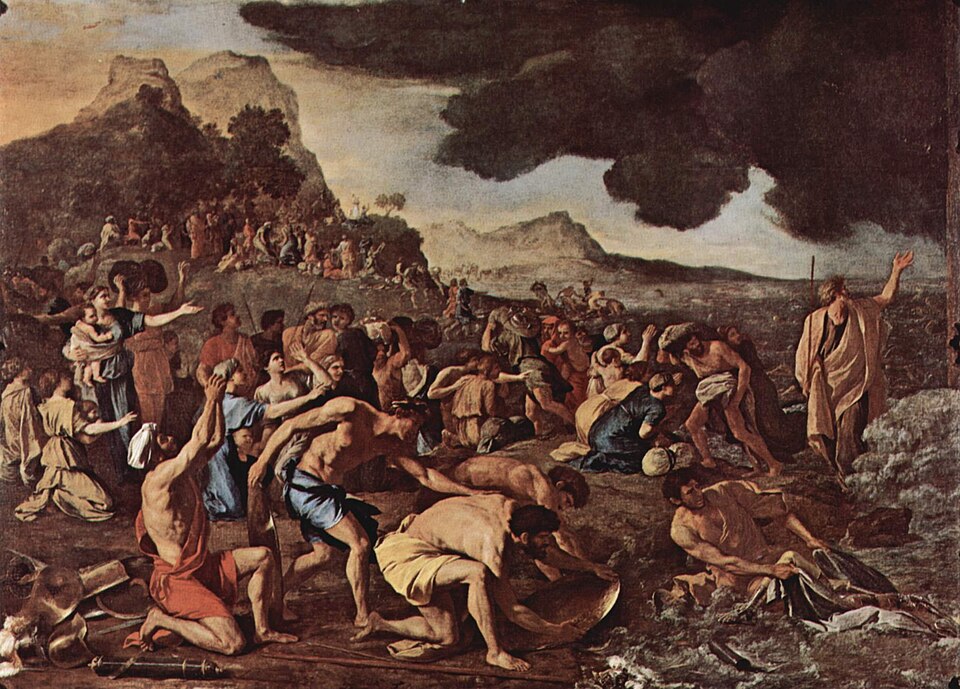 Source: Nicolas Poussin, The Crossing of the Red Sea 🔗, public domain, via Wikimedia Commons. Later Western illustrative reception, not Orthodox iconography.
Fear of God replaces fear of Egypt (Exodus 14:30-31; Greek/Brenton 14:30-31)
30: So the Lord delivered Israel in that day from the hand of the Egyptians, and Israel saw the Egyptians dead by the shore of the sea. 31: And Israel saw the mighty hand, the things which the Lord did to the Egyptians; and the people feared the Lord, and they believed God and Moses his servant.
The chapter ends with a crucial line: “the people feared the Lord, and they believed God and Moses his servant.” Fear and faith grow together here. This is not servile terror. It is the beginning of right knowledge. Israel sees what the Lord has done and finally understands that the God who redeemed them is not to be treated lightly.
This is one of the chapter’s quieter lessons. Israel had seen plagues in Egypt, but now the exodus becomes personal. They are not watching judgment happen to someone else. They themselves have crossed through death-like waters. They stand on the far shore as a people decisively separated from Pharaoh. Fear of God begins to replace fear of Egypt.
That shift is the real miracle inside the visible miracle. The sea opens outwardly, but the greater opening must happen inwardly. The heart must be re-ordered. Bondage must no longer define the imagination. The people must learn that their future is determined by the Lord’s presence, not by Pharaoh’s memory.
Believing Moses as God’s servant does not place him alongside God as a second object of worship. Hebrews 3:5-6 distinguishes Moses’ faithful service from Christ’s authority as Son over His house. John 5:46 joins faith in Moses to faith in Christ, because Moses wrote of Him. The servant’s testimony leads onward to the Son.
The Church’s Voice in Worship: Fear of God replaces fear of Egypt
The Holy Pascha lectionary appoints Exodus 14:13-15:1 at the Sixth Hour of Wednesday. The reading begins with courage and ends at the opening of the song. As the Church approaches the Passion, she hears salvation through an impossible barrier becoming worship. Christ’s death and Resurrection fulfill the deliverance, and Romans 6:3-11 explains the Christian’s baptismal participation in His death and new life.4
Covenant Thursday’s Laqan, the Liturgy of Blessing of the Water, also recalls the crossing and the song in a short excerpt printed as “Exodus from 14, 15.” It does not appoint both whole chapters or give a verse range.5 The deliverance described in Exodus 14:21-31 is heard in a service of cleansing as the Church turns toward the Lord who washes His disciples’ feet. Salvation through the water becomes thanksgiving before Him.
Spiritual Fruit
-
Do not romanticize Egypt. One of the soul’s most dangerous habits is false memory. When obedience becomes hard, the old life can suddenly look gentle, manageable, even nourishing. Exodus 14 exposes that lie. Egypt had food, but it also had chains. The passions promise familiarity, but never freedom.
-
Learn the difference between panic and faith. Fear shouts, blames, and revises history. Faith may tremble, but it listens. Moses does not deny the danger. He simply refuses to hand the meaning of the moment over to fear. Many spiritual defeats begin long before the act itself. They begin when panic becomes the interpreter of reality.
-
Receive baptism as exodus, not label. This chapter is not for abstract admiration. It asks whether we understand Christian life as a real crossing. If baptism means actual transfer from Pharaoh’s domain to Christ’s, then returning to old bondage cannot be treated as a harmless habit. It is a contradiction of the crossing.
-
Move when God opens the way. Some people want God to remove danger while allowing them to remain motionless on the shore. But the Lord says, “let them proceed.” There are moments when prolonged analysis is disobedience. Once God has opened the path, the next act of faith is movement.
-
Trust the rear guard of God. The pillar moves behind Israel. That is a word for every anxious heart. God does not only call us into unknown ground. He also stands between us and what would destroy us. We are not asked to pretend the enemy is unreal. We are asked to remember that the enemy does not have the final claim.
Teaching Notes
Linger over the false memory of verses 10-14, the stillness and obedience of verses 15-18, and the rear guard of verses 19-20. Poussin is an illustrative painting, not an icon or a source for reconstructing the route.
Discuss: The pursuer and the apparent dead end (Exodus 14:1-9; Greek/Brenton 14:1-9)
- Ask: What does Pharaoh’s question reveal about the kind of loss he is grieving?
- Watch for: Calling a manufactured crisis divine guidance, or making hardening an excuse for oppression.
Discuss: Fear makes slavery look safer than freedom (Exodus 14:10-14; Greek/Brenton 14:10-14)
- Ask: What does fear selectively remember about a destructive habit?
- Watch for: Using the command to hold peace to silence a person seeking safety or help.
Discuss: The Lord fights, but Israel still must walk (Exodus 14:15-18; Greek/Brenton 14:15-18)
- Ask: How do stillness and proceeding become two acts of one trust?
- Watch for: Passive fatalism on one side and the claim that courage earns grace on the other.
Discuss: The angel and the cloud stand behind Israel (Exodus 14:19-20; Greek/Brenton 14:19-20)
- Ask: What changes when we recognize God’s protection behind us as well as His guidance ahead?
- Watch for: Replacing Brenton with the service-book wording without identifying the witness.
Discuss: A path of life and the collapse of domination (Exodus 14:21-29; Greek/Brenton 14:21-29)
- Ask: Why does Pharaoh enter the same road as Israel but with an opposite intention?
- Watch for: Reducing Baptism to a symbol, gloating over death, or identifying neighbors with Pharaoh.
Discuss: Fear of God replaces fear of Egypt (Exodus 14:30-31; Greek/Brenton 14:30-31)
- Ask: How does trust in Moses as servant lead beyond him to Christ the Son?
- Watch for: Worshiping a human leader or confusing reverence for God with panic before Him.
Glossary
- Pascha: the Church’s celebration of the saving Passion and Resurrection of Christ, the fulfillment of Passover.
- Typology: reading earlier biblical events as real historical acts that also foreshadow Christ, the Church, or the sacraments.
- Pharaoh: in the spiritual reading of the chapter, a figure of tyrannical domination, the devil, and the passions.
- Theophany: a manifestation of God, here especially in the angel and pillar of cloud and fire.
- Synergy: the Orthodox teaching that salvation is God’s gift first, yet received and lived through real human obedience and participation.
Sources
Embedded Scripture is from Brenton’s English Septuagint (LXX).
Exodus 14, Brenton 🔗; 1 Corinthians 10:1-9; Romans 6:3-11; Hebrews 11:29; John 5:46; Hebrews 3:5-6.
Wisdom of Solomon 10:15-21 🔗 and 19:6-9 🔗; Isaiah 43:16-19 🔗; Isaiah 63:11-13 🔗; Psalm 114:1-8 (LXX 113:1-8) 🔗.
St. Cyril of Jerusalem, First Mystagogical Catechesis 2-3, text 🔗; St. Ambrose, On the Mysteries, III.12, text 🔗.
Nicolas Poussin, The Crossing of the Red Sea, Wikimedia Commons source 🔗, public domain. Retained as Western illustrative reception.
Footnotes
-
Exodus 14:21, Brenton and Hebrew-based English witnesses 🔗; Katameros of the Holy Pascha, St. Mary Coptic Orthodox Church, Ottawa, English edition, Wednesday Sixth Hour, p. 306. South wind and east wind are witness differences, not interchangeable quotations. ↩
-
St. Cyril of Jerusalem, First Mystagogical Catechesis 3, also numbered Catechetical Lecture 19.3, translated by Edwin Hamilton Gifford, NPNF Second Series, vol. 7, text 🔗. ↩
-
St. Ambrose, On the Mysteries, III.12, translated by H. de Romestin, E. de Romestin, and H. T. F. Duckworth, NPNF Second Series, vol. 10, text 🔗. ↩
-
Katameros of the Holy Pascha, St. Mary Coptic Orthodox Church, Ottawa, English edition, “The Sixth Hour of Wednesday,” pp. 305-307, Exodus 14:13-15:1. Coptic Reader, Coptic Orthodox Metropolis of the Southern United States, official app: Special > Pascha > Wednesday > Wednesday Day > 6th Hour, printed Exodus 14:13-15:1. The app link does not select a service; follow the named menu path. ↩
-
Coptic Reader, Coptic Orthodox Metropolis of the Southern United States, official app: Special > Pascha > Thursday > Thursday Day > Liturgy of the Waters, printed Exodus from 14, 15. The app link does not select a service; follow the menu path. Printed references are retained separately from the Brenton text displayed here. ↩