


This narration was recorded before the latest revision. The text on this page is current.
Israel has passed through the sea and reached Elim’s springs, but the road now leads into the wilderness of Sin, between Elim and Sinai. Exodus 16 dates this new crisis to the fifteenth day of the second month after the departure from Egypt. Hunger makes freedom feel dangerous. The people who have seen Pharaoh’s army defeated must now learn to receive food, care for their households, and rest without a taskmaster. God answers their complaint with bread, and through that bread He begins to heal the slave imagination.
Remembering Egypt falsely (Exodus 16:1-3; Greek/Brenton 16:1-3)
A note on numbering. This study follows NKJV chapter and verse numbering and prints Brenton’s English Septuagint with its own verse labels. Moses identifies the bread in NKJV 16:15, but his answer begins at Brenton 16:16 because the editions divide his speech differently. The later 16:9-16 reading keeps the complete passage together.
1 And they departed from Ælim, and all the congregation of the children of Israel came to the wilderness of Sin, which is between Ælim and Sina; and on the fifteenth day, in the second month after their departure from the land of Egypt, 2 all the congregation of the children of Israel murmured against Moses and Aaron. 3 And the children of Israel said to them, Would we had died smitten by the Lord in the land of Egypt, when we sat by the flesh-pots, and ate bread to satiety! for ye have brought us out into this wilderness, to slay all this congregation with hunger.
The hunger is real; the remembered Egypt is false. Israel recalls the flesh-pots and forgets the forced labour. The people speak as though the Lord’s deliverance had endangered them and bondage had kept them safe. Suffering has narrowed their memory until the place of oppression looks like a home.
Egypt fed Israel only in order to use Israel. God feeds Israel in order to form Israel. The contrast concerns Pharaoh’s regime and the Lord’s fatherly care: one maintained a labour force, while the other is making a free people capable of trust. Freedom therefore requires more than a change of address. The heart must learn to stop calling its chains security.
This can happen after repentance. A destructive habit begins to look attractive when obedience becomes tiring, because memory keeps the relief and removes the damage. Honest remembrance names both. At the same time, hunger must be answered with food. This chapter gives no permission to dismiss a hungry person’s need as a failure of faith. The Lord hears the complaint and feeds the people.
The Church’s Voice in Worship: Remembering Egypt falsely
The Ottawa Katameros of the Holy Pascha places the passage from Marah through Israel’s first complaint about hunger at the First Hour of Covenant Thursday. The reading joins bitter water, God’s healing promise, and the longing for bread on the day of the institution of the Holy Eucharist.1 It ends at Exodus 16:3, before the manna is given. Coptic Reader does not include this companion prophecy at Thursday’s First Hour.2 The hunger heard in the Ottawa edition leaves Israel’s need sounding in the Church’s ears as she turns toward the Lord who gives His own Body and Blood. Hunger is brought before the Giver, not hidden behind religious confidence.
Coptic Reader appoints Exodus 15:22-16:1 at the Apostles Feast Laqan and the consecration of a baptistery.2 These readings reach the arrival in the wilderness in verse 1, before either the complaint or the gift of manna. Their water-rite setting belongs to the preceding healing at Marah; the whole chapter’s Eucharistic interpretation remains a distinct scriptural connection.
Daily bread and the test of trust (Exodus 16:4-8; Greek/Brenton 16:4-8)
4 And the Lord said to Moses, Behold, I will rain bread upon you out of heaven: and the people shall go forth, and they shall gather their daily portion for the day, that I may try them whether they will walk in my law or not. 5 And it shall come to pass on the sixth day that they shall prepare whatsoever they have brought in, and it shall be double of what they shall have gathered for the day, daily. 6 And Moses and Aaron said to all the congregation of the children of Israel, At even ye shall know that the Lord has brought you out of the land of Egypt; 7 and in the morning ye shall see the glory of the Lord, inasmuch as he hears your murmuring against God; and who are we, that ye continue to murmur against us? 8 And Moses said, This shall be when the Lord gives you in the evening flesh to eat, and bread in the morning to satiety, because the Lord has heard your murmuring, which ye murmur against us: and what are we? for your murmuring is not against us, but against God.
The Lord promises abundance, but gives it in a form that calls for daily obedience. The people must go out and gather their portion; on the sixth day they must prepare twice as much. Bread and command arrive together. God is testing whether Israel will walk in His law, so the gift cannot be separated from the manner of receiving it.
Refusing to gather reveals presumption. A deliberate refusal of the task God has assigned differs from the helplessness of someone too sick, young, or frail to gather. Verse 16 requires provision for the whole household. Faith receives the gift through the work obedience requires, while love makes sure those who depend on others are fed.
Deuteronomy 8:2-3 gives Scripture’s own interpretation of this training. Hunger and manna disclose what is in Israel’s heart and teach that life rests on every word proceeding from God’s mouth. Bread truly nourishes the body, yet it cannot secure life apart from the Lord who gives it. In Matthew 4:4, Christ answers the temptation to turn stones into bread with that same word. Where Israel’s hunger became an accusation, the Son’s hunger remains within obedience to the Father.3
The Lord’s Prayer gathers daily need into prayer to the Father (Matthew 6:11). A day’s bread is small enough to expose our fear of tomorrow, and necessary enough to teach us that dependence is no disgrace. We may work and plan, but our work does not make us the source of our own life.
Gems from the Fathers : Bread for body and soul
St. Cyril of Jerusalem, explaining the Lord’s Prayer within his instruction on Holy Communion, hears in its petition a longing for the Holy Bread that sustains the whole person. He writes: “This common bread is not substantial bread, but this Holy Bread is substantial, that is, appointed for the substance of the soul.”4 His Eucharistic reading widens our prayer: we ask the Father for bodily sustenance, and we learn to hunger for the life that Christ gives.
Glory in the wilderness, bread from heaven (Exodus 16:9-16; Greek/Brenton 16:9-16)
9 And Moses said to Aaron, Say to all the congregation of the children of Israel, Come near before God; for he has heard your murmuring. 10 And when Aaron spoke to all the congregation of the children of Israel, and they turned toward the wilderness, then the glory of the Lord appeared in a cloud. 11 And the Lord spoke to Moses, saying, 12 I have heard the murmuring of the children of Israel: speak to them, saying, Towards evening ye shall eat flesh, and in the morning ye shall be satisfied with bread; and ye shall know that I am the Lord your God. 13 And it was evening, and quails came up and covered the camp: 14 in the morning it came to pass as the dew ceased round about the camp, that, behold, on the face of the wilderness was a small thing like white coriander seed, as frost upon the earth. 15 And when the children of Israel saw it, they said one to another, What is this? for they knew not what it was; and Moses said to them, 16 This is the bread which the Lord has given you to eat. This is that which the Lord has appointed: gather of it each man for his family, a homer for each person, according to the number of your souls, gather each of you with his fellow-lodgers.
Aaron calls the grumbling congregation to come near before God. As they turn toward the wilderness, the Lord’s glory appears in the cloud. The place they have called a death trap becomes the place of His presence. Verse 7 promised that they would see His glory; verse 10 shows that promise taking visible form before the camp is fed. The Lord is teaching them whom they are meeting in the gift.
Quails cover the camp in the evening. In the morning the dew withdraws and something unfamiliar lies on the ground. Israel can receive God’s provision before it can explain it. Their question, “What is this?”, is answered by Moses with the identity that matters most: this is the bread the Lord has given them.
The question also prepares for the name “Man” in verse 31, the manna familiar to Christian readers. The Hebrew wording of verse 15 has “mān hū”, rendered “What is it?”, while verse 31 names the food “mān”. Brenton makes the question clear but leaves the later name as “Man”. The name thus keeps the memory of their first bewilderment beside their later nourishment.5 They learn what the gift is by hearing God’s word about it, not by turning the unfamiliar into a reason to distrust Him.
Wisdom 16:20-21 (Septuagint) looks back on manna as “angels’ food” and says that God’s sustenance declared His sweetness toward His children. In verse 26, Wisdom draws the same lesson as Deuteronomy: God’s word preserves those who trust Him. The bread is both food for a hungry body and a sign of the goodness of the One who provides it.6
John 6:31-35 takes up this heavenly bread after Christ has fed the multitude. The crowd’s scriptural appeal in verse 31 recalls Psalm 78:24 (LXX 77:24), which says that God gave the people bread from heaven. Christ turns their attention from Moses as mediator to the Father as Giver, and from a past provision to the Bread now given for the life of the world. He identifies that Bread as Himself.7
The contrast becomes sharper in John 6:48-58. The ancestors ate manna and died; Christ gives His flesh for the world’s life and promises resurrection to those who receive His Body and Blood. Manna sustained Israel on the road to the promised land. The incarnate Son communicates the life that death cannot extinguish. The Eucharist brings us into communion with Him; its life-giving power rests in who He is, not in our ability to explain a miracle.
Gems from the Fathers : The true Manna
St. Cyril of Alexandria devotes Book III, chapter VI of his Commentary on John to manna as a type of Christ’s presence and the spiritual gifts He brings. He returns to Exodus itself, tracing the complaint, daily gathering, Sabbath, and golden pot. The Father who fed one people was preparing a gift for the whole world: “He then is the True Manna, the Bread from heaven, given to the whole rational creation by God the Father.”8
In Book IV, chapter II, on John 6:51, Cyril explains why Christ’s flesh gives life. The flesh belongs to the Word who is Life by nature and is united to Him. “Wherefore the Body of Christ giveth life to all who partake of It.”9 This is the heart of the Eucharistic fulfillment: we receive the incarnate Lord Himself. Manna is a true gift and a preparation; Holy Communion is participation in the life-giving Body and Blood of Christ.
Paul’s warning in 1 Corinthians 10:1-12 belongs beside this consolation. All shared the wilderness gifts, yet many fell through disobedience. The warning addresses the Church’s own presumption. Receiving holy gifts calls us into repentance and perseverance; it never makes sin harmless. Cyril likewise urges a holier life and reception of Christ’s healing gift, rather than either careless approach or endless withdrawal through despair.10
Enough for each household (Exodus 16:17-21; Greek/Brenton 16:17-21)
17 And the children of Israel did so, and gathered some much and some less. 18 And having measured the homer full, he that had gathered much had nothing over, and he that had gathered less had no lack; each gathered according to the need of those who belonged to him. 19 And Moses said to them, Let no man leave of it till the morning. 20 But they did not hearken to Moses, but some left of it till the morning; and it bred worms and stank: and Moses was irritated with them. 21 And they gathered it every morning, each man what he needed, and when the sun waxed hot it melted.
The gathering is measured by people and their needs. Each man gathers for his family and fellow-lodgers, and verse 18 concludes that no one has excess and no one lacks. The miracle forms a community in which the dependent person counts. God’s gift is received rightly when the people around us are fed too.
Paul quotes this very verse in 2 Corinthians 8:13-15 while urging material help for fellow Christians: “He that had gathered much had nothing over; and he that had gathered little had no lack” (KJV).11 He does not ask that one household be crushed so another can be comfortable. Present abundance is to supply another’s want, with mutual care as needs change. Manna’s lesson reaches into the use of our money: gratitude becomes sharing, not merely a feeling about what we possess.
The spoiled leftovers expose another form of distrust. Some keep manna overnight against Moses’ command, and their attempted security breeds worms. The gift that should have trained trust becomes an instrument of fear. Hoarding says that God’s promise is too uncertain to obey.
The chapter itself guards the difference between prudence and hoarding. On the sixth day storage will be commanded, and what is kept will remain sound. The issue is disobedience, not the mere existence of a reserve. Planning for dependents can be an act of love; accumulation becomes spiritually poisonous when it replaces trust or closes the hand against a neighbour’s need. Nor is ordinary anxiety a reason to accuse a struggling person of rebellion. The answer to fear is faithful provision, patient prayer, and a concrete next act of obedience.
Sabbath as liberation from Pharaoh’s time-order (Exodus 16:22-30; Greek/Brenton 16:22-30)
22 And it came to pass on the sixth day, they gathered double what was needed, two homers for one man; and all the chiefs of the synagogue went in and reported it to Moses. 23 And Moses said to them, Is not this the word which the Lord spoke? To-morrow is the sabbath, a holy rest to the Lord: bake that ye will bake, and seethe that ye will seethe, and all that is over leave to be laid by for the morrow. 24 And they left of it till the morning, as Moses commanded them; and it stank not, neither was there a worm in it. 25 And Moses said, Eat that to-day, for to-day is a sabbath to the Lord: it shall not be found in the plain. 26 Six days ye shall gather it, and on the seventh day is a sabbath, for there shall be none on that day. 27 And it came to pass on the seventh day that some of the people went forth to gather, and found none. 28 And the Lord said to Moses, How long are ye unwilling to hearken to my commands and my law? 29 See, for the Lord has given you this day as the sabbath, therefore he has given you on the sixth day the bread of two days: ye shall sit each of you in your houses; let no one go forth from his place on the seventh day. 30 And the people kept sabbath on the seventh day.
The same bread teaches Israel when to work and when to stop. What spoiled after an ordinary day remains fresh when kept according to the Sabbath command. God’s faithfulness governs both the gathering and the rest. The people who go out on the seventh day find nothing because they have refused the provision already made for them.
Verse 29 names the Sabbath as something the Lord has given. Rest is a gift before it is a restriction. Pharaoh’s world demanded production and more production; the Lord makes room for His people to cease. Their continued life will not depend on acting as though every hour must be forced to yield something.
The bread for two days is given before the day of rest. God does not command cessation while withholding what makes it possible. This matters in families and workplaces: someone else’s exhaustion cannot be called holy simply because it leaves us free to rest. A household receives God’s rhythm together by preparing, sharing responsibility, and protecting those whose labour is easily overlooked.
Hebrews 4:9-11 carries the promise of rest into the life of faith and warns against the disobedience that kept Israel from entering it. In Christ, rest reaches deeper than a pause in activity. We cease trying to secure life apart from God and learn to receive it from Him. The Church’s Lord’s Day worship, feasts, fasts, and prayer give our weeks a different centre from Pharaoh’s demands. These practices require real obedience, but they free us from treating productivity as the measure of a person’s worth.12
A golden pot and a remembered gift (Exodus 16:31-36; Greek/Brenton 16:31-36)
31 And the children of Israel called the name of it Man; and it was as white coriander seed, and the taste of it as a wafer with honey. 32 And Moses said, This is the thing which the Lord hath commanded, Fill an homer with manna, to be laid up for your generations; that they may see the bread which ye ate in the wilderness, when the Lord led you forth out of the land of Egypt. 33 And Moses said to Aaron, Take a golden pot, and cast into it one full homer of manna; and thou shalt lay it up before God, to be kept for your generations, 34 as the Lord commanded Moses: and Aaron laid it up before the testimony to be kept. 35 And the children of Israel ate manna forty years, until they came to the land they ate the manna, until they came to the region of Phœnicia. 36 Now the homer was the tenth part of three measures.
The chapter closes by joining the taste of manna to its remembrance. It is like a wafer with honey, and a full measure is kept so that later generations can see how the Lord fed Israel. The bread belongs to a history of mercy that the children must inherit. When abundance comes, this memorial will stand against the proud claim that the people have sustained themselves.
Brenton says “a golden pot”, a detail also preserved in Hebrews 9:4 when it names the pot containing manna among the covenant’s sacred treasures. Exodus describes Aaron laying it up before the testimony; Hebrews recalls it in the setting of the ark. The memorial belongs before God, where Israel’s remembered bread bears witness to His faithfulness.13
Verse 35 looks across forty years to the end of the wilderness provision. Joshua 5:12 supplies the sequel: when Israel eats the produce of the land, the manna ceases. The change of food does not mean a change of Giver. Dependence must survive the arrival of fields, harvests, and homes. Revelation 2:17 carries the image beyond that earthly arrival, promising hidden manna to the one who overcomes. Wilderness nourishment opens toward communion with God that outlasts the wilderness.14
The Church’s Voice in Worship: A golden pot and a remembered gift
The Sunday Theotokia, the Church’s hymn in honour of the Mother of God within the Sunday Midnight Praises, takes up the golden pot as a figure of the Virgin Mary. Its fifteenth part sings: “They likened the golden pot, to the Virgin, and the measure of the manna, to our Savior.”15 The hymn’s thirteenth part makes the meaning plain: the Word of the Father came and was incarnate of her. Mary bears the true Manna because the Son truly took flesh from her.
This praise keeps Christ at the centre of the Marian image. The vessel is honoured because of the One it bears. The wilderness memorial and the Virgin’s motherhood meet in the confession that the God who feeds His people has come among them in the flesh. The bread that trained Israel’s trust prepares us to receive the Lord who gives Himself.
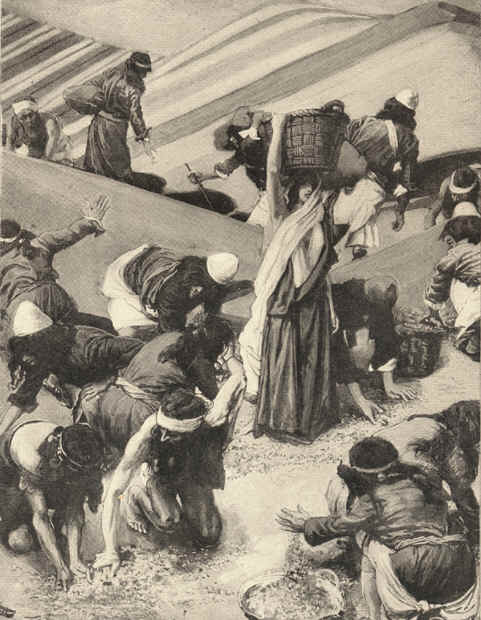 James Tissot, The Gathering of the Manna, public domain, via Wikimedia Commons 🔗. Later biblical illustration, not Orthodox iconography.
Glossary
- “Man” / manna: The name of Israel’s wilderness bread. Exodus 16:15 and 31 connect the first question about the unfamiliar food with its name.
- “Homer”: Brenton’s spelling for the portion measured in this chapter; verse 36 identifies its relation to a larger measure. It supplies a household’s share, rather than a claim to unlimited accumulation.
- “Sabbath”: The seventh day’s holy rest to the Lord, given here with a double portion on the preceding day.
- “Type”: A real person, event, or gift through which God prepares for a fuller reality in Christ. Manna is genuinely nourishing food and a preparation for the true Bread from heaven.
- “Eucharist”: The Church’s thanksgiving and sacramental communion in Christ’s true Body and Blood.
- “Theotokia”: A hymn in honour of the Theotokos, the Mother of God. Its praise confesses that the Son she bore is God incarnate.
Spiritual Fruit
Remember bondage truthfully. When an old sin begins to look comforting, recall what it actually did to prayer, relationships, and freedom. Bring that truth into confession without pretending that present hardship is easy. The Lord who heard Israel’s hunger can hear a plain request for help today.
Receive and share today’s portion. Thank God for a meal before rushing past it. Then identify one actual need in another household and meet what you reasonably can. Paul’s use of Exodus 16:18 makes care for another person’s lack part of our response to God’s provision.
Prepare for rest without making someone else carry everything. Protect time for worship and prayer, and help with the work that allows the rest of the household to do the same. The Sabbath bread is prepared beforehand. Holy time becomes tangible through shared responsibility, not through leaving the tired to serve the rested.
Come to Christ for life and healing. Approach Holy Communion with repentance, confession, and the guidance of your priest. Do not call carelessness confidence, or despair reverence. The life-giving Lord receives those who turn to Him and strengthens the obedience that fear alone cannot sustain.
At dawn Israel finds bread where it expected only hunger. The portion must be gathered, the household must be fed, and tomorrow must be entrusted to the Lord. Christ, the true Manna, gives more than a day of relief: He gives Himself. Lord, heal the memory that longs for Egypt, open the hand that clings to excess, and teach us to receive Your life with thanksgiving.
Teaching Notes
Keep the whole study centred on formation after deliverance: the Lord feeds free people into trust, mutual care, holy time, and communion with Christ. Linger over the contrast between ordinary spoiled leftovers and the preserved Sabbath portion; it prevents an indiscriminate attack on planning or saving.
Discuss: Remembering Egypt falsely (Exodus 16:1-3; Greek/Brenton 16:1-3)
- Ask: What has Israel included in its memory of Egypt, and what has it left out?
- Watch for: Never dismiss actual hunger or use the complaint to shame someone in need. The Lord provides food.
Discuss: Daily bread and the test of trust (Exodus 16:4-8; Greek/Brenton 16:4-8)
- Ask: How do the promise of bread and the command to gather belong together?
- Watch for: Distinguish refusing an assigned task from being unable to perform it. Explain Cyril of Jerusalem’s Eucharistic reading as a thematic witness, not direct Exodus commentary.
Discuss: Glory in the wilderness, bread from heaven (Exodus 16:9-16; Greek/Brenton 16:9-16)
- Ask: How do the cloud, the unfamiliar bread, and Christ’s words in John 6 reveal the Giver?
- Watch for: State Eucharistic fulfillment reverently through John 6 and Cyril’s account of the Incarnation. Preserve the distinction between manna as a type and Holy Communion as participation in Christ; apply Paul’s warning to our own presumption.
Discuss: Enough for each household (Exodus 16:17-21; Greek/Brenton 16:17-21)
- Ask: How does Paul’s quotation of verse 18 change the way a Christian uses abundance?
- Watch for: Do not equate all saving with hoarding or present involuntary anxiety as proof of rebellion. Paul’s appeal supplies need without crushing the giver.
Discuss: Sabbath as liberation from Pharaoh’s time-order (Exodus 16:22-30; Greek/Brenton 16:22-30)
- Ask: What does the gift of two days’ bread make possible, and who in a household needs help to receive rest?
- Watch for: Avoid mechanically transferring every wilderness rule to Sunday. Follow the passage’s gift of rest toward Christ and the Church’s worship.
Discuss: A golden pot and a remembered gift (Exodus 16:31-36; Greek/Brenton 16:31-36)
- Ask: Why must later generations remember manna after they can eat the produce of the land?
- Watch for: Keep the Sunday Theotokia’s Mary/pot and Christ/manna identification clear. Use the retained Tissot illustration as later biblical art, not as an Orthodox icon. The Covenant Thursday reading ends before the gift of manna; do not claim the service reads the whole chapter.
Sources
Embedded Scripture is from Brenton’s English Septuagint (LXX).
Exodus 16, Brenton 🔗; Deuteronomy 8 🔗; Wisdom 16 (Septuagint) 🔗; Psalm 78 (LXX 77) 🔗; Joshua 5 🔗.
New Testament cross-references: Matthew 4:4; 6:11; John 6:31-35, 48-58; 1 Corinthians 10:1-12; 2 Corinthians 8:9-15; Hebrews 4:9-11; 9:4; Revelation 2:17. The short quotation of 2 Corinthians 8:15 above is KJV.
St. Cyril of Alexandria, Commentary on John, Book III, chapter VI, on John 6:32-35, and Book IV, chapter II, on John 6:51-56, P. E. Pusey’s nineteenth-century English translation. Direct citations accompany the quotations below.
St. Cyril of Jerusalem, Mystagogical Catechesis V (Catechetical Lecture 23), §15, on the Lord’s Prayer in the Eucharistic liturgy. Direct citation below.
Katameros of the Holy Pascha, St. Mary Coptic Orthodox Church, Ottawa, English eBook edition, 2018, First Hour of Great Thursday, pp. 373-374. The printed reference is Exodus 15:23-16:3, but its opening text begins with Moses bringing Israel from the Red Sea, corresponding to Exodus 15:22. The reading runs through Exodus 16:3. “Covenant Thursday” follows the Coptic naming used by the Southern United States’ Eucharist account 🔗.
Sunday Theotokia, thirteenth and fifteenth parts, Sunday Midnight Praises, St. Antony Monastery English translation, as presented by Tasbeha.org 🔗.
James Tissot, The Gathering of the Manna, public-domain artwork, Wikimedia Commons file and rights page 🔗.
Footnotes
-
Katameros of the Holy Pascha, Ottawa, 2018, First Hour of Great Thursday, pp. 373-374; Coptic Orthodox account of the Eucharist’s institution on Covenant Thursday 🔗. The passage is printed as Exodus 15:23-16:3 but opens with the departure from the Red Sea, the content of 15:22, as distinguished above. ↩
-
Coptic Reader, Coptic Orthodox Metropolis of the Southern United States, official app: Special > Pascha > Thursday > Thursday Day > 1st Hour, printed Exodus 17:8-16; Special > Consecrations > Baptistery, printed Exodus 15:22-16:1; Special > Lakkan > Apostles Feast, printed Exodus 15:22-16:1. The app link does not select a service; follow the menu path. Printed references are retained separately from the Brenton text displayed here. ↩ ↩2
-
St. Cyril of Jerusalem, Mystagogical Catechesis V (Catechetical Lecture 23), §15, E. H. Gifford translation, primary text 🔗. ↩
-
Exodus 16:15, Hebrew text and analysis 🔗; Exodus 16:31, Hebrew text and analysis 🔗. ↩
-
John 6:31-35, 48-58 🔗; Psalm 78:24-25 (LXX 77:24-25), Brenton 🔗. ↩
-
St. Cyril of Alexandria, Commentary on John, Book III, chapter VI, on John 6:33, p. 365, P. E. Pusey translation, primary text 🔗. ↩
-
St. Cyril of Alexandria, Commentary on John, Book IV, chapter II, on John 6:51, p. 410, P. E. Pusey translation, primary text 🔗. ↩
-
St. Cyril of Alexandria, Commentary on John, Book IV, chapter II, on John 6:56, pp. 423-424, primary text 🔗; 1 Corinthians 10:1-12 🔗. ↩
-
Sunday Theotokia, fifteenth part (quotation) and thirteenth part (Incarnation), St. Antony Monastery English translation, Tasbeha.org hymn text 🔗. ↩