


This narration was recorded before the latest revision. The text on this page is current.
Pharaoh has ordered Hebrew sons to be thrown into the river. Into that threatened world Moses is born, and the river becomes the place of his preservation. A family hides him, a sister watches, and a princess receives him with compassion. When he grows up, faith draws him toward the suffering people of God rather than the security of Pharaoh’s house. Rejection and exile delay his public mission, but they do not cancel God’s purpose. The chapter closes with Israel’s cry and the covenant God who will make Himself known.
A family protects life under the decree (Exodus 2:1-4; Greek/Brenton 2:1-4)
A note on numbering. This study follows NKJV chapter and verse numbering and prints Brenton’s English Septuagint with its own verse labels. The numbered passage units here correspond in the two editions, although their wording can differ.
1: And there was a certain man of the tribe of Levi, who took to wife one of the daughters of Levi. 2: And she conceived, and bore a male child; and having seen that he was fair, they hid him three months. 3: And when they could no longer hide him, his mother took for him an ark, and besmeared it with bitumen, and cast the child into it, and put it in the ooze by the river. 4: And his sister was watching from a distance, to learn what would happen to him.
The chapter begins with a household of Levi, not with an army. Brenton says “they hid him,” even though the preceding sentence names the mother. Hebrews 11:23 makes the family participation explicit: Moses was hidden by his parents, and their action was an act of faith. His mother then prepares the vessel and his sister keeps watch. The family cannot control Pharaoh, but it can refuse to let his decree determine how it treats this child.
The mother places Moses in the “ooze by the river,” where his sister can watch him. The text describes a deliberate effort to preserve him, not a command to abandon children to danger. Faith here uses the protection available to it: hiding, a waterproof vessel, a chosen place, and someone watching. Parents and caregivers who seek shelter, medical help, or protection for a threatened child are not showing less faith than those who wait for an extraordinary rescue. Mercy takes practical form.
The “ark” and the memory of Noah
Brenton calls the vessel an “ark.” In the Hebrew text, the noun “tebah” is also used for Noah’s ark in Genesis 6:14; its biblical occurrences belong to the Noah narrative and this rescue of Moses. This is a Hebrew vocabulary link, not a claim that the Greek wording is identical. Both stories preserve life in a vessel amid dangerous waters. Noah’s ark bears a household through judgment; the small ark beside the Nile protects the child through whom Israel will later be led out. The scale changes, but the threatened life remains precious before God.1
This rescue also prepares the Christian reader to recognize another threatened child. Matthew 2:13-16 tells of Joseph taking the Child and His mother to Egypt when Herod seeks His life. Moses escapes a ruler within Egypt; Christ is sheltered in Egypt from another ruler. God’s saving purpose outlasts the power that tries to destroy it. The comparison leads us toward Christ without turning every detail of the basket into a separate symbol.
Compassion within Pharaoh’s house (Exodus 2:5-10; Greek/Brenton 2:5-10)
5: And the daughter of Pharao came down to the river to bathe; and her maids walked by the river’s side, and having seen the ark in the ooze, she sent her maid, and took it up. 6: And having opened it, she sees the babe weeping in the ark: and the daughter of Pharao had compassion on it, and said, This is one of the Hebrews’ children. 7: And his sister said to the daughter of Pharao, Wilt thou that I call to thee a nurse of the Hebrews, and shall she suckle the child for thee? 8: And the daughter of Pharao said, Go: and the young woman went, and called the mother of the child. 9: And the daughter of Pharao said to her, Take care of this child, and suckle it for me, and I will give thee the wages; and the woman took the child, and suckled it. 10: And when the boy was grown, she brought him to the daughter of Pharao, and he became her son; and she called his name, Moses, saying, I took him out of the water.
Pharaoh’s daughter recognizes the child as Hebrew before she has compassion on him. Mercy does not depend on mistaking him for one of her own. Her father’s policy sorts these children into a category marked for death; she sees a weeping infant. The princess’s compassion, the sister’s timely speech, and the mother’s care together reverse the decree. The child whom Pharaoh’s power endangers is nursed under protection from Pharaoh’s own household.
The sister does more than remain nearby. She speaks when help can be offered, and her proposal brings the child’s mother back to him. The mother is then paid to care for the son she could no longer hide. Providence works through their distinct actions, not through a vague promise that things will somehow improve. The women are participants in deliverance before Moses can perform any act of his own.
The princess’s explanation of the name is printed in verse 10: “I took him out of the water.” That explanation is enough for this reading; it need not be enlarged into an unverified account of the name’s linguistic origin. The rescued child will one day lead others out of bondage. For now, he must receive care. Even a future deliverer begins as someone who needs the mercy of others.
Acts 7:21-22 adds that Pharaoh’s daughter raised Moses as her own son and that he learned the wisdom of the Egyptians. Hebrews 11:24-26 then shows the decisive choice within that complicated upbringing: he chose affliction with God’s people over the pleasures and wealth available in Egypt, esteeming the reproach of Christ above those treasures. Education and access become spiritually fruitful when they serve the afflicted. Privilege becomes dangerous when it makes another person’s suffering easy to ignore.
 Teaching schematic spanning Exodus 1, 2, and 4. Its final figure, Zipporah, is Sepphora, Moses’ wife, and anticipates her act in chapter 4. Shiphrah and Puah are the midwives called Sepphora and Phua in Brenton; the midwife Sepphora and Moses’ wife are different women.
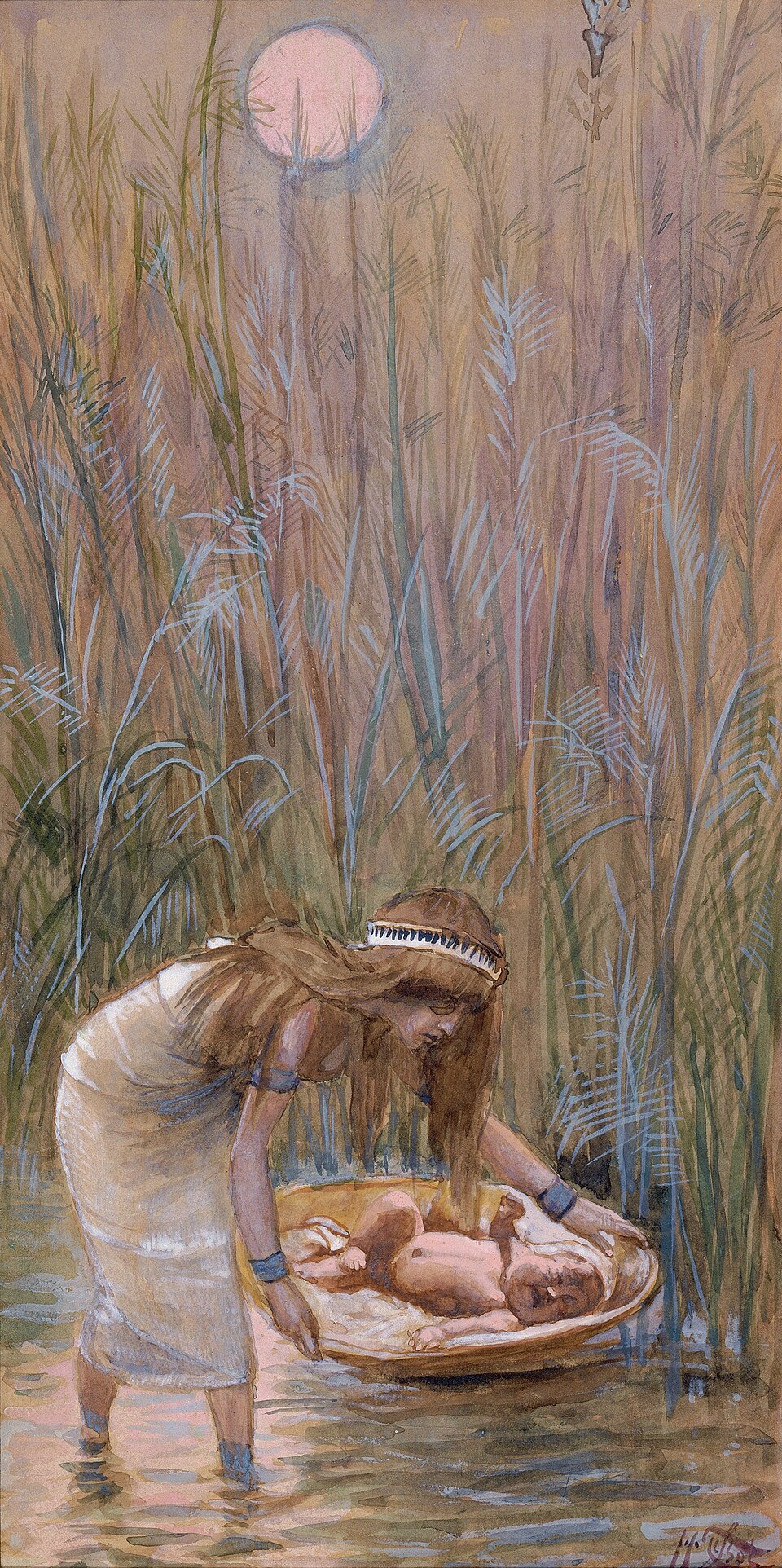 James Tissot, Moses Laid Amid the Flags. Public-domain Western biblical illustration, not Orthodox iconography. 🔗
Solidarity, rejection, and faithful flight (Exodus 2:11-15; Greek/Brenton 2:11-15)
11: And it came to pass in that length of time, that Moses having grown, went out to his brethren the sons of Israel: and having noticed their distress, he sees an Egyptian smiting a certain Hebrew of his brethren the children of Israel. 12: And having looked round this way and that way, he sees no one; and he smote the Egyptian, and hid him in the sand. 13: And having gone out the second day he sees two Hebrew men fighting; and he says to the injurer, Wherefore smitest thou thy neighbour? 14: And he said, Who made thee a ruler and a judge over us? wilt thou slay me as thou yesterday slewest the Egyptian? Then Moses was alarmed, and said, If it be thus, this matter has become known. 15: And Pharao heard this matter, and sought to slay Moses; and Moses departed from the presence of Pharao, and dwelt in the land of Madiam; and having come into the land of Madiam, he sat on the well.
Moses goes out to “his brethren” and sees their distress. The repeated language of kinship matters: the man raised in Pharaoh’s house belongs to the people whom Pharaoh oppresses. Acts 7:23-25 explains this visit at the age of forty as a defense of an oppressed brother. Stephen says Moses supposed his brethren would understand that God would deliver them by his hand, but they did not understand. The apostolic account directs attention to solidarity and a deliverer unrecognized by those he wishes to help. It does not make immaturity the controlling explanation of the scene.
The next day Moses addresses the man who is harming his neighbor. Acts 7:26 describes his aim as reconciliation between brothers. The aggressor answers with the question that will become central to Stephen’s preaching: who made Moses ruler and judge? Acts 7:35 returns to that rejection and declares that this very Moses is the one God sent as ruler and deliverer. The refusal of help does not give the final verdict on the helper. In Stephen’s witness to Christ, the rejected Moses exposes the terrible possibility of resisting the salvation God sends.
The killing and concealment of the Egyptian remain hard facts in Exodus. Reading the event through Stephen’s defense of Moses does not grant Christians permission to kill opponents or settle grievances by private violence. The New Testament’s praise of his faith directs us toward costly solidarity with the afflicted, not toward imitating every action in the narrative. The Christian task is to protect those in danger, seek justice through truthful and accountable means, and refuse hatred. Concern for another person’s suffering must never become an excuse for revenge.
Gems from the Fathers: Solidarity, rejection, and faithful flight
St. John Chrysostom faces the apparent tension between Moses being “alarmed” in Exodus 2:14 and Hebrews 11:27 saying that he left Egypt without fearing the king’s wrath. In Homily XXVI on Hebrews, §5, he connects Moses’ courage with his willingness to undertake the cause again, entrusting himself to God. Flight, in this reading, preserves a servant for the work ahead instead of proving that his faith has failed. Chrysostom then explains why remaining in a foreseeable danger would have tempted God:
“So that even flight was [an act of] faith. Why then did he not remain (you say)? That he might not cast himself into a foreseen danger.”2
Chrysostom reads Hebrews 11:27 in relation to this earlier flight and Moses’ later return. Readers also understand the verse as referring to the final departure from Egypt, so the identification should not be presented as universally settled. What is clear in Hebrews 11:24-27 is the direction of Moses’ faith: away from the treasures of Egypt, toward God’s afflicted people, and toward the invisible God whose promise he trusts.
St. Gregory of Nyssa also reads the confrontation positively in Life of Moses II.13-16, through an explicitly spiritual interpretation. The conflict becomes the struggle of righteousness against injustice and humility against arrogance. Moses’ taking the Hebrew’s side teaches the soul to side with virtue and overcome its adversary. Gregory directs this battle against evil within us, not against people whom we dislike.3
Chrysostom’s reading offers a merciful word for someone who needs to leave a dangerous place. Courage and prudent withdrawal can belong to the same faithful life. No threatened person must remain exposed to abuse merely to prove trust in God. Safety can preserve the freedom to serve again.
The Church’s Voice in Worship: Solidarity, rejection, and faithful flight
The Coptic Katameros places Exodus 2:11-20 among the Matins prophecies for Wednesday of the Second Week of the Holy Lent.4 The reading carries Moses from the distress of his brothers to his protection of the women at the well. Heard during the Fast, it joins self-denial to active concern for people who are being mistreated. Fasting should make us less captive to comfort and more attentive to the neighbor whose burden we could help carry.
A stranger serves at the well (Exodus 2:16-22; Greek/Brenton 2:16-22)
16: And the priest of Madiam had seven daughters, feeding the flock of their father Jothor; and they came and drew water until they filled their pitchers, to water the flock of their father Jothor. 17: And the shepherds came, and were driving them away; and Moses rose up and rescued them, and drew water for them, and watered their sheep. 18: And they came to Raguel their father; and he said to them, Why have ye come so quickly to-day? 19: And they said, An Egyptian delivered us from the shepherds, and drew water for us and watered our sheep. 20: And he said to his daughters, And where is he? and why have ye left the man? call him therefore, that he may eat bread. 21: And Moses was established with the man, and he gave Sepphora his daughter to Moses to wife. 22: And the woman conceived and bore a son, and Moses called his name Gersam, saying, I am a sojourner in a strange land.
In Madiam, commonly called Midian, Moses again sees people driven aside by stronger men. He rises to protect the priest’s daughters, then draws the water and waters their flock. His concern for the vulnerable continues after rejection in Egypt. Exile has taken away his palace position, but it has not taken away his capacity to help. The hands that cannot yet lead Israel can still relieve the labor of these women.
The well places this meeting alongside other biblical scenes of hospitality and household formation. Abraham’s servant meets Rebecca as she draws water and offers to water the camels in Genesis 24:11-27. Jacob meets Rachel and waters her father’s flock in Genesis 29:1-14. Moses likewise finds welcome through water-drawing and service. John 4:6-14 brings the well encounter to Christ: He asks the Samaritan woman for a drink and reveals the gift of living water. These are distinct stories, but their shared setting helps us notice how ordinary thirst and work become occasions of encounter.
The daughters call Moses “an Egyptian.” They recognize the stranger who helped them by that identity; the text gives no explanation of the particular outward sign that led them to it. The reader knows something they do not: this apparent Egyptian has chosen the afflicted Hebrews as his brothers. Their report warns us against assuming that a person’s appearance or social history tells us the whole truth of his loyalties. A man displaced from one household becomes a blessing to another.
Brenton names the father Jothor in verse 16 and Raguel in verse 18. These forms correspond to the names commonly rendered Jethro and Reuel. The account still presents the seven daughters returning to their father and the same household receiving Moses; it does not describe a transfer to a second family. The passage itself leaves the relationship between the two names unexplained. The two forms should remain visible rather than be silently replaced by one familiar name.
Moses marries Sepphora, commonly called Zipporah, and names his son Gersam, explaining that he is a sojourner in a strange land. Household life gives him welcome, responsibility, and daily work while the larger promise remains unfulfilled. Acts 7:30 states that forty years pass before the encounter at the bush, and Deuteronomy 34:7 gives his age at death as 120. The long preparation belongs to Scripture, not merely to a later tradition about his life. Yet a long wait by itself proves neither personal failure nor spiritual maturity. Its fruit appears in the faithful service a person actually gives.
For a servant in the Church, water-drawing is a searching image. It is possible to love the thought of leading people while resenting the small tasks that help them live. Household care, dependable work, and assistance offered without applause are real service. Formation in hidden years is worth preserving as a pastoral lesson here, but Moses’ exile should not be reduced to punishment for an unripe calling. God continues His purpose through the man who has already chosen solidarity with His people.
Covenant remembered, God made known (Exodus 2:23-25; Greek/Brenton 2:23-25)
23: And in those days after a length of time, the king of Egypt died; and the children of Israel groaned because of their tasks, and cried, and their cry because of their tasks went up to God. 24: And God heard their groanings, and God remembered his covenant made with Abraam and Isaac and Jacob. 25: And God looked upon the children of Israel, and was made known to them.
The king dies, but the burdens remain. Israel’s cry arises from the tasks themselves. The people need more than a change at the top of Egypt; they need deliverance from bondage. Their groaning reaches God before Moses hears the call at the bush. Salvation begins in God’s faithfulness, not in the deliverer’s discovery of a successful plan.
God “remembered his covenant” with Abraam, Isaac, and Jacob. The language prepares us for action on the promise. It does not mean that God had lost track of Israel and was reminded by the sound of pain. The promise already binds the present distress to the patriarchs’ story. In the next chapter, God will name Himself to Moses as the God of those fathers and announce that He has seen the affliction of His people.
The final line needs to be heard in Brenton’s own form: God “was made known to them.” Many Hebrew-based translations conclude that God knew or acknowledged Israel. The embedded Septuagint translation places the emphasis on God becoming known to His people. He hears, remembers, and looks upon them; His saving action will disclose who He is. The ending points beyond divine awareness of suffering toward the revelation of the covenant Lord in deliverance.
The line also brings us to a tender distinction in prayer. A person in bondage may believe that God exists and still cry out to know His help. Exodus does not rebuke that cry. Bring actual grief before Him, including the prayer that has become little more than groaning. Alongside prayer, the Church’s response must include practical help for the afflicted. We cannot celebrate the God who hears Israel while training ourselves not to hear the person beside us.
The Church’s Voice in Worship: Covenant remembered, God made known
The Matins prophecies of the first Monday of the Great Fast include Exodus 2:23-3:5.5 Israel’s groaning and the Lord’s covenant remembrance (2:23-25) lead directly into the unconsumed bush. At the beginning of the Fast, we bring suffering before the God who hears rather than measuring His faithfulness by how quickly distress ends.
Spiritual Fruit
Protect a life with the means at hand. Moses’ parents hide him, his mother prepares the vessel, and his sister watches. Choose one concrete act of protection or care: accompany someone seeking help, relieve a caregiver, support a family in distress, or make a household safer. Providence does not excuse passivity; it can work through this limited, available act.
Let faith change the use of privilege. Hebrews 11 places Moses’ choice beside the treasures of Egypt. Examine a comfort, connection, or position that tempts you to keep another person’s suffering at a distance. Use that resource in a way that costs something and serves someone. In prayer, ask Christ to make His reproach dearer to you than the approval that comes from remaining comfortable.
Serve faithfully before recognition comes. Moses protects the women and draws water while he is still a stranger. Complete an ordinary responsibility without turning it into a complaint about the more important work you hoped to do. A family member, fellow servant, or weary neighbor may need precisely that unnoticed faithfulness.
Bring the real burden into prayer. Israel cries because of its tasks, and God remembers His covenant. Name the burden without decorating it, then pray for the afflicted people who share it. Pray also for the grace to become part of the help they need. “Lord, make Yourself known to us in our distress, and make our hands ready for mercy.”
Teaching Notes
Keep Acts 7 and Hebrews 11 beside Exodus 2. They supply the apostolic account of solidarity, rejection, and faith. Hidden formation remains a useful pastoral application, but repeated judgments of Moses’ supposed immaturity should not govern the lesson.
Discuss: A family protects life under the decree (Exodus 2:1-4; Greek/Brenton 2:1-4)
- Ask: How do the parents’ hiding and the sister’s watching give concrete form to the faith described in Hebrews 11:23?
- Watch for: Treating the vessel as permission to abandon a child to danger, or presenting the Hebrew “ark” link as identical Greek vocabulary.
Discuss: Compassion within Pharaoh’s house (Exodus 2:5-10; Greek/Brenton 2:5-10)
- Ask: What does the princess know about the infant before she chooses to care for him?
- Watch for: Erasing the women’s distinct actions, or confusing the midwife Sepphora with Moses’ wife, who appears later. The chart spans chapters 1, 2, and 4.
Discuss: Solidarity, rejection, and faithful flight (Exodus 2:11-15; Greek/Brenton 2:11-15)
- Ask: How do Acts 7:25 and 7:35 change a reading that treats this scene chiefly as Moses’ failed ambition?
- Watch for: Turning Stephen’s defense of Moses into permission for private violence, or presenting Chrysostom’s identification of Hebrews 11:27 with the first flight as the only possible reading.
Discuss: A stranger serves at the well (Exodus 2:16-22; Greek/Brenton 2:16-22)
- Ask: What remains possible for Moses to do for others after he has lost his place in Egypt?
- Watch for: Inventing details about why the daughters call him Egyptian or claiming that this passage explains the relationship between Jothor and Raguel.
Discuss: Covenant remembered, God made known (Exodus 2:23-25; Greek/Brenton 2:23-25)
- Ask: What changes when we hear Brenton’s ending, “was made known to them,” rather than substitute “knew”?
- Watch for: Calling delayed deliverance proof of divine forgetfulness, or promising that every faithful family will experience Moses’ visible rescue.
Sources
Embedded Scripture is from Brenton’s English Septuagint (LXX).
Exodus 2, Brenton translation. 🔗
Acts 7:20-35; Hebrews 11:23-27; Matthew 2:13-16; John 4:6-14. These New Testament passages illuminate Moses’ upbringing, solidarity, rejection, faith, and the comparisons with Christ.
Genesis 24:11-27; Genesis 29:1-14; Deuteronomy 34:7, Brenton translation. 🔗 🔗 🔗
St. John Chrysostom, Homilies on Hebrews, Homily XXVI, §5, NPNF1, volume 14. The passage treats Exodus 2:14-15 in explaining Hebrews 11:27. 🔗
Katameros of the Holy Lent, Wednesday of the Second Week, Matins, printed pp. 155-156, hosted by the Coptic Orthodox Diocese of the Midlands. 🔗
Bible Hub, Hebrew text and lexical entry for “tebah,” Strong’s 8392; Genesis 6:14 and Exodus 2:3. The vocabulary observation uses the text and concordance, not the site’s devotional exposition. 🔗 🔗 🔗
James Tissot, Moses Laid Amid the Flags, image attribution. 🔗
Ellicott’s commentary on Hebrews 11:27, for the acknowledged distinction between the flight to Midian and the final Exodus; used only to document the alternative identification, not as a patristic authority. 🔗
Hebrew text and English parallels for Exodus 2:25, compared with the embedded Brenton ending. 🔗
Footnotes
-
Hebrew “tebah,” Strong’s 8392, occurs in the Noah narrative and Exodus 2:3, 5; compare the actual Hebrew forms in Genesis 6:14 and Exodus 2:3. 🔗 🔗 🔗 ↩
-
St. John Chrysostom, Homilies on Hebrews, Homily XXVI, §5, NPNF1, vol. 14, paragraph beginning “So that even flight.” 🔗 ↩
-
St. Gregory of Nyssa, Life of Moses II.13-16, especially II.14-15, translated by Abraham J. Malherbe and Everett Ferguson (Paulist Press, 1978), pp. 57-58. Paraphrase, 🔗 edition. ↩
-
Katameros of the Holy Lent, Wednesday of the Second Week, Matins, Exodus 2:11-20, printed pp. 155-156. 🔗 Coptic Reader, Coptic Orthodox Metropolis of the Southern United States, official app: Readings > Matins > Prophecies, printed Exodus 2:11-20. The app link does not select a service; follow the named menu path. The selected date was February 25, 2026, with the stated Great Fast occasions confirmed. ↩
-
Coptic Reader, Coptic Orthodox Metropolis of the Southern United States, official app: Readings > Matins > Prophecies, printed Exodus 2:23-3:5. The app link does not select a service; follow the menu path. Printed references are retained separately from the Brenton text displayed here. The consulted Reader document was selected for February 16, 2026, the first Monday of the Great Fast; this dated witness does not establish every edition’s calendar practice. ↩