
The altar on which prayer rises must itself be purified with blood. That detail in Exodus 30:10 prevents the sanctuary from becoming a monument to human religious achievement. Israel approaches God through gifts God appoints: incense, ransom, water, and anointing. The chapter carries us from the fragrance before the veil to the washing of hands and feet, and finally to the distinction between what is holy and what we would like to possess for ourselves.
Historical and Scriptural Context
Moses remains on Mount Sinai, receiving the sanctuary instructions that began in Exodus 25. Chapters 28–29 have described Aaron’s garments, consecration, and the daily lambs. Chapter 30 adds the incense altar and several requirements for the sanctuary’s life. These are commands for a dwelling not yet assembled. Chapter 31 will identify the people who can make these things and will limit even their sacred labor by Sabbath rest. Chapter 32 will expose the people’s desire for a visible god on their own terms.
The incense altar and the altar of whole burnt-offerings are different furnishings. The first stands inside the tent before the veil (30:6); the second belongs outside in the court. The laver, a basin for washing, stands between the tent and the outer altar (30:18). The chapter’s order of explanation is not a walking route through the court. Keeping the two altars distinct makes the instructions about incense, blood, and water intelligible.
The five sections below follow the chapter’s own subjects. Christological and Coptic connections arise from those subjects; they are not claims that Israel already celebrated the Church’s sacramental rites in their completed form.
Where to Linger
Linger over the altar that itself needs atonement (30:10), the equal ransom of rich and poor (30:15), the washing before service (30:19-21), and the oil that sanctifies what belongs to God (30:25-33). These details keep approach to God joined to mercy, bodily reverence, and obedience.
Prayer before the veil (Exodus 30:1-10)
1: And thou shalt make the altar of incense of incorruptible wood. 2: And thou shalt make it a cubit in length, and a cubit in breadth: it shall be square; and the height of it shall be of two cubits, its horns shall be of the same piece. 3: And thou shalt gild its grate with pure gold, and its sides round about, and its horns; and thou shalt make for it a wreathen border of gold round-about. 4: And thou shalt make under its wreathen border two rings of pure gold; thou shalt make it to the two corners on the two sides, and they shall be bearings for the staves, so as to bear it with them. 5: And thou shalt make the staves of incorruptible wood, and shalt gild them with gold. 6: And thou shalt set it before the veil that is over the ark of the testimonies, wherein I will make myself known to thee from thence. 7: And Aaron shall burn upon it fine compound incense every morning; whensoever he trims the lamps he shall burn incense upon it. 8: And when Aaron lights the lamps in the evening, he shall burn incense upon it; a constant incense-offering always before the Lord for their generations. 9: And thou shalt not offer strange incense upon it, nor an offering made by fire, nor a sacrifice; and thou shalt not pour a drink-offering upon it. 10: And once in the year Aaron shall make atonement on its horns, he shall purge it with the blood of purification for their generations: it is most holy to the Lord.
The altar begins with “incorruptible wood” (verse 1), then receives pure gold (verse 3). Its dimensions are modest: one cubit square and two cubits high (verse 2). Rings and gilded staves make it portable (verses 4–5). This dwelling accompanies a people on the way. The presence of God is not secured by a city, a monumental building, or material luxury. Even an object of gold is made to travel in obedience.
Verse 6 places the altar before the veil associated with the ark of the testimonies. The Lord’s promise is personal: He will make Himself known there. Incense therefore belongs to an encounter received from Him. Aaron does not burn it to manufacture a divine response. Morning incense accompanies the trimming of the lamps; evening incense accompanies their lighting (verses 7–8). Light and prayer are cared for together, with a constancy that reaches beyond a single intense religious experience.
Psalm 140:2 LXX gives this offering its scriptural language: “Let my prayer be set forth before thee as incense.”1 In Luke 1:8–11, Zacharias serves at the incense altar while the people pray outside. His priestly work and their prayer belong to one act of worship. Revelation 8:3–4 opens the earthly scene toward heaven: incense rises with the prayers of the saints before God. These connections deepen the meaning of incense without claiming that smoke by itself makes prayer acceptable. A distracted worshipper can smell the incense and remain absent in heart; the visible offering calls the heart to join it.
Verse 9 protects the altar’s particular purpose. It is not a second place for burnt sacrifices or drink-offerings, and “strange incense” may not be substituted for what God appoints. Distinct service requires obedient care. That care culminates in verse 10: once a year Aaron purges the horns with “the blood of purification.” Even the altar of prayer stands within the need for atonement. Our prayers can be mixed with resentment, vanity, and self-justification. We approach through mercy, rather than treating a religious act as proof that we are already pure.
Hebrews 9:7 remembers the high priest’s annual entry with blood, and Hebrews 9:25–26 distinguishes that repeated ministry from Christ’s once-for-all self-offering. Exodus 30:10 concerns the incense altar’s yearly purification; Hebrews sets the wider annual rite beside Christ’s perfect sacrifice. Hebrews 9:3–4 also associates the golden incense furnishing with the Holiest. Its wording has been translated as “censer” or “altar of incense.” It should not be used to redraw the clear position in Exodus 30:6: here the altar stands before the veil. The sanctuary’s arrangement and the furnishing’s relation to the inner ministry must be distinguished.2
Language insight: “incorruptible wood”
The Greek phrase in verses 1 and 5 is “ξύλων ἀσήπτων,” wood resistant to decay. Brenton’s “incorruptible” carries that material description. It is not a claim that wood is eternal or divine. In Christian contemplation, a durable wooden altar clothed with gold can turn the mind toward Christ, whose humanity is truly created and whose person is the divine Word. That is a typological reading, not a botanical proof of the Incarnation. The text first teaches the careful preparation of an earthly furnishing for holy service.3
The Church’s Voice in Worship
The Coptic Raising of Incense preserves an evening and morning offering: Vespers and Matins. Exodus 30:7–8 helps us recognize why repetition is fruitful. We bring the day we have lived and the day we are about to live under God’s mercy. The Church gathers prayer before we come to the Eucharistic offering; worship is more than arriving at its most solemn moment without preparation.4
The hymn Tai Shori joins incense to Aaron: “This is the censer of pure gold bearing the aroma, in the hands of Aaron the priest, offering up incense on the altar.”5 Ti Shori names the fulfillment through the Virgin: “The golden censer is the Virgin, her aroma is our Savior.”6 The censer carried by a priest is not the stationary altar described in verses 1–6. The hymns bring related sanctuary images into one confession: the offering is fulfilled in Christ, whom the Virgin truly bore.
The Sunday Theotokia, a hymn praising the mystery of God’s Incarnation through the Theotokos, makes the meaning of the live Coal explicit. Part Six calls it “God the Word, who was incarnate of you, and offered Himself as incense, to God His Father.”7 The Coal recalls Isaiah 6:6–7, where fire from the altar purifies the prophet; the hymn identifies the saving reality with the incarnate Word. Mary is honored as the one who carried Him, not as the source of His divinity or a rival redeemer.
Parts Thirteen and Fifteen broaden the image to the tabernacle’s furnishings: the ark, the vessel of manna, and the golden censer are contemplated through Mary’s bearing of Christ. Part Thirteen says, “A true tabernacle, is Mary the Virgin,” while Part Fifteen also relates the table to the altar and its bread to the Lord’s Body.8 The hymn is richer than a rigid scheme in which every object means only one thing. Its center is the true Sacrifice, the Lord who took flesh and gave Himself for the forgiveness of sins.
Every life belongs to the Lord (Exodus 30:11-16)
11: And the Lord spoke to Moses, saying, 12: If thou take account of the children of Israel in the surveying of them, and they shall give every one a ransom for his soul to the Lord, then there shall not be among them a destruction in the visiting of them. 13: And this is what they shall give, as many as pass the survey, half a didrachm which is according to the didrachm of the sanctuary: twenty oboli go to the didrachm, but the half of the didrachm is the offering to the Lord. 14: Every one that passes the survey from twenty years old and upwards shall give the offering to the Lord. 15: The rich shall not give more, and the poor shall not give less than the half didrachm in giving the offering to the Lord, to make atonement for your souls. 16: And thou shalt take the money of the offering from the children of Israel, and shalt give it for the service of the tabernacle of testimony; and it shall be to the children of Israel a memorial before the Lord, to make atonement for your souls.
A census can make people look like resources to be counted and controlled. Verse 12 interrupts that possibility: each person gives “a ransom for his soul to the Lord.” The danger of destruction shows that counting Israel cannot be detached from acknowledging the Lord who delivered it. Verses 13–14 specify the offering and the age at which it is given. Verse 16 gives the money a concrete use, the service of the tabernacle, and a spiritual meaning, a memorial before God. The offering supports the sanctuary while remembering that the lives counted belong to Him.
“The rich shall not give more, and the poor shall not give less” (verse 15). This fixed offering is not a general rule that every parish donation must be identical, nor a reason to ignore a poor person’s hardship. It places each counted life before the same need for atonement. Wealth cannot purchase a better place in this memorial, and poverty cannot diminish the person remembered. A church that honors influential donors while barely seeing those who have little has forgotten the force of the verse.
David’s census in 2 Kingdoms 24 (2 Samuel 24) provides a grave comparison. Joab questions the king’s demand, David later confesses his sin, and a plague follows. The narrative does not explain David’s sin simply as a failure to collect this ransom. It shows the danger of numbering the people in a way that becomes accountable before God, and of treating national strength as the ruler’s possession.9 Neither passage licenses believers to assign a modern epidemic to a particular group’s presumed sin.
Language insight: “half a didrachm” and the temple tax
Brenton prints “half a didrachm” in verse 13 and defines the sanctuary didrachm as twenty oboli. The Greek likewise has “τὸ ἥμισυ τοῦ διδράχμου,” half of the didrachm. Matthew 17:24 calls the temple tax “δίδραχμα,” didrachmas, while verse 27 names the coin found in the fish as a “στατήρ,” a stater.10 The shared monetary vocabulary makes Matthew a particularly close comparison, but the amounts must not be flattened. Exodus’s sanctuary didrachm and Matthew’s later tax terminology do not justify silently changing the printed “half a didrachm” into “a didrachm.”
In Matthew 17:24–27, Christ explains that the sons are free, yet provides payment for Himself and Peter to avoid giving offense. The Son’s freedom is joined to humble care for another. He does more than pay a sanctuary assessment: Matthew 20:28 says that He gives His life as a ransom for many, and 1 Peter 1:18–19 names His precious blood, rather than silver or gold, as the price of redemption. The fixed coin in Exodus points beyond a purchasable religious benefit. In Christ, we receive the redemption we could never buy. That gift frees generosity from the need to purchase importance.
Washed hands and feet (Exodus 30:17-21)
17: And the Lord spoke to Moses, saying, 18: Make a brazen laver, and a brazen base for it, for washing; and thou shalt put it between the tabernacle of witness and the altar, and thou shalt pour forth water into it. 19: And Aaron and his sons shall wash their hands and their feet with water from it. 20: Whensoever they shall go into the tabernacle of witness, they shall wash themselves with water, so they shall not die, whensoever they advance to the altar to do service and to offer the whole burnt-offerings to the Lord. 21: They shall wash their hands and feet with water, whensoever they shall go into the tabernacle of witness; they shall wash themselves with water, that they die not; and it shall be for them a perpetual statute, for him and his posterity after him.
The laver stands between the tent and the altar (verse 18), where Aaron and his sons must use it before entering the tent or approaching the altar for service (verses 19–21). The water touches hands and feet, the members that act and move. The command gives bodily form to a truth that reaches into the conscience: service at the altar does not excuse careless conduct on the way there. Religious responsibilities cannot cleanse dishonesty, harshness, or neglected duties merely by keeping us busy.
The warning “that they die not” must retain its gravity. The priests are approaching the Lord under a covenant whose holy service has exact boundaries. This is not evidence that an unwashed child, a person with a disability, or someone prevented from performing a ritual is rejected by God. Christians are not authorized to punish people violently in the name of sanctuary purity. The text calls us to reverence and accountable preparation, not terror directed at vulnerable people.
John 13:5–10 reverses the expected posture: the Lord kneels to wash His disciples’ feet. Peter first refuses, then asks for his hands and head as well. Christ teaches that participation in Him requires receiving His cleansing. Aaron washes before service; Christ washes those whom He is preparing to serve. The connection leads toward humility as well as purification. We can be proud both of our dirt and of our imagined cleanliness. The Lord’s gift breaks both forms of self-sufficiency.
Titus 3:5 names salvation through the washing of regeneration and the renewing of the Holy Spirit; Ephesians 5:26 presents Christ cleansing His Church with the washing of water by the word. These are substantial baptismal connections, while the laver itself remains the priestly washing appointed in Exodus. Baptism is the new birth Christ gives, not a routine repeated whenever hands are washed. Our continuing repentance lives from that gift rather than replacing it.
The Church’s Voice in Worship
The Apostles Feast Laqan and the consecration of a baptistery appoint Exodus 30:17-30. The first part of the consecration of a church appoints Exodus 30:17-31:13, carrying the laver and holy oil into the calling of the craftsmen. The washing commanded in verses 17-21 is therefore heard in actual Coptic rites of water and consecration, not only remembered through a resemblance.11
Before the Offering of the Lamb in the Coptic Liturgy, the priest washes his hands as he prepares to handle the bread that will become the Lord’s Body. The bodily preparation echoes the laver’s command without identifying the two rites as identical. Clean hands at the altar should awaken the desire for truthful hands at home, at work, and in our dealings with others.12
The Laqan services, liturgies for the blessing of water, bring the laver’s concern for water and bodily sanctification into the Church’s worship. On Covenant Thursday, the connection becomes especially close through the washing of feet and John 13. The service prays: “O You who prepared for us the way of life through the washing of the chosen holy disciples’ feet. We ask You, O Christ our God, to hear us and have mercy upon us.”13 Its rubric directs the priest to wash the feet of fellow priests, deacons, and people. Christ’s cleansing is received within a community called to humble service. The different Laqan celebrations should not all be described as foot-washing rites; the Covenant Thursday text establishes the particular form discussed here.
Holy oil and the gift of anointing (Exodus 30:22-33)
22: And the Lord spoke to Moses, saying, 23: Do thou also take sweet herbs, the flower of choice myrrh five hundred shekels, and the half of this two hundred and fifty shekels of sweet-smelling cinnamon, and two hundred and fifty shekels of sweet-smelling calamus, 24: and of cassia five hundred shekels of the sanctuary, and a hin of olive oil. 25: And thou shalt make it a holy anointing oil, a perfumed ointment tempered by the art of the perfumer: it shall be a holy anointing oil. 26: And thou shalt anoint with it the tabernacle of witness, and the ark of the tabernacle of witness, 27: and all its furniture, and the candlestick and all its furniture, and the altar of incense, 28: and the altar of whole burnt-offerings and all its furniture, and the table and all its furniture, and the laver. 29: And thou shalt sanctify them, and they shall be most holy: every one that touches them shall be hallowed. 30: And thou shalt anoint Aaron and his sons, and sanctify them that they may minister to me as priests. 31: And thou shalt speak to the children of Israel, saying, This shall be to you a holy anointing oil throughout your generations. 32: On man’s flesh it shall not be poured, and ye shall not make any for yourselves according to this composition: it is holy, and shall be holiness to you. 33: Whosoever shall make it in like manner, and whosoever shall give of it to a stranger, shall be destroyed from among his people.
The sanctuary’s consecration includes the trained work of a perfumer. Myrrh, cinnamon, calamus, cassia, and olive oil are compounded according to definite quantities (verses 23–25). Material skill serves holiness. The oil anoints the dwelling, its furnishings, the altars, and the laver (verses 26–29). Aaron and his sons are then anointed so that they may minister to the Lord (verse 30). Consecration sets people and things apart for His service; it does not make them possessions of the person who prepared the mixture.
Verse 32 can sound contradictory after verse 30: “On man’s flesh it shall not be poured.” Read together, the commands distinguish appointed priestly anointing from ordinary personal application. Verse 30 expressly requires oil on Aaron and his sons; verse 32 forbids treating the same composition as private perfume. Verse 33 extends the prohibition to copying it and giving it to a stranger. Holiness resists appropriation. These covenant penalties are not instructions for Christians to attack outsiders, police bodies, or give ethnic exclusion a sacred name.
Psalm 132:1–3 in Septuagint numbering celebrates brothers dwelling together and compares that unity to oil descending on Aaron’s beard and clothing.14 The anointing serves communion under God, not an isolated claim to spiritual superiority. Acts 10:38 names Jesus as anointed with the Holy Spirit and power, going about doing good and healing. Christ’s anointing bears mercy as its fruit. The Church receives an anointing from the Holy One (1 John 2:20, 27), and God establishes and seals believers in Christ, giving the Spirit in their hearts (2 Corinthians 1:21–22). The sanctuary’s consecration opens toward the consecration of persons whose whole life becomes service.
John’s anointing passage is also a safeguard. It calls believers to remain in what they heard from the beginning concerning the Father and the Son (1 John 2:24–27). It does not make each person’s inward impressions an infallible teacher or free us from the Church. The Spirit keeps us in the truth of Christ and trains our senses for obedience.
Gems from the Fathers
St. Cyril of Jerusalem addresses newly baptized Christians in Mystagogical Catechesis III, also numbered Catechetical Lecture 21. In section 6 he reads Aaron’s anointing as the earlier figure of their chrism: “after bathing in water, he anointed him; and Aaron was called Christ or Anointed, evidently from the typical Chrism.”15 Aaron is called anointed by office; he is not identified with Jesus Christ. The Christian fulfillment is participation in the anointing of the true Christ.
In section 3, Cyril guards the reality of the gift received through consecrated matter: “this holy ointment is no more simple ointment, nor (so to say) common, after invocation.”16 He goes on to distinguish the visible anointing of the body from the soul’s sanctification by the Holy and life-giving Spirit. His words make Exodus 30’s distinction between holy and common spiritually consequential. The oil is received as a gift of Christ; reverence includes the life that follows the anointing.
The Church’s Voice in Worship
The preparation of the Holy Myron appoints Exodus 30:22-38, and its consecration appoints Exodus 30:22-33. The Church hears the holy oil and its sanctifying purpose within the very rite that prepares and consecrates chrism. The ancient command remains a biblical witness, while the gift received in Chrismation belongs to Christ’s fulfilled work and the Holy Spirit.11
The Coptic Holy Myron, consecrated chrism, is used in Chrismation after Baptism and in the consecration of the Church’s appointed holy things. The newly baptized are anointed to receive the seal of the Holy Spirit. Exodus 30:26–30 gives a genuine biblical pattern for sanctifying both persons and furnishings, while the Church’s sacrament belongs to Christ’s fulfilled gift of the Spirit. It is neither a private attempt to reproduce Moses’ recipe nor a claim that every Christian has Aaron’s priestly office.17
Anointed eyes, ears, hands, and feet belong to a life received from the Lord. Chrismation is not spiritual decoration added to Baptism. It consecrates the person for communion with Christ, whose Spirit makes prayer truthful, service merciful, and the body an instrument of obedience.
Fragrance that belongs to God (Exodus 30:34-38)
34: And the Lord said to Moses, Take for thyself sweet herbs, stacte, onycha, sweet galbanum, and transparent frankincense; there shall be an equal weight of each. 35: And they shall make with it perfumed incense, tempered with the art of a perfumer, a pure holy work. 36: And of these thou shalt beat some small, and thou shalt put it before the testimonies in the tabernacle of testimony, whence I will make myself known to thee: it shall be to you a most holy incense. 37: Ye shall not make any for yourselves according to this composition; it shall be to you a holy thing for the Lord. 38: Whosoever shall make any in like manner, so as to smell it, shall perish from his people.
The incense is also compounded with skill. Verse 34 gives equal weights of the appointed substances; verse 35 calls the result “a pure holy work.” The material is beaten small and placed before the testimonies, where God promises to make Himself known (verse 36). This repeated promise from verse 6 joins the chapter’s beginning to its close. Fragrance is ordered toward meeting the Lord, rather than toward enjoying an atmosphere detached from Him.
Verses 37–38 forbid copying the composition for personal pleasure. The temptation is recognizable: to borrow worship’s beauty while refusing the One to whom it belongs. We may want sacred music without prayer, the Church’s language without repentance, or sacramental consolation without a changed life. The distinction between holy and common protects love from being reduced to consumption.
The severe penalty in verse 38 belongs to Israel’s covenant legislation; it authorizes no private or ecclesial violence against people today. Christian reverence expresses itself in repentance, careful care of holy things, and obedience to the Church’s lawful sacramental order. In the Sunday Theotokia’s reading of incense, the fragrance leads to the Son offering Himself to the Father. Our response is therefore communion and thanksgiving, not possession of a religious sensation.
Visual Teaching
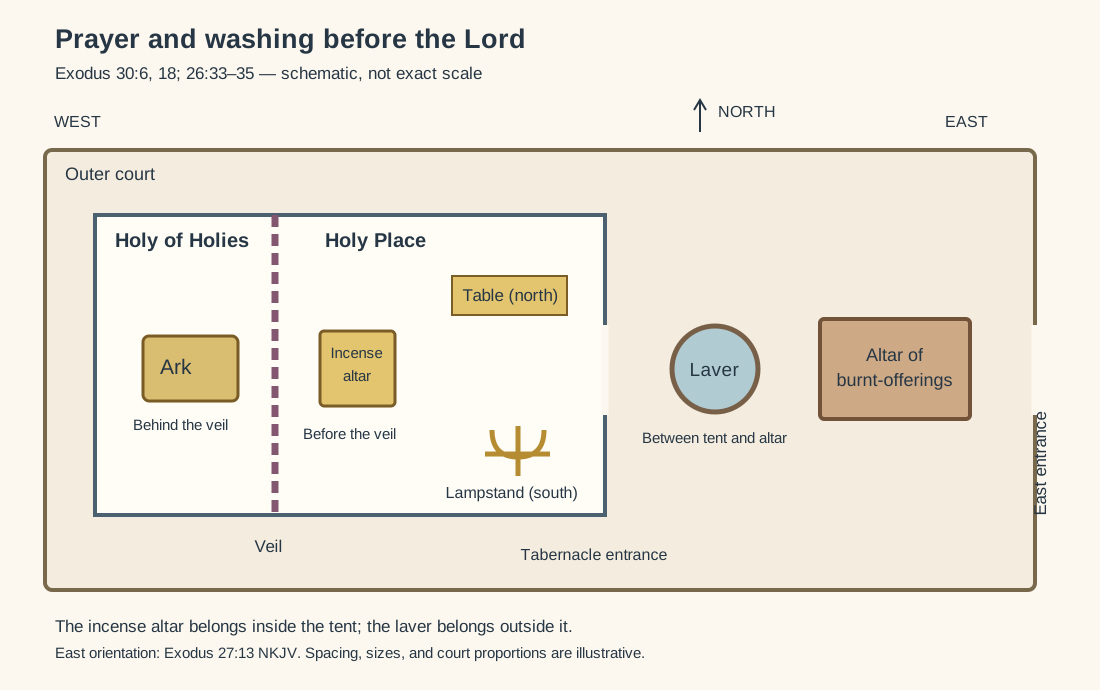 Source: Original schematic based on Exodus 30:6, 18 and 26:33–35; conventional eastward orientation follows Exodus 27:13–16 in the Hebrew-based NKJV. Not exact scale; spacing and proportions are illustrative.
The incense altar belongs before the inner veil, on the Holy Place side; the ark belongs behind it. The laver is outside, between the tent and the altar of whole burnt-offerings. The table’s northern position and the lampstand’s southern position come from Exodus 26:35. The diagram uses the conventional eastward entrance found in the Hebrew-based wording of Exodus 27:13–16. Brenton and the Greek Septuagint have different directional wording in Exodus 27:9–13, so this orientation is distinguished from the altar-and-laver positions given in chapter 30.18 The plan illustrates those positions without claiming surveyed distances between the furnishings.
Glossary
- Laver: a washing basin; here a brazen, or bronze, vessel used by Aaron and his sons before holy service.
- Atonement: God-appointed dealing with sin and purification so that His people may approach Him. The word does not imply that God can be bought or persuaded to become loving.
- Didrachm and obol: monetary or weight terminology in Brenton’s translation. Exodus defines its sanctuary didrachm as twenty oboli and requires half of it; the later didrachma tax appears in Matthew 17:24.
- Theotokos: “God-bearer,” the Church’s title for the Virgin Mary because the person she bore is God the Word incarnate.
- Theotokia: a hymn of praise to the Theotokos that confesses the mystery of the Incarnation through biblical types.
- Laqan: a basin and, by extension, the Coptic service of blessing water. Covenant Thursday includes the washing of feet.
- Myron / chrism: consecrated fragrant oil used in Chrismation and appointed consecrations. Chrismation seals the baptized with the Holy Spirit.
- Typology: reading earlier persons, events, and institutions as God-given patterns fulfilled in Christ. The real earlier event is retained, and the fulfillment exceeds it.
Spiritual Fruit
Give prayer a place in the day. Aaron’s morning and evening service in verses 7–8 challenges the habit of praying only when distress becomes unbearable. Keep a modest, faithful beginning and ending to the day. Bring a particular person’s need to Christ, and ask Him to gather your scattered attention. Constancy can be small without being casual.
Receive your worth before trying to display it. The equal ransom in verse 15 frees both wealthy and poor people from measuring their standing by what they can contribute. Give without demanding influence. Receive help without concluding that you matter less. The Lord who redeemed you with His blood did not price you according to your income.
Let preparation reach into conduct. The washed hands and feet of verses 19–21 give a concrete examination of conscience: what have these hands done, and where have these feet taken me? Before Communion, address the lie, the neglected responsibility, or the quarrel that religious busyness has hidden. Confession and practical repair belong beside prayer.
Live as one anointed. Verses 30–32 distinguish consecration from private use. Remember the Myron received after Baptism when deciding what to look at, listen to, say, or do. Holy things are not trophies, and the baptized person is not a vessel of contempt for others. Ask the Holy Spirit to make your body’s service truthful and merciful.
The altar stands before the veil, and God promises to make Himself known. Bring Him more than the fragrance of a passing feeling: bring the day, the conscience, and the body He has redeemed. Christ gives the cleansing that makes approach possible. Let thanksgiving remain when the incense is no longer visible.
Teaching Notes
Where to linger: 30:6–10, where daily incense and annual purification belong together; 30:15, where wealth cannot buy a larger place before God; 30:19–21, where bodily preparation carries grave responsibility; and 30:30–32, where priestly anointing explains the prohibition on ordinary application. Keep the two altars distinct throughout.
Prayer before the veil (Exodus 30:1-10)
- Ask: Why does the altar of prayer itself need purification with blood?
- Emphasize: The Lord appoints the place of meeting; prayer responds to His mercy.
- Watch for: Treating incense as a magical means of changing God, confusing censer and incense altar, or relocating the altar behind the veil by appeal to Hebrews 9:4.
- Connect: Zacharias in Luke 1:8–11, Revelation 8:3–4, the Raising of Incense, Tai Shori, Ti Shori, and the Sunday Theotokia.
- Show: Use the plan to locate the incense altar on the Holy Place side of the veil.
Every life belongs to the Lord (Exodus 30:11-16)
- Ask: How might a parish let money decide whose voice or suffering matters?
- Emphasize: The equal offering witnesses equal need for atonement; Christ’s ransom exceeds every monetary payment.
- Watch for: Turning verse 15 into an inflexible parish fundraising rule, equating the two historical didrachm amounts, or reducing David’s sin to a detail his narrative does not state.
- Connect: Matthew 17:24–27, Matthew 20:28, and 1 Peter 1:18–19.
Washed hands and feet (Exodus 30:17-21)
- Ask: What changes when the Lord Himself washes the disciples’ feet?
- Emphasize: Cleansing must be received, and reverence belongs with humble service.
- Watch for: Ritual scrupulosity, contempt for disability or illness, coercion, and confusion of repeated handwashing with Baptism.
- Connect: John 13:5–10, Titus 3:5, Ephesians 5:26, priestly handwashing, and the Covenant Thursday Laqan.
- Show: Locate the laver between the tent and the outer altar; do not put it inside the Holy Place.
Holy oil and the gift of anointing (Exodus 30:22-33)
- Ask: How does verse 30 clarify the prohibition in verse 32?
- Emphasize: Consecration belongs to God’s appointed service; Cyril’s catechesis distinguishes the earlier figure and Christian fulfillment.
- Watch for: Calling Cyril of Jerusalem “Cyril of Alexandria,” identifying Aaron with Christ personally, private reproduction of holy oil, or treating inward impressions as infallible.
- Connect: Holy Myron, 1 John 2:20–27, 2 Corinthians 1:21–22, and the merciful fruit of Christ’s anointing in Acts 10:38.
Fragrance that belongs to God (Exodus 30:34-38)
- Ask: When do we desire the beauty of worship while avoiding repentance?
- Emphasize: The chapter begins and ends with God making Himself known.
- Watch for: Any use of covenant penalties to authorize violence or exclusion against present-day peoples.
- Connect: The Sunday Theotokia’s confession of Christ as the true offering.
Sources
Embedded Scripture is from Brenton’s English Septuagint (LXX). Psalm numbers in the exposition follow the Septuagint: Psalm 140 corresponds to Hebrew-based Psalm 141, and Psalm 132 to Psalm 133.
Scripture connections developed above: Luke 1:8–11; Revelation 8:3–4; Hebrews 9:3–7, 25–26; Matthew 17:24–27; Matthew 20:28; 1 Peter 1:18–19; John 13:5–10; Titus 3:5; Ephesians 5:26; Acts 10:38; 1 John 2:20–27; 2 Corinthians 1:21–22.
St. Cyril of Jerusalem, Mystagogical Catechesis III / Catechetical Lecture 21, §§3, 6. These are Christian catecheses, not descriptions of a modern Coptic Myron service.
Coptic liturgical texts: Tai Shori, Ti Shori, and Sunday Theotokia Parts Six, Thirteen, and Fifteen; direct text links in the footnotes. No seasonal rubric for choosing between the censer hymns is asserted here.
Rites of Pascha Week, Book 4, Great Thursday Eve and Day, Covenant Thursday Laqan, pp. 169, 222, 250. This source supports Covenant Thursday’s water and foot-washing connection; the separately cited Apostles Feast Laqan appoints Exodus 30:17-30.
Southern Diocese rite instruction for the Raising of Incense and Offering of the Lamb; Br. Antonios the Shenoudian, The Holy Myron, a modern Coptic explanation. No prayer from the Myron consecration service or handwashing rite is quoted.
Footnotes
-
Brenton, Psalm 140:2, printed with the corresponding Hebrew-based number 141 on Bible Hub. ↩
-
Hebrews 9:3–4, translation comparison. The NKJV reads “golden censer”; a number of other translations read “golden altar of incense.” Exodus 30:6 supplies the spatial instruction used here. ↩
-
Greek Exodus 30:1, 5, Septuagint text; Brenton’s “incorruptible wood” is retained in the Scripture quotation. ↩
-
Southern Diocese, Coptic Rites (1): Raising of Incense, opening service order and Exodus 30:7–8 connection: rite instruction. ↩
-
Tai Shori, complete English hymn text, Tasbeha hymn library. ↩
-
Ti Shori, opening English lines, Tasbeha hymn library. ↩
-
Sunday Theotokia, Part Six, St. Antony Monastery English translation, hymn text. The English clauses are joined here with their printed commas retained. ↩
-
Sunday Theotokia, Parts Thirteen and Fifteen, St. Antony Monastery English translation, hymn text. ↩
-
Brenton, 2 Kingdoms 24 (2 Samuel 24), especially verses 3, 10, 15. ↩
-
Coptic Reader, Coptic Orthodox Metropolis of the Southern United States, Special: Apostles Feast Laqan, Exodus 30:17-30; Consecrations, Baptistery, Exodus 30:17-30; Church, Part 1, Exodus 30:17-31:13; Oil, Myron, Preparation, Exodus 30:22-38; Oil, Myron, Consecration, Exodus 30:22-33. Rite text. References are retained as printed. ↩ ↩2
-
Southern Diocese, Offering the Lamb, section “Washing Hands and Choosing the Lamb”: rite instruction. ↩
-
Rites of Pascha Week, Book 4, Great Thursday Eve and Day, p. 222; foot-washing rubric p. 250: service book. Line breaks in the English prayer have been joined without changing its words. ↩
-
Brenton, Psalm 132:1–3, printed with Hebrew-based Psalm 133 on Bible Hub. ↩
-
St. Cyril of Jerusalem, Mystagogical Catechesis III / Catechetical Lecture 21, §6, Edwin Hamilton Gifford translation, NPNF, Second Series, vol. 7: primary text. ↩
-
St. Cyril of Jerusalem, Mystagogical Catechesis III / Catechetical Lecture 21, §3, Gifford translation: primary text. ↩
-
Br. Antonios the Shenoudian, The Holy Myron, sections “Biblical References” and “When is the Holy Myron Used?”: Southern Diocese. ↩
-
Compare Exodus 27:13 NKJV, which specifies the east side, with Brenton, Exodus 27:9–13 and Greek Exodus 27. Brenton’s verse 13 specifies the south side; the conventional orientation is therefore not attributed to that wording. The incense altar and laver positions follow Exodus 30:6, 18 in the embedded text. ↩