


This narration was recorded before the latest revision. The text on this page is current.
The Nile cannot give Egypt drink, frogs occupy its beds and ovens, and the court’s magicians finally admit their limit. After Pharaoh’s refusal in Exodus 5, the Lord brings the demand for freedom into the places where Egypt expects security. He frees His people for worship, and exposes a ruler who seeks relief while retaining possession of them.
Chapters 7 and 8 belong together: the sign before the court leads into the first three plagues and then the dog-fly, which begins the next group. The study preserves that sequence without treating a chapter break as the end of a plague. References in headings follow NKJV numbering; the readings retain Brenton’s own verse labels.
A servant speaks with God’s authority (Exodus 7:1-7; Greek/Brenton 7:1-7)
A note on numbering. This study follows NKJV chapter and verse numbering and prints Brenton’s English Septuagint with its own verse labels. The frog warning numbered Exodus 8:1-4 in the NKJV is Septuagint 7:26-29; the rest of NKJV chapter 8 is Septuagint 8:1-28 because the two editions place the chapter break differently.
1: And the Lord spoke to Moses, saying, Behold, I have made thee a god to Pharao, and Aaron thy brother shall be thy prophet. 2: And thou shalt say to him all things that I charge thee, and Aaron thy brother shall speak to Pharao, that he should send forth the children of Israel out of his land. 3: And I will harden the heart of Pharao, and I will multiply my signs and wonders in the land of Egypt. 4: And Pharao will not hearken to you, and I will lay my hand upon Egypt; and will bring out my people the children of Israel with my power out of the land of Egypt with great vengeance. 5: And all the Egyptians shall know that I am the Lord, stretching out my hand upon Egypt, and I will bring out the children of Israel out of the midst of them. 6: And Moses and Aaron did as the Lord commanded them, so did they. 7: And Moses was eighty years old, and Aaron his brother was eighty-three years old, when he spoke to Pharao.
“I have made thee a god to Pharao” describes Moses’ commission, not a change in his nature. The arrangement recalls Exodus 4:16: Aaron speaks for Moses, and Moses receives what he is to say from God. Here Aaron is called Moses’ “prophet” because he carries that received word into Pharaoh’s court. Pharaoh commands slaves as though they belonged to him; Moses stands before him with an authority the king cannot confer or revoke.
The purpose appears in verse 5: the Egyptians will know the Lord, and Israel will come out. Revelation and deliverance belong together. Moses and Aaron, now eighty and eighty-three, obey the command before they can see its outcome. Their obedience gives a servant of the Church a sober pattern: speak what has been entrusted, refuse the temptation to make the message serve personal importance, and leave its power with God. The fuller account of Pharaoh’s hardening comes beside Exodus 9:16 in the next study.
The rod swallows the court’s imitation (Exodus 7:8-13; Greek/Brenton 7:8-13)
8: And the Lord spoke to Moses and Aaron, saying, 9: Now if Pharao should speak to you, saying, Give us a sign or a wonder, then shalt thou say to thy brother Aaron, Take thy rod and cast it upon the ground before Pharao, and before his servants, and it shall become a serpent. 10: And Moses and Aaron went in before Pharao, and before his servants, and they did so, as the Lord commanded them; and Aaron cast down his rod before Pharao, and before his servants, and it became a serpent. 11: But Pharao called together the wise men of Egypt, and the sorcerers, and the charmers also of the Egyptians did likewise with their sorceries. 12: And they cast down each his rod, and they became serpents, but the rod of Aaron swallowed up their rods. 13: And the heart of Pharao was hardened, and he hearkened not to them, as the Lord charged them.
The court can imitate the sign, but Aaron’s rod swallows the others. Exodus leaves the mechanics of the sorceries unexplained; it makes the result unmistakable. Pharaoh has summoned his experts to test the Lord’s messengers, and the sign turns the test upon the court itself. Its display cannot withstand the power it challenges.
St. Paul names Jannes and Jambres as opponents of Moses in 2 Timothy 3:8-9. He uses their resistance to expose corrupt teachers whose folly will become visible. A convincing performance is therefore a poor measure of spiritual authority. The person who speaks of God must also receive His truth, accept correction, and serve rather than possess those entrusted to him. The staff’s victory prepares us for Christ, who releases captives instead of impressing an audience with power.
The river of Egypt becomes blood (Exodus 7:14-25; Greek/Brenton 7:14-25)
14: And the Lord said to Moses, The heart of Pharao is made hard, so that he should not let the people go. 15: Go to Pharao early in the morning: behold, he goes forth to the water; and thou shalt meet him on the bank of the river, and thou shalt take in thine hand the rod that was turned into a serpent. 16: And thou shalt say to him, The Lord God of the Hebrews has sent me to thee, saying, Send my people away, that they may serve me in the wilderness, and, behold, hitherto thou hast not hearkened. 17: These things saith the Lord: Hereby shalt thou know that I am the Lord: behold, I strike with the rod that is in my hand on the water which is in the river, and it shall change it into blood. 18: And the fish that are in the river shall die, and the river shall stink thereupon, and the Egyptians shall not be able to drink water from the river. 19: And the Lord said to Moses, Say to thy brother Aaron, Take thy rod in thy hand, and stretch forth thy hand over the waters of Egypt, and over their rivers, and over their canals, and over their ponds, and over all their standing water, and it shall become blood: and there was blood in all the land of Egypt, both in vessels of wood and of stone. 20: And Moses and Aaron did so, as the Lord commanded them; and Aaron having lifted up his hand with his rod, smote the water in the river before Pharao, and before his servants, and changed all the water in the river into blood. 21: And the fish in the river died, and the river stank thereupon; and the Egyptians could not drink water from the river, and the blood was in all the land of Egypt. 22: And the charmers also of the Egyptians did so with their sorceries; and the heart of Pharao was hardened, and he did not hearken to them, even as the Lord said. 23: And Pharao turned and entered into his house, nor did he fix his attention even on this thing. 24: And all the Egyptians dug round about the river, so as to drink water, for they could not drink water from the river. 25: And seven days were fulfilled after the Lord had smitten the river.
Pharaoh goes to the water, and Moses meets him there with the demand he has refused: release the people so that they may serve the Lord. The plague reaches rivers, canals, pools, and stored water. Egypt’s river sustains its food and daily life; now the fish die and people must dig for drink. The magicians reproduce the affliction, but the narrative gives them no deliverance to offer. Pharaoh withdraws into his house while his people search for water.
Wisdom of Solomon 11:6-7 (Septuagint) interprets this blood against the command to kill the Hebrew infants. The river once received the children whom Pharaoh wanted erased; its corrupted water now reproves that violence. Wisdom makes the moral connection explicit, so the plague need not be explained through a speculative list of Egyptian gods. Exodus 12:12 and Numbers 33:4 state the broader judgment against Egypt’s gods; Wisdom 11:15-16 (Septuagint) explains how creatures worshipped in error become instruments of reproof. Creation belongs to its Maker, not to the ruler or worshipper who claims it.
Psalm 78:43-51 (LXX 77:43-51) remembers the river, the creatures, the crops, and the firstborn as the Lord’s signs. Psalm 105:26-36 (LXX 104:26-36) likewise begins with God sending Moses and Aaron. Their remembering turns the narrative into confession of God’s rule. The faithful response is also moral: the prosperity of a household or nation cannot excuse harm to those whose labour sustains it. The water that everyone needs exposes what the powerful would prefer to forget.
Frogs fill the houses, but relief is refused (Exodus 8:1-15; Greek/Brenton 7:26-8:11)
Exodus 8:1-4 (Septuagint 7:26-29).
26: And the Lord said to Moses, Go in to Pharao, and thou shalt say to him, These things says the Lord: send forth my people, that they may serve me. 27: And if thou wilt not send them forth, behold, I afflict all thy borders with frogs: 28: and the river shall teem with frogs, and they shall go up and enter into thy houses, and into thy bed-chambers, and upon thy beds, and upon the houses of thy servants, and of thy people, and on thy dough, and on thine ovens. 29: And upon thee, and upon thy servants, and upon thy people, shall the frogs come up.
Exodus 8:5-15 (Septuagint 8:1-11).
1: And the Lord said to Moses, Say to Aaron thy brother, Stretch forth with the hand thy rod over the rivers, and over the canals, and over the pools, and bring up the frogs. 2: And Aaron stretched forth his hand over the waters of Egypt, and brought up the frogs: and the frog was brought up, and covered the land of Egypt. 3: And the charmers of the Egyptians also did likewise with their sorceries, and brought up the frogs on the land of Egypt. 4: And Pharao called Moses and Aaron, and said, Pray for me to the Lord, and let him take away the frogs from me and from my people; and I will send them away, and they shall sacrifice to the Lord. 5: And Moses said to Pharao, Appoint me a time when I shall pray for thee, and for thy servants, and for thy people, to cause the frogs to disappear from thee, and from thy people, and from your houses, only in the river shall they be left behind. 6: And he said, On the morrow: he said therefore, As thou hast said; that thou mayest know, that there is no other God but the Lord. 7: And the frogs shall be removed away from thee, and from your houses and from the villages, and from thy servants, and from thy people, only in the river they shall be left. 8: And Moses and Aaron went forth from Pharao, and Moses cried to the Lord concerning the restriction of the frogs, as Pharao appointed him. 9: And the Lord did as Moses said, and the frogs died out of the houses, and out of the villages, and out of the fields. 10: And they gathered them together in heaps, and the land stank. 11: And when Pharao saw that there was relief, his heart was hardened, and he did not hearken to them, as the Lord spoke.
The frogs reach the bedchamber, dough, and ovens. Pharaoh’s private rooms and ordinary meals cannot be separated from his public refusal. The magicians bring more frogs; Moses prays for their removal. Pharaoh himself appoints the time, and the Lord’s answer shows that relief is neither coincidence nor the court’s achievement.
Wisdom 11:15-16 (Septuagint) gives the larger spiritual principle: the creatures trusted in false worship become the means by which that trust is exposed. The lesson is sharper than an Egyptological chart. What Pharaoh cannot control surrounds him, yet he still tries to control the people whom God has claimed.
After the frogs die, the land stinks, and Pharaoh treats relief as permission to return to refusal. Moses has interceded even for the oppressor. His prayer shows that obedience to God and mercy toward an enemy can coexist. We may ask for an affliction to end, but thanksgiving becomes truthful when it includes the obedience we postponed during it.
The Church’s Voice in Worship: Frogs fill the houses, but relief is refused
On Wednesday of the fourth week of Great Lent, the prophecy readings include Exodus 7:14-25 and 8:1-19 in Hebrew-based numbering. Together these correspond to Greek/Brenton Exodus 7:14-8:15. The Church hears the river, frogs, and lice while preparing for Pascha. Fasting uncovers the promises of control and comfort by which the heart remains captive; prayer seeks freedom for worship, not merely the removal of discomfort.1
The magicians recognise the finger of God (Exodus 8:16-19; Greek/Brenton 8:12-15)
12: And the Lord said to Moses, Say to Aaron, Stretch forth thy rod with thy hand and smite the dust of the earth; and there shall be lice both upon man, and upon quadrupeds, and in all the land of Egypt. 13: So Aaron stretched out his rod with his hand, and smote the dust of the earth; and the lice were on men and on quadrupeds, and in all the dust of the earth there were lice. 14: And the charmers also did so with their sorceries, to bring forth the louse, and they could not. And the lice were both on the men and on the quadrupeds. 15: So the charmers said to Pharao, This is the finger of God. But the heart of Pharao was hardened, and he hearkened not to them, as the Lord said.
The dust becomes lice on men and animals. Here the magicians try and fail. Brenton’s “lice” is the wording of the displayed text; “gnats” is familiar from other English renderings of this plague. Whatever the precise modern identification, the narrative places its weight on the court’s inability and its confession: “This is the finger of God.”
Exodus 31:18 uses the same expression for the writing of the covenant on stone. In Luke 11:20, Christ says that His casting out demons by the finger of God announces the arrival of God’s kingdom. The connection leads from the exposure of false power to covenant and liberation. Acknowledging God’s act must become obedience to His word; Pharaoh hears the admission of his own experts and still refuses.
Gems from the Fathers: The magicians recognise the finger of God
Eusebius of Caesarea places these very texts together in Proof of the Gospel III.2: the magicians’ admission, the tablets written by God’s finger, and Christ’s casting out demons. His larger comparison presents Moses’ deliverance as a preparation for the greater freedom brought by Christ: “Moses again transferred the Jewish race from the bitterness of Egyptian slavery to freedom: while Jesus Christ summoned the whole human race to freedom from their impious Egyptian idolatry under evil daemons.”2 The comparison makes the end of the signs clear. God’s victory is the freedom of captives, and in Christ that freedom reaches beyond one people to humanity.
The dog-fly and the limits of Pharaoh’s permission (Exodus 8:20-32; Greek/Brenton 8:16-28)
16: And the Lord said to Moses, Rise up early in the morning, and stand before Pharao: and, behold, he will go forth to the water, and thou shalt say to him, These things says the Lord: Send away my people, that they may serve me in the wilderness. 17: And if thou wilt not let my people go, behold, I send upon thee, and upon thy servants, and upon thy people, and upon your houses, the dog-fly; and the houses of the Egyptians shall be filled with the dog-fly, even throughout the land upon which they are. 18: And I will distinguish marvellously in that day the land of Gesem, on which my people dwell, in which the dog-fly shall not be: that thou mayest know that I am the Lord the God of all the earth. 19: And I will put a difference between my people and thy people, and on the morrow shall this be on the land. And the Lord did thus. 20: And the dog-fly came in abundance into the houses of Pharao, and into the houses of his servants, and into all the land of Egypt; and the land was destroyed by the dog-fly. 21: And Pharao called Moses and Aaron, saying, Go and sacrifice to the Lord your God in the land. 22: And Moses said, It cannot be so, for we shall sacrifice to the Lord our God the abominations of the Egyptians; for if we sacrifice the abominations of the Egyptians before them, we shall be stoned. 23: We will go a journey of three days into the wilderness, and we will sacrifice to the Lord our God, as the Lord said to us. 24: And Pharao said, I will let you go, and do ye sacrifice to your God in the wilderness, but do not go very far away: pray then for me to the Lord. 25: And Moses said, I then will go forth from thee and pray to God, and the dog-fly shall depart both from thy servants, and from thy people to-morrow. Do not thou, Pharao, deceive again, so as not to send the people away to do sacrifice to the Lord. 26: And Moses went out from Pharao, and prayed to God. 27: And the Lord did as Moses said, and removed the dog-fly from Pharao, and from his servants, and from his people, and there was not one left. 28: And Pharao hardened his heart, even on this occasion, and he would not send the people away.
The displayed text names “the dog-fly,” not scarabs. Many English versions call this plague “flies” or “swarms”; Brenton preserves the more specific designation. Its devastation reaches the Egyptian houses and land, while Gesem, usually called Goshen in English Bibles, is distinguished. God’s rule extends across the whole earth, including the dwelling places where His people live under another ruler’s control. The distinction is a gift for their deliverance, not a warrant for ethnic contempt or a promise that faithful people will never suffer.
Pharaoh offers sacrifice inside Egypt. Moses answers that Israel’s sacrifices would be “the abominations of the Egyptians” and provoke stoning: Exodus 8:26 in Hebrew-based numbering, Greek/Brenton 8:22. The phrase describes the Egyptians’ hostile response to Israel’s worship, not God’s rejection of the sacrifices He commands. Genesis 43:32 calls eating with Hebrews an abomination to Egyptians, and Genesis 46:34 reports their aversion to shepherds. Together these texts show that Pharaoh’s offer leaves Israel within a social order that can punish its obedience. They do not identify a particular god for each plague.
The next offer, to go but not very far, still makes Pharaoh the keeper of Israel’s freedom. Moses intercedes again, while plainly warning against deception. Worship cannot be made dependent on the oppressor’s preferred boundaries. A Christian who keeps prayer carefully apart from an injustice he will not abandon has accepted a similar bargain.
The Church’s Voice in Worship: The dog-fly and the limits of Pharaoh’s permission
Wednesday of the fifth week of Great Lent includes Exodus 8:20-32 (Greek/Brenton 8:16-28), followed by Exodus 9:1-35. The reading carries the distinction of Goshen and Pharaoh’s bargains into the next plagues. The Lenten question becomes concrete: what obedience do I still permit only so long as it leaves my cherished control untouched?1
Iconography and Visual Teaching
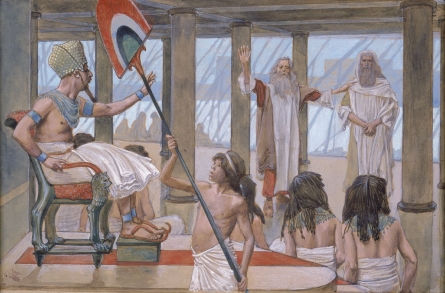 Source: 🔗 James Tissot, Moses Speaks to Pharaoh, public domain, via Wikimedia Commons. Later illustrative art, not Orthodox iconography.
The confrontation in Pharaoh’s court gives the illustration its relevance. Tissot’s work is later illustrative art, not an Orthodox icon.
Spiritual Fruit
Receive relief as an opportunity to obey. Pharaoh waits until the frogs have gone before returning to refusal. When a difficulty lifts, name one promise made in distress and fulfil it: an apology, a restitution, or a return to regular prayer. Thanksgiving should have a visible consequence.
Test impressive power by truth and service. The magicians can intensify an affliction but cannot free anyone from it. Refuse spiritual advice that encourages control, secrecy, or contempt for others. Bring troubling claims into the light with a trusted priest, and seek the patient fruit of obedience rather than fascination with signs.
Intercede without surrendering conscience. Moses prays for Pharaoh while refusing his bargains. Pray for a person who has harmed you without calling the harm good or placing yourself back within danger. Mercy and truthful boundaries can serve the same Lord.
Let worship claim the places you usually reserve. Pharaoh would allow a sacrifice while keeping Israel nearby. Offer Christ one guarded part of daily life: how you use authority, how you pay or treat someone dependent on you, or how you make room for prayer at home. The Lord’s claim reaches beyond the hours we find convenient.
Teaching Notes
Keep the signs’ purpose before the class: the knowledge of the Lord and freedom for worship. Use the Hebrew-based references below while identifying the retained Greek/Brenton verse markers.
Discuss: Exodus 7:1-7
- Ask: What makes Moses’ authority different from Pharaoh’s claim over Israel?
- Watch for: Reading “a god to Pharao” as a claim that Moses becomes divine by nature.
Discuss: Exodus 7:8-13
- Ask: What does the swallowing rod show that imitation alone cannot establish?
- Watch for: Fascination with magic or treating every unexplained sign as holy.
Discuss: Exodus 7:14-25
- Ask: How does Wisdom 11:6-7 (Septuagint) clarify the river’s judgment?
- Watch for: Turning the account into a list of defeated deities or ignoring the murdered children.
Discuss: Exodus 8:1-15; Greek/Brenton 7:26-8:11
- Ask: What changes between Pharaoh’s request for prayer and his response to relief?
- Watch for: Calling the request itself repentance before there is any obedience.
Discuss: Exodus 8:16-19; Greek/Brenton 8:12-15
- Ask: How do Exodus 31:18 and Luke 11:20 deepen the magicians’ admission?
- Watch for: Leaving recognition of God’s power disconnected from His word and kingdom.
Discuss: Exodus 8:20-32; Greek/Brenton 8:16-28
- Ask: Why does Moses refuse worship on Pharaoh’s terms while still praying for him?
- Watch for: Confusing forgiveness with renewed submission to coercion, or Goshen with ethnic superiority.
Sources
Embedded Scripture is from Brenton’s English Septuagint (LXX).
Exodus 7-8: 🔗 Brenton, chapter 7 and 🔗 chapter 8. The latter online display uses Hebrew-based verse labels. This guide retains the Greek/Brenton division: Hebrew-based 8:1-4 = Greek/Brenton 7:26-29; Hebrew-based 8:5-32 = Greek/Brenton 8:1-28. No episode is omitted by this chapter-boundary difference.
🔗 Wisdom 11 (Septuagint), especially 11:6-7, 15-16; Exodus 12:12; 🔗 Numbers 33:4. These establish the theological reading of Egypt’s judgment without assigning each plague to a named deity.
Psalm 78:43-51 (LXX 77): 🔗 Brenton text; Psalm 105:26-36 (LXX 104): 🔗 Brenton text. These pages use MT chapter labels and identify the LXX chapters within the text.
🔗 Exodus 4:16; 🔗 Exodus 31:18; 🔗 Genesis 43:32; 🔗 Genesis 46:34; 🔗 Luke 11:20; 🔗 2 Timothy 3:8-9.
Eusebius of Caesarea, Proof of the Gospel III.2, translated W. J. Ferrar (1920), pp. 105-108: 🔗 primary text.
Footnotes
-
Coptic Orthodox Great Lent Katameros, Wednesday prophecy readings: 🔗 Fourth week, p. 45, Exodus 7:14-8:19; 🔗 Fifth week, p. 45, Exodus 8:20-9:35. References are Hebrew-based; the Greek/Brenton equivalents are given beside the passages. For the retained text division, see 🔗 Brenton Exodus 7 and 🔗 Exodus 8. Coptic Reader, Coptic Orthodox Metropolis of the Southern United States, official app: Readings > Matins > Prophecies, printed Exodus 7:14-8:19; Readings > Matins > Prophecies, printed Exodus 8:20-9:35. The app link does not select a service; follow the named menu path. The selected dates were March 11, 2026, March 18, 2026, with the stated Great Fast occasions confirmed. Both separate week books begin the Exodus reading on printed p. 45 (PDF page 45); the identical page numbers are correct. ↩ ↩2
-
Eusebius of Caesarea, Proof of the Gospel III.2, trans. W. J. Ferrar (1920), p. 105; the “finger of God” comparison is on p. 107. 🔗 Primary text. The edition’s marginal Gospel reference beside that comparison is Matthew 12:27; the exact wording is found in Luke 11:20. ↩