


This narration is from a previous version of the study and may include a combined recording of multiple chapters.
Proverbs trains the soul to notice what its desires prefer to overlook. A flattering voice may be leading us toward ruin; a painful correction may be keeping us alive. The book teaches us to speak truthfully, desire cleanly, receive reproof, use power humbly, and open the hand to the poor. Its wisdom is fulfilled in Christ, who makes these ordinary decisions part of a life restored to the Father. The question that holds the book together is searching and hopeful: can I still be taught?
Historical and Scriptural Context
In the Hebrew Bible, Proverbs belongs to the Writings, the collection that includes the poetic and wisdom books. In the Christian Old Testament it stands among the books that teach prayer, suffering, love, judgment, and the fear of God. Its Hebrew name, Mishlei, comes from the family of words for a saying or comparison. A proverb concentrates experience so that a hearer can learn to recognize it in life. It gives more than an answer to repeat; it trains a judgment capable of acting.
The book names Solomon in Proverbs 1:1 and begins another Solomonic collection in Proverbs 10:1. Proverbs 25:1 attributes a further collection to the scribal work of Hezekiah’s men. The Hebrew headings also name Agur and Lemuel; their names do not appear as names in Brenton’s English Septuagint. The book’s own headings disclose a collection of collections. Solomonic wisdom, household instruction, royal memory, and faithful transmission belong together. Its authority does not require imagining a single moment in which every saying was first spoken or written down.
Solomon’s prayer in 1 Kings 3 is a fitting doorway. He asks for a heart able to judge rather than possessions or the death of enemies. His later failures also warn that wisdom must be lived, not merely received as a gift. Proverbs therefore addresses the wise as well as the inexperienced. The person who has already learned much can still gain direction by hearing.
The world of the sayings includes court, household, market, city gate, field, and sanctuary. It knows kings and officials, but it also knows false scales, neglected vineyards, tired families, reckless speech, betrayed friendships, and the need of the poor. No travel itinerary governs the book. Its geography is the place where a decision is made, and its history includes the long patience by which wisdom is received and handed on.
Brenton Septuagint Note
Embedded Scripture is from Brenton’s English Septuagint (LXX). The Septuagint is the ancient Greek translation through which the Old Testament deeply shaped Christian Scripture, worship, and patristic interpretation. Brenton gives an English rendering of that Greek witness. The choice allows the reader to hear the wording that often stands behind the New Testament’s use of Proverbs.
The Greek Proverbs is not simply the familiar Hebrew order rendered into another language. It adds lines, leaves some Hebrew lines unrendered, and arranges several later collections differently. Examples of additions include 3:16a, 3:22a, 6:8a-c, 9:12a-c, and 22:8a. Hebrew lines absent from its main form include 1:16, 4:7, 22:6, and 23:23. Brenton sometimes supplies alternative Alexandrian readings through notes or his Appendix. A verse missing from the main text and an alternative printed in an Appendix are different facts.
The individual studies distinguish these readings before the relevant Scripture. A reader holding an NKJV or KJV can therefore follow both the familiar Hebrew-based numbering and the Greek wording actually under discussion. The comparison does not treat one difference as a reason for panic or require one explanation for all differences. Sometimes the translator rendered a word differently; sometimes an additional line appears; sometimes a collection occupies another position. The exact wording of an earlier Hebrew exemplar is not always recoverable.
The Greek order of the later collections
| Brenton Septuagint | Hebrew / NKJV reference | What to notice |
|---|---|---|
| 1:1 to 24:22 | 1:1 to 24:22 | Broadly the same order, with the additions, omissions, and smaller transpositions explained in the studies. |
| 24:22a-22e | No direct Hebrew counterpart | Greek sayings about keeping the commandment and the king’s tongue. Brenton begins one bracketed block at 22a. |
| 24:22f | The heading of 30:1 | “My son, reverence my words, and receive them, and repent.” This ends the bracketed block but begins the material corresponding to Hebrew 30. The heading belongs with that material, not with the preceding Greek-only sayings. |
| Unnumbered sentence after 24:22f | 30:1b | “These things says the man to them that trust in God; and I cease.” The names Ithiel and Ucal are represented as words rather than retained as names. |
| 24:22g-22l | 30:2-6 | Humility before divine knowledge. Brenton’s lettering passes from 22i to 22k; no 22j is to be invented. |
| 24:22m-22o | 30:7-9 | The prayer for what is sufficient. |
| 24:22p | 30:10 | The warning against betraying a servant. |
| 24:22q-22t | 30:11-14 | Four descriptions of a wicked generation. |
| 24:23-34 | 24:23-34 | Further words of the wise, judgment, and the neglected field. |
| 24:35-53 | 30:15-33 | Numbered sayings, wonder, appetite, and restraint. |
| 24:54-62 | 31:1-9 | A king instructed by his mother; the name Lemuel is not retained as a name. |
| 25 to 29 | 25 to 29 | The collection associated with Hezekiah’s men. |
| 30 | No separate Brenton chapter text | Brenton directs the reader to chapter 24. |
| 31:10-31 | 31:10-31 | The valiant woman. Greek 31:26-27 occur in reverse order; the Hebrew alphabetic acrostic does not carry over into Greek. |
The different order shows that the small collections circulated in more than one arrangement. It is consistent with a differently arranged Hebrew collection behind the Greek, though the surviving order alone does not prove every stage by which that arrangement arose. The Masoretic order is the familiar order of Hebrew-based English Bibles. These studies keep its chapter references in their titles while naming Brenton’s actual location wherever the two differ.
Reading the Book’s Instruction
Proverbs 1-9 gives extended instruction before the shorter sayings begin. The hearer learns the fear of the Lord, the rival voices of Wisdom and Folly, the two paths, the keeping of the heart, and the choice between faithful love and destructive desire. This is why the book begins with formation rather than a quick list of useful maxims. A heart that loves flattery can use a true saying falsely.
From Proverbs 10 onward, the short sayings require careful hearing. A proverb often states a real pattern without promising a mechanical result in every case. Diligence ordinarily serves life, yet the diligent can suffer injustice. Wealth can be used wisely, yet possession cannot certify righteousness. The righteous sufferer of Job, the questions of Ecclesiastes, the prophets, the martyrs, and above all Christ crucified prevent us from turning moral order into a prosperity formula.
The book must also be heard as a whole. Proverbs can warn against answering a fool and then warn against leaving folly unanswered. The difference lies in what an answer would do in that circumstance. Wisdom is the ability to judge truthfully under God, not the ability to carry a sentence as a weapon into every conversation. Before using a proverb to expose another person’s folly, we must let it examine our own motives.
Major spiritual themes
The fear of the Lord makes the hearer teachable. This fear is awe joined to obedience and trust. It restores the creature’s truthful place before the Creator. The person who fears God can admit that an instinct needs healing, because his worth no longer depends on appearing self-sufficient.
Correction reveals what we love. Pride can boast, but it can also retreat into injured silence when someone tells the truth. Proverbs repeatedly asks whether we want healing more than the protection of an image. A wise rebuke exposes the wound in order to seek its cure; cruelty and coercion are not sanctified by calling them correction.
The mouth discloses the heart. Lying, flattery, slander, anger, and reckless promises show what the inner life is learning to welcome. The aim is more than polished speech. Truthful words require the healing of the resentment, fear, greed, or vanity from which untruth grows.
Desire needs a faithful home. The warnings about the adulterous woman expose seduction and covenant betrayal, never womanhood as such. Men and women alike can exploit, deceive, or be wounded. Wisdom keeps love truthful through attention, constancy, bodily dignity, and the refusal of secrecy that protects harm. The saints who repented of grave sins prevent the warning from becoming a sentence of despair.
Mercy tests the use of advantage. Proverbs praises work and diligence while condemning false weights, exploitation, contempt for the poor, and the wish to gain by another’s loss. Wisdom becomes visible in what a person does when he could withhold help. Timely mercy is a form of trust in God.
Holiness is tested in shared life. Families, friendships, neighbours, rulers, and those under authority all appear in the sayings. The wise person becomes steadier, more truthful, and safer to live with. This does not mean yielding to every demand or remaining in danger. Peace must be joined to justice and protection of the vulnerable.
LXX Insight
The New Testament repeatedly receives Proverbs in forms close to the Greek. Hebrews 12:5-6 quotes Proverbs 3:11-12, including the Greek’s language of scourging and receiving a son. James 4:6 and 1 Peter 5:5 use the opposition between the proud and the humble in Proverbs 3:34. Romans 12:17 and 2 Corinthians 8:21 echo the honourable conduct before God and people of Proverbs 3:4. The Greek Proverbs is part of the apostles’ moral and spiritual vocabulary.
The same pattern continues beyond the opening speeches. Hebrews 12:13 takes up the straight paths of Proverbs 4:26. First Peter 4:18 receives the Greek form of Proverbs 11:31, rather than its familiar Hebrew-based wording about recompense on earth. The Greek-only line at Proverbs 22:8a stands behind the language about the cheerful giver in 2 Corinthians 9:7. Romans 12:20 applies Proverbs 25:21-22 to feeding an enemy, while 2 Peter 2:22 uses the proverb of the returning dog in Proverbs 26:11. The Greek warning against drunkenness in Proverbs 23 has a close verbal echo in Ephesians 5:18.
This is not a rule that every apostolic allusion must agree with the Greek against the Hebrew. First Peter 4:8 and James 5:20 stand nearer the Hebrew sense of Proverbs 10:12 about love covering sins; Brenton instead has affection covering those who do not love strife. The apostles’ reception is richer than a single translation slogan. The differences matter because they show which words are being heard and what a particular connection can bear.
Christological and Typological Reading
St. Paul calls Christ the Wisdom of God in 1 Corinthians 1:24 and says that the treasures of wisdom and knowledge are hidden in Him in Colossians 2:3. Proverbs is therefore fulfilled in communion with a Person. Its commandments, warnings, and promises become an education in the truth, mercy, purity, courage, and obedience of the Lord Jesus Christ.
Personified Wisdom remains poetry that must be read attentively. Christian interpretation does not turn every grammatical feature into a separate divine person or identify Wisdom with an independent goddess. It hears the book within the confession of the eternal Word made flesh. The moral sense is preserved: a truthful reading of Wisdom must still produce a truthful mouth, a merciful hand, and a heart willing to obey.
Proverbs 8:22 requires particular care. Arians used its Greek language of creation to deny the Son’s eternal divinity. St. Athanasius answers within the rule of faith: “being God, He cannot be a work, and it is impious to call Him a creature”.1 This is from Discourse II against the Arians, §1. The eternal Son is begotten, not created, of one essence with the Father. The study of Proverbs 8 explains the disputed verse without surrendering that confession.
The Cross also governs the reading of every promise of life, peace, and glory. Christ enters His Passion freely in sovereign obedience; He is never the helpless victim of a stronger power. His willing self-offering reveals that wisdom can look like loss before the world while bringing life to the world. The sayings cannot promise us an exemption from the path our Lord chose to walk.
Gems from the Fathers 💎
St. John Cassian records the teaching of Abba Moses of Scetis in his second conference. Moses recalls St. Antony’s insistence that even impressive ascetical effort needs discretion, the judgment that avoids both presumption and slackness. The conference gives the book a deeply Egyptian lens: a person can fast strictly and still need to learn how to hear.2
At Conference 2.4 Cassian concludes, “For discretion is the mother of all virtues, as well as their guardian and regulator.”2 This is not a substitute for virtue or a licence to excuse ourselves from difficult obedience. Discretion keeps zeal from becoming vanity, courage from becoming rashness, and caution from becoming cowardice. It asks whether the good we claim to seek is the good our action will actually serve.
This helps avoid two opposite mistakes. Proverbs cannot be reduced to clever moral slogans, because the inner person needs healing. Nor can its plain commands be dissolved into a symbolism that leaves our habits unchanged. The same wisdom that draws the heart toward God must teach the mouth, the eyes, the hands, and the feet.
The Church’s Voice in Worship ⛪
Coptic worship hears Proverbs especially in weekday Great Lent prophecies and the day hours of Holy Pascha. These are seasons in which the Church exposes false appetites, retrains desire, and prepares the heart to stand with the Lord. The table distinguishes the authority of the witnesses: CR means confirmed against retained Coptic Reader evidence; WS is a working Holy Pascha source; KAT is the Katameros weekday reference cycle; REF is a special-service reference witness. These labels are not interchangeable.
| Occasion | Proverbs reading | Tier and companions |
|---|---|---|
| Monday and Tuesday of Pascha, Ninth Hour | 1:1-9 | WS. Monday: Genesis 2:15-3:24; Tuesday: Genesis 6:5-9:7. Both: Isaiah 40:1-5 and Matthew 21:23-27. |
| Wednesday of Pascha, Ninth Hour | 1:11 to the end of the chapter, displayed as 1:11-35 in Reader | CR. Genesis 24:1-9; Numbers 20:1-13; Psalm 41:5-7 (LXX Psalm 40:6-8); Matthew 26:3-16. The chapter ends at 33. |
| Monday, third week of Great Lent, Matins | 1:20-33 | CR. Isaiah 8:13-9:7; Psalm 32:1-2 (LXX Psalm 31:1-2); Luke 19:11-28. |
| Tuesday, third week, Matins | 2:1-15 | CR. Isaiah 10:12-20; Psalm 31:10 (LXX Psalm 30:11); Luke 12:54-59. |
| Thursday, third week, Matins | 2:16-3:4, one reading | CR. Genesis 18:17-19:29; Isaiah 11:10-12:2; Psalm 9:11-12 (LXX Psalm 9:12-13); Luke 20:20-26. |
| Wednesday of Pascha, First Hour | 3:5-14 | CR. Exodus 17:1-7; Hosea 5:13-6:3; Psalm 51:4 (LXX Psalm 50:6); Psalm 33:10 (LXX Psalm 32:10); John 11:46-57. |
| Monday, fifth week, Matins | 3:5-18 | CR. Isaiah 37:33-38:6; Job 22:1-30; Psalm 88:2-4 (LXX Psalm 87:3-5); Luke 12:16-21. |
| Tuesday, fifth week, Matins | 3:19-4:9, one reading | CR. Numbers 10:35-11:35; Isaiah 40:1-8; Job 25:1-6; Job 26:1-14; Psalm 86:5-6 (LXX Psalm 85:5-6); Mark 9:14-24. |
| Wednesday, fifth week | 4:10-19 | KAT. Exodus 8:20-9:35; 1 Samuel 1:1-2:21; Isaiah 41:4-14; Joel 3:9-21; Job 28:12-28. |
| Thursday, fifth week | 4:20-27 | KAT. Isaiah 42:5-16; Job 29:2-20; 1 Samuel 3:1-20. |
| Great Thursday, Third Hour | 4:4-27 with 5:1-4, one reading | WS. Exodus 32:30-33:5; Sirach 24:1-11; Zechariah 9:11-14; Zechariah 10:1-2; Psalm 94:21, 23 (LXX Psalm 93:21, 23); Matthew 26:17-19. |
| Friday, fifth week | 5:1-12 | KAT. Deuteronomy 11:29-32; Deuteronomy 12:1-27; 1 Kings 17:2-24; Isaiah 43:1-9; Job 30:9-31; Job 32:1-5. |
| Monday, Tuesday, Wednesday of the sixth week | 8:1-11; 8:12-21; 8:22-36 respectively | KAT. Job 32:6-16 and Isaiah 43:10-28 on Monday; Job 32:17-33:33, 2 Kings 5:1-27, and Isaiah 44:1-8 on Tuesday; Sirach 10, Exodus 10:1-11:10, Job 34, and Isaiah 44:21-28 on Wednesday. |
| Preparation of the Holy Myron | 8:22-31 | REF. Exodus 30:22-38; Isaiah 61:1-11; 1 Samuel 16:1-13. |
| Thursday, sixth week | 9:1-11 | KAT. Sirach 11:1-10; 2 Kings 4:8-37; Isaiah 45:1-10; Job 35. |
| Lakkan, or Liturgy of the Waters, Covenant Thursday | 9:1-11 | REF. Genesis 18:1-23; Isaiah 4:2-4; Isaiah 55:1-56:1; Ezekiel 36:25-29; Ezekiel 47:1-9; 1 Timothy 4:9-5:10; Psalm 51:7, 10 (LXX Psalm 50:9, 12); John 13:1-17. |
| Friday, sixth week | 9:12-18 | KAT. Genesis 22:1-18; Isaiah 45:11-17; Job 36:1-37:4; the Book of Tobit. |
| Monday, seventh week | 10:1-16 | KAT. Isaiah 48:17-22; Isaiah 49:1-4; Job 38:1-36. |
| Tuesday, seventh week | 10:17-33 | KAT. Isaiah 49:6-10; Job 38:37-39:30; Sirach 5:1-15. |
| Wednesday, seventh week | 11:1-13 | KAT. Isaiah 58:1-11; Job 40-41. |
| Thursday, seventh week | 11:13-26 | KAT. Isaiah 65:8-16; 2 Kings 6:8-7:20; Job 42:1-6. |
| Friday, seventh week, Matins | 11:27-12:22, one reading | CR. Genesis 49:33-50:26; Isaiah 66:10-24; Job 42:7-17; Psalm 32:10-11 (LXX Psalm 31:10-11); Luke 16:19-31. |
These companions often provide the key to hearing. The refusal of Wisdom stands beside the Gospel’s refusal of a king; seeking treasure stands beside the call to discern the time; firstfruits stand beside the rich fool; guarding the heart stands beside Samuel’s readiness to hear. In Pascha the calculation of conspirators is exposed before the Lord who offers Himself freely. The Church’s reading trains us to recognize these same decisions within ourselves.
Historical witnesses are distinct from these appointments. The removed Wednesday-of-Pascha readings of 1:10-33 and 4:4-5:4, the historical Tuesday Ninth Hour candidates 8:1-12 and 9:1-11, the historical Blessing of the Water 9:1-11, the Tuesday Eleventh Hour 6:20-7:4, and the Great Thursday 30:2-6 witness are HIST, not evidence of a current appointment. A separate KAT row naming only Proverbs 10:32 on Wednesday of the seventh week remains uncertain. No reading from Proverbs 12:23 through Proverbs 31 appears among the current appointments in the Coptic lectionary data used for these studies. That scoped absence is not a judgment about every Coptic practice.
Iconography Connection 🖼️

Solomon at the opening of Proverbs, Arnstein Bible, Harley MS 2799, folio 57v, about 1172, British Library. Western Christian manuscript art, not an Orthodox icon. Public domain.
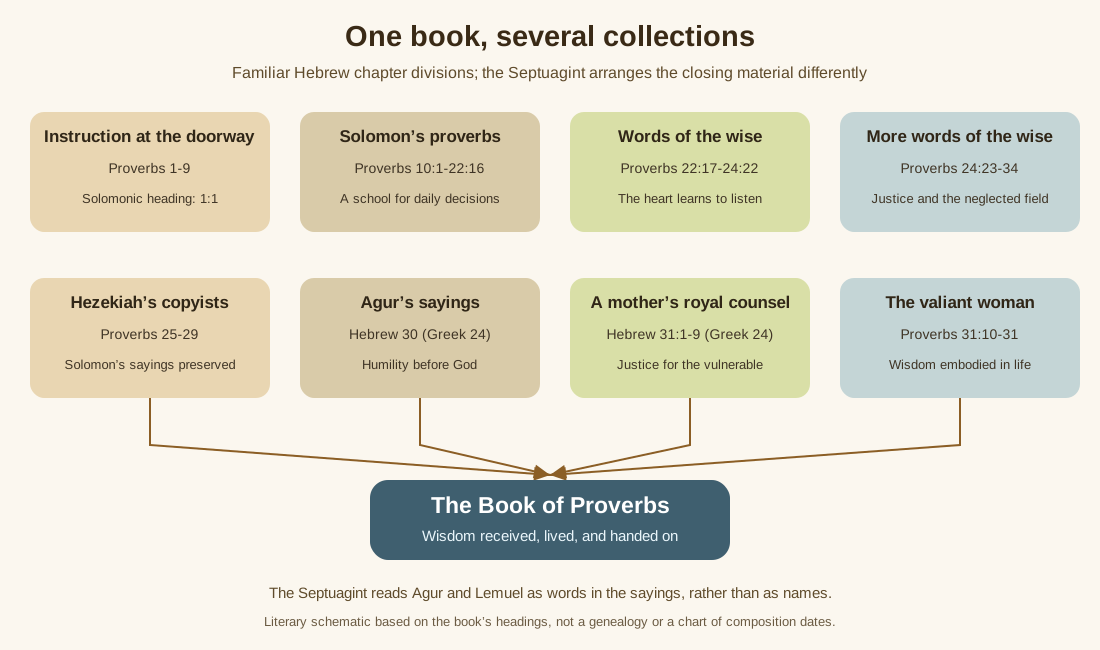
The collections of Proverbs and their transmission: Solomonic instruction, the words of the wise, Hezekiah’s scribes, and the later sayings whose Hebrew and Greek locations differ. Biblical schematic, not a genealogy.
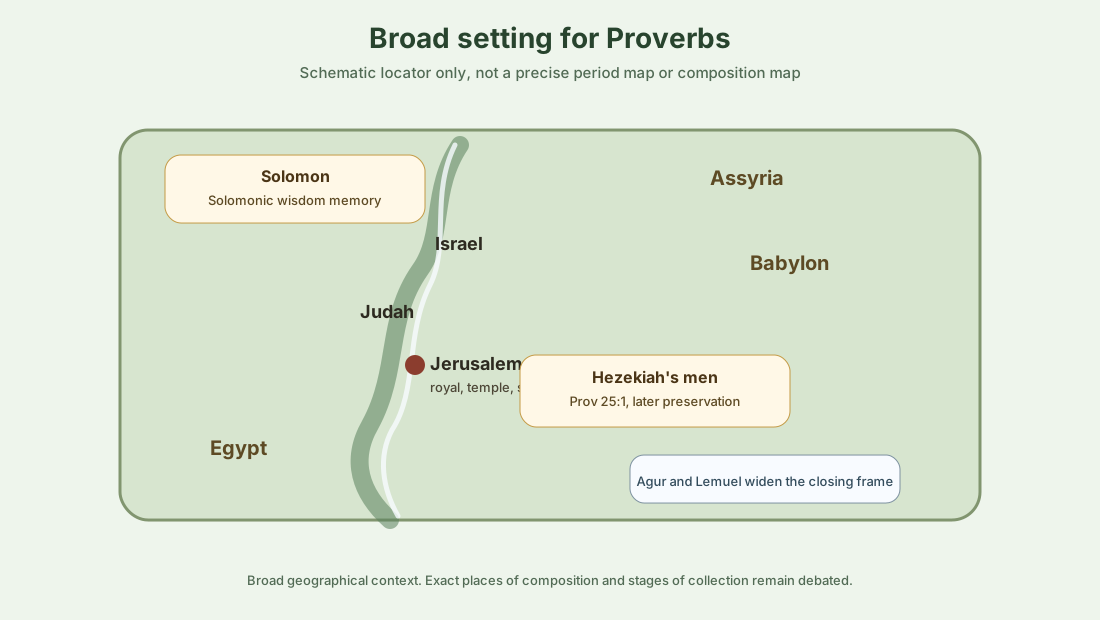
The broad setting of Proverbs in Israel and Judah. Schematic orientation, not an archaeological reconstruction or a claim to the exact place where a saying was composed.
The manuscript image makes received instruction visible, while the collection diagram explains why the book contains several headings and voices. Christ Pantocrator with the Gospel provides the strongest Orthodox iconographic centre: the Lord who is Wisdom teaches and blesses His people. Any Holy Wisdom imagery requires the confession that Wisdom is fulfilled in Christ, never an independent feminine divinity. The images serve attention to the word rather than replace it.
How This Study Moves Through the Book
The studies follow familiar Hebrew-based chapter references while explaining Brenton’s actual location. Each unit trains the soul in a particular obedience. Chapters 30 and the first part of 31 are heard in their Greek position within chapter 24, with the cross-reference always visible.
| Unit | Training of the soul |
|---|---|
| General Introduction | Receive the book as training in truthful perception. |
| Proverbs 1:1-7 | Become teachable in the fear of the Lord. |
| Proverbs 1:8-33 | Choose the voice that gives life rather than false belonging. |
| Proverbs 2 | Seek the treasure and let it guard covenant. |
| Proverbs 3 | Trust God with heart, possessions, and timely mercy. |
| Proverbs 4 | Guard the spring from which speech and action flow. |
| Proverbs 5 | Protect faithful love and bring secret desire into healing. |
| Proverbs 6 | Practise diligence and refuse the fire of adultery. |
| Proverbs 7 | Recognize the road before the flattering invitation wins consent. |
| Proverbs 8 | Hear Wisdom within the confession of the eternal Son. |
| Proverbs 9 | Choose the feast that gives life. |
| Proverbs 10 | Let righteousness become truthful speech and daily work. |
| Proverbs 11 | Join integrity, mercy, and responsibility for the city. |
| Proverbs 12 | Receive correction and let truth become a path of life. |
| Proverbs 13 | Let desire be schooled by discipline and hope. |
| Proverbs 14 | Test the way that seems right and protect the poor. |
| Proverbs 15 | Learn the gentle answer and the healing tongue. |
| Proverbs 16 | Entrust the heart to providence and resist pride. |
| Proverbs 17 | Guard friendship, endure testing, and relinquish resentment. |
| Proverbs 18 | Seek refuge in the Lord and honour the power of words. |
| Proverbs 19 | Receive counsel and lend to the Lord through mercy. |
| Proverbs 20 | Practise sobriety, honest measures, and inward examination. |
| Proverbs 21 | Prefer justice to self-exalting power. |
| Proverbs 22:1-16 | Choose a good name, generosity, and humble formation. |
| Proverbs 22:17-23:35 | Incline the ear and discipline appetite without exploiting the weak. |
| Proverbs 24:1-22 | Build wisely, rescue the endangered, and refuse envy. |
| Proverbs 24:23-34 | Judge without favouritism and repair the neglected field. |
| Proverbs 25 | Practise fitting speech and mercy toward enemies. |
| Proverbs 26 | Discern folly and refuse sloth and destructive talk. |
| Proverbs 27 | Receive a friend’s correction and care faithfully for what is entrusted. |
| Proverbs 28 | Confess sin and join justice to courage. |
| Proverbs 29 | Receive correction and fear God more than people. |
| Proverbs 30 | Learn humility, wonder, and the prayer for sufficiency. |
| Proverbs 31 | Use strength in justice, faithful care, and the fear of God. |
Spiritual Fruit 🍇
Keep one proverb long enough for it to examine you. Read a short passage slowly and choose a sentence that addresses a real habit. Carry it into prayer for a week. Notice the moment when it becomes inconvenient: before a sharp reply, a hidden purchase, a cruel joke, or a postponed act of mercy. That is where the saying is becoming instruction rather than decoration.
Receive a correction before choosing a correction to give. The wise person becomes wiser by hearing. When a truthful criticism hurts, ask what part of the hurt belongs to wounded pride and what part may reveal a genuine injustice. Accept the truth without accepting abuse. Then make a specific repair: apologize without an explanation that cancels the apology, change the repeated action, or seek the help you have resisted.
Give wisdom a bodily form. The book speaks of mouth, eyes, hands, feet, wells, fields, and scales because love is learned through what we do. Set one merciful limit on speech and one generous use of possessions. Refuse a conversation built on contempt; help a person while help is possible. A life increasingly ordered by Christ becomes more truthful and safer for others.
Read every promise beside the Cross and Resurrection. When faithfulness brings loss, do not conclude that Wisdom has failed you. When foolishness has already brought loss, do not conclude that repentance has become useless. Christ meets both the wounded righteous and the returning sinner. Seek His help in prayer, confession, the Holy Mysteries, and the trustworthy care through which He preserves a person from isolation.
Proverbs stands at the door and asks whether the heart can still be taught. Bring the reply you wish you had not spoken, the fear that closes your hand, and the desire you are tired of hiding. The Lord does not need an impressive student. He seeks a hearer willing to receive life, and His word can begin its work in the next ordinary act of love.
Teaching Focus
Proverbs forms perception under the fear of the Lord. Keep literal counsel, Christological fulfilment, timely mercy, and the healing of the heart together. Its sayings are neither prosperity formulas nor weapons for diagnosing everyone else.
Teaching Notes
The doorway of wisdom (Proverbs 1:1-7)
- Ask: What is the difference between knowing a wise sentence and becoming wise through it?
- Emphasize: The simple can be formed and the experienced can keep learning. Introduce the book through its purpose rather than an authorship debate.
- Watch for: Intellectual superiority disguised as discernment, or fear of the Lord explained as terror before cruelty.
- Connect: Solomon’s request in 1 Kings 3, Psalm 111:10 (LXX Psalm 110:10), and Christ the Wisdom of God.
Guarded desire and shared life (Proverbs 1:8-9:18)
- Ask: Which voices train our reactions before we notice that we have consented?
- Emphasize: Ear, mouth, eyes, and feet serve the heart. Teach faithful love as a positive good.
- Watch for: Misogyny, public shaming, coercive disclosure, or applying the warning to victims rather than chosen wrongdoing.
- Connect: The Pascha and Great Lent companions, with their actual authority labels. Christ enters His Passion freely.
Short sayings and patient judgment (Proverbs 10:1-29:27)
- Ask: How can a true saying be used falsely when circumstances and motives are ignored?
- Emphasize: Hear each proverb within its immediate contrast and the whole book. Mercy, justice, and protection of the vulnerable test apparent wisdom.
- Watch for: Prosperity theology, simplistic parenting formulas, and treating a sufferer’s pain as proof of folly.
- Connect: Job, Ecclesiastes, the Cross, and the apostolic uses of the Greek Proverbs.
Humility and embodied strength (Proverbs 30:1-31:31)
- Ask: How do wonder, sufficiency, and responsible care complete the book’s account of wisdom?
- Emphasize: Use the Greek-order table, including the heading at Brenton 24:22f. Familiar chapter references and actual Brenton positions are distinct.
- Watch for: Inventing Agur or Lemuel as printed names in Brenton, losing the heading at a boundary, or reducing the valiant woman to a burdening checklist.
- Connect: Humility before God’s mystery and the strength of a life given for others.
Single-session introduction plan
Allow 60 minutes: 8 for the lead and canonical context, 10 for the collection and Greek-order tables, 10 for the doorway at Proverbs 1:1-7, 10 for major themes and the Cross, 10 for Cassian and the worship companions, and 12 for discussion and a chosen practice. Use the collection schematic as a collection diagram, never as a genealogy. The broad locator gives orientation only. Keep any explanation of Holy Wisdom imagery explicitly Christological. Distinguish CR from WS, KAT, REF, and HIST before quoting an appointment as current practice. Begin each later meeting by asking what one saying changed in prayer or action, without making private confession into a public exercise.
Glossary
- Mishlei / mashal: Hebrew words associated with proverbs, sayings, and comparisons that teach judgment.
- Septuagint / LXX: The ancient Greek translation of the Old Testament, received deeply in Christian worship and interpretation.
- Masoretic text: The received Hebrew textual tradition underlying most familiar English Old Testaments.
- Fear of the Lord: Reverence, obedience, humility, and sober trust before God.
- Discretion / discernment: Judgment learning to distinguish what serves God from what merely appears attractive or useful.
- Simple: The unformed or easily influenced hearer, capable of being taught.
- Passions: Disordered habits of desire, anger, pride, or appetite that distort freedom and judgment.
- Typology: Reading earlier persons, events, and images in the light of their fulfilment in Christ, without erasing their first meaning.
- Holy Myron: The consecrated chrism used in the Church’s sacramental life.
- Lakkan: The Coptic Liturgy of the Waters.
Translation and Source Notes
Embedded Scripture is from Brenton’s English Septuagint (LXX). Hebrew-based comparisons use KJV where wording is quoted. Chapter references in the study titles follow familiar Hebrew-based numbering; the Greek-order table gives Brenton’s different later locations. The origins of all Greek differences cannot be settled merely by comparing two English translations.
Coptic appointments are distinguished by the authority of their witnesses. A retained Coptic Reader confirmation is identified as CR; a working Pascha source, Katameros cycle, special-service reference, or historical witness is never silently promoted to that tier. The range 1:11-35 is a Reader display label for a biblical chapter that ends at 33.
Sources
- Brenton’s English Septuagint: Proverbs, including the notes and the later collection order in chapter 24.
- KJV: Proverbs, for the Hebrew-based headings and comparisons.
- Biblical passages named in the commentary, especially 1 Kings 3, 1 Corinthians 1:24, Colossians 2:3, Hebrews 12, James 4:6, and 1 Peter 5:5.
- St. Athanasius, Discourse II against the Arians, §1; St. John Cassian, Conference II.2 and II.4, cited below.
- Coptic Holy Pascha, Katameros Great Lent cycle, special-service readings, and retained Coptic Reader witnesses, with the tiers distinguished above.
Further reading: Fr. Tadros Yacoub Malaty, commentary on Proverbs; Michael V. Fox, Proverbs 1-9 and Proverbs 10-31; Bruce K. Waltke, The Book of Proverbs. These are further reading, not sources for unquoted claims attributed to their authors here.
Footnotes
-
St. Athanasius of Alexandria, Discourse II against the Arians, §1, NPNF second series 4. Containing text. ↩
-
St. John Cassian, Conference II.2 and II.4, Second Conference of Abba Moses, NPNF second series 11, translated by Edgar C. S. Gibson. The quoted sentence is II.4. Containing text. ↩ ↩2