


This narration is from a previous version of the study and may include a combined recording of multiple chapters.
The Lord finally answers Job, but He does not answer with the explanation Job expected. He answers with creation. The whirlwind does not give Job a neat theory of suffering. It draws him into the living reality of the Creator whose wisdom governs foundations, seas, dawn, death, snow, stars, lions, ravens, wild goats, wild asses, the unicorn, the ostrich, the war horse, the hawk, and the eagle.
This is not evasion. It is revelation. God is showing Job that the world is not a small courtroom where human beings can master every case. It is a creation held in divine wisdom, filled with creatures beyond human control, and ordered by a mercy that feeds even young ravens crying to the Lord.
Historical and Scriptural Context
Job 35-37 ended Elihu’s final speech. He called Job to stand still before God’s power and spoke of thunder, snow, clouds, light, and the fear of the Almighty. Now the Lord Himself speaks from the whirlwind. Elihu’s storm language becomes divine encounter.
Job 38-39 begins the first divine speech. It does not condemn Job the way the friends did, nor does it explain the heavenly council from Job 1-2. Instead, God asks a series of questions that restore proportion. Job has spoken honestly, but he has also spoken beyond his knowledge. The Lord teaches him not by crushing him, but by bringing him into awe before divine wisdom.
Scope and Grouping Rationale
Job 38-39 belongs together because it is the first movement of the Lord’s answer from the whirlwind. Job 38 focuses on cosmic creation: earth’s foundation, sea’s boundaries, morning, death, light, snow, rain, stars, clouds, lions, and ravens. Job 39 turns to wild creatures and their hidden lives: mountain goats, hinds, wild ass, unicorn, ostrich, horse, hawk, and eagle.
The grouping follows Job 35-37 because Elihu’s speech prepared the reader for storm and awe. It precedes Job 40-41, where the Lord presses Job further and brings Behemoth and Leviathan before him. Job 38-39 is therefore not a random nature poem. It is the first divine medicine for Job’s wounded and overextended speech.
Geographical Significance ⛰️
The geography is cosmic and creaturely rather than political. The Lord moves Job through earth’s foundations, sea gates, the land of light and darkness, the treasures of snow, the paths of thunder and rain, the wilderness where no man lives, the constellations, the mountains, the salt land, the battlefield, and the eagle’s crag.
This matters because Job’s grief has narrowed his world around the question, “Why has this happened to me?” God does not shame that question. He enlarges Job’s vision until Job sees that divine wisdom includes places and creatures that never entered his calculations. The wilderness where no man lives is still watered by God. The young raven crying in hunger is still heard by God.
The Characters 👥
The Lord. God now speaks directly. He is not a theory in the friends’ mouths or a doctrine in Elihu’s mouth. He is the Creator who questions Job and reveals Himself through His works.
Job. Job is addressed as a man: “Gird thy loins like a man.” He is not discarded. He is summoned to stand before God, listen, and learn his limits.
Creation. Earth, sea, dawn, snow, stars, rain, wild animals, and birds are not decorative. They are witnesses to divine wisdom. They become God’s catechism.
The wild creatures. The animals in Job 39 reveal a world not organized around human usefulness. God delights in and governs creatures Job cannot tame, command, or even fully understand.
The Creator questions Job (Job 38:1-41)
1 And after Elius had ceased from speaking, the Lord spoke to Job through the whirlwind and clouds, saying,
2 Who is this that hides counsel from me, and confines words in his heart, and thinks to conceal them from me? 3 Gird thy loins like a man; and I will ask thee, and do thou answer me.
4 Where wast thou when I founded the earth? tell me now, if thou hast knowledge, 5 who set the measures of it, if thou knowest? or who stretched a line upon it? 6 On what are its rings fastened? and who is he that laid the corner-stone upon it? 7 When the stars were made, all my angels praised me with a loud voice. 8 And I shut up the sea with gates, when it rushed out, coming forth out of its mother’s womb. 9 And I made a cloud its clothing, and swathed it in mist. 10 And I set bounds to it, surrounding it with bars and gates. 11 And I said to it, Hitherto shalt thou come, but thou shalt not go beyond, but thy waves shall be confined within thee.
12 Or did I order the morning light in thy time; and did the morning star then first see his appointed place; 13 to lay hold of the extremities of the earth, to cast out the ungodly out of it? 14 Or didst thou take clay of the ground, and form a living creature, and set it with the power of speech upon the earth? 15 And hast thou removed light from the ungodly, and crushed the arm of the proud?
16 Or hast thou gone to the source of the sea, and walked in the tracks of the deep? 17 And do the gates of death open to thee for fear; and did the porters of hell quake when they saw thee? 18 And hast thou been instructed in the breadth of the whole earth under heaven? tell me now, what is the extent of it?
19 And in what kind of a land does the light dwell? and of what kind is the place of darkness? 20 If thou couldest bring me to their utmost boundaries, and if also thou knowest their paths; 21 I know then that thou wert born at that time, and the number of thy years is great.
22 But hast thou gone to the treasures of snow? and hast thou seen the treasures of hail? 23 And is there a store of them, for thee against the time of thine enemies, for the day of wars and battle? 24 And whence proceeds the frost? or whence is the south wind dispersed over the whole world under heaven? 25 And who prepared a course for the violent rain, and a way for the thunders; 26 to rain upon the land where there is no man, the wilderness, where there is not a man in it; so as to feed the untrodden and uninhabited land, 27 and cause it to send forth a crop of green herbs?
28 Who is the rain’s father? and who has generated the drops of dew? 29 And out of whose womb comes the ice? and who has produced the frost in the sky, 30 which descends like flowing water? who has terrified the face of the ungodly?
31 And dost thou understand the band of Pleias, and hast thou opened the barrier of Orion? 32 Or wilt thou reveal Mazuroth in his season, and the evening star with his rays? Wilt thou guide them? 33 And knowest thou the changes of heaven, or the events which take place together under heaven? 34 And wilt thou call a cloud with thy voice, and will it obey thee with a violent shower of much rain? 35 And wilt thou send lightnings, and they shall go? and shall they say to thee, What is thy pleasure? 36 And who has given to women skill in weaving, or knowledge of embroidery? 37 And who is he that numbers the clouds in wisdom, and has bowed the heaven down to the earth? 38 For it is spread out as dusty earth, and I have cemented it as one hewn stone to another.
39 And wilt thou hunt a prey for the lions? and satisfy the desires of the serpents? 40 For they fear in their lairs, and lying in wait couch in the woods. 41 And who has prepared food for the raven? for its young ones wander and cry to the Lord, in search of food.
The Lord begins after Elihu stops. That detail matters. Human speech has reached its limit. The Lord does not say Job’s pain was imaginary or that the friends were right. He asks, “Who is this that hides counsel?” The issue is not whether Job suffered. The issue is whether Job can stand above providence as its judge.
“Gird thy loins like a man” is not contempt. It is a summons. St Gregory the Great, in Moralia in Job, Book XXVIII, reads the command as a call to spiritual firmness and chastened strength. He says that Scripture calls those “men” who follow the ways of the Lord “with firm and steady steps”1 and that to gird the loins is to restrain disordered desire in work and thought. God is not humiliating Job into passivity. He is summoning him into mature creaturely courage.
The question “Where wast thou when I founded the earth?” restores proportion. Gregory gives a beautiful interpretive key: “For then thou answerest Me truly, if thou understandest what things thou knowest not.”2 This is the heart of the divine speech. The true answer begins when Job knows that he does not know.
The Lord then unfolds creation as a series of questions. Who set the measures of the earth? Who laid its corner-stone? Who bounded the sea when it rushed out as from a womb? Who orders morning, opens or closes the gates of death, stores snow and hail, gives rain to land where no human lives, binds Pleias, opens Orion, guides Mazuroth, commands clouds and lightning, and feeds the raven’s young?
This is not nature romanticism. Creation is morally and spiritually charged. Morning casts out the ungodly. Light is removed from the proud. The gates of death and the porters of hell tremble before the One who knows their thresholds. The wilderness no man sees is still fed. The raven’s cry is heard.
The rain that falls where no man lives reveals a providence not measured by human usefulness. God is good in places no audience sees and toward creatures no empire counts. That is medicine for Job and for us. We often assume that what is hidden is neglected. The Lord teaches the opposite.
St Gregory reads the “corner-stone” in Job 38:6 as opening beyond creation to the Church. The literal creation remains real, but Gregory sees Christ as the Cornerstone by whom the spiritual building is joined. He also reads the stars and angels of Job 38:7 as angelic praise. Brenton says, “When the stars were made, all my angels praised me with a loud voice.” Gregory says the angels are fittingly called morning stars because they exist in the light of wisdom and praise the Redeemer.
Job still has reason to care about justice. He must entrust it to the God whose wisdom is deeper than his grief and wider than human sight. Job is not given the cause of his suffering. He is given God.
God’s answer is not only a correction of Job’s thoughts. It is also the gift of divine presence. Job had cried for an audience, and the Lord truly gives one. The hidden cause of suffering is still not disclosed, but Job is no longer speaking into silence. The questions heal because they do not merely defeat Job’s argument. They draw him back into relation with the living God.
Language insight: “angels”, “weaving”, and a wisdom wider than ours
At Job 38:7, Brenton’s “all my angels praised me” follows the Septuagint’s angeloi. The Hebrew-based NKJV has “all the sons of God shouted for joy.” Both speak of heavenly praise, but the Greek explicitly names the angels. Gregory’s Latin verse speaks of morning stars, so his explanation of the angels as stars belongs to that biblical wording; it is not a quotation of Brenton.
At Job 38:36, Brenton follows the Greek question about women’s skill in weaving and embroidery. The Hebrew text is difficult: the NKJV reads wisdom in the mind, with “the inward parts” in its footnote, and understanding in the heart. These are distinct renderings, not instructions to insert an unfamiliar craft into the NKJV. In Brenton’s reading, the One who governs constellations also gives the patient skill of hands. The small, repeated work by which a household lives is not beneath the wisdom that made the heavens.
The chapter ends with a hungry bird. Christ’s “Consider the ravens” (Luke 12:24, NKJV) takes up the same creaturely dependence: they do not stock a storehouse, “and God feeds them.” Psalm 147:9 (LXX 146:9) likewise names the young ravens crying. Psalm 104 (LXX 103) praises the One who gives springs, food for lions, mountain refuge for wild goats, and a home to sea creatures. These passages do not promise a life without hunger or danger. They train attention toward the Father whose knowledge reaches into lives we overlook. The prayer that begins beneath the whirlwind can continue beside a hungry creature or an unnoticed neighbor.
Lesson Guide
- Key phrases: “through the whirlwind and clouds”; “Gird thy loins like a man”; “Where wast thou”; “the gates of death”; “rain upon the land where there is no man”; “young ones wander and cry to the Lord.”
- Emphasize: God’s answer restores proportion, not by denying suffering, but by revealing divine wisdom.
- Avoid: Do not teach this as God silencing Job because questions are sinful. God is healing Job’s overreach, not condemning honest lament.
The wild creatures beyond human control (Job 39:1-30)
1 Say if thou knowest the time of the bringing forth of the wild goats of the rock, and if thou hast marked the calving of the hinds: 2 and if thou hast numbered the full months of their being with young, and if thou hast relieved their pangs: 3 and hast reared their young without fear; and wilt thou loosen their pangs? 4 Their young will break forth; they will be multiplied with offspring: their young will go forth, and will not return to them.
5 And who is he that sent forth the wild ass free? and who loosed his bands? 6 whereas I made his habitation the wilderness, and the salt land his coverts. 7 He laughs to scorn the multitude of the city, and hears not the chiding of the tax-gatherer. 8 He will survey the mountains as his pasture, and he seeks after every green thing.
9 And will the unicorn be willing to serve thee, or to lie down at thy manger? 10 And wilt thou bind his yoke with thongs, or will he plough furrows for thee in the plain? 11 And dost thou trust him, because his strength is great? and wilt thou commit thy works to him? 12 And wilt thou believe that he will return to thee thy seed, and bring it in to thy threshing-floor?
13 The peacock has a beautiful wing: if the stork and the ostrich conceive, it is worthy of notice, 14 for the ostrich will leave her eggs in the ground, and warm them on the dust, 15 and has forgotten that the foot will scatter them, and the wild beasts of the field trample them. 16 She has hardened herself against her young ones, as though she bereaved not herself: she labours in vain without fear. 17 For God has withholden wisdom from her, and not given her a portion in understanding. 18 In her season she will lift herself on high; she will scorn the horse and his rider.
19 Hast thou invested the horse with strength, and clothed his neck with terror? 20 And hast thou clad him in perfect armour, and made his breast glorious with courage? 21 He paws exulting in the plain, and goes forth in strength into the plain. 22 He laughs to scorn a king as he meets him, and will by no means turn back from the sword. 23 The bow and sword resound against him; and his rage will swallow up the ground: 24 and he will not believe until the trumpet sounds. 25 And when the trumpet sounds, he says, Aha! and afar off he smells the war with prancing and neighing.
26 And does the hawk remain steady by thy wisdom, having spread out her wings unmoved, looking toward the region of the south? 27 And does the eagle rise at thy command, and the vulture remain sitting over his nest, 28 on a crag of a rock, and in a secret place? 29 Thence he seeks food, his eyes observe from far. 30 And his young ones roll themselves in blood, and wherever the carcases may be, immediately they are found.
The Lord now turns from cosmic structures to wild creatures. These animals are not chosen because they are useful to Job. Many are precisely beyond his use. The wild goats give birth in hidden rocks. The wild ass lives free from city and tax-gatherer. The unicorn will not serve at Job’s manger or plough his field. The ostrich seems foolish, yet can rise and scorn the horse and rider. The war horse charges toward battle. The hawk and eagle fly beyond Job’s command.
The spiritual point is sharp: the world is not arranged only around human control. God knows and governs creatures whose lives are hidden, untamed, strange, and even disturbing. Job’s wisdom cannot number the months of the wild goats or command the eagle’s nest. Yet God cares for them.
St Gregory the Great, in Moralia in Job, Book XXX, pauses over the wild goats and hinds. He notes the creaturely detail, then turns to spiritual meaning. In sections 36-37, Gregory reads the rocks through the examples of the holy fathers: their lives encourage hearers who fear that they cannot obey sublime precepts. The fruitfulness of the wild goats becomes an image of good works learned from those who have gone before us. This is not a denial of the literal animals. It is a patristic way of seeing creation as sacramental: the visible creature can teach the invisible life.
The ostrich is especially humbling. God says wisdom has been withheld from her, yet she still has a season in which she lifts herself on high and scorns the horse and rider. Even what appears deficient in one respect may be given strength in another. Human beings often judge creatures, and one another, by one measure. God governs by a wisdom wider than our scale.
The war horse and eagle close the chapter with fierce images. God is not sentimental about creation. The world includes birth, freedom, strength, blood, prey, and death. Job’s comfort will not come from pretending the world is gentle. It will come from meeting the Lord whose wisdom holds even the fierce world without losing goodness.
Job 39 also prepares the way for the next divine movement. If Job cannot oversee the hidden births of wild goats, command the eagle, or harness untamed creaturely strength, neither can he bring down the proud or master the deeper powers symbolized in Behemoth and Leviathan. The first speech teaches awe. The second will press awe into deeper humility.
Lesson Guide
- Key phrases: “wild goats of the rock”; “sent forth the wild ass free”; “will the unicorn be willing to serve thee”; “withholden wisdom”; “does the eagle rise at thy command.”
- Emphasize: God governs more than the humanly useful. His care includes hidden, wild, and untamable life.
- Avoid: Do not flatten the animal catalogue into trivia. Every creature exposes the limits of human control.
Christological and Typological Reading
The divine speech opens onto Christ because the Creator who questions Job is the Word through whom all things were made. The New Testament does not give us a different God from Job. It reveals that the Wisdom who founded the earth and bounded the sea has taken flesh.
Job 38:6 speaks of the corner-stone. Gregory reads this spiritually toward Christ and the Church. Christ is the Cornerstone who joins what was divided and gives the whole building its stability. The God who asks Job about the earth’s foundation later enters the earth He founded, stands before unjust judges, descends to the gates of death, and causes the porters of hell to tremble.
Job 38:17 is especially powerful in Christian light: “do the gates of death open to thee for fear; and did the porters of hell quake when they saw thee?” In Job, the question humbles Job. In Christ, it becomes victory. The gates of death do open before the Crucified and Risen Lord. Hades trembles before Him, and the dead are led into light.
The young ravens crying to the Lord also find their fullness in Christ’s teaching: not one sparrow falls apart from the Father. Creation is not forgotten. The Incarnate Lord reveals that divine majesty and tender care are not opposites.
The Church’s Voice in Worship ⛪
Coptic lectionary placement
Two appointments appear in the Katameros Great Lent cycle; neither has been confirmed against Coptic Reader:
- Monday of the Seventh Week: Job 38:1-36, with Proverbs 10:1-16, Isaiah 48:17-22, and Isaiah 49:1-4.
- Tuesday of the Seventh Week: Job 38:37-41 and Job 39:1-30, with Proverbs 10:17-33, Isaiah 49:6-10, and Sirach 5:1-15.
Reflection on Monday’s companions. The public lectionary lists Romans 14:10-15:2 as the Pauline Epistle. “For we shall all stand before the judgment seat of Christ” (Romans 14:10, NKJV) answers the temptation to occupy that seat ourselves. Paul’s question concerns our contempt for a brother. The Lord’s summons to Job thus reaches the ordinary judgments made at home and in the parish: we are fellow creatures who will give account, not owners of another person’s life. James 2:5-13, the public Catholic Epistle, ends, “Mercy triumphs over judgment” (James 2:13, NKJV). The Judge who summons us does not authorize cruelty. Humility before Him ought to make us less eager to condemn.
Reflection on Tuesday’s companions. The public lectionary lists Luke 17:1-10 as the Matins Gospel. “We are unprofitable servants” (Luke 17:10, NKJV) is the creature’s honest confession after obedience, not a claim that human life is worthless. Duty is no leverage for governing the Master. Yet the day’s public Liturgy Gospel, John 12:36-43, says that Isaiah “saw His glory and spoke of Him” (John 12:41, NKJV). Humility opens toward sight, anticipating Job’s confession in 42:5. The Lord’s questions are not a locked door. They draw a person away from mastery and toward the light of the One who is present. These are reflections on the readings heard together, not claims about an exclusive liturgical intention.
Worship and prayer resonance
The voice from the whirlwind resonates with the Church’s doxological prayer. True theology ends in worship. The divine questions lead the heart from argument to awe without making lament a sin. The Lenten soul learns to pray: Lord, I do not know all Your ways, but I know You are the Creator, and I stand before You.
Iconography Connection 🖼️
Blake’s whirlwind image is useful because it makes visible the scale shift in Job 38. Job wanted a courtroom; the Lord opens creation. The scene is neither mere weather nor a display of divine sarcasm. The whirlwind is theophany, a manifestation of divine presence that humbles Job without erasing God’s tenderness toward him.
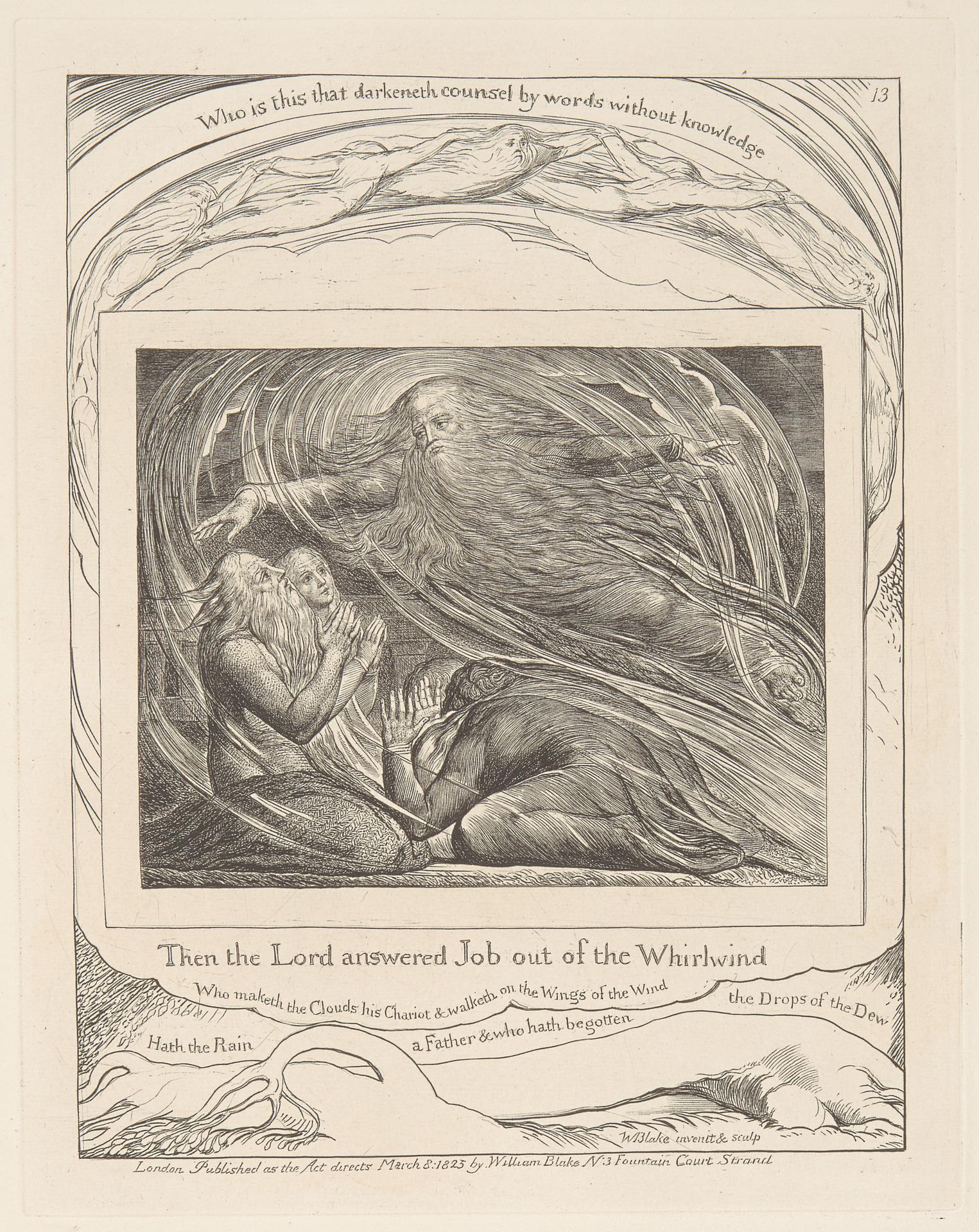 Source: William Blake, The Lord Answering Job out of the Whirlwind, CC0, Yale Center for British Art.
The small figures beneath the whirlwind stand before a vision far larger than their debate. Blake’s work is Western biblical art, not an Orthodox icon. Its scale helps convey the encounter without turning the Lord’s questions into a sneer at human grief.
Glossary
- Whirlwind: The storm from which God speaks to Job, marking divine revelation rather than ordinary weather.
- Gird thy loins: A biblical idiom of readiness, discipline, and courage.
- Corner-stone: A foundation stone. Patristically, this often points to Christ as the Cornerstone of the Church.
- Pleias / Pleiades, Orion, Mazuroth: Heavenly bodies named in Job 38 as signs of God’s governance of the heavens.
- Unicorn: Brenton’s rendering for a powerful wild animal, often associated in older translations with the wild ox.
- The gates of death: The boundary of death and Hades. In Christian reading, this becomes a doorway into Christ’s victory.
Translation and Source Notes
The embedded Old Testament text is from Brenton’s English Septuagint, public domain. Distinctive Brenton readings include “through the whirlwind and clouds,” “rings” of the earth, “all my angels praised me,” “who has given to women skill in weaving,” and “unicorn.”
Brenton prints Job 38 with 41 verses and Job 39 with 30 verses. The printed verse labels identify that edition’s text.
Both the NKJV and Brenton number Job 38 through verse 41 and Job 39 through verse 30. Their differences here concern wording, including the angels, weaving, and the gates of death, rather than a different endpoint for either chapter.
The Job appointments above come from the Katameros cycle. The named New Testament companions are public dated lectionary readings; they have not been represented as Coptic Reader-confirmed appointments.
Spiritual Fruit 🍇
-
Let God enlarge the question. Job asks why he suffers. God answers by revealing the whole creation. Sometimes healing begins not with a smaller answer, but with a larger vision of God.
-
Learn the holy words, “I do not know.” Gregory’s insight is decisive: we answer God truly when we understand what we do not know. Humility is not ignorance. It is truthful knowledge of our limits.
-
Trust the God who waters unseen wilderness. God sends rain where no man lives. Your hidden places are not outside His care. When you care for someone whose need receives no attention, your work resembles that hidden rain. Give a specific, unadvertised kindness this week, without waiting for anyone to recognize it.
-
Release the demand to control every creature and outcome. The wild ass, unicorn, ostrich, horse, hawk, and eagle are not under Job’s command. Much of life is not under ours. Name one person whose every decision you have been trying to manage. Offer that person to God in prayer, while keeping the real duty of care that belongs to you. Trust releases ownership; it does not abandon love.
-
Hear the Gospel in the gates of death. Job cannot make death open in fear. Christ can. The question that humbles Job becomes a proclamation of victory in the Resurrection.
A raven cries where Job cannot bring food; rain falls where he has never walked. The world is wider than the reach of his hands, yet it is not beyond the Creator’s care. Christ has entered that world and gone even to the gates of death. We may stand before Him with our unanswered questions, and with the courage to receive a care we cannot measure.
Teaching Notes
Suggested timing
- Opening context and grouping rationale: 7 minutes
- Job 38:1-21, foundations, sea, dawn, death: 18 minutes
- Job 38:22-41, weather, stars, ravens: 15 minutes
- Job 39, wild creatures: 18 minutes
- Christological and Lenten synthesis: 12 minutes
- Discussion and prayer: 10 minutes
Where to linger
Linger over Job 38:4 and Gregory’s line about knowing what we do not know. This is one of the clearest interpretive keys for the whole book.
Also linger over Job 38:17. It allows a disciplined move from Job’s humbling to Christ’s victory over Hades.
Where to compress
Compress the astronomical details if time is short. The point is not to identify every constellation but to hear the question: can Job govern the heavens?
Pastoral cautions
Do not say God answers Job by telling him to stop asking questions. The Lord answers by revealing Himself.
Do not use creaturely humility to minimize trauma. Awe heals only when joined to compassion.
Do not over-allegorize every animal. Let the literal wonder of creation stand.
Do not make the divine questions sound sarcastic. They are severe, but they are saving.
Do not use Job 38 as a bedside script for the newly afflicted. In the book itself, God speaks only after Job has been heard at length. The Church may proclaim these chapters as revelation, but she must not use them to rush a suffering person out of lament or tears.
Key phrases to say slowly
“Job is not given the cause of his suffering. He is given God.”
“We answer God truly when we understand what we do not know.”
“The wilderness no man sees is still watered by God.”
“The gates of death that humble Job open before Christ.”
The Creator’s questions (Job 38:1-41)
- Ask: Why does the rain in the uninhabited land matter to someone who feels forgotten?
- Watch for: Making divine questions a script for silencing newly bereaved people.
The lives we cannot command (Job 39:1-30)
- Ask: How does God’s care for creatures beyond our usefulness challenge our treatment of people?
- Watch for: Letting an allegorical reading erase the actual creatures.
Whole-session discussion
Ask: Why does God answer Job with questions rather than a direct explanation?
Ask: What does Job 38 teach about the difference between honest lament and judging providence from above?
Ask: Which creation image in Job 38 most challenges your desire for control?
Ask: How does the young raven crying to the Lord deepen the meaning of God’s care?
Ask: Why does Job 39 focus on wild creatures rather than only useful domestic animals?
Ask: How should Christians read Job 38:17 in light of Christ’s descent into Hades?
Ask: What would it look like this week to practice the words, “I do not know, but God knows”?
Visual teaching cue
- Show: Use Blake’s whirlwind image as art, not icon. Emphasize theophany and enlarged vision, not divine sarcasm.
Sources
Embedded Scripture is from Brenton’s English Septuagint (LXX). Short New Testament quotations are from NKJV.
Lancelot C. L. Brenton, The Septuagint Version of the Old Testament, Job. Brenton’s text.
St Gregory the Great, Moralia in Job, Book 28. Sections 12-14 and 34, spiritual firmness, truthful unknowing, Cornerstone and angels.
St Gregory the Great, Moralia in Job, Book 30. Sections 36-37, the wild goats, hinds, and the examples of the holy fathers.
Greek Job, corresponding chapters, for the Greek wording distinguished from Brenton and Hebrew-based translations.
Coptic Great Lent lectionary: the Katameros cycle, distinguished above from Coptic Reader-confirmed and public dated readings.
Psalm 147:9 (LXX 146:9); Psalm 104 (LXX 103); Luke 12:24.
William Blake, The Lord Answering Job out of the Whirlwind, Yale Center for British Art, CC0, linked with the image above.
Footnotes
-
St Gregory the Great, Moralia in Job XXVIII.12, on Job 38:3. Primary text. ↩
-
St Gregory the Great, Moralia in Job XXVIII.13, on “I will question thee, and answer thou Me.” Primary text. ↩