


This narration is from a previous version of the study and may include a combined recording of multiple chapters.
The Lord’s second answer presses Job beyond wonder into humility before powers he cannot master. Job first lays his hand on his mouth. Then God asks whether Job can set aside divine judgment, clothe himself with glory, bring down the proud, and save himself by his own right hand. The answer is no.
The mighty creatures are not placed before Job as a curiosity. Their untamable strength exposes the limits of human mastery. Gregory also reads them as figures of the ancient enemy, whom only God can restrain. The literal creature and the Christian spiritual reading are distinct, but both turn Job away from self-sufficiency and toward his Maker. The passage teaches humility without despair because the One who exposes Job’s limits is also the One who rules the powers Job fears.
Historical and Scriptural Context
Job 38-39 began the Lord’s answer from the whirlwind. God asked Job about earth’s foundations, the sea, dawn, death, light, snow, rain, stars, ravens, wild goats, wild asses, the unicorn, ostrich, horse, hawk, and eagle. The first speech widened Job’s vision of creation and revealed the limits of human knowledge.
Job 40-41 continues the divine answer. Job briefly responds with silence and humility, but the Lord speaks again. The focus shifts from the vastness of creation to the defeat of pride and the mystery of evil power. Behemoth and Leviathan stand before Job as creatures beyond his control and, in the patristic reading, figures of the ancient enemy’s strength and pride. What follows in Job 42 is Job’s repentance, intercession for his friends, and restoration.
Scope and Grouping Rationale
Job 40-41 belongs together because it is the second half of the Lord’s answer and centers on Job’s inability to save himself or subdue the proud powers. Job 40 begins with Job’s hand over his mouth, then moves to the creature named Behemoth in Hebrew. Job 41 describes Leviathan. Brenton places the opening eight verses of that second creature’s description at Job 40:25-32.
This grouping comes after Job 38-39 because the divine speech moves from cosmic creation and wild creatures to the deepest confrontation with pride, evil, and untamable power. It comes before Job 42 because this encounter brings Job to repentance and prepares him to intercede for the friends.
Geographical Significance ⛰️
The geography is symbolic and cosmic. Behemoth is associated with river, reeds, marsh, steep mountain, and Jordan. Leviathan belongs to sea, deep, fire, smoke, and armor-like scales. These are boundary places: river, wilderness, sea, abyss. They are places where ordinary human mastery fails.
This matters spiritually. Job has been seeking a courtroom where justice can be argued. God now shows him river and sea monsters. The issue is not only intellectual confusion. There are powers too great for Job to subdue. Salvation must come from God.
The Characters 👥
The Lord. God continues to speak from the cloud. He does not merely instruct Job about animals. He reveals Job’s inability to bring down pride and save himself.
Job. Job moves from argument to silence: “I will lay my hand upon my mouth.” This is the beginning of humility, but the Lord continues because Job’s healing is not finished.
Behemoth. This name comes from the Hebrew, retained in Gregory’s Latin. Brenton has “the wild beasts” at Job 40:15, following Greek thēria. The description presents immense bodily strength. In St Gregory’s moral reading, Behemoth signifies the ancient enemy and the swelling power of pride.
Leviathan / the serpent. The Hebrew name, also used by Gregory, is not in the Greek wording displayed here. At NKJV Job 41:1 (Brenton 40:25), Brenton has “the serpent,” following Greek drakōn, a dragon or great serpent. The creature is beyond human capture. This Greek dragon imagery continues the sequence heard in Job 3:8, with its great sea-creature, Job 7:12, with its serpent, and Job 26:12-13, with the overthrown sea-creature and apostate dragon. The repeated images invite a scriptural conversation; they do not make every sea-creature an identical symbol. In the patristic and biblical imagination, Leviathan becomes an image of the dragon, the devil, and the proud power God alone can restrain.
Job’s silence and the question of self-salvation (Job 40:1-14)
1 And the Lord God answered Job, and said, 2 Will any one pervert judgment with the Mighty One? and he that reproves God, let him return it for answer. 3 And Job answered and said to the Lord, 4 Why do I yet plead? being rebuked even while reproving the Lord: hearing such things, whereas I am nothing: and what shall I answer to these arguments? I will lay my hand upon my mouth. 5 I have spoken once; but I will not do so a second time.
6 And the Lord yet again answered and spoke to Job out of the cloud, saying,
7 Nay, gird up now thy loins like a man; and I will ask thee, and do thou answer me. 8 Do not set aside my judgment: and dost thou think that I have dealt with thee in any other way, than that thou mightest appear to be righteous? 9 Hast thou an arm like the Lord’s? or dost thou thunder with a voice like his? 10 Assume now a lofty bearing and power; and clothe thyself with glory and honour. 11 And send forth messengers with wrath; and lay low every haughty one. 12 Bring down also the proud man; and consume at once the ungodly. 13 And hide them together in the earth; and fill their faces with shame. 14 Then will I confess that thy right hand can save thee.
Job’s first answer is not full repentance yet, but it is a real turn. He lays his hand on his mouth. The man who demanded a hearing now begins to understand that the hearing belongs to God. This silence is not despair. It is the beginning of truthful worship.
Job’s hand over his mouth is not the death of prayer. It is the death of self-justifying speech. The mouth that had argued is being purified so that, in the final chapter, it may become the mouth of an intercessor. Holy silence in Scripture is not emptiness. It is the clearing of the heart before truth.
The Lord presses deeper: “Do not set aside my judgment.” Job’s pain had tempted him to speak as though God’s governance could be corrected from outside. God asks whether Job has an arm like the Lord’s, whether Job can thunder with divine voice, clothe himself with glory, humble every proud one, and save himself by his own right hand.
Language insight: “that thou mightest appear to be righteous”
Job 40:8 has a strikingly different emphasis in the Greek. Brenton reads, “dost thou think that I have dealt with thee in any other way, than that thou mightest appear to be righteous?” The phrase hina anaphanēs dikaios (ἵνα ἀναφανῇς δίκαιος) speaks of Job being shown righteous. The Hebrew-based NKJV asks, “Would you condemn Me that you may be justified?” One warns against securing one’s vindication at God’s expense; the other explicitly speaks of God’s dealings bringing Job’s righteousness to light.
Within the Greek narrative, that line allows us to look back toward the accuser’s challenge in Job 1:9. Job’s fidelity is more than a purchase made with prosperity, and his righteousness has survived the stripping away of rewards. This is a word of vindication within God’s correction, not a complete explanation of every loss or a universal reason for every person’s suffering. Job can be humbled without the friends being proved right. A wounded person need not accept a false accusation in order to bow before God.
The line “Then will I confess that thy right hand can save thee” is crucial. The human being cannot save himself by moral argument, spiritual intensity, or righteous outrage. Job is righteous compared with his friends’ accusations, but he is not God. His right hand cannot save him. His innocence against false charges does not give him divine power over evil.
St Gregory the Great, in Moralia in Job, Book XXXII, reads Job’s confession carefully. Gregory describes Job, already preferred above other men, as coming to a sharper knowledge of his own failures before God, including his lack of patience under affliction. That is Gregory’s reading of Job’s self-reproach, not a confirmation of the particular crimes the friends invented. The point is subtle and pastorally important: God does not validate the friends’ accusations. He heals Job’s manner of speaking before mystery.
Lesson Guide
- Key phrases: “I will lay my hand upon my mouth”; “Do not set aside my judgment”; “Hast thou an arm like the Lord’s?”; “thy right hand can save thee.”
- Emphasize: Silence before God can be healing, not defeat.
- Avoid: Do not say Job was secretly guilty of the crimes his friends invented. The correction is deeper than their accusation.
The mighty creature beside Job (Job 40:15-24)
15 But now look at the wild beasts with thee; they eat grass like oxen. 16 Behold now, his strength is in his loins, and his force is in the navel of his belly. 17 He sets up his tail like a cypress; and his nerves are wrapped together. 18 His sides are sides of brass; and his backbone is as cast iron. 19 This is the chief of the creation of the Lord; made to be played with by his angels. 20 And when he has gone up to a steep mountain, he causes joy to the quadrupeds in the deep. 21 He lies under trees of every kind, by the papyrus, and reed, and bulrush. 22 And the great trees make a shadow over him with their branches, and so do the bushes of the field. 23 If there should be a flood, he will not perceive it; he trusts that Jordan will rush up into his mouth. 24 Yet one shall take him in his sight; one shall catch him with a cord, and pierce his nose.
The Hebrew names Behemoth and Leviathan, familiar from the NKJV and Gregory’s Latin, remain useful names for the two descriptions. Brenton instead gives “the wild beasts” at 40:15 and “the serpent” at 40:25. Neither the Greek words nor the creatures’ terrifying features, by themselves, prove that the literal subject is Satan. Gregory’s interpretation is a spiritual reading of the creatures within Scripture’s larger account of evil and deliverance.
Behemoth is introduced as a mighty creature, eating grass like an ox yet possessing immense strength. His body is described in images of cypress, brass, and cast iron. The point is not zoological identification alone. Whether readers compare the image to hippopotamus, wild ox, mythic beast, or symbolic monster, the theological thrust is clear: Job cannot master this strength.
St Gregory the Great reads Behemoth morally as the ancient enemy. In Moralia in Job XXXII.16, he asks, “Whom does He suggest, under the name ‘Behemoth,’ except the ancient enemy?”1 Gregory’s reading follows the spiritual logic of the passage: after revealing divine power, God reveals the terrible strength of the adversary so Job may cling more humbly to his Defender. Gregory says that the more a person understands the danger escaped, the more he loves the Deliverer.
God is not saying that Job is Behemoth or Leviathan. He is saying that Job is not their master. That distinction matters pastorally. The sufferer need not be blamed for the existence of monstrous power in the world. But neither may he imagine that wounded innocence by itself can overthrow it.
The literal and spiritual readings illuminate different aspects of the passage. The literal creature matters because creation itself teaches Job humility. The spiritual figure matters because Scripture often uses monsters, serpents, dragons, and sea powers to speak of evil’s proud resistance to God. The two levels need not cancel each other.
The Brenton lines about Behemoth and Leviathan being played with or sported with by the angels should not be read trivially. Their force is comparative: what terrifies man does not terrify heaven. Under God, even the monstrous is known, bounded, and unthroned.
Lesson Guide
- Key phrases: “strength is in his loins”; “chief of the creation”; “pierce his nose.”
- Emphasize: The mighty creature is made by God, and remains under God’s rule.
- Avoid: Distinguish the literal description from Gregory’s spiritual interpretation.
Can Job capture the serpent? (Job 41:1-8; Brenton 40:25-32)
25 But wilt thou catch the serpent with a hook, and put a halter about his nose? 26 Or wilt thou fasten a ring in his nostril, and bore his lip with a clasp? 27 Will he address thee with a petition? softly, with the voice of a suppliant? 28 And will he make a covenant with thee? and wilt thou take him for a perpetual servant? 29 And wilt thou play with him as with a bird? or bind him as a sparrow for a child? 30 And do the nations feed upon him, and the nations of the Phœnicians share him? 31 And all the ships come together would not be able to bear the mere skin of his tail; neither shall they carry his head in fishing-vessels. 32 But thou shalt lay thy hand upon him once, remembering the war that is waged by his mouth; and let it not be done any more.
The description of the serpent asks Job whether he can catch it with a hook, place a halter on its nose, make a covenant with it, play with it like a bird, or share it among merchants. The answer is no. In Gregory’s spiritual reading, the unanswered questions also expose the folly of trying to domesticate evil. Pride cannot be turned into a pet. The ancient serpent does not become a safe servant because man decides to manage him.
Lesson Guide
- Key phrases: “catch the serpent with a hook”; “war that is waged by his mouth.”
- Emphasize: The passage exposes powers Job cannot master so that he may trust the God who can.
- Avoid: Do not reduce the section to a debate over animal identification. Keep the theological and spiritual force central.
The serpent’s terror under the Creator (Job 41:9-34; Brenton 41:1-26)
1 Hast thou not seen him? and hast thou not wondered at the things said of him? 2 Dost thou not fear because preparation has been made by me? for who is there that resists me? 3 Or who will resist me, and abide, since the whole world under heaven is mine?
4 I will not be silent because of him: though because of his power one shall pity his antagonist. 5 Who will open the face of his garment? and who can enter within the fold of his breast-plate? 6 Who will open the doors of his face? terror is round about his teeth. 7 His inwards are as brazen plates, and the texture of his skin as a smyrite stone. 8 One part cleaves fast to another, and the air cannot come between them. 9 They will remain united each to the other: they are closely joined, and cannot be separated. 10 At his sneezing a light shines, and his eyes are as the appearance of the morning star. 11 Out of his mouth proceed as it were burning lamps, and as it were hearths of fire are cast abroad. 12 Out of his nostrils proceeds smoke of a furnace burning with fire of coals. 13 His breath is as live coals, and a flame goes out of his mouth. 14 And power is lodged in his neck, before him destruction runs. 15 The flesh also of his body is joined together: if one pours violence upon him, he shall not be moved. 16 His heart is firm as a stone, and it stands like an unyielding anvil. 17 And when he turns, he is a terror to the four-footed wild beasts which leap upon the earth. 18 If spears should come against him, men will effect nothing, either with the spear or the breast-plate. 19 For he considers iron as chaff, and brass as rotten wood. 20 The bow of brass shall not wound him, he deems a slinger as grass. 21 Mauls are counted as stubble; and he laughs to scorn the waving of the firebrand. 22 His lair is formed of sharp points; and all the gold of the sea under him is as an immense quantity of clay. 23 He makes the deep boil like a brazen caldron; and he regards the sea as a pot of ointment, 24 and the lowest part of the deep as a captive: he reckons the deep as his range. 25 There is nothing upon the earth like to him, formed to be sported with by my angels. 26 He beholds every high thing: and he is king of all that are in the waters.
Leviathan is described in fire, armor, terror, impenetrable scales, smoke, flame, and command of the deep. Human weapons fail. Iron is chaff. Brass is rotten wood. The deep boils before him. He beholds every high thing and is king of all that are in the waters.
This is not a second god. The Lord says, “the whole world under heaven is mine.” Leviathan is terrifying, but not sovereign. He is made, known, bounded, and ultimately ruled by God. That distinction is spiritually essential. Evil is stronger than human beings, but not stronger than God.
The passage leaves no place for two rival gods. Job does not discover a dark power equal to God. He discovers that even what terrifies him remains creaturely, permitted, bounded, and finally answerable to the Lord. Fear is real, but it is not ultimate.
St Gregory the Great, in Moralia in Job, Book XXXIII, reads Leviathan as the devil under the name of deceptive addition. He says Leviathan promised the first human beings divine greatness but took away what they already possessed. This is the old pattern of temptation: promise more, steal life. Gregory also explains the ring in the nostril as the restraining power of God. The ancient enemy breathes guile, but divine power limits what he can do.
In Book XXXIV, Gregory emphasizes Leviathan’s pride, especially the neck as the stretching out of arrogance against God. This fits Job 41:22 (Brenton 41:14): “power is lodged in his neck.” Pride is not only vanity. It is a stiffening against God, a refusal to bow, a desire to stand as one’s own lord.
Leviathan is not only a lesson about external evil. Gregory presses the image inward toward pride. The stiff neck, the unyielding heart, the scorn that laughs at correction, the wish to answer to no one, these are the serpent’s lineaments within fallen man. That likeness is an examination of conscience: the wish to be beyond correction brings the terrifying picture uncomfortably close to home.
The passage therefore reveals why Job cannot save himself by his own right hand. The problem is bigger than Job’s personal pain. Human beings face sin, death, pride, accusation, and demonic malice. The answer cannot be mere explanation. It must be deliverance.
Once Job has seen that his right hand cannot save him and that proud power cannot be tamed by argument, the way is opened for the book’s final movement: repentance without self-hatred, intercession without denial, and restoration without triumphalism.
Language insight: “morning star” and “king of all that are in the waters”
At Job 41:18 (Brenton 41:10), the Greek compares the eyes to Heōsphoros, the morning star; the Hebrew-based NKJV compares them to “the eyelids of the morning.” The same Greek star-name occurs in Isaiah 14:12, in the lament over the fallen king of Babylon. Christian readers may hear an echo of fallen, proud splendor, but a shared image is not proof that Job’s creature is literally the devil. The morning star is a comparison of brightness here, not a second proper name for Satan.
The closing title also differs. Job 41:34 in the Hebrew-based NKJV calls him king over “the children of pride”; Brenton 41:26 calls him “king of all that are in the waters.” Gregory’s account of the proud enemy draws on the Hebrew and Latin wording. Brenton still supplies fierce strength, a rigid neck, and an unyielding heart, but its last word here is the waters. Keeping those readings distinct allows the moral warning against pride to remain honest.
Lesson Guide
- Key phrases: “who is there that resists me?”; “terror is round about his teeth”; “his heart is firm as a stone”; “he laughs to scorn”; “king of all that are in the waters.”
- Emphasize: Leviathan is terrifying but not sovereign. God alone is sovereign.
- Avoid: Do not stir unhealthy fascination with demons, dinosaur speculation, or fear-based teaching. The passage should increase trust in God, not curiosity about evil.
Christological and Typological Reading
Behemoth and Leviathan point beyond Job to Christ’s victory over the ancient enemy. Job cannot bring down the proud by his right hand. Christ can. Job cannot catch the serpent with a hook. Christ crushes the serpent’s head by His Cross and Resurrection.
The Church’s Holy Saturday theology is especially important here. Christ descends into Hades not as a victim trapped by Leviathan, but as the Lord who breaks the gates of death. The monster of the deep, the dragon, the serpent, death, and Hades are all shown to be beneath Him. What terrifies Job becomes, in Christ, conquered territory.
Gems from the Fathers 💎: The Jordan and the hook
St Cyril of Jerusalem reads the Jordan image of Job 40:23 within his teaching on Baptism. In Catechetical Lecture 3.11, he takes the dragon that draws Jordan into its mouth as a figure of the enemy confronted by Christ in the waters. The sinless Lord is baptized to give grace, not to have sins forgiven. Cyril writes, “He went down and bound the strong one in the waters,” and then, “The Life encountered him, that the mouth of Death might henceforth be stopped”.2 Cyril moves from Christ’s Baptism to our participation in His victory. The baptized do not enter a struggle abandoned to their own strength. The Lord has gone before them.
Gregory gives a related image in Moralia in Job XXXIII.14. His Latin biblical lemma at Job 40:24 says, “In his eyes He will take him as with a hook.” That is Job in Gregory’s Latin text, not Gregory’s own comment, and not Brenton’s “Yet one shall take him in his sight; one shall catch him with a cord”. Gregory then interprets the concealed point of the hook through the Incarnation: “He was caught, therefore, in the ‘hook’ of His Incarnation, because while he sought in Him the bait of His Body, he was pierced with the sharp point of His Divinity.”3
The image speaks of Christ’s sovereign victory through a death He willingly accepts. It does not make His humanity a disguise or divide His divinity from His suffering humanity. The One incarnate Lord truly assumes our mortal condition, and death encounters the divine Life in the very flesh it seeks to devour. We need not imagine ourselves stronger than the enemy. We belong to the Savior whose humility has overcome him.
At the same time, the passage warns against triumphalism. Christians do not defeat pride by pretending to be strong. We defeat pride by union with the humble Christ. In Moralia in Job XXXIV.54, Gregory writes that “the humility of God was found out as the instrument of our redemption.”4 The proud enemy is overcome by the humility of the Incarnate Lord.
The Church’s Voice in Worship ⛪
Coptic lectionary placement
The Katameros cycle appoints Job 40:1-24 and Job 41:1-34 at Matins on Wednesday of the Seventh Week of Great Lent, with Proverbs 10:32, Proverbs 11:1-13, and Isaiah 58:1-11. This appointment has not been confirmed against Coptic Reader. The cycle uses Hebrew-based numbering: NKJV 41:1-8 corresponds to Brenton 40:25-32, and NKJV 41:9-34 to Brenton 41:1-26. Both contain the complete two-creature unit, not merely a similar selection.
Reflection on the companion readings. Isaiah 58 brings the battle against pride into the treatment of hungry, homeless, and oppressed people. It is possible to speak eagerly of spiritual warfare while keeping one’s own hand closed. The true fast contradicts that divided life. The public lectionary lists Romans 10:4-13 as the Pauline Epistle. Paul’s question about descending into the abyss is answered by Christ’s Resurrection, not by our power to force the deep open. “whoever calls on the name of the Lord shall be saved” (Romans 10:13, NKJV) answers the Lord’s challenge to Job’s right hand. Salvation is received from the Lord whom we confess.
The public Catholic Epistle, James 1:13-21, says that God neither is tempted by evil nor tempts anyone. “Every good gift and every perfect gift is from above” (James 1:17, NKJV). The Creator’s rule over the terrifying creature never makes Him the author of its malice. Luke 14:28-35, the public Matins Gospel, asks whether a king can face a stronger army. Beside Job’s inability to master the serpent, Christ’s summons to reckon the cost of discipleship cuts through bravado. We surrender our claims to self-sufficiency and follow Him. These are reflections on the pairings, not declarations of an exclusive liturgical intention.
Theophany and the waters. Cyril’s Jordan reading gives a natural connection to the Feast of Theophany, called Ghitas. Psalm 114:3 (LXX 113:3), the turning back of Jordan, is listed in the special-service witness for the Theophany Liturgy of the Waters, an appointment not yet confirmed against Coptic Reader. The sacramental fulfillment belongs to Christ’s sanctifying presence, not to a fascination with creatures beneath the river.
Psalm 104:26 (LXX 103:26) places Leviathan within the Creator’s play, while its Greek form speaks of the dragon God made to play in the sea. This illuminates Brenton’s creatures made to be played with by angels at Job 40:19 and 41:33 (Brenton 41:25): their terror is no threat to heaven. Psalm 74:13-14 (LXX 73:13-14) speaks of broken dragon-heads; the public Holy Fifty Days lectionary includes verse 13 at the Liturgy on Wednesday of the Fourth Week, not the entire two-verse range. Psalm 91:13 (LXX 90:13) and Revelation 12:9 supply further scriptural dragon imagery. These cross-references strengthen the Christian spiritual reading without erasing the creatures of Job.
Worship and prayer resonance
In prayer, this passage should lead away from fear of Leviathan and toward confidence in the Lord. The Church does not sing to the dragon. She praises Christ, who has defeated death through His willing death and Resurrection. Lent trains the soul to stop negotiating with passions as if they were pets and to bring them to Christ for real deliverance.
Iconography Connection 🖼️
Blake’s Behemoth and Leviathan image can help readers feel creaturely terror and human limitation. It is Western biblical art, not an Orthodox icon. Its subject is creaturely power, not a claim to settle zoology or depict the devil’s appearance. The theological point is that proud and chaotic powers are real, terrifying, and still bounded by God.
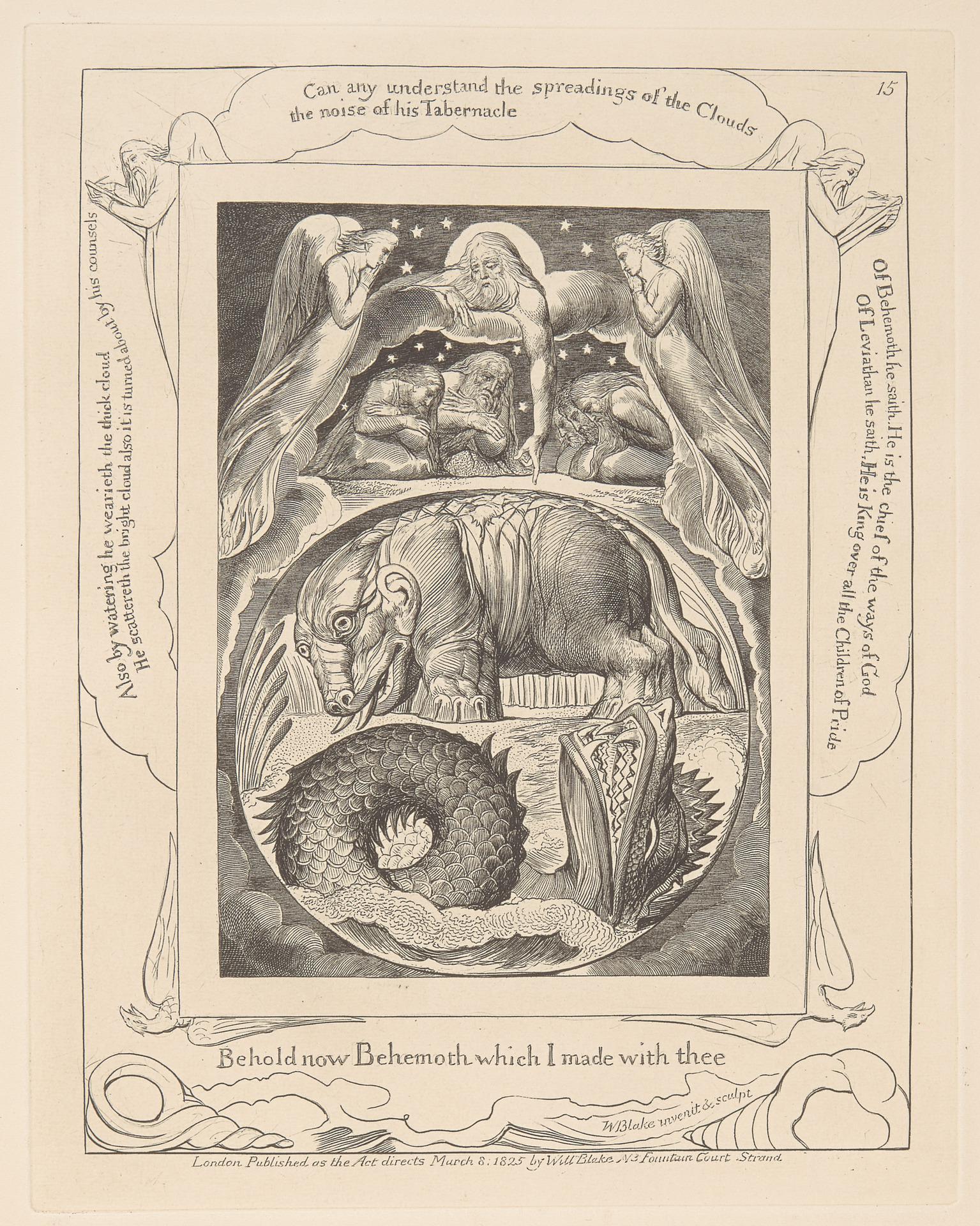 Source: William Blake, Behemoth and Leviathan, CC0, Yale Center for British Art.
The Orthodox fulfillment is not fascination with the monster, but Christ’s victory over death and the proud enemy. The contrast is simple: Job cannot save himself by his right hand; Christ saves by His pierced hands.
Glossary
- Behemoth: A mighty creature in Job 40. Patristically, St Gregory reads Behemoth as an image of the ancient enemy and proud power.
- Leviathan: A terrifying sea creature or serpent figure. In biblical and patristic symbolism, often associated with dragon-like evil and proud resistance to God.
- Ancient enemy: A patristic phrase for the devil.
- Right hand: A biblical image of power and saving strength. Job cannot save himself by his own right hand.
- Anastasis: The Resurrection icon showing Christ’s descent into Hades and raising of Adam and Eve.
- True fast: Isaiah 58’s teaching that fasting must include mercy, justice, and liberation from oppression.
Translation and Source Notes
The embedded Old Testament text is from Brenton’s English Septuagint, public domain. Distinctive Brenton readings include “serpent,” “Phœnicians,” “smyrite stone,” “formed to be sported with by my angels,” and “king of all that are in the waters.”
The passage headings use NKJV numbering. Scripture retains Brenton’s own printed verse labels: 40:25-32 under NKJV 41:1-8, and 41:1-26 under NKJV 41:9-34. The chapter endpoints and the whole Jordan-to-serpent sequence belong to the same complete unit in both systems. Gregory’s Latin biblical text sometimes has a further division; his biblical lemma is identified separately from his interpretation.
Spiritual Fruit 🍇
-
Put your hand over your mouth when words become self-justification. Job’s silence is not weakness. It is the beginning of wisdom after too much speech.
-
Stop trying to save yourself by your own right hand. You can defend truthfully against false accusation, but only God saves. Self-vindication cannot defeat sin, death, or the enemy.
-
Do not domesticate the serpent. Some passions, temptations, and patterns of pride cannot be safely managed as pets. Choose one concrete occasion of temptation and stop arranging your life around it. Bring it to confession and accept a simple rule of resistance rather than trusting your ability to stand near it unharmed.
-
Remember that evil is bounded. Leviathan terrifies man, but the whole world under heaven belongs to God. The enemy is dangerous, not ultimate.
-
Fight pride with Christ’s humility. The proud enemy is defeated by the humble Lord. The Christian weapon is not ego strengthened by religion, but repentance, obedience, fasting, prayer, confession, and communion with Christ.
Job’s hand can cover his mouth; it cannot rule the deep. Christ’s pierced hands can hold the person who has stopped pretending otherwise. In the waters He has gone before us, and through death He has opened life. We can lay down both our boasting and our fear before Him.
Teaching Notes
Suggested timing
- Opening context and numbering note: 6 minutes
- Job 40:1-14, silence and self-salvation: 14 minutes
- Job 40:15-24 and Job 41:1-8, the mighty creature and serpent: 18 minutes
- Job 41:9-34 (Brenton 41:1-26), Leviathan: 18 minutes
- Christological and Lenten synthesis: 12 minutes
- Discussion and prayer: 10 minutes
Where to linger
Linger over Job 40:4-5. Job’s hand over his mouth is one of the most human moments in the book. It helps the class see repentance beginning before the final restoration.
Linger over Job 40:14. “Thy right hand can save thee” is the theological key. The entire monster section answers that line.
Where to compress
Compress the zoological identification debate. Mention it briefly if needed, then return to the passage’s theological purpose: human inability and divine sovereignty over proud power.
Pastoral cautions
- Do not make this a sensational lesson about demons. The aim is humility and trust in Christ.
- Do not imply Job’s suffering was caused by his pride in the same way the friends accused him. God’s correction is real, but it is not the friends’ accusation.
- Do not encourage fear of evil as if God were absent. Leviathan is terrifying, but God is Lord.
- Do not turn spiritual warfare into self-reliance. The whole passage destroys self-reliance.
Key phrases to say slowly
“Evil is stronger than man, but not stronger than God.”
“Pride cannot be turned into a pet.”
“Job cannot save himself by his right hand. Christ saves by His pierced hands.”
“The humble Lord heals the wound made by the proud enemy.”
Silence, judgment, and vindication (Job 40:1-14)
- Ask: How does the Greek reading of 40:8 hold vindication and humility together?
- Watch for: Treating this line as a universal explanation for suffering.
The creature beside Job (Job 40:15-24)
- Ask: What changes when Cyril reads the Jordan image through Christ’s Baptism?
- Watch for: Confusing Cyril’s typology with the creature’s literal identity.
Capture and human limits (Job 41:1-8; Brenton 40:25-32)
- Ask: Why can the terrifying creature remain a creature before God?
- Watch for: Imagining an enemy equal in power to the Creator.
The deep and proud strength (Job 41:9-34; Brenton 41:1-26)
- Ask: Where does the moral image of the rigid neck touch ordinary resistance to correction?
- Watch for: Using the morning-star comparison as proof of a literal identification with Satan.
Whole-session discussion
Ask: Why does Job lay his hand on his mouth after the Lord’s first speech?
Ask: What does it mean that Job’s right hand cannot save him?
Ask: Why does God show Job Behemoth and Leviathan instead of giving a direct explanation of suffering?
Ask: How can Christians read Behemoth and Leviathan both literally and spiritually without becoming fanciful?
Ask: What are modern ways people try to domesticate the serpent?
Ask: How does Christ’s descent into Hades answer the terror of Leviathan?
Ask: What practice of humility most directly fights pride in your life right now?
Visual teaching cue
- Show: Use Blake’s Behemoth and Leviathan with anti-sensational guardrails. Avoid demonology spectacle, dinosaur speculation, and fear-based teaching.
Sources
Embedded Scripture is from Brenton’s English Septuagint (LXX). Short New Testament quotations are from NKJV.
Lancelot C. L. Brenton, The Septuagint Version of the Old Testament, Job. Brenton’s text.
St Gregory the Great, Moralia in Job, Book 32. Section 16, the ancient enemy as spiritual interpretation.
St Gregory the Great, Moralia in Job, Book 33. Sections 14, 17, and 21, the Incarnation hook and divine restraint.
St Gregory the Great, Moralia in Job, Book 34. Section 54, the humility of the Redeemer.
Greek Job, corresponding chapters, for the Greek wording distinguished from Brenton and Hebrew-based translations.
Coptic Great Lent lectionary: the Katameros cycle, distinguished above from Coptic Reader-confirmed and public dated readings.
St Cyril of Jerusalem, Catechetical Lecture 3.11, on Baptism, Jordan, and the dragon. Primary text.
Greek Isaiah, 14:12, for the morning-star wording.
Psalm 104:26 (LXX 103:26); Psalm 74:13-14 (LXX 73:13-14); Psalm 91:13 (LXX 90:13); Psalm 114:3 (LXX 113:3); Revelation 12:9.
William Blake, Behemoth and Leviathan, Yale Center for British Art, CC0, linked with the image above.
Footnotes
-
St Gregory the Great, Moralia in Job XXXII.16, on Behemoth. Primary text. ↩
-
St Cyril of Jerusalem, Catechetical Lecture 3.11, NPNF, second series, vol. 7, trans. Edwin Hamilton Gifford, New Advent revision. The Jordan line corresponds to Brenton Job 40:23; the page’s editorial Bible link labels it Job 40:18. Primary text. ↩
-
St Gregory the Great, Moralia in Job XXXIII.14, on his Latin lemma “In his eyes He will take him as with a hook,” Job 40:24 in English numbering. Primary text. ↩
-
St Gregory the Great, Moralia in Job XXXIV.54. Primary text. ↩