


This narration is from a previous version of the study and may include a combined recording of multiple chapters.
Job 11-14 completes the first cycle of speeches. Zophar, called Sophar in Brenton, is the sharpest of the first three friends. He does not simply misunderstand Job; he treats Job’s wounded speech as empty talk and asks God to expose Job as more guilty than Job knows.
Job’s answer is one of the great turning points in the book. He refuses the friends’ shallow certainty, mocks their claim to own wisdom, shows that creation and history are under God’s hand, and warns them that God does not need lies spoken in His defense. Then Job turns from the friends to God Himself. He asks to be heard, asks to know his sins, confesses human frailty, and reaches toward one of Scripture’s shadowed hopes beyond death: “For if a man should die, shall he live again… I will wait till I exist again?”
This section is not only about bad advice. It is about the soul learning to reject false comfort without rejecting God. Job will not let religious speech become cruelty, but neither will he walk away from the Lord whose face seems hidden.
Historical and Scriptural Context
Where this passage sits in Job
Job 4-7 introduced Eliphaz’s first speech and Job’s first reply. Job 8-10 gave Bildad’s harder appeal to inherited wisdom, followed by Job’s cry for a mediator. Job 11-14 now completes the first round: Zophar speaks, and Job answers him while also answering all three friends.
The reader must keep the prologue in view. Job is not being punished for hidden hypocrisy. The friends do not know the heavenly scene, so their explanations are built on a false diagnosis. Zophar’s speech is especially dangerous because it contains real truth about God’s wisdom and the need for repentance, but aims that truth at the wrong target.
Historical and cultural setting
Brenton calls Zophar “Sophar the Minæan.” The familiar English form “Zophar the Naamathite” comes from the Hebrew tradition. The place-name is uncertain, and nothing in the passage requires a precise map. What matters is his role in the ancient wisdom debate. Zophar speaks as a confident religious interpreter who believes the matter is simple: God is wise, Job is suffering, therefore Job should repent and receive restoration.
The Church reads this kind of speech carefully. The problem is not that Zophar says nothing true. The problem is that he takes truths about repentance, judgment, and divine wisdom, then uses them to accuse a righteous sufferer. In Orthodox pastoral care, true doctrine must be joined to discernment, humility, and love. Otherwise, words that sound like theology become an injury.
Scope and Grouping Rationale
Job 11-14 belongs together because it forms the third and final exchange of the first dialogue cycle.
- What comes before: Job 8-10 gave Bildad’s first speech and Job’s answer. Bildad appealed to God’s justice and tradition; Job responded with the impossibility of litigating against God and the longing for a Mediator.
- Why Job 11-14 is one unit: Job 11 is Zophar’s first speech. Job 12-14 is Job’s answer. The passage must be read as one movement, because Job’s hope beyond death rises directly out of Zophar’s accusation that Job needs only to repent and accept a neat explanation.
- What comes after: Job 15-17 begins the second cycle. Eliphaz returns with sharper accusation, and Job’s desire for a heavenly witness becomes more explicit.
This grouping also protects the rhetorical movement of Job’s answer. Job 12 rebukes the friends’ monopoly on wisdom. Job 13 warns them not to lie for God and then turns toward direct pleading. Job 14 becomes a meditation on mortality and a sustained expression of resurrectional longing. Splitting these chapters apart would weaken the way Job moves from social argument to prayer, and from prayer to hope beyond the grave.
Geographical Significance ⛰️
No new journey or physical location governs this passage. The drama remains Job’s place of affliction, with the friends speaking over him.
The spatial language is theological rather than geographical. Zophar speaks of heaven, hell, earth, and sea to emphasize God’s unsearchable wisdom. Job speaks of beasts, birds, earth, and fish as witnesses to the Creator’s hand. Job 14 turns toward the grave, the tree cut down, the scent of water, and the hidden place where God might remember him. These are not travel details; they are images of the soul’s condition. The soul is being taught that God is not contained by human argument, and that even the grave is not outside His remembrance.
The Characters 👥
Job
Job remains the righteous sufferer whose wound is not explained by secret rebellion. In these chapters he is not merely defending his reputation. He is defending truthful speech before God. He refuses to let the friends call cruelty “orthodoxy.”
Job’s boldness is not unbelief. He wants to speak to God, not escape Him. His prayer is dangerous, trembling, and deeply faithful: “How many are my sins and my transgressions? teach me what they are.” Job is willing to be corrected by God. He will not accept correction invented by men who do not know the truth of his case.
Zophar, or Sophar the Minæan
Zophar is the third friend to speak in the first cycle. He is sharper and less patient than Eliphaz and Bildad. He accuses Job of many words, claims Job has asserted purity, and wishes God Himself would open His lips against Job.
His spiritual danger is religious impatience. He cannot sit with unresolved suffering, so he forces the mystery into a formula. God is wise, sin is real, repentance is necessary, therefore Job’s suffering must mean Job is guilty. The first three statements are true. The conclusion is false.
The three friends
By this point the three friends have become a collective warning. They are not atheists. They are not fools in the ordinary sense. They speak many truths about God, but their speech is spiritually diseased because it lacks compassion and humility.
St Gregory the Great warns that the friends mix sound teaching with false application. Their errors do not make every sentence worthless; their true sentences do not make their verdict just. Job can reject the accusation without rejecting the God whose wisdom they claim to defend.1
God
God has not yet spoken from the whirlwind. His silence is part of Job’s trial. The friends talk about God as though they have mastered His purposes. Job speaks to God as one who cannot master Him but still trusts that God must be addressed.
The divine hiddenness in this passage is not absence. Job’s anguish comes precisely because he believes God is real, just, and able to hear. A person who has abandoned God does not cry, “Then shalt thou call, and I will hearken to thee.”
The tree, the grave, and the work of God’s hands
Job 14 makes images speak. The tree cut down, the scent of water, the grave, the sealed bag, the mountain falling, and the work of God’s hands are not decorative poetry. They carry Job’s deepest question: can the God who made man remember him after death?
For the Christian reader, these images open toward Christ’s death, descent into Hades, and Resurrection. Job does not yet see the full Paschal answer, but his lament leans toward it.
Job 11:1-6, Zophar mistakes wounded prayer for empty talk
1 Then Sophar the Minæan answered and said,
2 He that speaks much, should also hear on the other side: or does the fluent speaker think himself to be righteous? blessed is the short-lived offspring of woman. 3 Be not a speaker of many words; for is there none to answer thee? 4 For say not, I am pure in my works, and blameless before him.
5 But oh that the Lord would speak to thee, and open his lips with thee! 6 Then shall he declare to thee the power of wisdom; for it shall be double of that which is with thee: and then shalt thou know, that a just recompence of thy sins has come to thee from the Lord.
Zophar begins not by grieving with Job but by rebuking his speech. In Brenton, he asks whether “the fluent speaker” thinks himself righteous and then says Job should learn that “a just recompence of thy sins has come to thee from the Lord.” This is not neutral counsel. It is accusation.
Yet the passage is spiritually subtle because Zophar’s first principle is not entirely wrong. Scripture does warn against many words, self-justification, and speech without repentance. The danger is that Zophar takes a real ascetical warning and weaponizes it against a man whose lament God will later vindicate.
St Gregory the Great names this failure with precision. In Moralia in Job X.2, he observes that a sound rebuke loses its force when it strikes a righteous person. He writes, “Thus it is a certain truth, that ‘a man full of words cannot be justified,’ but a good thing is not well said, because there is no heed taken to whom it is spoken.”1 A true sentence can become false comfort when it is aimed without discernment. The words are not enough. The speaker must know the wound he is touching.
Zophar counts Job’s words but has stopped attending to their burden. A person who repeats a sorrow may need someone to bear it with him, not another warning against speaking. Listening begins when we stop treating the length of a lament as evidence against the one who laments.
Zophar’s wish in verses 5-6 is also dangerous: “oh that the Lord would speak to thee.” He assumes that if God spoke, God would confirm Zophar’s diagnosis. But when God finally speaks, He does not vindicate Zophar. He rebukes the friends and says they have not spoken rightly of Him as Job has. This is the warning: never ask God to endorse your judgment of another sufferer unless you are prepared for God to judge your judgment.
Lesson Guide
- Key phrases: “a good thing is not well said”; “true doctrine without discernment becomes accusation”; “God will not be recruited into our impatience.”
- Emphasize: Zophar’s error is not total doctrinal ignorance. It is true speech aimed wrongly.
- Avoid: Do not teach this as though Job simply talks too much. The book itself vindicates Job’s truthful lament over the friends’ pious cruelty.
Job 11:7-20, real wisdom misused as a formula
7 Wilt thou find out the traces of the Lord? or hast thou come to the end of that which the Almighty has made? 8 Heaven is high; and what wilt thou do? and there are deeper things than those in hell; what dost thou know? 9 Or longer than the measure of the earth, or the breadth of the sea.
10 And if he should overthrow all things, who will say to him, What hast thou done? 11 For he knows the works of transgressors; and when he sees wickedness, he will not overlook it.
12 But man vainly buoys himself up with words; and a mortal born of woman is like an ass of the desert.
13 For if thou hast made thine heart pure, and liftest up thine hands towards him; 14 if there is any iniquity in thy hands, put it far from thee, and let not unrighteousness lodge in thy habitation. 15 For thus shall thy countenance shine again, as pure water; and thou shalt divest thyself of uncleanness, and shalt not fear. 16 And thou shalt forget trouble, as a wave that has passed by; and thou shalt not be scared. 17 And thy prayer shall be as the morning star, and life shall arise to thee as from the noon-day. 18 And thou shalt be confident, because thou hast hope; and peace shall dawn to thee from out of anxiety and care. 19 For thou shalt be at ease, and there shall be no one to fight against thee; and many shall charge, and make supplication to thee. 20 But safety shall fail them; for their hope is destruction, and the eyes of the ungodly shall waste away.
Zophar’s speech becomes theologically grand. God is higher than heaven, deeper than hell, longer than the earth, and broader than the sea. Man cannot search out the Almighty. Wickedness must be put away. The heart must be purified. Hope and peace belong to the one who turns to God.
Taken by themselves, many of these words are true. Romans 11:33 says, “How unsearchable are His judgments and His ways past finding out!” James 4:8 says, “Cleanse your hands, you sinners; and purify your hearts, you double-minded.” Repentance does bring light. Prayer can become like the morning. Hope can steady the anxious soul.
But Zophar’s argument is false because he turns spiritual truth into an instant explanation. He tells Job, in effect, “If you repent, this will all make sense and your life will become bright again.” The Orthodox reader must be careful here. Repentance is always necessary, but repentance is not a lever by which we control providence. A sufferer may need repentance because every human being needs repentance. That does not mean the sufferer’s particular wound is proof of a particular hidden sin.
St Gregory’s reading helps us receive the call to humility without claiming access to God’s secret judgments. In Moralia in Job X.7, he distinguishes God’s manifest works from the hidden counsels we cannot search out. The failure to explain everything can itself become a lesson in reverence: “by that very failure we more thoroughly learn Whom we should fear.”2 Zophar speaks of a wisdom beyond human reach, yet acts as though Job’s case lies open in his hand.
In Moralia in Job X.13, Gregory reads the footsteps of God in his Latin biblical text as the lovingkindness of God’s visitation. Brenton speaks of finding out the Lord’s “traces.” God can awaken desire and leave signs of His mercy without giving us possession of His whole counsel. We follow those traces through prayer and obedience; we lose them when we turn another person’s wound into proof of our own insight.3
Two truths must remain together here. The call to put away wickedness is real. The promise that God is unsearchable is real. The claim that these truths explain Job’s suffering is false. Zophar knows the words of wisdom, but not the wound before him.
The final promises in Job 11 are especially tempting to misuse: shining face, forgotten trouble, morning-star prayer, peace from anxiety. These are real spiritual hopes, but they are not mechanical outcomes. In Christ, peace often comes not because the wound disappears, but because the Crucified One enters it. The morning star rises through the night, not by pretending there was no night.
Lesson Guide
- Key phrases: “repentance is necessary, but not every wound is a diagnosis”; “God’s footsteps are followed by love, not possessed by explanation.”
- Emphasize: The problem is not Zophar’s claim that God is wise. The problem is his presumption that he can use divine wisdom to decode Job’s suffering.
- Avoid: Do not flatten the passage into “Zophar is wrong, ignore him.” His words contain true ascetical material, but the book exposes their false application.
Job 12:1-6, Job rejects the friends’ monopoly on wisdom
1 And Job answered and said,
2 So then ye alone are men, and wisdom shall die with you? 3 But I also have a heart as well as you. 4 For a righteous and blameless man has become a subject for mockery. 5 For it had been ordained that he should fall under others at the appointed time, and that his houses should be spoiled by transgressors: let not however any one trust that, being evil, he shall be held guiltless, 6 even as many as provoke the Lord, as if there were indeed to be no inquisition made of them.
Job’s answer begins with holy irony: “So then ye alone are men, and wisdom shall die with you?” He does not deny wisdom. He denies their ownership of wisdom. The friends have spoken as though their inherited formula has settled the matter, so Job exposes the arrogance hidden beneath their piety.
Job then names what their system cannot absorb: “a righteous and blameless man has become a subject for mockery.” The prologue has already told us Job is righteous. His friends mock him by treating his suffering as evidence against him.
Brenton’s verses 5-6 warn against the confidence of those who provoke the Lord as though no reckoning would come. Job refuses to let the friends treat the present scene as the final verdict. In Gregory’s Latin biblical text, verse 6 describes the abundance of robbers’ tents. That wording makes the scandal of wicked prosperity more explicit, and explains Gregory’s meditation on riches below. The two forms share a warning against confusing temporary security with innocence.
St Gregory sees Job’s words about the prosperity of robbers in his Latin text as evidence of detachment. He writes in Moralia in Job XI.2, “It is easy for a man, at the time, to despise riches, when he has them, but it is hard to hold them worthless, when he lacks them.”4 Job has lost everything, yet Gregory hears in him a freedom that loss has not destroyed. Poverty need not turn into envy, and abundance need not be mistaken for blessedness.
Here the passage speaks strongly to Christian life. We are often tempted to read God’s approval from outward success. We see wealth, health, influence, platform, and ease, and assume blessing. Job says no. The hand of God is real, but His judgment is not measured by what the eye can count.
Lesson Guide
- Key phrases: “wisdom shall die with you?”; “visible success is not spiritual proof”; “Job loses everything and still refuses envy.”
- Emphasize: Job is not rejecting God’s justice. He is rejecting the friends’ shallow reading of providence.
- Avoid: Do not turn this into bitterness against the prosperous. Job’s point is discernment, not resentment.
Job 12:7-25, creation and history witness to God’s hand
7 But ask now the beasts, if they may speak to thee; and the birds of the air, if they may declare to thee. 8 Tell the earth, if it may speak to thee: and the fishes of the sea shall explain to thee. 9 Who then has not known in all these things, that the hand of the Lord has made them? 10 Whereas the life of all living things is in his hand, and the breath of every man.
11 For the ear tries words, and the palate tastes meats. 12 In length of time is wisdom, and in long life knowledge. 13 With him are wisdom and power, with him counsel and understanding. 14 If he should cast down, who will build up? if he should shut up against men, who shall open? 15 If he should withhold the water, he will dry the earth: and if he should let it loose, he overthrows and destroys it. 16 With him are strength and power: he has knowledge and understanding. 17 He leads counsellors away captive, and maddens the judges of the earth. 18 He seats kings upon thrones, and girds their loins with a girdle. 19 He sends away priests into captivity, and overthrows the mighty ones of the earth. 20 He changes the lips of the trusty, and he knows the understanding of the elders. 21 He pours dishonour upon princes, and heals the lowly. 22 Revealing deep things out of darkness: and he has brought into light the shadow of death. 23 Causing the nations to wander, and destroying them: overthrowing the nations, and leading them away. 24 Perplexing the minds of the princes of the earth: and he causes them to wander in a way they have not known, saying, 25 Let them grope in darkness, and let there be no light, and let them wander as a drunken man.
Job now turns to creation. Ask the beasts. Ask the birds. Ask the earth. Ask the fish. Every creature knows that life and breath are in the hand of the Lord. This is a rebuke to the friends. They have spoken as if Job needs elementary instruction, but Job says even the non-human creation already confesses the Creator’s sovereignty.
The irony is sharp. The friends claim wisdom, but their wisdom has made them less perceptive than the beasts. Creation knows God as Maker. The friends claim to know God as Judge, yet they judge without mercy.
St Gregory reads the beasts, birds, earth, and fish as different kinds of people and knowledge: the slower mind, the contemplative, the earthly-minded person, and those occupied in the world’s depths. All may acknowledge God’s power without living faithfully under it. Knowing that God rules is not yet the same as speaking rightly to a sufferer (Moralia in Job XI.5-8).5
The second half of the passage moves from creation to history. God casts down and builds up. He shuts and opens. He withholds waters and releases them. He leads counselors captive, humbles judges, overturns priests and mighty ones, changes lips, reveals deep things out of darkness, brings to light the shadow of death, and makes nations wander.
This is not an abstract hymn to power. Job is saying: you cannot turn God’s government into a small formula. God confounds counselors, elders, kings, priests, nations, and princes. If He overturns the structures by which humans claim certainty, then the friends should tremble before making Job’s suffering fit their system.
Job 12:18-13:1 is read at the First Hour of Good Friday in current Holy Week service books, though that appointment has not yet been checked against Coptic Reader. Brenton’s image is of God seating kings upon thrones and girding their loins, not loosening their belts. Their authority rests in His hand. Read beside the Passion, these words help us hear Christ before Pilate: “You could have no power at all against Me unless it had been given you from above” (John 19:11, NKJV). This is a Christian reflection on the pairing. Christ stands under human judgment by His willing obedience, and enters the shadow of death to bring it into light.
Olympiodorus of Alexandria, through a Catena Bible gateway fragment on Job 12:22, reads the verse prophetically: the profound meaning announces the advent of the Lord, who reveals the hidden things and brings the shadow of death to light. This fits the Good Friday reading. In Christ’s Passion, darkness is not denied. It is entered, exposed, and conquered.
Lesson Guide
- Key phrases: “creation knows what proud speech forgets”; “God’s hand cannot be reduced to our formula”; “Good Friday reveals the shadow of death brought to light.”
- Emphasize: Job’s creation language is not a nature reflection detached from suffering. It is a rebuke to shallow religious certainty.
- Avoid: Do not teach this as fatalism. God’s sovereignty is not cold determinism. It is the hidden government of the wise and living God.
Job 13:1-12, Job exposes false advocacy for God
1 Behold, mine eye has seen these things, and mine ear has heard them. 2 And I know all that ye too know; and I have not less understanding than you.
3 Nevertheless I will speak to the Lord, and I will reason before him, if he will. 4 But ye are all bad physicians, and healers of diseases. 5 But would that ye were silent, and it would be wisdom to you in the end.
6 But hear ye the reasoning of my mouth, and attend to the judgment of my lips. 7 Do ye not speak before the Lord, and utter deceit before him? 8 Or will ye draw back? nay, do ye yourselves be judges. 9 For it were well if he would thoroughly search you: for though doing all things in your power ye should attach yourselves to him, 10 he will not reprove you at all the less: but if moreover ye should secretly respect persons, 11 shall not his whirlpool sweep you round, and terror from him fall upon you? 12 And your glorying shall prove in the end to you like ashes, and your body like a body of clay.
Job now turns directly against the friends. He has seen and heard what they claim to know. He is not inferior to them. But unlike them, he wants to speak to the Lord. The friends talk about God over Job. Job wants to stand before God in truth.
The phrase “bad physicians” is one of the most pastorally important images in Job. A physician may have medicine, but if he does not understand the sickness, he harms the patient. The friends speak as healers, but their diagnosis is false, so their treatment deepens the wound.
Job’s wish for their silence exposes the difference between having medicine and knowing how to heal. They have moral sayings ready, but have not understood the person before them. Their desire to help cannot make a false diagnosis harmless. The first service a friend can offer here is to stop adding to the pain.
Job then says something every teacher, priest, parent, and comforter should fear: “Do ye not speak before the Lord, and utter deceit before him?” The friends think they are defending God. Job says they are lying in God’s presence.
St Gregory’s comment in Moralia in Job XI.37 is severe and necessary: “God doth not ‘stand in need of a lie,’ in that Truth does not seek to be stayed up by the aid of falsehood.”6 God needs no invented cause for another person’s suffering. A defense that depends on untruth injures the sufferer and misrepresents the Lord it claims to honor. We may confess God’s goodness while admitting that we do not know why a particular sorrow has come.
Job also asks, “will ye draw back? nay, do ye yourselves be judges.” He forces the friends to examine their own speech. If God searches them, will their words stand? If God’s terror falls, will their confident explanations survive? The friends have put Job on trial, but Job says their theology is also on trial.
This is deeply Orthodox. Theology is not only correctness of propositions. It is purification of speech, humility before mystery, and love for the person in front of us. A man can say something technically true and still sin against God by the way he says it.
Lesson Guide
- Key phrases: “bad physicians”; “God does not need a lie”; “false comfort is speech under judgment.”
- Emphasize: Job is not defending irreverence. He is defending truthful reverence against religious falsehood.
- Avoid: Do not use this passage to mock people who try to comfort poorly. Teach the danger, but also teach repentance and better care.
Job 13:13-28, Job risks his life to speak before God
13 Be silent, that I may speak, and cease from mine anger, 14 while I may take my flesh in my teeth, and put my life in my hand. 15 Though the Mighty One should lay hand upon me, forasmuch as he has begun, verily I will speak, and plead before him. 16 And this shall turn to me for salvation; for fraud shall have no entrance before him. 17 Hear, hear ye my words, for I will declare in your hearing. 18 Behold, I am near my judgment: I know that I shall appear evidently just. 19 For who is he that shall plead with me, that I should now be silent, and expire?
20 But grant me two things: then I will not hide myself from thy face. 21 Withhold thine hand from me: and let not thy fear terrify me. 22 Then shalt thou call, and I will hearken to thee: or thou shalt speak, and I will give thee an answer. 23 How many are my sins and my transgressions? teach me what they are.
24 Wherefore hidest thou thyself from me, and deemest me thine enemy? 25 Wilt thou be startled at me, as at a leaf shaken by the wind? or wilt thou set thyself against me as against grass borne upon the breeze? 26 For thou hast written evil things against me, and thou hast compassed me with the sins of my youth. 27 And thou hast placed my foot in the stocks; and thou hast watched all my works, and hast penetrated to my heels. 28 I am as that which waxes old like a bottle, or like a moth-eaten garment.
Job asks the friends to be silent so he may speak. His language becomes intense: he takes his flesh in his teeth and puts his life in his hand. This is a man who knows that speaking before God is not safe in a casual sense. Yet silence would be a worse death, because false speech has surrounded him and God’s face seems hidden.
Many English readers know Job 13:15 in the form, “Though He slay me, yet will I trust Him.” Brenton’s Septuagint wording is different: “Though the Mighty One should lay hand upon me, forasmuch as he has begun, verily I will speak, and plead before him.” The spiritual movement is similar but not identical. Brenton emphasizes Job’s determination to plead before God even under God’s hand. Job is not simply making a quiet statement of trust. He is daring to bring his case before the only One who can truly judge it.
The familiar Hebrew-based wording gives special prominence to trust under the threat of death. Brenton gives prominence to pleading. In either case Job remains turned toward God. Faith can cling to the Lord by asking Him to hear a case that no human voice has understood.
Job says, “this shall turn to me for salvation; for fraud shall have no entrance before him.” He would rather risk honest speech before God than survive by fraud. Gregory reads this as self-examination before the final Judge, drawing on 1 Corinthians 11:31: “For if we would judge ourselves, we would not be judged” (NKJV). Job asks to be searched truly, not to be flattered (Moralia in Job XI.48).7
The prayer in verses 20-23 is one of the most useful passages in Job for spiritual formation. Job asks God for two things: withhold Your hand, and do not let terror overwhelm me. Then he asks, “How many are my sins and my transgressions? teach me what they are.” This is not the prayer of a man refusing repentance. It is the prayer of a man refusing false accusation while still asking God for real correction.
Job asks for the terror to be lifted so that he can answer. He seeks neither exemption from truth nor permission to flee it. He asks for enough mercy to stand in God’s presence without being overwhelmed. In confession, that same distinction matters: fear can awaken repentance, but crushing dread can make a person unable to speak.
This passage gives a pattern for confession under affliction. Do not confess sins that others invent for you. Do not deny that you need God to search you. Ask God to reveal what is real, to protect you from despair, and to free your prayer from fraud.
The final image, “I am as that which waxes old like a bottle, or like a moth-eaten garment,” returns us to frailty. Job’s boldness is not self-confidence. It is the boldness of a dying man who has nowhere to go but God.
Lesson Guide
- Key phrases: “honest pleading is not fraud”; “ask God to reveal real sins, not invented accusations”; “Job’s fight remains inside faith.”
- Emphasize: Job 13 holds boldness and humility together. He rejects the friends’ accusations and still asks God to teach him his sins.
- Avoid: Do not use “Though He slay me” as a slogan that silences pain. In context, Job is still pleading, questioning, and seeking God’s face.
Job 14:1-6, mortality, impurity, and the shortness of human life
1 For a mortal born of a woman is short-lived, and full of wrath. 2 Or he falls like a flower that has bloomed; and he departs like a shadow, and cannot continue. 3 Hast thou not taken account even of him, and caused him to enter into judgment before thee? 4 For who shall be pure from uncleanness? not even one; 5 if even his life should be but one day upon the earth: and his months are numbered by him: thou hast appointed him for a time, and he shall by no means exceed it.
6 Depart from him, that he may be quiet, and take pleasure in his life, though as a hireling.
Job’s prayer widens from his own case to the condition of every human being. Man born of woman is short-lived and full of wrath or trouble. He falls like a flower and departs like a shadow. His days are numbered. He cannot exceed the bounds God has appointed.
This is not abstract pessimism. Job is bringing human fragility into prayer. He asks why God would bring such a creature into judgment. If man is dust, shadow, flower, and breath, then the mystery is not only why Job suffers. The mystery is why God regards man at all.
St Gregory reads “born of a woman” as an acknowledgment of frailty. He asks in Moralia in Job XI.65, “What strength shall he have in himself, who was born in frailty?”8 This does not despise embodied birth or womanhood. It names the mortal condition shared by all Adam’s children. Human life is brief, vulnerable, and unable to make itself clean.
Verse 4 intensifies the prayer: “who shall be pure from uncleanness? not even one.” The Septuagint carries the question into verse 5, even to a life of only one day. This clause is more explicit than the Hebrew form, which turns to the determination of man’s days. Job reaches beneath anyone’s record of particular deeds to humanity’s common need for cleansing. That does not make a newborn guilty of deliberate acts. It points toward the healing only God can give. The Word born of the Virgin enters our mortal condition without sin, so that those born in frailty may receive new life in Him.
Job asks God to “depart” from man so he may be quiet. This is a wounded request, not full theology. The deeper answer of Scripture is not that God leaves man alone, but that God comes near in mercy without crushing him. In Christ, God draws near as Physician, not as the false physicians did.
Lesson Guide
- Key phrases: “fragility brought into prayer”; “born in frailty, healed by Christ”; “God’s nearness must become mercy, not terror.”
- Emphasize: Job 14 is not nihilism. It is mortality spoken before God.
- Avoid: Do not use verse 4 to teach disgust toward embodied life or women. The issue is the fallen mortal condition, not contempt for creation.
Job 14:7-15, the tree, the grave, and hope that waits to exist again
7 For there is hope for a tree, even if it should be cut down, that it shall blossom again, and its branch shall not fail. 8 For though its root should grow old in the earth, and its stem die in the rock; 9 it will blossom from the scent of water, and will produce a crop, as one newly planted. 10 But a man that has died is utterly gone; and when a mortal has fallen, he is no more. 11 For the sea wastes in length of time, and a river fails and is dried up. 12 And man that has lain down in death shall certainly not rise again till the heaven be dissolved, and they shall not awake from their sleep.
13 For oh that thou hadst kept me in the grave, and hadst hidden me until thy wrath should cease, and thou shouldest set me a time in which thou wouldest remember me! 14 For if a man should die, shall he live again, having accomplished the days of his life? I will wait till I exist again? 15 Then shalt thou call, and I will hearken to thee: but do not thou reject the work of thine hands.
Job sees that a tree cut down may blossom again “from the scent of water.” Then he asks whether man, once dead, can live again. Brenton’s wording is striking: “I will wait till I exist again?” The punctuation carries the uncertainty of lament, but the longing is unmistakable. Job wants a time when God will remember him.
The tree image is not simple optimism. Job first contrasts the tree with man. The tree seems to have more hope than the human body. Yet the image itself begins to pull the prayer beyond despair. If a dead-looking stump can revive at the scent of water, can the Creator remember the work of His hands beyond death?
St Gregory gives the tree a rich Christian reading in Moralia in Job XII.5-8. He relates its branches of meaning to the Cross, the righteous person, and the incarnate Wisdom of God. The cut tree can therefore speak of a righteous person suffering for truth and living again. In his resurrectional reading of the human body, the stump buds “through the coming of the Holy Spirit”9. The body reduced to dust is still the Creator’s work; death has not made it impossible for Him to call it back.
Job 14 gives voice to the ache that Pascha answers. Job asks to be hidden in the grave until wrath passes. Gregory reads this through the saving descent of the Mediator: the righteous awaited the One who would open Paradise. When Christ descends into Hades, the hope that seemed buried is remembered (Moralia in Job XII.13-15).10
Job 14:14 remains a question, and its question mark belongs to the lament. Gregory’s Latin text proceeds from a question to a declaration of waiting for change. He reads this as the strong giving voice to the weak, then strengthening them. His comparison with Christ in Gethsemane rests on the Lord’s willing assumption of our weakness and His obedient fulfillment of the Father’s will, not on any rebellion in Christ (Moralia in Job XII.16).11
Gregory then draws hope from the waiting itself: “He that waits for his change with such ardent longing, shews how great his certainty was of the Resurrection”12. His comment follows the affirmative wording of Job in his Latin text. Brenton leaves the sentence questioning, “I will wait till I exist again?” The Christian reading can hear a genuine longing for resurrection while allowing Job’s uncertainty to remain audible.
Verse 15 is even more beautiful: “Then shalt thou call, and I will hearken to thee: but do not thou reject the work of thine hands.” Gregory reads the divine call as resurrection and transformation. God calls, and the creature answers by rising incorrupt. His Latin biblical text also names God’s right hand, which he interprets of the Son sent to lift humanity from its fallen condition. Brenton’s appeal concerns the work of God’s hands; the two forms meet in the Creator’s care for the creature He made (Moralia in Job XII.18).13
This is not a shallow happy ending. Job’s pain remains. His children are still dead. His body still hurts. His friends still misunderstand him. But in the middle of lament, the Spirit plants a question that will become Christian hope: if a man dies, shall he live again?
Lesson Guide
- Key phrases: “the scent of water”; “I will wait till I exist again”; “do not reject the work of Your hands.”
- Emphasize: Job’s hope is not yet full Paschal proclamation, but it truly leans toward resurrection.
- Avoid: Do not force Job to sound as if he already has post-resurrection clarity. Let the shadowed hope remain shadowed, then show how Christ fulfills it.
Job 14:16-22, sealed sins and the ache of unresolved mortality
16 But thou hast numbered my devices: and not one of my sins shall escape thee? 17 And thou hast sealed up my transgressions in a bag, and marked if I have been guilty of any transgression unawares.
18 And verily a mountain falling will utterly be destroyed, and a rock shall be worn out of its place. 19 The waters wear the stones, and waters falling headlong overflow a heap of the earth: and thou destroyest the hope of man. 20 Thou drivest him to an end, and he is gone: thou settest thy face against him, and sendest him away; 21 and though his children be multiplied, he knows it not; and if they be few, he is not aware. 22 But his flesh is in pain, and his soul mourns.
After the hope of verses 13-15, Job returns to the pain of being watched, numbered, and worn down. His transgressions are sealed in a bag. The mountain falls. The rock is worn away. Waters wear stones. God destroys the hope of man. Children rise or fall, but the dead man does not know. His flesh is in pain, and his soul mourns.
This return to sorrow is important. Scripture does not rush Job from hope to resolution. The hope is real, but the ache remains. This is often how Christian endurance works. A person may believe in resurrection and still grieve. A person may trust God and still feel watched, exposed, and worn down.
St Gregory reads the sealed bag in two ways in Moralia in Job XII.21. It can signify sins reserved for judgment, or the heart in which the penitent remembers sins truthfully before God. His reading draws on David’s penitence in Psalm 51:3 (Brenton LXX 50:5), where sin remains before the speaker. The comparison concerns remembrance that leads to mercy, not an endless rehearsal of shame. Gregory’s further language of chastening belongs to his spiritual interpretation; it does not authorize the friends to identify this particular affliction as payment for a crime.14
This gives a sober end to the chapter. Job does not deny sin in general. He denies the friends’ false knowledge of his sin. The right response is not self-defensive blindness, but truthful repentance before God. False guilt crushes the soul. Real repentance heals it.
The final line leaves flesh in pain and the soul mourning. The passage ends with embodied grief. Christian hope does not cancel the body. It waits for the redemption of the body. Until then, flesh can hurt and soul can mourn while faith still reaches toward God.
Lesson Guide
- Key phrases: “false guilt crushes; real repentance heals”; “hope does not erase mourning”; “the redemption of the body is the answer to embodied grief.”
- Emphasize: Job 14 ends unresolved on purpose. Let students feel the tension between hope and pain.
- Avoid: Do not turn resurrection hope into pressure to stop grieving.
Christological and Typological Reading
Job 11-14 opens several strong Christological lines without forcing the text.
First, Job is the righteous sufferer accused by religious speech. The friends think they defend God, but they wound the innocent. In the Passion, Christ is accused by religious leaders who believe they are defending God’s honor. Job warns us that one can speak about God while standing against the one God vindicates.
Second, Job’s “bad physicians” prepare us to recognize Christ as the true Physician. The friends diagnose falsely. Christ heals by entering the wound. He does not explain suffering from a distance. He bears it in His own flesh.
Third, Job 12:18-13:1 is appointed at Good Friday First Hour in current Holy Week service books, not yet checked against Coptic Reader. God seats kings upon thrones, sends priests into captivity, overturns the mighty, reveals deep things from darkness, and brings the shadow of death into light. On Good Friday, human judges, priests, and rulers appear to dispose of Christ. In truth, the Cross exposes the judgment of the world and begins the defeat of death.
Fourth, Job 14 opens toward the descent into Hades and the Resurrection. Job asks to be hidden in the grave until wrath passes and until God remembers him. Christ enters the grave and Hades not as a prisoner of despair, but as the Mediator who opens Paradise. The One who is the Wisdom of God Incarnate becomes the green tree cut down, and by His rising the dead receive hope beyond the dust.
Finally, Job’s plea, “do not thou reject the work of thine hands,” is fulfilled in the Incarnation. The Son, whom Gregory sees in the right hand named in his Latin text, comes to lift the work of God’s hands from corruption to incorruption. Human nature is not discarded. It is assumed, healed, raised, and glorified in Christ.
The Church’s Voice in Worship ⛪
Great Lent: true repentance and truthful speech
The Church reads Job 11:1-20 at Matins on Friday of the Second Week of Great Lent, and Job 12:1-14:22 at Matins on Wednesday of the Third Week. Both appointments are confirmed in Coptic Reader. On the first morning, the other prophecies include 1 Samuel 17:1-18:4 and Isaiah 7:1-14; on the second, Exodus 4:19-6:13, Joel 2:21-27, and Isaiah 9:9-10:4 accompany Job.
A reflection on Friday’s readings brings Zophar’s certainty into sharp relief. David faces Goliath without the outward equipment by which others measure strength; Isaiah speaks God’s promise of Immanuel amid fear. Neither reading allows appearances to settle what God can do. The Liturgy Gospel, Luke 6:39-49, is listed for that day in the public lectionary, not yet checked against Coptic Reader. Christ asks, “And why do you look at the speck in your brother’s eye, but do not perceive the plank in your own eye?” (Luke 6:41, NKJV). Zophar sees Job’s words with painful sharpness and misses the presumption in his own judgment. Fasting becomes fruitful when that question falls first on the one who offers advice.
Wednesday’s Liturgy Gospel, Luke 4:1-13, has the same public-lectionary status. As a reflection on the pairing, the devil’s use of Scripture against Christ illuminates Job’s warning against deceit spoken before the Lord. A biblical citation can be made to serve a false demand. Christ answers the tempter, “You shall not tempt the Lord your God” (Luke 4:12, NKJV). Reverence receives the word in obedience; presumption uses the word to force God to endorse its own design.
Good Friday: authority under the sovereign Christ
Job 12:18-13:1 is the seventh prophecy at the First Hour of Good Friday in current Holy Week service books, not yet checked against Coptic Reader. Wisdom 2:12-22, the sixth prophecy, belongs to the same hour with the same status. The slightly longer form Job 12:17-13:1 is an historical witness in the St Mary Ottawa Holy Pascha book, not a second confirmation of the current boundaries.
Read together, Job’s account of rulers under God’s hand and Wisdom’s account of men plotting against a righteous person who calls God his Father draw the Christian reader toward the Passion. This is reflection on their companionship, not a claim to an exclusive explanation of the appointment. Kings and judges really act, and remain responsible; their power does not displace Christ’s sovereignty. He submits willingly, and His entry into death reveals the limits of every earthly tribunal.
Holy Wednesday and prayer
The Church also reads the named “Memoirs of Job” at the Sixth Hour of Wednesday of Holy Pascha, an appointment confirmed in Coptic Reader. That is living worship, distinct from the historical appointments of other passages from Job during Holy Week.
Job’s question about life beyond the grave can become our prayer without being turned into a borrowed hymn: Lord Jesus Christ, remember the work of Your hands. Meet us in the grief we cannot explain, and keep us waiting for the life You have opened through Your death and Resurrection.
Iconography Connection 🖼️
The Anastasis icon gives visible form to the hope in Job 14. Job 14 asks to be hidden in the grave until God remembers him; the Anastasis shows Christ entering death and lifting Adam and Eve by the hand. The hands reaching into the grave answer Job’s plea that God not reject His handiwork.
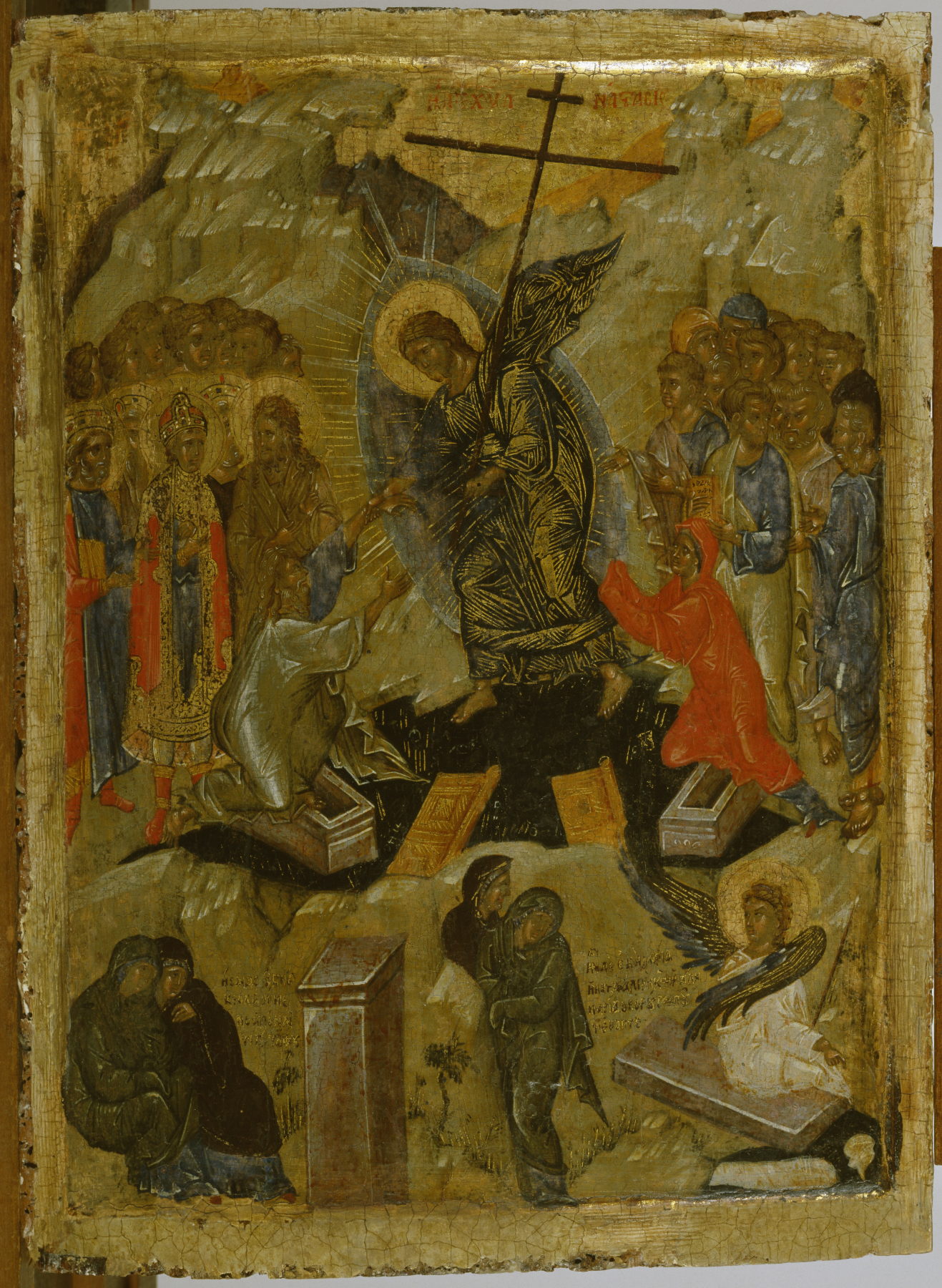 Source: Greek icon, Resurrection of Christ, public domain, Walters Art Museum.
The icon answers the grave through Christ’s presence there. It does not make Job’s grief unreal. The tree’s scent of water and the icon’s raised hands speak of the same hope from different sides: the creature waits, and the Creator comes to lift it.
Spiritual Fruit 🍇
-
Do not mistake someone’s grief for rebellion. Zophar hears many words and assumes guilt. The Church must listen more deeply. A suffering person may sound disordered because pain is disordered, but that does not mean the heart has abandoned God.
-
Never lie for God. Job 13:7 is a permanent warning. God does not need exaggerated explanations, invented causes, or forced certainty. If you do not know why someone suffers, say so. Silence with love is better than a false answer with religious vocabulary.
-
Ask God to reveal real sins, not the sins others assign to you. Job is willing to pray, “teach me what they are.” This is a healthy confession. False guilt leads to despair. Real repentance leads to healing.
-
Let creation humble your certainty. Beasts, birds, earth, and fish all witness that life is in God’s hand. But creation’s witness does not give us permission to decode every wound. Wonder should make us humbler, not more controlling.
-
Hold resurrection hope without shaming grief. Job 14 reaches toward life beyond death, then returns to pain and mourning. When visiting someone bereaved, do not make belief in resurrection a demand that tears end. Stay long enough to hear the name of the person they miss. Christian hope gives the grieving somewhere to wait.
The tree has been cut down, and Job still feels the ache of the grave. Yet he asks God to remember him. Bring one sorrow you cannot resolve into that same prayer today. The hands that made us have not ceased to be merciful.
Teaching Notes
Job 11:1-6
- Ask: What does Zophar assume God will say if He speaks, and how does Job 42 overturn that assumption?
- Watch for: Treating repeated lament as proof that a sufferer has rejected God.
Job 11:7-20
- Ask: How can an appeal to God’s unsearchable wisdom become a claim to know too much?
- Watch for: Promising immediate health or outward success as the test of repentance.
Job 12:1-6
- Ask: What changes when temporary security is no longer treated as a final verdict?
- Watch for: Blending Brenton’s verses 5-6 with the robbers’ tents in Gregory’s Latin text without naming the difference.
Job 12:7-25
- Ask: Why does Job move from creatures to counselors, kings, and nations?
- Watch for: Importing the Hebrew image of loosened royal belts into Brenton’s enthroning and girding of kings.
Job 13:1-12
- Ask: What would it mean to defend God’s goodness while admitting that we do not know the reason for a particular sorrow?
- Watch for: Turning the criticism of bad physicians into ridicule of friends who need to learn gentler care.
Job 13:13-28
- Ask: Why does Job ask for his sins to be shown after rejecting the friends’ charges?
- Watch for: Using the familiar wording of 13:15 to silence the very pleading the chapter records.
Job 14:1-6
- Ask: How does the Septuagint’s one-day clause widen Job’s prayer beyond his own deeds?
- Watch for: Assigning personal guilt to infants or speaking contemptuously about birth, women, or the body.
Job 14:7-15
- Ask: How does the contrast between tree and human life become an appeal to the Creator?
- Watch for: Erasing Brenton’s question mark or making Job speak with the clarity of the completed Gospel.
- Show: Read the grief before showing the Anastasis icon; let Christ’s raised hands answer the plea to be remembered.
Job 14:16-22
- Ask: Why can hope and mourning remain in the same prayer?
- Watch for: Treating Gregory’s spiritual reading of chastening as proof of the friends’ diagnosis.
Session guidance
- Allow time for silence after Job 13:23 and Job 14:15. Invite prayer rather than demanding personal disclosures.
- Distinguish the Coptic Reader-confirmed Lenten appointments, public Gospel companions, current unchecked Holy Week appointment, and historical Ottawa boundary.
Glossary
- Sophar / Zophar: Brenton’s “Sophar the Minæan” corresponds to the more familiar Zophar the Naamathite.
- Retribution logic: The assumption that present suffering proves personal guilt and present prosperity proves righteousness.
- False comfort: Speech meant to explain or console that instead harms because it is untrue, premature, or without compassion.
- Sheol / Hades / grave: Terms used in biblical and later Christian language for the state or abode of the dead. Job 14 uses grave language that Christians read in light of Christ’s descent into Hades.
- Anastasis: The icon and feast reality of Christ’s Resurrection, especially His raising of Adam and Eve from Hades.
- Good Friday First Hour: A Holy Pascha service in the Coptic Orthodox Church. Current Holy Week service books include Job 12:18-13:1 in this hour; this appointment is not yet checked against Coptic Reader.
- Catena: A chain of commentary excerpts attributed to different Christian interpreters.
Translation and Source Notes
Embedded Scripture is from Brenton’s English Septuagint (LXX).
Brief New Testament quotations are from NKJV.
Brenton’s questioning form in Job 14:14 and the affirmative waiting in Gregory’s Latin biblical text give different accents to hope. His commentary on the tree, the resurrection, and God’s right hand follows that Latin text. The shorter Old Greek and its later supplements are discussed in the Introduction to Job.
Sources
Sir Lancelot C. L. Brenton, The Septuagint Version of the Old Testament, Job 11-14. Job 11, Job 12, Job 13, Job 14.
St Gregory the Great, Moralia in Job, Books X-XII, with passage-level citations below. His quoted biblical lemmas follow his Latin text, not Brenton’s English Septuagint.
Olympiodorus of Alexandria, commentary fragments on Job 12:22 and 14:14, accessed through Catena Bible as gateway source.
Coptic Reader, Great Lent Matins prophecies for Friday of the Second Week and Wednesday of the Third Week; Holy Pascha Wednesday, Sixth Hour, “Memoirs of Job.”
Current Holy Pascha service-book reading order, Good Friday First Hour, Wisdom 2:12-22 and Job 12:18-13:1, not yet checked against Coptic Reader; St Mary Ottawa Holy Pascha book, historical Job 12:17-13:1 witness.
Public date-resolved Coptic lectionary, Friday of the Second Week and Wednesday of the Third Week of Great Lent, Liturgy Gospels Luke 6:39-49 and Luke 4:1-13, not yet checked against Coptic Reader.
New Testament cross-references include Romans 11:33; James 4:8; 1 Corinthians 11:31; John 19:11. Brief quotations are from NKJV.
Psalm 51:3 (Brenton LXX 50:5), the penitential remembrance used in Gregory’s reading of Job 14:17. Brenton LXX 50.
Footnotes
-
St Gregory the Great, Moralia in Job, Book X, section 2; text. ↩ ↩2
-
St Gregory the Great, Moralia in Job, Book X, section 7; text. ↩
-
St Gregory the Great, Moralia in Job, Book X, section 13; text. ↩
-
St Gregory the Great, Moralia in Job, Book XI, section 2; text. ↩
-
St Gregory the Great, Moralia in Job, Book XI, section 5-8; text. ↩
-
St Gregory the Great, Moralia in Job, Book XI, section 37; text. ↩
-
St Gregory the Great, Moralia in Job, Book XI, section 48; text. ↩
-
St Gregory the Great, Moralia in Job, Book XI, section 65; text. ↩
-
St Gregory the Great, Moralia in Job, Book XII, section 7; text. ↩
-
St Gregory the Great, Moralia in Job, Book XII, section 13-15; text. ↩
-
St Gregory the Great, Moralia in Job, Book XII, section 16; text. ↩
-
St Gregory the Great, Moralia in Job, Book XII, section 17; text. ↩
-
St Gregory the Great, Moralia in Job, Book XII, section 18; text. ↩
-
St Gregory the Great, Moralia in Job, Book XII, section 21; text. ↩