


This narration is from a previous version of the study and may include a combined recording of multiple chapters.
Job 42 is the end of the argument and the beginning of healing. Job does not receive a tidy explanation for his suffering. He receives a vision of God that turns hearing into sight, complaint into repentance, and isolation into priestly intercession. The friends are rebuked, not vindicated. Job is corrected, not condemned.
The restoration is real, but it must not be read as a cheap replacement for grief. The children lost in Job 1 are not erased by the children born in Job 42. The ending points beyond compensation toward resurrection, especially in Brenton’s Septuagint ending: “it is written that he will rise again with those whom the Lord raises up.” Job’s final hope is not merely doubled possessions. It is life before God.
Historical and Scriptural Context
Job 40-41 brought Job before Behemoth and Leviathan, powers beyond human mastery. God asked whether Job could save himself by his own right hand. Job could not. The Lord’s speeches have restored the difference between Creator and creature.
Job 42 records Job’s response, God’s rebuke of the friends, Job’s intercession for them, and the restoration of Job’s household and fortunes. The book ends with a resurrection promise followed by the Septuagint notice about Job’s background, Edomite setting, and earlier name Jobab. This ending matters for Orthodox reading because it explicitly refuses to let restoration stop at earthly prosperity.
Scope and Grouping Rationale
Job 42 stands alone because it is the book’s conclusion. It contains four distinct movements: Job’s repentance after seeing God, God’s judgment against the friends, Job’s priestly intercession, and restoration with resurrectional hope. Combining it with Job 40-41 would weaken the final turn from divine confrontation to reconciled healing.
What came before was the Lord’s answer from the whirlwind and the revelation of creatures and powers Job could not master. What follows is not another speech cycle, but the reader’s response. Job 42 closes the book and sends the Church back into life with humility, truth, intercession, and hope.
Geographical Significance ⛰️
The narrative conclusion itself does not involve travel, but Brenton’s ending gives geographical and genealogical background. Job is described as living in the land of Ausis, on the borders of Idumea and Arabia. He is linked with Edom and with the name Jobab. This reinforces the book’s ancient, non-Israelite, wisdom setting.
Theologically, that setting matters because Job’s righteousness and encounter with God are not confined to Israel’s later institutional borders. The God of Israel is the Creator and Judge of all. Wisdom, suffering, and resurrectional hope are presented on a universal human stage.
The Characters 👥
Job. Job becomes the repentant seer and intercessor. He is humbled by God, vindicated against the friends’ false claims, and restored in a way that points beyond earthly prosperity.
The Lord. God rebukes Job’s overreach, rebukes the friends’ false speech, accepts Job’s prayer, and restores him. His justice and mercy meet without confusion.
Eliphaz, Bildad, and Zophar. The friends are corrected by God. Their theological defense of God was false because it misrepresented Him and wounded Job.
Job’s family and community. Those who had known Job return, eat and drink with him, comfort him, and give gifts. Restoration includes communal return, not only private blessing.
Job’s daughters. Brenton names them Day, Casia, and Amalthæa’s horn, and says they receive inheritance among their brothers. Their naming and inheritance mark the restored household with unusual honor.
From hearing to sight (Job 42:1-6)
1 Then Job answered and said to the Lord,
2 I know that thou canst do all things, and nothing is impossible with thee. 3 For who is he that hides counsel from thee? or who keeps back his words, and thinks to hide them from thee? and who will tell me what I knew not, great and wonderful things which I understood not?
4 But hear me, O Lord, that I also may speak: and I will ask thee, and do thou teach me. 5 I have heard the report of thee by the ear before; but now mine eye has seen thee. 6 Wherefore I have counted myself vile, and have fainted: and I esteem myself dust and ashes.
Job’s repentance is often misunderstood. It is not Job saying, “My friends were right.” God will immediately say the opposite. Job’s repentance is the repentance of a righteous man who has encountered God more deeply and now sees the limits of his own speech. He had heard of God; now his eye has seen Him.
St Gregory the Great, in Moralia in Job, Book XXXV, reads Job 42:2 as Job’s answer to the revelation of Behemoth and Leviathan. Against the enemy’s strength, Gregory quotes Job’s “I know that Thou canst do all things”. Against the enemy’s hidden craft, he quotes “no thought is hid from Thee.”1 That second clause is Job in Gregory’s Latin biblical text, not the Brenton wording above. Brenton has “nothing is impossible with thee” in verse 2, then asks in verse 3 who can hide counsel from God. Job’s confidence has moved from self-vindication to God’s omnipotence and knowledge.
Gregory’s comment on Job 42:5 is one of the best keys to the ending: “as far as sight is superior to hearing, so far does the progress also he had made through suffering differ from that which he was before.”2 Suffering did not automatically make Job holy. But endured before God, corrected by God, and illumined by encounter, it became a place of deeper sight.
Job counts himself dust and ashes. This is not self-hatred. It is truth. Gregory connects this humility to Abraham, Moses, and Isaiah: the closer the saints come to divine light, the more clearly they see their own poverty. The point is not shame for its own sake. It is the healing humility that lets grace be received.
One mystery remains at the end: God never tells Job about the heavenly council of chapters 1-2. Even now, Job is not given the backstage explanation that the reader received. The book closes, then, not with total disclosure but with communion. Job knows God more truly without knowing everything.
Lesson Guide
- Key phrases: “nothing is impossible with thee”; “great and wonderful things which I understood not”; “now mine eye has seen thee”; “dust and ashes.”
- Emphasize: Job’s repentance does not vindicate the friends. It marks deeper sight before God.
- Avoid: Do not teach repentance as self-contempt. It is truth in the light of God.
God rebukes the friends and Job intercedes (Job 42:7-10)
7 And it came to pass after the Lord had spoken all these words to Job, that the Lord said to Eliphaz the Thæmanite, Thou hast sinned, and thy two friends: for ye have not said anything true before me, as my servant Job has. 8 Now then take seven bullocks, and seven rams, and go to my servant Job, and he shall offer a burnt-offering for you. And my servant Job shall pray for you, for I will only accept him: for but for his sake, I would have destroyed you, for ye have not spoken the truth against my servant Job.
9 So Eliphaz the Thæmanite, and Baldad the Sauchite, and Sophar the Minæan, went and did as the Lord commanded them: and he pardoned their sin for the sake of Job.
10 And the Lord prospered Job: and when he prayed also for his friends, he forgave them their sin: and the Lord gave Job twice as much, even the double of what he had before.
God’s verdict is severe: the friends have sinned. They tried to defend God, but they did not speak truth before Him as Job did. This overturns the simplistic reading of the book. Job’s lament was dangerous and needed correction, but it was more truthful than the friends’ clean theology applied without mercy.
St Gregory, in Book XXXV, sees both justice and mercy in God’s command. He writes that the just and merciful God “neither passes over their faults without reproof, nor yet leaves their guilt without conversion.”3 God names the wound and then gives the medicine. The friends must go to Job. The one they accused must pray for them.
The reconciliation here is not sentimental. God first names the friends’ sin, then requires sacrifice, then commands them to go to the man they wounded, and only then grants pardon through Job’s prayer. That order matters. Biblical forgiveness is not denial of harm. It is truth, humility, sacrifice, and grace.
This is one of the most beautiful reversals in Scripture. Job is not healed by winning an argument. He is drawn into intercession. He must pray for the men who wounded him. The friends are not healed by being humiliated publicly only. They are restored through sacrifice, obedience, and the prayer of the righteous sufferer.
Ezekiel 14:14 and Ezekiel 14:20 name Noah, Daniel, and Job as righteous men whose righteousness cannot rescue others from that particular judgment. Here God expressly grants mercy through Job’s prayer. The contrast protects intercession from becoming a mechanism by which one person controls another’s fate. Its efficacy rests in the God who invites and accepts it.
The verse also points strongly to Christ. Job intercedes for false comforters and accusers. Christ intercedes for those who crucify Him: “Father, forgive them, for they do not know what they do” (Luke 23:34, NKJV). Job’s prayer is a shadow. Christ’s prayer is the fulfillment. Hebrews 7:25 names the continuing source of that hope: “He always lives to make intercession for them” (NKJV). We pray for the wounded and the wrongdoer in union with the living Savior, not as substitutes for Him.
The restoration begins “when he prayed also for his friends.” That does not mean forgiveness is a technique for getting blessings. It means healing is inseparable from mercy. Job’s world opens again when he stands before God not only as a sufferer, but as an intercessor.
Job ends not merely as a restored sufferer, but as a priestly figure. The mouth once filled with complaint now offers acceptable prayer for others. The Lord does not simply return Job to private peace. He restores him to mediating mercy.
Lesson Guide
- Key phrases: “ye have not said anything true”; “my servant Job shall pray for you”; “he pardoned their sin for the sake of Job”; “when he prayed also for his friends.”
- Emphasize: God rebukes false theology and heals through intercession.
- Avoid: Do not make forgiveness sound easy or transactional. Job’s intercession is costly.
Restoration, daughters, and resurrectional hope (Job 42:11-17)
11 And all his brethren and his sisters heard all that had happened to him, and they came to him, and so did all that had known him from the first: and they ate and drank with him, and comforted him, and wondered at all that the Lord had brought upon him: and each one gave him a lamb, and four drachms’ weight of gold, even of unstamped gold.
12 And the Lord blessed the latter end of Job, more than the beginning: and his cattle were fourteen thousand sheep, six thousand camels, a thousand yoke of oxen, a thousand she-asses of the pastures. 13 And there were born to him seven sons and three daughters. 14 And he called the first, Day, and the second, Casia, and the third, Amalthæa’s horn. 15 And there were not found in comparison with the daughters of Job, fairer women than they in all the world: and their father gave them an inheritance among their brethren.
16 And Job lived after his affliction a hundred and seventy years: and all the years he lived were two hundred and forty: and Job saw his sons and his sons’ sons, the fourth generation. 17 And Job died, an old man and full of days: and it is written that he will rise again with those whom the Lord raises up. This man is described in the Syriac book as living in the land of Ausis, on the borders of Idumea and Arabia: and his name before was Jobab; and having taken an Arabian wife, he begot a son whose name was Ennon. And he himself was the son of his father Zare, one of the sons of Esau, and of his mother Bosorrha, so that he was the fifth from Abraam. And these were the kings who reigned in Edom, which country he also ruled over: first, Balac, the son of Beor, and the name of his city was Dennaba: but after Balac, Jobab, who is called Job: and after him Asom, who was governor out of the country of Thæman: and after him Adad, the son of Barad, who destroyed Madiam in the plain of Moab; and the name of his city was Gethaim. And his friends who came to him were Eliphaz, of the children of Esau, king of the Thæmanites, Baldad sovereign of the Sauchæans, Sophar king of the Minæans.
The restoration begins communally. Job’s brethren, sisters, and former acquaintances come, eat, drink, comfort him, wonder, and give gifts. This matters because Job’s suffering had included social abandonment and shame. Restoration is not only wealth returning. It is table fellowship returning.
Their return should also be read soberly. Their table fellowship is a real mercy, but it does not make their earlier distance admirable. The text shows restoration arriving late, not perfect human loyalty from the beginning. Their renewed presence is welcome without making the earlier loneliness unreal.
The doubling of Job’s goods is a gift, not an equation that cancels grief. The text says the Lord gave Job twice as much as before, but no child is replaceable. The seven sons and three daughters born later do not erase the seven sons and three daughters who died earlier. The arithmetic of restoration points beyond arithmetic. The hope of Job is not that grief becomes irrelevant. The hope is resurrection.
The resurrection line, Job 42:17a in Greek editions and within Brenton’s extended verse 17, makes that explicit: “it is written that he will rise again with those whom the Lord raises up.” This Septuagint ending is a gift to Orthodox reading. Its theological center is the resurrection line, not the genealogy that follows. The Edomite and Arabian notice can orient the reader to the LXX appendix, but it must remain a caveated tradition. The final horizon is not livestock, long life, household blessing, or genealogical certainty. It is resurrection with those whom the Lord raises.
St Gregory’s treatment of the double restoration also moves beyond simple prosperity. In Moralia in Job XXXV.25, he describes the Church’s final joy in “the blessedness of our soul, and the incorruption of our body”.4 He supports this with Isaiah 61:7, the promise of a double portion. “Incorruption” means that the body itself is freed from decay, not discarded once the soul has been comforted. This is deeply Christian. Full restoration is not disembodied consolation and not earthly prosperity alone. It is the resurrection of the whole person.
Job’s daughters receive names and inheritance. This is not a minor decorative ending. The restored household is marked by beauty, honor, and unusual generosity. The man who had lost everything now becomes a father whose blessing extends broadly.
Language insight: the daughters and the Greek ending
The daughters’ names show the difference between preserving Hebrew sounds and giving Greek equivalents. The NKJV names Jemimah, Keziah, and Keren-Happuch; Brenton has Day, Casia, and Amalthæa’s horn. The last Greek name evokes the horn of plenty associated with Amalthaea, while the Hebrew name refers to a horn of eye-paint. Its use here is a Greek way of naming abundance and beauty, not an invitation to worship a figure from Greek mythology. The inheritance given to the daughters remains the narrative’s decisive act of generosity.5
At Job 42:16, the Hebrew-based NKJV gives 140 years after the affliction. Brenton gives 170 years after it and 240 years in all. Those numbers belong to distinct textual forms; they should not be combined into a new chronology. The extended Greek ending is also absent from the Hebrew. Greek editions distinguish the resurrection promise as 42:17a and the Syriac-book notice and genealogy as 42:17b-e. Brenton prints them together under 17, which is how the Scripture above remains presented. The Jobab identification resonates with Genesis 36:33, but it is the appendix’s received identification, not independent proof settling every historical question about Job.
Lesson Guide
- Key phrases: “ate and drank with him”; “comforted him”; “twice as much”; “inheritance among their brethren”; “rise again with those whom the Lord raises up.”
- Emphasize: The restoration is real, but the deepest hope is resurrection, not replacement.
- Avoid: Do not say God replaced Job’s children. That is pastorally harmful and theologically shallow.
Christological and Typological Reading
Job 42 points to Christ in three strong ways.
First, Job moves from suffering to intercession. He prays for the friends who sinned against him. Christ fulfills this completely on the Cross, interceding for His enemies and offering Himself as the sacrifice that reconciles humanity to God.
Second, Job is vindicated by God after being falsely accused. Christ is the truly Innocent One, condemned by men but vindicated by the Father in the Resurrection. Job’s righteousness is real but partial. Christ’s righteousness is perfect and saving.
Third, Brenton’s resurrection ending opens the whole book toward Pascha. Job does not end only with possessions restored. It ends with the promise that he will rise again with those whom the Lord raises. In Christ, this hope becomes the foundation of the Church’s life.
The Church’s Voice in Worship ⛪
Coptic lectionary placement
The Katameros cycle appoints Job 42:1-6 at Matins on Thursday of the Seventh Week of Great Lent, with Proverbs 11:13-26, Isaiah 65:8-16, and 2 Kings 6:8-33 with 2 Kings 7:1-20. This Job appointment has not been confirmed against Coptic Reader.
For Friday of the Seventh Week, Coptic Reader confirms Job 42:7-17 at Matins with Genesis 49:33-50:26, Proverbs 11:27-12:22, and Isaiah 66:10-24. It also confirms the Matins Gospel, Luke 16:19-31, and the Liturgy readings: 2 Timothy 3:1-4:5, James 5:7-16, Acts 15:1-18, and Luke 13:31-35. The accompanying Psalms are Psalm 32:10-11 (LXX 31:10-11) at Matins and Psalm 98:8-9 (LXX 97:8-9) at the Liturgy.
Reflection on Friday: the Lord’s compassion and the righteous man’s prayer
James gives the New Testament’s own reading of Job’s endurance: “You have heard of the perseverance of Job and seen the end intended by the Lord” (James 5:11, NKJV). He immediately names the Lord’s compassion and mercy. The end is more than an increase of possessions. Job is brought into sight, truth, accepted prayer, and restored fellowship. Perseverance did not mean that he never lamented; it meant that his wounded speech continued to seek God rather than finally letting Him go.
James 5:16 then names what the ending enacts: “The effective, fervent prayer of a righteous man avails much” (NKJV). The hands that once scraped sores can now be raised for the men who accused him. Such prayer is neither a prize awarded for never hurting nor a command to deny the hurt. God has already named the wrong. Intercession brings the wrongdoer before the Judge who is also Physician.
Joseph stands beside Job in Genesis 50:19-20. He refuses God’s seat and tells the brothers who meant him harm that God has brought good out of their evil. Both righteous men renounce revenge without declaring the wrong good. The reader who has been harmed may begin far short of full reconciliation: by asking that the offender be brought to repentance, and by leaving judgment in God’s hands. Mercy can begin truthfully there.
Luke’s Lazarus is another sufferer covered with sores, and the rich man’s ease is no proof of God’s approval. Christ’s story ends with the warning, “neither will they be persuaded though one rise from the dead” (Luke 16:31, NKJV). Read beside the Greek Job’s resurrection promise, that saying exposes the heart that demands more evidence while refusing the mercy Scripture already commands. Isaiah 66:13 gives the day’s consolation the tenderness of a mother’s comfort. The kin who finally eat with Job and comfort him participate, however belatedly, in that restoration of human nearness. Food, presence, and material help belong beside words.
Reflection on Thursday: opened eyes and an eternal weight
In 2 Kings 6:17, Elisha asks God to open his servant’s eyes. The army surrounding them has not vanished; a deeper reality becomes visible. Beside Job’s “now mine eye has seen thee,” the pairing suggests a change of sight that need not wait for every threat to disappear. The public lectionary lists Mark 12:18-27 as the Liturgy Gospel: “He is not the God of the dead, but the God of the living” (Mark 12:27, NKJV). It supplies a fitting horizon for the Greek ending’s resurrection promise.
The public Pauline Epistle, 2 Corinthians 4:5-18, speaks of “a far more exceeding and eternal weight of glory” (2 Corinthians 4:17, NKJV). Paul does not give bystanders permission to call someone else’s grief light. He speaks from affliction, measuring present loss against the life God gives. These reflections on Thursday and Friday do not claim to exhaust the Church’s intention in the pairings.
Job remembered through the Church’s year
On Tout 1, the Feast of El-Nayrouz and the beginning of the Coptic year, the Coptic Synaxarium commemorates “The Commemoration of the Healing of the Righteous Job.” On Bashans 2 it commemorates “The Departure of the Righteous Job.” The Bashans narrative remembers the destruction of his household and wealth, the wounds of wife and friends, his healing, and his peaceful departure. It concludes the story, “He lived to a good old age and departed in peace.”6 Its account includes a traditional thirty-year illness, a duration the biblical narrative itself does not give. The remembrance honors patient faith without turning every detail of the commemoration into a biblical chronology.
As reflection, it is consoling that the Church opens her year remembering Job’s healing. A new beginning can bear the memory of suffering instead of erasing it. His departure then places earthly healing beneath the larger hope of life with God. The Church also appoints the named “Memoirs of Job” at the Sixth Hour of Holy Wednesday, confirmed by Coptic Reader. The older St Mary Ottawa Holy Pascha book associates Job’s pains with Christ’s Passion and calls the day Job’s Wednesday; that historical explanation is distinct from the present appointment. Christ’s willing suffering makes Job’s story a companion for hope, never a promise that every earthly loss will be repaired before death.
Iconography Connection 🖼️
The final visual center is resurrection, not compensation. The Greek Anastasis icon below presents Christ raising humanity from Hades. It is a clearly labeled Greek alternative, not a claim to show a Coptic icon. Its hope reaches beyond replacement of loss.
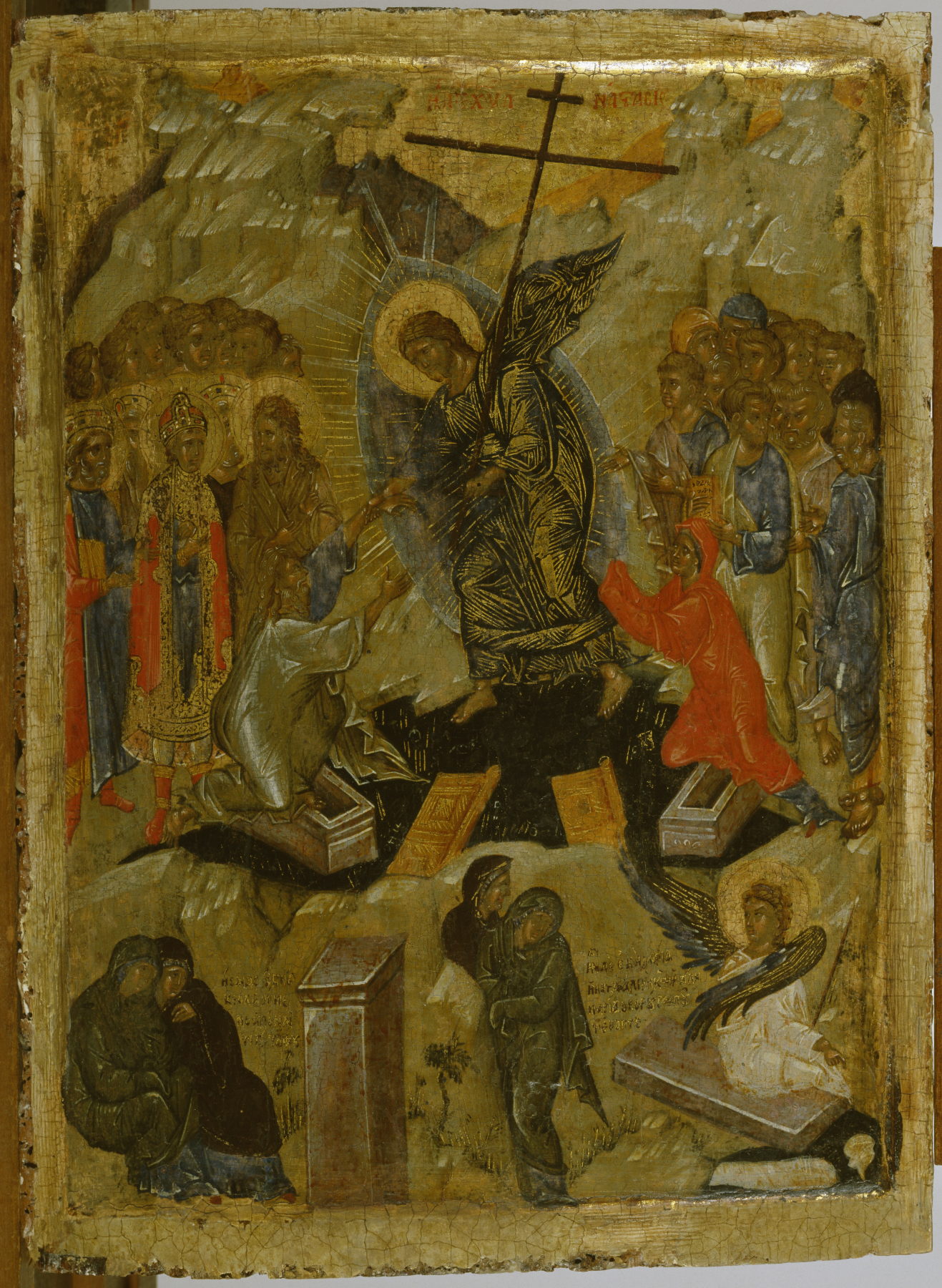 Source: Greek icon, Resurrection of Christ, public domain, Walters Art Museum.
Glossary
- Dust and ashes: Biblical language of humility, mortality, repentance, and creaturely truth before God.
- Intercession: Prayer offered on behalf of another. Job becomes an intercessor for the friends who sinned against him.
- Burnt offering: Sacrificial offering commanded here as part of the friends’ repentance and reconciliation.
- Ausis: Brenton’s place-name for Job’s land, connected in the ending with Idumea and Arabia.
- Jobab: The earlier name Brenton’s ending associates with Job.
- Paschal hope: Resurrectional hope grounded in Christ’s death and Resurrection.
Translation and Source Notes
The embedded Old Testament text is from Brenton’s English Septuagint, public domain. Brenton’s distinctive ending includes the explicit resurrection line and the Syriac / Edomite background notice.
Brenton prints Job 42 with 17 verses, with verse 17 containing an extended final notice. This differs from many modern English Old Testament editions, where the genealogical and resurrectional notice is absent or footnoted.
Brenton’s wording in 42:6 is unusually stark: “I have counted myself vile, and have fainted: and I esteem myself dust and ashes.” Job is not endorsing the friends’ accusations. The point is humbled creatureliness before God, not surrender to false theology.
The Church reads Job 42:7-17 on Friday of the Seventh Week of Great Lent; the resurrection line in 42:17a belongs to the Septuagint text. Thursday’s Job 42:1-6 appointment is attested in the Katameros cycle, while Friday’s reading is confirmed against Coptic Reader. The Synaxarium titles above follow the Coptic commemorations; the quoted Bashans narrative is the public CopticChurch.net Synaxarium entry.
Spiritual Fruit 🍇
-
Let repentance be truthful, not theatrical. Job does not perform self-hatred. He sees God and tells the truth about himself. Ask for repentance that comes from light, not shame.
-
Do not confuse correction with condemnation. God corrects Job and vindicates him against the friends. A person can need correction and still have been wronged.
-
Pray for those who wounded you, but do not pretend the wound was nothing. God names the friends’ sin before Job intercedes. Begin, if necessary, with a prayer that God will prevent further harm and bring the wrongdoer to repentance. Christian forgiveness is truth plus mercy, not denial; it does not forbid boundaries or require returning to danger.
-
Receive restoration as gift, not replacement. Job’s latter blessing is real, but grief is not erased by arithmetic. When you visit someone who has lost a child or spouse, do not explain what God may give in return. Bring a meal, speak the beloved person’s name, and be willing to listen again. Christian hope is deeper than compensation.
-
Anchor hope in resurrection. Brenton’s ending gives the final word: Job will rise again with those whom the Lord raises. The book’s deepest answer is Paschal.
The table is set again, but those who died are still loved. Job can pray for the men who wounded him without calling their words true. Beyond his long life stands the promise that the Lord will raise him with His own. We leave him there, neither forgotten in ashes nor satisfied by possessions, but held in the hope of resurrection.
Teaching Notes
Visual teaching aids
Brenton’s extended Job 42:17 (Greek 42:17b-e) also preserves a genealogy and Edomite king-list notice. In the diagram below, solid lines follow Brenton’s notice, while dotted lines mark Edomite king-list resonance. The identification remains a tradition in the Greek appendix, not a dogmatic determination of Job’s historical identity.
Source: project teaching diagram based on Brenton Job 42:17, with dotted Edomite king-list resonance. Teaching aid only, not dogmatic historical identification.
A second diagram shows the pastoral movement of the chapter: God corrects Job without condemning him, rebukes the friends without abandoning them, and heals through costly intercession.
Source: project teaching diagram created from Job 42.
The visual lesson: restoration is not merely getting life back. It is life transfigured by encounter with God, truth, intercession, and resurrection.
Suggested timing
- Opening context and Job’s repentance: 12 minutes
- God’s rebuke of the friends and Job’s intercession: 18 minutes
- Restoration and resurrectional hope: 18 minutes
- Lenten and Christological synthesis: 12 minutes
- Discussion and prayer: 10 minutes
Where to linger
Linger over Job 42:5. Hearing becomes sight. This is the spiritual turn of the book.
Also linger over Job 42:8-10. The wounded righteous man becomes intercessor. This is one of the clearest Christological shadows in Job.
Where to compress
Compress the long genealogical notice in verse 17 if time is short, but do not omit the resurrection line. It is the most theologically important feature of Brenton’s ending.
Pastoral cautions
- Do not say Job’s new children replace the dead children.
- Do not say the friends were basically right because Job repented.
- Do not pressure wounded people into premature reconciliation. God first names the friends’ sin.
- Do not reduce restoration to prosperity. The final hope is resurrection.
Key phrases to say slowly
“Job is corrected, not condemned; the friends are rebuked, not vindicated.”
“Hearing becomes sight.”
“Forgiveness is truth plus mercy, not denial.”
“The deepest answer to Job is Pascha.”
Hearing and sight (Job 42:1-6)
- Ask: How does repentance become different when it grows from seeing God’s goodness rather than agreeing with a false accusation?
- Watch for: Treating humility as self-hatred.
The wounded intercessor (Job 42:7-10)
- Ask: Why does the order of truth, sacrifice, approach to Job, and prayer matter?
- Watch for: Requiring unsafe contact or premature reconciliation from someone who has been harmed.
Restoration and the Greek ending (Job 42:11-17)
- Ask: What does resurrection give that compensation cannot?
- Watch for: Calling the later children replacements, or making the Greek appendix’s genealogy the chapter’s center.
Whole-session discussion
Ask: What is the difference between Job’s repentance and admitting the friends were right?
Ask: Why does seeing God make Job see himself differently?
Ask: Why does God require the friends to go to Job?
Ask: What does Job’s intercession teach about forgiveness after real harm?
Ask: Why is it important not to say Job’s children were replaced?
Ask: How does Brenton’s resurrection ending change the way we read the restoration?
Ask: What would it mean for this Bible study to end not with explanation, but with worship and intercession?
Visual teaching cue
- Show: Use the Anastasis icon first, the LXX genealogy tree second, and the intercession tree third. Lead with resurrection and intercession, not compensation.
Sources
Embedded Scripture is from Brenton’s English Septuagint (LXX). Short New Testament quotations are from NKJV.
Lancelot C. L. Brenton, The Septuagint Version of the Old Testament, Job. Brenton’s text.
St Gregory the Great, Moralia in Job, Book 35. Sections 2, 5, 11, and 25, divine knowledge, sight, correction, and incorruption.
Greek Job, corresponding chapters, for the Greek wording distinguished from Brenton and Hebrew-based translations.
Coptic Great Lent lectionary: the Katameros cycle, distinguished above from Coptic Reader-confirmed and public dated readings.
Synaxarium, Tout 1, “The Commemoration of the Healing of the Righteous Job”; Bashans 2, “The Departure of the Righteous Job.” Bashans narrative.
St Mary Ottawa, Holy Pascha service book, introduction, on Job’s Wednesday; present Sixth Hour Memoirs appointment distinguished from the older account.
Ezekiel 14:14, Ezekiel 14:20; Isaiah 61:7; Hebrews 7:25; Luke 23:34.
Greek Anastasis icon, Walters Art Museum, and the two explanatory diagrams, linked and identified above.
Footnotes
-
St Gregory the Great, Moralia in Job XXXV.2, quoting Job in his Latin biblical text. Primary text. ↩
-
St Gregory the Great, Moralia in Job XXXV.5, on Job 42:5. Primary text. ↩
-
St Gregory the Great, Moralia in Job XXXV.11, on Job 42:8. Primary text. ↩
-
St Gregory the Great, Moralia in Job XXXV.25, the soul’s blessedness and the body’s incorruption, citing Isaiah 61:7. Primary text. ↩
-
Brown-Driver-Briggs, entry for Keren-happuch, Job 42:14, “horn of antimony”; Joseph Benson, commentary on Job 42:14, for the Greek horn-of-plenty wording. Lexical entry; Benson at Job 42:14. ↩
-
Coptic Synaxarium, Bashans 2, “The Departure of the righteous Job,” concluding narrative sentence. Public text. ↩