


This narration is from a previous version of the study and may include a combined recording of multiple chapters.
Job is not a puzzle book where God explains suffering. It is a holy book where the suffering righteous man refuses both blasphemy and shallow religion until he meets God Himself. The book exposes one of the most dangerous lies religious people can tell: that visible suffering proves hidden guilt. Job teaches the Church how to lament honestly, how to reject cruel comfort, how to wait for a Mediator, and how to stand in awe before the wisdom of God when explanation is not given.
The book is spiritually necessary because it gives words to faithful pain. Job does not curse God, but he does curse the day of his birth. He does not abandon God, but he argues with Him. His friends often say things that sound pious, but the Lord finally rebukes them because true words spoken without mercy can become false witness. Job’s final healing is not a prosperity formula. It is the revelation that God receives honest lament, commands intercession for failed comforters, and points beyond death toward resurrection.
Historical and Scriptural Context
Where Job falls in the Old Testament
This project follows the familiar English order, with Job after Esther and before Psalms. The order varies in biblical manuscripts and editions; Job need not occupy this place for its teaching to hold. After the historical books have traced creation, covenant, monarchy, exile, and return, Job opens the Wisdom and poetic books by forcing the question that history alone cannot answer: how should the righteous suffer before God?
In the Hebrew canon, Job belongs to the Writings, the Ketuvim. In many Christian Old Testament arrangements, including the practical order used in this project, Job begins the Wisdom or poetic section before Psalms, Proverbs, Ecclesiastes, and Song of Songs. This matters spiritually. Job does not give commandments like the Law, recount national history like Samuel and Kings, or deliver oracle after oracle like Isaiah. It gives the Church a school of discernment. The question is not merely, “What happened?” The question is, “How does a soul remain truthful before God when providence is hidden?”
Historical background
The book itself does not name its author. The safest reading is to say that authorship is unknown. Ancient and medieval interpreters sometimes speculated that Job himself, Moses, or another inspired writer preserved the account, but the text does not require certainty on this point. St Gregory the Great treats Job’s own authorship as a possible traditional opinion, writing in the preface to Moralia in Job that “we may with greater probability suppose that the same blessed Job, who bore the strife of the spiritual conflict, did likewise relate the circumstances of his victory when achieved”1. That is useful as a witness to ancient reverence for Job, not as a fact we need to force.
The setting feels patriarchal and ancient. Job offers sacrifices on behalf of his children as head of his household. There is no mention of Sinai, Israel’s priesthood, the temple, or Jerusalem. Job lives in the land of Uz, outside Israel’s national story. The Septuagint ending, preserved in Brenton, places him in a border region connected with Idumea and Arabia and identifies him with Jobab of Edom. Brenton’s extended Job 42:17b-e says: “This man is described in the Syriac book as living in the land of Ausis, on the borders of Idumea and Arabia: and his name before was Jobab.” The historical value of that appendix must be handled cautiously, but its spiritual value is clear: Job is a righteous Gentile whose suffering becomes Scripture for Israel and for the Church.
This means Job is not only Israel’s grief. It is human grief brought under God’s judgment and mercy. Outside Israel’s national history, the book places a righteous sufferer in the dust and lets him speak. Its patriarchal setting does not establish when it was composed. Job’s world is ancient, but his wound is not ancient. It is the wound of every person who has tried to remain faithful while life collapses.
Literary shape of the book
Job is built as a dramatic wisdom book. The prose frame in chapters 1 to 2 introduces Job’s righteousness, the heavenly accusation, the losses, the bodily affliction, and the arrival of the friends. Chapter 3 begins the poetic lament. Chapters 4 to 27 form cycles of speeches between Job and his three friends, Eliphaz, Bildad, and Zophar. Chapter 28 rises as a hymn to wisdom. Chapters 29 to 31 give Job’s final defense. Chapters 32 to 37 introduce Elihu, a younger speaker with real insight and real overconfidence. Chapters 38 to 41 bring the Lord’s answer from the whirlwind. Chapter 42 closes with Job’s repentance, the rebuke of the friends, Job’s intercession for them, and restoration.
The book’s final judgment changes how we hear the earlier speeches. A friend’s religious language is not, by itself, the voice of God. Their theology often contains fragments of truth, but their application is cruel. The book trains the reader to test not only whether a sentence sounds religious, but whether it bears the mercy, humility, and fear of God.
Translation History and Textual Background
Hebrew, Greek, and the Orthodox reading of Job
The book of Job is famously difficult in Hebrew. Its poetry is dense, ancient, and sometimes obscure. The Orthodox Church’s Old Testament tradition receives the Septuagint as the Church’s Greek scriptural inheritance, so this study guide uses Brenton’s English Septuagint for embedded Old Testament Scripture blocks. Brief New Testament cross references may use NKJV.
Greek Job is not a simple word-for-word rendering of the Hebrew Masoretic Text. The NETS introduction to Greek Job says plainly: “A cursory overview of the OG text of Iob reveals that it is substantially shorter than the MT.” It also summarizes the scale: “OG Iob is about one-sixth shorter than the MT.” NETS further describes Greek Job as “not just free or paraphrastic” but “something of an epitome of the longer and often difficult original.” 2 Brenton and Hebrew-based English Bibles therefore sometimes give different emphases, even where their verse numbers appear to agree.
The differences are not merely technical. The Greek tradition includes the long speech of Job’s wife in Job 2:9, which makes her more than a flat villain. She speaks as a crushed co-sufferer who has lost children, stability, and home. The Greek ending also gives an explicit resurrectional hope. Brenton’s Job 42:17 includes the explicit hope of 42:17a: “And Job died, an old man and full of days: and it is written that he will rise again with those whom the Lord raises up.” The resurrection line and the following Syriac-book notice and genealogy, commonly distinguished as 42:17b-e, belong to the Greek extended ending and are absent from the Hebrew. The book’s last horizon is larger than the recovery of an earthly household.
Origen, Theodotion, and later Greek transmission
Greek Job also carries the history of Origen’s Hexapla. NETS explains that Origen compared the Septuagint with the Hebrew and other Greek translations, and that where Old Greek was shorter than the Hebrew, material was often supplied, typically from Theodotion, with critical marks. This means later ecclesiastical Greek Job can contain layers: the Old Greek translation and later supplied material meant to align the Greek more closely with the Hebrew text.
This history calls for humility rather than anxiety. The Church has received Job through a real history of translation and transmission. Where Greek and Hebrew-based Bibles differ, hearing each witness clearly is more fruitful than making them sound artificially identical.
Why Brenton is used here
Brenton’s English Septuagint is public domain, usable for full embedded Scripture blocks, and keeps the Old Testament guide set anchored in the Church’s Greek biblical tradition. It is not perfect English. It can sound old, compressed, or strange. But in Job, strangeness is often a gift. Brenton helps the reader hear the Septuagint’s particular witness, especially in Job 2, Job 19, and Job 42.
The Characters 👥
Job
Job is introduced as blameless, upright, fearing God, and turning away from evil. He is not sinless in the absolute sense that belongs to Christ alone, but he is truly righteous. The opening verdict comes before the disasters. We cannot turn his later pain into evidence that this verdict was false.
Job is also priestly in his household. He offers sacrifices for his children, saying that perhaps they sinned in their hearts. This makes his suffering more painful, not less. He is not careless. He is watchful, reverent, and intercessory, yet calamity still comes.
The Lord
The Lord is not on trial, though Job often speaks as if he wants a hearing. The Lord permits the testing, restrains the Accuser, hears Job’s speech, refuses the friends’ false certainty, and finally answers from the whirlwind. The divine speeches do not give Job a tidy explanation. They open Job’s eyes to the vastness of divine wisdom. The answer is not information. The answer is encounter.
The Accuser
The Hebrew term behind Satan can mean the adversary or accuser. The Septuagint calls him ὁ διάβολος, ho diabolos, the slanderer, rendered “the devil” by Brenton (Job 1:6). His attack is an accusation against the sincerity of love, not a discovery of a concealed crime. In Job, the Accuser questions the sincerity of righteousness: does Job fear God for nothing? This is spiritual warfare at the level of motive. The accusation is not only against Job; it is against the possibility of love. The Accuser claims that piety is a transaction. Job’s endurance proves that communion with God is more than payment for benefits.
Job’s wife
Job’s wife must be treated carefully. In many readings she is reduced to a temptation voice, but the Septuagint gives her a long speech of grief. She has buried children too. She has fallen into wandering and servitude too. Her final counsel is wrong, but her suffering is real. A pastoral Orthodox reading should neither follow her despair nor mock her wound.
The friends: Eliphaz, Bildad, and Zophar
The friends begin well. They come, weep, tear their garments, sprinkle dust, and sit in silence. St Gregory the Great says this is the right order of consolation: “when we would stay one that is afflicted from his grief, we first essay to accord with his sorrow by grieving.”3 Their failure begins when they stop mourning with Job and start explaining him.
Their error is not that every sentence is false. Their error is that they weaponize a partial doctrine. They know that God is just. They infer that Job’s suffering must be proof of Job’s guilt. The book teaches that theology without humility can become accusation.
Elihu
Elihu is younger, intense, and not identical with the three friends. He rightly objects that both Job and the friends have spoken wrongly in different ways. He also speaks too confidently. Gregory’s judgment is useful for the whole book: Elihu “knew the truth which he was speaking about God, and yet his silly pride was making foolish the things he said of himself.”4 Truth can be damaged by the spirit in which it is spoken.
Light from the Word 🕯️
Job 1 to 2: the righteous sufferer tested
The book begins by removing the shallow explanation before the reader can invent it. Job’s suffering is not caused by a hidden scandal. He is introduced as righteous before calamity falls. The heavenly scene shows that the deepest issue is whether a human being can love God when every visible support is removed.
Job’s first responses are not numbness. He tears his robe, shaves his head, falls to the ground, and worships. The grief is real and the worship is real. The Church must keep both together. To quote “The Lord gave, and the Lord has taken away” without tears is to misuse Job.
Lesson Guide
- Key phrase: Job’s grief does not cancel his worship, and his worship does not erase his grief.
- Emphasize: The book denies that suffering automatically reveals hidden guilt.
- Avoid: Coldly using Job’s words over fresh grief as if pain should disappear quickly.
Job 3: lament that remains addressed to God
Job curses the day of his birth, not God. This distinction is spiritually important. The Bible does not sanitize lament. It gives faithful people language for pain that has not yet become praise. Job 3 is not a model of despair to imitate without caution; it is a witness that God can receive the speech of a crushed soul.
This chapter also prepares the reader for Christ. The innocent sufferer who sinks into darkness creates longing for the Innocent One who will enter death voluntarily and transform the grave from inside.
Lesson Guide
- Key phrase: Job’s lament is fierce, but it is still spoken before God.
- Emphasize: Lament can be faithful when it refuses to abandon God.
- Avoid: Romanticizing despair or ignoring self-destructive language when someone is suffering.
Job 4 to 27: the speech cycles and the failure of cruel certainty
The long middle section is spiritually exhausting by design. The friends return again and again to the same argument: God is just, therefore Job must have sinned in a way that explains his suffering. Job rejects the accusation. He speaks rashly at times, but he refuses to confess a lie just to make the system feel safe.
This section is a warning to teachers, servants, parents, priests, and friends. It is possible to defend God in a way God Himself rejects. The friends do not need less doctrine. They need humility, silence, compassion, and fear.
Lesson Guide
- Key phrase: Correct doctrine applied without mercy can become false witness.
- Emphasize: The friends’ speeches must be interpreted within the book’s final verdict.
- Avoid: Pulling isolated lines from the friends as if the book endorses their accusations.
Job 28: wisdom hidden with God
Job 28 interrupts the argument with one of the great wisdom poems of Scripture. Human beings can dig into the earth for silver and gold, but they cannot mine divine wisdom by force. Brenton’s Job 28:28 says: “Behold, godliness is wisdom: and to abstain from evil is understanding.” The Greek word behind “godliness” is θεοσέβεια, theosebeia, reverence toward God. The Hebrew-based wording, “the fear of the Lord,” names the same Godward posture with a different expression. Here wisdom begins in how we stand before God, not in how much we can explain.
The verse does not solve Job’s pain. It reorders the soul. Wisdom is not control over the explanation. Wisdom is reverence, godliness, and repentance before the Lord.
Lesson Guide
- Key phrase: Wisdom is not the power to explain God, but the fear of the Lord that keeps the soul faithful.
- Emphasize: Job 28 is the theological hinge between argument and surrender.
- Avoid: Reducing wisdom to practical advice.
Job 29 to 31: Job’s final defense
Job remembers his former life of honor, mourns his humiliation, and gives a moral inventory. Chapter 31 is especially important. Job speaks of chastity, justice for servants, mercy to the poor, hospitality to strangers, refusal of greed, and rejection of idolatry. He does not claim vague niceness. He names concrete righteousness.
This is crucial for spiritual formation. Job is not merely a victim. He is a man whose life had been shaped by mercy and self-command. His defense is not self-righteous boasting; it is the refusal to let false accusation rewrite the truth.
Lesson Guide
- Key phrase: Job’s innocence is concrete, not sentimental.
- Emphasize: Chapter 31 gives teachers a moral map: chastity, justice, almsgiving, hospitality, and purity of worship.
- Avoid: Treating Job’s defense as pride without reading the false accusations that forced it.
Job 32 to 37: Elihu and the danger of true words in a proud spirit
Elihu insists that suffering can instruct, not only punish. That is a real insight. Hebrews 12 will later speak of divine chastening as sonship. But Elihu still stands under correction. The book is not asking the reader to replace the three friends with Elihu as a final answer. It is showing that even better theology can become unsafe when the speaker is intoxicated with his own certainty.
Elihu’s speeches also prepare for the storm. He turns the mind toward God’s majesty, thunder, cloud, and mystery. The transition is not random. Human speech is reaching its limit.
Lesson Guide
- Key phrase: Even true words need humility, timing, and love.
- Emphasize: Elihu moves the discussion toward awe, but he is not the final answer.
- Avoid: Treating suffering as educational in a way that sounds detached from grief.
Job 38 to 41: the Lord answers from the whirlwind
The Lord does not begin by explaining the heavenly council of chapters 1 to 2. He asks Job about creation, sea, morning, death, stars, animals, Behemoth, and Leviathan. This can feel evasive unless we understand the spiritual purpose. Job wanted a courtroom. God gives him a cosmos.
The divine speeches reveal that creation is filled with wisdom Job cannot govern. This does not humiliate Job into worthlessness. It restores him to creaturehood. The sufferer does not need to be God in order to trust God.
St Gregory reads the Lord’s answer morally as a cure for pride even after victory. He says that after Job endured so much, God still reproves him “lest his very victory should lay him low with the sword of pride.”5 That is a hard and healing insight. Even endurance needs purification.
Lesson Guide
- Key phrase: God gives Job Himself before He gives Job an explanation.
- Emphasize: Creaturely limits are not an insult. They are the beginning of peace.
- Avoid: Presenting God’s speeches as if God is bullying a wounded man.
Job 42: repentance, intercession, and resurrection hope
Job repents in dust and ashes. This does not mean the friends were right. The Lord immediately says they did not speak rightly of Him as Job did. Job must pray for them. The wounded righteous man becomes intercessor for the people who wounded him.
The restoration that follows must not be turned into prosperity theology. Job’s restored goods do not erase buried children. The book’s deepest hope is not that every loss is replaced in this life, but that God raises the dead. The Septuagint ending makes that horizon explicit: “it is written that he will rise again with those whom the Lord raises up.”
Lesson Guide
- Key phrase: Job’s final victory is not wealth. It is encounter, repentance, intercession, and resurrection hope.
- Emphasize: The Lord vindicates Job’s honest speech over the friends’ pious cruelty.
- Avoid: Saying or implying that faith guarantees earthly replacement of every loss.
Chapter Grouping Rationale for This Study Set
The passage studies follow the book’s dramatic and spiritual development. Each friend’s speech remains beside Job’s reply, so that an accusation is heard together with the wounded man’s answer.
| Guide | Why this grouping makes sense | What comes before and after |
|---|---|---|
| Introduction | A book-level overview is needed before the chapter guides because Job’s genre, translation history, lectionary use, and pastoral risks shape every later lesson. | Comes before the prose prologue and sets the theological guardrails. |
| Job 1-2 | These chapters form the prose prologue: Job’s righteousness, heavenly accusation, catastrophic loss, bodily affliction, wife’s speech, and friends’ arrival. | Comes after the overview. Leads into Job’s first lament in chapter 3. |
| Job 3 | This chapter stands alone because it is the first major turn from prose narration to poetic lament. | Comes after the silent grief of the friends. Leads into Eliphaz’s first answer. |
| Job 4-7 | Eliphaz’s first speech and Job’s first answer belong together because the reader needs to hear accusation and response as one exchange. | Comes after Job’s lament. Leads into Bildad’s sharper traditional argument. |
| Job 8-10 | Bildad’s appeal to inherited wisdom and Job’s plea before God form the second exchange of the first cycle. | Comes after Eliphaz and Job. Leads into Zophar’s accusation. |
| Job 11-14 | Zophar’s speech completes the first friend cycle, and Job’s reply opens some of the book’s strongest hope beyond death. | Comes after Bildad and Job. Leads into the harsher second cycle. |
| Job 15-17 | Eliphaz returns with a harder tone, while Job speaks of a witness in heaven. | Comes after the first full cycle. Leads into Bildad’s second speech and Job’s hope in his eternal Deliverer. |
| Job 18-19 | Bildad’s portrait of the wicked meets Job’s plea for pity and hope in his eternal Deliverer. | Comes after Eliphaz’s second speech. Leads into Zophar’s second speech. |
| Job 20-21 | Zophar predicts the wicked man’s collapse; Job answers with the disturbing prosperity of the wicked. | Comes after Job’s confession of hope. Leads into Eliphaz’s final accusation. |
| Job 22-24 | Eliphaz makes explicit moral accusations, while Job searches for the hidden God and names social evil. | Comes after Zophar’s speech and Job’s reply about the prosperity of the wicked. Leads into the collapse of the speech cycles and the wisdom hymn. |
| Job 25-28 | Bildad’s brief final speech, Job’s answer, and the wisdom hymn belong together because the friends’ argument fades and wisdom is located in God. | Comes after Job’s search and social lament. Leads into Job’s final defense. |
| Job 29-31 | Job’s memory, humiliation, and oath of innocence form one final defense. | Comes after the wisdom hymn. Leads into Elihu’s intervention. |
| Job 32-34 | Elihu’s entrance and first arguments should be heard together because they introduce his distinct role and tone. | Comes after Job finishes speaking. Leads into Elihu’s continued movement toward divine majesty. |
| Job 35-37 | Elihu’s later speeches move from rebuke toward awe before God’s greatness. | Comes after Elihu’s opening argument. Leads directly into the Lord’s answer from the whirlwind. |
| Job 38-39 | The Lord’s first speech surveys creation, cosmic order, and wild creatures. | Comes after Elihu’s storm language. Leads into the second divine speech and the great beasts. |
| Job 40-41 | Behemoth and Leviathan deserve a focused guide because they gather creaturely terror, chaos imagery, and spiritual symbolism. | Comes after the first divine speech. Leads into Job’s repentance and restoration. |
| Job 42 | The final chapter stands alone because it contains Job’s repentance, the Lord’s rebuke of the friends, intercession, restoration, and the Septuagint resurrectional ending. | Completes the book and sends the reader back to the whole argument with clarified vision. |
Iconography and Visual Teaching 🖼️
The Russian icon of Righteous Job below remembers a saint, not a spectacle of pain. It is a non-Coptic Orthodox image. The maps that follow give orientation while leaving the uncertain date and location of Job open.
 Source: Holy Righteous Job the Long-suffering icon, public domain.
The map below gives a broad ancient Near East setting around the kind of world often associated with patriarchal narratives. It does not prove Job’s date. The Edom locator helps readers understand why the Brenton ending mentions Idumea and Arabia. It does not locate Uz with certainty.
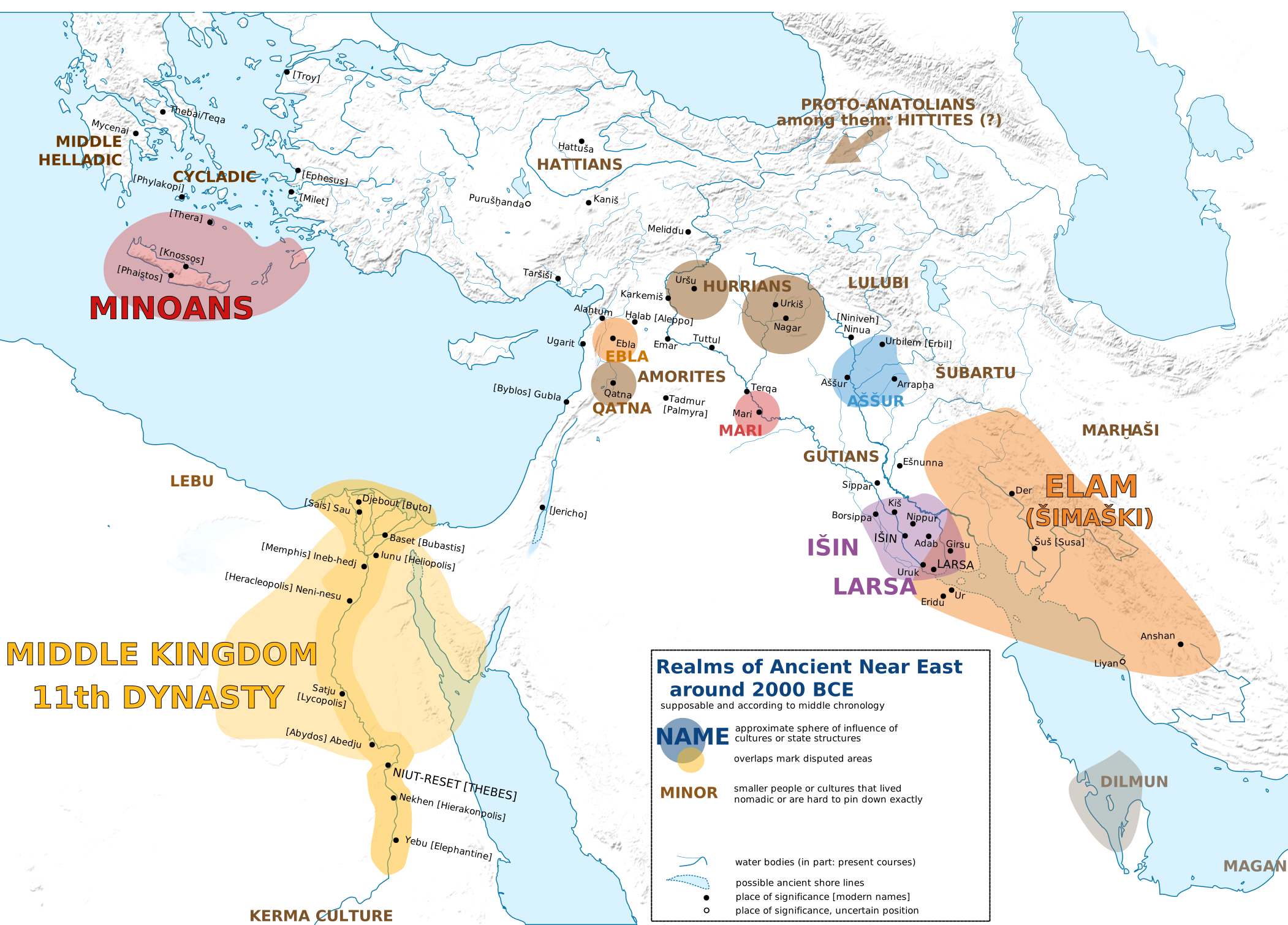 Source: Ancient Near East 2000 BC map, CC BY-SA 4.0.
 Source: Edom regional locator, public domain.
The Church’s Voice in Worship ⛪
Coptic lectionary use
Job accompanies the Church through the Second to Seventh Weeks of Great Lent. The Church reads these nine Matins appointments, confirmed in Coptic Reader:
| Day in Great Lent | Job reading |
|---|---|
| Tuesday, Second Week | Job 19:1-27 |
| Friday, Second Week | Job 11:1-20 |
| Wednesday, Third Week | Job 12:1-14:22 |
| Monday, Fourth Week | Job 16:1-17:16 |
| Wednesday, Fourth Week | Job 1:1-22 |
| Thursday, Fourth Week | Job 20:1-29 |
| Monday, Fifth Week | Job 22:1-30 |
| Tuesday, Fifth Week | Job 25:1-6 and Job 26:1-14 |
| Friday, Seventh Week | Job 42:7-17 |
Other portions appear in the Katameros cycle, without the same Coptic Reader confirmation: Job 15 on Friday of the Third Week; Job 18 and Job 21 on Tuesday and Friday of the Fourth Week; and the sequence from Job 28:12-28 on Wednesday of the Fifth Week through Job 42:1-6 on Thursday of the Seventh Week. Job 2-10, Job 31, and Job 37:5-24 have no verse-addressed appointment in these records. The sequence is selective, not a claim that every chapter is read.6
In Holy Pascha the Church reads the Memoirs of Job at the Sixth Hour of Wednesday. This is living worship, confirmed in Coptic Reader. The service reading retells Job’s mercy to the poor, his trials, his wife’s suffering, his perseverance, and his healing. It is a devotional retelling, with details beyond the biblical narrative, rather than a continuous reading of the Book of Job.7
Other Job passages are read in current Holy Week service books, not yet checked against Coptic Reader: Job 23:2-24:25 at Tuesday’s First Hour; Job 27:2-28:13 at Great Thursday’s Ninth Hour; Job 12:18-13:1 at Good Friday’s First Hour; and Job 29:21-30:10 at Good Friday’s Third Hour. The St Mary Ottawa Holy Pascha book also witnesses older appointments at Tuesday’s Third Hour, Job 27:2-28:2, and Wednesday’s Third Hour, Job 27:16-28:2. These two Third Hour readings belong to historical practice, not the current Coptic Reader order.6
James: the Lord’s intended end
On Friday of the Seventh Week of Great Lent, the Church reads James 5:7-16 as the Catholic Epistle on the same day as Job 42:7-17 at Matins. Both appointments are confirmed in Coptic Reader. James names “the perseverance of Job” and “the end intended by the Lord,” then declares “that the Lord is very compassionate and merciful” (James 5:11, NKJV).6 The New Testament directs our attention beyond the duration of the trial to the character of the Lord who brings it to its end. Job’s endurance is real, but mercy has the final word.
As a reflection on this pairing, James 5:16 also helps us hear Job’s last task: “The effective, fervent prayer of a righteous man avails much” (NKJV). The man who had been wounded by his friends becomes their intercessor. James 5:10-20 is also appointed in the first prayer of the Unction of the Sick. Job thus stands beside the Church’s prayer for healing without making healing a reward that the sick must earn.8
Two commemorations of Righteous Job
The Coptic Synaxarium commemorates the Healing of the Righteous Job on Tout 1, El-Nayrouz, the beginning of the Coptic year, and his Departure on Bashans 2.9 The Tout 1 account published by St Shenouda Monastery remembers his healing through bathing in water. The Bashans 2 account published by CopticChurch.net remembers the Accuser’s envy, Job’s endurance, the wounds caused by wife and friends, his healing, and his peaceful departure. Its thirty-year illness is a hagiographical detail, not a duration supplied by Scripture.
As a reflection on these commemorations, the Church’s new year begins with room for a wounded man made whole. A new beginning need not deny the years that hurt. We can ask for renewal while still carrying scars, and remember that the saint whose healing is celebrated also awaited the resurrection.
Spiritual significance of the lectionary pattern
The Great Lent and Pascha use of Job teaches three things.
First, the Church puts Job in the mouth of repentance without blaming the sufferer. Lent is a school of repentance, but Job prevents repentance from becoming cruelty toward the wounded. Not every wound is proof of a secret sin.
Second, the Church puts Job near the Passion because Christ fulfills the righteous sufferer. Job longs for a witness, mediator, deliverer, and resurrection. Christ is the true Witness, the one Mediator, the innocent Sufferer, and the Resurrection Himself.
Third, the Church lets Job teach endurance without sentimentalizing pain. Great Lent is ascetical, but Job shows that ascetic endurance is not denial. The holy sufferer can weep, argue, wait, repent, and worship.
Major Spiritual Themes
1. Righteous suffering is real
Job destroys the false comfort that says, “If you were righteous, this would not have happened.” Scripture begins by saying Job is righteous. Any reading that secretly sides with the friends has missed the book.
The spiritual fruit is humility. When we meet suffering, our first duty is not explanation. It is reverence, presence, prayer, and practical mercy.
2. Lament can be faithful
Job’s lament is not polite. It is fierce enough to unsettle the reader. Yet it remains speech before God. This is one reason Job is pastorally indispensable. Many Christians think faith means never saying what hurts. Job teaches that God is not protected by our dishonesty.
The Church must teach people to pray their grief without baptizing bitterness. There is a difference between lament and rebellion. Job walks that line painfully, but he keeps speaking toward God.
3. The friends reveal the danger of loveless theology
The friends defend divine justice but fail the suffering person in front of them. Their error is not atheism. Their error is religious certainty without discernment. This is why Job belongs in every ministry of care, confession, hospital visitation, grief support, and spiritual direction.
St Gregory’s line about consolation is a rule for pastoral life: we first accord with sorrow by grieving. If the friend’s doctrine arrives before his tears, his doctrine will probably wound.
4. Job longs for Christ
Job repeatedly reaches beyond the immediate argument. He longs for an arbiter between God and man. He speaks of a witness in heaven. In the Hebrew-based wording familiar from the NKJV, he confesses a living Redeemer; the Hebrew term go’el names a redeemer or family champion. Brenton’s Job 19:25-26 reads, “For I know that he is eternal who is about to deliver me, and to raise up upon the earth my skin that endures these sufferings”.10 The Greek ἀναστήσει, anastēsei, “will raise up,” stands in 19:26 and belongs to the verb family heard in anastasis, resurrection. Both the cited Brenton edition and the Greek witness place the raising of the skin in verse 26. The Christian hope is therefore more than escape from an argument: even the flesh that suffers is held before God’s power to raise.
These are not isolated proof texts. They are the book’s spiritual ache. Job’s need is fulfilled in Christ, who is innocent, mocked, pierced, buried, risen, and living forever to intercede for us.
5. Wisdom is communion, not control
Job’s friends think wisdom means having an answer. Job 28 teaches that wisdom belongs to God and is received through godliness. The final divine speeches deepen this. God does not give Job control over the cosmos. He gives Job a vision of the Creator.
For Orthodox spiritual life, this is crucial. The fear of the Lord is not panic before a tyrant. It is reverent awakening before the One whose wisdom is larger than our wound and whose mercy is deeper than our perception.
6. Repentance does not mean the friends were right
Job repents after seeing God, but the Lord says the friends did not speak rightly as Job did. This guards the ending from misreading. Job’s repentance is not an admission that Eliphaz, Bildad, and Zophar correctly diagnosed him. It is the repentance of a creature who has encountered the living God.
This distinction matters pastorally. A sufferer may need repentance, as all human beings do, without deserving blame for the suffering itself.
7. Restoration points beyond this life
Job receives restoration, but the ending is not a vending-machine theology of reward. The dead children are not erased. The scars are not denied. The Septuagint’s final resurrection line keeps the ending from becoming shallow: Job will rise with those whom the Lord raises up.
The Christian reads Job 42 in the light of Pascha. Earthly restoration is a mercy. Resurrection is the final answer.
Patristic Reading: How the Fathers Help Us Read Job
St Gregory the Great’s Moralia in Job is the central patristic source for this study. Gregory reads Job historically, morally, and typologically. In his epistle, he explains his method: “first, we lay the historical foundations; next, by pursuing the typical sense, we erect a fabric of the mind to be a strong hold of faith; and moreover as the last step, by the grace of moral instruction, we, as it were, clothe the edifice with an overcast of colouring.”11 Job must be read as event, as type, and as medicine for the soul.
Gregory also explains why Scripture matters spiritually: “Holy Writ is set before the eyes of the mind like a kind of mirror, that we may see our inward face in it”12. Job is a mirror. It reveals our impatience, our fear, our need to explain, our temptation to accuse, and our fragile trust in God.
Gregory helps preserve the book’s spiritual depth. His reading of Job’s trials says that Job, “though aimed at for death in his temptation, gained growth unto life by the stroke.”13 This is not a romantic statement about pain. It is an ascetical statement about grace: what the enemy meant as destruction, God permitted as revelation, purification, and victory.
Gregory’s historical, moral, and Christological readings help keep the whole person before us: the sufferer who needs mercy and the soul that still needs purification. Cassian, Isaac the Syrian, and Maximus can deepen the ascetical reading where the text turns to speech, anger, endurance, passions, and purification.
Christological and Typological Reading
Job is one of the Old Testament’s great icons of the innocent sufferer. He is not a full type in every detail, but his affliction opens repeatedly toward Christ.
Job is righteous and suffers. Christ is the Righteous One who suffers voluntarily for the ungodly. Job is accused by friends who think they defend God. Christ is condemned by religious authorities who think they defend the Law. Job longs for a mediator. Christ is the one Mediator between God and man. Job wants his words written in a book. Christ’s wounds are written in His risen body. Job speaks of a living Deliverer. Christ is the Redeemer who lives. Job is restored and intercedes for those who failed him. Christ rises and intercedes for transgressors.
The Pascha connection is therefore not decorative. Job helps the Church stand before the Passion without cheap explanations. At the Cross, the innocent sufferer is not merely vindicated. He saves.
Glossary
- Ketuvim: The Writings, the third major division of the Hebrew Bible. Job belongs here in the Hebrew canon.
- Wisdom literature: Biblical books that teach the fear of the Lord, discernment, righteous living, and the limits of human understanding. Job is wisdom literature, but in dramatic and poetic form.
- Septuagint / LXX: The ancient Greek translation and textual tradition of the Old Testament received in the Orthodox Church.
- Old Greek Job / OG Iob: The earliest recoverable Greek translation of Job, shorter and freer than the Masoretic Text in significant ways.
- Masoretic Text / MT: The medieval Hebrew textual tradition underlying most modern Old Testament translations.
- Theodotion: A Jewish Greek translator or reviser associated with a more literal Greek tradition. Later Greek Job transmission includes material supplied from Theodotion in places where Old Greek was shorter than the Hebrew.
- Hexapla: Origen’s great six-column comparison of Hebrew and Greek biblical texts.
- Uz: Job’s land. Its exact location is debated, but the book places Job outside Israel’s national center, with Edomite or Arabian associations in the Greek appendix.
- Mimar of Job: The homiletic reading also called the Memoirs of Job, read at the Sixth Hour of Wednesday of Holy Pascha.
- The Accuser: The adversarial figure in Job 1 to 2 who challenges Job’s sincerity before God.
Translation and Source Notes
Embedded Scripture is from Brenton’s English Septuagint (LXX). Brief New Testament quotations are from NKJV. Hebrew-based wording and Gregory’s Latin biblical text are distinguished where they differ from Brenton. Coptic Reader-confirmed appointments, the Katameros cycle, public lectionary listings, and historical Holy Pascha witnesses have different levels of authority and are named accordingly.
Spiritual Fruit 🍇
-
Do not explain another person’s suffering too quickly. If you are not weeping with them, your answer is probably too early. Sit first. Pray first. Serve first. A meal left at the door, a hospital visit without an explanation, or an offer to carry an ordinary household task can make mercy tangible.
-
Bring grief to God instead of editing it into religious language. Job teaches that God can receive speech that sounds unfinished, wounded, and fierce. Honest prayer is safer than polished avoidance. If all you can bring to prayer is the name of the person you lost, begin there; love does not have to arrive with an explanation.
-
Refuse the Accuser’s bargain. The Accuser says people love God only for benefits. Every act of faithfulness in loss becomes a quiet answer: God is worthy even when His gifts are hidden.
-
Let suffering purify speech. Much of Job is about words: words of grief, accusation, defense, wisdom, rebuke, repentance, and intercession. A mature soul learns when to speak, when to stay silent, and when to repent for words spoken beyond knowledge.
-
Wait for the living Redeemer. Job’s hope is not that he can solve his own case. His hope is that God lives, sees, vindicates, raises, and restores. The Christian name for that hope is Jesus Christ.
Job does not teach us to love suffering. It teaches us to love God when suffering has stripped away the rewards we thought love required. The friends speak many words, but the Lord receives the wounded man who kept turning toward Him. In Job, the Church learns to sit in ashes without despair, to speak honestly without blasphemy, and to wait for the Redeemer who raises the dead.
Teaching Notes
Teaching aim
The aim of the Job overview is to prepare the class to read the whole book without falling into the friends’ error. The class should leave knowing that Job is about righteous suffering, truthful lament, failed comfort, hidden wisdom, encounter with God, intercession, and resurrection hope.
Where to linger
- Linger over the opening claim that Job is righteous. This prevents the most common misreading.
- Linger over the friends. People easily recognize them in others, but the goal is to recognize the friend inside ourselves.
- Linger over the Coptic Great Lent and Pascha usage. This will help the class see Job as a Church book, not just a philosophical text.
- Linger over Job 42:17 in Brenton. Lead with the resurrection line, then explain the genealogy notice as a caveated LXX appendix.
Where to compress
- Do not over-teach authorship theories. Say authorship is unknown, mention traditional possibilities briefly, then move on.
- Do not get stuck in technical Septuagint details. Explain only the details that change the spiritual reading, especially Job 2:9, Job 14, Job 19, Job 28:28, and Job 42:17.
Pastoral warnings
Do not use Job to tell sufferers that God caused their pain because they needed a lesson.
Do not quote Job’s worship in chapter 1 as a demand that grief become instantly composed.
Do not mock Job’s wife. Correct her counsel, but recognize her grief and the LXX witness to exhausted co-suffering.
Do not make Job 42 a promise that every earthly loss will be replaced in this life.
Do not let the class speak about suffering only in abstractions. Bring it back to prayer, presence, repentance, and mercy.
Visual teaching cue
- Show: Use the speech-flow diagram before starting the chapter guides. Use the maps only as broad orientation, and say clearly that they do not prove Job’s exact date or location. Use the LXX genealogy tree only after leading with the resurrection line in Job 42:17.
Visual aids for teaching
The whole book is a movement of speech: grief, accusation, defense, wisdom, correction, divine revelation, repentance, and intercession. This diagram is often more useful than repeating the same ash-heap image in every lesson.
Source: project teaching diagram created for this Job study from the guide structure.
The friends’ names have regional associations, but not all are equally certain. The schematic distinguishes possible associations from secure locations.
Source: project teaching diagram created from Job names and the Brenton Job 42:17 regional notice. Uncertain associations are intentionally marked.
Finally, Brenton’s Job 42:17 preserves a genealogy and Edomite king-list notice. The theological center of that ending is still the resurrection line, “he will rise again with those whom the Lord raises up.” The genealogy tree is a teaching aid for the LXX appendix, not a dogmatic identification of Job.
Source: project teaching diagram based on Brenton Job 42:17, with dotted Edomite king-list resonance. Teaching aid only, not dogmatic historical identification.
Sources
Embedded Scripture is from Brenton’s English Septuagint (LXX). Brief New Testament quotations are from NKJV.
St Gregory the Great, Moralia in Job, cited by book and numbered section in the notes below; Lectionary Central text.
Coptic lectionary: Coptic Reader appointments; Katameros-cycle and current Holy Pascha service-book witnesses, distinguished in the text.
Coptic Synaxarium, Tout 1 and Bashans 2, and Memoirs of Job, Sixth Hour of Wednesday of Holy Pascha.
Claude E. Cox, “Iob: To the Reader,” in A New English Translation of the Septuagint, pp. 667-670, on the Old Greek and ecclesiastical text.
Footnotes
-
St Gregory the Great, Moralia in Job, Preface 3, https://www.lectionarycentral.com/GregoryMoralia/Preface.html. ↩
-
Claude E. Cox, “Iob: To the Reader,” A New English Translation of the Septuagint, pp. 667-669, https://ccat.sas.upenn.edu/nets/edition/28-iob-nets.pdf. ↩
-
St Gregory the Great, Moralia in Job, III.20, https://www.lectionarycentral.com/GregoryMoralia/Book03.html. ↩
-
St Gregory the Great, Moralia in Job, XXVIII.11, https://www.lectionarycentral.com/GregoryMoralia/Book28.html. ↩
-
St Gregory the Great, Moralia in Job, Book XXVIII, Preface 1, https://www.lectionarycentral.com/GregoryMoralia/Book28.html. ↩
-
Coptic Reader, Great Lent Matins prophecies and Holy Pascha; Katameros-cycle readings and Holy Pascha service-book witnesses are distinguished in the text. Coptic Reader: https://copticreader.org/app/. ↩ ↩2 ↩3
-
Memoirs of Job, Wednesday of Holy Pascha, Sixth Hour, especially the charity of Job, his wife’s endurance, and the account of healing; Coptic Reader, https://copticreader.org/app/. ↩
-
Coptic rite of the Unction of the Sick, first prayer, Catholic Epistle James 5:10-20; Coptic Reader, https://copticreader.org/app/. ↩
-
Coptic Reader Synaxarium, Tout 1, “The Commemoration of the Healing of the Righteous Job,” and Bashans 2, “The Departure of the Righteous Job.” For the narratives: St Shenouda Monastery, Studies in the Coptic Synaxarium, 1 Tute, section 2; CopticChurch.net, Bashans 2. ↩
-
Brenton, Job 19:25-27, compared with the Greek text of Job, 19:25-26. Both cited witnesses place the raising of the skin in verse 26; the Greek displays ἀναστήσει there. Compare Brown-Driver-Briggs, גאל, Qal 3a, for God as deliverer and the Job 19:25 reference. ↩
-
St Gregory the Great, Moralia in Job, Epistle to Leander 3, https://www.lectionarycentral.com/GregoryMoralia/Epistle.html. ↩
-
St Gregory the Great, Moralia in Job, II.1, https://www.lectionarycentral.com/GregoryMoralia/Book02.html. ↩
-
St Gregory the Great, Moralia in Job, III.1, https://www.lectionarycentral.com/GregoryMoralia/Book03.html. ↩