


This narration is from a previous version of the study and may include a combined recording of multiple chapters.
Obadiah is one chapter, but it is not one flat thought. The prophecy rises and falls like a mountain line: Edom trusts the height of his rocks, the Lord brings pride down, the brother’s wound is uncovered, the Day of the Lord widens the judgment to all nations, and Mount Zion becomes the place of deliverance, sanctuary, and the Kingdom that belongs to the Lord.
The deepest sin in the chapter is not simply that Edom was strong while Judah was weak. It is that Edom was a brother who acted like an enemy. He watched, rejoiced, boasted, entered the gate, attacked the wounded, and blocked escape. Christ reveals the final depth of this brother-wound. He is betrayed by His own, mocked in His affliction, and lifted up before those who look on. Yet He answers with the Cross, commands enemy-love, and gathers His people to the unshakable Kingdom.
Why This Passage Matters
Obadiah matters because it names a sin respectable people often excuse: the pleasure of seeing another person exposed, trapped, or diminished. The book refuses to let the reader keep gloating in the category of harmless emotion. Edom’s looking, rejoicing, boasting, entering, attacking, and blocking fugitives are one moral movement. The heart that enjoys the brother’s fall is already learning violence.
The prophecy also matters because it distinguishes two heights. Edom’s height is self-protection without mercy. Zion’s height is sanctuary, deliverance, and the Lord’s reign. That contrast makes Obadiah especially useful for Orthodox teaching: the goal is not to replace Edom’s pride with Judah’s triumphalism, but to bring every high place under Christ, the humbled and exalted King.
Obadiah is not only about individual pride. It is also about communal and inherited hostility. Families, tribes, nations, churches, ministries, and friend groups can carry old wounds until they become habits of contempt. The Christian reading must preserve the historical judgment against Edom while also asking a direct question: where have I inherited a rivalry and chosen to keep it alive?
Placement in the Book and Grouping Rationale
Obadiah is one complete prophetic oracle. It should stay as one session rather than being split into smaller lessons, because the book’s force comes from the whole movement: pride in the rocks, false supports collapsing, violence against the brother, the Day of the Lord, and finally Zion and the Kingdom. Splitting the chapter would make the individual units easier to schedule but weaker spiritually. The single-session structure lets the class feel how the first proud question, “Who will bring me down?” is answered by the final confession, “the kingdom shall be the Lord’s.”
This guide therefore quotes the book by sense unit and explains each movement immediately after its Scripture text. It does not front-load all twenty-one verses, because the teaching burden changes from section to section. Verses 10-14 require the slowest treatment. They are the pastoral center, where Edom moves from watching the brother suffer to helping close the escape.
Historical and Scriptural Context
Obadiah belongs to the Twelve Prophets. The book is directed against Edom, rendered by Brenton as Idumea. Edom descends from Esau, Jacob’s brother, so the prophecy carries a family wound before it becomes a national oracle. Genesis gives the Jacob and Esau background, including the deception and blessing in Genesis 27, but also the embrace and tears of Genesis 33. That reconciliation matters. The story is not that Jacob and Esau were doomed to hate forever. Obadiah shows something more tragic: descendants can inherit an old wound and choose betrayal after mercy had once appeared.
Numbers 20 remembers Edom refusing Israel passage through his land even when Israel promised not to pass through fields, vineyards, or wells. That refusal is an early form of closing the way. Psalm 137:7 (LXX Psalm 136:7) remembers Edom around Jerusalem’s fall: “Remember, O Lord, the children of Edom.” Ezekiel 35 strengthens the same witness by naming Edom’s perpetual hostility, bloodshed, possessiveness over Israel’s land, and rejoicing over desolation. Amos 1:11-12 is especially close to Obadiah’s heart: Edom pursued his brother with the sword and cast off pity. Malachi 1:2-5 later uses Edom as a covenant-history warning, but it must not be simplified into contempt for Edomite people. Scripture is exposing pride and betrayal, not licensing hatred.
The immediate scene is commonly read against Jerusalem’s fall to Babylon in 586 BC or the wider crisis around it. The Overview distinguishes that historical inference from the earlier setting preserved in the Coptic Synaxarium. Foreigners enter the gates, cast lots on Jerusalem, and take the city’s forces captive. Edom’s guilt is described not as one isolated act, but as a progression of sin. Passive looking becomes rejoicing; rejoicing becomes boasting; boasting becomes entering; entering becomes violence; violence becomes the shutting up of fugitives. The prophecy therefore teaches that indifference to the wounded brother is not morally neutral.
Geographical Significance ⛰️
Obadiah’s geography is spiritual. Edom was associated with rocky strongholds, Mount Seir, Teman, and the high places south and southeast of Judah. The landscape helped Edom imagine that height meant safety. The heart learned to say, “Who will bring me down to the ground?”
The Lord answers that question by contrasting two heights. Edom’s height is the false height of pride, the eagle’s nest and the imagined place among the stars. Zion’s height is different. Mount Zion becomes deliverance, sanctuary, inheritance, and the confession that the Kingdom belongs to the Lord.
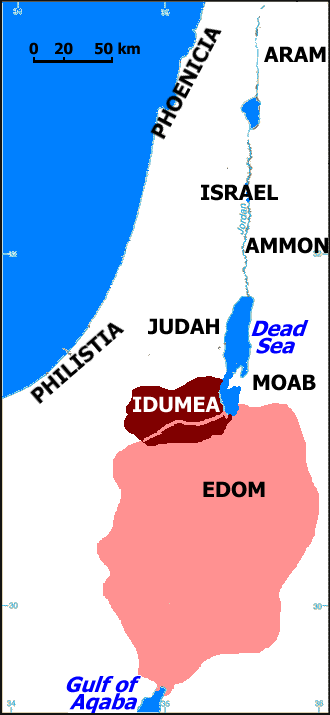 Source: Wikimedia Commons,
 Idumea.png
, by Valp, CC BY-SA 4.0. Boundaries are approximate and should be used as a regional locator, not as a precise reconstruction.
The map helps the class see Edom south and southeast of Judah, near the Dead Sea and the routes around Mount Seir. It should not become the center of the lesson. Its purpose is to make the brother-neighbor relation visible and to explain why the language of height, passageways, and escape matters.
The Characters 👥
- The Lord God: The true speaker and judge. He exposes hidden pride, measures violence against the brother, and promises deliverance on Mount Zion.
- Obadiah / Obdias: The prophet. Brenton uses the form Obdias. His name means servant or worshipper of the Lord. The book gives no family history or date for him; the Coptic Synaxarium preserves a biographical tradition distinguished in the Overview.
- Edom / Idumea / Esau: The brother-nation descended from Esau. Edom is a concrete historical people, but spiritually he also becomes a mirror of pride, gloating, and opportunism.
- Jacob / Judah / Jerusalem: The wounded brother and covenant people in the day of affliction. Their suffering does not give Edom permission to profit from them.
- Joseph: Named in verse 18 with Jacob. His presence shows that restoration is wider than Judah alone. Zion’s deliverance points toward the healing and gathering of Israel, not merely payback for one tribe.
- The nations: The prophecy begins with Edom but widens to all the Gentiles. Edom’s case becomes a warning to every nation and every heart.
- Those who escape on Mount Zion: The remnant of mercy. Their presence keeps the ending from becoming revenge and points toward sanctuary and Kingdom.
Source: Hermes project-made teaching schematic, 2026-06-19, based on Genesis 25, Genesis 33, Numbers 20, and Obadiah 10-14.
Light from the Word 🕯️
Obadiah should be taught as one complete prophetic oracle, but by internal movements. The session should not rush. The class needs time to feel how the sin develops from height, to false security, to brotherly violence, to the Day of the Lord, to Zion and the Kingdom.
Obadiah 1:1-4 - Pride speaks from the heights
Translation: Brenton Septuagint.
- The vision of Obdias. Thus saith the Lord God to Idumea; I have heard a report from the Lord, and he has sent forth a message to the nations.
- Arise ye, and let us rise up against her to war.
- Behold, I have made thee small among the Gentiles: thou art greatly dishonoured. The pride of thine heart has elated thee, dwelling as thou dost in the holes of the rocks, as one that exalts his habitation, saying in his heart, Who will bring me down to the ground?
- If thou shouldest mount up as the eagle, and if thou shouldest make thy nest among the stars, thence will I bring thee down, saith the Lord.
The prophecy opens with the Lord’s report against Idumea. Before Edom’s military or political behavior is explained, the Lord names the root: “The pride of thine heart has elated thee.” Edom lives in the holes of the rocks and turns terrain into theology. The people believe their high places make them unreachable. Their question is not only strategic. It is spiritual: “Who will bring me down to the ground?”
Pride is not merely thinking highly of oneself. It is refusing creaturely dependence. Edom’s question is atheistic in posture even if it is not formally atheist: it imagines a place where God cannot correct, judge, reach, or humble. Pride always tries to move judgment far away. It tells the soul that correction cannot reach it, that consequences belong to other people, and that height is proof of rightness.
Brenton’s forms Obdias
and Idumea
are useful orientation points. They remind the reader that the Orthodox Old Testament is received through the Septuagint, even when the theological burden remains the same: Edom’s pride is exposed by the Lord.
The Christian fulfillment is seen by contrast in Philippians 2. Edom reaches upward and falls. Christ, who is truly equal with the Father, humbles Himself and is exalted. The creature who seizes height loses it; the Son who descends in mercy saves.
Gems from the Fathers 💎: The Son Who Descends (1:1-4)
Eusebius of Caesarea gives a brief Christian reading of the opening verse in Proof of the Gospel: he understands the report from the Lord in relation to the call of the Gentiles. This is an actual interpretive move, though not a developed exposition of Edom’s pride.1 The fuller help for the contrast between pride and humility comes through Philippians 2.
St Athanasius, treating Philippians 2 in his defense of the Son’s true glory, helps the teacher avoid a shallow contrast. Christ’s humility is not the humiliation of a mere creature climbing upward. It is the saving descent of the eternal Son in the flesh. Athanasius states the order plainly: “Therefore He was not man, and then became God, but He was God, and then became man, and that to deify us.”2 Here deification means sharing in God’s life by grace, not becoming God by nature. Against Edom’s false height stands a gift we cannot seize: the eternal Son makes us His Father’s children.
Obadiah 1:5-9 - False supports collapse
Translation: Brenton Septuagint.
- If thieves came in to thee, or robbers by night, where wouldest thou have been cast away? would they not have stolen just enough for themselves? and if grape-gatherers went in to thee, would they not leave a gleaning?
- How has Esau been searched out, and how have his hidden things been detected?
- They sent thee to thy coasts: all the men of thy covenant have withstood thee; thine allies have prevailed against thee, they have set snares under thee: they have no understanding.
- In that day, saith the Lord, I will destroy the wise men out of Idumea, and understanding out of the mount of Esau.
- And thy warriors from Thæman shall be dismayed, to the end that man may be cut off from the mount of Esau.
The second movement dismantles what Edom trusts. Thieves usually steal only what they want. Grape gatherers leave gleanings behind. Edom’s judgment will be more complete than either image. Hidden things are searched out. Allies become opponents. Wisdom disappears. Warriors from Thæman are dismayed.
This is poetic justice. The proud heart often does not feel proud. It feels prepared. It has hidden things, agreements, allies, experts, plans, and strong people nearby. Edom’s supports are not evil simply because they are practical. They become false because Edom uses them to avoid repentance and mercy. When the Lord searches the heart, hidden things stop being hidden.
Verse 6 is pastorally useful: “How has Esau been searched out, and how have his hidden things been detected?” This is not only the exposure of private secrets. It is the collapse of everything Edom thought was inaccessible: treasure, counsel, alliances, wisdom, and force. Relationships built only on advantage become snares. Wisdom detached from righteousness becomes blindness. Strength detached from mercy becomes fear. Verse 7 ends, “they have no understanding”; verse 8 then announces the loss of understanding from Esau’s mountain. The collapse is not only military: the people who seemed so well advised cannot see where their trust has led them. Brenton’s “They sent thee to thy coasts” differs from the KJV’s account of confederates bringing Edom to the border and deceiving him, but both expose the failure of the relationships on which Edom relied.
The text itself is clear and sharp. In Christ, the Church learns to use prudence without making an idol of control. The true refuge is not secrecy, strategy, or force. It is repentance before the Lord.
Obadiah 1:10-14 - Violence against the brother
Translation: Brenton Septuagint.
- Because of the slaughter and the sin committed against thy brother Jacob, shame shall cover thee, and thou shalt be cut off for ever.
- From the day that thou stoodest in opposition to him, in the days when foreigners were taking captive his forces, and strangers entered into his gates, and cast lots on Jerusalem, thou also wast as one of them.
- And thou shouldest not have looked on the day of thy brother in the day of strangers; nor shouldest thou have rejoiced against the children of Juda in the day of their destruction; neither shouldest thou have boasted in the day of their affliction.
- Neither shouldest thou have gone into the gates of the people in the day of their troubles; nor yet shouldest thou have looked upon their gathering in the day of their destruction, nor shouldest thou have attacked their host in the day of their perishing.
- Neither shouldest thou have stood at the opening of their passages, to destroy utterly those of them that were escaping; neither shouldest thou have shut up his fugitives in the day of affliction.
This is the moral center of Obadiah. The Lord names the wound: “thy brother Jacob.” Edom’s sin is not only violence. It is violence against the brother. The family language sharpens the judgment because betrayal is worse when it comes from kin.
Genesis 33 makes the wound even sharper. Jacob and Esau once met with fear, tears, embrace, and peace. Obadiah is not the story of two peoples who could never be reconciled. It is the story of a later generation choosing contempt after reconciliation had once been given. That is why inherited hostility is so dangerous. A family, parish, ministry, or people can preserve the memory of rivalry more faithfully than the memory of mercy.
Amos 1:11-12 belongs beside this passage. Amos says Edom pursued his brother with the sword and cast off pity. Obadiah shows what that looks like in detail. Edom stands in opposition. He looks. He rejoices. He boasts. He enters the gate. He looks again on the gathering. He attacks. He stands at the passageways. He shuts up fugitives. Sin begins in the eye and heart, then recruits the mouth, hands, and feet. The whole person becomes organized against mercy.
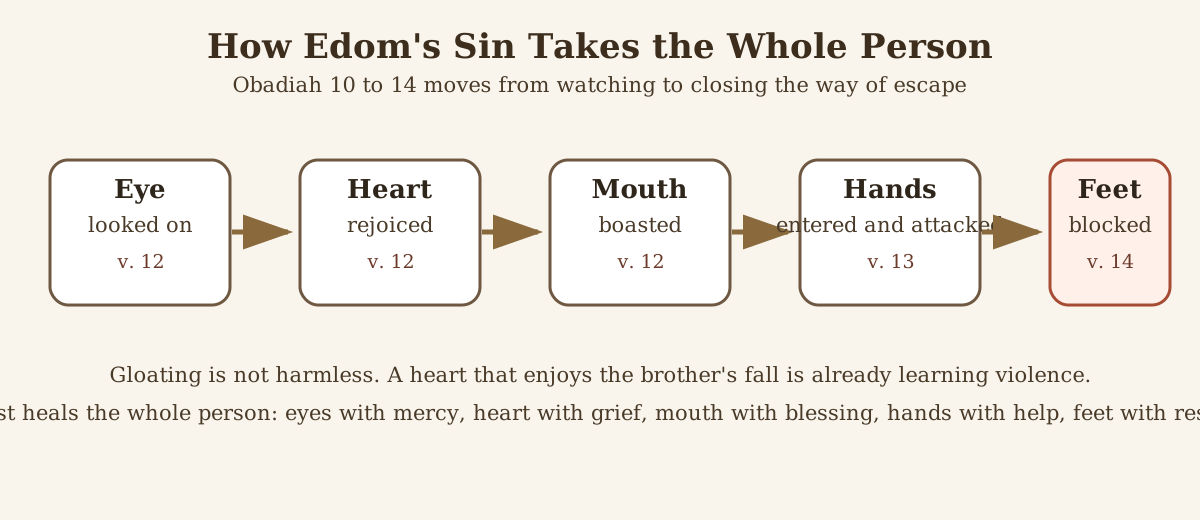 Source: Hermes project-made teaching schematic, 2026-06-19, based on Obadiah 10-14.
The warning is severe because gloating is not harmless. The person who rejoices over another person’s collapse has already begun to participate in violence. A class may find this uncomfortable because many forms of gloating are socially acceptable: gossip, reposted humiliation, enjoying a rival’s exposure, using another person’s failure as proof of superiority, ministry rivalry disguised as concern, or staying silent when mercy would cost comfort. Obadiah says the wounded person is still a brother. Brotherhood obliges mercy, not unlimited access to harm: forgiveness does not require remaining exposed to abuse, and protecting the endangered person may require distance, help, and accountability.
Christ reveals the final depth of the brother-wound. He is betrayed by His own, handed over to strangers, mocked in His affliction, and surrounded by those who look on. Yet He does not become Edom. He prays for His enemies and opens the way of escape through His Cross. The Christian cannot study Obadiah and then enjoy revenge. The Cross forbids the wounded brother from becoming another betrayer.
Gems from the Fathers 💎: Mercy Without Performance (1:10-14)
St John Chrysostom, preaching on John 10 and invoking Matthew 25, measures our mercy by the mercy we have received from God. He presses the hearer toward practical care, not admiration for mercy as an idea: “We therefore must so take pity upon our neighbor, according to His great mercy towards us.”3 The question becomes concrete: when the brother is exposed, do we grieve, help, and protect?
This is also why Matthew 25 belongs near Obadiah 10-14. Christ identifies Himself with the hungry, stranger, naked, sick, and imprisoned. Obadiah says Edom shut up fugitives in the day of affliction; Christ says that the King will ask how we treated His brethren in their affliction. The two passages are not identical, but Christ reveals the final seriousness of the brother-question.
Obadiah 1:15-16 - The Day of the Lord universalizes Edom’s case
Translation: Brenton Septuagint.
- For the day of the Lord is near upon all the Gentiles: as thou hast done, so shall it be done to thee: thy recompense shall be returned on thine own head.
- For as thou hast drunk upon my holy mountain, so shall all the nations drink wine; they shall drink, and go down, and be as if they were not.
Verse 15 is the hinge of the book. Edom’s case becomes universal. The Day of the Lord is near upon all the Gentiles. What Edom has done returns upon Edom’s own head, and the cup language widens from the holy mountain to all nations.
This is not petty revenge and not impersonal karma. It is personal divine judgment. The Lord reveals that actions have moral weight before Him. Read in continuity with the address to Edom, Brenton’s singular “thou” presents the drinking on the holy mountain as the victor’s triumph, answered by the nations’ cup of judgment. The Hebrew plural, reflected in the KJV’s “ye,” has also been read as Judah first drinking the cup of judgment; interpreters of that text differ over the addressee.4 The pronoun alone does not settle the scene, but neither reading lets the nations stand beyond the Lord’s judgment. “As thou hast done” resonates with Matthew 7:2 and Galatians 6:7: the measure we use returns to us, and a person reaps what he sows. Obadiah keeps the matter before the living God, not before an automatic force. Yet this warning about deliberate violence is not a key for reading someone else’s calamity as proof of secret sin. Job 42:7 rebukes his friends’ false account of God; Luke 13:1-5 and John 9:1-3 forbid the easy equation of suffering with exceptional guilt. The warning calls me to repentance, not to a verdict over the afflicted.
Romans 12 is essential for Christian teaching here. St Paul commands believers not to avenge themselves, because vengeance belongs to the Lord. He then commands mercy toward the enemy: if the enemy hungers, feed him; if he thirsts, give him drink. This guards Obadiah from misuse. The teacher must not deny judgment. The Day of the Lord is real. But the Christian response to judgment is not personal vengeance. It is repentance, mercy, and surrender of recompense to God.
Gems from the Fathers 💎: Judgment Not Ours to Take (1:15-16)
St John Chrysostom, while invoking Romans 12 in his preaching, warns that the person who seeks revenge wounds himself first. His warning gives the wound a startling direction: “Knowing then this, let us never plot against others, aware that by so doing we whet the sword against ourselves, and inflict upon ourselves the deeper wound.”5 The prophecy announces divine recompense; Chrysostom presses the Christian soul not to turn that announcement into permission for private revenge.
This is why enemy-love is not weakness. It is faith that God is Judge. The Christian can feed the enemy precisely because judgment does not belong to private anger. Obadiah teaches that the Lord sees Edom. Romans 12 teaches that because the Lord sees, the Christian does not need to become Edom.
Obadiah 1:17-21 - Mount Zion and the Kingdom of the Lord
Translation: Brenton Septuagint.
- But on mount Sion there shall be deliverance, and there shall be a sanctuary; and the house of Jacob shall take for an inheritance those that took them for an inheritance.
- And the house of Jacob shall be fire, and the house of Joseph a flame, and the house of Esau shall be for stubble; and Israel shall flame forth against them, and shall devour them, and there shall not be a corn-field left to the house of Esau; because the Lord has spoken.
- And they that dwell in the south shall inherit the mount of Esau, and they in the plain the Philistines: and they shall inherit the mount of Ephraim, and the plain of Samaria, and Benjamin, and the land of Galaad.
- And this shall be the domain of the captivity of the children of Israel, the land of the Chananites as far as Sarepta; and the captives of Jerusalem shall inherit as far as Ephratha; they shall inherit the cities of the south.
- And they that escape shall come up from mount Sion, to take vengeance on the mount of Esau; and the kingdom shall be the Lord’s.
The last movement reverses the book’s geography. Edom’s height falls, but Mount Sion becomes deliverance and sanctuary. Brenton’s verse 17 says, “there shall be a sanctuary.” This is close to the holiness language found in the Masoretic tradition, but Brenton’s wording lets the teacher stress worship, refuge, and holy space. Zion is not a counter-fortress for revenge. It is the place where the Lord gathers His people into holiness. The rest of verse 17 carries its own reversal: those once taken as an inheritance now inherit those who dispossessed them. The oppressor’s claim is not final; the Lord can restore a future to people treated as possessions. This vindication remains under His reign, not a warrant for us to possess or exploit another person.
Verse 18 names both Jacob and Joseph. That matters. The restoration is not only Judah’s vindication after Jerusalem’s humiliation. It gestures toward a wider restoration of Israel. The wounded people are not healed so they can become another Edom. They are gathered toward the Lord’s reign.
Verse 18 contains another Brenton wording that should be handled carefully. The house of Esau becomes stubble, and Brenton says “there shall not be a corn-field left to the house of Esau.” The KJV and MT tradition say that no survivor remains. The teacher should not overbuild on the difference. Brenton’s line still communicates complete devastation: what Edom trusted, cultivated, and possessed is consumed under the Lord’s word.
Verse 20 also differs in geography from the common MT tradition. Brenton has Ephratha where many English Bibles have Sepharad. The safest teaching approach is to treat the details as restoration language without turning the class into a technical debate. The theological point is that exile, captivity, dispossession, and shame are not the last word. The Lord restores inheritance.
Verse 21 must be taught through Christ. Brenton says those who escape come from Mount Sion “to take vengeance” on Mount Esau; the KJV tradition says “saviours” come up to judge Mount Esau. Romans 12 has already told the Church that personal vengeance belongs to God. Therefore the Christian reading does not celebrate private retaliation. It sees the Lord’s judgment as part of His final reign, and it lets the final clause govern the whole ending: “the kingdom shall be the Lord’s.”
Hebrews 12 gives the great fulfillment anchor. Believers have come to Mount Zion, the heavenly Jerusalem, the Church of the firstborn, Jesus the Mediator of the New Covenant, and a Kingdom that cannot be shaken. Obadiah does not end with Edom falling. It ends with the Lord reigning.
Gems from the Fathers 💎: Sinai and the Heavenly Zion (1:17-21)
St John Chrysostom, preaching on Hebrews 12, contrasts Sinai’s terrifying manifestation with the greater reality to which Christians have come: Mount Zion, the heavenly Jerusalem, the assembly of the faithful, and Jesus the Mediator. He explains why the apostle draws the contrast: “They who make comparisons elevate the one side the more, that they may show the other to be far greater. In this respect also our [privileges] are more gentle and more admirable.”6 He goes on to call these gifts more accessible: we approach through Christ the Mediator. The last word is not private victory over an enemy, but entrance into the worship and Kingdom of God.
Chrysostom helps keep the ending sober. Zion is not revenge theater. Zion is where the Church learns reverence, gratitude, and holy fear. The Kingdom belongs to the Lord, not to our anger.
The Church’s Voice in Worship ⛪
Obadiah is commemorated in the Coptic Synaxarium on Toba 15 / Tubah 15 as “The Departure of Obadiah, the Prophet.” The checked Coptic lectionary readings for that day are prophet-themed, but they do not show Obadiah 1 itself as an assigned Scripture reading. The chapter should therefore not be assigned to a specific Coptic service unless later source evidence is found.
The passage still resonates deeply with Orthodox worship and ascetical life. Fasting exposes pride. Holy Week exposes betrayal, gloating, mockery, and the wounded Brother. The daily life of repentance teaches the Christian not to stand at another person’s gate in judgment, but to stand before God in compunction. Obadiah can therefore be used as a spiritual mirror: when Christ is wounded in the brethren, am I with Him, or am I watching with Edom?
The ending also belongs to the Church’s worship of the Kingdom. Every Divine Liturgy trains the faithful to confess that the Kingdom is not ours to seize. It is the Lord’s gift, presence, and reign. Obadiah’s final line is therefore not only prophetic judgment. It is a doorway into doxology.
Iconography and Visual Teaching 🖼️
A restrained visual plan keeps attention on the prophet’s words rather than on imagined scenes of battle.
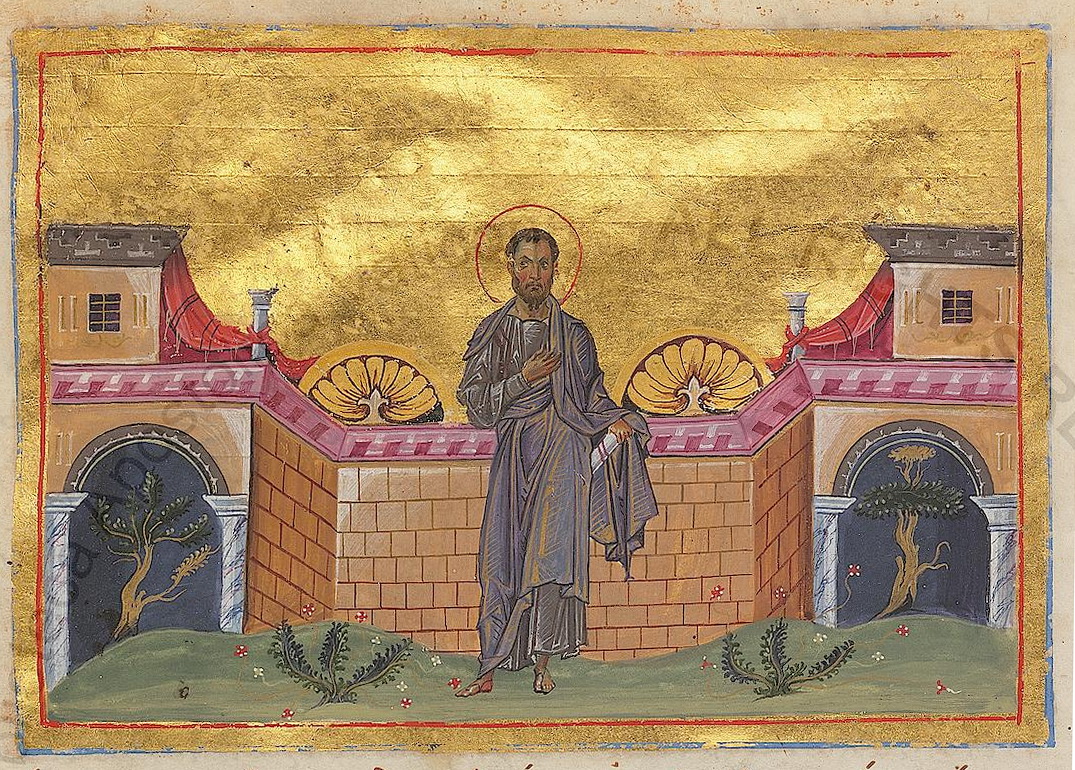 Source: Wikimedia Commons,
 Prophet Obadiah (Menologion of Basil II).jpg
, public domain. Byzantine manuscript illumination from the Menologion of Basil II, c. 985.
This image should be described as a Byzantine manuscript illumination of the prophet, not as a narrative scene from Obadiah. It helps the reader see Obadiah as a prophetic witness with a scroll. It should not carry more interpretive weight than that.
The most important visual aid for this book is the map, because geography is part of the theology. The relationship schematic is also useful because it keeps the class from treating Edom as a faceless enemy. Edom is brother first. The sin-progression schematic can help servants teach verses 10-14 without turning the section into a vague warning against pride.
Western biblical art, such as James Tissot’s watercolor of Obadiah, can be useful as an optional attention aid, but it should be labeled as Western art, not iconography. Avoid battle art or images that make Edom’s destruction feel entertaining. The book is not inviting Christians to enjoy judgment. It is inviting the heart to fear pride, protect the brother, and confess the Lord’s Kingdom.
Spiritual Fruit 🍇
-
Watch the first movement of the heart when someone falls. Before words or actions, Obadiah exposes looking and rejoicing. If another person is humiliated, corrected, exposed, or defeated, ask honestly: did I grieve, or did I secretly enjoy it?
-
Do not stand at the gate of another person’s affliction. Edom is condemned for watching, entering, attacking, and blocking escape. In ordinary life this can mean repeating shameful news, refusing help, making someone else’s weakness useful to you, or staying silent because mercy would cost comfort.
-
Repent of inherited rivalries. Some hostility feels normal because it was handed to us by family, community, politics, church conflict, or old history. Obadiah asks whether we are preserving wounds more carefully than mercy.
-
Bring your high place to Christ before it brings you down. Everyone has a place where the heart says, “Who will bring me down?” It may be knowledge, reputation, money, ministry, family standing, competence, or control. Confess that place before the Lord.
-
Give vengeance back to God. Obadiah teaches judgment, but Romans 12 teaches the Christian response. Feed the enemy, bless the persecutor, and overcome evil with good. The Lord can judge without becoming unjust. We cannot.
-
End in worship, not in winning. The book’s last line is “the kingdom shall be the Lord’s.” If the study makes us harsher, we missed the ending. The right fruit is repentance, mercy, reverence, and longing for the unshakable Kingdom.
Teaching Notes
Obadiah 1:1-4 - Pride speaks from the heights
- Ask: Where does the heart say, “Who will bring me down?”
- Emphasize: Pride is refusal of creaturely dependence, not merely a strong personality.
- Watch for: Do not reduce Edom’s pride to confidence. In Obadiah, pride is refusal to be accountable to God and merciful to the brother.
- Connect: Edom reaches upward and falls; Christ descends in mercy and is exalted.
- Show: Use the Edom/Idumea map only after explaining the spiritual meaning of height, so the visual serves the passage rather than distracting from it.
Obadiah 1:5-9 - False supports collapse
- Ask: What false supports do people use to keep repentance away?
- Emphasize: Hidden things, allies, wisdom, and warriors fail when they become shelters for sin.
- Watch for: This is not a warning against wisdom or friendship. It is a warning against trust detached from righteousness.
- Connect: The true refuge is not managed control, but repentance before the Lord.
- Show: No separate artwork is needed here. Let the theft, gleaning, and searched-out-hidden-things imagery carry the lesson.
Obadiah 1:10-14 - Violence against the brother
- Ask: When another person falls, do I grieve, help, stay silent, or secretly enjoy it?
- Emphasize: Gloating is already a form of violence because the heart begins participating in the brother’s ruin.
- Watch for: Do not let the class talk only about nations or politics. Press the ordinary forms: gossip, humiliation, reposted shame, rivalry, ministry jealousy, and refusal to help.
- Connect: Christ reveals the final depth of the brother-wound and opens escape through the Cross instead of closing it.
- Show: Use the Jacob/Esau relationship schematic before the sin-progression schematic. First show why Edom is brother; then show how sin takes the whole person.
Obadiah 1:15-16 - The Day of the Lord universalizes Edom’s case
- Ask: What is the difference between trusting God’s judgment and craving personal revenge?
- Emphasize: The Day of the Lord unveils moral reality before the living God. It does not authorize Christians to become cruel.
- Watch for: Do not turn “as thou hast done” into scorekeeping, resentment, or revenge spirituality.
- Connect: Romans 12 governs the Christian response: vengeance belongs to God, and enemy-love belongs to us.
- Show: A simple contrast between cup/judgment and mercy/enemy-love can help, but do not make the cup imagery theatrical.
Obadiah 1:17-21 - Mount Zion and the Kingdom of the Lord
- Ask: How does the final line change the emotional tone of the whole book?
- Emphasize: Obadiah does not end with Edom falling. It ends with the Lord reigning.
- Watch for: Do not read restoration as triumphalism. Zion is sanctuary and Kingdom, not revenge theater.
- Connect: Hebrews 12 shows the Christian fulfillment: Mount Zion, the heavenly Jerusalem, Jesus the Mediator, and the unshakable Kingdom.
- Show: End with the map or prophet image only if it leads to worship. Do not add unreliable heavenly-Jerusalem imagery just to have a closing picture.
Session guidance
- Timing: 50 to 65 minutes. Teach the whole book in one session, but do not rush the middle.
- Where to linger: Verses 10-14. Let the class feel the movement from looking to rejoicing to boasting to attacking and blocking escape.
- Where to compress: Detailed debates over dating, Edomite archaeology, and the full geography of verse 20.
- Key phrases to say slowly: “Gloating is already a form of violence” and “Obadiah does not end with Edom falling. It ends with the Lord reigning.”
- Pastoral warning: Do not teach Edom as a racial symbol or as permission to despise enemies.
- Pastoral warning: Do not let the class use Obadiah to diagnose everyone else’s pride before naming their own.
- Accuracy note: Direct early patristic coverage of Obadiah is thin in the sources used here. Eusebius briefly interprets the opening report in relation to the call of the Gentiles; the fuller patristic treatments used here come through New Testament anchors.
- Lectionary note: This passage has no confirmed assigned place in the Coptic Orthodox lectionary from the sources checked; Obadiah the Prophet is commemorated in the Synaxarium on Toba 15 / Tubah 15.
Glossary
- Day of the Lord: God’s decisive intervention in judgment and salvation. In Obadiah, Edom’s case widens to all nations.
- Edom / Idumea: The people descended from Esau and associated with the region south and southeast of Judah. Brenton uses Idumea.
- Esau: Brother of Jacob in Genesis. Obadiah’s use of Esau sharpens the brotherhood and betrayal theme.
- House of Joseph: In verse 18, part of the restored Israel imagery. Its presence helps keep the ending from shrinking into Judah’s private revenge.
- Mount Seir: Mountain region associated with Edom.
- Mount Sion / Mount Zion: The holy mountain associated with Jerusalem, deliverance, sanctuary, and the Lord’s reign.
- Thæman / Teman: A region or people associated with Edom, often linked with wisdom and warriors in prophetic texts.
- The Twelve Prophets: The collection of the twelve shorter prophetic books, read as a unified prophetic witness.
Source Notes
Embedded Scripture is from Brenton’s English Septuagint (LXX). Brenton uses Obdias for Obadiah and Idumea for Edom. Brenton’s notable renderings include sanctuary in verse 17, corn-field in verse 18, Ephratha in verse 20, and taking vengeance in verse 21. These are handled cautiously and interpreted through New Testament fulfillment anchors rather than treated as excuses for private revenge.
Eusebius of Caesarea, Proof of the Gospel, Book 5, chapter 24, briefly reads the opening report in relation to the call of the Gentiles; he does not offer a continuous exposition of the book. Athanasius on Philippians 2 and Chrysostom on mercy, Romans 12, and Hebrews 12 serve as Christian theological companions, not as direct commentators on every Obadiah verse. Their verified words follow the explanation of their relevance.
Sources
Primary sources
- Obadiah 1, Brenton Septuagint.
- Genesis 25, 27, and 33, for Jacob and Esau.
- Numbers 20:14-21, for Edom refusing passage to Israel.
- Psalm 137:7 (LXX Psalm 136:7), Ezekiel 35, Amos 1:11-12, and Malachi 1:2-5, for the wider scriptural memory of Edom.
- Philippians 2:5-11, Matthew 25:31-46, Romans 12:14-21, Matthew 7:2, Galatians 6:7, and Hebrews 12:22-29, for New Testament fulfillment anchors.
- Eusebius of Caesarea, Proof of the Gospel, Book 5, chapter 24, brief interpretation of Obadiah 1:1: Read online.
- St Athanasius of Alexandria, Discourses Against the Arians, Discourse 1, chapter 11, on Philippians 2:9-10: Read online.
- St John Chrysostom, Homilies on John, Homily 60, on John 10:14-15 and practical mercy: Read online.
- St John Chrysostom, Homilies on John, Homily 51, invoking Romans 12 against personal vengeance: Read online.
- St John Chrysostom, Homilies on Hebrews, Homily 32 on Hebrews 12:18-24: Read online.
Secondary academic sources
- T. Desmond Alexander, Obadiah, Jonah and Micah, Tyndale Old Testament Commentaries.
- Leslie C. Allen, The Books of Joel, Obadiah, Jonah, and Micah, New International Commentary on the Old Testament.
- Daniel I. Block, Obadiah: The Kingship Belongs to YHWH, Hearing the Message of Scripture.
- Mark Allan Powell, ed., HarperCollins Bible Dictionary, entry summarized by Bible Odyssey: Read online.
Coptic Orthodox / pastoral sources
- CopticChurch.net Synaxarium, Toba 15, “The Departure of Obadiah, the Prophet”: Read online.
- CopticChurch.net Coptic Lectionary readings for Toba 15, used to distinguish the Synaxarium commemoration from an assigned Obadiah Scripture reading: Read online.
Web pages and non-academic sources cited
- BibleProject, Book of Obadiah Guide: Read online.
- King James Bible Online, Obadiah 1 KJV, used only for public-domain MT/KJV comparison in translation notes: Read online.
Maps / images for location context
Wikimedia Commons,
Idumea.png, approximate Idumea and Edom map, CC BY-SA 4.0, by Valp: Read online.Wikimedia Commons,
Prophet Obadiah (Menologion of Basil II).jpg, public domain Byzantine manuscript illumination: Read online.Wikimedia Commons,
Tissot Obadiah.jpg, public domain Western biblical art by James Tissot: Read online.Project-made teaching schematic,
Assets/obadiah-jacob-esau-relationship-tree.svg, based on Genesis 25, Genesis 33, Numbers 20, and Obadiah 10-14.Project-made teaching schematic,
Assets/obadiah-sin-progression.svg, based on Obadiah 10-14.
Footnotes
-
Eusebius of Caesarea, Proof of the Gospel V.24, translated by W. J. Ferrar (1920), chapter 24. ↩
-
St Athanasius of Alexandria, Discourses Against the Arians I, chapter XI, §39, NPNF2, vol. 4, the saving descent of the Son. ↩
-
St John Chrysostom, Homilies on John, Homily LX (60), on John 10:14-15, NPNF1, vol. 14, practical mercy in light of Matthew 25. ↩
-
The KJV has the plural “ye” in Obadiah 1:16. The alternatives are discussed in Keil and Delitzsch on Obadiah 1:15-16, which reports the Judah interpretation but itself argues for Edom. This is a comparison of readings, not a patristic witness. ↩
-
St John Chrysostom, Homilies on John, Homily LI (51), on John 7:37-38, §3, NPNF1, vol. 14, the self-inflicted wound of revenge. ↩
-
St John Chrysostom, Homilies on Hebrews, Homily XXXII (32), on Hebrews 12:18-24, NPNF1, vol. 14, the greater and more accessible gifts. Square brackets around “privileges” belong to the English translation. ↩