


This narration is from a previous version of the study and may include a combined recording of multiple chapters.
Obadiah is one of the briefest prophetic books, but it is not a small book spiritually. It exposes a sin that hides behind distance, safety, inherited rivalry, and religious language: the refusal to see the wounded person as a brother. Edom’s pride is not only that he lives high in the rocks and says, “Who will bring me down to the ground?” His deeper fall is that he stands at the gates while Jacob suffers, rejoices over Judah’s ruin, and helps close the way of escape.
The book moves from the proud height of Edom to the holy height of Zion, from the false security of the self-exalted heart to the final confession that “the kingdom shall be the Lord’s.” For the Church, Obadiah is not a private ethnic quarrel between ancient neighbors. It is a prophetic mirror. Edom is Esau’s house, Jacob’s brother, and that is why the judgment is so piercing. The sin is violence against kin, gloating over calamity, and using another person’s collapse as an opportunity for gain. In Christ, the betrayed Brother takes that violence into Himself, answers it with the Cross, and still warns every proud heart that the Day of the Lord is near.
Why Obadiah Matters
Obadiah teaches that pride becomes most dangerous when it believes it is untouchable. Edom’s geography gave the people a sense of height and security. The mountain strongholds, the trade routes, and the rocky places became more than a homeland. They became a spiritual illusion. The heart began to say, “Who will bring me down to the ground?”
The Lord answers that question Himself. The issue is not that high places are evil. Zion is also a mountain. Sinai is a mountain. Tabor is a mountain. The issue is what the height means. Edom’s height is self-exaltation; Zion’s height is deliverance and sanctuary. Edom climbs so no one can reach him. Zion is lifted so the Lord can gather, heal, and reign.
This is the spiritual spine of the book: the false height of pride is brought down, and the holy height of Zion becomes the place of deliverance. The book is therefore not only about judgment. It is about the kind of kingdom God is establishing. The final line, “the kingdom shall be the Lord’s,” is not an ornament. It is the goal toward which the whole prophecy moves.
Historical and Scriptural Context
Obadiah belongs to the Twelve Prophets, the collection received in both Jewish and Christian Scripture. In the Hebrew ordering followed by many English Bibles, it is fourth, after Hosea, Joel, and Amos; the Greek Septuagint tradition places it fifth, after Joel. “Minor Prophets” describes the books’ length, not the weight of their witness.1 Like the other prophets, it takes concrete historical sin and opens it into the larger Day of the Lord. Edom’s behavior toward Jerusalem becomes a sign of how God will judge all nations that act with pride, violence, and contempt.
Edom traces back to Esau, the brother of Jacob. That family relationship matters throughout the book. Genesis 25 and 27 set the early family wound in motion, but Genesis 33 also matters because Jacob and Esau meet again with tears and embrace. Obadiah should not be taught as though Jacob and Esau were forever incapable of peace. The tragedy is deeper: a later generation chooses betrayal after mercy had once appeared.
Numbers 20 shows Edom refusing Israel passage even when Israel promises not to take fields, vineyards, or well water. That refusal becomes an early sign of closing the way. Psalm 137:7 (LXX Psalm 136:7) remembers Edom around Jerusalem’s destruction. Ezekiel 35 speaks of perpetual hostility, bloodshed, and rejoicing over Israel’s desolation. Amos 1:11-12 gives one of the clearest parallels: Edom pursued his brother with the sword and cast off pity. Malachi 1:2-5 should be handled carefully as covenant-history warning, not as permission for contempt.
The opening names Obadiah, but supplies neither his family history nor a king’s reign by which to date the vision. The immediate historical setting is usually connected to Jerusalem’s fall to Babylon in 586 BC or to the wider crisis around that destruction.2 This is an inference from the catastrophe described, not a date printed in the prophecy. The Coptic Synaxarium remembers the prophet in an earlier setting, discussed below. The book describes foreigners entering Jerusalem’s gates, casting lots, and taking the city’s forces captive. Edom’s guilt is described in escalating verbs: looking on, rejoicing, boasting, entering the gate, attacking, standing at the escape routes, and shutting up fugitives. The prophet does not treat passive indifference as innocent. To stand with the destroyer against the wounded brother is to become “as one of them.”
Geographical Significance ⛰️
Obadiah’s geography is theological. Edom lay south and southeast of Judah, associated with Mount Seir, Teman, rocky heights, trade routes, and defensive terrain. The people could imagine themselves protected by cliffs, alliances, wisdom, and warrior strength. The geography helped them believe they were unreachable.
That is why the prophet’s language is so sharp: “If thou shouldest mount up as the eagle, and if thou shouldest make thy nest among the stars, thence will I bring thee down, saith the Lord.” Edom’s vertical imagination is exposed. He thinks height means invulnerability. The Lord says height without humility becomes the place from which judgment descends.
The last movement reverses the geography. Mount Zion is not just a counter-fortress. It becomes deliverance, sanctuary, inheritance, and the place from which the Lord’s reign is confessed. The prophecy does not end by saying, “Edom falls and Judah wins.” It ends by saying, “the kingdom shall be the Lord’s.” The land language moves toward worship and divine reign.
The Edom/Idumea map in the Obadiah 1 guide locates these neighbors and their difficult terrain. It makes the language of height and blocked escape concrete without pretending that a map can explain the heart.
The Characters 👥
- The Lord God: The true speaker and judge. He exposes Edom’s hidden pride, measures violence against the brother, and promises deliverance on Zion.
- Obadiah: The prophet whose name means “servant of the Lord” or “worshipper of the Lord.” The book itself gives no biography beyond naming him. The messenger disappears behind the message; the Coptic commemoration preserves a fuller account, distinguished below.
- Edom / Esau: The brother-nation descended from Esau. Edom represents a concrete historical people, not an abstract villain. Spiritually, Edom becomes the image of pride that trusts in height, alliances, wisdom, and opportunity.
- Jacob / Judah / Jerusalem: The wounded brother and the covenant people in the day of affliction. The text does not hide Judah’s suffering, but it also does not let Edom profit from it.
- Joseph: Named near the end of the prophecy. His presence widens the restoration imagery beyond Judah alone.
- The nations: The prophecy begins with Edom but widens to “all the Gentiles” and the Day of the Lord. Edom becomes the case study for the judgment of pride everywhere.
- Those who escape on Mount Zion: The remnant gathered by mercy. Their presence keeps the book from becoming only an oracle of destruction.
Light from the Word 🕯️
Read Obadiah in one sitting before turning to the Obadiah 1 guide for close exposition. Its five movements carry one argument: the Lord brings down the height that refuses mercy and establishes the reign in which the wounded find sanctuary.
- Obadiah 1:1-4: Pride speaks from the heights. Listen for the question Edom asks from the rocks: “Who will bring me down to the ground?” The answer exposes the difference between security received from God and an imagined exemption from accountability; Philippians 2 will bring that contrast into the light of Christ’s humility.
- Obadiah 1:5-9: False supports collapse. Treasure, alliances, wisdom, and warriors fall away in turn. These good things cannot become substitutes for righteousness; preparedness becomes blindness when it keeps repentance outside the door.
- Obadiah 1:10-14: Violence against the brother. Linger here: the repeated prohibitions uncover sin’s movement from looking and rejoicing to attacking and blocking escape. Brotherhood obliges mercy, not continued exposure to abuse; protecting the endangered person is part of refusing Edom’s sin, not a failure of forgiveness.
- Obadiah 1:15-16: The Day of the Lord. Edom’s case opens into judgment upon all nations. This is a warning about deliberate violence, not a key for diagnosing another person’s suffering as deserved punishment (Job 42:7; Luke 13:1-5; John 9:1-3); Romans 12 entrusts recompense to God and calls us to mercy.
- Obadiah 1:17-21: Zion and the Kingdom. Keep the final clause in view as you read the hard language of judgment: “the kingdom shall be the Lord’s.” Zion is not another Edomite stronghold; deliverance leads toward sanctuary, restored inheritance, and, in Hebrews 12, the unshakable Kingdom gathered around Jesus.
The Church’s Voice in Worship ⛪
Obadiah the Prophet is commemorated in the Coptic Synaxarium on Toba 15 / Tubah 15 as “The Departure of Obadiah, the Prophet.” The book itself gives no genealogy. The Synaxarium describes him as Hananya’s son, of Judah, prophesying under Jehoshaphat for more than twenty years; it also reports a tradition identifying him with the third captain of fifty sent to Elijah (2 Kings 1:13-15). That biblical passage does not name the captain. These are the commemoration’s biographical traditions, not details supplied by Obadiah’s oracle.3
The two chronological settings should remain distinct: the Synaxarium places the prophet in Jehoshaphat’s reign, whereas the usual historical reading connects the oracle with Jerusalem’s sixth-century fall. The prophecy itself gives no reign or date that resolves the difference. We can receive the Church’s remembrance without presenting it as the book’s own chronological statement.
The Coptic readings sources consulted for this study do not establish Obadiah 1 itself as an assigned Scripture reading. The commemoration is therefore a real liturgical connection, but not evidence that this chapter is read at a particular service.
Still, Obadiah belongs naturally in the Church’s ascetical and Holy Week imagination. It speaks of pride, betrayal, gloating, violence against the brother, the Day of the Lord, Mount Zion, sanctuary, and the Kingdom. These are not abstract themes. They are the themes by which fasting and Pascha expose the heart. In Holy Week, the Church sees Christ betrayed by His own, mocked by rulers, surrounded by the nations, and lifted up on the Cross. Obadiah helps the servant ask: am I with the wounded Brother, or am I standing at the gate with Edom?
The book also belongs in the formation of mercy. It warns the Church that judgment texts should not produce hard-hearted people. The soul that studies Edom must first repent of Edom.
Iconography and Visual Teaching 🖼️
A restrained visual approach suits this short oracle: the prophet as witness, the neighboring lands, and the movement of sin described in the text.
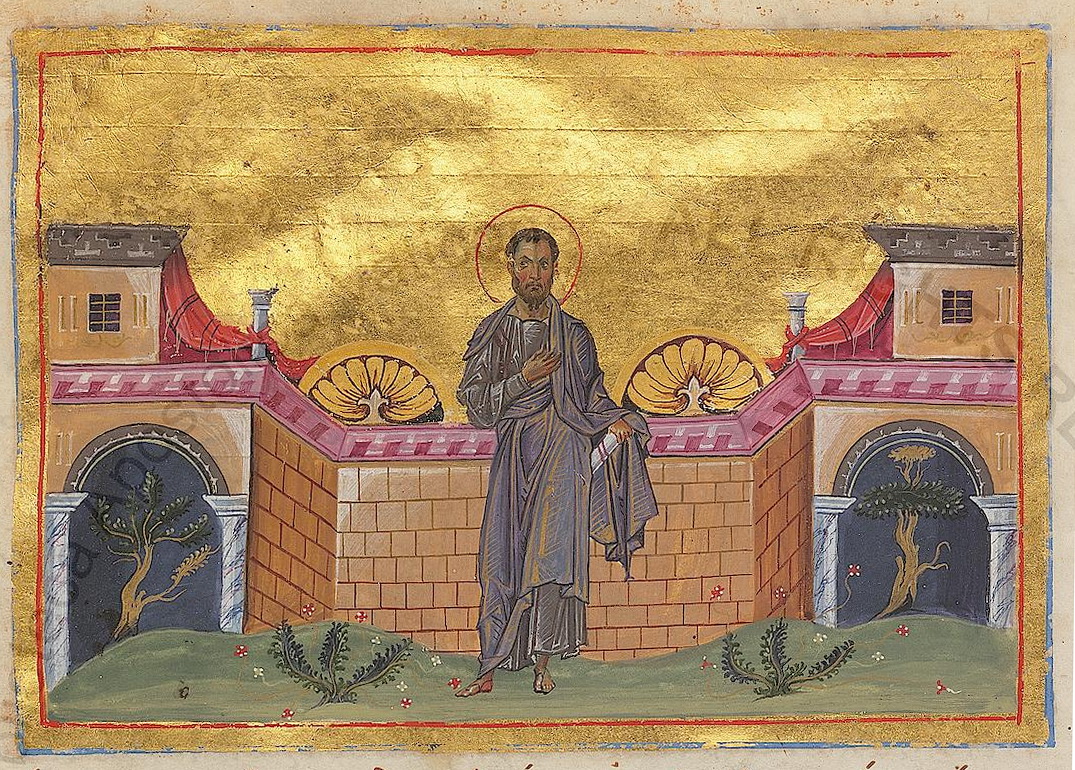 Source: Wikimedia Commons,
 Prophet Obadiah (Menologion of Basil II).jpg
, public domain. Byzantine manuscript illumination from the Menologion of Basil II, c. 985.
This image should be used as a prophetic witness image, not as a narrative scene from Obadiah. A reliable Orthodox icon of the Prophet Obadiah can serve the same purpose if preferred. The point is to anchor the reader in prophecy and witness, not in revenge imagery.
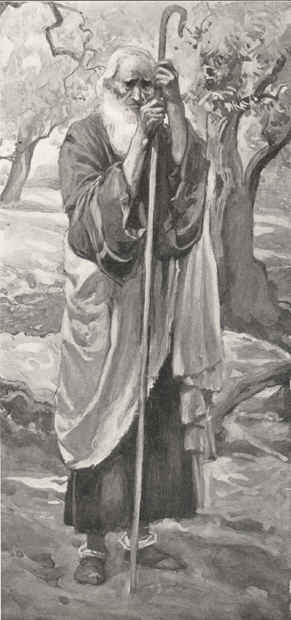 Source: Wikimedia Commons,
 Tissot Obadiah.jpg
, public domain. Western biblical art by James Tissot, c. 1896 to 1902. This is not Orthodox iconography.
Tissot’s image can help a modern reader pause over Obadiah’s prophetic burden, but it should be labeled as Western biblical art. It should not carry doctrinal or iconographic authority.
A teacher can use four visual anchors across the overview and chapter guide:
- Byzantine or Orthodox prophet image: Keeps the focus on prophecy and the servant of the Lord.
- A map of Edom, Judah, Jerusalem, the Dead Sea, and Mount Seir: Helps the class see the brother-nation relation, the southern geography, and why Edom’s height matters.
- A Jacob and Esau relationship schematic: Makes the brother-wound visible.
- A sin-progression schematic for Obadiah 10-14: Shows the movement from eye to heart to mouth to hands to feet.
Avoid generic battle art or images that romanticize Edom’s destruction. Obadiah is not asking the Christian to enjoy judgment. It is asking the heart to fear pride, protect the brother, and confess the Lord’s Kingdom.
Spiritual Fruit 🍇
-
Repent of gloating quickly. Obadiah treats rejoicing over another person’s calamity as serious sin. If someone falls, fails, is exposed, loses status, or suffers, watch the first movement of your heart. The first movement may reveal Edom.
-
Do not stand at the gate of another person’s affliction. Edom is condemned for watching, entering, blocking, and shutting up fugitives. In ordinary life, this can mean repeating a humiliating story, refusing to help when help is possible, using someone’s weakness for advantage, or staying silent because intervention would cost comfort.
-
Repent of inherited hostility. Obadiah is historical, but its spiritual warning reaches inherited rivalry in families, communities, parishes, ministries, and nations. Do not preserve contempt more carefully than mercy.
-
Let Christ humble the high place. Everyone has a place where the heart says, “Who will bring me down?” It may be competence, reputation, money, spiritual knowledge, family standing, ministry role, or control. Obadiah asks us to bring that height before Christ before judgment brings it down.
-
Give vengeance back to God. The Day of the Lord is real, but it is not a license for personal revenge. Romans 12 teaches the Christian to feed the enemy, bless the persecutor, and overcome evil with good because judgment belongs to the Lord.
-
End in worship, not in winning. The book ends, “the kingdom shall be the Lord’s.” If studying Obadiah makes us sharper, crueler, or more eager to condemn, we have missed the ending. The right fruit is repentance, mercy, reverence, and longing for the Kingdom.
Teaching Notes
Suggested teaching use
Teach the whole book in one full session after the overview is read. It is only twenty-one verses, but it should not be rushed. Slow down especially at verses 10-14, because that section exposes the heart most directly.
Where to linger
- The contrast between Edom’s height and Zion’s height.
- The phrase “thy brother Jacob” in verse 10.
- The Genesis 33 background, because it shows that reconciliation had once appeared.
- Numbers 20 as an early refusal to make way for Israel.
- Amos 1:11-12, because it names Edom as the brother who cast off pity.
- The progression from looking to rejoicing to boasting to attacking in verses 12-14.
- The hinge in verse 15: “as thou hast done, so shall it be done to thee.”
- The final confession: “the kingdom shall be the Lord’s.”
Where to compress
- Speculative dating debates. Give the likely Jerusalem-fall context and move to the theological burden.
- Detailed Edomite archaeology. Use geography only as much as needed to explain pride, height, and brotherhood.
- Long canonical side discussions. Obadiah is accepted in ordinary Christian Old Testament canons, so the canon question is not the main issue here.
Pastoral warnings
- Do not teach Obadiah as permission to despise Edomites, nations, enemies, or political opponents.
- Do not weaponize the book against someone else’s pride before naming our own.
- Do not turn “as thou hast done” into personal scorekeeping. Romans 12 must govern the Christian response.
- Do not romanticize the judgment language. The book’s ending is the Lord’s Kingdom, not our revenge.
- Do not call Western biblical art iconography. Keep categories clear.
Glossary
- Day of the Lord: The biblical language for God’s decisive intervention in judgment and salvation. In Obadiah, Edom’s judgment widens into judgment on all nations.
- Edom / Idumea: The people descended from Esau and associated with the region south and southeast of Judah. Brenton often uses Idumea for Edom.
- Esau: Brother of Jacob in Genesis. Obadiah’s use of Esau intensifies the theme of brotherly betrayal.
- House of Joseph: In verse 18, a sign that restoration imagery is wider than Judah alone.
- Mount Seir: Mountain region associated with Edom.
- Mount Zion: The holy mountain associated with Jerusalem, deliverance, sanctuary, and the Lord’s reign.
- Teman: A region or people associated with Edom, often linked with wisdom and warriors in prophetic language.
- The Twelve Prophets: The collection of the twelve shorter prophetic books, read as a unified prophetic witness in Jewish and Christian tradition.
Translation and Source Notes
Embedded Scripture is from Brenton’s English Septuagint (LXX). The chapter guide uses the same edition. Brenton names the prophet “Obdias” and often renders Edom as “Idumea.” Brief New Testament anchors are used as fulfillment and theological uptake, not as direct commentary on Obadiah. The main anchors for this series are Philippians 2, Matthew 25, Romans 12, and Hebrews 12.
Direct early patristic commentary on Obadiah is sparse in the sources used for this study, so the Overview does not pretend that a rich Father-by-Father Obadiah commentary has been found. Eusebius offers a brief reading of the opening report in relation to the call of the Gentiles; the fuller patristic discussion in the chapter guide comes chiefly through New Testament anchors. These witnesses deepen the Christian reading without being presented as a continuous ancient commentary on all twenty-one verses.
Sources
Primary sources
- Obadiah 1, Brenton Septuagint.
- Genesis 25, 27, and 33, for Jacob and Esau.
- Numbers 20:14-21, for Edom refusing passage to Israel.
- Psalm 137:7 (LXX Psalm 136:7), Ezekiel 35, Amos 1:11-12, and Malachi 1:2-5, for the broader scriptural memory of Edom.
- Philippians 2:5-11, Matthew 25:31-46, Romans 12:14-21, and Hebrews 12:22-29, for New Testament fulfillment anchors.
- Eusebius of Caesarea, Proof of the Gospel, Book 5, chapter 24, brief interpretation of Obadiah 1:1: Read online.
Secondary academic sources
- T. Desmond Alexander, Obadiah, Jonah and Micah, Tyndale Old Testament Commentaries.
- Leslie C. Allen, The Books of Joel, Obadiah, Jonah, and Micah, New International Commentary on the Old Testament.
- Daniel I. Block, Obadiah: The Kingship Belongs to YHWH, Hearing the Message of Scripture.
- Mark Allan Powell, ed., HarperCollins Bible Dictionary, entry on Obadiah, summarized by Bible Odyssey: Read online.
Coptic Orthodox / pastoral sources
- CopticChurch.net Synaxarium, Toba 15, “The Departure of Obadiah, the Prophet”: Read online.
- CopticChurch.net Coptic Lectionary readings for Toba 15, showing the Synaxarium commemoration and the assigned readings for the day: Read online.
Web pages and non-academic sources cited
- BibleProject, Book of Obadiah Guide: Read online.
- King James Bible Online, Obadiah 1 KJV, used only for public-domain MT/KJV comparison in translation notes: Read online.
Maps / images for location context
Wikimedia Commons,
Idumea.png, approximate Idumea and Edom map, CC BY-SA 4.0, by Valp: Read online.Wikimedia Commons,
Prophet Obadiah (Menologion of Basil II).jpg, public domain Byzantine manuscript illumination: Read online.Wikimedia Commons,
Tissot Obadiah.jpg, public domain Western biblical art by James Tissot: Read online.Project-made teaching schematic,
Assets/obadiah-jacob-esau-relationship-tree.svg, based on Genesis 25, Genesis 33, Numbers 20, and Obadiah 10-14.Project-made teaching schematic,
Assets/obadiah-sin-progression.svg, based on Obadiah 10-14.
Footnotes
-
George Adam Smith, The Book of the Twelve Prophets, vol. I, chapter I, on the Hebrew and Greek ordering of the Twelve. Read online. ↩
-
HarperCollins Bible Dictionary, “Obadiah, The Book of,” in Bible Odyssey, connects the oracle with Jerusalem’s destruction in 586 BC. ↩
-
Coptic Synaxarium, Toba 15, “The Departure of Obadiah, the Prophet,” CopticChurch.net. The biographical identifications and chronology are attributed to this commemorative account. ↩