


Jacob meets the brother he once deceived, and the feared encounter becomes an embrace. Genesis 33 gives reconciliation a body: bowed knees, running feet, tears, and an offered blessing. Yet the journey remains unfinished. Jacob must care for his vulnerable household, speak truthfully about his intentions, and remember the vow he made at Bethel. Peace with Esau is a mercy to receive and a beginning to live from.
After the night struggle in Genesis 32, Jacob sees Esau coming toward him with four hundred men. The gifts sent ahead have prepared for this meeting, but they cannot dictate his brother’s response. The chapter carries Jacob from fear into restored brotherhood and then into settlement near Shechem.
Embedded Scripture is from Brenton’s English Septuagint (LXX).
Jacob’s bow and Esau’s embrace (Genesis 33:1-11)
1 And Jacob lifted up his eyes, and beheld, and lo! Esau his brother coming, and four hundred men with him; and Jacob divided the children to Lea and to Rachel, and the two handmaidens. 2 And he put the two handmaidens and their children with the first, and Lea and her children behind, and Rachel and Joseph last. 3 But he advanced himself before them, and did reverence to the ground seven times, until he drew near to his brother. 4 And Esau ran on to meet him, and embraced him, and fell on his neck, and kissed him; and they both wept. 5 And Esau looked up and saw the women and the children, and said, What are these to thee? And he said, The children with which God has mercifully blessed thy servant. 6 And the maid-servants and their children drew near and did reverence. 7 And Lea and her children drew near and did reverence; and after this drew near Rachel and Joseph, and did reverence. 8 And he said, What are these things to thee, all these companies that I have met? And he said, That thy servant might find grace in thy sight, my lord. 9 And Esau said, I have much, my brother; keep thine own. 10 And Jacob said, If I have found grace in thy sight, receive the gifts through my hands; therefore have I seen thy face, as if any one should see the face of God, and thou shalt be well-pleased with me. 11 Receive my blessings, which I have brought thee, because God has had mercy on me, and I have all things; and he constrained him, and he took them.
Jacob goes ahead of his family. His seven bows acknowledge the brother whom he had wronged in the struggle for Isaac’s blessing (Genesis 27:35-41). He exposes himself to the encounter rather than hiding behind the people whose safety he fears for. The arrangement of the household also keeps Rachel and Joseph last. The reconciliation scene leaves that visible preference in place; the family history still has consequences to unfold.
Esau answers with an action Jacob cannot buy: he runs, embraces, falls upon his neck, kisses, and weeps with him. Luke 15:20 gives a closely comparable picture when the father runs to embrace and kiss his returning son. The comparison helps us recognize mercy that moves toward another person before a full account can be given. Esau is Jacob’s brother, however, and this scene does not make him a complete portrait of the heavenly Father. Here a real human act of forgiveness breaks the expectation of revenge.
Jacob repeatedly speaks of God’s mercy. His children are gifts received from God, and his possessions have come through that same mercy. The chapter’s most searching reversal arrives in verse 11: “Receive my blessings.” The man who took his brother’s blessing now presses a blessing upon him. The gift cannot undo Genesis 27, but it lets Jacob approach his brother as a giver rather than a rival. Repentance acquires substance when the desire to possess gives way to the willingness to make amends.
The language of the face also reaches back to the night at Peniel. Jacob had named the place of his night encounter “the Face of God,” usually called Peniel (Brenton Genesis 32:31; commonly 32:30). His words about Esau’s face take up that same language: he receives his brother’s favorable face as a likeness of God’s mercy. He is expressing the wonder of being welcomed when he expected hostility. His brother’s face has ceased to be a threat.
For a person who has caused harm, Jacob’s humility offers a concrete examination of conscience: approach without rehearsing excuses, acknowledge the injury, and offer fitting repair. A harmed person remains free to discern the terms of renewed contact. The beauty of Esau’s embrace must never become pressure to return to an unsafe relationship.
A tender household and a difficult promise (Genesis 33:12-17)
12 And he said, Let us depart, and proceed right onward. 13 And he said to him, My lord knows, that the children are very tender, and the flocks and the herds with me are with young; if then I shall drive them hard one day, all the cattle will die. 14 Let my lord go on before his servant, and I shall have strength on the road according to the ease of the journey before me, and according to the strength of the children, until I come to my lord to Seir. 15 And Esau said, I will leave with thee some of the people who are with me. And he said, Why so? it is enough that I have found favour before thee, my lord. 16 And Esau returned on that day on his journey to Seir. 17 And Jacob departs to his tents; and he made for himself there habitations, and for his cattle he made booths; therefore he called the name of that place, Booths.
Esau offers shared travel and then an escort. Jacob explains why children and animals with young cannot sustain the pace of a larger company. His concern gives us an enduring measure of leadership: the journey must account for those most easily exhausted. A household’s peace can be damaged by the impatience of its strongest member.
But care for the vulnerable does not settle every question about Jacob’s words. He says he will come to Esau in Seir; Esau travels there, while Jacob makes habitations and booths at another stopping place. Genesis 33 records no subsequent arrival in Seir. The narrative therefore leaves a discrepancy between the announced destination and the journey described. The narrator supplies no explanation. Jacob’s care for the children is explicit; whether he intends to keep the promise of Seir remains uncertain.
Brenton calls the stopping place “Booths,” the place commonly named Succoth in other English Bibles. Its habitations and cattle shelters make the pause tangible. Reconciliation has allowed the brothers to part without violence; it has not made their households identical or solved every difficulty of speech and trust. We can honor the care Jacob shows while also allowing his unfulfilled words to trouble us. Peace becomes more secure when a promised next step is stated honestly and followed through.
Land, an altar, and the vow still ahead (Genesis 33:18-20)
18 And Jacob came to Salem, a city of Secima, which is in the land of Chanaan, when he departed out of Mesopotamia of Syria, and took up a position in front of the city. 19 And he bought the portion of the field, where he pitched his tent, of Emmor the father of Sychem, for a hundred lambs. 20 And he set up there an altar, and called on the God of Israel.
The names in Brenton need a brief orientation: Secima is the Shechem region, Sychem is the man usually called Shechem, and Emmor is Hamor. Verse 18 says Jacob came to “Salem, a city of Secima.” Some Hebrew-based translations, including the NABRE, describe his arriving safely at the city of Shechem; the KJV instead retains the place-name Shalem. The difference matters when comparing this return with Jacob’s request to be brought home “in safety” in Genesis 28:21. Brenton’s displayed sentence names Salem; it does not contain that explicit statement of safe arrival.1
Jacob acquires a field rather than remaining entirely dependent on permission to camp. The hundred lambs are the payment in the displayed text. His altar and invocation of the God of Israel bear witness that the new name received in Genesis 32 belongs to a life of worship. Yet Shechem is not the end of the vow. At Bethel he had promised that the stone would become a house of God (Genesis 28:20-22); in Genesis 35:1 God will command him to go up to Bethel and build an altar there. Worship at Shechem is real, while the promised return remains ahead. Genesis 33 itself gives no explicit divine rebuke for buying this field, so it would be premature to make the purchase the declared cause of the next chapter’s violence.
There is also a fitting Gospel comparison in the order of events: Jacob is reconciled to his brother and then builds an altar. In Matthew 5:23-24 Christ commands reconciliation with one’s brother before returning to offer a gift at the altar. That command gives Christian worship a searching demand. Prayer must reach into the relationship we would rather leave unrepaired.
The Church’s Voice in Worship ⛪
In the Coptic Liturgy of St. Cyril, the Prayer of Reconciliation asks for heavenly peace and prepares the congregation to greet one another with a holy kiss. The deacon then calls for that greeting; the Anaphora, the central Eucharistic prayer, follows with the call to lift up our hearts.2 The order joins the peace offered in Christ to the people who approach His altar together. Jacob’s embrace with Esau before his altar and Christ’s command in Matthew 5:23-24 illuminate that preparation. This is a connection with the rite, not a claim that Genesis 33 is appointed to be read there. The holy kiss calls for truthful peace and never licenses pressure for unsafe contact or the concealment of wrongdoing.
Gems from the Fathers 💎
St. John Chrysostom’s Homily 31 on John, section 2, explains John 4:5-6 by recalling Jacob’s land and well. This is a geographical recollection within his exposition of John’s Gospel, rather than a homily on Genesis 33. He explains why the Evangelist identifies the parcel of ground so precisely: “It is, that when you hear the woman say, Jacob our father gave us this well, you may not think it strange.” He then recalls the “cruel slaughter” that Levi and Simeon wrought in anger over what was done to Dinah.3
This recollection joins several generations without making their deeds alike. Joshua 24:32 places Joseph’s burial in the parcel Jacob purchased. John 4:5-6 brings Christ to Jacob’s well near the land given to Joseph. The place bears the memory of a patriarch’s settlement, his household’s later violence, and the Savior’s meeting with a Samaritan woman. Christ enters that inherited history and offers living water (John 4:10-14).
Paul names the full reach of Christ’s peace in Ephesians 2:14-16: He breaks down the dividing wall of enmity and reconciles both peoples to God in one body through the Cross. Jacob and Esau’s embrace gives us a human scene of hostility overcome. Christ’s work gathers estranged people into communion with God. In Him, reconciliation is sustained by a new life together, with truth, repentance, and mercy at its center.
One healed relationship does not mean the whole household is healed. Genesis 34 will expose a grievous wrong and the destructive passions still present among Jacob’s sons. Gratitude for this embrace must continue as watchfulness and obedience.
Geographical Significance ⛰️
Jacob’s return includes the departure from Laban, the covenant boundary, the meeting of angels, the night struggle, and settlement. This schematic follows the narrative sequence of Genesis 31-33; it is not a measured route map.
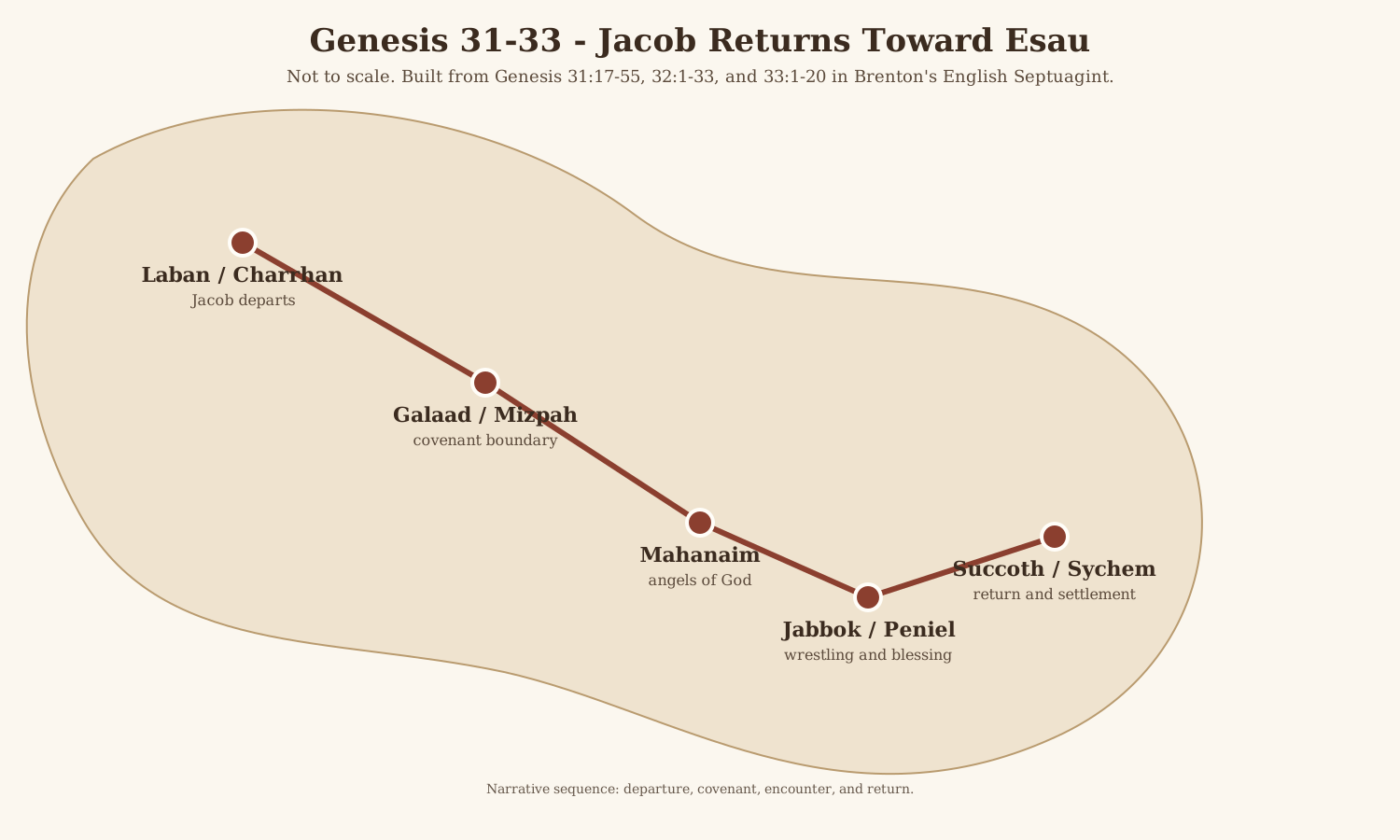
Original study schematic based on Jacob’s return in Genesis 31-33 in Brenton’s English Septuagint. Not to scale.
Glossary
- The Face of God / Peniel: the place Jacob names in Brenton Genesis 32:31 (commonly 32:30), recalled by the language of Esau’s face.
- Blessing: here, Jacob’s offered gift in 33:11; its wording recalls the blessing taken in Genesis 27 without suggesting Isaac’s blessing can be mechanically transferred back.
- Seir: Esau’s destination in 33:14-16, distinguished from the stopping place Jacob actually reaches in this chapter.
- Succoth / Booths: the place where Jacob builds dwellings and shelters for cattle in 33:17.
- Secima / Shechem; Sychem / Shechem; Emmor / Hamor: Brenton’s forms for the locality, the ruler’s son, and his father respectively.
- Reconciliation: restored peace between estranged people. In Ephesians 2:14-16, Christ reconciles people to God together through His Cross.
Spiritual Fruit 🍇
- Offer repair without controlling the response. Jacob’s blessing becomes a gift to his brother. Where you have caused a specific injury, name it in confession and make a fitting amendment: repay what was taken, correct the false account, or offer an apology free of excuses. The other person’s trust is theirs to give.
- Let the vulnerable set a humane pace. Jacob notices children and animals with young. Choose one household or service commitment whose pace is exhausting someone quieter than you. Reduce the burden or share the work, rather than praising endurance while leaving the load unchanged.
- Join peaceful intentions to truthful words. Jacob’s promise of Seir and his journey to Booths leave a difficult gap. Review one promise you have allowed to become vague. Fulfill it, or clearly explain what you can now do.
- Bring the unfinished vow into prayer. The Shechem altar does not complete the return to Bethel. Thank God for a reconciliation already received, then name an obedience still waiting. Before offering worship, take a safe, honest step toward the repair Christ commands in Matthew 5:23-24.
Lord Jesus Christ, our peace, teach me to receive mercy without pretending that my work of repentance is finished. Let the face I fear become a person I can pray for. Give me the humility to make amends, the patience to protect the weak, and the truthfulness to keep my word.
Teaching Notes
Jacob’s bow and Esau’s embrace (Genesis 33:1-11)
- Ask: How does “Receive my blessings” change our reading of the man who took Esau’s blessing?
- Watch for: Treating a gift as payment for forgiveness, or using Esau’s embrace to require unsafe contact from a harmed person.
A tender household and a difficult promise (Genesis 33:12-17)
- Ask: Which part of Jacob’s explanation is confirmed by the text, and which part remains difficult when his next destination is described?
- Watch for: Turning concern for the children into proof that every word Jacob speaks is truthful; the narrator leaves the Seir promise unresolved.
Land, an altar, and the vow still ahead (Genesis 33:18-20)
- Ask: How can the altar at Shechem be genuine worship while the return to Bethel remains unfinished?
- Watch for: Calling the land purchase a divinely condemned act or the cause of Dinah’s violation. Christ’s command addresses the person whose brother has a grievance against him; do not turn it into a demand that a harmed person restore unsafe contact before worship.
Sources
Brenton’s English Septuagint, Genesis 33, with Genesis 27:35-41; 28:20-22; 32:31 (commonly 32:30); 35:1; Joshua 24:32. 🔗 Genesis 33, 🔗 Brenton edition.
Luke 15:20; Matthew 5:23-24; John 4:5-14; Ephesians 2:14-16, for the interpreted Gospel comparisons. 🔗 Luke 15, 🔗 Matthew 5, 🔗 John 4, 🔗 Ephesians 2.
St. John Chrysostom, Homilies on John, Homily 31, section 2 on John 4:5-6, translated by Charles Marriott, Nicene and Post-Nicene Fathers, First Series, vol. 14. 🔗 Primary text.
Genesis 33:18 in the Hebrew-based New American Bible, Revised Edition, for comparison with Brenton’s “Salem.” 🔗 Chapter text.
The Coptic Liturgy of Saint Mark the Apostle, commonly known as The Liturgy of St. Cyril (1998), Prayer of Reconciliation and the following Anaphora. 🔗 Printed service.
Route schematic: original study asset based on the cited Genesis passages, retained as narrative orientation rather than archaeological or cartographic evidence.
Footnotes
-
Compare Brenton, Genesis 33:18, 🔗 LXX translation, with 🔗 NABRE Genesis 33:18 and 🔗 KJV Genesis 33:18. ↩
-
The Coptic Liturgy of Saint Mark the Apostle, commonly known as The Liturgy of St. Cyril (1998), Prayer of Reconciliation, holy kiss, and the following Anaphora. 🔗 Primary service text. ↩
-
St. John Chrysostom, Homilies on John, Homily 31, section 2 on John 4:5-6, trans. Charles Marriott, NPNF1 14. 🔗 Primary text. ↩