


Laban’s face has changed, but God’s promise has not. After years of marriage, births, and labor among the flocks, Jacob hears resentment in the household where he has served. The Lord answers with a command joined to presence: return to your father’s land, and I will be with you. That word carries the family through departure, pursuit, a search for stolen gods, and a covenant made with stones. God has seen what Laban does; He has seen the labor of Jacob’s hands; He will remain witness when the households part.
Genesis 31 continues the increase of Genesis 29–30 and recalls the promise of return given at Bethel in Genesis 28:15. Jacob now has people to bring home and responsibilities to carry with them. Leah and Rachel must be heard, the children protected, and the household brought under God’s command. The homeward road will lead toward Esau and the encounter of Genesis 32.
A changed face and an unchanged promise (Genesis 31:1-3)
1 And Jacob heard the words of the sons of Laban, saying, Jacob has taken all that was our father’s, and of our father’s property has he gotten all this glory. 2 And Jacob saw the countenance of Laban, and behold it was not toward him as before. 3 And the Lord said to Jacob, Return to the land of thy father, and to thy family, and I will be with thee.
Laban’s sons describe Jacob’s prosperity as something taken from their father. Their accusation prepares us for Laban’s later insistence that everything is his. The increase described through the flocks in Genesis 30 has become a reason for hostility. Verse 2 gives a quieter sign: a changed countenance. Familiar surroundings have ceased to offer familiar welcome.
The Lord’s command specifies a destination, the land of Jacob’s father and his family. “I will be with thee” reaches back to Bethel, where God pledged to preserve him and bring him back. Return is an act of divine faithfulness as well as human obedience. The long years away have not erased the word spoken before them.
Jacob will still speak of being afraid in verse 31. Obedience can begin while fear remains, because the promise rests in the One who gives it. We often wait to feel ready before doing what is already clear: telling the truth, settling a debt, asking forgiveness, or fulfilling a postponed responsibility. Jacob’s call teaches us to anchor the next faithful act in God’s remembered mercy. The Lord who has carried us to this day can be trusted with the obedience of this day.
Labor, wages, and provision seen by God (Genesis 31:4-9)
4 And Jacob sent and called Lea and Rachel to the plain where the flocks were. 5 And he said to them, I see the face of your father, that it is not toward me as before, but the God of my father was with me. 6 And ye too know that with all my might I have served your father. 7 But your father deceived me, and changed my wages for the ten lambs, yet God gave him not power to hurt me. 8 If he should say thus, The speckled shall be thy reward, then all the cattle would bear speckled; and if he should say, The white shall be thy reward, then would all the cattle bear white. 9 So God has taken away all the cattle of your father, and given them to me.
Jacob calls Leah and Rachel to the plain where the flocks are. He brings the conversation to the place of his work and begins with what they know: he has served their father with all his might. The women are witnesses to these years, and their answer will help determine the family’s departure.
Their father’s face is no longer favorable, but the God of Jacob’s father has been with him. Laban has deceived him in his wages; God has provided despite that deception. When the reward is speckled, the offspring are speckled; when it is white, they are white. Jacob credits the increase to God. Read after Genesis 30, his speech directs attention beyond his management of the flocks to the providence that sustained him through it.
Service with all one’s strength deserves truthful payment. Jacob joins gratitude to a plain description of injustice: he can thank God for provision and still say Laban deceived him. Thanksgiving need not erase what happened.
The wealth will travel with the household, but it has already stirred resentment and will not prevent pursuit. Gratitude matures when we receive God’s provision without making possessions the measure of His nearness, and use it for the people entrusted to us.
The God of Bethel remembers the vow (Genesis 31:10-16)
10 And it came to pass when the cattle conceived and were with young, that I beheld with mine eyes in sleep, and behold the he-goats and the rams leaping on the sheep and the she-goats, speckled and variegated and spotted with ash-coloured spots. 11 And the angel of God said to me in a dream, Jacob; and I said, What is it? 12 And he said, Look up with thine eyes, and behold the he-goats and the rams leaping on the sheep and the she-goats, speckled and variegated and spotted with ash-coloured spots; for I have seen all things that Laban does to thee. 13 I am God that appeared to thee in the place of God, where thou anointedst a pillar to me, and vowedst to me there a vow; now then arise and depart out of this land, depart into the land of thy nativity, and I will be with thee. 14 And Rachel and Lea answered and said to him, Have we yet a part or inheritance in the house of our father? 15 Are we not considered strangers by him? for he has sold us, and quite devoured our money. 16 All the wealth and the glory which God has taken from our father, it shall be our’s and our children’s; now then do whatsoever God has said to thee.
In Jacob’s dream the angel of God addresses him by name and directs his eyes toward the flock. The explanation comes in verse 12: “for I have seen all things that Laban does to thee.” Jacob has seen a changed face; God has seen the whole treatment behind it. The animals display provision, while the speech reaches the deeper consolation: the Lord knows the life of His servant.
Then the speaker recalls the pillar and vow. The stone anointed at Bethel was a memorial of mercy; the vow was Jacob’s answer to the promise. God brings that encounter into a decision about work, family, and travel. Worship and daily obedience belong to the same life. A vow is a solemn commitment to God; Jacob’s included allegiance to the Lord and an offering from what He would give. Return calls him toward the place of that commitment, carrying the fruit of the intervening years. After receiving mercy, we too must consider what we will now place in God’s hands.
Rachel and Leah answer together. They say their father has considered them strangers, sold them, and consumed their money. Their conclusion includes their children: the wealth taken from their father will belong to them and their children. They affirm Jacob’s obedience, “do whatsoever God has said to thee.” The women of the preceding chapters, often divided by rivalry and grief, speak with one judgment here. Their future matters, and their voices are heard.
Language insight: “the place of God”
Brenton’s phrase in verse 13 recalls Bethel, named the House of God in Genesis 28:19. St. Justin’s quotation gives “Bethel,” and his edition notes the literal wording “in the place of God.”1 At Bethel Jacob awoke to the Lord’s presence and named the place His house. The God who has accompanied him through years of work now recalls that first recognition. Return is a summons to live again before the One whose mercy made the strange place home.
Gems from the Fathers 💎: The divine speaker who knows Jacob
St. Justin Martyr reads this speech as a revelation of the divine Son who appears to the patriarchs. The One called Angel speaks as God and Lord; “Angel” names His messenger’s office in Justin’s interpretation. Summing up Jacob’s visions, Justin writes: “He is called God, and He is and shall be God.”2 His wider argument identifies this speaker with the Son and Word of the Father.
The One who knows Jacob’s humiliation will become man and enter human labor and suffering. In the Church’s Nicene confession, He is true God, of one essence with the Father. Christ’s care is personal and faithful: He knows those He calls, and His command opens a life of communion with Him.
The household sets out, carrying a hidden theft (Genesis 31:17-21)
17 And Jacob arose and took his wives and his children up on the camels; 18 and he took away all his possessions and all his store, which he had gotten in Mesopotamia, and all that belonged to him, to depart to Isaac his father in the land of Chanaan. 19 And Laban went to shear his sheep; and Rachel stole her father’s images. 20 And Jacob hid the matter from Laban the Syrian, so as not to tell him that he ran away. 21 And he departed himself and all that belonged to him, and passed over the river, and went into the mountain Galaad.
Verse 17 answers the command to arise: Jacob arises and brings his wives and children onto the camels. His destination is Isaac in Chanaan. Obedience takes bodily form. Children must be lifted, goods gathered, animals moved, and a river crossed. The promise enters ordinary responsibilities one by one.
The narrator places two concealed actions alongside this departure. Rachel steals her father’s images, and Jacob hides the flight. Jacob will explain his concealment through fear that the daughters and possessions would be seized. The family has agreed to go, but he expects their father to resist. Discretion can serve the protection of vulnerable people; wisdom attends to actual danger and the responsibilities of care.
Rachel’s theft is separately named, without an explanation of her motive. The household carrying God’s promise also carries concealed stolen objects, and Jacob is unaware of them. That hidden fact will make his confident words during the search dangerously uninformed.
The family crosses the river toward the mountain Galaad, commonly called Gilead. Distance changes the setting, but does not complete its spiritual return. In Genesis 35:2–4 Jacob will summon the household to remove its strange gods, purify itself, and go up to Bethel. Going home to God involves bringing our loyalties into His light.
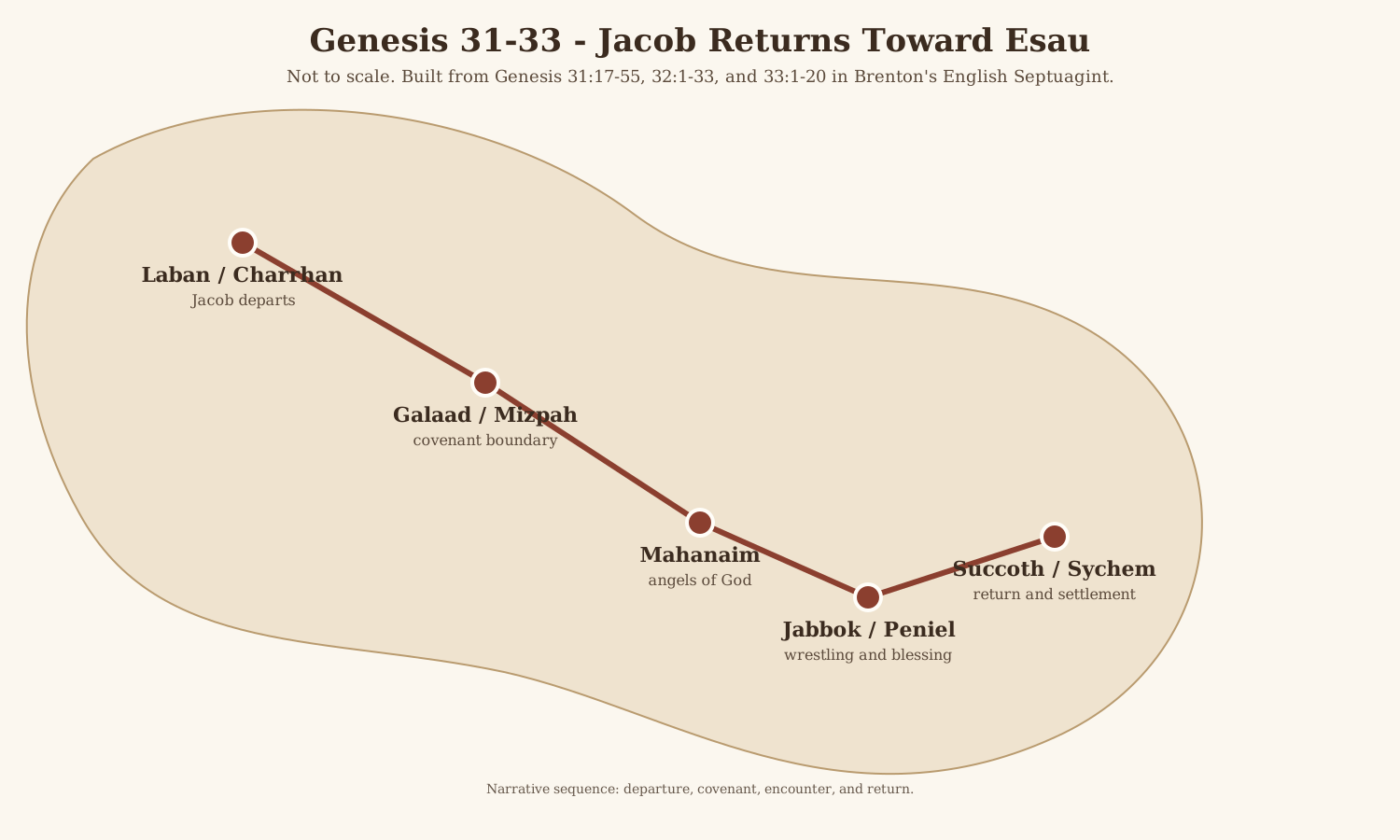 Source: generated narrative schematic, Genesis 31–33, 2026-06-06; not to scale.
God restrains the pursuer before the confrontation (Genesis 31:22-29)
22 But it was told Laban the Syrian on the third day, that Jacob was fled. 23 And having taken his brethren with him, he pursued after him seven days’ journey, and overtook him on Mount Galaad. 24 And God came to Laban the Syrian in sleep by night, and said to him, Take heed to thyself that thou speak not at any time to Jacob evil things. 25 And Laban overtook Jacob; and Jacob pitched his tent in the mountain; and Laban stationed his brothers in the mount Galaad. 26 And Laban said to Jacob, What hast thou done? wherefore didst thou run away secretly, and pillage me, and lead away my daughters as captives taken with the sword? 27 Whereas if thou hadst told me, I would have sent thee away with mirth, and with songs, and timbrels, and harp. 28 And I was not counted worthy to embrace my children and my daughters; now then thou hast wrought foolishly. 29 And now my hand has power to hurt thee; but the God of thy father spoke to me yesterday, saying, Take heed to thyself that thou speak not evil words to Jacob.
Laban hears of the flight on the third day, gathers his brethren, and pursues Jacob for seven days. This is a sustained pursuit by a group with power to confront the departing family. At Galaad, Jacob pitches his tent and Laban stations his brothers nearby. The road of obedience still contains danger.
Before Laban speaks to Jacob, God speaks to Laban. The warning concerns evil speech against Jacob. Laban repeats it beside his admission that he has power to hurt him. The narrator lets us hear divine restraint before human accusation. Mercy is already at work beyond Jacob’s knowledge.
Laban describes his daughters as captives taken with a sword, although the reader has heard them consent to departure. He imagines the music, timbrels, and harp with which he says he would have sent Jacob away, and complains of a denied embrace. His words express a father’s grievance; the account holds them beside his pursuit and stated power to harm. Affectionate language is tested by what a person does with power.
God’s warning makes that power accountable. In a household, workplace, or parish, wounded pride can turn a demand for honor into punishment. The ability to injure someone is never its own justification.
For someone facing a credible threat, prayer belongs with seeking protection and trustworthy help; remaining exposed to violence is not a test of faith. This deliverance gives hope in God’s freedom to restrain evil, without promising every believer the same outward outcome. Our deepest hope is in Christ, whose resurrection overcomes even the death His faithful servants may suffer. We ask for safety and act responsibly, entrusting life to Him.
An unguarded declaration and the concealed images (Genesis 31:30-35)
30 Now then go on thy way, for thou hast earnestly desired to depart to the house of thy father; wherefore hast thou stolen my gods? 31 And Jacob answered and said to Laban, Because I was afraid; for I said, Lest at any time thou shouldest take away thy daughters from me, and all my possessions. 32 And Jacob said, With whomsoever thou shalt find thy gods, he shall not live in the presence of our brethren; take notice of what I have of thy property, and take it; and he observed nothing with him, but Jacob knew not that his wife Rachel had stolen them. 33 And Laban went in and searched in the house of Lea, and found them not; and he went out of the house of Lea, and searched in the house of Jacob, and in the house of the two maid-servants, and found them not; and he went also into the house of Rachel. 34 And Rachel took the idols, and cast them among the camels’ packs, and sat upon them. 35 And she said to her father, Be not indignant, Sir; I cannot rise up before thee, for it is with me according to the manner of women. Laban searched in all the house, and found not the images.
Laban concedes Jacob’s desire to return home, then asks about his stolen gods. Jacob answers for the concealed departure: “Because I was afraid.” He feared the seizure of the daughters and possessions. The Lord’s command is real, and so is the trembling of the man obeying it.
On the theft Jacob speaks beyond his knowledge: whoever is found with the gods shall not live. The narrator immediately tells us he did not know Rachel had stolen them. His confidence places his beloved wife in danger. The man who once concealed his identity before Isaac now speaks without seeing the concealment in his own household. God’s care has not finished its patient work of bringing this family into truth. A death declaration made in ignorance warns us about the violence certainty can carry; it gives no permission to threaten or punish another person.
Laban searches the houses of Leah, Jacob, the two maid-servants, and Rachel, as Brenton names them. Rachel has put the idols among the camels’ packs and sits upon them. She asks her father not to be indignant, giving “the manner of women” as her reason for remaining seated. The narrator records her explanation without confirming her bodily condition. Menstruation itself is no moral fault; the wrong here concerns concealed stolen images.
The search offers a striking contrast with God’s speech. The living God sees Laban’s conduct and warns him before the confrontation. Laban’s gods must be searched for and remain hidden beneath Rachel. Read as literary irony, the objects cannot even make their whereabouts known. God’s sight reaches His servant’s hidden labor; the images need their owner to recover them.
Genesis 35 will describe the household handing over its strange gods before going to Bethel. Colossians 3:5 brings renunciation into Christian life by naming covetousness as idolatry. A desire becomes idolatrous when it claims the obedience owed to God. Repentance takes visible form: returning what was taken, refusing dishonest advantage, giving generously, and receiving enough as a gift. Return deepens as what is hidden is surrendered.
God sees the labor of the hands (Genesis 31:36-42)
36 And Jacob was angry, and strove with Laban; and Jacob answered and said to Laban, What is my injustice, and what my sin, that thou hast pursued after me, 37 and that thou hast searched all the furniture of my house? what hast thou found of all the furniture of thine house? set it here between thy relations and my relations, and let them decide between us two. 38 These twenty years have I been with thee; thy sheep, and thy she-goats have not failed in bearing; I devoured not the rams of thy cattle. 39 That which was taken of beasts I brought not to thee; I made good of myself the thefts of the day, and the thefts of the night. 40 I was parched with heat by day, and chilled with frost by night, and my sleep departed from my eyes. 41 These twenty years have I been in thy house; I served thee fourteen years for thy two daughters, and six years among thy sheep, and thou didst falsely rate my wages for ten lambs. 42 Unless I had the God of my father Abraam, and the fear of Isaac, now thou wouldest have sent me away empty; God saw my humiliation, and the labour of my hands, and rebuked thee yesterday.
The fruitless search releases Jacob’s protest. What injustice, what sin, and what property has Laban found? Let it be set before their relations and judged. Jacob asks that accusation yield to evidence and witnesses.
His twenty years are full of things that can be counted and felt. The sheep and goats bore their young; he did not consume the rams. He bore losses from beasts and theft himself. Day brought heat, night brought frost, and sleep departed from his eyes. Fourteen years served for the daughters, six for the sheep. Laban’s wealth stands behind the bodily expenditure of the man he pursued.
Verse 42 gathers humiliation and labor together: God has seen both. The warning of the previous night answers years of hidden service. God’s knowledge gives dignity to work others treat as replaceable. Jacob’s grievance has full force: the person who benefited from his labor was ready to send him away empty.
James 5:4 carries this moral truth into the Church. Fraudulently withheld wages cry out, and the workers’ cries reach the Lord of Sabaoth, the Lord of hosts. God’s power attends to people cheated of their pay. Wages, hours, and promised compensation are matters of conscience for a Christian employer. Prayer cannot make dishonest payment holy.
Hebrews 6:10 consoles faithful service: God is not unjust to forget work and labor of love shown toward His name in ministry to the saints. Jacob’s shepherding and Christian ministry differ, but human forgetfulness governs neither passage’s divine remembrance. The unpaid worker may need redress; the unnoticed servant may need rest and help. Their faithful labor does not disappear before Christ because another person refuses to acknowledge it.
Jacob’s bearing of loss also helps us hear John 10:11–15. The Good Shepherd gives His life for the sheep, while the hireling abandons them when the wolf comes. Jacob describes taking the cost of lost animals upon himself. Christ brings costly care to its fullness: He freely bears the Cross and gives life to His flock. Those serving in His name learn to protect the entrusted person even when it costs comfort, reputation, or resources.
Gems from the Fathers 💎: Providence can open the road home
St. John Chrysostom, preaching on Acts 23, considers how harmful designs against Jacob and Joseph were turned toward good. He includes Laban’s evil designs and wage fraud among the injuries turned toward Jacob’s return: “True, but even this was for his good, that he might thereupon return to his own country; for if he had been in good circumstances, he would not have so longed for home.”3
Evil intentions cannot dictate what God will finally make of a life. Laban’s wrong remains wrong while the Lord makes a road through it. The same Acts homily notices Paul accepting practical human rescue after the Lord’s encouragement. Trust in providence strengthens action: seek help, tell the truth, and remain open to God’s good beyond the injury.
Witnesses, daughters, and God’s watchful care (Genesis 31:43-50)
43 And Laban answered and said to Jacob, The daughters are my daughters, and the sons my sons, and the cattle are my cattle, and all things which thou seest are mine, and the property of my daughters; what shall I do to them to-day, or their children which they bore? 44 Now then come, let me make a covenant, both I and thou, and it shall be for a witness between me and thee; and he said to him, Behold, there is no one with us; behold, God is witness between me and thee. 45 And Jacob having taken a stone, set it up for a pillar. 46 And Jacob said to his brethren, Gather stones; and they gathered stones and made a heap, and ate there upon the heap; and Laban said to him, This heap witnesses between me and thee to-day. 47 And Laban called it, the Heap of Testimony; and Jacob called it, the Witness Heap. 48 And Laban said to Jacob, Behold this heap, and the pillar, which I have set between me and thee; this heap witnesses, and this pillar witnesses; therefore its name was called, the Heap witnesses. 49 And the vision of which he said—Let God look to it between me and thee, because we are about to depart from each other,— 50 If thou shalt humble my daughters, if thou shouldest take wives in addition to my daughters, see, there is no one with us looking on. God is witness between me and thee.
Laban answers Jacob’s detailed account with a sweeping claim: daughters, children, cattle, and everything seen are his. The words contrast with Jacob’s work and the daughters’ complaint about their consumed inheritance. Calling everything one’s own can obscure the lives and claims of the people before us. Yet his question about what he can do to the daughters and their children begins to turn the encounter toward agreement.
Jacob sets up a stone, and his brethren gather a heap. The companies eat there; both men name the heap as a witness. Visible objects remember an undertaking that must hold when the witnesses disperse. Like Bethel’s pillar, the stone keeps a solemn encounter before human memory. Here the pledge concerns two households’ conduct in God’s sight.
Brenton gives “the vision,” with the petition that God look between them as they part. Verse 50 makes its force clear. Beyond a father’s observation, the daughters deserve protection. Jacob must not humble them or add wives to their injury. A flawed father speaks a real obligation: the women have worth before God.
The plurality of marriages belongs to the history of Genesis 29–30; this covenant addresses the daughters’ vulnerability within it. For Christians, the moral summons reaches private conduct. Words spoken at home, financial decisions, fidelity, and treatment during conflict are lived before God. A wife’s dignity does not depend on her father’s presence to defend her.
Jacob has been consoled that God saw Laban’s injustice; now he must live knowing God will see his own treatment of the daughters. The same sight comforts the afflicted and calls the powerful to restraint. Prayer for God’s help brings our own use of strength under His truth.
Language insight: “the vision” and “Let God look”
The Greek gives ἡ ὅρασις, “the vision,” and ἐφίδοι ὁ θεός, “may God look.”4 The familiar name Mizpah belongs to this setting, while Brenton makes the divine watching explicit. Stones preserve a public pledge; God’s sight reaches the treatment of the daughters beyond the stones.
An oath, a sacrifice, and a blessing at parting (Genesis 31:51-55)
51 And Laban said to Jacob, Behold, this heap, and this pillar are a witness. 52 For if I should not cross over unto thee, neither shouldest thou cross over to me, for mischief beyond this heap and this pillar. 53 The God of Abraam and the God of Nachor judge between us; and Jacob swore by the Fear of his father Isaac. 54 And he offered a sacrifice in the mountain, and called his brethren, and they ate and drank, and slept in the mountain. 55 And Laban rose up in the morning, and kissed his sons and his daughters, and blessed them; and Laban having turned back, departed to his place.
The heap and pillar witness to a precise limit: neither party is to cross beyond them toward the other for mischief. The covenant restrains harmful approach. The pursued household can continue its return; the pursuer accepts an obligation reaching beyond the emotion of the moment.
Laban calls upon the God of Abraham and the God of Nachor to judge between them. Jacob swears by the Fear of his father Isaac, returning to the One he credited in verse 42 with seeing his work. The formulas preserve each speaker’s words while placing judgment beyond either man’s power.
Language insight: “the Fear of Isaac”
Greek φόβος, “fear,” occurs concerning Isaac in verse 42 and again in the oath.5 In context, “the Fear of Isaac” names the God Isaac reveres. Jacob swears by that God, not an anxious feeling. Holy fear lets God’s holiness govern our conduct; judgment belongs to the Lord his father worships.
Jacob offers a sacrifice and calls his brethren to eat. Suspicion gives way to worship, a shared meal, and a night on the mountain. Sacrifice acknowledges the Lord; hospitality expresses the undertaking among people. This recalls Isaac’s feast and oath with Abimelech in Genesis 26:26–31, where a questioned relationship found practical peace. A meal can enact willingness to cease harm and receive another person without renewed accusation.
Morning brings Laban’s kisses and blessing. These are genuine farewell actions in the narrator’s account, giving the household more than a memory of pursuit. The good in this parting can be received while its future depends on the covenant being kept. Peace grows through faithful action after the warm word.
Laban returns to his place; Jacob continues toward the meeting of God’s angels in Genesis 32. Colossians 1:13 describes Christians’ greater deliverance: the Father brings us out of darkness into the kingdom of His beloved Son. Jacob’s summons gives a pattern of deliverance ordered toward belonging. Christ leads us out of sin to live under His good rule, worship the Father, and learn the peace of His household.
Spiritual Fruit 🍇
-
Let remembered mercy become present obedience. God recalls Jacob’s pillar and vow. Bring to prayer one commitment made in gratitude that has faded: restitution, a promised work of mercy, or time given to the Lord. Ask your father of confession for help if the obligation is uncertain, then take the next honest step. Mercy becomes fruitful when the life receiving it answers God today.
-
Place labor before the God who sees. Tell the Lord about exhausting work and withheld recognition. Seek just payment or practical help where needed. If you supervise others, examine whether their effort is being concealed beneath your success, and repair what is owed. God’s remembrance frees us from hopelessness about hidden service and from indifference to another worker’s cost.
-
Use truth with humility about what you know. Jacob asks for evidence, yet earlier declares death for a theft he does not know occurred. Distinguish what you witnessed from what you inferred. Pause, ask, and leave room for correction. In confession, bring the urge to sound certain because you feel threatened. Christ gives courage that speaks firmly without risking another’s dignity to defend your own name.
-
Surrender what cannot come with you to Bethel. Rachel’s concealed images travel inside a household already moving home. Examine one attachment competing with obedience. Where covetousness is involved, return a possession, correct a dishonest gain, give to someone in need, or relinquish an advantage that harms another. Join the act to prayer and confession. Repentance becomes freedom as the hidden claim loses command over your choices.
-
Keep peace where God alone sees you. Choose one obligation you can keep: faithful provision, respectful speech, an agreed limit on contact, or refusal to recruit others into retaliation. Where danger is present, seek safeguarding help. Pray for the other’s salvation while doing the good within your responsibility. The meal and morning blessing show that a difficult parting can make room for real kindness.
The stones remain on the mountain, and morning comes to the two households. Lord Jesus Christ, You see the work of our hands and the things we have hidden. Give us courage to obey, honesty to surrender what is stolen, and tenderness toward those entrusted to us. Guard those in danger, teach those with power to fear You, and lead us into the peace of Your Father’s house.
Teaching Notes
A changed face and an unchanged promise (Genesis 31:1-3)
- Ask: How does the promise of presence in verse 3 answer the changed face in verse 2?
- Watch for: God’s specific command to Jacob should be distinguished from a private impression used to override counsel or responsibilities.
Labor, wages, and provision seen by God (Genesis 31:4-9)
- Ask: What changes when Jacob credits God for the increase described in Genesis 30?
- Watch for: Brenton gives wages “for the ten lambs” and “white” as a reward; explain the displayed wording rather than importing another translation’s details.
The God of Bethel remembers the vow (Genesis 31:10-16)
- Ask: What do the pillar and vow add to the command to depart?
- Watch for: Read Rachel and Leah’s actual agreement before Laban’s later claim that they were carried off as captives.
The household sets out, carrying a hidden theft (Genesis 31:17-21)
- Ask: How does the later removal of strange gods in Genesis 35 deepen the return begun here?
- Watch for: Rachel’s motive for stealing the images is not stated; proposed inheritance customs or an intention to destroy idolatry remain conjectures.
- Show: Trace departure and Galaad on the schematic, then the encounters still ahead; its line represents narrative sequence, not measured geography.
God restrains the pursuer before the confrontation (Genesis 31:22-29)
- Ask: Why are we told God’s warning before we hear Laban’s accusations?
- Watch for: Providence offers hope, not a guarantee of bodily immunity; credible threats require protection and trustworthy help.
An unguarded declaration and the concealed images (Genesis 31:30-35)
- Ask: What does “Jacob knew not” teach us about speaking severe judgments?
- Watch for: The search does not prove Rachel’s motive or confirm her menstrual condition, and this chapter establishes no curse mechanism causing her later death.
God sees the labor of the hands (Genesis 31:36-42)
- Ask: Which details make Jacob’s grievance concrete, and how do James 5:4 and Hebrews 6:10 extend its moral truth?
- Watch for: The Good Shepherd connection concerns costly care; Jacob’s tending is not identical to Christ’s saving self-offering, and material increase is not promised to every faithful worker.
Witnesses, daughters, and God’s watchful care (Genesis 31:43-50)
- Ask: How does the witness of God protect the daughters when their father is absent?
- Watch for: Laban’s earlier wrongs do not cancel this real safeguard; the clause about further wives addresses the existing household without making polygamy a Christian ideal.
An oath, a sacrifice, and a blessing at parting (Genesis 31:51-55)
- Ask: What do the sacrifice, meal, kisses, and blessing contribute to the witnessed agreement?
- Watch for: The covenant forbids crossing for mischief, not every possible future meeting. The farewell contains real kindness without giving a verdict on the complete healing of either heart.
Sources
Embedded Scripture is from Brenton’s English Septuagint (LXX). New Testament wording discussed here is from NKJV.
- Genesis 31 in Brenton’s Septuagint 🔗. This guide keeps the familiar Genesis 31:55 farewell, which opens Genesis 32:1 in Brenton’s chapter division. Its presence at the opening of the neighboring study is an intentional boundary overlap, not an additional event. Bible Hub presents the farewell as 31:55 and gives verse 51 separately.
- Genesis 28:15, 18–22; 26:26–31; 35:2–4, read with Genesis 31 for the promise of return, the pillar and vow, a feast and oath, and the removal of strange gods. Genesis 32 continues the homeward road with the meeting of God’s angels.
- Swete’s Septuagint, Genesis 31 🔗, for the wording of “the vision,” God’s looking, and the “Fear of Isaac.” Its displayed verse divisions differ in places from the Brenton English witness.
- St. Justin Martyr, Dialogue with Trypho 58 and 61, ANF, vol. 1, Dods and Reith translation. Direct interpretation of the divine speaker in Jacob’s visions. Justin’s early theological vocabulary is read here in the light of the Church’s Nicene confession, not treated as a substitute for it.
- St. John Chrysostom, Homilies on Acts, Homily XLIX on Acts 23:6–8, NPNF1, vol. 11, pp. 292–296. Jacob’s wage dispute is an explicit example within a sermon on providence, rather than a continuous commentary on Genesis 31.
- James 5:4; Hebrews 6:10; John 10:11–15; Colossians 1:13 and 3:5, for honest wages, remembered service, the Good Shepherd’s costly care, deliverance into the Son’s kingdom, and the renunciation of covetousness.
No specific Coptic lectionary placement for Genesis 31 was verified in the annual, Pascha, Bright Saturday, and special-service sources consulted for this study.
Footnotes
-
St. Justin Martyr, Dialogue with Trypho 58, ANF, vol. 1, p. 226, Dods and Reith translation; the accompanying note identifies the literal wording “in the place of God.” 🔗 ↩
-
St. Justin Martyr, Dialogue with Trypho 58, ANF, vol. 1, p. 226, Dods and Reith translation, “He is called God, and He is and shall be God.” 🔗 For the titles Son and Logos, see chapter 61 🔗. ↩
-
St. John Chrysostom, Homilies on Acts, Homily XLIX, NPNF1, vol. 11, p. 295; translated by J. Walker, J. Sheppard, and H. Browne, revised by George B. Stevens. 🔗 Translation credits are given on the work’s title page 🔗. ↩
-
Swete’s Septuagint, Genesis 31:49, ἡ ὅρασις and ἐφίδοι ὁ θεός. 🔗 ↩
-
Swete’s Septuagint, Genesis 31:42 and the oath displayed at 31:54; Brenton places the oath at 31:53. The noun φόβος means “fear”; the oath context identifies the One Isaac reveres. 🔗 ↩