


Abram has refused to let the king of Sodom make him rich. Now the Lord promises him a very great reward, and Abram answers with the grief that wealth cannot relieve: he has no child. Victory has not healed that wound. Genesis 15 brings the man who has rescued others before the God on whom his own future depends. The Lord receives his questions, leads him beneath the stars, and gives a solemn covenant pledge. Yet the answer includes centuries of suffering and a fulfillment beyond Abram’s lifetime. Faith will have to rest on the One who speaks, even when the promise is larger than the life in which it is first heard.
From victory to an unfinished promise
In Genesis 13, Abram allowed Lot to choose his portion first; God then renewed the promise of land and descendants. In Genesis 14, Abram rescued Lot, received Melchizedek’s blessing, and refused the king of Sodom’s goods, lest that king claim to have made him rich. These decisions clarify the opening of chapter 15. Abram has relinquished a visible advantage, and God speaks of protection and reward. God’s reassurance follows dangerous conflict and costly refusal; the chapter does not specify every cause of Abram’s fear.
Two promises now receive fuller explanation: the heir in verses 1–6 and the inheritance in verses 7–21. God answers childlessness with descendants beyond counting; He answers uncertainty about the land with a covenant, a solemn pledged relationship. Abram receives assurance, but he receives no shortcut around waiting. The next chapter will show how hard it is for a household to live within that assurance. Sarai’s plan involving Hagar produces a child and also rivalry, affliction, and flight. Genesis 15 must therefore be read as a gift to be lived, not as the end of the patriarch’s struggle.
Brenton’s Septuagint wording is retained below. Abram receives the name Abraham later, in Genesis 17.
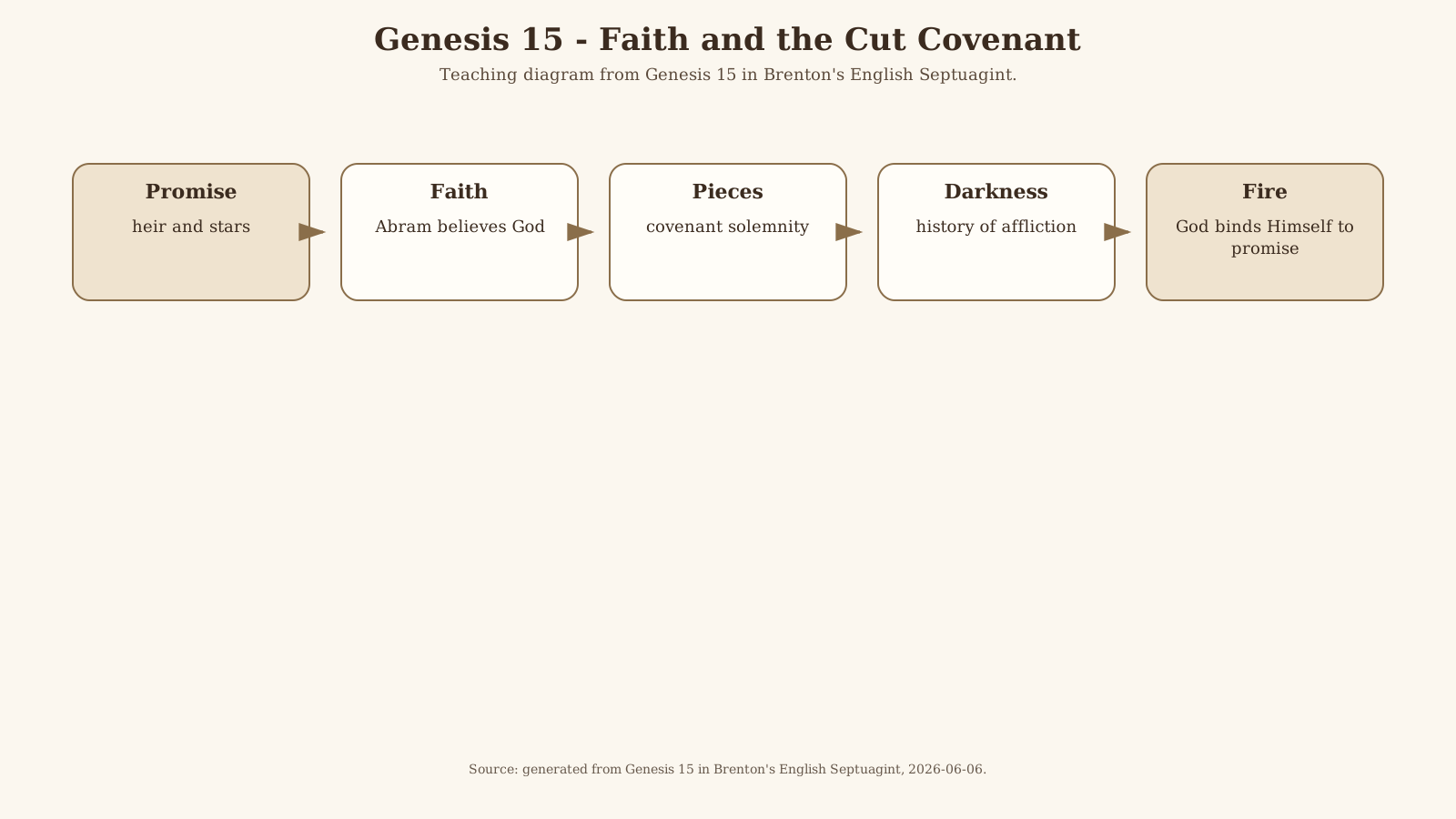 Teaching schematic based on Genesis 15 in Brenton’s English Septuagint, created for this study, 2026-06-06.
The shield and the grief spoken aloud (Genesis 15:1-4)
1 And after these things the word of the Lord came to Abram in a vision, saying, Fear not, Abram, I shield thee, thy reward shall be very great. 2 And Abram said, Master and Lord, what wilt thou give me? whereas I am departing without a child, but the son of Masek my home-born female slave, this Eliezer of Damascus is mine heir. 3 And Abram said, I am grieved since thou hast given me no seed, but my home-born servant shall succeed me. 4 And immediately there was a voice of the Lord to him, saying, This shall not be thine heir; but he that shall come out of thee shall be thine heir.
The Lord begins with Abram’s name and fear. Before explaining the future, He assures the man that he is protected: “I shield thee.” The protection rests on God’s care, not on Abram’s recent military success. A victory can leave a person exhausted or newly conscious of danger. The courage required to act yesterday does not necessarily supply the peace needed to wait today.
The reward answers the preceding refusal. Abram would not let Sodom’s king claim authorship of his prosperity. Refusing a compromised advantage can expose how much we relied on it. Someone who declines dishonest income may feel poorer and overlooked. Obedience can leave us feeling exposed while placing our hope more truthfully in God.
Abram’s answer turns from possessions to succession. The detailed description of Eliezer’s household position is difficult, but verse 3 makes the concern plain: a home-born servant will inherit because there is no descendant. We need no invented family history to understand his grief. The promise of a great nation seems to stand against the apparent end of his own line.
He calls God “Master and Lord” and then says what hurts. Reverence and candor occupy the same prayer. His statement that God has given him no seed is sharper than a vague complaint about circumstances: he brings the unfulfilled promise directly before the Promiser. Scripture lets us hear this without presenting the question as a repudiation of faith. The Lord responds by distinguishing the household servant from the coming heir, who will come from Abram himself.
The answer is definite and still incomplete. At this point God specifies Abram’s own offspring; the fuller identification of Sarah and Isaac comes later. Faith receives what God has actually said without supplying every missing detail. We can pray with the same honesty, naming illness, loneliness, or concern for a child before Christ. We must also distinguish God’s promises from outcomes we strongly desire. Abram’s particular assurance of a son is not a guarantee that every faithful couple will conceive. The tenderness of the passage belongs to those whose grief remains unresolved as surely as to those who later receive the answer they sought.
The stars and righteousness received by faith (Genesis 15:5-6)
5 And he brought him out and said to him, Look up now to heaven, and count the stars, if thou shalt be able to number them fully, and he said, Thus shall thy seed be. 6 And Abram believed God, and it was counted to him for righteousness.
God brings Abram out. The man’s attention has been fixed on the household that will survive him; the Lord directs it toward a multitude he cannot count. The stars give visible form to the scale of the promise, while providing no mechanism by which a childless man can fulfill it. They are a sign accompanying God’s word, not evidence that Abram possesses descendants already. He is asked to trust the speaker across the distance between present barrenness and promised abundance.
Verse 6 places the decisive response before the covenant ceremony: Abram believed God. Righteousness here means being accounted right before God. The Lord receives his trust before the child is born, the land is inherited, or the ceremonial sign is given. This is why the verse carries such weight in the apostolic teaching. Romans 4:1–5 contrasts grace with wages owed for work. Abram has no claim by which he can compel God to pay him righteousness. He receives God’s gift through faith.
Paul also attends to the order of events. In Romans 4:9–12, faith is counted for righteousness before circumcision, which comes in Genesis 17. The later sign seals a righteousness already received. Abraham can therefore be father of believing Gentiles as well as of those within Israel who walk in his faith. The promise breaks open the assumption that inherited religious standing can substitute for living trust. Parish belonging, family devotion, and accurate doctrine are precious gifts; none gives us grounds to boast before God while withholding our hearts from Him.
James 2:21–23 looks ahead to another event, the offering of Isaac in Genesis 22. There faith works together with Abraham’s deeds and reaches maturity through them. James explicitly says that Genesis 15:6 is fulfilled in this later obedience. Paul addresses boasting and the gift of righteousness; James exposes a profession of faith that remains fruitless. Together they show faith receiving grace and becoming active in a life offered to God. Orthodox cooperation with grace means our real, willing response to God’s prior gift. It neither purchases salvation nor excuses an unchanged life. A person who trusts God’s mercy can begin to confess honestly, forgive, and serve because mercy has opened the way.
Romans 4:16–25 carries Abraham’s trust to resurrection faith. The God who gives life where human possibility has failed raised Jesus our Lord from the dead. His victory grounds Christian confidence more securely than our fluctuating feelings.
Gems from the Fathers 💎: The same faith and the coming inheritance
St. Irenaeus reads this verse through Galatians 3 and explains why Abraham’s faith concerns the Church. The patriarch trusts a future God has pledged; Christians likewise await the inheritance of God’s kingdom. Irenaeus writes: “his faith and ours are one and the same: for he believed in things future, as if they were already accomplished, because of the promise of God”1. The certainty lies in God’s promise, not in pretending that the future has physically arrived. The Church learns from Abraham to live toward an inheritance she cannot yet see in its fullness.
Eusebius of Caesarea, in Proof of the Gospel I.6, makes a complementary observation. Righteousness precedes circumcision and the legislation given through Moses. He states that Abraham “received the sign of circumcision after his attainment of righteousness and after the witness to his holiness”2. His concern is the foundation through which the Gospel reaches the nations. A received sign cannot place God in our debt or make obedience dispensable.
Remembered deliverance and the request for assurance (Genesis 15:7-8)
7 And he said to him, I am God that brought thee out of the land of the Chaldeans, so as to give thee this land to inherit. 8 And he said, Master and Lord, how shall I know that I shall inherit it?
God identifies Himself through an act already accomplished: He brought Abram out. The promised inheritance belongs to the same purpose as the original call. Abram is not being asked to entrust himself to an unknown power. The One who speaks has already redirected his life and brought him into this land. Remembering divine mercy gives hope a history.
Abram has believed, and now he asks how he shall know. The placement of verse 8 after verse 6 matters. Faith can contain a request for assurance; the narrator gives no rebuke here and proceeds to the sign God provides. The request differs from setting conditions under which we will consent to obey. Abram addresses his Lord from within the relationship already begun.
This distinction helps the person troubled by questions in prayer. Asking Christ for help to understand, endure, or remain faithful need not mean that faith has disappeared. The danger comes when assurance is reduced to control: unless God explains every outcome or meets our deadline, we refuse His word. Abram receives a sign, but the explanation will make his future less manageable, not more. God’s answer will include generations he cannot supervise.
The divided pieces and the man who waits beside them (Genesis 15:9-11)
9 And he said to him, Take for me an heifer in her third year, and a she-goat in her third year, and a ram in his third year, and a dove and a pigeon. 10 So he took to him all these, and divided them in the midst, and set them opposite to each other, but the birds he did not divide. 11 And birds came down upon the bodies, even upon the divided parts of them, and Abram sat down by them.
Abram answers with obedience. He gathers the specified animals, divides the larger bodies, and sets the pieces opposite one another; the dove and pigeon remain undivided. The arrangement prepares the path through which the fiery signs will pass. His hands have work to do, even though they cannot produce the promised heir or secure the inheritance.
Jeremiah 34:18–20 provides a biblical comparison for the rite. People who had made a covenant before God cut a calf in two and passed between its parts; when they broke that covenant, judgment was pronounced upon them. The divided animal gives the pledge a deadly solemnity, without establishing a separate secret meaning for every animal in Genesis. 🔗
In Genesis, Abram prepares the pieces and waits beside them. The God who has spoken must complete what He has commanded. This is active dependence: Abram does the task entrusted to him, then remains where obedience has placed him. We can speak truth, pray, and care for another person; we cannot force repentance in another heart. Waiting becomes faithful when it follows the obedience we can offer.
Translation insight: “Abram sat down by them”
Brenton’s verse 11 says that birds descended and Abram “sat down by them.” The NKJV reads, “Abram drove them away.” These renderings give the scene a different emphasis, and the distinction matters for teaching. The embedded Septuagint text presents Abram beside the bodies; an explanation that describes him chasing birds would silently substitute the other rendering. 🔗
Here the spiritual application rests on his obedient preparation and continued presence. The birds’ arrival makes the scene exposed and vulnerable. We can speak of patient attendance, but the verse as printed does not establish a detailed allegory of fighting demons or guarding a sacrifice against defilement. Letting Scripture retain its own words often yields a quieter and truer lesson than adding a dramatic action it does not describe.
The terror and a promise beyond one lifetime (Genesis 15:12-16)
12 And about sunset a trance fell upon Abram, and lo! a great gloomy terror falls upon him. 13 And it was said to Abram, Thou shalt surely know that thy seed shall be a sojourner in a land not their own, and they shall enslave them, and afflict them, and humble them four hundred years. 14 And the nation whomsoever they shall serve I will judge; and after this, they shall come forth hither with much property. 15 But thou shalt depart to thy fathers in peace, nourished in a good old age. 16 And in the fourth generation they shall return hither, for the sins of the Amorites are not yet filled up, even until now.
The assurance Abram sought comes with terror. The trance falls upon him; he does not arrange this experience as a spiritual technique. His question about inheritance receives an answer that includes dispossession. His descendants will live as strangers, suffer enslavement and affliction, and eventually return. The covenant makes the promise certain without making its history painless.
The four hundred years convey the long horizon of affliction; the fourth generation marks the return. The Exodus will reveal this promised deliverance. Like Abram in the earlier departure from Egypt, the people will come out with possessions through God’s saving action. Verse 14 announces judgment on the enslaving nation: the oppressor remains answerable.
This accountability guards against a cruel use of providence. Knowing that God can bring deliverance through a history of suffering never makes enslavement good or permits us to protect the one who causes harm. God’s promise belongs to the afflicted; His judgment confronts the nation that afflicts them. Christians awaiting God’s help may seek safety, oppose injustice, and use lawful protection. Endurance in faith does not require surrendering another person to abuse.
Abram himself will depart in peace and good old age. He will not see the return described here. The inheritance reaches beyond the span of the life that receives the first promise. Hebrews 11:13–16 gives this its fuller Christian horizon: the patriarchs die in faith, confess themselves pilgrims, and desire the heavenly country God prepares. Faithfulness may bear fruit after our death. A parent, servant, or teacher can labor without demanding to see the whole harvest as proof that the labor was worthwhile.
The final reason for delay concerns the Amorites: their sins are not yet filled up. God attends to the moral history of peoples beyond Abram’s household. The land is not handed over merely because the chosen man wants it now. Judgment has a moral seriousness and a patience that restrain human haste. This verse offers no ethnic license to despise later peoples or to declare a contemporary population ripe for destruction. The decision belongs to God within this particular history. The reader’s first response should be humility about his own sins and gratitude for the time allowed for repentance.
The darkness likewise needs careful application. In this scene terror accompanies a divine revelation; Scripture establishes that connection here. We cannot therefore pronounce every depression, traumatic experience, or spiritual desolation a revelation sent by God. A sufferer may need medical care, safety, and attentive pastoral support. The consolation is that dread cannot make the Lord’s word false. Abram hears a promise even here, and the promise includes judgment of the oppressor and peace beyond the limits of his own sight.
The fire and the Lord’s solemn pledge (Genesis 15:17-21)
17 And when the sun was about to set, there was a flame, and behold a smoking furnace and lamps of fire, which passed between these divided pieces. 18 In that day the Lord made a covenant with Abram, saying, To thy seed I will give this land, from the river of Egypt to the great river Euphrates. 19 The Kenites, and the Kenezites, and the Kedmoneans, 20 and the Chettites, and the Pherezites, and the Raphaim, 21 and the Amorites, and the Chananites, and the Evites, and the Gergesites, and the Jebusites.
The smoking furnace and lamps of fire pass between the pieces, and the narrator immediately declares that the Lord made a covenant. The signs express the divine pledge. Abram is never described as passing through the path. The decisive assurance comes from God’s action, while the man who has believed and prepared the scene receives it. The rite’s solemnity belongs to the faithfulness of the Lord who undertakes to fulfill His word.
Jeremiah’s comparison makes the covenant’s seriousness clear, but Genesis does not explicitly say that God pronounces a curse upon Himself or can become faithless and be destroyed like the animals. We should distinguish a theological reading of the rite from a sentence the text actually contains. The secure claim is that the Lord confirms His promise through these signs. His pledge is stronger than Abram’s capacity to guarantee the future.
The land and named peoples give the promise historical substance. Its broad limits, from the river of Egypt to the Euphrates, are no warrant for drawing modern borders or authorizing conquest in God’s name. The passage concerns a specific covenant history, and the apostolic interpretation leads Christians toward inheritance in Christ. Taking the historical promise seriously and refusing its political misuse are compatible responsibilities.
Galatians 3:13–18 provides the ground for a Christian reading toward the Cross. Paul declares that Christ redeems from the curse of the law so that Abraham’s blessing reaches the Gentiles and the promised Spirit is received through faith. He identifies Christ as the decisive Seed in whom the promises find fulfillment. We reach the Cross through this apostolic explanation, not by claiming that every feature of the furnace independently predicts a detail of the Passion. God fulfills the promise through the faithful Son who saves those unable to save themselves.
Hebrews 6:13–20 adds the assurance of God’s promise and oath, recalling the later pledge to Abraham. Its focus is the impossibility of God’s lying and the hope made secure through Jesus, our High Priest. Hope becomes an anchor because Christ has entered God’s presence for us. Christ’s saving work stands even when our attention and courage falter.
Gems from the Fathers 💎: Walking with the Word
St. Irenaeus joins Abraham’s counted righteousness to Christ’s statement that Abraham rejoiced to see His day. In Against Heresies IV.5.3, Abraham believes in the Creator and in the promised multitude; his departure becomes a life of following God’s Word. Irenaeus describes him as “walking as a pilgrim with the Word, that he might [afterwards] have his abode with the Word.”3
The image joins companionship now to communion in the coming fulfillment. The Creator who calls Abraham is the same God who reveals Himself in Christ. Christians share that hope by belonging to Christ: Galatians 3:26–29 speaks of faith, baptism into Christ, and heirs according to the promise. Gift and response remain together. We receive a life we could never purchase, and within that life we learn to follow the One who gives it.
The Church’s Voice in Worship ⛪
The Coptic Synaxarium commemorates Abraham, Isaac, and Jacob on 28 Mesra. Its remembrance of Abraham joins belief in God’s promise to obedience and the later offering of Isaac.4 The Church remembers a faith that grew through a whole life. The man beneath the stars will still have to learn patience; the son promised here will later become the occasion of deeper surrender. Honoring Abraham directs us toward steadfast trust in Christ.
Spiritual Fruit 🍇
Give grief a truthful place in prayer. Abram names the absence no reward can conceal. Before asking yourself to sound grateful or strong, bring one actual sorrow to Christ without disguising it. A short, attentive prayer may be enough: tell Him what you fear and what you cannot repair. Pray also for another person whose unfulfilled longing you have overlooked. Faithful companionship refuses both embarrassment about grief and easy promises of a particular outcome.
Receive mercy before trying to prove yourself. Righteousness is counted before Abram can exhibit the promised fulfillment. When shame drives you to avoid confession until you have become respectable, reverse that order. Come to Christ for mercy and then undertake the amendment mercy makes possible. Name a concrete wrong, accept correction, and make one repair. Obedience becomes the fruit of trust, rather than a price demanded before you dare to approach God.
Attend to the work entrusted to you. Abram prepares the pieces and remains beside them. Distinguish today’s responsibility from the outcome you cannot command. You may be able to arrange care, speak honestly, continue intercession, or keep a commitment made to someone vulnerable. Do that work without treating anxious repetition as additional faithfulness. Waiting does not cancel responsible action, and responsible action need not become an attempt to control another person’s life.
Let hope outlive your timetable. Abram is promised peace, while the return belongs to descendants beyond his lifetime. Pray for a child, a parish, or a reconciliation without making your own opportunity to witness success the condition of hope. At the same time, hear the judgment on the enslaving nation: the long view must deepen mercy toward those suffering now. Protect someone, challenge an injustice you can address, and give time to repentance in your own heart before pronouncing judgment on others.
Abram sits beside the pieces, unable to bring the promise to completion himself. The Lord’s pledge gives that waiting a foundation stronger than the man’s strength. We bring our unfinished lives before Christ, whose death and resurrection secure the hope we could never establish. Lord Jesus Christ, receive our grief, make our faith fruitful in obedience, and teach us to wait without withholding mercy from those beside us.
Teaching Notes
Central teaching burden: God receives Abram’s candid grief and establishes the promise; faith receives grace, obeys the given command, and endures a future it cannot control. Keep the heir and inheritance together without treating every desired outcome as a personal divine promise.
The shield and the grief spoken aloud (Genesis 15:1-4)
- Ask: How do Abram’s refusal of Sodom’s goods, God’s promised reward, and the grief of childlessness illuminate one another?
- Watch for: God names protection, but the narrator does not specify every cause of fear. Do not promise conception or a particular family outcome to readers experiencing infertility or loss.
The stars and righteousness received by faith (Genesis 15:5-6)
- Ask: What does Romans 4 add by placing righteousness before circumcision, and how does James 2 show this faith becoming mature later?
- Watch for: Distinguish the events in Genesis 15, 17, and 22. Neither earned salvation nor passive assent does justice to grace received through living faith.
Remembered deliverance and the request for assurance (Genesis 15:7-8)
- Ask: Why does God recall bringing Abram out before answering his request for assurance?
- Watch for: A question can be spoken within faith. Remembering mercy does not establish a formula that every later trial must end identically.
The divided pieces and the man who waits beside them (Genesis 15:9-11)
- Ask: What does Abram do, and what must he wait for God to do, in the preparation of the covenant scene?
- Watch for: Brenton says Abram sat beside the pieces; the NKJV says he drove the birds away. Explain the printed text and use Jeremiah 34:18–20 as a comparison for solemn covenant-making, not as proof of meanings for each animal.
The terror and a promise beyond one lifetime (Genesis 15:12-16)
- Ask: How do judgment on the oppressor, peace for Abram, and patience toward the Amorites change the way we understand the delay?
- Watch for: Neither oppression nor abuse becomes good because God brings deliverance. Avoid ethnic condemnation and the claim that every experience of darkness is divinely sent.
The fire and the Lord’s solemn pledge (Genesis 15:17-21)
- Ask: How do God’s covenant action, Galatians 3:13–18, and Hebrews 6:13–20 establish hope more securely than human control can?
- Watch for: Distinguish the fiery signs and divine pledge from an explicit self-curse, which Genesis does not state. Hebrews recalls a later oath. The historical land promise does not authorize modern borders or violence.
Worship scope: The 28 Mesra commemoration is verified; it is not a full-chapter reading assignment. No assignment of Genesis 15 was established in the annual, Pascha, Bright Saturday, or special-service references consulted. This is a limit of the evidence used here, not a claim that the passage has no place anywhere in Coptic worship.
Sources
Embedded Scripture is from Brenton’s English Septuagint (LXX). New Testament references and brief quotations use NKJV.
Genesis 13:14–18; 14:18–24; 15:1–21; 16:1–6. Brenton text of Genesis 15 🔗.
Genesis 15:11, NKJV, for the comparison with Brenton; Jeremiah 34:18–20, NKJV, for divided animals, covenant-making, and judgment 🔗.
Romans 4:1–5, 9–12, 16–25; Galatians 3:13–18, 26–29; James 2:20–24; Hebrews 6:13–20; 11:13–16. These passages interpret righteousness, living faith, Abraham’s blessing in Christ, the divine oath, and the inheritance beyond earthly life.
St. Irenaeus of Lyons, Against Heresies IV.21.1, Abraham’s faith and the Church’s hope; ANF, vol. 1, translated by Alexander Roberts and William Rambaut 🔗.
St. Irenaeus of Lyons, Against Heresies IV.5.3, the Creator, Abraham’s counted righteousness, and pilgrimage with the Word; ANF, vol. 1, translated by Alexander Roberts and William Rambaut 🔗.
Eusebius of Caesarea, Proof of the Gospel I.6, righteousness before circumcision and the Mosaic law; translated by W. J. Ferrar (1920) 🔗.
Coptic Synaxarium, 28 Mesra, commemoration of Abraham, Isaac, and Jacob, English text at St-Takla 🔗.
Footnotes
-
St. Irenaeus, Against Heresies IV.21.1; ANF, vol. 1, translated by Alexander Roberts and William Rambaut 🔗. ↩
-
Eusebius of Caesarea, Proof of the Gospel I.6; translated by W. J. Ferrar (1920) 🔗. ↩
-
St. Irenaeus, Against Heresies IV.5.3; ANF, vol. 1, translated by Alexander Roberts and William Rambaut 🔗. ↩
-
Coptic Synaxarium, 28 Mesra, “The Commemoration of the Patriarchs: Abraham, Isaac, and Jacob,” English text at St-Takla 🔗. ↩