


This narration is from a previous version of the study and may include a combined recording of multiple chapters.
Israel has crossed the river and kept Passover, but Jericho’s gates remain closed. Jericho, the first fortified city before Israel in the land, does not fall through siege engines, political maneuver, or reckless assault. It falls through obedient procession around the ark, priestly trumpets, patient silence, and a final shout given at Joshua’s command. The chapter is about victory, but even more deeply it is about the form victory takes when the Lord fights for His people.
For the Church, Jericho is never only an ancient city. It is also an image of the proud stronghold that resists God, the hardened habit that seems immovable, and the world arranged against divine promise. The Christian spiritual reading is distinct from the account’s historical violence. Jericho becomes a figure of passions and demonic resistance. The city falls not by carnal violence in Christian hands, but by the Lord’s presence, disciplined obedience, and holy judgment.
The chapter also preserves a profound tension. Jericho is devoted to destruction, while Rahab and her household are saved alive. Judgment and mercy stand side by side. What is under ban is removed; what clings to faith is gathered into Israel. The collapse of Jericho is therefore also the collapse of pride, self-security, and false refuge.
Historical and Scriptural Context
Joshua 6 follows immediately after Israel’s consecration at Gilgal in Joshua 5. Circumcision, Passover, and Joshua’s meeting with the commander of the Lord’s host all prepare for this moment. The battle for Jericho is therefore not a merely military episode. It is the first great test of whether Israel will fight as a covenant people under divine command.
Jericho stands as the firstfruits of conquest. For that reason the city is devoted to the Lord in a special way. Israel is not permitted to seize everything as ordinary spoil. The principle is theological: the first victory belongs wholly to God. Achan’s sin in the next chapter will show what happens when Israel treats holy things as private property.
This is also a difficult chapter because it includes the destruction of a city under divine judgment. Orthodox teaching does not flatten this difficulty. Under the Old Covenant, God sometimes used Israel as an instrument of historical judgment. The Church does not receive these texts as permission for religious violence. She receives them historically, morally, ascetically, and Christologically. Ephesians 6:12 directs Christian warfare against spiritual powers, not against flesh and blood.
Scripturally, Joshua 6 also remains linked with later revelation. Hebrews 11:30-31 remembers the fall of Jericho as an act of faith, and Rahab as a model of believing hospitality. James 2:25 likewise remembers Rahab’s active faith. The chapter is therefore read in the New Testament not as antiquarian history, but as living instruction.
Geographical Significance ⛰️
- Jericho was a strategic oasis city in the lower Jordan valley, guarding access from the river plain up into the central hill country.
- Its shut gates and fortification make the mode of victory especially striking. Israel is facing a closed stronghold, not an open settlement.
- Gilgal, Israel’s base nearby, remains the place of return, rest, and covenant identity.
- Rahab’s house shelters the household marked for mercy. Its location on the wall belongs to the Hebrew wording of Joshua 2:15, not to Brenton’s Greek verse.
The Characters 👥
- The Lord: the true conqueror, who gives Jericho before Israel possesses it.
- Joshua: the obedient leader who receives and executes a command that no ordinary strategist would invent.
- The priests: bear sacred trumpets and move before the ark in liturgical obedience.
- The ark of the covenant: sign of the Lord’s presence and kingship in the midst of Israel.
- The people of Israel: called to silence, patience, obedience, and restraint.
- Rahab: faithful foreigner whose earlier act of trust now bears fruit in deliverance.
- Jericho: both historical city under judgment and spiritual image of proud resistance to God.
Light from the Word 🕯️
Scripture readings below retain Brenton’s Septuagint wording while headings follow NKJV numbering. The NKJV follows the Masoretic Hebrew tradition, represented by the medieval Leningrad Codex; Brenton’s Greek edition draws chiefly on fourth-century Codex Vaticanus. These are edition-level descriptions, not a claim that every Greek manuscript agrees at every verse. Leonard Greenspoon explains both the diversity of the Greek witnesses and the debated roles of translation and Hebrew source differences in NETS, pp. 174-175; the date and place of Joshua’s Greek translation remain uncertain.1
Joshua 6:1-5 - Jericho shut up and the Lord’s strange command
Text and translation note. Brenton’s Greek text has shorter instructions in 6:3-5 and no verse 4; the NKJV’s Masoretic account specifies daily circuits for six days and seven circuits on the seventh. The Greek narrative nevertheless reports six days in 6:14 and seven circuits on the seventh day in 6:15. Holmes, pp. 32-33, argues that the longer instructions reflect Hebrew expansion, while Greenspoon, NETS p. 175, explains that chapter 6 is substantially shorter and that Hebrew-source differences remain debated against translator intervention.21 These are explanations of the forms, not proof that every Greek witness has identical wording. At 6:5 Brenton’s “fall of themselves” contrasts with the NKJV’s “fall down flat”; this changes the description of the fall, emphasizing unengineered collapse rather than the direction of the falling wall. The origin of that smaller contrast is uncertain, but both witnesses attribute the victory to the Lord.
1 Now Jericho was closely shut up and besieged, and none went out of it, and none came in. 2 And the Lord said to Joshua, Behold, I deliver Jericho into thy power, and its king in it, and its mighty men. 3 And do thou set the men of war round about it.
5 And it shall be that when ye shall sound with the trumpet, all the people shall shout together. And when they have shouted, the walls of the city shall fall of themselves; and all the people shall enter, each one rushing direct into the city.
Literal sense. Jericho is sealed tight, but the Lord speaks as if the outcome is already settled: “I deliver Jericho into thy power.” The command that follows is not conventional siege warfare. Israel is told to surround, sound, and shout, because this victory will expose God’s power rather than Israel’s technique.
Textual observation. The promise comes before the action. The grammar of the chapter teaches faith. The city is still standing, yet the Lord announces it as already given. The fall begins in divine speech. Even the final collapse is described as happening of itself, meaning not without cause, but without human engineering as the decisive cause.
Christological and typological reading. Joshua, whose Greek name is the same as Jesus, Iesous, receives the city as gift before it falls. Christ conquers not by worldly domination but by holy authority. Jericho therefore becomes an image of the soul’s hard enclosure before grace, and of the world itself confronted by the Lord’s strange wisdom.
Joshua 6:6-14 - Silent procession and patient obedience
Text and translation note. In 6:8 Brenton has “sacred trumpets,” where the NKJV specifies “trumpets of rams’ horns.” Brenton’s Greek tradition describes their consecrated character, while the Masoretic account identifies the kind of horn. Greenspoon, NETS pp. 174-175, describes variable Greek renderings and the competing source-text and translator explanations; he does not establish the origin of this individual phrase.1 A change of description in translation is possible, but its precise mechanism remains uncertain. The reading directs attention to the priestly proclamation before the ark without denying the concrete instruments in the Hebrew account.
6 And Joshua the son of Naue went in to the priests, 7 and spoke to them, saying, Charge the people to go round, and encompass the city; and let your men of war pass on armed before the Lord. 8 And let seven priests having seven sacred trumpets proceed thus before the Lord, and let them sound loudly; and let the ark of the covenant of the Lord follow. 9 And let the men of war proceed before, and the priests bringing up the rear behind the ark of the covenant of the Lord proceed sounding the trumpets. 10 And Joshua commanded the people, saying, Cry not out, nor let any one hear your voice, until he himself declare to you the time to cry out, and then ye shall cry out. 11 And the ark of the covenant of God having gone round immediately returned into the camp, and lodged there.
12 And on the second day Joshua rose up in the morning, and the priests took up the ark of the covenant of the Lord. 13 And the seven priests bearing the seven trumpets went on before the Lord; and afterwards the men of war went on, and the remainder of the multitude went after the ark of the covenant of the Lord, and the priests sounded with the trumpets. 14 And all the rest of the multitude compassed the city six times from within a short distance, and went back again into the camp; this they did six days.
Literal sense. The battle begins with procession, repetition, and silence. Israel is not rushing at the wall. They are being trained in obedience. The ark stands at the center, and the people are forbidden to break the silence until Joshua gives the word.
LXX insight. Brenton’s phrase “sacred trumpets” strengthens the liturgical feel of the action. The people move “before the Lord.” Jericho is not merely encircled by soldiers. It is encircled by a people ordered around divine presence.
Christological and typological reading. The Church’s warfare also has a liturgical center. She processes, prays, fasts, and keeps silence before she speaks. This is not magic and not empty ceremony. It is the ordering of life around the presence of Christ. The wall of pride often begins to crack long before it visibly falls.
Joshua 6:15-21 - The seventh day, the shout, and the hard text of judgment
15 And on the seventh day they rose up early, and compassed the city on that day seven times. 16 And it came to pass at the seventh circuit the priests blew the trumpets; and Joshua said to the children of Israel, Shout, for the Lord has given you the city. 17 And the city shall be devoted, it and all things that are in it, to the Lord of Hosts: only do ye save Raab the harlot, and all things in her house. 18 But keep yourselves strictly from the accursed thing, lest ye set your mind upon and take of the accursed thing, and ye make the camp of the children of Israel an accursed thing, and destroy us. 19 And all the silver, or gold, or brass, or iron, shall be holy to the Lord; it shall be carried into the treasury of the Lord.
20 And the priests sounded with the trumpets: and when the people heard the trumpets, all the people shouted at once with a loud and strong shout; and all the wall fell round about, and all the people went up into the city: 21 and Joshua devoted it to destruction, and all things that were in the city, man and woman, young man and old, and calf and ass, with the edge of the sword.
Literal sense. The climax comes on the seventh day. The people shout only when commanded, and the wall collapses. Jericho is not treated as ordinary spoil. It is devoted to the Lord, except for Rahab and those with her. The severity of the destruction must be faced honestly as a text of historical judgment.
Facing the hard text. The account names the killing of men and women, and we must neither disguise it nor celebrate slaughter. Its scriptural frame includes God’s patience before judgment (Genesis 15:16), the land’s defilement (Leviticus 18:24-28), and Israel’s warning that the gift is not a reward for its righteousness (Deuteronomy 9:4-5). Rahab’s household and the Gibeonites show that outsiders who turn can be spared and brought into Israel’s worship (Joshua 6:25; 9:27). St John Cassian, Conferences 5.16-24, reads the nations as vices overcome in the heart; in 5.23 patience occupies what anger had held, and humility what pride had occupied.3 This is a spiritual reading, governed by Ephesians 6:12, not an authorization to attack people. No people, ethnic group, or modern conflict may be identified as a new Canaan to be destroyed. Leviticus 27:28 supplies the wider law of things devoted to the Lord.
Textual observation. The passage moves between what is “devoted” and what is “holy to the Lord.” Jericho cannot be handled as private property. Some things are destroyed; precious metals go into the Lord’s treasury. The issue is not indiscriminate greed but holy ownership.
Christological and typological reading. Jericho is a figure of pride, boastful self-sufficiency, and the false city opposed to God. It falls when the Lord’s people obey His word. The shout before the collapsing wall recalls a deeper biblical pattern in which divine voice and divine presence overthrow what human strength cannot. In Christian warfare, that becomes the overthrow of passions by the power of Christ.
Joshua 6:22-25 - Rahab saved alive and joined to Israel
22 And Joshua said to the two young men who had acted as spies, Go into the house of the woman, and bring her out thence, and all that she has. 23 And the two young men who had spied out the city entered into the house of the woman, and brought out Raab the harlot, and her father, and her mother, and her brethren, and her kindred, and all that she had; and they set her without the camp of Israel. 24 And the city was burnt with fire with all things that were in it; only of the silver, and gold, and brass, and iron, they gave to be brought into the treasury of the Lord.
25 And Joshua saved alive Raab the harlot, and all the house of her father, and caused her to dwell in Israel until this day, because she hid the spies which Joshua sent to spy out Jericho.
Literal sense. In the midst of judgment, Joshua carefully fulfills the oath made to Rahab. Her deliverance is not accidental or last minute. It is a matter of covenant faithfulness. She is brought out, preserved, and eventually made to dwell in Israel. Hebrews 11:30-31 places the wall’s fall and Rahab’s rescue together under faith; James 2:25 remembers her hospitality, and Matthew 1:5 includes her in Christ’s genealogy. St Cyril of Jerusalem, Catechetical Lecture 10.11, compares Joshua’s rescue of the believing Rahab with Christ’s reception of sinners.4 Mercy brings the outsider into a people rather than preserving her as a permanent exception.
Textual observation. Rahab is not merely spared from death. She is relocated and incorporated. The movement from “without the camp” to “dwell in Israel” marks a real transition from outsider to member of the covenant people.
Christological and typological reading. Rahab’s rescue prefigures salvation through faith, through the sign marked by blood, and through incorporation into the people of God. The city falls, but the household that clings to the promise lives. This is one of Joshua’s clearest anticipations of the gathering of the nations into Christ.
Joshua 6:26-27 - The curse on rebuilding Jericho
Text and translation note. Brenton’s 6:26 adds the curse’s fulfillment by Hozan of Bæthel within Joshua; the NKJV’s Masoretic Joshua gives the curse alone, with fulfillment by Hiel of Bethel narrated in 1 Kings 16:34. These are the printed Greek and Hebrew forms, not evidence that every Greek witness has the same addition. The correspondence with Kings makes an explanatory or harmonizing addition a plausible explanation, though its location and direction cannot be proved from resemblance alone. Holmes, p. 37, discusses arguments for the opposite direction of dependence and notes variation in the Greek Kings tradition.2 The reader can hear the addition’s force without resolving that debate: rebuilding what God has judged has a cost beyond the builder’s ambition.
26 And Joshua adjured them on that day before the Lord, saying, Cursed be the man who shall build that city: he shall lay the foundation of it in his first-born, and he shall set up the gates of it in his youngest son. And so did Hozan of Bæthel; he laid the foundation in Abiron his first-born, and set up the gates of it in his youngest surviving son.
27 And the Lord was with Joshua, and his name was in all the land.
Literal sense. Joshua does not want Jericho’s overthrow treated as a temporary inconvenience. A curse is placed on rebuilding it, showing that this fall has covenant significance. The closing line then seals the chapter: the Lord is with Joshua, and Joshua’s fame spreads through the land.
LXX insight. Brenton includes the remembered fulfillment of Joshua’s word, which intensifies the seriousness of the curse. Jericho is not just a ruined city. It is a testimony that some things must not be rebuilt.
Patristic voice. St John Cassian and St Maximus, in different ways, teach that the passions return when the heart reconstructs the occasions and architecture of sin. Jericho becomes the image of old life reconstructed after deliverance.
Christological and typological reading. Christ overthrows the strongholds of the enemy in order to free His people, not to give them permission to restore their former slavery in another shape. The Christian must not rebuild Jericho in the heart after the wall has fallen.
The Church’s Voice in Worship 📖
Joshua 6 is not appointed as a verse-addressed reading in the current lectionary index. At the Consecration of a Church, Part 4, Coptic Reader appoints James 2:14-26 as the Catholic Epistle.5 Read alongside Rahab, it joins the faith that receives mercy to the action that shelters the spies.
The Pauline Epistle Hebrews 11:17-31 is listed in some lectionary sources for Toba 9, Babah 27, and Amshir 5. The Pauline Epistle 2 Corinthians 10:1-18 is likewise listed in some lectionary sources for Babah 4 and Babah 8. Read alongside Jericho, 2 Corinthians 10:4-5 gives a Christian account of strongholds brought down: thoughts are brought into obedience to Christ, not populations marked for violence.
Gems from the Fathers 💎
St John Chrysostom, Homilies on Hebrews 27.3, makes the difference between sound and faith unmistakable: “For assuredly the sound of trumpets is not able to throw down stones, though one blow for ten thousand years; but Faith can do all things.”6 He then turns to Rahab, who believed what she heard rather than sheltering inside the unbelief of her neighbors. The spiritual center of the chapter is therefore neither technique nor loudness. Faith obeys the Lord whose promise gives the act its power.
Iconography and Visual Teaching 🖼️
Tissot’s Western biblical artwork depicts the fall of the city. The biblical scene holds obedient procession and severe judgment together with the promised rescue of Rahab’s household.
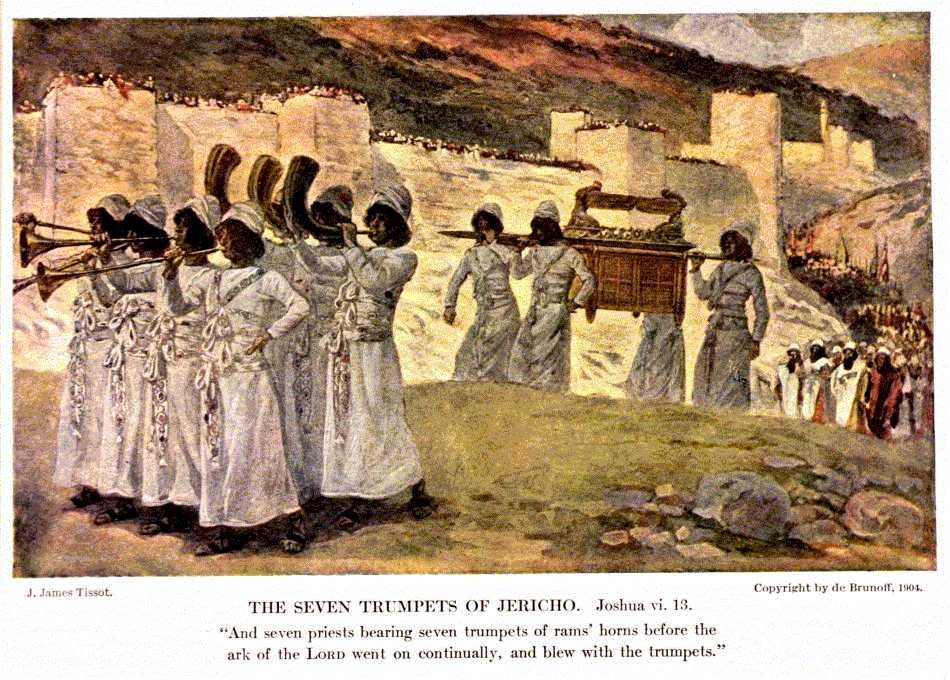 Source: 🔗 Wikimedia Commons, James Tissot, public domain. Western biblical artwork, not an Orthodox icon.
Spiritual Fruit 🍇
-
Some walls fall through obedient worship, not visible force. Jericho is not taken by ordinary military strength. The pattern is strange, repetitive, and liturgical. This exposes our impatience. We often want one dramatic act to break a stronghold, but God may prescribe humble repetition: prayer every morning, confession, fasting, silence instead of retaliation, showing up to liturgy, blessing the person we resent. Obedience may look ineffective until the wall falls.
-
Jericho names the fortified pride of the heart. Pride does not always appear as arrogance. It may look like defensiveness, refusal to apologize, spiritual self-protection, addiction to being right, or fear of being known. Jericho is shut up tightly. The soul can become like that. The Lord does not merely want to decorate our walls; He wants to bring down whatever keeps grace outside.
-
Rahab warns us not to decide too quickly who is inside mercy. The city falls, yet Rahab is preserved. This prevents a hard reading of judgment from becoming a hard heart. God judges evil without forgetting the trembling person who clings to mercy. In Church life, family life, and ministry, this means we must be serious about sin and still hopeful about people.
-
Do not rebuild what God has judged. The curse on rebuilding Jericho has a direct spiritual edge. After confession, repentance, or deliverance, the temptation is to quietly reconstruct the same old pattern. A person leaves resentment and then rebuilds it through old stories. A person confesses impurity and then rebuilds the same access points. A person escapes vanity and then rebuilds the audience. Jericho must not be rebuilt in the heart.
-
Mercy must become incorporation. Rahab is not merely spared; she is brought into Israel’s story. Christian mercy is not only rescue from danger. It is entrance into the people of God, into worship, discipline, healing, and communion. When the Church welcomes the repentant, she must not leave them standing outside the camp as permanent outsiders.
Summary Table
| Text | Literal focus | Spiritual and Christological reading |
|---|---|---|
| Joshua 6:1-5 | Jericho shut up; God gives the city before the action | The stronghold of pride is defeated first in divine promise |
| Joshua 6:6-14 | Procession, silence, and sacred trumpets | Patient obedience and worship shape spiritual warfare |
| Joshua 6:15-21 | The seventh-day shout and the city’s fall | God topples what human power cannot; judgment on hardened resistance |
| Joshua 6:22-25 | Rahab and her household saved alive | Gentile faith, scarlet-marked mercy, and incorporation into God’s people |
| Joshua 6:26-27 | Curse on rebuilding Jericho | Do not reconstruct what grace has already overthrown |
Closing Meditation
Jericho falls in a way meant to humble every boast except boasting in the Lord. The city is closed. Israel cannot negotiate its way in. The people cannot congratulate themselves for siegecraft. They walk, wait, keep silence, bear the Lord’s presence, and cry out only when commanded. Then the wall collapses. That pattern remains spiritually true. What most needs to fall in us often yields only when we stop trusting our own force and submit to the wisdom of God.
Yet the chapter is not only about collapse. It is also about distinction. Pride falls, but faith is spared. Rahab lives. The treasury is honored. The accursed thing is not to be touched. The chapter therefore teaches the discipline of holy separation. Not everything can be carried forward into inheritance. Some things must be left in ruins forever.
Teaching Notes
Whole-study teaching helps:
- Teach this chapter as both victory narrative and spiritual diagnosis. The title theme of pride is not decorative. It is central.
- Do not skip the difficulty of the destruction. State clearly that the Church does not receive Joshua 6 as a charter for Christian violence.
- Make much of the ark and the sacred trumpets. The chapter is about holy order under divine presence.
- Connect Rahab back to Joshua 2 so that the students see the continuity of promise and fulfillment.
- The line about not rebuilding Jericho is especially useful for pastoral application on relapse, recurring passions, and false repentance.
Joshua 6:1-5 - Jericho shut up and the Lord’s strange command
Ask: What stronghold are you trying to break with force rather than faithful obedience?
Emphasize: the first victory in the land is designed to humble human self-confidence.
Watch for: reducing the chapter to a lesson in positive thinking or military psychology.
Show: Show the Jericho artwork only after naming the pastoral guardrail: this is not spectacle, but obedience, judgment, and mercy held together.
Joshua 6:6-14 - Silent procession and patient obedience
- Ask: What repeated act of prayer or restraint is training your patience?
- Emphasize: obedience is not passive. It is disciplined participation in God’s action.
- Watch for: treating repetition in worship as meaningless simply because it is repeated.
Joshua 6:15-21 - The seventh day, the shout, and the hard text of judgment
- Ask: How do we face the violence honestly without making it a model for Christian action?
- Emphasize: the Church reads this as historical judgment and as a warning against sin, not as permission for Christian violence.
- Watch for: sentimentalizing the severity of the passage or, on the other side, glorifying violence as if that were the chapter’s spiritual meaning.
Joshua 6:22-25 - Rahab saved alive and joined to Israel
- Ask: What would it mean to welcome a repentant person into belonging rather than leave them outside?
- Emphasize: divine judgment never abolishes divine mercy toward faith.
- Watch for: speaking of Rahab as if her past identity were her final identity.
Joshua 6:26-27 - The curse on rebuilding Jericho
- Ask: What access point to an old sin have you begun to rebuild?
- Emphasize: repentance requires not only collapse of sin but refusal to reconstruct it.
- Watch for: treating the curse as superstition rather than covenant testimony.
Glossary
- Jericho: fortified oasis city in the Jordan valley, first great objective west of the river.
- Rahab / Raab: woman of Jericho whose faith and hospitality lead to the salvation of her household.
- Ark of the covenant: sign of the Lord’s presence and kingship among His people.
- Devoted / accursed thing: what is placed under ban and may not be seized for private use.
- Sacred trumpets: priestly instruments that mark the liturgical character of Jericho’s fall.
- Gilgal / Galgala: Israel’s nearby covenant base after crossing the Jordan.
Sources
Embedded Scripture is from Brenton’s English Septuagint (LXX).
Scripture: The Holy Bible, Brenton Septuagint, the chapters displayed above; NKJV for comparisons and New Testament references.
Leonard J. Greenspoon, NETS “Iesous,” pp. 174-176 and the corresponding chapter readings.
S. Holmes, Joshua: The Hebrew and Greek Texts (1914), the chapter-and-verse notes specified above.
St John Chrysostom, Homilies on Hebrews 27.3; St Cyril of Jerusalem, Catechetical Lecture 10.11; St John Cassian, Conferences 5.16-24.
St Maximus the Confessor, ascetical writings on the passions and their overthrow.
Coptic Reader, Church Consecration, Part 4; other placements qualified above.
Footnotes
-
Leonard J. Greenspoon, “Iesous: To the Reader,” A New English Translation of the Septuagint, pp. 174-176, official edition. ↩ ↩2 ↩3
-
S. Holmes, Joshua: The Hebrew and Greek Texts (Cambridge, 1914), chapter and verse notes cited in the text, public-domain edition. His proposed reconstructions are historical scholarly hypotheses, not established manuscript histories. ↩ ↩2
-
St John Cassian, Conferences, Conference 5.16-24, especially 5.23-24, translated Edgar C. S. Gibson, NPNF, Second Series, vol. 11, Conference 5. ↩
-
St Cyril of Jerusalem, Catechetical Lecture 10.11, translated Edwin Hamilton Gifford, NPNF, Second Series, vol. 7, Lecture 10. ↩
-
Coptic Reader, Special > Consecrations > Church > Part 4, Catholic Epistle James 2:14-26. ↩
-
St John Chrysostom, Homilies on Hebrews 27.1-3, NPNF, First Series, vol. 14, Homily 27. ↩