


This narration is from a previous version of the study and may include a combined recording of multiple chapters.
Joshua is the book of entering the promised rest. God fights for Israel, gives the land, and keeps His word; Israel must receive the gift, remember the Giver, and choose whom it will serve. The river can be crossed while the heart still wanders. This is why a book of fulfilled promise ends with a summons to faithfulness.
The leader who brings Israel in bears the Greek name Iesous, Jesus. His inheritance is real, but it is not the end of God’s promise. Hebrews 4:8 asks whether Joshua had given the final rest, and answers by pointing to the further day God still announces. Christians read this history without erasing Israel’s story: the crossing, the mercy shown to outsiders, the gift of a portion, and the struggle against idolatry open toward Christ, who brings His people into communion with God.
Historical and Scriptural Context
Joshua follows Deuteronomy. Moses has died, and the people stand east of the Jordan with a commission, a law, and a promise. The narrative moves from entry into Canaan to campaigns, tribal allotments, and the old leader’s final words. Its claim is not that Israel has become incapable of failure. It is that the Lord has not failed Israel.
Joshua’s formation began long before the first chapter. In Exodus 17:8-16 he leads the fight against Amalek while Moses’ hands are supported on the hill. He accompanies Moses toward the mountain (Exodus 24:13) and remains at the tabernacle (Exodus 33:11). Yet apprenticeship also includes correction: when he is jealous for Moses’ authority, Moses wishes that all the Lord’s people might be prophets (Numbers 11:28-29). The servant must learn to desire God’s gifts for others, not guard his master’s importance as though it were his own possession.
He is one of the faithful spies in Numbers 13-14. Later, Moses lays hands on the man in whom is the Spirit (Numbers 27:18-23); the succession is renewed in Deuteronomy 31:7-8, 23 and recalled in Deuteronomy 34:9. His courage has been formed through service, fidelity under pressure, and obedience to a word he did not invent. The opening command to be strong is addressed to this tested servant, not to a self-made conqueror.
St Justin Martyr reads Moses’ outstretched hands and Joshua’s leadership together as Christian typology: one bears the figure of the Cross, while the other bears the name Jesus (Dialogue with Trypho 111). The historical victory is not Christ’s Passion, but Justin sees both signs finding their fulfillment in the one Savior.1
Outline: entering, receiving, and keeping faith
The sixteen chapter studies follow four parts of the book:
| Part | Studies | Governing question |
|---|---|---|
| Entering the land, Joshua 1-5 | Joshua 1-2, Joshua 3-4, Joshua 5 | Will Israel follow the Lord who goes before it? |
| Taking the land, Joshua 6-12 | Joshua 6, Joshua 7-8, Joshua 9, Joshua 10, Joshua 11-12 | Can victory be received without prayerlessness, hidden sin, or pride? |
| Dividing the land, Joshua 13-21 | Joshua 13-14, Joshua 15, Joshua 16-17, Joshua 18-19, Joshua 20-21 | Will the gift become worship, mercy, and obedient life? This part ends with the declaration that not a word failed (21:43-45). |
| Keeping faith in the land, Joshua 22-24 | Joshua 22, Joshua 23, Joshua 24 | Will a settled people still cleave to the Lord? |
The studies use NKJV chapter and verse references. Thus the altar on Mount Ebal is studied in Joshua 7-8 as 8:30-35, although Brenton prints that passage after 9:2 as 9:2a-f. It is not read twice in this series.
Reading two ancient textual forms
The NKJV Old Testament translates the Masoretic Hebrew tradition, preserved in medieval witnesses such as the Aleppo and Leningrad codices. Brenton’s English Septuagint, first published in 1844, primarily follows the Greek of Codex Vaticanus, a fourth-century manuscript. The Hebrew manuscripts from which Joshua was translated into Greek were much older than the surviving medieval Hebrew codices. The two Joshua scrolls from Qumran, 4QJosh-a and 4QJosh-b, also belong to the evidence for the book’s early textual history; they do not supply a witness to every verse discussed here. Codex Sinaiticus does not preserve Joshua.
These are two ancient forms of the same book, not two rival accounts of God’s faithfulness. Leonard Greenspoon’s NETS introduction distinguishes translation decisions from differences that may already have existed in the translator’s Hebrew manuscript. He reports that most scholars explain many substantial differences through a different Hebrew source, while others give more weight to the Greek translator’s interpretive activity. The date and place of Joshua’s Greek translation are uncertain; NETS mentions a proposed mid-third-century BC date rather than establishing a precise Egyptian, second-century origin.2
Some variations are small changes of emphasis. Others shorten, expand, or rearrange a passage. The closing chapters contain especially striking differences: a notice about stone knives, a different sequence around Joshua’s death, and a longer ending that already opens toward Judges. Ville Mäkipelto argues that several of these differences preserve an earlier Hebrew edition behind the Greek; Johan Wildenboer surveys both the literary effects and disputed explanations of the closing chapter. Their proposals help us understand the evidence without pretending that every editorial step can be recovered.3
The Coptic Old Testament was translated from Greek, so the Septuagint belongs to the Church’s scriptural inheritance. English readers will also encounter the Hebrew-based NKJV. This series reads Brenton while following NKJV numbering so that those readers can find the same scene. Short notes before the readings explain significant differences, and lettered markers identify Greek material absent from the corresponding Hebrew passage: 15:59a, 21:42a-d, 24:31a, and 24:33a-b. A letter is a reading aid, not a claim that an addition is less worthy of attention.
The name: Joshua and Jesus
Numbers 13:16 records Moses’ renaming of Hoshea as Joshua. In Greek, Joshua is Iesous, the same name used for Jesus Christ. The New Testament itself uses Iesous for Joshua in Acts 7:45 and Hebrews 4:8; the English distinction between “Joshua” and “Jesus” helps identify the persons but hides the shared Greek name. Sirach 46:1 hears the saving significance of the name when it praises Jesus the son of Nave as “great according to his name”.
That shared name serves a real contrast. Joshua leads people into a temporary inheritance; Christ grants the eternal possession. Justin makes this distinction explicitly in Dialogue with Trypho 113, and St Cyril of Jerusalem connects Joshua’s Jordan beginning, the twelve, and Rahab’s deliverance to Christ in Catechetical Lecture 10.11.14 Typology recognizes a historical servant pointing beyond himself. It does not make him the incarnate Son or diminish Moses, whose faithful service prepared the people for this crossing.
Threads that run through Joshua
Rest given, rest still awaited. Rest is promised in 1:13, 15, tasted after war in 11:23 and 14:15, and declared in 21:44, 22:4, and 23:1. Yet possession does not make the heart faithful, and death still awaits the leader. Hebrews 3:7-4:11 therefore presses the promise into the present: hear God’s voice, refuse a hardened heart, and enter the rest still offered in Christ. St Augustine’s City of God 22.30 describes its final horizon as the perpetual Sabbath, where praise does not exhaust the soul.5
Stones that remember. Stones mark grace and judgment: the Jordan and Gilgal memorials (4:9, 20), stone knives at circumcision (5:2), the heaps over Achar and the king of Ai (7:26; 8:29), the written law (8:32), stones over the cave of the five kings (10:27), the altar of witness (22:34), and the stone that “has heard” the covenant words (24:26-27). They are not interchangeable symbols. Some remember deliverance; others prevent a people from treating rebellion as harmless. Beside them, 1 Peter 2:4-5 gives the Christian image of living stones built into a spiritual house.
Outsiders brought in. Rahab’s household is spared through faith and mercy (chapters 2 and 6). The Gibeonites enter through deceit, yet the oath Israel has sworn is kept, and their service is placed at the Lord’s altar (9:27). These stories prevent the reader from making ancestry the simple measure of belonging. The conquest book itself keeps a door open to those who turn toward Israel’s God.
The unfinished conquest. The land is given, but territories remain unpossessed and compromises persist (13:1, 13; 15:63; 16:10; 17:12-13; 18:3; 19:47). The story continues into Judges. St John Cassian applies the nations to vices in Conferences 5.16-24: the heart must recover the places where patience, chastity, courage, and humility should dwell. This is an ascetical interpretation, a reading about the soul’s healing, not a license to label living peoples enemies of God.6
Every word kept. The narrator’s verdict in 21:43-45 returns in Joshua’s farewell at 23:14. Solomon later makes the same confession at the Temple dedication (1 Kings 8:56). For Christians, the promise opens toward the Yes of God in Christ (2 Corinthians 1:20). Fidelity is the center; boasting is a distortion of it.
The stone knives carried to the end. The Greek notices link circumcision at Gilgal (5:2) to the knives stored in Joshua’s city (21:42d) and buried with him (24:31a). The MT lacks these later notices. Their continuity keeps covenant renewal in view even when the book is listing portions or describing graves. The meaning of the thread is explored in the relevant chapter studies rather than imposed on every stone in the book.
Geographical Significance ⛰️
- Shittim / Sattin: the gathering place east of the Jordan before the entry.
- The Jordan: the river crossed behind the ark, with priests standing until all have passed.
- Jericho: the first great confrontation west of the river, where judgment and Rahab’s deliverance stand together.
- Gilgal / Galgala: the camp of memorial, circumcision, and Passover.
- Mount Ebal and Mount Gerizim: the setting of the law, blessing, and curse, connecting possession to covenant obedience.
- Shiloh / Selo: the tabernacle’s center during allotment; Brenton also places the final covenant assembly there, where the NKJV has Shechem (24:1, 25). Wildenboer surveys both harmonizing and anti-Samaritan explanations of this disputed variant.3
- Shechem: the place of Joseph’s burial (24:32) in both textual forms, with memories reaching back to Abraham and Jacob.
The river, the camp, the sanctuary, and the allotments keep the gift concrete. God’s people do not learn fidelity in an imagined world. They must practice it where they eat, work, worship, and raise their children.
The Characters 👥
- The Lord: giver of the land, judge of evil, keeper of promise, and the true leader of Israel.
- Joshua son of Nun, Naue in Brenton: Moses’ servant and successor, formed by faithfulness before receiving authority.
- The priests and Levites: bearers of the holy things and servants of worship whose life is distributed among the tribes.
- Rahab: a woman of Jericho whose confession and mercy lead to deliverance and inclusion.
- Caleb: an old servant whose request for the mountain answers the temptation to leave the gift unpossessed.
- The tribes of Israel: recipients of promise who must learn to act together and remain faithful after victory.
- The Canaanite peoples: historical peoples of the land in a narrative of divine judgment; their names must never become labels for modern communities or conflicts.
Reading the hard texts
Joshua narrates killing, destruction, and the ban, the devotion of particular cities and goods to judgment. A truthful reading neither hides these things nor delights in slaughter. Scripture frames the judgment with God’s long patience: the promise to Abraham waits because the Amorites’ iniquity is not yet complete (Genesis 15:16). Leviticus 18:24-28 describes practices that defile the land, while Deuteronomy 9:4-5 warns Israel that the gift is not a reward for its own righteousness. The reader stands under warning with Israel, not above it.
Rahab and the Gibeonites belong inside that frame. Judgment does not make ethnicity an unbreakable sentence. The book narrates people from outside Israel spared and brought into its life. Neither the literal history nor its spiritual interpretation authorizes conquest in Christ’s name against any people today. Ephesians 6:12 names the Christian battle as one against spiritual powers, not flesh and blood.
Cassian’s Conferences 5.16 and 5.23-24 turns the struggle toward vices that occupy the heart and virtues that recover their rightful place.6 This reading makes the text harder to evade personally. It is easier to condemn a distant enemy than to surrender the resentment that has become useful, the desire for admiration that shapes one’s service, or the secret compromise defended as a small exception.
The hardening in Joshua 11:20 also requires care. Origen, considering Pharaoh in On First Principles III.1.10-11, compares God’s action to the same rain falling on cultivated and neglected soil, and to the same sun melting wax and hardening mud. The difference lies in the disposition that receives the action. His argument protects both God’s goodness and human responsibility: God does not manufacture evil in an innocent heart.7 The Joshua 11-12 study treats the particular verse alongside Augustine’s direct discussion.
Light from the Word 🕯️
Joshua 1:1-9 - Courage under the word
Before reading: wisdom and success. The NKJV speaks of prospering and good success in 1:7-8; Brenton includes prosperity in 1:8 but also repeats the call to be wise. The contrast is between the MT-based NKJV and the Greek tradition principally represented by Vaticanus in Brenton, not between a Hebrew text with no wisdom and a Greek text with no prosperity. Brown, Driver, and Briggs list both prudent action and success under the Hebrew verb sakal, explicitly citing Joshua 1:7-8 under the success sense; a choice between these related senses is therefore a plausible explanation of the Greek rendering, rather than evidence here of a different Hebrew edition. The wording lets the reader hear success through obedient understanding rather than worldly achievement.8 Both readings place the promise under meditation on and obedience to God’s law, so neither warrants a prosperity formula.2
1 And it came to pass after the death of Moses, that the Lord spoke to Joshua the son of Naue, the minister of Moses, saying, 2 Moses my servant is dead; now then arise, go over Jordan, thou and all this people, into the land, which I give them. 3 Every spot on which ye shall tread I will give it you, as I said to Moses. 4 The wilderness and Antilibanus, as far as the great river, the river Euphrates, and as far as the extremity of the sea; your coasts shall be from the setting of the sun. 5 Not a man shall stand against you all the days of thy life; and as I was with Moses, so will I also be with thee, and I will not fail thee, or neglect thee. 6 Be strong and quit thyself like a man, for thou shalt divide the land to this people, which I sware to give to your fathers. 7 Be strong, therefore, and quit thyself like a man, to observe and do as Moses my servant commanded thee; and thou shalt not turn therefrom to the right hand or to the left, that thou mayest be wise in whatsoever thou mayest do. 8 And the book of this law shall not depart out of thy mouth, and thou shalt meditate in it day and night, that thou mayest know how to do all the things that are written in it; then shalt thou prosper, and make thy ways prosperous, and then shalt thou be wise. 9 Lo! I have commanded thee; be strong and courageous, be not cowardly nor fearful, for the Lord thy God is with thee in all places whither thou goest.
Moses is dead, but God’s promise has not died. The new leader is commanded to cross and to remain under the word already entrusted to Israel. Courage begins with God’s presence and takes the shape of obedience. The detailed exposition belongs to Joshua 1-2; here the passage names the rule of the whole book: the receiver of the gift must remain a hearer of God’s word.
Joshua 21:43-45 - Not one good word failed
Before reading: the Greek keeps the stone knives in view. Immediately before this declaration, Brenton prints 21:42a-d, including Joshua’s portion at Thamnasachar and the storage of the knives used at Gilgal; the NKJV’s MT-based chapter has no corresponding addition. The Greek notice belongs to the Vaticanus-related tradition used by Brenton, and the corresponding notice about buried knives returns at 24:31a. Mäkipelto considers either additions to the Hebrew source behind the Greek or deliberate omissions from the Hebrew tradition behind the MT; among the proposed motives, he discusses preserving the final resting place of covenant objects and removing objects whose reverence could be regarded as idolatry (“The Four Deaths of Joshua,” pp. 227-229). These are competing editorial explanations, not a recovered history of the knives. Readers of the Coptic Greek-derived tradition meet a fuller chain of covenant remembrance, while both textual forms affirm God’s fulfillment in the verses below.3
43 So the Lord gave to Israel all the land which he sware to give to their fathers: and they inherited it, and dwelt in it. 44 And the Lord gave them rest round about, as he sware to their fathers: not one of all their enemies maintained his ground against them; the Lord delivered all their enemies into their hands. 45 There failed not one of the good things which the Lord spoke to the children of Israel; all came to pass.
The repeated subject is the Lord: He gives land, gives rest, and delivers the enemies. The knives notice keeps the people who receive this gift close to the covenant renewed before the campaigns began. Possession has a memory and an obligation. It cannot be detached from worship and made into the story of Israel’s greatness.
The rest is real and incomplete. Hebrews 4:8-9 keeps us from denying the gift or making it final. God’s faithfulness in a particular deliverance teaches us to trust Him for the promised inheritance death cannot take away.
Gems from the Fathers 💎
St Augustine describes the end of faithful life as rest in God, not an empty suspension of activity. Seeing, love, and praise become inexhaustible. His City of God 22.30 gives language to the hope beyond Joshua’s settled land: “There we shall rest and see, see and love, love and praise.”5 The Christian does not despise earthly blessings; he learns not to demand eternity from them.
Joshua 24:14-15 - A received gift calls for a chosen allegiance
Before reading: righteousness, justice, and holiness. The NKJV has “in sincerity and in truth” in 24:14 and ends Joshua’s household declaration without Brenton’s “for he is holy”; Brenton has “in righteousness and justice” and includes that final clause. The NKJV follows the Masoretic Hebrew, while Brenton represents the Vaticanus-related Greek tradition; NETS p. 194 also prints the holiness clause. The moral wording illustrates a translation difference, while the extra clause is a textual plus: Greenspoon’s discussion on pp. 174-175 warns that Greek differences may arise either from another Hebrew source or from interpretation, and does not establish the particular origin of this clause. The wording changes emphasis rather than the summons itself: the Greek makes God’s holiness the explicit reason for the household’s choice.2
14 And now fear the Lord, and serve him in righteousness and justice; and remove the strange gods, which our fathers served beyond the river, and in Egypt; and serve the Lord. 15 But if it seem not good to you to serve the Lord, choose to yourselves this day whom ye will serve, whether the gods of your fathers that were on the other side of the river, or the gods of the Amorites, among whom ye dwell upon their land: but I and my house will serve the Lord, for he is holy.
The book ends where covenant life must arrive: a concrete allegiance grounded in remembered grace. Israel can live in the land and still serve strange gods. “Righteousness and justice” makes the choice visible in ordinary conduct, while “for he is holy” prevents it from becoming a declaration of household self-sufficiency. Serving the Lord means receiving His holiness into the places where we speak, spend, work, forgive, and pray. The full scene is developed in Joshua 24.
The Church’s Voice in Worship ⛪
Consecration of a Church, Part 2: Coptic Reader appoints Joshua 3:7-4:9, following readings about the Levites carrying the holy things and preceding the ark’s arrival under David and the Temple readings. The rite’s Liturgy of the Word includes 1 Peter 2:1-10, and Part 4 includes Acts 7:44-56, whose verse 45 remembers the tabernacle brought in with Joshua. Read alongside this sequence, the crossing suggests a people gathered behind God’s presence and stones that teach the memory of grace. This is a reading of the rite’s arrangement, not an assertion that its rubric supplies that interpretation.9
This is the sole verse-addressed Joshua pericope in the current lectionary index. There is also an adapted text headed “Joshua from 1, 3” in the Great Thursday Lakkan, the service of blessing the waters. It summarizes the Jordan crossing rather than appointing Joshua 1-3 continuously. The Jordan’s connection to Theophany remains typology, not an appointment of a Joshua chapter there; the Theophany Lakkan reads Psalm 114:3, 5 (LXX 113:3, 5), remembering the sea’s flight and the Jordan’s turning back.9
Great Thursday, First Hour: Exodus 17:8-16 is read, bringing Joshua’s earlier fight and Moses’ raised hands into Holy Pascha. Third Sunday of Amshir, Liturgy Pauline Epistle: Hebrews 3:1-4:2 calls the worshiping people to hear God’s voice and refuse hardness of heart. Consecration of a Monk, Pauline Epistle: Ephesians 6:10-20 names the armor and spiritual battle. Read alongside Joshua, these passages bring formation, obedience, and the struggle for the heart into worship without turning the conquest into Christian violence.9
Synaxarium, Tout 4: the Church commemorates Joshua, the son of Nun. Paona 26: she commemorates the sun standing still through his prayers. These are commemorations, not claims that the whole book or chapter is appointed as a Scripture reading on those days.10
Iconography and Visual Teaching 🖼️
The ark, the Jordan, the memorial stones, the scarlet cord, and the altar of witness give the book a concrete visual vocabulary. Biblical art and schematics can help a reader notice these objects, but a modern illustration is not thereby an Orthodox icon or a historical map. The relationship chart below distinguishes the historical succession from the Christian reading that points toward Christ; it is not a complete genealogy.
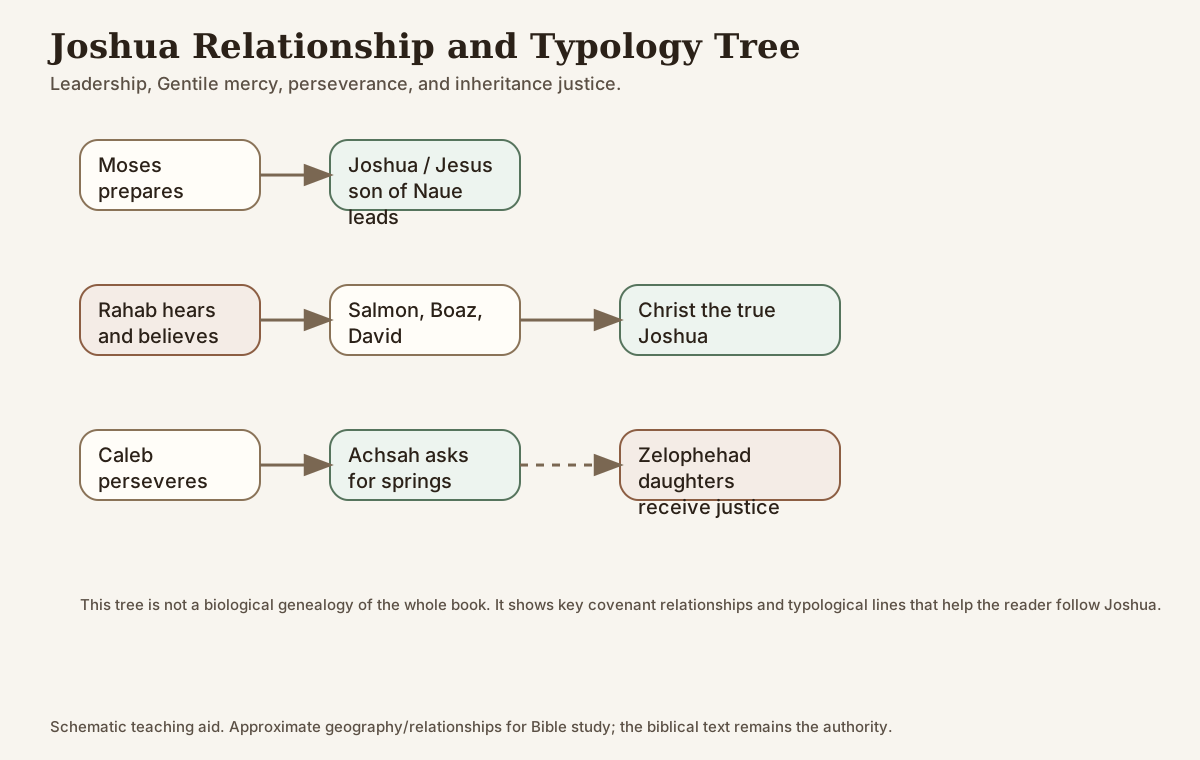 Schematic teaching aid, Orthodox Bible Study. Joshua-to-Christ rest typology is anchored in Hebrews 4.
Spiritual Fruit 🍇
-
Read Joshua as a book about grace that must be inhabited. The land is given before it is fully possessed. That matters for the Christian life. Baptism, chrismation, Eucharist, confession, Scripture, and the life of the Church are gifts before they are achievements. Yet a gift can remain neglected. Joshua asks the reader: what has God already given that I have not yet entered with obedience? The question is not abstract. It may be a neglected prayer rule, an unreconciled relationship, a confession postponed too long, or a spiritual responsibility in the home that has been left to someone else.
-
Let the conquest texts sober the heart, not harden it. The Church does not receive Joshua as permission for Christian violence. She receives it as a warning that evil is not harmless and that sin wants territory. The passions do not ask politely for a corner of the heart; they fortify themselves. Anger, lust, resentment, vanity, despair, control, and spiritual laziness all build little Jerichos. Joshua teaches that mercy is real, as Rahab shows, but it also teaches that compromise with destructive powers is not compassion.
-
Hold memory and decision together. Joshua is full of stones, altars, boundaries, names, inheritances, and final speeches because forgetfulness destroys covenant life. A family, parish, or soul that forgets the works of God soon begins to serve smaller gods. Make memory concrete: tell your children what God has done, keep feast days seriously, write down answered prayers, remember the saints, and return often to the story of your own deliverance.
-
Receive inheritance as service, not status. The tribes do not receive land so they can boast over one another. They receive a place from which to worship, obey, raise children, welcome the stranger, and live under God. The Christian version of inheritance is never private religious wealth. Whatever Christ gives us, peace, knowledge, stability, repentance, resources, family, or ministry, becomes a place from which we serve.
-
Choose the Lord again after the great crossing. Joshua warns that spiritual danger does not end after the Jordan. Sometimes the soul is most vulnerable after deliverance, when the pressure lifts and settled life begins. The book teaches vigilance after grace. The question is not only, “Did God bring me out?” It is also, “Will I serve Him now that I have room to forget Him?”
Summary Table
| Theme | Historical meaning in Joshua | Christian typology and spiritual fruit |
|---|---|---|
| Crossing | Israel follows the ark into the promised land | God’s presence goes first; baptism begins a life of obedience |
| Joshua’s leadership | Moses’ successor receives a commission already formed through service | Jesus brings the faithful into the final rest |
| Rahab and Gibeon | Outsiders are spared and receive a place among God’s people | Mercy forbids making ancestry a measure of salvation |
| Conquest and its incompleteness | Judgment is narrated honestly; tolerated enemies remain | The Christian battle is against sin and spiritual evil, never modern peoples |
| Allotment and refuge | Portions have boundaries, worship is near, and mercy has cities | Receive gifts as service and run toward Christ rather than hide |
| Covenant renewal | A settled people remembers and chooses | Faithfulness continues after deliverance |
| Rest | Real settlement follows conflict | God Himself is the final inheritance |
Closing Meditation
Joshua teaches that promise fulfilled is not the end of spiritual vigilance. The river can be crossed and the heart can still wander. The walls can fall and pride can still survive in subtler forms. The land can be given and gratitude can still wither. Therefore the book belongs to every stage of Christian life. It teaches us to remember that inheritance without holiness becomes judgment, but inheritance received with obedience becomes thanksgiving.
Teaching Notes
Whole-book guidance
- Distinguish the literal account, a located ancient Christian interpretation, and a contemporary application. None gives permission to apply conquest to a modern people.
- Read the book’s gifts together with its unfinished obedience. Avoid both boasting and despair.
- Explain the two textual forms without calling either an error. The notes identify actual differences and the limits of proposed explanations.
- Use the relationship chart for succession and typology, not geography. The omitted route schematic was a flowchart, not a map.
- Keep the Commander identification open; the Joshua 5 study presents the located alternatives pending a priestly ruling.
Joshua 1:1-9 - Courage under the word
- Ask: What responsibility frightens you because you have been measuring it only against your own strength?
- Emphasize: God’s presence, not Joshua’s talent, is the heart of the commission.
- Watch for: turning courage into self-help language or setting Joshua against Moses.
Joshua 21:43-45 - Not one good word failed
- Ask: Which answered prayer has become so ordinary that you have stopped giving thanks for it?
- Emphasize: God’s fulfilled promise leads to gratitude and worship; the Greek knives thread remembers covenant renewal.
- Watch for: denying historical fulfillment or treating it as the final rest promised in Christ.
Joshua 24:14-15 - A received gift calls for a chosen allegiance
- Ask: What change in your household would make its confession of the Lord visible this week?
- Emphasize: the choice is grounded in God’s prior gifts and His holiness.
- Watch for: using “choose this day” as a slogan detached from the chapter’s account of grace.
Glossary
- Iesous: the Greek name rendered Joshua for the son of Nun and Jesus for the incarnate Son; the persons remain distinct.
- Septuagint / LXX: the ancient Greek Old Testament tradition from which the Coptic Old Testament was translated.
- Masoretic text / MT: the Hebrew textual tradition translated in the NKJV Old Testament.
- Typology: reading real biblical persons and events as foreshadowings fulfilled in Christ, without erasing their historical sense.
- Rest: the land’s actual respite from war and the further promise of life in God considered by Hebrews.
- The ban: devotion to judgment in the narrative’s particular old-covenant setting, never a Christian mandate against living peoples.
Sources
Embedded Scripture is from Brenton’s English Septuagint (LXX). Chapter and verse references follow the NKJV unless a difference is identified.
Primary sources
- St Justin Martyr, Dialogue with Trypho 111, 113.
- St Cyril of Jerusalem, Catechetical Lecture 10.11.
- St John Cassian, Conferences 5.16-24, especially 5.23-24.
- St Augustine, City of God 22.30.
- Origen, On First Principles III.1.10-11.
Textual scholarship
- Leonard J. Greenspoon, “Iesous: To the Reader,” A New English Translation of the Septuagint, pp. 174-176; Joshua 24:14-15, p. 194.
- Ville Mäkipelto, “The Four Deaths of Joshua,” Hebrew Bible and Ancient Israel 6/2 (2017), pp. 224-229.
- Johan Wildenboer, “Joshua 24 in the LXX: Some Literary and Theological Remarks,” Journal for Semitics 25/2 (2016), pp. 492-498.
Coptic worship and pastoral reading
Coptic Reader, Church Consecration Parts 2 and 4 and Liturgy of the Word; Great Thursday First Hour and Lakkan; Theophany Lakkan; Consecration of a Monk; third Sunday of Amshir.
Coptic Synaxarium, Tout 4 and Paona 26.
Footnotes
-
St Justin Martyr, Dialogue with Trypho 111 and 113, translation of Marcus Dods and George Reith, text. ↩ ↩2
-
Leonard J. Greenspoon, NETS, Joshua introduction, pp. 174-176, and Joshua 24, p. 194, official text. ↩ ↩2 ↩3
-
Ville Mäkipelto, “The Four Deaths of Joshua” (2017), pp. 224-229, author-approved offprint; Johan Wildenboer, “Joshua 24 in the LXX” (2016), pp. 492-498, article. ↩ ↩2 ↩3
-
St Cyril of Jerusalem, Catechetical Lecture 10.11, Edwin Hamilton Gifford translation, text. ↩
-
St Augustine, City of God 22.30, Marcus Dods translation, text. ↩ ↩2
-
St John Cassian, Conferences 5.16-24, especially 5.23-24, C. S. Gibson translation, text. ↩ ↩2
-
Origen, On First Principles III.1.10-11, Frederick Crombie translation of the Rufinus Latin form, text. ↩
-
Brown, Driver, and Briggs, Hebrew and English Lexicon, entry שָׂכַל, Hiphil senses 5-6, with Joshua 1:7-8 under sense 6, entry. The Hebrew forms are shown in the Joshua 1:7 and 1:8 interlinear texts. ↩
-
Coptic Reader, Special > Consecrations > Church > Part 2, Part 4 and Liturgy of the Word; Holy Pascha > Great Thursday > First Hour and Liturgy of the Waters; Special > Lakkan > Theophany; Consecration of a Monk; annual readings, third Sunday of Amshir. ↩ ↩2 ↩3
-
Coptic Synaxarium, Tout 4, “The Commemoration of Joshua, the son of Nun”; Paona 26, commemoration of the sun standing still through the prayers of Joshua son of Nun. ↩