


This narration is from a previous version of the study and may include a combined recording of multiple chapters.
“How long will ye be slack?” Israel has crossed the Jordan and seen the land subdued, but seven tribes have still not received their portions. Joshua brings the unfinished task before the tabernacle at Shiloh. The gift must now be surveyed, written down, and received before the Lord. At the end, after the people have been served, Joshua receives his own city. Worship, diligence, and humble leadership hold these chapters together.
Historical and Scriptural Context
Judah and Joseph’s houses have received their principal western allotments. The remaining seven are Benjamin, Simeon, Zebulun, Issachar, Asher, Naphtali, and Dan. Shiloh in Ephraim becomes the gathering place at which the tabernacle stands and the lots are cast. The opening in 18:1 and the conclusion in 19:51 return to the same sanctuary, framing the distribution as a responsibility carried before God.
Shiloh later holds Hannah’s prayer and Samuel’s service (1 Samuel 1-3), but it also witnesses the loss of the ark (1 Samuel 4). Jeremiah 7:12-14 and Psalm 78:60 (LXX 77:60) remember its ruin. The sanctuary is a gift that calls for fidelity, not a guarantee that worshipers can safely ignore God’s word. Joshua’s rebuke belongs within that history: the presence of holy things does not make obedience unnecessary.
Geographical Significance ⛰️
- Shiloh / Selo: sanctuary center for the survey and remaining allotments.
- Benjamin: the middle portion between Judah and Joseph.
- Simeon: towns assigned within Judah’s larger inheritance.
- Zebulun, Issachar, Asher, and Naphtali: the northern allotments, including places later associated with Christ’s Galilean ministry.
- Dan: a western portion under pressure, followed by a conquest notice whose wording differs between Greek and Hebrew.
- Timnath-serah / Thamnasarach: Joshua’s requested city in Ephraim.
The Characters 👥
- The Lord: the giver before whom the portions are received.
- Joshua: the leader who names delay, directs the survey, and receives last.
- Eleazar and the family heads: responsible for the distribution before the Lord.
- The surveyors: representatives who turn an unfinished task into a written description.
- The seven remaining tribes: distinct families receiving places within one shared promise.
Light from the Word 🕯️
Joshua 18:1-10 - Shiloh, the tabernacle, and the rebuke of slackness
Before the reading. Brenton calls the sanctuary the “tabernacle of witness” in 18:1 and “tabernacle of testimony” in 19:51; the NKJV calls it the “tabernacle of meeting.” The Hebrew-based English stresses the appointed meeting place, while Brenton follows the Greek designation familiar from the Septuagint’s sanctuary language. This is a rendering difference rather than two separate sanctuaries: witness and testimony name the same tent at the beginning and end of these chapters. Greenspoon notes that Joshua’s Greek translators used the earlier Greek Pentateuch extensively, while also varying their vocabulary, so continuity with that translation is a safer explanation than a claim of a different sanctuary tradition.1 Both forms place the distribution before the Lord, with worship at the center of Israel’s shared life.
1 And all the congregation of the children of Israel were assembled at Selo, and there they pitched the tabernacle of witness; and the land was subdued by them.
2 And the sons of Israel remained, even those who had not received their inheritance, seven tribes. 3 And Joshua said to the sons of Israel, How long will ye be slack to inherit the land, which the Lord our God has given you? 4 Appoint of yourselves three men of each tribe, and let them rise up and go through the land, and let them describe it before me, as it will be proper to divide it. 5 And they came to him: and he divided to them seven portions, saying, Juda shall stand to them a border southward, and the sons of Joseph shall stand to them northward. 6 And do ye divide the land into seven parts, and bring the description hither to me, and I will give you a lot before the Lord our God. 7 For the sons of Levi have no part among you; for the priesthood of the Lord is his portion; and Gad, and Ruben, and the half tribe of Manasse, have received their inheritance beyond Jordan eastward, which Moses the servant of the Lord gave to them.
8 And the men rose up and went; and Joshua charged the men who went to explore the land, saying, Go and explore the land, and come to me, and I will bring you forth a lot here before the Lord in Selo. 9 And they went, and explored the land: and they viewed it, and described it according to the cities, seven parts in a book, and brought the book to Joshua. 10 And Joshua cast the lot for them in Selo before the Lord.
Joshua confronts delay and gives it a remedy. Three men from each tribe are to go through the land; their description becomes seven parts in a book; the lots are then cast at Shiloh. “In a book” is also present in the Hebrew-based account. It is a literal detail of ordered responsibility, not a special Septuagint doctrine. The rebuke becomes a task that can be undertaken.
Hebrews 4:11 calls Christians to diligence in entering God’s rest. Read alongside Joshua, that summons reveals how easily we substitute admiration of the promise for obedience to it. A household may agree that prayer matters while never giving it a time. A servant may want reconciliation while postponing the first conversation. The Lord’s gift deserves an answer in action.
Levi’s distinct portion also prevents us from reducing inheritance to property: “the priesthood of the Lord is his portion.” St Jerome applies the lot-and-portion language to clergy in Letter 52.5: the minister must possess the Lord and be possessed by Him.2 His concern is freedom from acquisitiveness, not permission to leave ministers without support. Service at the altar must remain service to the Lord rather than a means of securing advantage.
Joshua 18:11-20 - Benjamin receives a middle inheritance
11 And the lot of the tribe of Benjamin came forth first according to their families: and the borders of their lot came forth between the children of Juda and the children of Joseph.
12 And their borders were northward: the borders shall go up from Jordan behind Jericho northward, and shall go up to the mountain westward, and the issue of it shall be Bæthon of Mabdara. 13 And the borders will go forth thence to Luz, behind Luz, from the south of it; this is Bæthel: and the borders shall go down to Maatarob Orech, to the hill country, which is southward of Bæthoron the lower.
14 And the borders shall pass through and proceed to the part that looks toward the sea, on the south, from the mountain in front of Bæthoron southward, and its termination shall be at Cariath-Baal, this is Cariath-Jarin, a city of the children of Juda; this is the part toward the west.
15 And the south side on the part of Cariath-Baal; and the borders shall go across to Gasin, to the fountain of the water of Naphtho. 16 And the borders shall extend down on one side, this is in front of the forest of Sonnam, which is on the side of Emec Raphain northward, and it shall come down to Gæenna behind Jebusai southward: it shall come down to the fountain of Rogel. 17 And the borders shall go across to the fountain of Bæthsamys: 18 and shall proceed to Galiloth, which is in front by the going up of Æthamin; and they shall come down to the stone of Bæon of the sons of Ruben; and shall pass over behind Bætharaba northward, and shall go down to the borders behind the sea northward. 19 And the termination of the borders shall be at the creek of the salt sea northward to the side of Jordan southward: these are their southern borders.
20 And Jordan shall be their boundary on the east: this is the inheritance of the children of Benjamin, these are their borders round about according to their families.
Benjamin receives the first of the seven lots between Judah and Joseph. The border follows familiar places from the Jordan and Jericho toward Bethel, the hills, and the region of Jerusalem. Size alone tells us little about the importance of a portion: a middle territory can connect, shelter, and also bear pressure from its neighbors.
The spiritual lesson is modest but searching. A calling does not need to be conspicuous to be consequential. The person who quietly connects a family, welcomes a newcomer, or keeps a promise may hold together more than anyone notices. In Christ’s Body, members receive their place for the good of one another (1 Corinthians 12:12-27).
Joshua 18:21-28 - Benjamin’s cities, and Jerusalem named before its full possession
21 And the cities of the children of Benjamin according to their families were Jericho, and Bethegæo, and Amecasis, 22 and Bæthabara, and Sara, and Besana, 23 and Æein, and Phara, and Ephratha, 24 and Carapha, and Cephira, and Moni, and Gabaa, twelve cities and their villages: 25 Gabaon, and Rama, and Beerotha; 26 and Massema, and Miron, and Amoke; 27 and Phira, and Caphan, and Nacan, and Selecan, and Thareela, 28 and Jebus (this is Jerusalem); and Gabaoth, Jarim, thirteen cities, and their villages; this is the inheritance of the sons of Benjamin according to their families.
Benjamin’s towns include Jericho, Gibeon, Ramah, and Jebus, identified as Jerusalem. “Jebus (this is Jerusalem)” is not unique to the Greek; it helps both traditions’ readers recognize a city whose later story matters. Joshua 15:63 and Judges 1:21 show that being named within an inheritance did not mean that the city had already been fully possessed.
A calling can be genuine before it has matured. This gives hope to the person who sees how unfinished he is, but it also removes an excuse: the name we bear should become the life we live. Baptism begins a real life in Christ; it does not make watchfulness or repentance superfluous.
Joshua 19:1-9 - Simeon receives in the midst of Judah
1 And the second lot came out for the children of Symeon; and their inheritance was in the midst of the lots of the children of Juda. 2 And their lot was Beersabee, and Samaa, and Caladam, 3 and Arsola, and Bola, and Jason, 4 and Erthula, and Bula, and Herma, 5 and Sikelac, and Bæthmachereb, and Sarsusin, 6 and Batharoth, and their fields, thirteen cities, and their villages. 7 Eremmon, and Thalcha, and Jether, and Asan; four cities and their villages, 8 round about their cities as far as Balec as men go to Bameth southward: this is the inheritance of the tribe of the children of Symeon according to their families. 9 The inheritance of the tribe of the children of Symeon was a part of the lot of Juda, for the portion of the children of Juda was greater than theirs; and the children of Symeon inherited in the midst of their lot.
Simeon receives towns within Judah’s portion, because Judah’s allotment is larger than needed. The second tribe’s inheritance is real even though it is nested within another’s. Genesis 49:5-7 had foretold the scattering of Simeon and Levi. Here Simeon’s share lies within Judah; in Joshua 21, Levi will be spread through the tribes in cities of service. Their histories are distinct, but both show that a scattered portion need not erase a place among God’s people.
The Church’s common life likewise refuses the fiction that every person must be self-sufficient. Receiving support can be a form of humility, and sharing abundance can be obedience. A portion sheltered within another is still a portion to tend with gratitude.
Joshua 19:10-39 - The northern tribes receive their portions
10 And the third lot came out to Zabulon according to their families: the bounds of their inheritance shall be—Esedekgola shall be their border, 11 the sea and Magelda, and it shall reach to Bætharaba in the valley, which is opposite Jekman. 12 And the border returned from Sedduc in a contrary direction eastward from Bæthsamys, to the borders of Chaselothaith, and shall pass on to Dabiroth, and shall proceed upward to Phangai. 13 And thence it shall come round in the opposite direction eastward to Gebere to the city of Catasem, and shall go on to Remmonaa Matharaoza. 14 And the borders shall come round northward to Amoth, and their going out shall be at Gæphael, 15 and Catanath, and Nabaal, and Symoön, and Jericho, and Bæthman. 16 This is the inheritance of the tribe of the sons of Zabulon according to their families, these cities and their villages.
17 And the fourth lot came out to Issachar. 18 And their borders were Jazel, and Chasaloth, and Sunam, 19 and Agin, and Siona, and Reeroth, 20 and Anachereth, and Dabiron, and Kison, and Rebes, 21 and Remmas, and Jeon, and Tomman, and Æmarec, and Bersaphes. 22 And the boundaries shall border upon Gæthbor, and upon Salim westward, and Bæthsamys; and the extremity of his bounds shall be Jordan. 23 This is the inheritance of the tribe of the children of Issachar according to their families, the cities and their villages.
24 And the fifth lot came out to Aser according to their families. 25 And their borders were Exeleketh, and Aleph, and Bæthok, and Keaph, 26 and Elimelech, and Amiel, and Maasa, and the lot will border on Carmel westward, and on Sion, and Labanath. 27 And it will return westward from Bæthegeneth, and will join Zabulon and Ekgai, and Phthæel northwards, and the borders will come to Saphthæbæthme, and Inael, and will go on to Chobamasomel, 28 and Elbon, and Raab, and Ememaon, and Canthan to great Sidon. 29 And the borders shall turn back to Rama, and to the fountain of Masphassat, and the Tyrians; and the borders shall return to Jasiph, and their going forth shall be the sea, and Apoleb, and Echozob, 30 and Archob, and Aphec, and Raau. 31 This is the inheritance of the tribe of the sons of Aser according to their families, the cities and their villages.
32 And the sixth lot came out to Nephthali. 33 And their borders were Moolam, and Mola, and Besemiin, and Arme, and Naboc, and Jephthamai, as far as Dodam; and their goings out were Jordan. 34 And the coasts will return westward by Athabor, and will go out thence to Jacana, and will border on Zabulon southward, and Aser will join it westward, and Jordan eastward.
35 And the walled cities of the Tyrians, Tyre, and Omathadaketh, and Kenereth, 36 and Armaith, and Arael, and Asor, 37 and Cades, and Assari, and the well of Asor; 38 and Keroe, and Megalaarim, and Bætthame, and Thessamys. 39 This is the inheritance of the tribe of the children of Nephthali.
Zebulun, Issachar, Asher, and Naphtali receive their portions in sequence. Borders, cities, and villages take up most of the reading because the shared inheritance must be made concrete. Asher reaches toward Carmel, Sidon, Tyrian territory, and the sea; Naphtali’s borders join other northern tribes and the Jordan. Each tribe’s place belongs to the whole, rather than to a separate story of private gain.
Isaiah 9:1-2 names Zebulun and Naphtali in its promise of light, and Matthew 4:13-16 brings that promise into Christ’s ministry in Galilee. The allotment’s northern names now become the setting of the Gospel promise. Places that pass quickly through an allotment list later become places where people hear the Lord. He remembers more than our attention can hold.
Gems from the Fathers 💎
Origen speaks directly to readers who become weary of these names in Philocalia 12.1-2, an excerpt headed as from his twentieth Homily on Joshua. He compares Scripture’s nourishment with food whose benefit appears after it has been received: “Let us not then weary when we hear Scriptures which we do not understand.”3 His encouragement keeps patience joined to faith that inspired Scripture is profitable. It is not a requirement to find an allegory for every syllable. We can listen, seek understanding, and allow the names to remind us that God’s promise embraces ordinary places.
Joshua 19:40-48 - Dan’s troubled inheritance and the cost of difficult possession
Before the reading. NKJV 19:47 tells the conquest of Leshem and its renaming as Dan before the inheritance summary in 19:48; Brenton places the summary first and calls the conquered city “Lachis” and then “Lasendan.” Brenton also gives Amorite resistance and Ephraim’s imposition of tribute, material parallel to Judges 1:34-35, which is absent from the NKJV Joshua passage. Holmes’s notes on 19:47-48 survey two explanations, insertion of Judges material into Greek or retention of material removed from Hebrew, and favor the latter; that is his argued position, not a proved reconstruction.4 The unfamiliar Greek names and changed order belong to Brenton’s account; “Lachis” here does not establish that this was the southern city of Lachish, and Judges 18:27-29 identifies the northern city as Laish. The origin of those name forms remains uncertain, while both editions show a tribe facing a difficult inheritance.
40 And the seventh lot came out to Dan. 41 And their borders were Sarath, and Asa, and the cities of Sammaus, 42 and Salamin, and Ammon, and Silatha, 43 and Elon, and Thamnatha, and Accaron; 44 and Alcatha, and Begethon, and Gebeëlan, 45 and Azor, and Banæbacat, and Gethremmon. 46 And westward of Hieracon the border was near to Joppa. 47 This is the inheritance of the tribe of the children of Dan, according to their families, these are their cities and their villages: and the children of Dan did not drive out the Amorite who afflicted them in the mountain; and the Amorite would not suffer them to come down into the valley, but they forcibly took from them the border of their portion.
48 And the sons of Dan went and fought against Lachis, and took it, and smote it with the edge of the sword; and they dwelt in it, and called the name of it Lasendan: and the Amorite continued to dwell in Edom and in Salamin: and the hand of Ephraim prevailed against them, and they became tributaries to them.
Dan’s western portion is named, but the account immediately exposes pressure. In Brenton the Amorite confines the tribe to the mountain and restricts access to the valley. The ensuing conquest and continuing Amorite presence refuse to let an allotment list masquerade as a record of uncomplicated success.
Judges 18:27-29 continues Dan’s northern story and shows why this brief notice should not become simple praise of successful expansion. For our life, hardship calls for discernment rather than automatic conclusions about guilt or divine rejection. A difficult calling may require patient courage, and apparent escape can carry a cost we have not yet understood. Ancient warfare is not a model for treating contemporary peoples or neighbors as enemies.
Joshua 19:49-51 - Joshua receives last, before the Lord at Shiloh
49 And they proceeded to take possession of the land according to their borders, and the children of Israel gave an inheritance to Joshua the son of Naue among them, 50 by the command of God, and they gave him the city which he asked for, Thamnasarach, which is in the mount of Ephraim; and he built the city, and dwelt in it.
51 These are the divisions which Eleazar the priest divided by lot, and Joshua the son of Naue, and the heads of families among the tribes of Israel, according to the lots, in Selo before the Lord by the doors of the tabernacle of testimony, and they went to take possession of the land.
Joshua receives his own inheritance after the tribes have been served. He asks for a city, receives it by God’s command, builds it, and lives among his brethren. The final sentence returns to Shiloh and the tabernacle doors, completing the frame that opened in 18:1. The leader belongs within the shared gift, not above it.
“Receiving last can be holy leadership.” Read beside Mark 10:44, Joshua’s order offers a limited but beautiful anticipation of service: those who desire first place must become servants of all. Parents and parish servants need not despise their own needs, but they must resist the habit of securing their comfort before everyone else’s good. His city will be remembered at his burial in Joshua 24:30 and Judges 2:9, a home received after faithful labor.
The Church’s Voice in Worship 📖
Joshua 18-19 has no appointment in the current verse-addressed Coptic lectionary. At the Theophany Lakkan, Isaiah 9:1-2 is among the prophecies; the northern light promised there supplies a scriptural connection to Zebulun and Naphtali, not a reading of Joshua at Theophany. Psalm 16 (LXX 15) is prayed in the First Hour of the Agpeya, and verse 6 gives the inheritance a voice of thanksgiving. The Synaxarium commemorates Hannah on Baba 6 and Samuel on Paona 9, recalling the prayer and service that later took place at Shiloh.
Iconography and Visual Teaching 🖼️
The Shiloh schematic represents the survey and allotment process around the sanctuary. It is a teaching diagram, not a map or an icon.
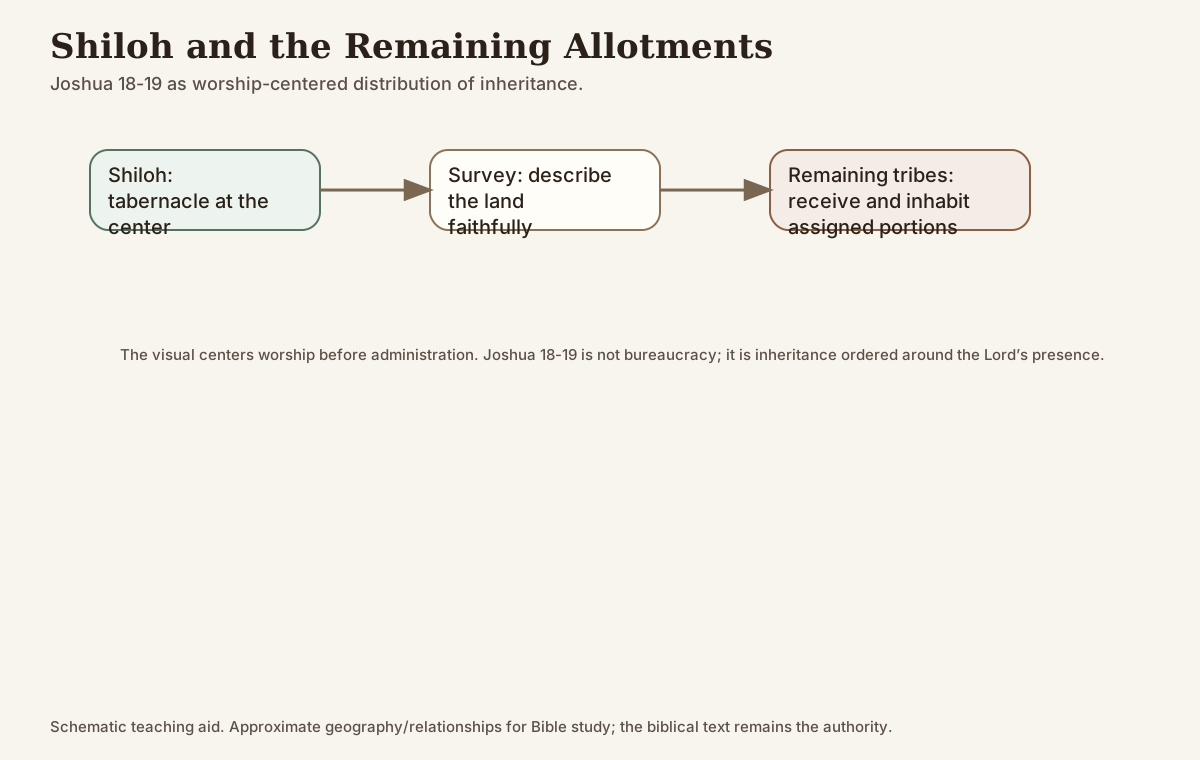 Source: Schematic teaching aid, Orthodox Bible Study. Worship-centered teaching aid for Joshua 18-19; schematic, not to scale.
Spiritual Fruit 🍇
-
Put worship at the center before organizing the rest of life. Shiloh comes before the remaining allotments are completed. This is not accidental. When worship is displaced, every other boundary becomes unstable. A household should not fit prayer and liturgy around everything else as leftovers. Put the tabernacle in the center: Sunday liturgy, confession, feast days, morning prayer, blessing before meals, icons, Scripture, and mercy.
-
Delay can become disobedience even when it looks harmless. Joshua asks, “How long will you be slack?” The tribes have not openly rebelled, but they have delayed entering what God gave. This is one of the most common spiritual dangers. We delay confession, delay reconciliation, delay serious prayer, delay serving, delay addressing a child’s spiritual need, delay forgiving. Delay feels neutral; Joshua names it.
-
Survey the land instead of living by vague intention. The remaining territory is written down before the Lord. The spiritual life also needs honest mapping. Where am I actually weak? Where is my home spiritually strong or thin? What habits shape my children? What triggers anger? What time of day destroys prayer? Vague guilt rarely heals. Truth written before God becomes a beginning of obedience.
-
Receiving last can be holy leadership. Joshua receives his own inheritance after the tribes. This is not passivity; it is servant leadership. Parents, priests, servants, and ministry leaders are often tempted to secure themselves first. Joshua shows another order: help others enter what God has given, then receive your portion without resentment.
Summary Table
| Text | Literal focus | Spiritual and Christological reading |
|---|---|---|
| Joshua 18:1-10 | Shiloh; delay rebuked; survey written | Worship gives obedience a concrete center |
| Joshua 18:11-20 | Benjamin’s middle territory | Hidden service can hold others together |
| Joshua 18:21-28 | Benjamin’s towns, including Jerusalem | Calling must become a lived holiness |
| Joshua 19:1-9 | Simeon’s portion within Judah | Shared abundance supports a real inheritance |
| Joshua 19:10-39 | Four northern tribes receive portions | Christ’s light reaches named places and forgotten lives |
| Joshua 19:40-48 | Dan under pressure; differing Greek account | Hardship requires discernment and courage |
| Joshua 19:49-51 | Joshua receives his city last | Leadership serves before securing its own comfort |
Closing Meditation
Return to Shiloh, where the book of surveyed land is brought before the Lord. Bring Him one task you have left in vague intention. Name it without making excuses, and ask for the grace to begin. Then look at Joshua receiving his city among the people he has served. A life ordered before God can receive its own portion without hurry or resentment.
Teaching Notes
Joshua 18:1-10 - Shiloh, the tabernacle, and the rebuke of slackness
- Ask: What gift of God are you still neglecting to possess, and what first step would give the answer a date?
- Emphasize: Joshua converts delay into survey, writing, and reception before God.
- Watch for: Confusing exhaustion or disability with refusal to obey.
Joshua 18:11-20 - Benjamin receives a middle inheritance
- Ask: Who holds people together through a service that is easily overlooked?
- Emphasize: A small territory may have a crucial place in common life.
- Watch for: Equating visible size with spiritual worth.
Joshua 18:21-28 - Benjamin’s cities, and Jerusalem named before its full possession
- Ask: How can a genuine calling remain unfinished without becoming unreal?
- Emphasize: The identifying phrase about Jerusalem belongs to both traditions.
- Watch for: Treating baptism as mature virtue already achieved.
Joshua 19:1-9 - Simeon receives in the midst of Judah
- Ask: What abundance could you share without treating the receiver as inferior?
- Emphasize: Genesis 49:5-7 connects, but does not collapse, Simeon’s and Levi’s histories.
- Watch for: Calling dependence a spiritual failure.
Joshua 19:10-39 - The northern tribes receive their portions
- Ask: How do Isaiah 9:1-2 and Matthew 4:13-16 change the way we hear Zebulun and Naphtali?
- Emphasize: Read all four tribes’ Scripture as one unit; give the Gospel connection without repeated generic allegory.
- Watch for: Assigning invented meanings to every town name.
Joshua 19:40-48 - Dan’s troubled inheritance and the cost of difficult possession
- Ask: When does seeking an easier situation need discernment rather than automatic approval?
- Emphasize: Holmes records debated explanations of the longer Greek account.
- Watch for: Locating Brenton’s Lachis in southern Judah or using warfare against present-day people.
Joshua 19:49-51 - Joshua receives last, before the Lord at Shiloh
- Ask: What would receiving after serving look like in your present responsibility?
- Emphasize: The conclusion returns to the sanctuary where the distribution began.
- Watch for: Using servant leadership to deny legitimate care to leaders.
Sources
Embedded Scripture is from Brenton’s English Septuagint (LXX). Chapter and verse headings follow NKJV numbering; lettered markers identify material present in Brenton beyond the corresponding Hebrew verse.
Brenton, Joshua 18 and Joshua 19; NKJV, Genesis 49:5-7; 1 Samuel 1-4; Jeremiah 7:12-14; Isaiah 9:1-2; Matthew 4:13-16; Mark 10:44; Hebrews 4:11.
Origen, Philocalia 12.1-2, trans. George Lewis (1911).
St Jerome, Letter 52.5.
Greenspoon, NETS Iesous, pp. 174-176; Holmes, Joshua: The Hebrew and Greek Texts, pp. 70-71.
Coptic Reader, Theophany Lakkan prophecies; Agpeya, First Hour; Coptic Synaxarium, Baba 6 and Paona 9.
Footnotes
-
Leonard J. Greenspoon, introduction to Iesous, A New English Translation of the Septuagint, pp. 174-176. Introduction and translation. ↩
-
St Jerome, Letter 52 to Nepotian, §5, NPNF, second series, vol. 6. Direct text. ↩
-
Origen, Philocalia 12.1-2, excerpt headed as from the twentieth Homily on Joshua, trans. George Lewis (1911), pp. 54-57. Direct text. The section numbers here belong to the Philocalia excerpt. ↩
-
S. Holmes, Joshua: The Hebrew and Greek Texts (1914), pp. 70-71, notes on 19:47-48. Edition. ↩