


This narration is from a previous version of the study and may include a combined recording of multiple chapters.
Mercy now has an address. Six cities stand open to the person who killed without intent, restraining vengeance until the congregation can judge. The Levitical cities place sacred service throughout the tribes, and the whole account closes with the narrator’s verdict: every good thing the Lord spoke came to pass. The gift of land must become a place where truth can be heard, mercy can be reached, and worship can enter ordinary life.
Historical and Scriptural Context
Joshua 20 enacts the refuge law given through Moses, especially Numbers 35:9-34 and Deuteronomy 19:1-13. It distinguishes an unintentional killing from murder without making the loss of life trivial. Joshua 21 then enacts the provision for Levitical cities and pasturelands in Numbers 35:1-8. At Shiloh, the Levites appeal to God’s command and receive places among the other tribes rather than one continuous territory.
Refuge cities reappear within the Levitical list. Hebron, Caleb’s hard-won mountain, becomes both a priests’ city and a shelter for the pursued slayer, while the surrounding fields and villages remain with Caleb’s family. The final statement of fulfillment gathers the allotments into thanksgiving. Earlier failures of possession remain honestly recorded; they do not turn God’s faithfulness into a failure. Hebrews 4:8-9 will look beyond Joshua’s historical rest to the rest still promised by God.
Geographical Significance ⛰️
- Kedesh, Shechem, and Hebron: the three western refuge cities in Naphtali, Ephraim, and Judah.
- Bezer / Bosor, Ramoth, and Golan / Gaulon: the eastern cities in Reuben, Gad, and Manasseh.
- Shiloh / Selo: sanctuary center where the Levites request their cities.
- The forty-eight Levitical cities: places of sacred service within Israel’s common inheritance.
- Joshua’s Thamnasachar: in Brenton’s additional notice, the city that receives the stone knives.
The Characters 👥
- The Lord: giver of refuge and fulfiller of the promise.
- Joshua, Eleazar, and the family heads: those responsible for carrying the commands into settled life.
- The congregation: the people before whom the slayer’s case must be judged.
- The avenger of blood: the family representative whose claim is restrained by the refuge law.
- The unintentional slayer: protected from immediate vengeance while still accountable for the killing.
- The Levites and sons of Aaron: sacred servants receiving cities among the tribes, with Aaron’s sons having the priestly portion.
- The stranger: included with Israel in the law’s protection.
Light from the Word 🕯️
Joshua 20:1-3 - The Lord appoints refuge against blood vengeance
Before the reading. The NKJV’s Joshua 20:4-6 gives the hearing at the city gate, protection from the avenger, and residence until judgment and the high priest’s death; Brenton moves from verse 3 to verse 7. Brenton’s shorter Greek form nevertheless retains public judgment in verse 3, and the law of release at the high priest’s death is present in Greek Numbers 35:25-28. Greenspoon identifies the shorter Joshua chapter as a major difference between the Hebrew and Greek traditions; Holmes argues that the longer material was not before the Greek translator.1 A different Hebrew form behind the translation is therefore a located scholarly explanation, while the exact stages of expansion remain debated. Readers of both traditions encounter protection and judgment, but a reader of Brenton must turn to Numbers for the release law rather than imagine that it is quoted here.
1 And the Lord spoke to Joshua, saying, 2 Speak to the children of Israel, saying, Assign the cities of refuge, of which I spoke to you by Moses. 3 Even a refuge to the slayer who has smitten a man unintentionally; and the cities shall be to you a refuge, and the slayer shall not be put to death by the avenger of blood, until he have stood before the congregation for judgment.
The law does not abolish the seriousness of bloodshed, but it refuses to let vengeance rule unexamined. The manslayer who killed unintentionally must flee quickly, and the congregation must judge the case. Justice is neither denied nor privatized.
The congregation’s judgment matters because the bereaved family’s anger cannot by itself establish whether the killing was intentional. Shelter protects the possibility of a true hearing. The difference between refuge and immunity is vital: the law makes room for judgment rather than allowing fear to pronounce sentence first.
The death of the anointed high priest. Numbers 35:25-28 adds a limit to the slayer’s stay: he remains until the death of the high priest anointed with holy oil, then returns to his possession. The Greek verb for anointing belongs to the word-family of Christos, “Anointed One.” This lexical connection helps a Christian reading but does not itself identify the priest with Jesus. Hebrews 6:18-20 places those who have fled for refuge beside Jesus, the High Priest forever; it does not explicitly declare this release law a type of His death.
Read as Christian typology, the law points toward Christ, whose willing death opens the way home. St Ambrose gives a located witness in Flight from the World 9.55-57: he joins the higher city of refuge to Christ’s once-for-all death, baptism into His death and resurrection, and the crucifixion of the old man so that we no longer serve sin.2 His reading does not repeat Christ’s historical sacrifice. We participate in the saving death He truly endured for us according to the flesh. Refuge in Christ becomes a life of repentance and resurrection, not permission to remain unchanged.
This application must preserve the literal distinction in Joshua. An unintentional slayer is not simply a concealed murderer; nor may Christian forgiveness become a means of hiding violence or preventing lawful protection of the vulnerable. Mercy shelters truthful return and calls harm by its name.
Joshua 20:7-9 - Refuge is spread through the land, and the stranger is included
7 And Joshua separated Cades in Galilee in the mount Nephthali, and Sychem in the mount Ephraim, and the city of Arboc; this is Chebron, in the mountain of Juda.
8 And beyond Jordan he appointed Bosor in the wilderness in the plain out of the tribe of Ruben, and Aremoth in Galaad out of the tribe of Gad, and Gaulon in the country of Basan out of the tribe of Manasse.
9 These were the cities selected for the sons of Israel, and for the stranger abiding among them, that every one who smites a soul unintentionally should flee thither, that he should not die by the hand of the avenger of blood, until he should stand before the congregation for judgment.
The six cities are placed on both sides of the Jordan. Refuge is available within the western allotments and within the eastern inheritance, rather than reserved for those nearest the sanctuary. The stranger dwelling among Israel receives the same protection and stands before the same judgment.
This geography gives mercy a practical test. A protection that exists only in principle is of little use to someone who cannot reach it. In the Church, care must be accessible to the newcomer, the poor, and the person ashamed to ask. Christ’s mercy is not a private possession of the influential. Ephesians 2:18-19 speaks of access to the Father through Him and of those once strangers becoming members of God’s household.
Joshua 21:1-8 - The Levites ask for their cities, and Israel gives by command of the Lord
1 And the heads of the families of the sons of Levi drew near to Eleazar the priest, and to Joshua the son of Naue, and to the heads of families of the tribes of Israel. 2 And they spoke to them in Selo in the land of Chanaan, saying, The Lord gave commandment by Moses to give us cities to dwell in, and the country round about for our cattle. 3 So the children of Israel gave to the Levites in their inheritance by the command of the Lord the cities and the country round.
4 And the lot came out for the children of Caath; and the sons of Aaron, the priests the Levites, had by lot thirteen cities out of the tribe of Juda, and out of the tribe of Symeon, and out of the tribe of Benjamin.
5 And to the sons of Caath that were left were given by lot ten cities, out of the tribe of Ephraim, and out of the tribe of Dan, and out of the half tribe of Manasse.
6 And the sons of Gedson had thirteen cities, out of the tribe of Issachar, and out of the tribe of Aser, and out of the tribe of Nephthali, and out of the half tribe of Manasse in Basan.
7 And the sons of Merari according to their families had by lot twelve cities, out of the tribe of Ruben, and out of the tribe of Gad, and out of the tribe of Zabulon.
8 And the children of Israel gave to the Levites the cities and their suburbs, as the Lord commanded Moses, by lot.
The Levites do not seize land. They draw near, appeal to the command already given through Moses, and receive what the Lord assigned. Their inheritance is distributive rather than concentrated. They dwell among the tribes.
Levi’s scattering, foretold with Simeon’s in Genesis 49:5-7, now takes a form of service. Deuteronomy 33:8-11 speaks of Levi teaching God’s judgments and serving at His altar. The land is therefore not fully ordered by property alone: provision must also be made for the ministry that keeps worship and the word near the people.
Gems from the Fathers 💎: The Lord as portion
St Jerome’s Letter 52.5 brings the lot-and-portion language into Christian clerical life. A minister must live according to the belonging his name expresses: “must so bear himself as to possess the Lord and to be possessed by Him.”3 Jerome’s surrounding counsel rejects acquisitiveness and welcomes poor people and strangers to the table. His use of Levi therefore searches the minister’s heart rather than flattering his status. A sacred office is fruitful when the Lord, not advantage, is its portion.
Joshua 21:9-19 - The sons of Aaron receive cities, and Hebron becomes priestly refuge
9 And the tribe of the children of Juda, and the tribe of the children of Symeon, and part of the tribe of the children of Benjamin gave these cities, and they were assigned 10 to the sons of Aaron of the family of Caath of the sons of Levi, for the lot fell to these. 11 And they gave to them Cariatharboc the metropolis of the sons of Enac; this is Chebron in the mountain country of Juda, and the suburbs round it. 12 But the lands of the city, and its villages Joshua gave to the sons of Chaleb the son of Jephonne for a possession.
13 And to the sons of Aaron he gave the city of refuge for the slayer, Chebron, and the suburbs belonging to it; and Lemna and the suburbs belonging to it; 14 and Ælom and its suburbs; and Tema and its suburbs; 15 and Gella and its suburbs; and Dabir and its suburbs; 16 and Asa and its suburbs; and Tany and its suburbs; and Bæthsamys and its suburbs: nine cities from these two tribes. 17 And from the tribe of Benjamin, Gabaon and its suburbs; and Gatheth and its suburbs; 18 and Anathoth and its suburbs; and Gamala and its suburbs; four cities. 19 All the cities of the sons of Aaron the priests, thirteen.
The Aaronic priests receive cities from Judah, Simeon, and Benjamin, with Hebron explicitly named as a city of refuge. The text holds together several layers of memory: Caleb’s inheritance, patriarchal associations, priestly presence, and legal mercy.
Verse 12 makes an important distinction: the city’s fields and villages remain Caleb’s family’s possession, while Hebron itself and its surrounding provision serve the priests. Courage that once faced the Anakim now bears fruit in a place of refuge. The mountain is no longer only a memory of victory; it provides shelter and sacred service.
Christian mercy also needs forms that can be reached: confession, prayer, wise counsel, material help, and protection when someone is in danger. Christ remains the Savior; His servants must never make themselves indispensable in His place. Yet neither should they offer an abstract promise of care while refusing the concrete labor through which a wounded person can actually receive it.
Joshua 21:20-33 - The remaining Levites are spread among the tribes, and refuge remains near
20 And to the families, even the sons of Caath the Levites, that were left of the sons of Caath, there was given their priests’ city, 21 out of the tribe of Ephraim; and they gave them the slayer’s city of refuge, Sychem, and its suburbs, and Gazara and its appendages, and its suburbs; 22 and Bæthoron and its suburbs: four cities: 23 and of the tribe of Dan, Helcothaim and its suburbs; and Gethedan and its suburbs: 24 and Ælon and its suburbs; and Getheremmon and its suburbs: four cities. 25 And out of the half tribe of Manasse, Tanach and its suburbs; and Jebatha and its suburbs; two cities. 26 In all were given ten cities, and the suburbs of each belonging to them, to the families of the sons of Caath that remained.
27 And Joshua gave to the sons of Gedson the Levites out of the other half tribe of Manasse cities set apart for the slayers, Gaulon in the country of Basan, and its suburbs; and Bosora and its suburbs; two cities. 28 And out of the tribe of Issachar, Kison and its suburbs; and Debba and its suburbs; 29 and Remmath and its suburbs; and the well of Letters, and its suburbs; four cities. 30 And out of the tribe of Aser, Basella and its suburbs; and Dabbon and its suburbs; 31 and Chelcat and its suburbs; and Raab and its suburbs; four cities. 32 And of the tribe of Nephthali, the city set apart for the slayer, Cades in Galilee, and its suburbs; and Nemmath, and its suburbs; and Themmon and its suburbs; three cities. 33 All the cities of Gedson according to their families were thirteen cities.
The remaining Kohathites and the Gershonites receive cities among the other tribes. Shechem, Golan, and Kedesh appear as places set apart for slayers within this distribution. The recurring city names make the relation between refuge and Levitical life visible: the map of mercy is woven into the map of sacred service.
The Levites are among the people, not beyond their ordinary concerns. For Christian life, this suggests a remembrance of worship that reaches home, work, and family decisions. Prayer at the altar should make us more truthful at the table, more merciful in an argument, and more attentive to a neighbor’s need. Holy service fails its purpose when it leaves the rest of life untouched.
Joshua 21:34-42 - The Merarites complete the Levitical network in the midst of Israel
Before the reading. The NKJV proceeds from the suburbs of the Levitical cities at 21:42 to the summary of fulfilled promise; Brenton also gives 21:42a-d, closing the division, retelling Joshua’s receipt of Thamnasachar, and placing the stone knives there. This Greek material repeats Joshua’s portion already given in 19:49-50 and joins it to the circumcision at Gilgal in Joshua 5 and the knives buried with Joshua in Brenton 24:31a. Greenspoon singles out 21:42d and 24:31a among the substantial Greek additions and explains that many scholars understand larger differences as reflecting a different Hebrew text behind the Greek, while others allow more interpretive activity in the Greek tradition.4 That supports an edition-level explanation without establishing the origin of every clause or identifying the reading of all manuscripts. The lettered markers make the Greek’s covenant-memory thread visible without changing Brenton’s words.
34 And to the family of the sons of Merari the Levites that remained, he gave out of the tribe of Zabulon, Maan and its suburbs; and Cades and its suburbs, 35 and Sella and its suburbs: three cities. 36 And beyond Jordan over against Jericho, out of the tribe of Ruben, the city of refuge for the slayer, Bosor in the wilderness; Miso and its suburbs; and Jazer and its suburbs; 37 and Decmon and its suburbs; and Mapha and its suburbs; four cities. 38 And out of the tribe of Gad the city of refuge for the slayer, both Ramoth in Galaad, and its suburbs; Camin and its suburbs; 39 and Esbon and its suburbs; and Jazer and its suburbs: the cities were four in all. 40 All these cities were given to the sons of Merari according to the families of them that were left out of the tribe of Levi; and their limits were the twelve cities.
41 All the cities of the Levites in the midst of the possession of the children of Israel, were forty-eight cities, 42 and their suburbs round about these cities: a city and the suburbs round about the city to all these cities: 42a and Joshua ceased dividing the land by their borders: 42b and the children of Israel gave a portion to Joshua because of the commandment of the Lord: they gave him the city which he asked: they gave him Thamnasachar in mount Ephraim; 42c and Joshua built the city, and dwelt in it: 42d and Joshua took the knives of stone, wherewith he circumcised the children of Israel that were born in the desert by the way, and put them in Thamnasachar.
The Merarites’ cities complete the distribution, and the narrator totals forty-eight cities within Israel’s possession. The text holds together a common inheritance and distinct forms of service. The land belongs to a people whose life requires more than each family securing its own advantage.
The additional Greek notice then turns to Joshua’s city and the stone knives. The allotment closes by remembering the covenant renewal with which life in the land began. A home is received, but a holy memory is also laid up there. Spiritually, stable life can remember the grace that made its beginning possible: baptism, forgiveness received, a reconciliation that seemed impossible. Comfort becomes dangerous when it forgets its source.
Joshua 21:43-45 - The Lord fulfills every good promise and gives rest
43 So the Lord gave to Israel all the land which he sware to give to their fathers: and they inherited it, and dwelt in it. 44 And the Lord gave them rest round about, as he sware to their fathers: not one of all their enemies maintained his ground against them; the Lord delivered all their enemies into their hands. 45 There failed not one of the good things which the Lord spoke to the children of Israel; all came to pass.
The Lord gave the land, gave rest, delivered the enemies, and fulfilled every good word. The repeated subject is the Lord. This is a verdict on His fidelity, not a claim that every tribe has already obeyed perfectly. Joshua 23:14 will repeat it; Solomon proclaims the same certainty at the Temple dedication in 1 Kings 8:56. The record of unfinished obedience makes thanksgiving more truthful, not less necessary.
Hebrews 4:8-9 teaches that Joshua’s rest was real but not final. In Christ the promises of God are “Yes” (2 Corinthians 1:20), and the rest already tasted becomes hope for a life no longer threatened by death. Christian longing grows from fulfilled mercy, rather than from suspicion that God has forgotten His word.
Gems from the Fathers 💎: The Sabbath without evening
St Augustine describes the final rest in City of God 22.30. The redeemed celebrate Christ’s grace and receive a Sabbath that has no evening. His closing words give hope its proper direction: “There we shall rest and see, see and love, love and praise.”5 This is a thematic witness to final rest, not Augustine’s direct commentary on Joshua 21. The promise of unending communion frees us to receive present rest gratefully without demanding that it be heaven already.
The Church’s Voice in Worship 📖
Joshua 20-21 has no appointment in the current verse-addressed Coptic lectionary. The Agpeya prays Psalm 46 (LXX 45) in the Third Hour and Psalm 91 (LXX 90) in the Sixth Hour and the first watch of the Midnight Prayer. These psalms give refuge a daily language of trust, rather than an assignment of Joshua itself.
At the Consecration of a Church, Part 2, 1 Kings 8:22-61 is read in the same sequence that includes Joshua 3:7-4:9. Solomon’s declaration in 8:56 that God’s good promise has not failed makes a fitting worship connection to Joshua 21:45. The Synaxarium also commemorates the departure of Aaron the priest on Baramouda 1, joining the priestly names in this chapter to the Church’s remembrance.
Iconography and Visual Teaching 🖼️
The reconstructed cities-of-refuge map shows the six shelters on both sides of the Jordan. Their distribution makes the provision for mercy easier to see; the map is a teaching reconstruction rather than an ancient survey.
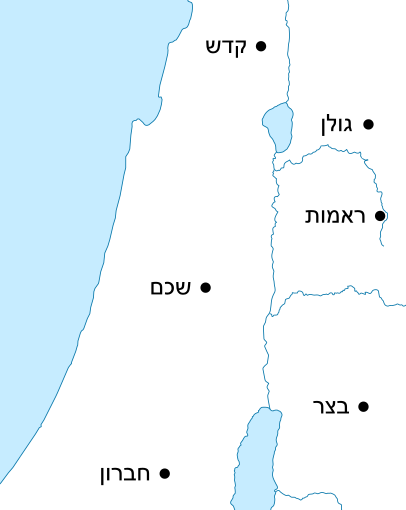 Source: 🔗 Wikimedia Commons, User:Agbad; derivative work Oriaaaass, CC BY-SA 3.0. Reconstructed teaching map, not an ancient-period map.
Spiritual Fruit 🍇
-
Run to Christ as refuge before shame teaches you to hide. The cities of refuge are not sentimental; they exist because blood has been shed and danger is real. Christ our Refuge does not pretend sin, harm, or consequence are imaginary. He gives a place where the pursued soul can be judged truthfully and protected from destruction. In practice, this means run to confession quickly. Do not let shame become your avenger.
-
Mercy needs order. The refuge law makes protection and truthful judgment work together. Christian mercy also needs counsel, repentance, restitution where possible, and protection for the vulnerable. A family that confuses mercy with avoidance will not heal wounds. A community that confuses justice with revenge will crush souls. Keep both the need for shelter and the need for truth before you.
-
The Levites remind us that worship must be distributed through daily life. Levi does not receive one isolated religious zone. Levitical presence is scattered through Israel. The Christian version is clear: prayer cannot remain trapped inside church walls. The home, workplace, car, table, calendar, phone, and bank account all need priestly presence. Bring blessing into ordinary geography.
-
Promise fulfilled should produce humility, not spiritual laziness. Joshua 21 says the Lord gave, gave rest, delivered, and fulfilled. The emphasis is God’s faithfulness. When God answers prayer or stabilizes a family, the temptation is to relax into forgetfulness. Fulfillment should deepen gratitude and obedience. The right response to rest is not complacency; it is worship.
-
Become a refuge for others without pretending to be the Savior. Christians are not Christ, but His mercy should make our homes and churches safer places for truthful return. Be the kind of person before whom someone can say, “I sinned,” without being destroyed, manipulated, or gossiped about. Refuge is one of the clearest ways the Church images her Lord.
Summary Table
| Text | Literal focus | Spiritual and Christological reading |
|---|---|---|
| Joshua 20:1-3 | Refuge appointed; congregation judges | Christ our Refuge and High Priest makes truthful return possible |
| Joshua 20:7-9 | Six cities open also to the stranger | Mercy must be accessible and impartial |
| Joshua 21:1-8 | Levites receive commanded cities | Sacred service belongs within common life |
| Joshua 21:9-19 | Hebron serves priests and slayers | Courage bears fruit in a place of mercy |
| Joshua 21:20-33 | Levitical cities across the tribes | Worship should reach daily conduct |
| Joshua 21:34-42 | Forty-eight cities; Greek knives notice | Settlement remembers covenant grace |
| Joshua 21:43-45 | Every good word fulfilled; rest given | God’s faithfulness grounds hope for final rest |
Closing Meditation
Picture the road to a city whose gate is open to the pursued. Then bring before Christ what shame has told you to conceal. His refuge holds truth and mercy together, and His willing death has opened the way home. Remain with Him long enough for the old life to lose its mastery. The Lord who has kept His word can be trusted with the rest you have not yet seen.
Teaching Notes
Joshua 20:1-3 - The Lord appoints refuge against blood vengeance
- Ask: How does shelter make a true judgment possible rather than unnecessary?
- Emphasize: Numbers 35 supplies the high-priest release law absent from Brenton Joshua 20.
- Watch for: Calling the unintentional slayer a murderer; hiding abuse under Christian mercy.
Joshua 20:7-9 - Refuge is spread through the land, and the stranger is included
- Ask: Who finds it difficult to reach the help our community says it offers?
- Emphasize: The stranger shares the same protection and judgment.
- Watch for: Making access dependent on status or familiarity.
Joshua 21:1-8 - The Levites ask for their cities, and Israel gives by command of the Lord
- Ask: What does it mean for a minister to have the Lord, rather than advantage, as his portion?
- Emphasize: Distinguish Aaronic priests from the wider Levitical families.
- Watch for: Using Jerome to excuse neglect of clergy’s actual needs.
Joshua 21:9-19 - The sons of Aaron receive cities, and Hebron becomes priestly refuge
- Ask: How does Caleb’s inheritance become fruitful for others without simply disappearing?
- Emphasize: The text distinguishes the city from Caleb’s fields and villages.
- Watch for: Making a priest or counselor a substitute for Christ.
Joshua 21:20-33 - The remaining Levites are spread among the tribes, and refuge remains near
- Ask: What decision outside church needs to become more faithful to what you pray at the altar?
- Emphasize: The names preserve the overlap of refuge and Levitical service.
- Watch for: Treating prayer as an exemption from practical justice.
Joshua 21:34-42 - The Merarites complete the Levitical network in the midst of Israel
- Ask: Which beginning of grace should your present stability remember?
- Emphasize: Display all four lettered markers without altering words or punctuation.
- Watch for: Claiming every Greek manuscript has the same additions.
Joshua 21:43-45 - The Lord fulfills every good promise and gives rest
- Ask: How can gratitude for real rest coexist with longing for the final rest?
- Emphasize: God’s fidelity and incomplete human obedience are not the same claim.
- Watch for: Demanding that current sacramental life already remove every trial.
Sources
Embedded Scripture is from Brenton’s English Septuagint (LXX). Chapter and verse headings follow NKJV numbering; lettered markers identify material present in Brenton beyond the corresponding Hebrew verse.
Brenton, Joshua 20, Joshua 21, and Numbers 35, with Swete’s Greek at 35:25; NKJV, Exodus 21:13; Numbers 35:1-34; Deuteronomy 4:41-43; 19:1-13; Hebrews 4:8-9; 6:18-20; 2 Corinthians 1:20.
St Ambrose, Flight from the World 9.55-57, Latin, PL 14, cols. 623-624; the interpretation here is a paraphrase, not a quotation from a modern English edition.
St Jerome, Letter 52.5; St Augustine, City of God 22.30.
Greenspoon, NETS Iesous, pp. 174-176; Holmes, Joshua: The Hebrew and Greek Texts, p. 71.
Agpeya, Third Hour, Sixth Hour, and Midnight First Watch; Coptic Reader, Church Consecration Part 2; Coptic Synaxarium, Baramouda 1.
Footnotes
-
Greenspoon, NETS Iesous, p. 175; S. Holmes, Joshua: The Hebrew and Greek Texts (1914), p. 71, chapter 20 introduction. Holmes edition. ↩
-
St Ambrose, De fuga saeculi (Flight from the World) 9.55-57, Latin, PL 14, cols. 623-624. Primary Latin scan. ↩
-
St Jerome, Letter 52 to Nepotian, §5, NPNF, second series, vol. 6. Direct text. ↩
-
Leonard J. Greenspoon, introduction to Iesous, A New English Translation of the Septuagint, pp. 174-176. Introduction and translation. ↩
-
St Augustine, City of God 22.30, trans. Marcus Dods, NPNF, first series, vol. 2. Direct text. ↩