


Israel loses the ark while trying to make it guarantee victory. The Lord then overthrows Dagon and brings the ark home without Israel rescuing it. These four chapters belong together because they distinguish the return of a sacred gift from the return of a people’s heart: the ark comes back in chapter 6; Israel turns back under Samuel in chapter 7. The warning is anti-superstition, not anti-sacrament. God’s gifts are real and holy, and their purpose is communion with Him, not protection from the obedience He asks of us.
Lesson Guide
- Key phrases: holy things cannot replace repentance; Dagon falls; Ichabod; Ebenezer after repentance
- Emphasize: the passage is sacramental and anti-superstitious at the same time
- Avoid: mocking sacred objects or treating them as magic
Historical and Scriptural Context
This study uses the familiar English book names. In the Septuagint, 1-2 Samuel and 1-2 Kings form the four books of Kingdoms, so this book is 1 Kingdoms there.
The judgment announced against Eli’s house now enters history. Hophni and Phinehas die on the same day, Eli dies on hearing of the ark’s capture, and a bereaved mother gives birth while dying. Samuel, whose prophetic word was established in chapter 3, disappears from the immediate account of the ark’s travels and returns to call Israel to repentance. His absence matters: the Lord’s freedom does not depend on the availability of a heroic human agent. The familiar personal names are used in the explanation alongside Brenton’s forms in the Scripture.
Geographical Significance ⛰️
The narrative passes from the battlefield near Aben-ezer and Aphec to Shiloh, then into Philistine cities, back to Beth-shemesh and Kirjath-jearim, and finally to Israel gathered at Mizpah. Brenton calls Shiloh “Selom,” Beth-shemesh “Bæthsamys,” Kirjath-jearim “Cariathiarim,” and Mizpah “Massephath.” The changing locations expose a changing relationship to God: attempted control, involuntary surrender, fearful reception, and wholehearted return. The map is a schematic aid to that sequence, not an archaeological identification of every site or a guarantee that different textual city names are interchangeable.
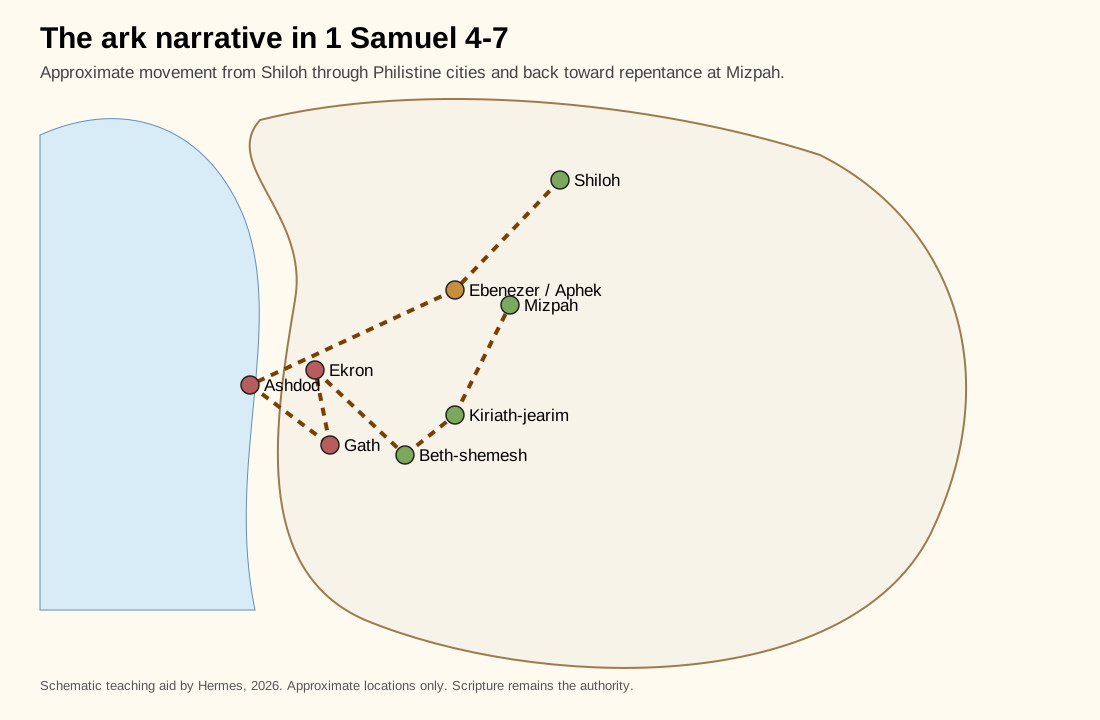 Text-based schematic of the ark’s travels; approximate geography, not an Orthodox icon or an excavated route.
An unanswered question and an immediate plan (1 Samuel 4:1-5)
- And it came to pass in those days that the Philistines gathered themselves together against Israel to war; and Israel went out to meet them and encamped at Aben-ezer, and the Philistines encamped in Aphec.
- And the Philistines prepare to fight with Israel, and the battle was turned against them; and the men of Israel fell before the Philistines, and there were smitten in the battle in the field four thousand men.
- And the people came to the camp, and the elders of Israel said, Why has the Lord caused us to fall this day before the Philistines? let us take the ark of our God out of Selom, and let it proceed from the midst of us, and it shall save us from the hand of our enemies.
- And the people sent to Selom, and they take thence the ark of the Lord who dwells between the cherubs: and both the sons of Heli, Ophni and Phinees, were with the ark.
- And it came to pass when the ark of the Lord entered into the camp, that all Israel cried out with a loud voice, and the earth resounded.
The elders ask why the Lord has allowed defeat. They then answer their own question with a plan: bring the ark, “and it shall save us.” They seek a change in their military position before seeking a change in their relationship with God. The ark is genuinely the sign of the Lord who dwells between the cherubim; the error is the inference that carrying His gift obliges Him to serve their purpose. Hophni and Phinehas accompany it. Their corruption has not disappeared because they now stand beside something holy.
Joshua’s victories do not authorize this experiment. At the Jordan and Jericho, the ark proceeds within God’s command (Joshua 3:7-17; 6:1-7). In Numbers 14:44-45, Israel marches presumptuously while Moses and the ark remain in the camp, and is routed. After defeat at Ai, Joshua falls before the Lord and receives His answer concerning Israel’s sin (Joshua 7:6-12). Here the elders ask, but do not wait. Repeating an outward action from a former deliverance cannot replace listening to the God who delivered.1
The camp’s great shout makes the earth resound. It gives the people confidence before there is any word from God confirming their plan. A crowded service, a moving hymn, or a long record of ministry can also encourage us while leaving a concealed wrong untouched. Reverence begins when we allow the Lord to answer the question we would rather solve ourselves.
The ark is captured, but God is not conquered (1 Samuel 4:6-11)
- And the Philistines heard the cry, and the Philistines said, What is this great cry in the camp of the Hebrews: and they understood that the ark of the Lord was come into the camp.
- And the Philistines feared, and said, These are the Gods that are come to them into the camp.
- Woe to us, O Lord, deliver us to-day, for such a thing has not happened aforetime: woe to us, who shall deliver us out of the hand of these mighty Gods? these are the Gods that smote Egypt with every plague, and in the wilderness.
- Strengthen yourselves and behave yourselves like men, O ye Philistines, that ye may not serve the Hebrews as they have served us, but be ye men and fight with them.
- And they fought with them; and the men of Israel fall, and they fled every man to his tent; and there was a very great slaughter; and there fell of Israel thirty thousand fighting men.
- And the ark of God was taken, and both the sons of Heli, Ophni and Phinees, died.
The Philistines hear the shout and fear the God whose power was revealed in Egypt. Their speech describes Him in the plural and confuses parts of the Exodus history, but it remembers what Israel’s strategy has overlooked: the Lord acts with sovereign power. They fight rather than flee. Israel’s larger defeat, the capture of the ark, and the deaths of the two priests fulfill the announced sign concerning Eli’s house. Sacred proximity has provided no exemption.
Scripture itself interprets this catastrophe. Psalm 78:60-64 (LXX Psalm 77:60-64) remembers the rejection of the tent at Shiloh, captivity, and priests falling by the sword. Jeremiah later sends people who trust in repeated assurances about the temple to consider Shiloh (Jeremiah 7:4, 12-14; 26:6). His demand is concrete: amend conduct, practice justice, and cease oppressing the stranger, orphan, and widow. Israel’s story therefore warns the Church from within Scripture, rather than providing Christians with a reason to mock Israel’s worship.2
Icons, relics, crosses, holy water, and the Holy Mysteries are gifts through which the faithful honor and receive God’s grace. The Eucharist is Christ’s Body and Blood, not an object equivalent to every other sacred gift. None of these makes exploitation or a refusal to repent harmless. A priest’s office or a servant’s role cannot sanctify abuse or demand a victim’s silence. The right response to this passage is to draw near honestly, with confession and amendment, not to abandon sacramental life.
Lesson Guide
- Key phrases: holy things cannot be used to avoid repentance
- Emphasize: this is anti-superstition, not anti-sacrament
- Avoid: speaking as if outward holy things are meaningless
Eli’s last trembling (1 Samuel 4:12-18)
- And there ran a man of Benjamin out of the battle, and he came to Selom on that day: and his clothes were rent, and earth was upon his head.
- And he came, and behold, Heli was upon the seat by the gate looking along the way, for his heart was greatly alarmed for the ark of God: and the man entered into the city to bring tidings; and the city cried out.
- And Heli heard the sound of the cry, and said, What is the voice of this cry? and the man hasted and went in, and reported to Heli.
- Now Heli was ninety years old, and his eyes were fixed, and he saw not.
- And Heli said to them that stood round about him, What is the voice of this sound? And the man hasted and advanced to Heli, and said to him, I am he that is come out of the camp, and I have fled from the battle to-day: and Heli said, What is the event, my son?
- And the young man answered and said, The men of Israel fled from the face of the Philistines, and there was a great slaughter among the people, and both thy sons are dead, and the ark of God is taken.
- And it came to pass, when he mentioned the ark of God, that he fell from the seat backward near the gate, and his back was broken, and he died, for he was an old man and heavy: and he judged Israel twenty years.
The messenger’s torn clothing and the earth upon his head announce disaster before he speaks. Eli cannot see, but he hears the city’s cry. His anxious waiting has already been explained: “his heart was greatly alarmed for the ark of God.” The report rises through Israel’s flight, the slaughter, and his sons’ deaths to the capture of the ark. It is at the mention of the ark that he falls.
This detail prevents a flat portrait. The man rebuked for honoring his sons above God is finally shown trembling for God’s ark. There is a last mercy in the narrator’s attention to that love, even while the judgment on his negligent leadership stands. We cannot pronounce on his final state or turn an involuntary death into an act of martyrdom. We can allow Scripture to expose failure without pretending that failure exhausts a human person.
Brenton says Eli judged Israel “twenty years.” The Rahlfs-based Greek has “eikosi,” twenty, and NETS agrees; Hebrew-based editions commonly have forty. The two chronologies should remain distinct. No spiritual significance is established merely by making the Greek number match the twenty years in 7:2.3
A mother names the loss of glory (1 Samuel 4:19-22)
- And his daughter-in-law the wife of Phinees was with child, about to bring forth; and she heard the tidings, that the ark of God was taken, and that her father-in-law and her husband were dead; and she wept and was delivered, for her pains came upon her.
- And in her time she was at the point of death; and the women that stood by her, said to her, Fear not, for thou hast born a son: but she answered not, and her heart did not regard it.
- And she called the child Uæbarchaboth, because of the ark of God, and because of her father-in-law, and because of her husband.
- And they said, The glory of Israel is departed, forasmuch as the ark of the Lord is taken.
The wife of Phinehas hears of the captured ark as well as the deaths in her household. She gives birth while dying. The women offer the consolation of a son, but she neither answers nor attends to it. Genesis 35:17-18 gives a close narrative parallel: Rachel’s midwife announces another son as Rachel dies and names him from her sorrow. Here too, a birth does not erase a mother’s suffering. The woman must be heard as a person enduring catastrophe, not reduced to a device for explaining her child’s name.
Brenton prints “Uæbarchaboth.” The Greek form is “Ouai Barchaboth,” rendered “Woe Barchaboth” in NETS; “Ichabod” is the familiar Hebrew-based form. We use “the child” in the explanation rather than substituting that familiar name into the quoted Greek tradition. The mother names him because of the ark, her father-in-law, and her husband. Verse 22 then says “they said,” not “she said”: the plural voice, naturally read with the attending women in the scene, interprets the loss as the departure of Israel’s glory. Her naming and their lament together read the event more deeply than the elders’ plan.4
Glory has departed from Israel’s life; God has not ceased to be God. The next chapter makes that distinction visible. Ezekiel 10:18-19 and 11:22-23 will likewise describe the glory departing from a sanctuary and city that cannot hold it by right of possession. John 1:14 gives the positive Christian center: the Word becomes flesh, dwells among us, and reveals His glory, full of grace and truth. The Lord restores communion by giving Himself, not by validating our claim to own Him.5
Naming a real spiritual loss can begin repentance. It is different from declaring that God has abandoned a grieving person. The mother is not accused of causing the calamity, and her death is no warrant for assigning divine punishment to childbirth, bereavement, or depression.
Lesson Guide
- Key phrases: Ichabod names the truth; glory is not decoration
- Emphasize: honest naming can begin repentance
- Avoid: treating the woman as a side detail only
Dagon must be carried; the Lord acts (1 Samuel 5:1-5)
- And the Philistines took the ark of God, and brought it from Abenezer to Azotus.
- And the Philistines took the ark of the Lord, and brought it into the house of Dagon, and set it by Dagon.
- And the people of Azotus rose early, and entered into the house of Dagon; and looked, and behold, Dagon had fallen on his face before the ark of the Lord: and they lifted up Dagon, and set him in his place. And the hand of the Lord was heavy upon the Azotians, and he plagued them, and he smote them in their secret parts, Azotus and her coasts.
- And it came to pass when they rose early in the morning, behold, Dagon had fallen on his face before the ark of the covenant of the Lord; and the head of Dagon and both the palms of his hands were cut off each before the threshold, and both the wrists of his hands had fallen on the floor of the porch; only the stump of Dagon was left.
- Therefore the priests of Dagon, and every one that enters into the house of Dagon, do not tread upon the threshold of the house of Dagon in Azotus until this day, for they step over.
The captors place the ark beside Dagon, as though their victory has established the rank of the two gods. In the morning Dagon lies on his face before the ark. His worshippers have to lift him back into place. On the next morning he has lost his head and hands, while the Lord’s hand continues to act. The image is sharp: people must support the god they trust, while the living God needs no supporting army.
The custom of stepping over Dagon’s threshold preserves memory of his defeat, yet the story does not describe the destruction of his cult. Seeing an idol humbled and putting it away are different acts. A person can admit that ambition, resentment, or money has failed him and still carefully set it back in its accustomed place. Israel will have to do more in 7:4: actually remove the gods it has been serving.
Christ’s victory through apparent defeat gives this scene a Christian horizon. Hebrews 2:14-15 says that He shares our flesh and blood and destroys the devil’s power through death, releasing those held in fear of death. The resemblance is an interpretive pattern, not a statement that the ark’s captivity and Christ’s Passion are identical. He enters death freely to deliver us; His resurrection is no permission to seek suffering or expose others to danger.5
The Church’s Voice in Worship ⛪
On Pashons 24, the Coptic Church celebrates the Entrance of the Lord Christ into Egypt. Coptic Reader’s Synaxarion, published by the Coptic Orthodox Diocese of the Southern United States, recounts idols falling at the Holy Family’s presence and connects the visit with Isaiah 19:1. A public Arabic Synaxarium parallel explicitly compares the falling idols with Dagon before the ark. The carried Child, outwardly vulnerable in a foreign land, is the Lord whose presence brings idols down. This is a received Coptic reading of Christ’s entry, not an assertion that these chapters are appointed as that feast’s Scripture reading.6
Cities cannot pass holiness along as a problem (1 Samuel 5:6-12)
- And the hand of the Lord was heavy upon Azotus, and he brought evil upon them, and it burst out upon them into the ships, and mice sprang up in the midst of their country, and there was a great and indiscriminate mortality in the city.
- And the men of Azotus saw that it was so, and they said, The ark of the God of Israel shall not abide with us, for his hand is heavy upon us and upon Dagon our god.
- And they send and gather the lords of the Philistines to them, and say, What shall we do to the ark of the God of Israel? and the Gittites say, Let the ark of God come over to us; and the ark of the God of Israel came to Geth.
- And it came to pass after it went about to Geth, that the hand of the Lord comes upon the city, a very great confusion; and he smote the men of the city small and great, and smote them in their secret parts: and the Gittites made to themselves images of emerods.
- And they send away the ark of God to Ascalon; and it came to pass when the ark of God went into Ascalon, that the men of Ascalon cried out, saying, Why have ye brought back the ark of the God of Israel to us, to kill us and our people?
- And they send and gather the lords of the Philistines, and they said, Send away the ark of the God of Israel, and let it lodge in its place; and let it not slay us and our people.
- For there was a very great confusion in all the city, when the ark of the God of Israel entered there; and those who lived and died not were smitten with emerods; and the cry of the city went up to heaven.
The ark is moved from city to city, but the affliction follows. At Azotus the people recognize a hand heavy upon themselves and Dagon; at Geth men small and great are struck; at Ascalon the people protest that the ark has been brought to kill them. Their leaders keep asking what to do with the ark before acknowledging what their own relationship to the Lord must become. The chapter ends with a city’s cry rising to heaven. We should hear the sufferers, not only celebrate the idol’s humiliation.
The Greek tradition here makes the devastation of the land explicit. Rahlfs-based Greek and NETS place mice in 5:6 and 6:1, as does the displayed Brenton text. There are no mice in 5:3 in these witnesses: that verse describes bodily affliction. Nor can the combination of mice and swellings establish a modern medical diagnosis. The story’s theological claim is divine judgment; its words do not give us clinical evidence for identifying a pathogen.7
The Lord is free among Israel’s enemies as among His own people. That truth humbles religious pride as well as idolatry. Nothing here authorizes ethnic contempt, delight in another people’s disease, or the claim that ordinary illness reveals a person’s guilt. Those who suffer still need mercy and care.
Lesson Guide
- Key phrases: God is not defeated when His people are humbled
- Emphasize: the ark in Philistine territory reveals divine freedom
- Avoid: making this only a triumphalist anti-pagan story
Another Exodus, while Israel cannot rescue the ark (1 Samuel 6:1-12)
- And the ark was seven months in the country of the Philistines, and their land brought forth swarms of mice.
- And the Philistines call their priests, and their prophets, and their enchanters, saying, What shall we do to the ark of the Lord? teach us wherewith we shall send it away to its place.
- And they said, If ye send away the ark of the covenant of the Lord God of Israel, do not on any account send it away empty, but by all means render to it an offering for the plague; and then shall ye be healed, and an atonement shall be made for you: should not his hand be thus stayed from off you?
- And they say, What is the offering for the plague which we shall return to it? and they said,
- According to the number of the lords of the Philistines, five golden emerods, for the plague was on you, and on your rulers, and on the people; and golden mice, the likeness of the mice that destroy your land: and ye shall give glory to the Lord, that he may lighten his hand from off you, and from off your gods, and from off your land.
- And why do ye harden your hearts, as Egypt and Pharao hardened their hearts? was it not so when he mocked them, that they let the people go, and they departed?
- And now take wood and make a new waggon, and take two cows, that have calved for the first time, without their calves; and do ye yoke the cows to the waggon, and lead away the calves from behind them home.
- And ye shall take the ark and put it on the waggon; and ye shall restore to it the golden articles for the trespass-offering in a coffer by the side of it: and ye shall let it go, and send it away, and ye shall depart.
- And ye shall see, if it shall go the way of its coasts along by Bæthsamys, he has brought upon us this great affliction; and if not, then shall we know that his hand has not touched us, but this is a chance which has happened to us.
- And the Philistines did so; and they took two cows that had calved for the first time, and yoked them to the waggon, and shut up their calves at home.
- And they set the ark of the Lord, and the coffer, and the golden mice, on the waggon.
- And the cows went straight on the way to the way of Bæthsamys, they went along one track; and laboured, and turned not aside to the right hand or to the left, and the lords of the Philistines went after it as far as the coasts of Bæthsamys.
After seven months, the Philistines seek counsel about sending the ark away. Their priests, prophets, and enchanters are not Israel’s teachers, yet their advice recognizes what resistance has cost: return it with an offering, give glory to the Lord, and stop hardening the heart. Their golden swellings and mice represent the plague upon the people and land. These are their proposed offerings, not a new sacrificial ordinance for Israel or a pattern the Church is asked to reproduce.
The Exodus is named twice across the story: in the alarm of 4:8 and in the warning about Pharaoh’s hard heart in 6:6. The ark’s captivity and return have the shape of a second Exodus. The Lord’s sign is carried into an enemy land; He strikes the captors, brings about its release, and it leaves with gold. Exodus 12:35-36 supplies the earlier departure with precious goods. Israel has neither negotiated the release nor won it in battle. God is not defeated when His people are humbled, and His restoring action has begun before their national repentance is described.8
The test with the cows addresses the possibility raised in verse 9 that the affliction was chance. Newly calved cows, separated from their calves, go directly towards Beth-shemesh rather than returning home. Their unswerving course convinces the observers within the narrative. It does not give believers a general license to demand signs from God or decide private questions by contrived tests. Faith receives this recorded act of deliverance; it does not turn providence into a technique.
Joy receives a gift Israel did not earn (1 Samuel 6:13-18)
- And the men of Bæthsamys were reaping the wheat harvest in the valley; and they lifted up their eyes, and saw the ark of the Lord, and rejoiced to meet it.
- And the waggon entered into the field of Osee, which was in Bæthsamys, and they set there by it a great stone; and they split the wood of the waggon, and offered up the cows for a whole-burnt-offering to the Lord.
- And the Levites brought up the ark of the Lord, and the coffer with it, and the golden articles upon it, and placed them on the great stone, and the men of Bæthsamys offered whole-burnt-offerings and meat-offerings on that day to the Lord.
- And the five lords of the Philistines saw, and returned to Ascalon in that day.
- And these are the golden emerods which the lords of the Philistines gave as a trespass-offering to the Lord; for Azotus one, for Gaza one, for Ascalon one, for Geth one, for Accaron one.
- And the golden mice according to the number of all the cities of the Philistines, belonging to the five lords, from the fenced city to the village of the Pherezite, and to the great stone, on which they placed the ark of the covenant of the Lord, that was in the field of Osee the Bæthsamysite.
The harvesters lift their eyes and rejoice to meet the ark. Their joy is the text’s first response to its return, and it is good. The wagon becomes fuel, the cows are offered, and the Levites set the ark and coffer upon the stone. The foreign rulers witness the reception and depart. The catalogue of gold offerings makes the reversal concrete: what the Philistines carried off as a trophy comes home accompanied by their gifts.
Joy does not abolish the ordered care of holy things. Joshua 21:16 names Beth-shemesh among the cities allotted to Aaron’s priestly descendants, and Numbers 4:15-20 gives careful instructions concerning carrying and seeing the sanctuary’s holy things. This background makes reverent reception intelligible. It does not establish that every resident knew each rule or prove an unrecorded act of mishandling in verse 19. The next paragraph must be read on its own terms.9
Thanksgiving starts by acknowledging that a gift has arrived which we did not produce. The returned ark is not evidence that Israel’s first strategy was right. It is evidence that the Lord can restore what presumption has endangered. Grace draws the people toward a response of worship and a renewed heart.
Those who would not rejoice, and a fearful question (1 Samuel 6:19-21)
- And the sons of Jechonias were not pleased with the men of Bæthsamys, because they saw the ark of the Lord; and the Lord smote among them seventy men, and fifty thousand men: and the people mourned, because the Lord had inflicted on the people a very great plague.
- And the men of Bæthsamys said, Who shall be able to pass before this holy Lord God? and to whom shall the ark of the Lord go up from us?
- And they send messengers to the inhabitants of Cariathiarim, saying, The Philistines have brought back the ark of the Lord, go down and take it home to yourselves.
The displayed text does not say that the harvesters were punished for looking into the ark. It names “the sons of Jechonias,” who “were not pleased with the men of Bæthsamys.” The Rahlfs-based Greek has “ouk ēsménisan,” a refusal to be glad or pleased; NETS retains “were not pleased with.” Verse 13 uses a different verb, “euphrainō,” for the people’s rejoicing. The contrast is real without pretending that the same Greek word occurs twice: one group welcomes the returned ark; another does not share that glad reception. Their precise motive remains unreported.10
The Hebrew-based reading instead associates the striking of the men of Beth-shemesh with looking into or upon the ark. That is a distinct textual explanation, and the two should not be combined into a single invented offense. Brenton and NETS preserve “seventy men, and fifty thousand men,” while the NRSV Updated Edition prints seventy by a stated conjectural correction and records the longer Hebrew wording in a note. These severe, inconsistent numerical presentations are not solved by guessing that the larger number counts casualties from other cities. The grief and holiness stand before us, while the transmission of the number remains difficult.10
The people ask who can pass before this holy Lord and to whom the ark should go. Their question acknowledges holiness, but their proposed response is distance: let another town receive it. Fear can awaken repentance, or become another way of sending God away. Leviticus 10:1-3 and the later death of Uzzah in 2 Samuel 6:6-7 likewise warn that privileged nearness does not make divine holiness ordinary. None of these passages licenses a religious leader to terrify a vulnerable person, diagnose illness as punishment, or claim personal power over life and death.9
Gems from the Fathers 💎: The Table that gives life
St. John Chrysostom’s Homily 28 on First Corinthians addresses Eucharistic reception rather than this ark episode. He distinguishes the life-giving gift from the disordered reception of it. On 1 Corinthians 11:29 he calls the Table “the cause of so many blessings and teeming with life,” and explains judgment as arising from the will of the person approaching, not the gift’s nature. His insistence on examination is personal: “he bids not one examine another, but each himself.” His conclusion returns to care for the poor. Reverence before Christ therefore includes repentance from anger, greed, and the humiliating treatment of a neighbor, not only attention to ceremonial details.11
This thematic witness clarifies the warning without reducing Communion to danger. Paul says to examine oneself and then eat and drink (1 Corinthians 11:28); the call is to healed reception. A fearful or wounded believer should seek patient pastoral help, not assume that anxiety or sickness disqualifies him from Christ’s mercy.
The Church’s Voice in Worship ⛪
Before Communion in the Coptic Liturgy of St. Basil, the priest proclaims, “The holies for the holy,” and blesses the Lord Jesus Christ with reference to the sanctification of the Holy Spirit. The congregation answers: “One is the All-Holy Father. One is the All-Holy Son. One is the All-Holy Spirit. Amen.” This is the people’s reply at this point, distinct from the deacon’s earlier response during the offering. The Church answers Beth-shemesh’s fearful question by confessing the source of holiness, the Holy Trinity, rather than announcing our self-sufficiency.12
Mystagogical Catechesis V.19, traditionally attributed to St. Cyril of Jerusalem, explains the corresponding proclamation in Jerusalem’s rite: Christ is holy by nature, while we are holy through participation, discipline, and prayer. His rite’s response is not the wording of the Coptic response just quoted. His theological explanation helps us approach with humility and hope: “we too are holy, but not by nature, only by participation, and discipline, and prayer.” He closes the catechesis by urging believers not to sever themselves from Communion. Sanctification is received and lived, not claimed as an achievement that makes God indebted to us.13
Lesson Guide
- Key phrases: joy and fear belong together before holy things
- Emphasize: reverence protects love from becoming casual
- Avoid: flattening the judgment into arbitrary severity
The ark is kept; the people must return (1 Samuel 7:1-6)
- And the men of Cariathiarim come, and bring up the ark of the covenant of the Lord: and they bring it into the house of Aminadab in the hill; and they sanctified Eleazar his son to keep the ark of the covenant of the Lord.
- And it came to pass from the time that the ark was in Cariathiarim, the days were multiplied, and the time was twenty years; and all the house of Israel looked after the Lord.
- And Samuel spoke to all the house of Israel, saying, If ye do with all your heart return to the Lord, take away the strange gods from the midst of you, and the groves, and prepare your hearts to serve the Lord, and serve him only; and he shall deliver you from the hand of the Philistines.
- And the children of Israel took away Baalim and the groves of Astaroth, and served the Lord only.
- And Samuel said, Gather all Israel to Massephath, and I will pray for you to the Lord.
- And they were gathered together to Massephath, and they drew water, and poured it out upon the earth before the Lord. And they fasted on that day, and said, We have sinned before the Lord. And Samuel judged the children of Israel in Massephath.
The ark is entrusted to the household of Abinadab, with Eleazar sanctified to keep it. Time passes, and Israel looks after the Lord. The twenty years describe the interval associated with the ark’s stay and Israel’s turning; this verse alone does not establish that the ark left that household when those years ended. Samuel addresses longing with a definite demand: return with the whole heart, remove the foreign gods, prepare the heart, and serve the Lord alone. The removal of Baalim and Astaroth in verse 4 shows that this is more than a change in religious feeling.
Mizpah gathers repentance into body, speech, and community. The people fast, pour water upon the ground before the Lord, and confess their sin. Water poured out cannot be held back in the hand. The gesture expresses surrendered weakness, although the narrative does not explain its ritual origin. Lamentations 2:19 provides a fitting biblical comparison by calling the people to pour out their heart like water before the Lord, with prayer for hungry children. Such prayer is honest dependence that moves toward care for the weak.14
Psalm 22:14 (LXX Psalm 21:15) describes the suffering righteous one as poured out like water. In the Passion’s scriptural horizon, this gives our Christian reflection a text: our surrender in repentance is received by Christ who gives Himself for us. He is the sinless Savior, not a penitent confessing His own sins, and Mizpah’s gesture is not explicitly called a prediction of the Cross. We bring our emptied hands and confession to the One whose self-offering opens the way home.14
The Church’s Voice in Worship ⛪
The Sunday Theotokia, Part Two, sings of the ark overlaid with gold and made of wood that would not decay. It interprets that sign through the Word made man without separation and addresses Mary as clothed with the glory of the divinity within and without. “Theotokos” means Mother of God: she bore the incarnate Word. Calling her the living ark honors the Son whom she bears, rather than making her another deity.15
The biblical resemblance becomes clearer in 2 Samuel 6:9-11 and Luke 1:39-56: David’s question about the ark coming to him and its three-month stay in a household stand beside Elizabeth’s wonder at the mother of her Lord coming to her and Mary’s stay of about three months. Revelation 11:19-12:1 places the heavenly ark and the sign of the woman in adjacent visions. These support a Christian Marian and ecclesial contemplation; adjacency alone does not settle every identity in Revelation. The hymn supplies the explicit received Coptic ark imagery. Its praise leads us to receive God’s presence with faith, thanksgiving, and a purified heart.5
Prayer, thunder, and a stone of help (1 Samuel 7:7-17)
- And the Philistines heard that all the children of Israel were gathered together to Massephath: and the lords of the Philistines went up against Israel: and the children of Israel heard, and they feared before the Philistines.
- And the children of Israel said to Samuel, Cease not to cry to the Lord thy God for us, and he shall save us out of the hand of the Philistines.
- And Samuel took a sucking lamb, and offered it up as a whole-burnt-offering with all the people to the Lord: and Samuel cried to the Lord for Israel, and the Lord heard him.
- And Samuel was offering the whole-burnt-offering; and the Philistines drew near to war against Israel; and the Lord thundered with a mighty sound in that day upon the Philistines, and they were confounded and overthrown before Israel.
- And the men of Israel went forth out of Massephath, and pursued the Philistines, and smote them to the parts under Bæthchor.
- And Samuel took a stone, and set it up between Massephath and the old city; and he called the name of it Abenezer, stone of the helper; and he said, Hitherto has the Lord helped us.
- So the Lord humbled the Philistines, and they did not any more come into the border of Israel; and the hand of the Lord was against the Philistines all the days of Samuel.
- And the cities which the Philistines took from the children of Israel were restored; and they restored them to Israel from Ascalon to Azob: and they took the coast of Israel out of the hand of the Philistines; and there was peace between Israel and the Amorite.
- And Samuel judged Israel all the days of his life.
- And he went year by year, and went round Bæthel, and Galgala, and Massephath; and he judged Israel in all these consecrated places.
- And his return was to Armathaim, because there was his house; and there he judged Israel, and built there an altar to the Lord.
The Philistines advance while Israel is gathered in repentance. The people’s fear does not mean that their repentance was false; obedience has not made them invulnerable. This time they ask Samuel to continue crying to the Lord. In chapter 4 their confidence rested on bringing the ark; here their dependence is expressed in intercession and sacrifice. Samuel offers a suckling lamb, the Lord hears him, and the thunder confounds the attackers before Israel pursues them.
Hannah’s song in 2:10 already names the Lord’s thunder and judgment. In 7:10 that song sounds in Israel’s deliverance; in 12:17-18 thunder and rain will expose Israel’s own wrong demand for a king. God’s power is faithful, but cannot be reduced to a weapon against whichever people we dislike. The song is a key to the book because it joins the humbling of the proud, the lifting of the weak, judgment, and the Lord’s anointed.
Sirach 46:16-18 remembers Samuel calling upon the Lord with an offering of a suckling lamb and the Lord answering with thunder. Psalm 99:6 (LXX Psalm 98:6) places him among those who call on the Lord’s name and are heard. Jeremiah 15:1 names Moses and Samuel as exemplary intercessors precisely while declaring that even their prayers would not override a hardened people’s judgment. Intercession is real, and it calls others into return; it is no substitute for their freedom and obedience.16
The lamb and Samuel’s intercession direct Christian readers toward Christ, the Lamb of God (John 1:29), who always lives to intercede for those coming to God through Him (Hebrews 7:25). Samuel offers an animal and cries for his people; Christ offers Himself and brings us to the Father. Prayer and sacrifice here find their fullness in His personal self-giving, not in a religious technique that forces a result.5
Samuel names the stone “Abenezer,” which Brenton explains as “stone of the helper.” The name was heard at the place of defeat in 4:1; now it becomes an act of thanksgiving after wholehearted return. The narrative correspondence matters more than an uncertain identification of both sites as one location. “Hitherto has the Lord helped us” remembers grace without promising that no further battle will come. Peace, restored towns, and Samuel’s yearly circuit of judgment follow. A delivered people still needs patient, truthful governance. Gratitude should become the ordinary work of justice, not merely a memorable monument.
Lesson Guide
- Key phrases: repentance makes Ebenezer true
- Emphasize: chapter 7 corrects chapter 4
- Avoid: using Ebenezer as a sentimental slogan detached from repentance
Earlier failure or question The Lord’s answer in these chapters Life in Christ Carry the ark to guarantee victory The Lord acts freely even after its capture Receive His gifts with repentance, not control Glory has departed God remains sovereign beyond Israel’s camp The Word dwells among us and reveals His glory Dagon stands beside the ark The idol falls and cannot raise itself Let Christ’s victory free us from false masters Who can pass before this holy Lord? Holiness demands a truthful reception The Trinity sanctifies those who draw near Fear when enemies approach Samuel prays; the Lord hears and thunders Rely on Christ’s intercession and practice faithful prayer Ebenezer beside defeat A stone remembers help after return Thanksgiving grows into amended life and justice
Spiritual Fruit 🍇
- Ask and wait before changing the arrangement. When prayer or service seems fruitless, resist the elders’ haste to replace self-examination with a new strategy. Name one wrong you are defending, bring it honestly to confession, and make the practical amendment it requires. Holy gifts are a reason to return, not a reason to conceal the truth.
- Let the fallen idol remain fallen. Notice what you keep lifting back into place after it has damaged your life: a grudge, approval-seeking, dishonest gain, or the need to control others. Remove one concrete occasion that feeds it. If the matter involves abuse or danger, seek safe support and proper accountability rather than calling continued exposure repentance.
- Receive Communion with hope and mercy. Prepare with prayer and honest examination, seek your priest’s guidance when needed, and refuse contempt for another communicant. Chrysostom’s warning includes the poor: join reverence at the altar to a specific act of generosity or repair outside it. Anxiety is not holiness, and Christ’s life-giving gift should not become a pretext for despair.
- Pour out the heart and remember help. Pray plainly for someone who is afraid, as Israel asked Samuel to pray. Join that prayer to practical care. At week’s end, recall a real help received from the Lord, give thanks without boasting, and let the remembrance strengthen the next act of obedience.
Lord Jesus Christ, we stand before You with more need than strength. Receive the truth we have been afraid to confess, and free our hands from the idols we keep rebuilding. Make Your holy gifts fruitful in mercy, worship, and a heart that turns wholly to You. Teach us to remember Your help without trying to possess it. May our thanksgiving become the quiet justice and faithful prayer by which a restored people lives.
Teaching Notes
Whole-study guidance: Keep chapter 4 and chapter 7 in view together. Preserve the distinction between anti-superstition and anti-sacrament, and between Israel’s failure and God’s freedom. The schematic illustrates narrative sequence only. No exact Coptic lectionary appointment of this four-chapter passage is asserted; hymn and feast connections have their own sources. Do not explain bereavement or illness by assigning hidden guilt, and do not turn reverence into institutional intimidation.
An unanswered question and an immediate plan (1 Samuel 4:1-5)
- Ask: What happens between the elders’ question and their decision to bring the ark?
- Watch for: Treating a sacred object as a guarantee, or treating the failure of that strategy as proof that sacred gifts are empty.
The ark is captured, but God is not conquered (1 Samuel 4:6-11)
- Ask: How does Jeremiah’s appeal to Shiloh sharpen the meaning of this defeat?
- Watch for: Mockery of Israel, or using religious office to protect wrongdoing.
Eli’s last trembling (1 Samuel 4:12-18)
- Ask: Why does the narrator mark the mention of the ark as the moment Eli falls?
- Watch for: Either excusing negligent leadership or erasing Eli’s remaining concern for God.
A mother names the loss of glory (1 Samuel 4:19-22)
- Ask: What do the mother’s naming and the plural lament each contribute?
- Watch for: Putting the women’s words into the mother’s mouth, or blaming her suffering on sin.
Dagon must be carried; the Lord acts (1 Samuel 5:1-5)
- Ask: What does the contrast between lifting Dagon and the Lord’s acting hand expose?
- Watch for: Turning the Coptic Egypt tradition into an exact appointment of this chapter or a reason for contempt.
Cities cannot pass holiness along as a problem (1 Samuel 5:6-12)
- Ask: What remains unchanged as the ark moves from city to city?
- Watch for: An unsupported medical diagnosis or delight in the sufferers’ pain.
Another Exodus, while Israel cannot rescue the ark (1 Samuel 6:1-12)
- Ask: How do Pharaoh, plagues, release, and gold make the Exodus comparison more than a vague resemblance?
- Watch for: Treating the Philistines’ proposed offerings or test as a prescribed Christian practice.
Joy receives a gift Israel did not earn (1 Samuel 6:13-18)
- Ask: What does the harvesters’ joy say about the gift they are receiving?
- Watch for: Reading the good joy of verse 13 as the unreported offense of verse 19.
Those who would not rejoice, and a fearful question (1 Samuel 6:19-21)
- Ask: How do the Greek and Hebrew-based readings change the specific offense under discussion?
- Watch for: Smoothing away the numerical difficulty, or making Communion a threat instead of a call to sanctification.
The ark is kept; the people must return (1 Samuel 7:1-6)
- Ask: Why must Samuel call for the removal of idols when the ark is already back?
- Watch for: Confusing an embodied act of repentance with a ritual that forces forgiveness.
Prayer, thunder, and a stone of help (1 Samuel 7:7-17)
- Ask: How does the people’s request in verse 8 differ from the elders’ solution in 4:3?
- Watch for: Turning Ebenezer into a guarantee of an easy future or intercession into a replacement for obedience.
Sources
Embedded Scripture is from Brenton’s English Septuagint (LXX).
Brenton’s 1 Samuel 4-7 and the comparisons discussed here: 🔗 Brenton Septuagint. Hebrew-based numbering is identified where relevant. The embedded words remain Brenton’s, including difficult forms and numbers.
Bernard A. Taylor, NETS, 1 Reigns, Old Greek 1 Samuel 4-7: 🔗 official edition, compared with the 🔗 Rahlfs-based CCAT Greek.
The located ancient witnesses, worship texts, and biblical comparisons are cited below. Chrysostom and Cyril are thematic Eucharistic witnesses, not direct commentators on the ark episode. No general patristic consensus or exact four-chapter Coptic reading assignment is claimed.
Footnotes
-
Joshua 3:7-17; 6:1-7; Numbers 14:44-45; Joshua 7:6-12. 🔗 Joshua’s commanded reception; 🔗 Numbers 14; 🔗 Joshua 7. ↩
-
Psalm 78:60-64 (LXX Psalm 77:60-64), 🔗 Brenton LXX Psalm 77; Jeremiah 7:4, 12-14; 26:6, 🔗 the prophet’s Shiloh warning. ↩
-
1 Samuel 4:18, 🔗 NETS 1 Reigns, printed p. 252; 🔗 Rahlfs-based Greek. Compare the forty years in 🔗 Hebrew-based 1 Samuel 4:18. ↩
-
1 Samuel 4:20-22, 🔗 NETS, printed p. 252; 🔗 Rahlfs-based Greek. Rachel comparison: 🔗 Genesis 35:16-20. The plural verb in 4:22 is secure; the attending women are its natural contextual referent, not an explicitly repeated noun. ↩
-
Ezekiel 10:18-19; 11:22-23, 🔗 departing glory; John 1:14; 2:19-21; Luke 1:39-56; Hebrews 2:14-15; 7:25; Revelation 11:19-12:1, 🔗 incarnation, victory, intercession, and ark comparisons; 🔗 John 1:29, Lamb of God. ↩ ↩2 ↩3 ↩4
-
Coptic Reader, Coptic Orthodox Diocese of the Southern United States, Synaxarion, Pashons 24, “The Commemoration of the Entrance of the Lord Christ into Egypt,” 🔗 Coptic Reader. The entry recounts falling idols and Isaiah 19:1; 🔗 publisher information. 🔗 Arabic public Synaxarium parallel, first commemoration explicitly compares Dagon. This parallel is not substituted for Coptic Reader’s day record. ↩
-
1 Samuel 5:3, 6; 6:1, 🔗 NETS, printed p. 252; 🔗 Rahlfs-based Greek surface forms. ↩
-
1 Samuel 4:8; 6:5-6, compared with 🔗 Exodus 12:35-36. “Second Exodus” describes the narrative resemblance rather than a title supplied by the text. ↩
-
🔗 Joshua 21:16; 🔗 Numbers 4:15-20; 🔗 Leviticus 10:1-3; 🔗 2 Samuel 6:6-11. ↩ ↩2
-
1 Samuel 6:13, 19-21, 🔗 NETS, printed pp. 252-253; 🔗 Rahlfs-based Greek. 🔗 NRSV Updated Edition 1 Samuel 6:19 with textual notes adopts the Greek offense and records the Hebrew looking reading; its seventy is marked as a conjectural correction of the longer number. ↩ ↩2
-
St. John Chrysostom, Homilies on First Corinthians, XXVIII.1-3, on 1 Corinthians 11:28-33, NPNF, First Series, vol. 12, English text reproduced by New Advent; 🔗 Homily 28. The quoted phrases concern personal examination and the life-giving Table. The homily also gives a severe account of sickness and judgment; the present application does not authorize diagnosis of another person’s suffering. ↩
-
Coptic Liturgy of St. Basil, proclamation before Communion and congregation’s response, 🔗 complete liturgy with speaker labels. The response at this point is Trinitarian, not the distinct wording of Jerusalem’s rite in Cyril’s catechesis. ↩
-
St. Cyril of Jerusalem, Mystagogical Catechesis V.19, 23, also numbered Catechetical Lecture 23, NPNF, Second Series, vol. 7, translated by Edwin Hamilton Gifford; 🔗 on the sacred liturgy and Communion. A thematic witness on sanctification, not direct commentary on 1 Samuel. ↩
-
🔗 Lamentations 2:19; Psalm 22:14 (LXX Psalm 21:15), 🔗 Brenton LXX Psalm 21. These are scriptural comparisons; the narrative does not itself define Mizpah’s ritual origin. ↩ ↩2
-
Sunday Theotokia, Part Two, annual Sunday Midnight Praises, English translation of St. Antony Monastery, California, 🔗 English and Coptic hymn text. Ark imagery is explicit; no exact reading assignment of 1 Samuel 4-7 follows from it. ↩
-
Sirach 46:16-18, Benjamin G. Wright’s NETS translation, 🔗 official Sirach, printed pp. 757-758; Psalm 99:6 (LXX Psalm 98:6), 🔗 Brenton LXX Psalm 98; Jeremiah 15:1, 🔗 Samuel and Moses as intercessors. Hannah’s thunder and its later return: 🔗 1 Samuel 2:10 and 🔗 12:17-18. ↩