


This narration is from a previous version of the study and may include a combined recording of multiple chapters.
Isaiah 19-20 is one of the most astonishing turns in the whole book. Egypt is shaken, its idols tremble, its Nile economy collapses, its wisdom fails, and its political confidence is exposed. Yet the same Egypt is promised an altar to the Lord, healing after smiting, a highway with Assyria, and even the blessing “Blessed be my people that is in Egypt.” Chapter 20 then explains why this must be read with theological sobriety: Judah must not place its hope in Egypt or Ethiopia as political saviors.
These chapters belong together because chapter 19 gives the full arc of Egypt judged and healed, while chapter 20 provides the embodied prophetic sign against trusting Egypt and Ethiopia as worldly refuge. The healing promise is therefore not permission for political dependence. It is a promise of divine conversion.
This note follows Isaiah 17-18, where distant nations were already beginning to move toward Zion. It pushes that horizon further by naming Egypt and Assyria together with Israel in a shared blessing. What follows, in Isaiah 21-23, returns to other collapsing powers and trading cities.
Historical and Scriptural Context
Egypt was one of Israel’s oldest points of memory, temptation, fear, and fascination. It could function as oppressor, refuge, and imagined ally. Isaiah therefore treats Egypt with unusual richness. The oracle does not stop at denunciation because Egypt’s story in salvation history is already layered.
Chapter 19 is also one of the strongest examples in Isaiah of judgment that aims through ruin toward knowledge of the Lord. The chapter does not say Egypt was fine all along. It says Egypt must be shaken, stripped, and then healed. Chapter 20 keeps the sequence honest. Judah is not to confuse God’s future mercy toward Egypt with present permission to trust Egypt as a savior.
Geographical Significance ⛰️
Egypt, the Nile, Tanis, Memphis, the land of Judah, Assyria, and the future highway between nations all matter here. The river’s failure is not incidental because Egypt’s social and economic life was tied to it. The geography is a theology of dependence.
The final highway from Egypt to Assyria is especially significant. What used to be a corridor of threat becomes a pathway of reconciliation. Geography itself is converted.
The Characters 👥
Egypt
Egypt appears first as proud, idolatrous, divided, and confused. Then, astonishingly, it appears as healed and belonging to God.
Assyria
Assyria remains a feared imperial power, yet even Assyria enters the final blessing scene of chapter 19.
Isaiah
In chapter 20, the prophet’s own body becomes the sign. He does not merely announce judgment from a distance. He enacts humiliation so Judah can see the shame of its false trust.
🕯️ Light from the Word
Isaiah 19:1-4
1 The Vision of Egypt. Behold, the Lord sits on a swift cloud, and shall come to Egypt: and the idols of Egypt shall be moved at his presence, and their heart shall faint within them.
2 And the Egyptians shall be stirred up against the Egyptians: and a man shall fight against his brother, and a man against his neighbour, city against city, and law against law. 3 And the spirit of the Egyptians shall be troubled within them; and I will frustrate their counsel: and they shall enquire of their gods and their images, and them that speak out of the earth, and them that have in them a divining spirit. 4 And I will deliver Egypt into the hands of men, of cruel lords; and cruel kings shall rule over them: thus saith the Lord of hosts.
The Lord does not stay at the border. He comes to Egypt. The idols shake before His presence, and internal collapse begins.
St. John Chrysostom uses Isaiah 19:1 when explaining the Ascension cloud in Acts. For him, the cloud is not decorative atmosphere but a sign of divine power: the prophets speak of the Lord who makes clouds His chariot and who sits upon the light cloud. That helps the reader hear Isaiah 19: the One who comes to Egypt is not one regional power among others, but the Lord whose presence shakes idols and judges false counsel.1
That movement is spiritually exact. False worship is not just wrong in theory. It creates a society that cannot remain whole under divine visitation. Idols, divided loyalties, occult consultation, and frustrated counsel belong together.
Isaiah 19:5-10
5 And the Egyptians shall drink the water that is by the sea, but the river shall fail, and be dried up. 6 And the streams shall fail, and the canals of the river; and every reservoir of water shall be dried up, in every marsh also of reed and papyrus. 7 And all the green herbage round about the river, and everything sown by the side of the river, shall be blasted with the wind and dried up. 8 And the fishermen shall groan, and all that cast a hook into the river shall groan; they also that cast nets, and the anglers shall mourn. 9 And shame shall come upon them that work fine flax, and them that make fine linen. 10 And they that work at them shall be in pain, and all that make beer shall be grieved, and be pained in their souls.
The Nile is not just a river here. It is Egypt’s confidence, rhythm, and economic bloodstream. When it fails, workers, fishers, linen-makers, and drink-makers all feel the judgment.
The passage is helpful pastorally because it shows how false security often travels through ordinary prosperity. People can mistake functioning systems for ultimate guarantees.
Isaiah 19:11-15
11 And the princes of Tanis shall be fools: as for the king’s wise counsellors, their counsel shall be turned into folly: how will ye say to the king, We are sons of wise men, sons of ancient kings? 12 Where are now thy wise men? and let them declare to thee, and say, What has the Lord of hosts purposed upon Egypt? 13 The princes of Tanis have failed, and the princes of Memphis are lifted up with pride, and they shall cause Egypt to wander by tribes. 14 For the Lord has prepared for them a spirit of error, and they have caused Egypt to err in all their works, as one staggers who is drunken and vomits also. 15 And there shall be no work to the Egyptians, which shall make head or tail, or beginning or end.
Now wisdom itself is judged. Ancient prestige, political experience, and cultured self-confidence all collapse because none of them can answer the central question: “What has the Lord of hosts purposed upon Egypt?”
This is one of Isaiah’s best exposures of sophisticated blindness. A civilization may be highly trained and deeply foolish at the same time if it does not know how to ask what God is doing.
Isaiah 19:16-18
16 But in that day the Egyptians shall be as women, in fear and in trembling because of the hand of the Lord of hosts, which he shall bring upon them. 17 And the land of the Jews shall be for a terror to the Egyptians: whosoever shall name it to them, they shall fear, because of the counsel which the Lord of hosts has purposed concerning it. 18 In that day there shall be five cities in Egypt speaking the language of Chanaan, and swearing by the name of the Lord of hosts; one city shall be called the city of Asedec.
Verse 16 should be taught carefully. The point is exposed vulnerability and fear, not contempt for women. Isaiah is speaking in the idiom of social humiliation, not making womanhood itself into a defect.
Then the chapter begins to turn. Egypt starts speaking the language of Canaan and swearing by the name of the Lord. Fear becomes the beginning of conversion.
Isaiah 19:19-22
19 In that day there shall be an altar to the Lord in the land of the Egyptians, and a pillar to the Lord by its border. 20 And it shall be for a sign to the Lord for ever in the land of Egypt: for they shall presently cry to the Lord by reason of them that afflict them, and he shall send them a man who shall save them; he shall judge and save them. 21 And the Lord shall be known to the Egyptians, and the Egyptians shall know the Lord in that day; and they shall offer sacrifices, and shall vow vows to the Lord, and pay them. 22 And the Lord shall smite the Egyptians with a stroke, and shall completely heal them: and they shall return to the Lord, and he shall hear them, and thoroughly heal them.
This is one of the most beloved passages in Coptic memory for good reason. Egypt is not merely tolerated. Egypt is visited, given an altar, taught the knowledge of the Lord, and healed after being struck.
The rhythm matters: smite, return, hear, heal. Isaiah does not cheapen healing by detaching it from repentance. Nor does he preach repentance as though God had no desire to heal. Verse 20 also names the people’s cry because others afflict them, and God sends a savior. This promise is not a rule that sick, injured, or abused people have earned their pain. Sin calls for repentance; wounded persons call for protection and healing. The Lord hears them before we have any explanation of their suffering.
In a thematic account of salvation, St. Irenaeus says Christ was promised by the law and the prophets so that He would “make His salvation visible to all flesh”2. Isaiah 19 is one of the clearest prophetic pictures of that universal reach. The Lord who once judged Egypt now makes Himself known there.
Eusebius of Caesarea offers two early Christian receptions of Isaiah 19. In Proof of the Gospel 6.20, he connects the Lord’s coming to Egypt with the Word’s bodily visitation and the Holy Family’s flight.3 In 8.5 he points to Christian churches and altars in Egypt as fulfillment of the knowledge and worship of the Lord.4 These are bounded historical witnesses, not authority for every speculation in his argument. Their useful emphasis is that Egypt’s people are capable of receiving Christ, not fixed forever as a symbol of bondage.
Isaiah 19:23-25
23 In that day there shall be a way from Egypt to the Assyrians, and the Assyrians shall enter into Egypt, and the Egyptians shall go to the Assyrians, and the Egyptians shall serve the Assyrians. 24 In that day shall Israel be third with the Egyptians and the Assyrians, blessed in the land which the Lord of hosts has blessed, 25 saying, Blessed be my people that is in Egypt, and that is among the Assyrians, and Israel mine inheritance.
The end of chapter 19 is staggering, but its steps are not symmetrical. Verse 23 says the Egyptians shall serve the Assyrians; it does not simply say that both worship together. The way permits movement in both directions, while the service clause retains a difficult inequality. Then verses 24-25 place Israel third with them under the Lord’s blessing and name His people in Egypt and among the Assyrians. Shared blessing is real without our rewriting the service relation.
This is hope for God’s final mercy, not political naivete. The old map of enemies opens toward blessing, though every relation in the picture is not explained. God is free to create a communion larger than inherited hostility. Geography itself is converted.
For Christian teaching, this is one of the Old Testament’s strongest witnesses that election is never meant to terminate in tribal possession. It is meant to open outward into blessing.
Isaiah 20:1-6
1 In the year when Tanathan came to Azotus, when he was sent by Arna king of the Assyrians, and warred against Azotus, and took it; 2 then the Lord spoke to Esaias the son of Amos, saying, Go and take the sackcloth off thy loins, and loose thy sandals from off thy feet, and do thus, going naked and barefoot. 3 And the Lord said, As my servant Esaias has walked naked and barefoot three years, there shall be three years for signs and wonders to the Egyptians and Ethiopians; 4 for thus shall the king of the Assyrians lead the captivity of Egypt and the Ethiopians, young men and old, naked and barefoot, having the shame of Egypt exposed. 5 And the Egyptians being defeated shall be ashamed of the Ethiopians, in whom they had trusted; for they were their glory. 6 And they that dwell in this island shall say in that day, Behold, we trusted to flee to them for help, who could not save themselves from the king of the Assyrians: and how shall we be saved?
Chapter 20 guards chapter 19 from bad use. Verse 5 first names Egypt’s failed trust in Ethiopia. Then the island or coastland speakers confess that the helpers to whom they hoped to flee could not save themselves. The warning reaches Judah’s temptation to rely on Egypt, but we must hear the actual failed relation before extending it. God’s promised mercy toward a nation does not make that nation a present political savior.
Isaiah’s exceptional sign-act makes captivity visible. The young and old led away exposed are not bodies for our contempt; captive humiliation is an atrocity to lament and resist. This prophetic command gives no priest, parent, or teacher permission to demand degrading acts from someone in their care. The final question, how shall we be saved, turns false trust toward the Lord without making the humiliated responsible for their humiliation.
The Church’s Voice in Worship 📖
The consulted Pascha working table places Isaiah 19:19-25 at Great Thursday, Eleventh Hour, second Old Testament reading. This is a retained table witness, not a fresh confirmation of current app usage. Its complete hour also includes Isaiah 52:13-53:12, Zechariah selections, Psalm 50:17-18 (LXX Ps 49:17-18), and John 13:21-30.
The Gospel here concerns Judas’s identification and departure, not the institution narrative. Read beside the suffering Servant and the betrayal, Egypt’s altar and healing invite a sober Christian meditation: Christ offers Himself for a world whose wounds include treachery, and His saving mercy reaches beyond old borders. This is a spiritual connection, not a claim to know the compilers’ single intention. His voluntary self-offering is never an injunction to remain exposed to abuse.
Iconography Connection 🖼️
This guide pairs naturally with iconography of the Holy Family in Egypt, Christ’s universal kingship, the altar and healing of the nations, and the prophet’s sign-act of humiliation. The Coptic icon of the Flight into Egypt is especially resonant because Isaiah 19 does not leave Egypt as a symbol of bondage only. It dares to speak of an altar, healing, and blessing in Egypt.
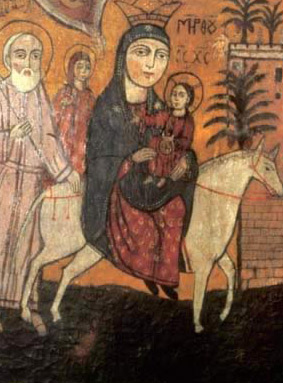 Source: Coptic icon of the Flight into Egypt, Church of Saints Sergius and Bacchus (Abu Serga), Cairo, 17th century, via Wikimedia Commons, Public Domain Mark, https://commons.wikimedia.org/wiki/File:Flight_into_Egypt_(coptic_icon).jpg
Spiritual Fruit 🍇
1. Let God expose what you lean on too much
Egypt’s river, wisdom, politics, and idols all fail. What in your life has become functional but absolute?
2. Let the sign-act preach before you explain it
Isaiah embodies a warning about false refuge. Receive its seriousness without repeating its exceptional act or using another person’s shame as a sermon illustration. Protection of exposed and endangered people belongs to faithfulness, not to the false trust the chapter condemns.
3. Believe that healing can follow judgment
The Lord smites and thoroughly heals Egypt. Ask Him to destroy the idols you choose and heal the wounds you bear. Do not confuse the two, or withhold care until a sufferer can explain the pain.
4. Expect grace to cross old enemy lines
Egypt, Assyria, and Israel stand together under blessing. The kingdom of God is larger than inherited hostility.
Closing Meditation
Lord who comes on the swift cloud, shake every idol, every false wisdom, and every borrowed confidence within us. Destroy our sin, heal wounded persons, hear the afflicted, and make in us a highway where old enmity gives way to Your blessing.
Glossary
- Egypt: In Isaiah, both ancient power and object of remarkable future mercy.
- Swift cloud: The image of divine visitation at the opening of chapter 19.
- Altar in Egypt: A startling sign of worship of the true God arising in a former land of bondage.
- Highway: The reconciled path between former enemies in Isaiah 19:23.
- False refuge: Chapter 20’s governing pastoral theme.
Translation and Source Notes
Embedded Scripture is from Brenton’s English Septuagint (LXX). Its directional clauses matter: the Egyptians serve the Assyrians in Isaiah 19:23, and Egypt is ashamed of its trust in Ethiopia in Isaiah 20:5. The wider Christian hope of communion and refuge must not replace those printed relations.
The guide also keeps chapter 20 attached to chapter 19 so the healing promise of Egypt is not misread as a political endorsement of Egypt.
Sources
Primary sources
Isaiah 19-20, Brenton Septuagint.
St. Irenaeus, Against Heresies 3.10, on Christ making salvation visible to all flesh.
St. John Chrysostom, Homilies on Acts, Homily II on Acts 1:6-11, on the cloud as a sign of divine power.
Eusebius of Caesarea, Proof of the Gospel 6.20 and 8.5, on the Lord’s coming to Egypt and worship in Egypt.
Coptic Orthodox / pastoral sources
Consulted Pascha table: Great Thursday, Eleventh Hour, Isaiah 19:19-25; a working-source witness, not a new app confirmation.
Direct Source Pages and Verification Links
Scripture text
- Brenton Septuagint, Isaiah 19: https://biblehub.com/sep/isaiah/19.htm
- Brenton Septuagint, Isaiah 20: https://biblehub.com/sep/isaiah/20.htm
Patristic source pages
-
St. John Chrysostom, Homilies on Acts, Homily II on Acts 1:6-11: https://www.ccel.org/ccel/schaff/npnf111.vi.ii.html#vi.ii-p9
-
Eusebius of Caesarea, Proof of the Gospel, on Isaiah 19:1-4 (CHAPTER 20): https://www.tertullian.org/fathers/eusebius_de_08_book6.htm#C20
-
Eusebius of Caesarea, Proof of the Gospel, on Isaiah 19:1-3 (CHAPTER 5): https://www.tertullian.org/fathers/eusebius_de_10_book8.htm#C5
-
St. Irenaeus of Lyons, Against Heresies 3.10, salvation visible to all flesh: https://www.newadvent.org/fathers/0103310.htm
Geography and visual context
- OpenBible.info, all places mentioned in Isaiah, interactive map and KML: https://www.openbible.info/geo/preview/isa
- Project Gutenberg, Hurlbut Bible Atlas, public-domain biblical geography background: https://www.gutenberg.org/cache/epub/41140/pg41140-images.html
- Wikimedia Commons, Coptic icon of the Flight into Egypt from Abu Serga, Public Domain Mark: https://commons.wikimedia.org/wiki/File:Flight_into_Egypt_(coptic_icon).jpg
Coptic lectionary provenance
- The Great Thursday placement follows the consulted Pascha working table; its exact hour and companions are distinguished from general Holy Thursday themes.
Teaching Notes
Overall teaching emphases
- Why these chapters stay together: Chapter 19 gives the full arc of Egypt judged and healed; chapter 20 interprets it through the sign against trusting Egypt and Ethiopia as political saviors.
- Where to linger: Isaiah 19:1, 19:12, 19:19-22, 19:25, and 20:6.
- Where to be careful: Teach 19:16 without weaponizing it against women, and teach 19:19-25 without turning it into nationalist triumphalism.
- Pastoral warning: Many hearers are happy to quote “Blessed be my people that is in Egypt” while still trusting worldly Egypts for safety.
- Key phrases to say slowly: “the Lord shall be known to the Egyptians,” “shall completely heal them,” and “how shall we be saved?”
Consolidated section teaching cues
Isaiah 19:1-4
- Key phrases: “the Lord comes to Egypt,” “idols shake before presence,” “false worship destabilizes a people.”
- Emphasize: The judgment begins not only in politics but in spiritual exposure.
- Avoid: Reading the civil conflict as a merely secular event. Isaiah ties it to worship and counsel gone wrong.
Isaiah 19:5-10
- Key phrases: “the river is Egypt’s confidence,” “ordinary prosperity can become false security,” “judgment reaches the daily economy.”
- Emphasize: Isaiah judges not only shrines and kings but also the false absoluteness of material systems.
- Avoid: Treating economic collapse as if it were spiritually irrelevant.
Isaiah 19:11-15
- Key phrases: “sophisticated blindness,” “wise men who cannot read God’s purpose,” “ancient prestige is not the same as wisdom.”
- Emphasize: Spiritual ignorance can hide inside elite confidence.
- Avoid: Teaching this section as anti-learning. Isaiah is not attacking wisdom itself, but wisdom severed from the Lord.
Isaiah 19:16-18
- Key phrases: “fear becomes the beginning of conversion,” “exposed vulnerability,” “Egypt begins to learn a new language.”
- Emphasize: The chapter pivots here from terror toward transformation.
- Avoid: Repeating verse 16 in a way that weaponizes it against women.
Isaiah 19:19-22
- Key phrases: “smite, return, hear, heal,” “Egypt is visited, not merely tolerated,” “salvation visible to all flesh.”
- Emphasize: Healing in Isaiah comes through return to the Lord.
- Avoid: Turning Egypt’s altar into ethnic triumphalism. The deeper point is the wideness of divine mercy.
Isaiah 19:23-25
- Key phrases: “the old map of enemies is overcome,” “election opens outward into blessing,” “God creates communion larger than inherited hostility.”
- Emphasize: The nations are not merely subdued. They are blessed.
- Avoid: Domesticating the shock of verse 25. Let it remain surprising.
Isaiah 20:1-6
- Key phrases: “chapter 20 guards chapter 19,” “false trust ends in shame,” “only after false refuges fail does the soul ask how it will be saved.”
- Emphasize: Divine mercy toward Egypt is not permission for Judah to lean on Egypt.
- Avoid: Turning the sign-act into spectacle. Its function is to expose dependence on worldly power.
Footnotes
-
St. John Chrysostom, Homilies on Acts, Homily II on Acts 1:6-11, cloud exposition: https://www.ccel.org/ccel/schaff/npnf111.vi.ii.html#vi.ii-p9. ↩
-
St. Irenaeus, Against Heresies 3.10.2: https://www.newadvent.org/fathers/0103310.htm. ↩
-
Eusebius of Caesarea, Proof of the Gospel 6.20, trans. W. J. Ferrar: https://www.tertullian.org/fathers/eusebius_de_08_book6.htm#C20. ↩
-
Eusebius of Caesarea, Proof of the Gospel 8.5, trans. W. J. Ferrar: https://www.tertullian.org/fathers/eusebius_de_10_book8.htm#C5. ↩