


This narration is from a previous version of the study and may include a combined recording of multiple chapters.
Isaiah 36-39 is the historical hinge of the book. After the long prophetic movement of Isaiah 1-35, Assyria is no longer only a warning in oracle form. Assyria stands at Jerusalem’s wall. The question becomes visible and urgent: will Judah trust Egypt, fear Assyria, or turn to the living God?
The section moves in four literary steps. Isaiah 36 shows the enemy’s speech: Rabsaces mocks trust, weaponizes fear, and tries to make surrender sound like blessing. Isaiah 37 shows the faithful response: Hezekiah tears his clothes, enters the house of the Lord, asks Isaiah for prayer, opens the threatening letter before God, and receives deliverance. Isaiah 38 turns the crisis inward: Hezekiah himself is sick unto death and learns that the God who can save a city can also hear tears in a sickroom. Isaiah 39 then exposes a subtler danger: received mercy is endangered as pride opens the house to Babylon.
The whole unit belongs together literarily and spiritually. Isaiah 34-35 closed the first major prophetic movement with judgment and the holy way. Isaiah 36-39 tests those themes in history: false refuge, Zion under threat, prayer, deliverance, death, healing, self-display, and exile. The Prayer of Hezekiah also has a place in Bright Saturday worship. Isaiah 40 will answer the Babylon warning with comfort. Public deliverance does not abolish mortality, and received mercy does not make vigilance unnecessary.
Historical and Scriptural Context
Isaiah 36-39 parallels 2 Kings 18-20 and 2 Chronicles 32. The historical crisis is the Assyrian invasion of Judah under Sennacherib during Hezekiah’s reign, traditionally placed in 701 BC. Assyria had already become the terrifying imperial power of the region. Smaller kingdoms were tempted to survive by diplomacy, tribute, military coalitions, and Egyptian help. Earlier in Isaiah, Egypt-trust had already been exposed as false refuge. Here that theme becomes narrative.
The Assyrian messenger’s speech is not merely political intimidation. It is theological warfare. He mocks Egypt as a bruised reed, but then he goes further and blasphemes the Lord by placing Him among the defeated gods of the nations. This is why Hezekiah’s prayer is not mainly, “Save my reputation,” or even, “Save my city.” He prays, “deliver us from his hands, that every kingdom of the earth may know that thou art God alone” (Isaiah 37:20, Brenton).
Isaiah 39 is also essential to the structure of the book. Babylon appears not as immediate conqueror but as future shadow. The treasures Hezekiah displays will be carried away. His children will be taken. This prepares the comfort movement beginning in Isaiah 40. The Lord will comfort His people, but the comfort comes after a truthful word about exile, pride, and the cost of sin.
Geographical Significance ⛰️
Lachish and Jerusalem
Rabsaces comes from Lachish to Jerusalem. Lachish was a major fortified city of Judah and a key target in Sennacherib’s campaign. The Assyrian pressure has already reached deep into Judah before the messenger stands at Jerusalem. The crisis is not imaginary anxiety. It is real imperial force.
The Assyrian Empire map shows Judah’s smallness without making imperial size the theological center. Isaiah 36-39 is not finally about Assyria’s greatness, but about the living God before whom Assyria’s voice is judged.
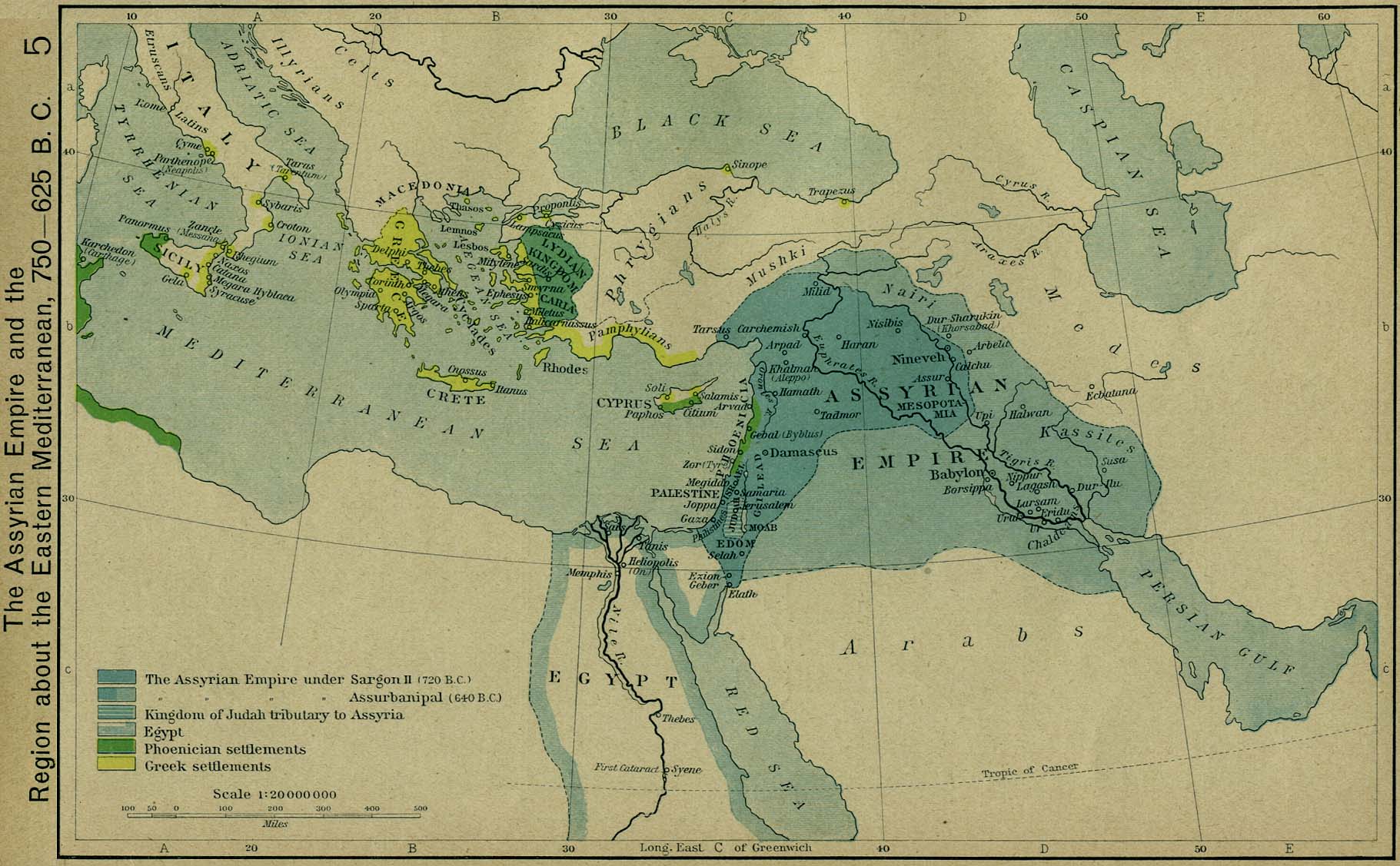 Source: William Robert Shepherd, map of the Assyrian Empire, 750 to 625 BC, via Wikimedia Commons, public domain, https://commons.wikimedia.org/wiki/File:Assyrian_empire_750_625.jpg
The conduit of the upper pool and the fuller’s field
The messenger stands “by the conduit of the upper pool in the way of the fuller’s field” (Isaiah 36:2). This recalls Isaiah 7:3, where Isaiah was sent to meet Ahaz at the same place during an earlier crisis. The repetition matters. Ahaz had been called to trust the Lord and failed. Now Hezekiah is tested at the same symbolic place: water, security, fear, and the temptation to trust visible power more than God.
The wall
The wall is where public fear is amplified. Rabsaces refuses to speak privately in Aramaic and instead speaks in the Jewish language to the men on the wall. This is propaganda aimed at the ordinary people. Spiritually, the wall is the place where fear tries to become communal. Hezekiah’s command to remain silent is therefore not weakness. It is disciplined refusal to let blasphemy control the conversation.
The house of the Lord and the house of treasures
Hezekiah enters the house of the Lord in chapter 37. In chapter 39 he shows Babylon the house of his treasures. The literary contrast is sharp. In danger he brings the threat to God; before the envoys he exposes his abundance. Where do I turn when threatened, and what do I seek when admired?
The Characters 👥
The Lord, the living God
The Lord is named as the God who sits upon the cherubim, the Maker of heaven and earth, and the only God of every kingdom of the world. He is not one deity among regional powers. He is the living God, blasphemed by Assyria and vindicated by His own act.
Hezekiah
Hezekiah is a righteous king, but not a flawless savior. He shows real faith in the Assyrian crisis and real tears in sickness. Yet he also shows dangerous vanity before Babylon. This makes him spiritually useful for the Church’s reading. He is a type of the faithful king who prays, but he also shows why we need Christ, the true Son of David whose humility does not collapse after victory.
Isaiah
Isaiah is the prophet who speaks the word of God into both public and private crisis. He answers the king’s fear, announces the Lord’s defense of Jerusalem, pronounces the sign of recovery, and also names the future exile. He does not flatter Hezekiah after deliverance.
Rabsaces and Sennacherib
Rabsaces is the voice of imperial contempt. Sennacherib is the power behind him. Together they represent the arrogant power that treats the living God as one defeated idol among many. Their downfall shows that blasphemous power can be loud, persuasive, and temporarily successful, yet still unable to enter the city God chooses to defend.
The remnant
The remnant is named in Isaiah 37:31-32: those left in Judah will take root downward and bear fruit upward. This is a deeply spiritual image. Fruitfulness depends on hidden rooting. The Church must learn to take root in prayer before bearing visible fruit in witness.
Babylonian envoys
The envoys from Babylon do not arrive with open threats. They arrive with letters, gifts, and curiosity about Hezekiah’s recovery. Their danger is subtle. The enemy at the wall is easier to recognize than the admiring visitor who awakens vanity.
🕯️ Light from the Word
Isaiah 36:1-22, the enemy’s speech at the wall
1 Now it came to pass in the fourteenth year of the reign of Ezekias, that Sennacherim, king of the Assyrians, came up against the strong cities of Judea, and took them. 2 And the king of the Assyrians sent Rabsaces out of Laches to Jerusalem to king Ezekias with a large force: and he stood by the conduit of the upper pool in the way of the fuller’s field. 3 And there went forth to him Heliakim the steward, the son of Chelcias, and Somnas the scribe, and Joach the son of Asaph, the recorder.
4 And Rabsaces said to them, Say to Ezekias, Thus says the great king, the king of the Assyrians, Why art thou secure? 5 Is war carried on with counsel and mere words of the lips? and now on whom dost thou trust, that thou rebellest against me? 6 Behold, thou trustest on this bruised staff of reed, on Egypt: as soon as a man leans upon it, it shall go into his hand, and pierce it: so is Pharao king of Egypt and all that trust in him. 7 But if ye say, We trust in the Lord our God; 8 yet now make an agreement with my lord the king of the Assyrians, and I will give you two thousand horses, if ye shall be able to set riders upon them. 9 And how can ye then turn to the face of the satraps? They that trust on the Egyptians for horse and rider are our servants. 10 And now, Have we come up against this land to fight against it without the Lord? The Lord said to me, Go up against this land, and destroy it.
11 Then Eliakim and Somnas and Joach said to him, Speak to thy servants in the Syrian tongue; for we understand it: and speak not to us in the Jewish tongue: and wherefore speakest thou in the ears of the men on the wall? 12 And Rabsaces said to them, Has my lord sent me to your lord or to you, to speak these words? has he not sent me to the men that sit on the wall, that they may eat dung, and drink their water together with you?
13 And Rabsaces stood, and cried with a loud voice in the Jewish language, and said, Hear ye the words of the great king, the king of the Assyrians: 14 thus says the king, Let not Ezekias deceive you with words: he will not be able to deliver you. 15 And let not Ezekias say to you, That God will deliver you, and this city will not at all be delivered into the hand of the king of the Assyrians. 16 Hearken not to Ezekias: thus says the king of the Assyrians, If ye wish to be blessed, come out to me: and ye shall eat every one of his vine and his fig-trees, and ye shall drink water out of your own cisterns; 17 until I come and take you to a land, like your own land, a land of corn and wine, and bread and vineyards. 18 Let not Ezekias deceive you, saying, God will deliver you. Have the gods of the nations delivered each one his own land out of the hand of the king of the Assyrians? 19 Where is the god of Emath, and Arphath? and where is the god of Eppharuaim? have they been able to deliver Samaria out of my hand? 20 Which is the god of all these nations, that has delivered his land out of my hand, that God should deliver Jerusalem out of my hand? 21 And they were silent, and none answered him a word; because the king had commanded that none should answer.
22 And Heliakim the son of Chelcias, the steward, and Somnas the military scribe, and Joach the son of Asaph, the recorder, came in to Ezekias, having their garments rent, and they reported to him the words of Rabsaces.
Rabsaces begins with the language of power: “Thus says the great king, the king of the Assyrians.” The formula resembles prophetic announcement, but the voice exalted is the Assyrian ruler’s. Evil can borrow the shape of divine speech while changing its source. The claim sounds authoritative, inevitable, almost prophetic, yet it asks Judah to measure truth by imperial success.
The speech has three movements. First, it attacks false refuge: Egypt is a bruised reed. Isaiah would agree that Egypt cannot save Judah. But the enemy uses a partial truth to drive the people into despair. Second, it twists theology: Rabsaces claims that the Lord Himself sent Assyria. Third, it offers a counterfeit peace: surrender and “eat every one of his vine and his fig-trees.” The language sounds like blessing, but it is exile dressed up as comfort.
The hardest spiritual attack is not always the obvious lie. It is the half-truth that removes God from the conclusion. Yes, Egypt cannot save. Yes, Judah is weak. Yes, Assyria has defeated many nations. But the living God is not one powerless idol among defeated nations. Faith must be honest about weakness without surrendering the truth of God.
Jerome explains the command not to answer as a refusal to provoke further blasphemy, linking it to the scriptural warning against kindling a sinner’s coals. This is a paraphrase of his Latin commentary on Isaiah 36:21.1 There is a time when answering feeds the attack. Here silence is disciplined by the king’s command and followed by prayer. It is not a general command that victims remain silent about harm.
Isaiah 37:1-7, sackcloth, the prophet, and the remnant
1 And it came to pass, when king Ezekias heard it, that he rent his clothes, and put on sackcloth, and went up to the house of the Lord.
2 And he sent Heliakim the steward, and Somnas the scribe, and the elders of the priests clothed with sackcloth, to Esaias the son of Amos, the prophet. And they said to him, Thus says Ezekias, 3 To-day is a day of affliction, and reproach, and rebuke, and anger: for the pangs are come upon the travailing woman, but she has not strength to bring forth. 4 May the Lord thy God hear the words of Rabsaces, which the king of the Assyrians has sent, to reproach the living God, even to reproach with the words which the Lord thy God has heard: therefore thou shalt pray to thy Lord for these that are left.
5 So the servants of king Ezekias came to Esaias. 6 And Esaias said to them, Thus shall ye say to your master, Thus saith the Lord, Be not thou afraid at the words which thou hast heard, wherewith the ambassadors of the king of the Assyrians have reproached me. 7 Behold, I will send a blast upon him, and he shall hear a report, and return to his own country, and he shall fall by the sword in his own land.
Hezekiah’s first response is not strategy but repentance and worship. He tears his clothes, puts on sackcloth, and enters the house of the Lord. He also sends the elders of the priests to Isaiah. This is not anti-intellectual panic. It is rightly ordered crisis: humility before God, appeal to prophetic truth, and prayer for the remnant.
The king’s words are painfully honest: “the pangs are come upon the travailing woman, but she has not strength to bring forth.” Judah is at the point of birth but lacks strength. In prophetic language, this is the agony of a people who cannot produce salvation from themselves. The remnant needs God to bring forth what human strength cannot.
The petition ends by asking Isaiah to pray for those who remain. The king and his officers cannot produce deliverance by rank. Their appeal admits need, and the remnant’s need becomes a shared burden of prayer. One person’s faith does not excuse the rest from seeking God together.
The Lord’s answer through Isaiah begins with “Be not thou afraid.” The enemy’s speech was designed to create fear. The prophetic word does not deny the threat; it names the deeper reality. The Lord has heard the blasphemy and will turn Assyria back.
Isaiah 37:8-38, the letter opened before the Lord and the angelic deliverance
8 So Rabsaces returned, and found the king of the Assyrians besieging Lobna: for he had heard that he had departed from Lachis. 9 And Tharaca king of the Ethiopians went forth to attack him. And when he heard it, he turned aside, and sent messengers to Ezekias, saying, 10 Thus shall ye say to Ezekias king of Judea, Let not thy God, in whom thou trustest, deceive thee, saying, Jerusalem shall not be delivered into the hand of the king of the Assyrians.
11 Hast thou not heard what the kings of the Assyrians have done, how they have destroyed the whole earth? and shalt thou be delivered? 12 Have the gods of the nations which my fathers destroyed delivered them, both Gozan, and Charrhan, and Rapheth, which are in the land of Theemath? 13 Where are the kings of Emath? and where is the king of Arphath? and where is the king of the city of Eppharuaim, and of Anagugana?
14 And Ezekias received the letter from the messengers, and read it, and went up to the house of the Lord, and opened it before the Lord. 15 And Ezekias prayed to the Lord, saying,
16 O Lord of hosts, God of Israel, who sittest upon the cherubs, thou alone art the God of every kingdom of the world: thou hast made heaven and earth. 17 Incline thine ear, O Lord, hearken, O Lord; open thine eyes, O Lord, look, O Lord: and behold the words of Sennacherim, which he has sent to reproach the living God. 18 For of a truth, Lord, the kings of the Assyrians have laid waste the whole world, and the countries thereof, 19 and have cast their idols into the fire: for they were no gods, but the work of men’s hands, wood and stone; and they have cast them away. 20 But now, O Lord our God, deliver us from his hands, that every kingdom of the earth may know that thou art God alone.
21 And Esaias the son of Amos was sent to Ezekias, and said to him, Thus saith the Lord, the God of Israel, I have heard thy prayer to me concerning Sennacherim king of the Assyrians. 22 This is the word which God has spoken concerning him; The virgin daughter of Sion has despised thee, and mocked thee; the daughter of Jerusalem has shaken her head at thee. 23 Whom hast thou reproached and provoked? and against whom hast thou lifted up thy voice? and hast thou not lifted up thine eyes on high against the Holy One of Israel? 24 For thou hast reproached the Lord by messengers; for thou hast said, With the multitude of chariots have I ascended to the height of mountains, and to the sides of Libanus; and I have cropped the height of his cedars and the beauty of his cypresses; and I entered into the height of the forest region: 25 and I have made a bridge, and dried up the waters, and every pool of water.
26 Hast thou not heard of these things which I did of old? I appointed them from ancient times; but now have I manifested my purpose of desolating nations in their strong holds, and them that dwell in strong cities. 27 I weakened their hands, and they withered; and they became as dry grass on the house-tops, and as grass. 28 But now I know thy rest, and thy going out, and thy coming in. 29 And thy wrath wherewith thou hast been enraged, and thy rancour has come up to me; therefore I will put a hook in thy nose, and a bit in thy lips, and will turn thee back by the way by which thou camest.
30 And this shall be a sign to thee, Eat this year what thou hast sown; and the second year that which is left: and the third year sow, and reap, and plant vineyards, and eat the fruit of them. 31 And they that are left in Judea shall take root downward, and bear fruit upward: 32 for out of Jerusalem there shall be a remnant, and the saved ones out of mount Sion: the zeal of the Lord of hosts shall perform this. 33 Therefore thus saith the Lord concerning the king of the Assyrians, He shall not enter into this city, nor cast a weapon against it, nor bring a shield against it, nor make a rampart round it. 34 But by the way by which he came, by it shall he return, and shall not enter into this city: thus saith the Lord. 35 I will protect this city to save it for my own sake, and for my servant David’s sake.
36 And the angel of the Lord went forth, and slew out of the camp of the Assyrians a hundred and eighty-five thousand: and they arose in the morning and found all these bodies dead. 37 And Sennacherim king of the Assyrians turned and departed, and dwelt in Nineve. 38 And while he was worshipping Nasarach his country’s god in the house, Adramelech and Sarasar his sons smote him with swords; and they escaped into Armenia: and Asordan his son reigned in his stead.
The second Assyrian message is a written threat. Hezekiah receives the letter, reads it, goes to the house of the Lord, and opens it before God. This is one of the most practical images of prayer in Scripture. He does not pretend the threat is not there. He does not let it remain only in his own mind. He places it in the presence of God.
Hezekiah’s prayer begins with who God is: “O Lord of hosts, God of Israel, who sittest upon the cherubs, thou alone art the God of every kingdom of the world: thou hast made heaven and earth.” Only after worship does he ask for deliverance. This order teaches the soul how to pray under pressure. Fear says, “Look first at the threat.” Faith says, “Look first at the Lord.”
The answer is both tender and severe. Zion, called the virgin daughter, despises the arrogant king. Assyria’s pride is exposed: it imagined its conquests were self-made, but the Lord says He had appointed and permitted what Assyria arrogantly claimed as its own. Then comes the sign of restoration: the remnant will take root downward and bear fruit upward. Hidden rooting precedes visible fruit.
The death of the Assyrian army is a hard text and must be handled carefully. Isaiah says the angel of the Lord slew 185,000 in the Assyrian camp. This is divine judgment in an Old Covenant historical crisis against a blaspheming imperial power threatening Zion. It is not a pattern for Christian violence or revenge. The Church receives it spiritually and Paschally: the Lord can overthrow powers that seem unconquerable, and He can defend His people when all visible strength fails. In Christ, the decisive victory is the Cross and Resurrection, where death is defeated not by human vengeance but by the self-giving victory of God.
The section ends with Sennacherib returning to Nineveh and being struck down in the house of his god. The contrast is complete. He mocked the living God as unable to save, but he dies while worshiping a powerless god. Isaiah does not invite gloating. He invites holy fear: blasphemous pride collapses in the very place where it expected protection.
Isaiah 38:1-8, sickness, tears, and the shadow turned back
1 And it came to pass at that time, that Ezekias was sick even to death. And Esaias the prophet the son of Amos came to him, and said to him, Thus saith the Lord, Give orders concerning thy house: for thou shalt die, and not live. 2 And Ezekias turned his face to the wall, and prayed to the Lord, saying, 3 Remember, O Lord, how I have walked before thee in truth, with a true heart, and have done that which was pleasing in thy sight. And Ezekias wept bitterly. 4 And the word of the Lord came to Esaias, saying, Go, and say to Ezekias, 5 Thus saith the Lord, the God of David thy father, I have heard thy prayer, and seen thy tears: behold, I will add to thy time fifteen years. 6 And I will deliver thee and this city out of the hand of the king of the Assyrians: and I will defend this city. 7 And this shall be a sign to thee from the Lord, that God will do this thing; 8 behold, I will turn back the shadow of the degrees of the dial by which ten degrees on the house of thy father the sun has gone down—I will turn back the sun the ten degrees; so the sun went back the ten degrees by which the shadow had gone down.
The narrative now turns from the public siege to Hezekiah’s sickness. Chapter order is not by itself a settled chronology: Isaiah 38:6 still promises deliverance from Assyria. The literary arrangement brings public danger and personal mortality together without proving that the illness occurred after the city was saved. The spiritual insight remains: deliverance from one crisis does not remove our need for mercy and life from God.
Isaiah’s word is blunt: “Give orders concerning thy house: for thou shalt die, and not live.” Hezekiah turns his face to the wall and weeps bitterly. St. Cyril of Jerusalem uses the passage to teach the power of repentance and confession, and to resist despair even when hope appears closed.2 The tears are not a payment that binds God. They are the king’s truthful appeal to the Giver of life.
This does not mean every illness will be reversed if we weep enough. The passage is not a formula. It reveals that God sees tears and that repentance is never meaningless before Him. Hezekiah receives fifteen more years, but he still remains mortal. Christ alone passes through death and breaks death’s dominion forever.
Cyril of Jerusalem sets the sun turning back for Hezekiah beside the darkened sun at Christ’s Crucifixion.2 The lesser sign serves the sick king; the greater cosmic sign accompanies the crucified Lord. Hezekiah’s life is extended, but Christ enters death and brings resurrection life. The contrast, not an astronomical explanation of the Cross, is Cyril’s concern.
Isaiah 38:9-22, the Prayer of Hezekiah
9 The Prayer of Ezekias king of Judea, when he had been sick, and was recovered from his sickness.
10 I said in the end of my days, I shall go to the gates of the grave: I shall part with the remainder of my years. 11 I said, I shall no more at all see the salvation of God in the land of the living: I shall no more at all see the salvation of Israel on the earth: I shall no more at all see man. 12 My life has failed from among my kindred: I have parted with the remainder of my life: it has gone forth and departed from me, as one that having pitched a tent takes it down again: my breath was with me as a weaver’s web, when she that weaves draws nigh to cut off the thread. 13 In that day I was given up as to a lion until the morning: so has he broken all my bones: for I was so given up from day even to night. 14 As a swallow, so will I cry, and as a dove, so do I mourn: for mine eyes have failed with looking to the height of heaven to the Lord, who has delivered me, 15 and removed the sorrow of my soul. 16 Yea, O Lord, for it was told thee concerning this; and thou hast revived my breath; and I am comforted, and live. 17 For thou hast chosen my soul, that it should not perish: and thou hast cast all my sins behind me. 18 For they that are in the grave shall not praise thee, neither shall the dead bless thee, neither shall they that are in Hades hope for thy mercy. 19 The living shall bless thee, as I also do: for from this day shall I beget children, who shall declare thy righteousness, 20 O God of my salvation; and I will not cease blessing thee with the psaltery all the days of my life before the house of God.
21 Now Esaias had said to Ezekias; Take a cake of figs, and mash them, and apply them as a plaister, and thou shalt be well. 22 And Ezekias said, This is a sign to Ezekias, that I shall go up to the house of God.
The Prayer of Hezekiah is one of the most spiritually intimate parts of the whole unit. He speaks from the edge of death: the gates of the grave, the tent taken down, the weaver’s thread cut off, the broken bones, the swallow and dove crying toward heaven. This is not abstract theology. It is the language of a man who has felt life leaving him.
The prayer also belongs to the Old Testament’s honest longing for life before the full light of Christ’s Resurrection. “They that are in the grave shall not praise thee, neither shall the dead bless thee, neither shall they that are in Hades hope for thy mercy.” The Church does not read this as the final word about the dead after Christ. Rather, we hear the depth of human longing before the Harrowing of Hades. Hezekiah’s fear becomes part of the long biblical cry that Christ answers by descending into death and filling Hades with His victory.
Verse 17 is especially pastoral: “thou hast chosen my soul, that it should not perish: and thou hast cast all my sins behind me.” Healing is not only an extension of time. It is received mercy. Verse 19 turns that mercy toward children who will declare God’s righteousness. In verse 21 the practical fig plaster belongs beside tears and divine promise: prayer does not exclude medical care. Receive treatment with prayer, without turning this particular recipe into a cure for modern disease.
St. Athanasius cites Hezekiah’s praise as a pattern of thanksgiving after affliction. He writes, “For at no time should a man freely praise God, more than when he has passed through afflictions; nor, again, should he at any time give thanks more than when he finds rest from toil and temptations.”3 Mercy should make us more thankful, more worshipful, and more ready to declare God’s righteousness to the next generation. Thanksgiving need not wait until every wound has disappeared.
Isaiah 39:1-8, Babylonian envoys and the danger after deliverance
1 At that time Marodach Baladan, the son of Baladan, the king of Babylonia, sent letters and ambassadors and gifts to Ezekias: for he had heard that he had been sick even to death, and was recovered. 2 And Ezekias was glad of their coming, and he shewed them the house of his spices, and of silver, and gold, and myrrh, and incense, and ointment, and all the houses of his treasures, and all that he had in his stores: and there was nothing in his house, nor in all his dominion, which Ezekias did not shew.
3 And Esaias the prophet came to king Ezekias, and said to him, What say these men? and whence came they to thee? and Ezekias said, They are come to me from a land afar off, from Babylon. 4 And Esaias said, What have they seen in thine house? and Ezekias said, They have seen everything in my house; and there is nothing in my house which they have not seen: yea, also the possessions in my treasuries. 5 And Esaias said to him, Hear the word of the Lord of hosts: 6 Behold, the days come, when they shall take all the things that are in thine house, and all that thy fathers have gathered until this day, shall go to Babylon; and they shall not leave anything at all: and God hath said, 7 that they shall take also of thy children whom thou shalt beget; and they shall make them eunuchs in the house of the king of the Babylonians. 8 And Ezekias said to Esaias, Good is the word of the Lord, which he hath spoken: let there, I pray, be peace and righteousness in my days.
The final chapter is short, but it is spiritually piercing. Hezekiah has survived Assyria and sickness. Then Babylon comes with letters, ambassadors, and gifts because they heard he had been sick and recovered. The danger is no longer an enemy shouting at the wall. The danger is admiration, curiosity, diplomacy, and the pleasure of being important.
St. Gregory the Dialogist uses Hezekiah’s display to warn people entrusted with responsibility. Many outward cares can leave the inner life unexamined. Gregory says, “For he who judges is within; that which is judged is within.”4 A leader may avoid obvious cruelty and still let admiration displace humble self-knowledge. Responsibility makes that scrutiny more necessary, not less.
Aphrahat also uses Hezekiah’s wealth as a warning against a heart lifted up by abundance.5 The particular display stands beside the particular prophecy of loss. It is not a universal law that gifts we show will be taken away. Theft, bereavement, disaster, or illness does not reveal hidden vanity in the sufferer. Gifts may be shared gratefully and innocently; the question here is whether gratitude has become self-exaltation.
Hezekiah’s final response is difficult: “Good is the word of the Lord” and “let there, I pray, be peace and righteousness in my days.” This may express submission, yet it also leaves the future children’s cost before us. We need not invent one settled motive to feel the moral pressure. In chapter 38 children were to inherit thanksgiving; in chapter 39 they face captivity. A leader’s horizon must reach beyond his own lifetime. Christ, the true King, gives Himself for His children rather than preserving Himself at their cost.
Babylon’s warning leads directly into the next chapter’s word of comfort. The future is neither secured by Hezekiah’s treasures nor exhausted by his failure. The Lord who names exile will also speak to His people’s heart. Vigilance is therefore not despair about every good gift, but the work of receiving mercy without treating it as our own achievement.
Orthodox Theological Reading
Isaiah 36-39 teaches the Orthodox pattern of trust under pressure. The believer is attacked from outside by fear, from inside by mortality, and after mercy by pride. Assyria, sickness, and Babylon are not random episodes. They reveal three arenas of spiritual warfare: threat, death, and vanity.
The first answer is prayer. Hezekiah does not answer blasphemy with blasphemy. He brings the matter into the house of the Lord. He opens the letter before God. This is a practical icon of Orthodox prayer: place the real threat before the real God. Do not spiritualize away the letter. Do not let the letter define reality. Put it before the Lord who sits upon the cherubim.
The second response is tears before God. Cyril receives Hezekiah’s appeal as an example of repentance and confession.2 The Church also knows that every temporary healing points beyond itself. Fifteen years are mercy, not immortality. Christ alone makes healing final by entering death and rising. A sick person’s tears, or inability to weep, cannot be used to calculate the quality of faith.
The third lesson is vigilance after deliverance. Hezekiah’s failure before Babylon warns the soul that prosperity can be more dangerous than attack. When Assyria threatens, Hezekiah seeks God. When Babylon admires, Hezekiah displays himself. The Church must teach this plainly. Spiritual life does not end when the crisis passes. Gratitude must become humility, not self-display.
Christological Reading
Hezekiah is a partial type of the faithful Davidic king. He prays for his people, seeks the prophet, enters the house of the Lord, and receives deliverance for Jerusalem. Yet he is also a limited king. He becomes sick, fears death, is granted more years, and later exposes his treasures. The contrast points to Christ, the true Son of David. Christ does not merely receive a temporary extension of mortal life; He conquers death. He does not display treasures to secure His reputation; He empties Himself. He does not save His people by preserving Himself; He saves them by the Cross.
The line “for my own sake, and for my servant David’s sake” (Isaiah 37:35) is part of the Davidic horizon that finds its fullness in Christ. Jerusalem is defended because God’s covenant purpose has not failed. The final Davidic King will not only defend one city from Assyria. He will gather the nations, defeat death, and make the Church the city set on the holy mountain.
Cyril’s contrast between the reversed sun-sign and the darkened sun at the Cross points beyond Hezekiah.2 One sign accompanies extended mortal life; the Crucifixion and Resurrection open life incorruptible. The king receives more time. Christ saves us from death’s final dominion.
The Prayer of Hezekiah is also Paschal. His fear of Hades and his thanksgiving after deliverance prepare the Church to hear the deeper answer of Bright Saturday: Christ descends into Hades, breaks its bars, and turns the cry of the dying into praise.
Isaiah 39 does not close the Lord’s purpose for His people or the nations. It opens the wound that the following word of comfort addresses. The reader can confess Hezekiah’s failure without making failure the final truth about a person who has received mercy.
Christological Types and Prophecies
- Hezekiah as a limited Davidic type: He prays for the city and receives deliverance, but his mortality and pride show that he is not the final King.
- The Lord’s defense for David’s sake: Isaiah 37:35 keeps the Davidic promise alive and points toward Christ, the true Son of David.
- The angelic overthrow of Assyria: The sudden defeat of the blaspheming army prefigures the Lord’s victory over powers that human strength cannot overcome, fulfilled supremely in Christ’s Pascha.
- The remnant taking root downward: Isaiah 37:31-32 points to the Church’s hidden rootedness in Christ before visible fruit.
- Hezekiah’s tears and healing: His recovery is a sign of divine compassion, but only Christ’s death and Resurrection transform death itself.
- The reversed shadow and the darkened sun: The sign for Hezekiah is surpassed by the cosmic sign at the Crucifixion and by the Resurrection’s new light.
- The Prayer of Hezekiah: The cry from the edge of Hades becomes, in the Church’s Paschal reading, a preparation for Christ’s descent and victory.
- Babylon’s warning and the word of comfort: The announced exile makes the Lord’s coming consolation in Isaiah 40 more necessary, not less credible.
Liturgical and Coptic Connections
The Coptic lectionary and Bright Saturday service book give two distinct appointments here:6
- Isaiah 37:33-38:6: Monday of the fifth week of Great Lent, one prophecy spanning the chapter boundary. Its prophecy companions are Proverbs 3:5–18 and Job 22:1–30.
- Isaiah 38:10-20: Bright Saturday Midnight Praises, the Prayer of Hezekiah within the Praises of the Prophets.
The Lenten appointment places the city’s promised defense beside the king’s tears without settling the chronology of the underlying events. Proverbs calls for trust rather than self-reliance. Job’s companion speech must be heard as part of that book’s argument, not as permission to blame a sick neighbor. On Bright Saturday the prayer stands among the prayers of Jonah, Daniel, Hannah, and others. The Church hears the cry from death’s edge in the light of Christ’s descent into Hades and Resurrection. These are spiritual connections within the named services, not a promise that every crisis ends in temporal recovery.
Patristic Commentary Highlights
-
Jerome explains the silence before Rabsaces as refusal to provoke further blasphemy, not indifference to danger.1
-
Cyril of Jerusalem uses Hezekiah to resist despair and compares the sun-sign with the greater sign at Christ’s Cross.2
-
Athanasius receives Hezekiah’s praise as a call to thanksgiving after affliction.3
-
Gregory the Dialogist warns that outward responsibility must not displace inward self-examination.4
-
Aphrahat warns against boasting in wealth through Hezekiah’s example. His warning is for our repentance, not for diagnosing someone else’s loss.5
Spiritual Lessons
- Fear often speaks with borrowed authority. Rabsaces sounds official, inevitable, and almost prophetic, but his authority is counterfeit.
- A half-truth can be spiritually dangerous. Egypt really cannot save, but the enemy uses that truth to deny the Lord’s power.
- Do not answer every blasphemous voice. Some speech should be met with silence, prayer, and obedience rather than reactive argument.
- Open the letter before the Lord. Bring concrete threats into prayer instead of letting them rule the imagination.
- Take root downward before bearing fruit upward. The remnant’s visible fruit depends on hidden rootedness in God.
- Tears matter, but Christ is more than extended life. Hezekiah receives fifteen years; Christ gives resurrection.
- Mercy calls for vigilance, not suspicion of every gift. Hezekiah’s display warns against vanity; another person’s loss is not evidence of hidden pride.
- Healed life should become liturgical life. The mercy that restores us should make us people of thanksgiving before the house of God.
- Do not seek only peace in your own days. Faithfulness must care about the generations that come after us.
Closing Meditation
The enemy came to the wall with loud words, but Hezekiah brought the letter into the house of the Lord. The sick king turned his face to the wall, but the Lord saw his tears. The shadow turned back, the city was spared, and the remnant was promised roots and fruit. Yet the same king who prayed well under threat became careless under admiration.
Isaiah 36-39 therefore teaches us to trust God in danger, repent before death, and remain humble after mercy. Christ is the fulfillment of what Hezekiah could only foreshadow. He is the true King who opens not a letter but our whole condition before the Father. He enters death itself, not to gain fifteen more years, but to destroy death by His death. He guards the true Zion, gathers the remnant, and opens His kingdom to worshipers from the nations.
Translation, Version, and Source Notes
Embedded Scripture is from Brenton’s English Septuagint (LXX). Brenton uses the title Esaias; this guide uses Isaiah. The displayed Scripture retains its own names and wording. Christian fulfillment and further spiritual applications are distinguished from the words of the prophetic text.
Sources
The passage-specific sources cited in the footnotes below support the retained patristic and worship connections.
Teaching Notes
Overall teaching emphases
- Main teaching aim: Help the class read Isaiah 36-39 - Hezekiah Assyria and Babylon as part of Isaiah’s movement from judgment to hope, with Christ and the Church in view.
- Where to linger: Slow down at the guide’s stated turning points, verified lectionary anchors, patristic witnesses, and difficult pastoral guardrails rather than racing through every verse.
- Teacher preparation: Read the full passage and its footnotes; distinguish prophecy, Christian fulfillment, and pastoral application.
- Show: Use the Assyrian Empire map before Isaiah 36 to help readers see Judah under imperial pressure, then return to Hezekiah opening the letter before the Lord so the map serves prayer, not geopolitics.
Consolidated section teaching cues
Isaiah 36:1-22, the enemy’s speech at the wall
- Key phrases: “counterfeit prophecy,” “half-truth without God,” “disciplined silence.”
- Emphasize: Rabsaces is not merely a military spokesman. He is the voice of fear, propaganda, and blasphemous confidence.
- Avoid: Treating silence as cowardice. In this passage, silence keeps the people from being dragged into the enemy’s terms.
Isaiah 37:1-7, sackcloth, the prophet, and the remnant
- Key phrases: “sackcloth before strategy,” “the remnant needs prayer,” “be not afraid.”
- Emphasize: Orthodox crisis response begins with repentance, worship, spiritual counsel, and prayer.
- Avoid: Presenting Hezekiah’s repentance as a technique to force God. It is humility before the living God.
Isaiah 37:8-38, the letter opened before the Lord and the angelic deliverance
- Key phrases: “open the letter before the Lord,” “root downward, fruit upward,” “God judges blasphemous power.”
- Emphasize: Prayer begins with who God is before it names what the enemy threatens.
- Avoid: Using the Assyrian slaughter as permission for revenge. The Christian reading is repentance, trust, and Paschal confidence in God’s victory.
Isaiah 38:1-8, sickness, tears, and the shadow turned back
- Key phrases: “public deliverance, private mortality,” “tears seen by God,” “the lesser sign and the greater Christ.”
- Emphasize: Hezekiah’s healing reveals God’s compassion, but it does not replace the resurrection hope fulfilled in Christ.
- Avoid: Turning the passage into a simplistic guarantee of physical healing.
Isaiah 38:9-22, the Prayer of Hezekiah
- Key phrases: “the gates of the grave,” “sins cast behind God,” “healed life becomes liturgical life.”
- Emphasize: The prayer is a school of thanksgiving after affliction and a cry that finds its full answer in Christ’s descent into Hades and Resurrection.
- Avoid: Reading Hezekiah’s words about Hades as if the Church had not received the Paschal revelation of Christ’s victory over death.
Isaiah 39:1-8, Babylonian envoys and the danger after deliverance
- Key phrases: “the danger after mercy,” “unguarded vanity,” “care for the next generation.”
- Emphasize: The enemy at the wall is easier to recognize than pride awakened by admiration.
- Avoid: Excusing self-display or making loss proof of pride. Keep the warning particular and the concern for future children concrete.
Discussion questions
- What voices in your life sound like Rabsaces: authoritative, frightening, and partly true, but ultimately faithless?
- What would it look like to “open the letter before the Lord” in a concrete anxiety you are carrying?
- How does the literary pairing of the siege and sickness enlarge our prayer without proving a precise chronology?
- How does the Bright Saturday use of Hezekiah’s prayer deepen the Church’s understanding of Hades and hope?
- Where are you most vulnerable after mercy: fear, forgetfulness, vanity, or self-display?
- How does Hezekiah point to Christ, and where does Hezekiah’s limitation make Christ’s glory clearer?
- What treasures, gifts, or accomplishments need to be guarded with humility rather than displayed for admiration?
Footnotes
-
Jerome, Commentary on Isaiah, book XI, on Isaiah 36:21 (paraphrased from Latin). https://la.wikisource.org/wiki/Commentaria_in_Isaiam_(Hieronymus)/11. ↩ ↩2
-
Cyril of Jerusalem, Catechetical Lecture, 2.15. https://www.newadvent.org/fathers/310102.htm. ↩ ↩2 ↩3 ↩4 ↩5
-
Athanasius of Alexandria, Festal Letter 10, 3. https://www.newadvent.org/fathers/2806010.htm. ↩ ↩2
-
Gregory the Dialogist, Pastoral Rule, 1.4. https://www.newadvent.org/fathers/36011.htm. ↩ ↩2
-
Aphrahat, Demonstration 5, 7. https://www.ccel.org/ccel/schaff/npnf213.iii.ix.iv.html. ↩ ↩2
-
Coptic Great Lent Katameros, Monday of week five, Isaiah 37:33–38:6; Bright Saturday, Midnight Praises, Praises of the Prophets, Prayer of Hezekiah, Isaiah 38:10–20. ↩