


This narration was recorded before the latest revision of this study.
Hezekiah reforms Judah, hears Assyria’s threats, and spreads its letter before the living God, who defends Jerusalem for His own sake.
Assyria speaks as if its victories have settled the question of who rules the world. Hezekiah has seen conquered cities, paid tribute, and stripped temple gold, yet the threatening voice still reaches Jerusalem’s walls. His prayer neither minimizes the danger nor accepts the enemy’s interpretation of it. He brings the letter before the Creator, asking for deliverance so that the kingdoms may know the Lord.
Historical and Scriptural Context
After the northern kingdom’s fall, Judah faces the same imperial power. Isaiah 36-37 and 2 Chronicles 32 preserve parallel accounts. Second Chronicles 29-31 describes Hezekiah’s temple cleansing and Passover more fully than Kings’ opening verses. Sirach 48:17-21 remembers the siege, the people’s appeal, Isaiah, and the angelic deliverance. These witnesses extend the memory without replacing Kings’ particular account.
Geographical Significance ⛰️
Lachis, Lachish, is the Assyrian campaign base; Jerusalem is the threatened city. The spokesman stands at the upper pool’s aqueduct, where Isaiah met Ahaz during the crisis of 2 Kings 16 (Isaiah 7:3). That shared place joins two kings’ responses to fear. Lobna, Libnah, appears as the campaign moves; Nineve, Nineveh, becomes the place of Sennacherib’s return. The final journey reverses the conqueror’s advance.
The Characters 👥
Hezekiah trusts and reforms, yet also pays tribute before turning to prayer. Sennacherib commands the invading empire and mistakes its achievements for unlimited power. Rabshakeh attacks the people’s trust through public speech. Eliakim, Shebna, and Joah (Brenton’s Joas) receive and report the message. Eliakim’s stewardship recalls the key of David’s house in Isaiah 22:20-22, a figure taken up in Revelation 3:7. Isaiah answers the humbled king with the Lord’s word. The angel of the Lord brings the promised deliverance.
Name key for the reading: Ezekias is Hezekiah; Achaz is Ahaz; Osee is Hoshea; Salamanassar is Shalmaneser; Sennacherim is Sennacherib; Rapsakes is the Rabshakeh, an Assyrian official’s title; Heliakim is Eliakim; Somnas is Shebna; Esaias is Isaiah; Neesthan is Nehushtan; Tharaca is Tirhakah; Meserach is Nisroch; Lachis is Lachish; Lobna is Libnah; Nineve is Nineveh.
Hezekiah’s reform and trust (2 Kings 18:1-8)
1 And it came to pass in the third year of Osee son of Ela king of Israel that Ezekias son of Achaz king of Juda began to reign. 2 Five and twenty years old was he when he began to reign, and he reigned twenty and nine years in Jerusalem: and his mother’s name was Abu, daughter of Zacharias. 3 And he did that which was right in the sight of the Lord, according to all that his father David did. 4 He removed the high places, and broke in pieces the pillars, and utterly destroyed the groves, and the brazen serpent which Moses made: because until those days the children of Israel burnt incense to it: and he called it Neesthan. 5 He trusted in the Lord God of Israel; and after him there was not any like him among the kings of Juda, nor among those that were before him. 6 And he clave to the Lord, he departed not from following him; and he kept his commandments, as many as he commanded Moses.
7 And the Lord was with him; and he was wise in all that he undertook: and he revolted from the king of the Assyrians, and served him not. 8 He smote the Philistines even to Gaza, and to the border of it, from the tower of the watchmen even to the strong city.
Hezekiah removes the high places that earlier kings left standing. Trust becomes obedience: he clings to the Lord and keeps Moses’ commandments. The account does not describe faith as a feeling added to political strength; it shows allegiance expressed through the removal of rival worship.
The bronze serpent is the most searching example. Numbers 21:4-9 records its original place in God’s healing provision. Wisdom 16:5-7 explains that those who turned toward it were saved by the Savior of all, not by the thing seen. Now incense is being offered to the object itself. Hezekiah destroys it because a former instrument of mercy has become an object of idolatry.
John 3:14-15 identifies the serpent’s raising as a figure of Christ lifted up for life. This does not authorize despising holy things. It distinguishes the sign from the Lord to whom it points. An icon, relic, or sacred place is honored in communion with God, never treated as a controllable substitute for Him.
Assyria’s shadow and the fall of Israel recalled (2 Kings 18:9-12)
9 And it came to pass in the fourth year of king Ezekias (this is the seventh year of Osee son of Ela king of Israel,) that Salamanassar king of the Assyrians came up against Samaria, and besieged it. 10 And he took it at the end of three years, in the sixth year of Ezekias, (this is the ninth year of Osee king of Israel, when Samaria was taken.) 11 And the king of the Assyrians carried away the Samaritans to Assyria, and put them in Alaë and in Abor, by the river Gozan, and in the mountains of the Medes; 12 because they hearkened not to the voice of the Lord their God, and transgressed his covenant, even in all things that Moses the servant of the Lord commanded, and hearkened not to them, nor did them.
The account pauses to recall Samaria’s siege and removal. Judah knows the threat through the fate of its northern neighbor. The narrator also names the reason for that fall: the people would not hear or do what the covenant commanded. Military weakness is not the whole explanation.
Hezekiah’s trust must be heard with this memory close by. Jerusalem has no reason to assume that a sacred history makes it untouchable. The contrast between hearing and doing in verse 12 calls Judah to the obedience Israel refused. The same warning meets Christians who know the words of Scripture but keep delaying their response.
Sennacherib’s pressure and Hezekiah’s tribute (2 Kings 18:13-16)
13 And in the fourteenth year of king Ezekias came up Sennacherim king of the Assyrians against the strong cities of Juda, and took them. 14 And Ezekias king of Juda sent messengers to the king of the Assyrians to Lachis, saying, I have offended; depart from me: whatsoever thou shalt lay upon me, I will bear. And the king of Assyria laid upon Ezekias king of Juda a tribute of three hundred talents of silver, and thirty talents of gold. 15 And Ezekias gave all the silver that was found in the house of the Lord, and in the treasures of the king’s house. 16 At that time Ezekias cut off the gold from the doors of the temple, and from the pillars which Ezekias king of Juda had overlaid with gold, and gave it to the king of the Assyrians.
Hezekiah sends an admission of offense and promises to bear whatever Assyria imposes. The payment empties treasury silver and removes gold from doors and pillars he himself had adorned. His prior reform does not make him immune to fear or guarantee that each decision is exemplary.
Kings records the cost without supplying a separate divine verdict on the tribute here. What follows shows its inadequacy: the Assyrian delegation still comes against Jerusalem. The king cannot buy the final security he needs. This prepares the prayer without making his earlier weakness cancel his genuine trust.
Rabshakeh’s speech: psychological and theological warfare (2 Kings 18:17-37)
17 And the king of the Assyrians sent Tharthan and Raphis and Rapsakes from Lachis to king Ezekias with a strong force against Jerusalem. And they went up and came to Jerusalem, and stood by the aqueduct of the upper pool, which is by the way of the fuller’s field. 18 And they cried to Ezekias: and there came to him Heliakim the son of Chelcias the steward, and Somnas the scribe, and Joas the son of Saphat the recorder.
19 And Rapsakes said to them, Say now to Ezekias, Thus says the king, the great king of the Assyrians, What is this confidence wherein thou trustest? 20 Thou hast said, (but they are mere words,) I have counsel and strength for war. Now then in whom dost thou trust, that thou hast revolted from me? 21 See now, art thou trusting for thyself on this broken staff of reed, even upon Egypt? whosoever shall stay himself upon it, it shall even go into his hand, and pierce it: so is Pharao king of Egypt to all that trust on him. 22 And whereas thou hast said to me, We trust on the Lord God: is not this he, whose high places and altars Ezekias has removed, and has said to Juda and Jerusalem, Ye shall worship before this altar in Jerusalem? 23 And now, I pray you, make an agreement with my lord the king of the Assyrians, and I will give thee two thousand horses, if thou shalt be able on thy part to set riders upon them. 24 How then wilt thou turn away the face of one petty governor from among the least of my lord’s servants? whereas thou trustest for thyself on Egypt for chariots and horsemen. 25 And now have we come up without the Lord against this place to destroy it? The Lord said to me, Go up against this land, and destroy it.
26 And Heliakim the son of Chelkias, and Somnas, and Joas, said to Rapsakes, Speak now to thy servants in the Syrian language, for we understand it; and speak not with us in the Jewish language: and why dost thou speak in the ears of the people that are on the wall? 27 And Rapsakes said to them, Has my master sent me to thy master, and to thee, to speak these words? has he not sent me to the men who sit on the wall, that they may eat their own dung, and drink their own water together with you?
28 And Rapsakes stood, and cried with a loud voice in the Jewish language, and spoke, and said, Hear the words of the great king of the Assyrians: 29 thus says the king, Let not Ezekias encourage you with words: for he shall not be able to deliver you out of his hand. 30 And let not Ezekias cause you to trust on the Lord, saying, The Lord will certainly deliver us; this city shall not be delivered into the hand of the king of the Assyrians: hearken not to Ezekias: 31 for thus says the king of the Assyrians, Gain my favour, and come forth to me, and every man shall drink of the wine of his own vine, and every man shall eat of his own fig-tree, and shall drink water out of his own cistern; 32 until I come and remove you to a land like your own land, a land of corn and wine, and bread and vineyards, a land of olive oil, and honey, and ye shall live and not die: and do not ye hearken to Ezekias, for he deceives you, saying, The Lord shall deliver you. 33 Have the gods of the nations at all delivered each their own land out of the hand of the king of the Assyrians? 34 Where is the god of Hæmath, and of Arphad? where is the god of Seppharvaim, Ana, and Aba? for have they delivered Samaria out of my hand? 35 Who is there among all the gods of the countries, who have delivered their countries out of my hand, that the Lord should deliver Jerusalem out of my hand?
36 But the men were silent, and answered him not a word: for there was a commandment of the king, saying, Ye shall not answer him. 37 And Heliakim the son of Chelcias, the steward, and Somnas the scribe, and Joas the son of Saphat the recorder came in to Ezekias, having rent their garments; and they reported to him the words of Rapsakes.
Rabshakeh first attacks military confidence. Egypt is a broken reed that wounds the one leaning on it; Judah cannot even supply riders for the horses he mockingly offers. His argument begins with real vulnerability and then treats weakness as proof that resistance is foolish. Fear becomes more persuasive when it uses facts selectively.
Second, he attacks confidence in Hezekiah’s reform. The high places were removed, so he alleges the king offended the God on whom Judah depends. He misunderstands, or misrepresents, obedience as impiety. He then claims that the Lord authorized his invasion. Isaiah 10:5-15 does call Assyria a rod of judgment, but also condemns its arrogance. Being used within providence does not make an empire’s desires righteous or every claim it makes a divine word.
Third, he attacks the people’s endurance and belonging. Speaking in “the Jewish language,” he deliberately reaches the men on the wall with the degradation of siege. He promises each man his vine, fig-tree, and cistern, followed by removal to a land like their own. This is a counterfeit covenant promise. First Kings 4:25 and Micah 4:4 describe peaceful life beneath vine and fig-tree; Deuteronomy 8:7-9 describes the good land. The enemy borrows the Lord’s gifts as the language of exile. Matthew 4:8-9 exposes the same temptation to receive apparent abundance by surrendering allegiance.
Finally, he attacks the Lord’s power. Other gods did not save their lands, so he concludes Jerusalem’s God cannot save either. He treats the Creator as another defeated local deity. The central issue now lies beyond army size: who is the Lord?
The people obey the king and remain silent. Their silence refuses the enemy’s chosen terms of debate; the officers bring the words back with torn garments. Silence here is disciplined obedience, not a general command never to answer abuse, report wrongdoing, or seek help.
Hezekiah seeks Isaiah (2 Kings 19:1-7)
1 And it came to pass when king Ezekias heard it, that he rent his clothes, and put on sackcloth, and went into the house of the Lord. 2 And he sent Heliakim the steward, and Somnas the scribe, and the elders of the priests, clothed with sackcloth, to Esaias the prophet the son of Amos. 3 And they said to him, Thus says Ezekias, This day is a day of tribulation, and rebuke, and provocation: for the children are come to the travail-pangs, but the mother has no strength. 4 Peradventure the Lord thy God will hear all the words of Rapsakes, whom the king of Assyria his master has sent to reproach the living God and to revile him with the words which the Lord thy God has heard: and thou shalt offer thy prayer for the remnant that is found.
5 So the servants of king Ezekias came to Esaias. 6 And Esaias said to them, Thus shall ye say to your master, Thus saith the Lord, Be not afraid of the words which thou hast heard, wherewith the servants of the king of the Assyrians have blasphemed. 7 Behold, I send a blast upon him, and he shall hear a report, and shall return to his own land; and I will overthrow him with the sword in his own land.
Hezekiah tears his clothing, puts on sackcloth, and enters the Lord’s house. He also seeks Isaiah through officers and elders of the priests. Humility makes him willing to ask for prayer, rather than carry the danger alone as though kingship required self-sufficiency.
The image of children at the birth with no strength to deliver them gives helplessness a bodily urgency. Something must happen, yet human capacity is exhausted. The king asks Isaiah to pray for the remnant and names the insult as reproach against “the living God.” Assyria’s victory list cannot define the God whose life is not dependent on a city’s survival.
Isaiah’s answer addresses the words themselves: do not fear them. The Lord will turn the enemy back and bring his end in his own land. The promise does not tell Hezekiah to pretend the army is absent. It tells him whose word must govern his fear.
The threatening letter spread before the Lord (2 Kings 19:8-19)
8 So Rapsakes returned, and found the king of Assyria warring against Lobna: for he heard that he had departed from Lachis. 9 And he heard concerning Tharaca king of the Ethiopians, saying, Behold, he is come forth to fight with thee: and he returned, and sent messengers to Ezekias, saying, 10 Let not thy God on whom thou trustest encourage thee, saying, Jerusalem shall not be delivered into the hands of the king of the Assyrians. 11 Behold, thou hast heard all that the kings of the Assyrians have done in all the lands, to waste them utterly: and shalt thou be delivered? 12 Have the gods of the nations at all delivered them, whom my fathers destroyed; both Gozan, and Charran, and Raphis, and the sons of Edem who were in Thaesthen? 13 Where is the king of Hæmath, and the king of Arphad? and where is the king of the city of Seppharvaim, of Ana, and Aba?
14 And Ezekias took the letter from the hand of the messengers, and read it: and he went up to the house of the Lord, and Ezekias spread it before the Lord, 15 and said, O Lord God of Israel, that dwellest over the cherubs, thou art the only God in all the kingdoms of the earth; thou hast made heaven and earth. 16 Incline thine ear, O Lord, and hear: open, Lord, thine eyes, and see: and hear the words of Sennacherim, which he has sent to reproach the living God. 17 For truly, Lord, the kings of Assyria have wasted the nations, 18 and have cast their gods into the fire: because they are no gods, but the works of men’s hands, wood and stone; and they have destroyed them. 19 And now, O Lord our God, deliver us out of his hand, and all the kingdoms of the earth shall know that thou alone art the Lord God.
The second threat tries to close the opening Isaiah’s answer has given. Sennacherib’s message again uses conquered lands to present deliverance as impossible. Hezekiah reads it, takes it into the temple, and spreads it before the Lord. He refuses to let the written threat remain the final document in the case.
His address joins the Lord’s dwelling “over the cherubs” with His universal sovereignty: “thou art the only God” who made heaven and earth. The temple is a place of divine presence, not a limit on divine power. Hezekiah asks the Lord to hear the insult against the living God and distinguish Himself from idols made of wood and stone.
The king does not deny the enemy’s record: Assyria has wasted nations and burned their gods. He denies the conclusion drawn from it. Those objects were not gods. The prayer ends beyond survival, asking that all kingdoms know the Lord. In crisis, prayer can hold the evidence honestly while refusing the false meaning fear gives it.
Isaiah’s answer: Assyria judged, Zion preserved (2 Kings 19:20-34)
Translation note: Brenton 19:25 prints an assertion about bringing the matter to its conclusion where the NKJV gives a rhetorical question about God’s earlier purpose. The prophetic reply must be read in its displayed wording.
20 And Esaias the son of Amos sent to Ezekias, saying, Thus saith the Lord God of hosts, the God of Israel, I have heard thy prayer to me concerning Sennacherim king of the Assyrians. 21 This is the word which the Lord has spoken against him; The virgin daughter of Sion has made light of thee, and mocked thee; the daughter of Jerusalem has shaken her head at thee. 22 Whom hast thou reproached, and whom hast thou reviled? and against whom hast thou lifted up thy voice, and raised thine eyes on high? Is it against the Holy One of Israel?
23 By thy messengers thou hast reproached the Lord, and hast said, I will go up with the multitude of my chariots, to the height of the mountains, to the sides of Libanus, and I have cut down the height of his cedar, and his choice cypresses; and I have come into the midst of the forest and of Carmel. 24 I have refreshed myself, and have drunk strange waters, and I have dried up with the sole of my foot all the rivers of fortified places. 25 I have brought about the matter, I have brought it to a conclusion; and it is come to the destruction of the bands of warlike prisoners, even of strong cities. 26 And they that dwelt in them were weak in hand, they quaked and were confounded, they became as grass of the field, or as the green herb, the grass growing on houses, and that which is trodden down by him that stands upon it. 27 But I know thy down-sitting, and thy going forth, and thy rage against me. 28 Because thou wast angry against me, and thy fierceness is come up into my ears, therefore will I put my hooks in thy nostrils, and my bridle in thy lips, and I will turn thee back by the way by which thou camest.
29 And this shall be a sign to thee; eat this year the things that grow of themselves, and in the second year the things which spring up: and in the third year let there be sowing, and reaping, and planting of vineyards, and eat ye the fruit of them. 30 And he shall increase him that has escaped of the house of Juda: and the remnant shall strike root beneath, and it shall produce fruit above. 31 For from Jerusalem shall go forth a remnant, and he that escapes from the mountain of Sion: the zeal of the Lord of hosts shall do this. 32 Is it not so? Thus saith the Lord concerning the king of the Assyrians, He shall not enter into this city, and he shall not shoot an arrow there, neither shall a shield come against it, neither shall he heap a mound against it.
33 By the way by which he comes, by it shall he return, and he shall not enter into this city, saith the Lord. 34 And I will defend this city as with a shield, for my own sake, and for my servant David’s sake.
The answer begins personally: the Lord has heard Hezekiah’s prayer. Sennacherib’s proud voice meets the Holy One of Israel. The daughter of Zion mocks the aggressor, not because her walls are stronger, but because his boasting has misunderstood whom he challenges.
Verses 23-28 repeat the conqueror’s claims, then show their limits. Brenton 19:25 prints an assertion of having brought the matter to its conclusion where the NKJV gives a rhetorical question about God’s prior purpose. The prophetic reply still places events under the Lord’s knowledge and rule: He knows the enemy’s sitting, going out, and rage, and will turn him back with hook and bridle. Isaiah 10:5-15 makes the same distinction between the rod and the One who governs it. Instrumental power cannot become independent sovereignty.
The sign in verses 29-31 concerns ordinary life after terror. Volunteer growth will feed survivors before sowing, harvest, and vineyards resume. The remnant will strike root beneath and bear fruit above. Deliverance means more than the disappearance of an enemy; it makes patient life possible again. The Lord’s zeal, not the remnant’s strength, carries this promise.
The final assurance excludes the enemy’s entry, arrow, shield, and siege mound at Jerusalem. God defends the city for His own sake and David’s sake. This is covenant mercy, not an endorsement of every choice Judah has made or a timeless guarantee against the city’s later judgment.
Gems from the Fathers 💎
St. John Chrysostom explicitly recalls 19:34 in Homilies on John 85, §6. In urging almsgiving and modest care for the departed, he reasons from God’s remembrance of David: “the memory of admirable men, though dead, hath protected the living.”1 His setting is Christian mercy and remembrance, not a military explanation of the siege. He uses the actual promise to show that holy lives bear fruit beyond their lifetime. The city’s preservation cannot be reduced to the merit or brilliance of its current ruler.
Deliverance and Sennacherib’s end (2 Kings 19:35-37)
35 And it came to pass at night that the angel of the Lord went forth, and smote in the camp of the Assyrians a hundred and eighty-five thousand: and they rose early in the morning, and, behold, these were all dead corpses. 36 And Sennacherim king of the Assyrians departed, and went and returned, and dwelt in Nineve. 37 And it came to pass, while he was worshipping in the house of Meserach his god, that Adramelech and Sarasar his sons smote him with the sword: and they escaped into the land of Ararath; and Asordan his son reigned in his stead.
Psalm 76 (LXX Ps 75) bears the Septuagint title “a Song for the Assyrian” and celebrates the Lord’s breaking of weapons and saving of the meek. Read beside this night, it gives the deliverance the language of worship rather than imperial boasting.
The night’s angelic judgment breaks Assyria’s claim to invulnerability. The immense loss of life belongs to the gravity of divine judgment, not to entertainment or a model for personal retaliation. Sirach 48:17-21 remembers the deliverance, while 1 Maccabees 7:41 and 2 Maccabees 8:19; 15:22 appeal to it in later danger.
Sennacherib returns to Nineveh and is killed while worshiping in his god’s house. The contrast with Hezekiah is sharp: one enters the Lord’s house with weakness and receives an answer; the other cannot secure his life in the sanctuary of his own god. The narrative completes the promise of 19:7 but does not say the murder happened immediately after his return. Tobit 1:18-21 also remembers his return, violence, and death. God’s answer extends beyond the moment at Jerusalem’s walls.
Orthodox Theological and Christological Reading
Prayer here is an act of truth. The king neither denies Assyria’s force nor submits to its theology. He places power before the Creator and asks for mercy. A sacred object cannot replace that communion, a tribute cannot purchase it, and a mocking voice cannot revoke it.
The taunts of 18:30, 35 return in the mockery of Christ’s trust at the Cross in Matthew 27:43. Jerusalem’s people remain silent before the spokesman, and Christ bears accusation without surrendering to it. The comparison has a limit: Hezekiah receives rescue from death, while Christ enters death freely and defeats it through the Resurrection. His self-offering reveals the greater deliverance toward which faithful Davidic kingship points. He is the true Temple in whom humanity comes before the Father (John 2:19-21).
The Church’s Voice in Worship ⛪
No passage from 2 Kings 18-19 is appointed under that reference in the Coptic lectionary evidence considered here. Isaiah 37:33-38:6 is read at Matins on Monday of the fifth week of Great Lent; its opening repeats the promise and deliverance of 2 Kings 19:32-37. Isaiah 10:12-20 is read on Tuesday of the third week of Great Lent. The Prayer of Hezekiah, Isaiah 38:10-20, belongs to the Bright Saturday Praises and concerns his illness, not this siege. The Synaxarium remembers Hezekiah on 4 Mesra and Isaiah on 6 Tout. These appointments join the Church’s prayer to the same king and prophet without making this entire study one lectionary reading. See the lectionary.
Iconography and Visual Teaching 🖼️
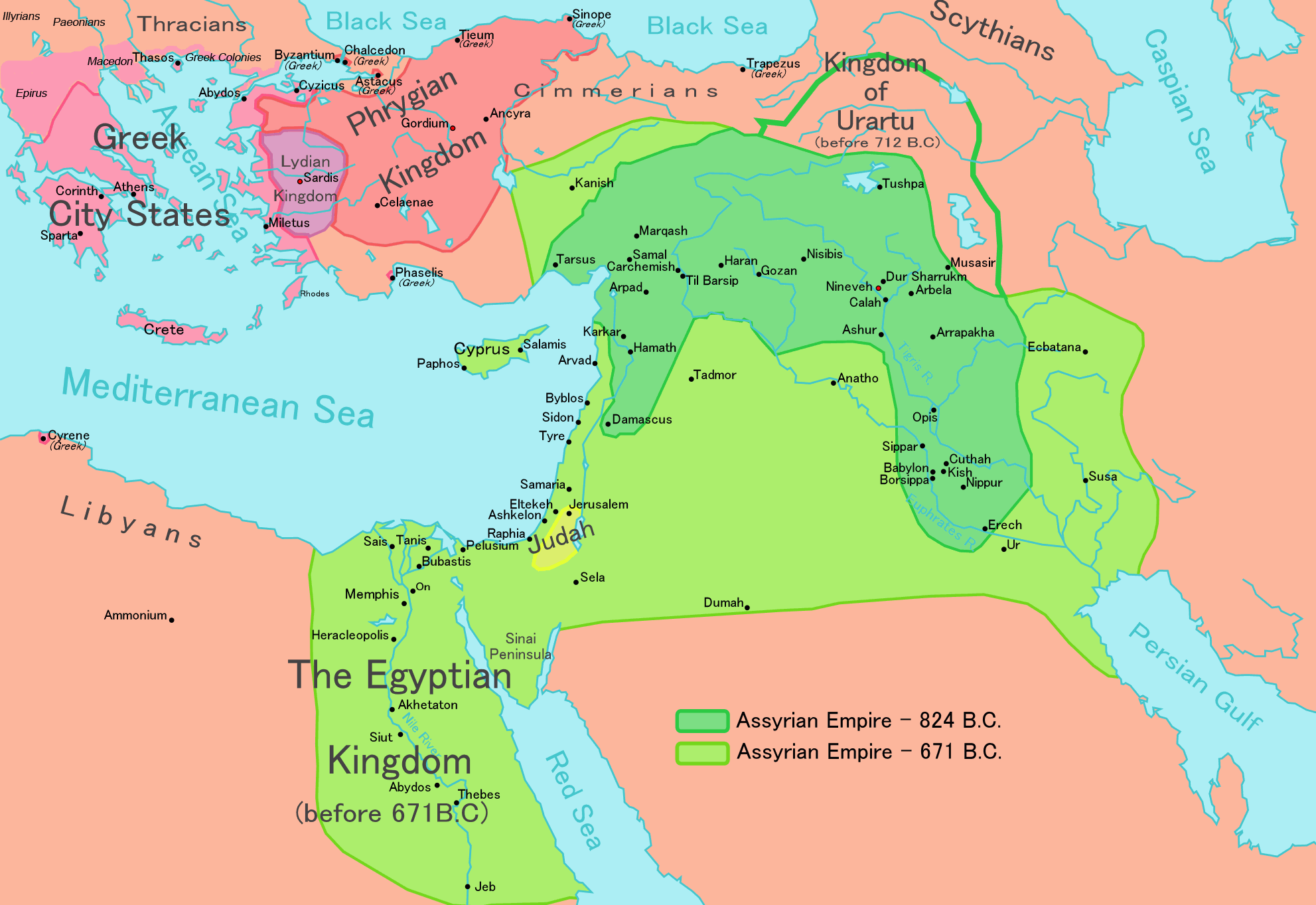 Source: Map of the Assyrian Empire, public domain via Wikimedia Commons.
The Lachish reliefs and Wikimedia collection are Assyrian royal art, not neutral accounts of every event. Hezekiah’s Tunnel and the Siloam Inscription provide geographical and material context. They do not supply the meaning of Hezekiah’s prayer.
Summary Table
| Passage | Event | Spiritual burden |
|---|---|---|
| 18:1-8 | Reform and trust | Signs must lead to their Lord |
| 18:9-12 | Samaria’s fall recalled | Hear and obey the covenant |
| 18:13-16 | Tribute and temple stripping | Security cannot finally be purchased |
| 18:17-37 | Four attacks on confidence | Discern the meaning attached to threats |
| 19:1-7 | Sackcloth and Isaiah’s answer | Ask for prayer in helplessness |
| 19:8-19 | Letter spread before God | Face evidence without obeying fear |
| 19:20-34 | Enemy bounded; remnant rooted | Covenant mercy restores life |
| 19:35-37 | Deliverance and the enemy’s end | Power remains under judgment |
Glossary
Rabshakeh: title of the Assyrian spokesman. Remnant: those preserved through judgment. Cherubs: heavenly beings associated with God’s throne and the ark. Nehushtan: name given to the bronze serpent in this account. Siege mound: earthwork used to attack defenses. Sackcloth: rough clothing expressing grief or repentance.
Spiritual Fruit 🍇
-
Let holy things lead you to God. The serpent’s history cannot excuse worship directed to it. Honor the Church’s sacred things with prayer and obedience, rather than treating them as protection independent of communion.
-
Discern words that use true facts falsely. Assyria’s victories are real, but its conclusion about God is false. When fear presents evidence, distinguish the fact from the hopeless meaning attached to it.
-
Bring the document into prayer. Hezekiah reads the letter before spreading it out. Bring a bill, diagnosis, conflict, or demand before the Lord without denying it, then take the responsible next step with a heart freed from panic.
-
Ask another to pray. Kingship does not prevent Hezekiah from seeking Isaiah’s help. Share a real burden with a trusted priest or faithful friend instead of making isolation a proof of strength.
-
Wait for roots as well as rescue. The remnant must return to planting and harvesting. After a crisis, receive ordinary duties patiently; recovery bears fruit through sustained life with God.
Prayer
O Lord Jesus Christ, living God and faithful King, receive the fears we spread before You. Deliver us from proud speech and from the lies our own fear tells us. Root us in Your mercy, teach us to pray for one another, and make our deliverance serve the knowledge of Your holy name. Amen.
Teaching Notes
Hezekiah’s reform and trust (2 Kings 18:1-8)
- Ask: Why must a bronze serpent with a holy history be destroyed?
- Watch for: Do not use the passage against all sacred objects.
- Connect: Numbers 21:4-9; Wisdom 16:5-7; John 3:14-15.
Assyria’s shadow and the fall of Israel recalled (2 Kings 18:9-12)
- Ask: Why does Kings recall Samaria before Judah’s crisis?
- Watch for: Jerusalem’s sacred history does not promise immunity from judgment.
- Connect: Hearing and doing in verse 12.
Sennacherib’s pressure and Hezekiah’s tribute (2 Kings 18:13-16)
- Ask: What does the tribute cost, and what does it fail to secure?
- Watch for: Preserve genuine trust without making every royal choice exemplary.
- Connect: Ahaz’s earlier appeal.
Rabshakeh’s speech: psychological and theological warfare (2 Kings 18:17-37)
- Ask: Which four arguments make the speech spiritually dangerous?
- Watch for: Silence is obedience here, not a demand that victims hide abuse.
- Show: Use the Lachish reliefs as imperial propaganda, then identify the counterfeit vine and fig-tree promise.
Hezekiah seeks Isaiah (2 Kings 19:1-7)
- Ask: What does the childbirth image reveal about the king’s need?
- Watch for: Seeking prayer is not abandoning responsible action.
- Connect: The living God and Isaiah’s answer.
The threatening letter spread before the Lord (2 Kings 19:8-19)
- Ask: What would it mean to spread a real threatening document before God today?
- Watch for: Prayer neither denies facts nor guarantees the outcome we prefer.
- Connect: The Creator enthroned over the cherubs.
Isaiah’s answer: Assyria judged, Zion preserved (2 Kings 19:20-34)
- Ask: Why does the sign include roots, crops, and resumed sowing?
- Watch for: Assyria’s role in providence does not justify its arrogance.
- Connect: Isaiah 10:5-15 and David’s covenant.
Deliverance and Sennacherib’s end (2 Kings 19:35-37)
- Ask: How does Christ fulfill faithful kingship while His victory differs from Hezekiah’s?
- Watch for: Do not celebrate the dead as entertainment or assume the murder immediately follows the return.
- Connect: Sirach 48; the Maccabean prayers; Tobit 1:18-21.
Session guidance: Keep the taunt and answer combined. If two meetings are needed, break after 18:37 and recap the four arguments before reading 19:1.
Sources
Embedded Scripture is from Brenton’s English Septuagint (LXX). In the Septuagint tradition, 2 Kings is numbered 4 Kingdoms. Chapter and verse headings follow the NKJV framing.
Numbers 21:4-9; Wisdom 16:5-7; John 3:14-15; Isaiah 7:3; 10:5-20; 22:20-22; 36-37; 2 Chronicles 29-32.
Sirach 48:17-21; 1 Maccabees 7:41; 2 Maccabees 8:19; 15:22; Tobit 1:18-21; Matthew 4:8-9; 27:43; Revelation 3:7.
Coptic lectionary and Synaxarium appointments described above.
Footnotes
-
St. John Chrysostom, Homilies on John, Homily 85, §6, on John 19:16-18 and the remembrance of David in 2 Kings 19:34, CCEL. ↩