


This narration was recorded before the latest revision of this study.
2 Kings 11 is a story of attempted destruction and hidden preservation. Athaliah seizes power and destroys the royal seed, but Joash is hidden in the house of the Lord for six years. In the seventh year, Jehoiada the priest brings him out, crowns him, renews the covenant, and the people overthrow Athaliah and the temple of Baal.
The chapter is one of the clearest royal-preservation passages in Kings. The promise to David appears almost extinguished, but God preserves the king in hiddenness. The rescued child invites comparison with Christ’s preservation from Herod, while Joash’s later failure keeps the comparison sober. God’s promise survives through a king who himself still needs salvation.
Summary Table
| Passage | What happens | Spiritual concern |
|---|---|---|
| 2 Kings 11:1-3 | The royal seed attacked, but Joash hidden | How do Josabee, the nurse, and the temple make survival possible? |
| 2 Kings 11:4-12 | Jehoiada orders the guards | Why must the testimony accompany the crown? |
| 2 Kings 11:13-16 | Athaliah exposed | How does “A conspiracy, a conspiracy” expose Athaliah’s claim to legitimacy? |
| 2 Kings 11:17-20 | Covenant renewed and Baal worship destroyed | How do the two covenants change royal authority and the people’s worship? |
Historical and Scriptural Context
Athaliah is connected to the house of Ahab. Through her, the corruption of the northern kingdom reaches the throne of Judah. Her massacre of the royal seed threatens the Davidic line, and therefore appears to threaten the messianic promise.
The promise at stake is 2 Samuel 7:12-16, recalled in 2 Kings 8:19 as the continuing lamp for David’s sons. Psalm 132:11, 17 (LXX Psalm 131) joins David’s heir to that lamp; Psalm 89 (LXX Psalm 88) holds the sworn covenant beside the grief of apparent royal rejection. Jeremiah 33:14-22 names the promised righteous Branch and the endurance of God’s covenant. Athaliah rules visibly while the heir of that promise survives unseen.
Second Chronicles 23 gives the parallel account of this restoration. Jehoiada’s action is priestly, covenantal, and liturgical. The restoration of the king happens in the temple, around ordered service, guarded thresholds, testimony, anointing, and covenant renewal.
Geographical Significance ⛰️
The central place is the house of the Lord. The temple is not only a building. It becomes the place where the royal promise is preserved.
The repeated attention to gates, guards, ranks, and thresholds gives the chapter a liturgical feeling. Holy things are guarded. The king’s protection is both sacred service and a carefully organized political restoration. The temple setting does not make every armed action in the account a model for church practice.
The Characters 👥
Athaliah
Athaliah is a usurper who seeks to preserve power through death. She cries “A conspiracy, a conspiracy” when her own violent rule is exposed.
Joash / Jehoash
Joash is the hidden Davidic heir. As a child, he does not save himself. He is preserved by God through faithful people.
Jehosheba / Josabee
She rescues Joash and hides him. Her quiet courage preserves the royal line.
Second Chronicles 22:11 identifies her as Jehoiada’s wife. Her family connection to the palace and her marriage to the priest clarify how the child and his nurse could be sheltered in the house of the Lord.
Jehoiada
Jehoiada the priest acts with wisdom, order, and courage. He brings the hidden king into public view and renews covenant fidelity.
Name key: Gotholia = Athaliah; Ochozias = Ahaziah; Josabee = Jehosheba; Joram = Jehoram; Joas = Joash; Jodae = Jehoiada; Chorri and Rhasim = the Carites and guards; Mathan = Mattan.
Numbering note: Brenton places the notice that Joash was seven at accession at 12:1; the NKJV places it at 11:21. It is retained with that notice before the opening reading of the next study.
The royal seed attacked, but Joash hidden (2 Kings 11:1-3)
1 And Gotholia the mother of Ochozias saw that her son was dead, and she destroyed all the seed royal. 2 And Josabee daughter of king Joram, sister of Ochozias, took Joas the son of her brother, and stole him from among the king’s sons that were put to death, secreting him and his nurse in the bedchamber, and hid him from the face of Gotholia, and he was not slain. 3 And he remained with her hid in the house of the Lord six years: and Gotholia reigned over the land.
Athaliah’s first act is anti-messianic in shape. She tries to destroy the royal seed. Yet one child is hidden. The promise of God rests, humanly speaking, in a vulnerable child concealed in the temple.
The child and his nurse cannot confront the ruler who has seized the land. Josabee’s intervention is therefore decisive: she takes, conceals, and hides him. Exodus 1:22 to 2:10 likewise follows a threatened infant preserved through the courage of women; Matthew 2:13-23 reveals the holy Child preserved from Herod’s violence. Revelation 12:4-5 also portrays a threatened child and God’s protection, though its apocalyptic vision should not be reduced to this royal escape. The preservation of Joash is a fitting Christian comparison, not a claim that Kings predicts every detail of Christ’s childhood.
Jehoiada orders the guards (2 Kings 11:4-12)
4 And in the seventh year Jodae sent and took the captains of hundreds of the Chorri and of the Rhasim, and brought them to him into the house of the Lord, and made a covenant of the Lord with them, and adjured them, and Jodae shewed them the king’s son. 5 And charged them, saying, This is the thing which ye shall do. 6 Let a third part of you go in on the sabbath-day, and keep ye the watch of the king’s house in the porch; and another third in the gate of the high way, and a third at the gate behind the footmen; and keep ye the guard of the house. 7 And there shall be two parties among you, even every one that goes out on the sabbath, and they shall keep the guard of the Lord’s house before the king. 8 And do ye compass the king about every man with his weapon in his hand, and he that goes into the ranges shall die: and they shall be with the king in his going out and in his coming in.
9 And the captains of hundreds did all things that the wise Jodae commanded; and they took each his men, both those that went in on the sabbath-day, and those that went out on the sabbath-day, and went in to Jodae the priest. 10 And the priest gave to the captains of hundreds the swords and spears of king David that were in the house of the Lord. 11 And the footmen stood each with his weapon in his hand from the right corner of the house to the left corner of the house, by the altar and the house round about the king. 12 And he brought forth the king’s son, and put upon him the crown and gave him the testimony; and he made him king, and anointed him: and they clapped their hands, and said, Long live the king.
Jehoiada does not act chaotically. The revelation of the king is surrounded by order. Guards are assigned. Entrances are watched. The testimony is given to the king. He is anointed and acclaimed.
Six years of concealment give way to disclosure in the seventh year, with the guard change arranged on the sabbath. Rest and release are fitting associations, but the chapter does not decode the six years as an exact prediction of Christian chronology. Jehoiada acts through ordinary duty rosters and inherited weapons, and the people see a real child whose safety still depends on faithful adults.
The testimony belongs beside the crown. Deuteronomy 17:18-20 requires the king to read God’s law and keep it, so that his heart is not lifted above his brethren. Whatever physical form the testimony here took, its place at the coronation declares that royal authority is accountable to God’s word. The child is not crowned as his own lawgiver.
The child king emerges from the house of God under the care of faithful servants, with testimony beside his crown. His rescue prepares a Christian comparison with the threatened Child in Matthew 2, while the law reminds us that Joash remains a human king accountable to God.
Athaliah exposed (2 Kings 11:13-16)
Translation note: The NKJV gives Athaliah’s cry as “Treason! Treason!” Brenton prints “A conspiracy, a conspiracy.” The explanation below follows the displayed wording.
13 And Gotholia heard the sound of the people running, and she went in to the people to the house of the Lord. 14 And she looked, and, behold, the king stood near a pillar according to the manner; and the singers and the trumpeters were before the king and all the people of the land even rejoicing and sounding with trumpets: and Gotholia rent her garments, and cried, A conspiracy, a conspiracy. 15 And Jodae the priest commanded the captains of hundreds who were over the host, and said to them, Bring her forth without the ranges, and he that goes in after her shall certainly die by the sword. For the priest said, Let her not however be slain in the house of the Lord. 16 And they laid hands upon her, and went in by the way of the horses’ entrance into the house of the Lord, and she was slain there.
Athaliah sees the king standing by the pillar and cries “A conspiracy, a conspiracy.” The irony is severe. The usurper accuses the rightful king’s supporters of betrayal. Sin often calls repentance treason because repentance threatens its rule.
Jehoiada prevents her execution inside the house of the Lord. Even judgment is ordered so the holy place is not treated casually.
Covenant renewed and Baal worship destroyed (2 Kings 11:17-20)
17 And Jodae made a covenant between the Lord and the king and the people, that they should be the Lord’s people; also between the king and the people. 18 And all the people of the land went into the house of Baal, and tore it down, and completely broke in pieces his altars and his images, and they slew Mathan the priest of Baal before the altars. And the priest appointed overseers over the house of the Lord. 19 And he took the captains of the hundreds, and the Chorri, and the Rhasim, and all the people of the land, and brought down the king out of the house of the Lord; and they went in by the way of the gate of the footmen of the king’s house, and seated him there on the throne of the kings. 20 And all the people of the land rejoiced, and the city was at rest: and they slew Gotholia with the sword in the house of the king.
The enthronement is not merely political. Jehoiada makes a covenant between the Lord, the king, and the people. Verse 17 distinguishes two covenants: one between the Lord, king, and people, binding them to be the Lord’s people; another between king and people, ordering their relation to one another. Restored royal power is therefore placed under allegiance to God and responsibility toward the people. The people then destroy the house of Baal, and the city enters quiet.
The renewed covenant places royal power under an allegiance Athaliah’s violence denied. King and people are bound again to the Lord, and the city finds rest.
Jehu has just destroyed Baal’s house in Samaria (10:27), yet a house of Baal still stands in Jerusalem until this restoration. Northern judgment has not automatically purified Judah. Nor does Joash’s rescue guarantee his fidelity: 2 Kings 12 and 2 Chronicles 24:17-22 must be read beside this joy. The king preserved by Jehoiada later orders the killing of Jehoiada’s son. God’s faithful promise and a ruler’s faithless response must both remain visible.
Orthodox Theological Reading
The hidden king in the temple points toward the mystery of Christ. The true King is preserved by God, revealed in the fullness of time, anointed, acclaimed, and enthroned. The people rejoice when the rightful king appears because his presence exposes the false ruler.
The chapter also shows the Church’s vocation to guard what is holy. Jehoiada’s order is not bureaucracy. It is faithful stewardship.
Christological Reading
Joash is not Christ, but he is a type. He is a vulnerable royal child preserved from a murderous ruler, hidden until the appointed time, then revealed to the people. This pattern naturally recalls Herod’s slaughter of the infants, the flight into Egypt, and the hidden years of Christ before His public manifestation.
The law placed beside Joash’s crown shows the difference between a human king under God’s word and the incarnate Word who fulfills it. Christ fulfills the Law and the Prophets (Matthew 5:17); His kingdom is revealed through obedient suffering rather than another court massacre. The threatened royal child provides a partial pattern, while Joash’s later betrayal exposes why David’s promise needs a greater Son.
Gems from the Fathers 💎
St. John Chrysostom, commenting on the flight into Egypt in Homily 8 on Matthew, explains why the divine Child’s preservation takes the form of an actual flight. Christ’s real humanity is shown through His acceptance of human vulnerability. His counsel about the Magi is direct: “For this most especially belongs to faith, not to seek an account of what is enjoined, but merely to obey the commandments laid upon us.”1
This is commentary on Matthew 2, not on Athaliah. Its thematic bearing on Josabee’s rescue is precise: faithful obedience can look like carrying a threatened child to safety, rather than defeating the tyrant in open spectacle. Providence acts through human care without making that care unnecessary.
The Church’s Voice in Worship ⛪
No reading is appointed under the reference 2 Kings 11 in the Coptic lectionary evidence used here. Matthew 2:13-23 is the Liturgy Gospel on 3 Toba, the Martyrdom of the Children of Bethlehem, and on the Feast of the Entrance into Egypt.2 The lectionary gives the actual appointments.
The Church remembers both the preserved Christ and the murdered children. Reading Joash beside that Gospel therefore calls for tenderness toward those who suffer, not an easy claim that faithful children always escape. The comparison is theological; it does not make 2 Kings 11 an appointed feast reading.
Iconography and Visual Teaching 🖼️
The kings genealogy chart shows why the preservation of Joash matters for David’s house. Western coronation artwork illustrates the narrative but is not an Orthodox icon.
- Visual source: Athaliah dismayed at the coronation of Joash. Solomon Alexander Hart, Athaliah’s Dismay at the Coronation of Joash, public domain via Wikimedia Commons. Western artwork, not an Orthodox icon.
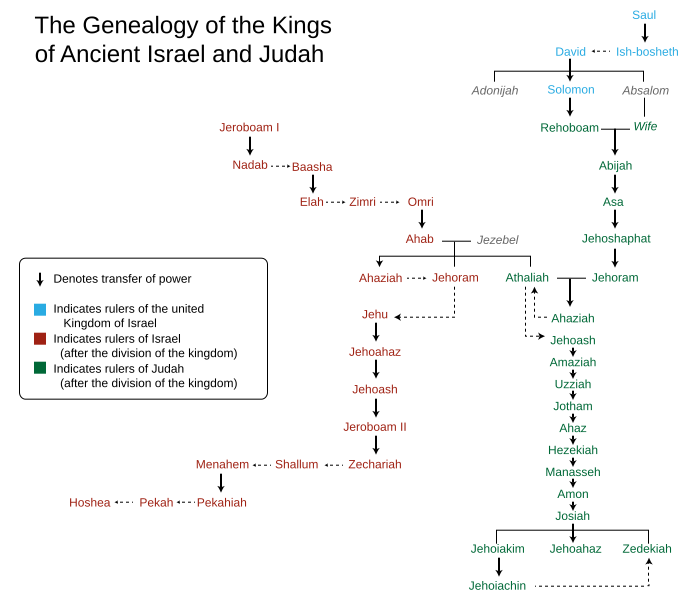
Genealogy chart source: Genealogy of the kings of Israel and Judah, public domain via Wikimedia Commons. Historical teaching chart, not an icon.
- Related visual collection: Athaliah, Wikimedia Commons category.
Glossary
- Royal seed: The royal descendants Athaliah tries to destroy.
- Testimony: God’s covenant instruction given with the crown; the king remains accountable to it.
- Covenant: A binding relationship of allegiance and responsibility; verse 17 names two.
- Type: An earlier person or event whose partial pattern points toward Christ, without equating them.
Spiritual Fruit 🍇
Practice hidden courage
Josabee protects a child while another person controls the land. Give steady care to someone whose safety or formation depends on you, even when the work brings no public recognition.
Receive authority under the word
The testimony stands beside Joash’s crown. When responsibility gives you power over others, read God’s commandments as a judgment on your own conduct before treating them as rules for those below you.
Renew allegiance in action
The two covenants restore worship and responsibility together. A renewed promise to God must change how you treat your family and parish, including the false loyalties you have allowed to remain.
Hope without presumption
God preserves David’s house through a vulnerable child, yet Joash later fails. Give thanks for protection without treating an earlier rescue as permission to neglect present repentance.
Prayer
Lord Jesus Christ, Son of David, protect those threatened by cruelty and strengthen those who shelter them. Teach me to serve faithfully when no one sees, to receive Your word above my own will, and to honor the people entrusted to my care. Preserve in me the hope that bears fruit in obedience. Amen.
Teaching Notes
The royal seed attacked, but Joash hidden (2 Kings 11:1-3)
- Ask: How do Josabee, the nurse, and the temple make survival possible?
- Watch for: The holy Child comparison is partial; God’s preservation does not mean that all threatened children escape.
Jehoiada orders the guards (2 Kings 11:4-12)
- Ask: Why must the testimony accompany the crown?
- Watch for: Distinguish a useful sabbath pattern from a claimed numerical prediction of Christ’s coming.
Athaliah exposed (2 Kings 11:13-16)
- Ask: How does “A conspiracy, a conspiracy” expose Athaliah’s claim to legitimacy?
- Watch for: Reverence for the sanctuary gives no modern warrant to execute an opponent.
Covenant renewed and Baal worship destroyed (2 Kings 11:17-20)
- Ask: How do the two covenants change royal authority and the people’s worship?
- Watch for: Read Joash’s later betrayal beside his rescue; the type is not the sinless reality of Christ.
Visual aid: Use the retained genealogy chart with the coronation artwork to distinguish preservation of David’s house from a claim that Joash becomes a sinless king.
Sources
Embedded Scripture is from Brenton’s English Septuagint (LXX). In the Septuagint, 2 Kings is numbered 4 Kingdoms. The headings follow NKJV chapter and verse framing; printed Scripture labels remain Brenton’s.
Biblical parallels and covenant texts: 2 Chronicles 22:11; 23; 24:17-22; Deuteronomy 17:18-20; 2 Samuel 7:12-16; Jeremiah 33:14-22; Psalm 89 (LXX Psalm 88); Psalm 132:11, 17 (LXX Psalm 131); Matthew 2:13-23; Revelation 12:4-5.
St. John Chrysostom, Homilies on Matthew, Homily 8, direct commentary on the Gospel comparison, not on Athaliah.
Coptic lectionary and Synaxarium evidence: @andraws/lectionary-data 1.3.1.
Footnotes
-
St. John Chrysostom, Homilies on Matthew, Homily 8, sections 1-2, on Matthew 2:12-13. New Advent. ↩
-
Coptic readings and commemorations from @andraws/lectionary-data 1.3.1, preserving the package’s Katameros-cycle and date-resolved source distinctions. A related commemoration or Gospel appointment is not an appointment of this chapter. ↩