


This narration was recorded before the latest revision of this study.
Ahaz buys Assyrian rescue with sacred treasure, then copies a Damascus altar and lets political fear reshape Judah’s worship.
Jerusalem’s enemies cannot yet overcome it, but Ahaz’s fear opens a different breach. He calls himself Assyria’s servant and son, then sends a foreign altar’s pattern to the priest. Sacrifices continue while the authority governing them changes. The heart can retain religious activity while taking its instructions from the power it fears.
Historical and Scriptural Context
Isaiah 7:1-9 describes the coalition of Rezin and Pekah. Isaiah meets Ahaz at the upper pool (7:3), the location later occupied by Assyria’s spokesman before Hezekiah (2 Kings 18:17). Isaiah 7:9 calls for faith; 7:10-14 offers the sign of Immanuel. Kings shows the political response while Isaiah exposes the spiritual crisis.
Geographical Significance ⛰️
Jerusalem is threatened but not conquered. Ælath, Elath, is lost; Damascus becomes the meeting place with Judah’s new protector. The king’s journey ends with a foreign altar’s pattern traveling back to Jerusalem. Assyria gives immediate relief while making Judah dependent.
The Characters 👥
Ahaz chooses his protector and reorders worship. Rezin and Pekah besiege him but do not prevail in 16:5. Tiglath-Pileser answers his appeal and receives his dependence: Ahaz declares, “I am thy servant and thy son.” Uriah implements the king’s commands; Isaiah 8:2 names Uriah the priest as a reliable witness, making his compliance here sobering. Hezekiah succeeds Ahaz and later reforms Judah.
Name key for the reading: Achaz is Ahaz; Joatham is Jotham; Phakee is Pekah; Raasson is Rezin; Thalgath-phellasar is Tiglath-Pileser; Urias is Uriah; Ezekias is Hezekiah; Ælath is Elath.
Ahaz’s evil reign and false worship (2 Kings 16:1-4)
1 In the seventeenth year of Phakee son of Romelias began Achaz the son of Joatham king of Juda to reign. 2 Twenty years old was Achaz when he began to reign, and he reigned sixteen years in Jerusalem; and he did not that which was right in the eyes of the Lord his God faithfully, as David his father had done. 3 And he walked in the way of the kings of Israel, yea, he made his son to pass through the fire, according to the abominations of the heathen whom the Lord cast out from before the children of Israel. 4 And he sacrificed and burnt incense on the high places, and upon the hills, and under every shady tree.
Ahaz is compared with David, the measure of royal faithfulness, but walks in the way of Israel’s kings. Making his son pass through fire adopts the abominations of the nations expelled before Israel. Leviticus 18:21 and Deuteronomy 12:31; 18:10 forbid such offerings. Reverence for God protects the child; religion that consumes the child betrays Him.
Kings does not describe the rite’s mechanics here. Second Chronicles 28:3 is explicit about burning sons, but that fuller account must be identified as a parallel, not silently supplied as this verse’s wording. The high places, hills, and shady trees show worship distributed according to preference rather than obedience. Ahaz anticipates Israel’s indictment in 17:17 and Manasseh’s offense in 21:6: Judah is adopting what will bring the north into exile.
Political fear and the Assyrian appeal (2 Kings 16:5-9)
5 Then went up Raasson king of Syria and Phakee son of Romelias king of Israel against Jerusalem to war, and besieged Achaz, but could not prevail against him. 6 At that time Raasson king of Syria recovered Ælath to Syria, and drove out the Jews from Ælath, and the Idumeans came to Ælath, and dwelt there until this day. 7 And Achaz sent messengers to Thalgath-phellasar king of the Assyrians, saying, I am thy servant and thy son: come up, deliver me out of the hand of the king of Syria, and out of the hand of the king of Israel, who are rising up against me. 8 And Achaz took the silver and the gold that was found in the treasures of the house of the Lord, and of the king’s house, and sent gifts to the king. 9 And the king of the Assyrians hearkened to him: and the king of the Assyrians went up to Damascus and took it, and removed the inhabitants, and slew king Raasson.
The besiegers “could not prevail against him.” Danger is real, but the narrative does not make the Assyrian appeal inevitable. Isaiah’s word offers a different ground for confidence. Ahaz chooses the power he can pay rather than the Lord who asks him to believe.
“I am thy servant and thy son” expresses a surrender of belonging. In 2 Samuel 7:14 God promises fatherly care to David’s heir; Psalm 2:7 names royal sonship before God. Ahaz transfers the language of dependence to Assyria, and his actions give it weight: treasure from the Lord’s house funds the new protector. Fear empties the sanctuary to buy security.
The appeal succeeds immediately. Damascus falls, its population is removed, and Rezin dies. Effective strategy and faithful obedience are not the same. Isaiah 8:6-8 pictures Assyria as a flood following rejected divine provision. The rescue bought from empire can become domination from which Judah next needs rescue.
The Damascus altar copied into Jerusalem (2 Kings 16:10-16)
Translation note: Brenton omits the statement that the altar was finished before Ahaz returned. Verse 13 names the brazen altar; verse 15 reserves it for the king “in the morning,” where the NKJV speaks of inquiry.
10 And king Achaz went to Damascus to meet Thalgath-phellasar king of the Assyrians at Damascus; and he saw an altar at Damascus. And king Achaz sent to Urias the priest the pattern of the altar, and its proportions, and all its workmanship. 11 And Urias the priest built the altar, according to all the directions which king Achaz sent from Damascus.
12 And the king saw the altar, and went up to it, 13 and offered his whole-burnt-offering, and his meat-offering, and his drink-offering, and poured out the blood of his peace-offerings on the brazen altar that was before the Lord. 14 And he brought forward the one before the house of the Lord from between the altar and the house of the Lord, and he set it openly by the side of the altar northwards. 15 And king Achaz charged Urias the priest, saying, Offer upon the great altar the whole-burnt-offering in the morning and the meat-offering in the evening, and the whole-burnt-offering of the king, and his meat-offering, and the whole-burnt-offering of all the people, and their meat-offering, and their drink-offering; and thou shalt pour all the blood of the whole-burnt-offering, and all the blood of any other sacrifice upon it: and the brazen altar shall be for me in the morning. 16 And Urias the priest did according to all that king Achaz commanded him.
The decisive word is “pattern.” Ahaz sends the altar’s proportions and workmanship; Uriah builds according to his directions. Exodus 25:9, 40 and Hebrews 8:5 describe another pattern: Moses receives what God shows on the mountain. Ahaz reverses the direction. The sanctuary receives a design from the place where worldly power has impressed him.
Verse 13 places the poured blood on the brazen altar before the Lord. Verse 15 directs the daily, royal, and public offerings onto the great altar, reserving the brazen altar for the king “in the morning.” The NKJV speaks of inquiry at that point. Whatever the secondary function, the king now determines the altar’s place and use.
Second Chronicles 28:23-24 explains Ahaz’s reasoning: he sacrifices to the gods of Damascus because he credits them with its kings’ success, then closes the Lord’s house. Kings itself describes the altar without that explicit rationale. Together the accounts expose success being treated as a revelation of whom to worship.
Uriah obeys without a recorded objection. Isaiah’s reliable witness is still capable of failure. A respected servant may skillfully carry out a powerful person’s wishes while failing to ask whether those wishes betray God. Holy service needs the courage to refuse as well as the competence to execute.
The temple rearranged under Assyrian pressure (2 Kings 16:17-18)
Translation note: Brenton 16:18 speaks of a throne base and the royal entrance; the NKJV describes a covered Sabbath structure and the outer entrance.
17 And king Achaz cut off the borders of the bases, and removed the laver from off them, and took down the sea from the brazen oxen that were under it, and set it upon a base of stone. 18 And he made a base for the throne in the house of the Lord, and he turned the king’s entrance without in the house of the Lord because of the king of the Assyrians.
Ahaz cuts the bases, removes the laver, and lowers the bronze sea from its oxen to stone. Brenton then describes a throne base and a changed royal entrance, rather than the NKJV’s covered Sabbath structure. Fear has acquired a material shape within the sanctuary.
The stated reason is “because of the king of the Assyrians.” The text does not explain every practical motive behind each alteration. It does show how far dependence reaches: the protector beyond Jerusalem governs choices within the Lord’s house. Foreign power has become a designer of worship.
Ahaz’s death (2 Kings 16:19-20)
19 And the rest of the acts of Achaz, even all that he did, are not these written in the book of the chronicles of the kings of Juda? 20 And Achaz slept with his fathers, and was buried in the city of David: and Ezekias his son reigned in his stead.
Ahaz’s burial in the city of David records the dynasty’s continuation without endorsing his reign. Hezekiah inherits damaged worship and political dependence. 2 Kings 18-19 will show him turning toward the Lord under Assyrian pressure, though he too learns through crisis.
A destructive example need not be the last word in a family. Receiving an inheritance truthfully includes repenting of its corruption. The succession notice preserves a possibility of return after Ahaz’s failure.
Orthodox Theological and Christological Reading
Ahaz makes worship answer his chosen rescuer’s demands. His failure concerns more than taste: fear governs belonging, treasure, sacrifice, and priestly service. Received worship teaches us to stand before God rather than manage Him. This does not make every artistic or practical change an imitation of Ahaz; the offense is surrendering truth and obedience to an alien authority.
Christ is the faithful Son, High Priest, and fulfillment of sacrifice. Hebrews 13:10 names the altar of Christian worship; Hebrews 9:11-14 explains His self-offering. The Eucharist is communion in His sacrifice, not a competing human invention. Matthew 1:23 names Him Immanuel, God with us. Ahaz’s purchased protection cannot accomplish the salvation God gives through the Virgin-born Lord.
Gems from the Fathers 💎
St. Justin Martyr, in Dialogue with Trypho 43, recounts the sign offered to Ahaz and argues that Christ, not Hezekiah, fulfills it. Having traced His descent from Abraham, Judah, and David, he calls Christ “the everlasting law and the everlasting covenant.”1 This is direct commentary on Isaiah’s prophecy in Ahaz’s crisis, not discussion of the copied altar. The king buys a protector while God promises His own saving presence.
The Church’s Voice in Worship ⛪
No passage from 2 Kings 16 is appointed under that reference in the Coptic lectionary evidence considered here. Isaiah 7:1-14 is read at Matins on Friday of the second week of Great Lent. The Church hears the coalition’s threat, the call to faith, and the sign of Immanuel together. Setting that appointment beside Ahaz’s altar is an interpretive connection, not an appointment of this chapter. See the lectionary.
Iconography and Visual Teaching 🖼️
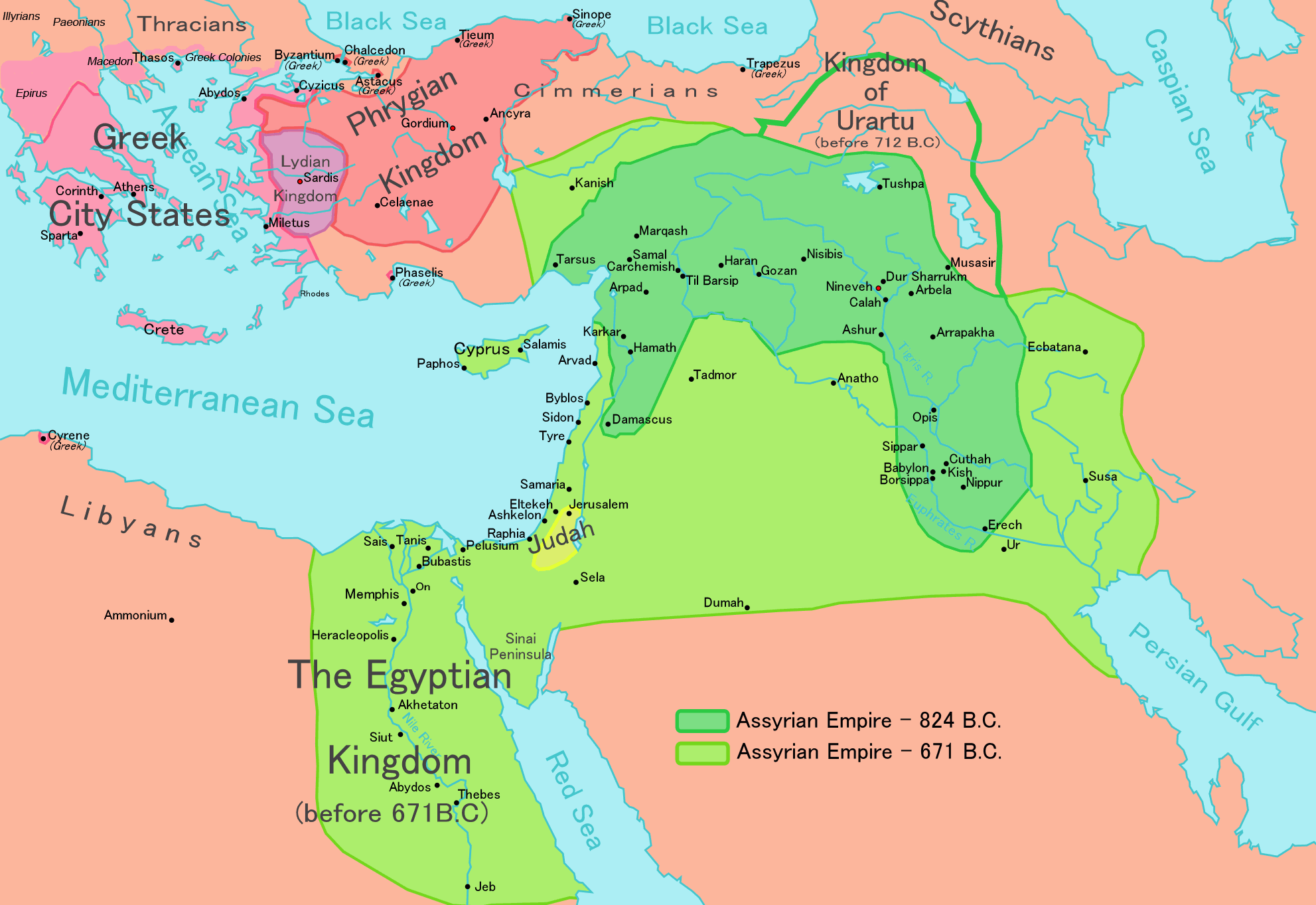 Source: Map of the Assyrian Empire, public domain via Wikimedia Commons.
Assyrian art offers imperial context, not evidence for the exact altar Ahaz copied.
Summary Table
| Passage | Event | Spiritual burden |
|---|---|---|
| 16:1-4 | False worship and the child’s ordeal | Protect the vulnerable |
| 16:5-9 | Rescue purchased | Relief can deepen bondage |
| 16:10-16 | Foreign altar adopted | Receive worship from God |
| 16:17-18 | Temple arrangements altered | Fear enters sacred service |
| 16:19-20 | Hezekiah succeeds | Inherited corruption can be reversed |
Glossary
Immanuel: God with us. Laver: washing basin. Brazen: made of bronze. Whole-burnt-offering: offering wholly consumed on the altar. Meat-offering: older English for a food or grain offering. Vassal: ruler dependent on an overlord.
Spiritual Fruit 🍇
-
Name fear before obeying it. Ahaz’s choices grow from the power he expects to save him. Bring a concrete fear into prayer before giving it the obedience that belongs to God.
-
Guard what pressure asks you to surrender. Sacred treasure buys relief before sacred order changes. Ask what loyalty a seemingly small compromise trains you to accept next.
-
Receive worship humbly. Ahaz makes the altar answer his preference. Offer yourself in the Church’s worship rather than using it to secure approval or control.
-
Do not hide behind compliance. Uriah’s standing does not make his action faithful. Seek wise counsel and refuse to lend service to a corrupt demand.
-
Trust the faithful Son. Ahaz gives sonship-language to the power he hires. When anxiety tempts you to buy approval through compromise, turn to Christ in prayer and choose the truthful action that belongs to a child of the Father.
Prayer
Lord Jesus Christ, Immanuel, deliver us from fear that teaches our hearts to obey false masters. Cleanse our worship and service; give us courage to protect the vulnerable and resist corrupt commands. Let Your presence be our refuge. Amen.
Teaching Notes
Ahaz’s evil reign and false worship (2 Kings 16:1-4)
- Ask: How does false worship injure the vulnerable here?
- Watch for: Do not invent the rite’s mechanics or sanitize the child’s suffering.
- Connect: Leviticus 18:21; Deuteronomy 12:31; 18:10.
Political fear and the Assyrian appeal (2 Kings 16:5-9)
- Ask: Why is the appeal dangerous even though Assyria answers it?
- Watch for: Verse 5 does not make surrender inevitable.
- Connect: Royal sonship and Isaiah 7:9; 8:6-8.
The Damascus altar copied into Jerusalem (2 Kings 16:10-16)
- Ask: What does the copied pattern represent, and how does Moses’ pattern differ?
- Watch for: Read Brenton 16:13 and 15 before importing a familiar altar sequence.
- Connect: Isaiah’s reliable witness and the priest’s compliance.
The temple rearranged under Assyrian pressure (2 Kings 16:17-18)
- Ask: How can a practical adjustment become spiritual surrender?
- Watch for: The text leaves several motives unexplained; do not reconstruct the altar with certainty.
- Show: Pair the empire map with the temple narrative, labeling Assyrian art as historical context.
Ahaz’s death (2 Kings 16:19-20)
- Ask: How does Immanuel answer Ahaz’s failure, and what does Hezekiah inherit?
- Watch for: A child need not repeat a parent’s sins.
- Connect: Matthew 1:23 and the later prayer at Jerusalem.
Sources
Embedded Scripture is from Brenton’s English Septuagint (LXX). In the Septuagint tradition, 2 Kings is numbered 4 Kingdoms. Chapter and verse headings follow the NKJV framing.
Exodus 25:9, 40; Leviticus 18:21; Deuteronomy 12:31; 18:10; 2 Samuel 7:14; Psalm 2:7.
Isaiah 7:1-14; 8:2, 6-8; 2 Chronicles 28:3, 23-24; Matthew 1:23; Hebrews 8:5; 9:11-14; 13:10.
Coptic lectionary: Isaiah 7:1-14, Friday of the second week of Great Lent, Matins.
Footnotes
-
St. Justin Martyr, Dialogue with Trypho, chapter 43, Roberts-Donaldson translation, primary text. ↩