


This narration is from a previous version of the study and may include a combined recording of multiple chapters.
Isaiah 7-8 is the Immanuel crisis cycle. Judah is terrified, Ahaz is politically calculating, foreign kings are closing in, and the house of David is tempted to secure itself by human arrangement rather than by faith. Into that fear the Lord gives both warning and promise: do not tremble before the smoking firebrands, ask for a sign, and learn what it means that God is with us.
These two chapters belong together because they form a single narrative and symbolic unit around the Syro-Ephraimite crisis, the sign of Immanuel, Isaiah’s children as prophetic signs, and the contrast between trusting the gentle waters of God and being overwhelmed by the flood of Assyria. Chapter 6 came just before this and showed the prophet purified for service. Chapters 9-12 come next and widen the same Immanuel hope into messianic light, remnant restoration, and hymns of salvation. Even so, the project keeps chapters 7-8 together because the Ahaz crisis has its own coherence. The Brenton text of 8:23 already begins to turn toward Galilee and chapter 9, but it still functions as the close of this present crisis dossier.
Historical and Scriptural Context
Historically these chapters stand in the days of Ahaz, king of Judah, during the Syro-Ephraimite threat. Aram and the northern kingdom of Israel attempt to pressure Judah into anti-Assyrian alignment and even propose a replacement king. Jerusalem shakes. Ahaz fears the coalition in front of him, but Isaiah reveals the deeper issue. The true danger is not merely two hostile kings. It is the Davidic house refusing to trust the Lord.
Within Isaiah, these chapters introduce one of the book’s most decisive themes: faith versus calculation. The sign of Immanuel is not given into a vacuum. It is given into panic, dynastic anxiety, and false piety. Ahaz sounds reverent when he refuses to ask for a sign, but his refusal is unbelief dressed as humility.
Geographical Significance ⛰️
Geography matters closely in these chapters. Isaiah meets Ahaz at the pool of the upper way of the fuller’s field, a detail that places the king near the city’s water system and defense concerns. The setting shows him preoccupied with siege logic while God is speaking about faith.
The waters of Siloam that go softly in chapter 8 become one of the strongest geographic-theological contrasts in the passage. Jerusalem has within it a quiet, life-giving source, but the people despise that softness and end up flooded by the strong river of Assyria. Damascus, Samaria, Jerusalem, Siloam, and finally Galilee of the Gentiles all serve the same spiritual point: geography becomes a map of trust or unbelief.
The Characters 👥
Ahaz
Ahaz is the frightened king who would rather manage danger than trust God. He is politically active, spiritually evasive, and devastatingly instructive.
Isaiah
Isaiah appears not only as prophet but as living sign. He speaks, walks, names children, records words, and embodies the message before the king and the nation.
Shear-jashub and Maher-shalal-hash-baz
Isaiah’s children function symbolically. One name points to a remnant that returns. The other points to rapid spoil and Assyrian judgment. The household of the prophet becomes part of the prophecy.
The house of David and the people of Judah
These chapters address more than one king’s nerves. They expose the spiritual crisis of the royal house and of the people who prefer visible power over the hidden faithfulness of God.
🕯️ Light from the Word
Isaiah 7:1-9
1 And it came to pass in the days of Achaz the son of Joatham, the son of Ozias, king of Juda, there came up Rasin king of Aram, and Phakee son of Romelias, king of Israel, against Jerusalem to war against it, but they could not take it. 2 And a message was brought to the house of David, saying, Aram has conspired with Ephraim. And his soul was amazed, and the soul of his people, as in a wood a tree is moved by the wind. 3 And the Lord said to Esaias, Go forth to meet Achaz, thou, and thy son Jasub who is left, to the pool of the upper way of the fuller’s field. 4 And thou shalt say to him, Take care to be quiet, and fear not, neither let thy soul be disheartened because of these two smoking firebrands: for when my fierce anger is over, I will heal again. 5 And as for the son of Aram, and the son of Romelias, forasmuch as they have devised an evil counsel, saying, 6 We will go up against Judea, and having conferred with them we will turn them away to our side, and we will make the son of Tabeel king of it; 7 thus saith the Lord of hosts, This counsel shall not abide, nor come to pass. 8 But the head of Aram is Damascus, and the head of Damascus, Rasim; and yet within sixty and five years the kingdom of Ephraim shall cease from being a people. 9 And the head of Ephraim is Somoron, and the head of Somoron the son of Romelias: but if ye believe not, neither will ye at all understand.
Fear enters the chapter before faith does. Ahaz and the people shake “as in a wood a tree is moved by the wind.” Isaiah names that condition precisely. Panic makes the soul movable. It becomes ready for any alliance, any flattery, any half-religious excuse that promises relief.
The Lord’s first command is therefore deeply spiritual: “Take care to be quiet, and fear not.” That is not passivity. It is disciplined trust. Judah is not told to deny danger. It is told to refuse enthroning danger.
The last line is decisive: “if ye believe not, neither will ye at all understand.” In Isaiah, understanding is not merely analysis. It is the fruit of faith. A fearful king may have military information, water access, and political options and still be blind because he does not trust God.
Isaiah 7:10-17
10 And the Lord again spoke to Achaz, saying, 11 Ask for thyself a sign of the Lord thy God, in the depth or in the height. 12 And Achaz said, I will not ask, neither will I tempt the Lord. 13 And he said, Hear ye now, O house of David; is it a little thing for you to contend with men? and how do ye contend against the Lord? 14 Therefore the Lord himself shall give you a sign; behold, a virgin shall conceive in the womb, and shall bring forth a son, and thou shalt call his name Emmanuel. 15 Butter and honey shall he eat, before he knows either to prefer evil, or choose the good. 16 For before the child shall know good or evil, he refuses evil, to choose the good; and the land shall be forsaken which thou art afraid of because of the two kings.
17 But God shall bring upon thee, and upon thy people, and upon the house of thy father, days which have never come, from the day that Ephraim took away from Juda the king of the Assyrians.
Ahaz’s refusal sounds devout, but Isaiah exposes it as wearying God. The king does not want a sign because he does not want to surrender his preferred strategy. False piety often sounds cautious while quietly protecting unbelief.
The sign given is greater than Ahaz deserves and greater than his moment alone can contain: “behold, a virgin shall conceive… Emmanuel.” The chapter is rooted in an immediate political crisis, yet the sign overflows the crisis. The house of David is told that its future does not finally rest on royal cleverness but on God’s own coming presence.
St. Irenaeus reads Emmanuel as both truly God and truly human. Butter, honey, and childhood belong to real human infancy; the refusal of evil is fitting to God. His reading guards against imagining either a mere man or God without flesh.1 “God with us” therefore means more than rescue at a distance: the Lord takes our human life without sin. At the same time, verse 16 addresses the near-term fear of the two kings. That horizon must remain audible without inventing a settled identification of the child within the immediate crisis.
Fr Bishoy Kamel applies the passage to prayer: God is ready to give Himself, while we may settle for small requests that leave our lives unchanged.2 This is a pastoral invitation to receive Emmanuel, not a reason to despise the ordinary needs we bring to God.
Isaiah 7:18-25
18 And it shall come to pass in that day that the Lord shall hiss for the flies, which insect shall rule over a part of the river of Egypt, and for the bee which is in the land of the Assyrians. 19 And they all shall enter into the clefts of the land, and into the holes of the rocks, and into the caves, and into every ravine. 20 In that day the Lord shall shave with the hired razor of the king of Assyria beyond the river the head, and the hairs of the feet, and will remove the beard. 21 And it shall come to pass in that day, that a man shall rear a heifer, and two sheep. 22 And it shall come to pass from their drinking an abundance of milk, that every one that is left on the land shall eat butter and honey.
23 And it shall come to pass in that day, for every place where there shall be a thousand vines at a thousand shekels, they shall become barren land and thorns. 24 Men shall enter thither with arrow and bow; for all the land shall be barren ground and thorns. 25 And every mountain shall be certainly ploughed: there shall no fear come thither: for there shall be from among the barren ground and thorns that whereon cattle shall feed and oxen shall tread.
The sign of Immanuel does not cancel the coming judgment on unbelief. The same house of David that is promised God’s presence is also warned of Assyria as a hired razor. The shaving image is humiliating on purpose. Judah will be stripped of the dignities it trusted.
Even the repeated mention of butter and honey must be read carefully. It is not simple prosperity language here. In context it belongs to a land reduced, a landscape thinned, where abundance has narrowed into aftermath. The chapter refuses sentimental prophecy. Divine promise does not erase the consequences of royal unbelief.
Isaiah 8:1-8
1 And the Lord said to me, Take to thyself a volume of a great new book, and write in it with a man’s pen concerning the making a rapid plunder of spoils; for it is near at hand. 2 And make me witnesses of faithful men, Urias, and Zacharias the son of Barachias. 3 And I went in to the prophetess; and she conceived, and bore a son. And the Lord said to me, Call his name, Spoil quickly, plunder speedily. 4 For before the child shall know how to call his father or his mother, one shall take the power of Damascus and the spoils of Samaria before the king of the Assyrians.
5 And the Lord spoke to me yet again, saying, 6 Because this people chooses not the water of Siloam that goes softly, but wills to have Rassin, and the son of Romelias to be king over you; 7 therefore, behold, the Lord brings up upon you the water of the river, strong and abundant, even the king of the Assyrians, and his glory: and he shall come up over every valley of yours, and shall walk over every wall of yours: 8 and he shall take away from Juda every man who shall be able to lift up his head, and every one able to accomplish anything; and his camp shall fill the breadth of thy land, O God with us.
Isaiah’s prophetic household becomes part of the message again. The child named for rapid spoil embodies the speed of the coming judgment. God writes the warning into family life, not only into public discourse.
Verses 6-8 contrast “the water of Siloam that goes softly” with the violent river of Assyria. First attend to the actual preference in verse 6: “this people” wants Rassin and the son of Romelias, the coalition rulers who threatened Ahaz in chapter 7. That is not the same choice as Ahaz’s calculation about Assyria. The Lord answers the rejection of Siloam by bringing the Assyrian flood, which overwhelms Judah too. The quiet water can teach us the sufficiency of God’s care, but the image must not erase the different parties and desires in the crisis.
The line “O God with us” at the end cuts both ways. Immanuel is promise, but it is also exposure. God is with His land, and therefore unbelief cannot be hidden in His presence.
Isaiah 8:9-15
9 Know, ye Gentiles, and be conquered; hearken ye, even to the extremity of the earth: be conquered, after ye have strengthened yourselves; for even if ye should again strengthen yourselves, ye shall again be conquered. 10 And whatsoever counsel ye shall take, the Lord shall bring it to nought; and whatsoever word ye shall speak, it shall not stand among you: for God is with us. 11 Thus saith the Lord, With a strong hand they revolt from the course of the way of this people, saying, 12 Let them not say, It is hard, for whatsoever this people says, is hard: but fear not ye their fear, neither be dismayed. 13 Sanctify ye the Lord himself; and he shall be thy fear. 14 And if thou shalt trust in him, he shall be to thee for a sanctuary; and ye shall not come against him as against a stumbling-stone, neither as against the falling of a rock: but the houses of Jacob are in a snare, and the dwellers in Jerusalem in a pit. 15 Therefore many among them shall be weak, and fall, and be crushed; and they shall draw nigh, and men shall be taken securely.
The middle of chapter 8 gives the spiritual center of the whole Immanuel cycle. “Fear not ye their fear.” Judah’s deepest problem is borrowed fear. It learns panic from the world and then starts speaking the world’s language back to itself.
Isaiah offers the remedy in one sentence: “Sanctify ye the Lord himself; and he shall be thy fear.” Holy fear heals worldly fear. The heart cannot simply stop fearing. It must be reordered around the Lord.
The Lord then becomes either sanctuary or stone. That dual possibility is fundamental. God’s presence never remains neutral. To the trusting He is refuge. To the resisting He becomes what they trip over. The New Testament will later apply this stone language to Christ, but even here the logic is already present.
Isaiah 8:16-23
16 Then shall those who seal themselves that they may not learn the law be made manifest.
17 And one shall say, I will wait for God, who has turned away his face from the house of Jacob, and I will trust in him. 18 Behold I and the children which God has given me: and they shall be for signs and wonders in the house of Israel from the Lord of hosts, who dwells in mount Sion.
19 And if they should say to you, Seek those who have in them a divining spirit, and them that speak out of the earth, them that speak vain words, who speak out of their belly: shall not a nation diligently seek to their God? why do they seek to the dead concerning the living? 20 For he has given the law for a help, that they should not speak according to this word, concerning which there are no gifts to give for it.
21 And famine shall come sorely upon you, and it shall come to pass, that when ye shall be hungry, ye shall be grieved, and ye shall speak ill of the prince and your fathers’ ordinances: and they shall look up to heaven above, 22 and they shall look on the earth below, and behold severe distress, and darkness, affliction, and anguish, and darkness so that one cannot see; and he that is in anguish shall not be distressed only for a time.
23 Drink this first. Act quickly, O land of Zabulon, land of Nephthalim, and the rest inhabiting the sea-coast, and the land beyond Jordan, Galilee of the Gentiles.
This final movement gathers witness, waiting, family, law, and darkness. Isaiah will trust in God even when God seems to have turned His face away. That is mature faith. It does not collapse when consolation is delayed.
The line “Behold I and the children which God has given me” later echoes into Hebrews 2, where Christ is heard in solidarity with the children given to Him. Even before that New Testament use, the line shows that God preserves a witnessing household inside an unbelieving generation.
Verses 19-20 also strike directly at spiritual counterfeits. When people will not wait for God, they seek secret knowledge, mediums, whispers, and the dead. Isaiah answers with a simple rebuke: why seek the dead concerning the living? The word of God is the help that keeps the soul from wandering into counterfeit light.
The darkness at the end is heavy, but not final. The mention of Galilee of the Gentiles points forward. This is why the next guide begins with the great light of chapter 9. The darkness must be felt before the light is received.
The Church’s Voice in Worship 📖
The recurring Matins readings preserved with Coptic Reader attestation include:
- Second-week Friday: Isaiah 7:1-14.
- Third-week Monday: Isaiah 8:13-9:7.
The Friday prophecy companions are Deuteronomy 8:1-9:4, 1 Samuel 17:1-18:4, and Job 11:1-20. Trust is tested in different situations and through different speakers; the speech of Zophar in Job is not automatically God’s own verdict. These companions invite discernment rather than a simple formula that every hardship is deserved.
Fr Bishoy Kamel reads Isaiah 7:10-14 as an invitation to deep prayer and Isaiah 8 as a summons to holy fear, discipleship, and return to God’s word.23 His Prodigal Son comparison is pastoral interpretation, not a substitute for Brenton’s particular wording.
This is exactly the sort of lectionary wisdom Isaiah needs. These chapters are not only proof texts about the Virgin Birth. They are also Lenten texts about fear, trust, spiritual imitation, and repentance.
Iconography Connection 🖼️
Isaiah 7-8 naturally connects with iconography of the Annunciation and Nativity through the Immanuel sign, but the guide should not stop there. It also suits icons of the prophet holding the virgin prophecy, of the house of David under pressure, and of the faithful remnant preserved in crisis.
The icon of the Theotokos of the Sign is especially fitting here. It does not reduce Isaiah 7:14 to an isolated prediction. It shows the sign as a mystery of divine indwelling: the Virgin receives and bears Emmanuel, and the fearful house of David is answered by God Himself coming among His people.
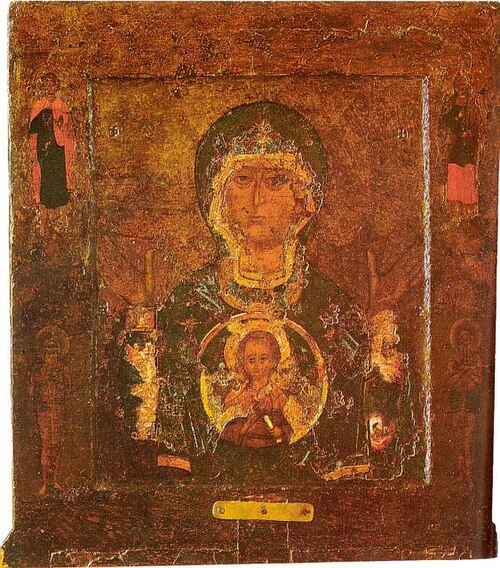 Source: Orthodox icon of Our Lady of the Sign, Veliky Novgorod, Russia, 12th century, via Wikimedia Commons, Public Domain Mark, https://commons.wikimedia.org/wiki/File:Orthodox_icon_of_Our_Lady_of_the_Sign._Veliky_Novgorod,_Russia.jpg
Spiritual Fruit 🍇
1. Refuse elegant unbelief
Ahaz teaches how unbelief can wear polite religious clothes. Learn to recognize the moment when your “prudence” is really refusal to trust God.
2. Seek the soft waters before the flood comes
Receive the Lord’s quiet care in the ordinary means He gives: a truthful prayer, counsel that asks no display, a commandment obeyed when panic urges haste. The contrast of Siloam and the flood invites trust without giving us a formula for diagnosing how every troubled life went wrong.
3. Let holy fear displace worldly fear
You will fear something. Isaiah does not say otherwise. He teaches the heart to be reordered so that the Lord, not the crisis, becomes the center.
4. Stay with the word when darkness thickens
When the soul is tempted toward whispers, omens, shortcuts, or hidden knowledge, Isaiah sends it back to testimony and law. The word steadies what fear tries to scatter.
Closing Meditation
God with us, teach us to trust You before we can see outcomes. Save us from the false reverence that refuses obedience. Give us the quiet of Siloam, the fear that sanctifies, and the patience to wait in darkness until Your light rises.
Glossary
- Immanuel / Emmanuel: “God with us,” the heart of the sign given to the house of David.
- Syro-Ephraimite crisis: The political threat from Aram and the northern kingdom that frames Isaiah 7-8.
- Siloam: Jerusalem’s softly flowing water, used here as an image of quiet divine provision.
- Remnant: The preserved people signaled already in the name Shear-jashub.
- House of David: The royal line addressed in both warning and promise.
Translation and Source Notes
This guide uses Brenton’s English Septuagint for embedded Scripture. The Brenton wording is especially important in Isaiah 7:14, where the text explicitly reads virgin. The guide therefore does not soften that wording.
The chapter split also matters. The Brenton text of Isaiah 8 ends with 8:23, which already turns toward Galilee and the coming light. This guide keeps 8:23 with the 7-8 crisis cycle but names it openly as the hinge toward Isaiah 9.
Sources
Primary sources
- Isaiah 7-8, Brenton Septuagint.
- St. Irenaeus, Against Heresies 3.21, on Isaiah 7:14 and Emmanuel as the sign of the virgin birth and divine identity.
Coptic Orthodox / pastoral sources
- Fr. Bishoy Kamel, The Journey through Lent with Isaiah, especially the deep-prayer reading of Isaiah 7:10-14 and the Prodigal Son week reading of Isaiah 8.
Web pages and non-academic sources cited
- New Advent Fathers page used as an access point for Irenaeus.
- Coptic lectionary source material, especially Great Lent week 2 and week 3 cycle references.
Source References
Scripture text
- Brenton Septuagint, Isaiah 7: https://biblehub.com/sep/isaiah/7.htm
- Brenton Septuagint, Isaiah 8: https://biblehub.com/sep/isaiah/8.htm
Patristic source pages
- St. Irenaeus of Lyons, Against Heresies 3.21, Isaiah 7:14 and Emmanuel: https://www.newadvent.org/fathers/0103321.htm
Geography and visual context
- OpenBible.info, all places mentioned in Isaiah, interactive map and KML: https://www.openbible.info/geo/preview/isa
- Project Gutenberg, Hurlbut Bible Atlas, public-domain biblical geography background: https://www.gutenberg.org/cache/epub/41140/pg41140-images.html
- Wikimedia Commons, Orthodox icon of Our Lady of the Sign, Public Domain Mark: https://commons.wikimedia.org/wiki/File:Orthodox_icon_of_Our_Lady_of_the_Sign._Veliky_Novgorod,_Russia.jpg
Coptic readings
- Coptic reading references follow the retained Great Lent cycle and service witnesses in @andraws/lectionary-data 1.3.5. Working service witnesses and historical records are distinguished in the discussion; printed references are not silently remapped to Brenton verse labels.
Teaching Notes
Overall teaching emphases
- Why these chapters stay together: They form one historical and symbolic unit around Ahaz, the Immanuel sign, prophetic children, and the trust-versus-fear crisis.
- Where to linger: Isaiah 7:9, 7:14, 8:6-8, 8:13-14, and 8:19-20.
- Where to be careful: Do not teach 7:14 as if its only purpose were argument. It is a sign of God’s presence given into a living crisis of unbelief.
- Pastoral warning: Many hearers resemble Ahaz more than they admit. They prefer manageable help to surrendered faith.
- Key phrases to say slowly: “if ye believe not,” “a virgin shall conceive,” “the water of Siloam that goes softly,” and “Sanctify ye the Lord himself.”
Consolidated section teaching cues
Isaiah 7:1-9
- Key phrases: “panic makes the soul movable,” “take care to be quiet,” “understanding is the fruit of faith.”
- Emphasize: The crisis is political, but the root issue is trust.
- Avoid: Reducing the chapter to ancient diplomacy. The spiritual logic is perennial.
Isaiah 7:10-17
- Key phrases: “false piety protects unbelief,” “the sign overflows the crisis,” “God is ready to give Himself.”
- Emphasize: Isaiah 7:14 is both rooted in its historical moment and fulfilled beyond it in Christ.
- Avoid: Turning the verse into polemics only. The deeper issue is the refusal of faith.
Isaiah 7:18-25
- Key phrases: “promise does not erase consequence,” “Assyria is a hired razor,” “Judgment strips false dignity.”
- Emphasize: God’s presence is not permission for unbelief.
- Avoid: Reading butter and honey as uncomplicated comfort without the surrounding devastation.
Isaiah 8:1-8
- Key phrases: “the people rejected the soft water,” “quiet sufficiency,” “the flood cannot be controlled.”
- Emphasize: Verse 6 names a preference for the coalition rulers; do not identify it with Ahaz’s use of Assyria. Then explain the quiet-water/flood contrast and its spiritual application.
- Avoid: Romanticizing softness into passivity. Siloam is gentle because God is trustworthy, not because danger is unreal.
Isaiah 8:9-15
- Key phrases: “borrowed fear,” “holy fear heals worldly fear,” “sanctuary or stone.”
- Emphasize: The cure for panic is not bravado. It is sanctifying the Lord.
- Avoid: Treating fear only psychologically. Isaiah is speaking about worship and allegiance.
Isaiah 8:16-23
- Key phrases: “I will trust in him,” “why seek the dead concerning the living?” “the darkness points forward to light.”
- Emphasize: Waiting on God and holding to His word are acts of resistance against false spiritual power.
- Avoid: Treating 8:23 as a throwaway verse. It is the literary hinge into Isaiah 9.
Footnotes
-
St. Irenaeus of Lyons, Against Heresies 3.21.4, https://www.newadvent.org/fathers/0103321.htm. ↩
-
Fr Bishoy Kamel, The Journey through Lent with Isaiah, Second week, “The Experience Of Deep Prayers”; modern Coptic pastoral reflection on receiving God Himself in prayer. English archival text; translator and published edition are not identified. ↩ ↩2
-
Fr Bishoy Kamel, The Journey through Lent with Isaiah, The Third Week of Lent, “Repentance” and “Hardness Of The Heart”; modern Coptic pastoral reflection on holy fear and return to God’s word. English archival text; translator and published edition are not identified. ↩