


This narration is from a previous version of the study and may include a combined recording of multiple chapters.
Isaiah 13-14 opens the book’s long sequence of nation-oracles with a blow against Babylonian pride. The section is not merely anti-empire rhetoric. It is an unveiling of what human power becomes when it glories in itself, devours peoples, forgets mortality, and imagines that no one can cast it down.
These two chapters belong together because chapter 13 announces Babylon’s overthrow in cosmic and historical terms, while chapter 14 turns that judgment into taunt, lament, and theological interpretation. The note keeps 14:24-32 inside the same guide because the shift to Assyria and Philistia does not break the theme. It widens it. Babylon is not the only arrogant power under judgment. The Lord’s purpose stands over all the nations, and Zion becomes the place of refuge for the poor when imperial boasting falls.
This note follows Isaiah 9-12, where the book ended with the Root of Jesse, gathered remnant, and song of salvation. It precedes Isaiah 15-16, where judgment turns toward Moab and is voiced with grief rather than mockery.
Historical and Scriptural Context
Historically, Babylon functions both as a concrete imperial enemy and as a concentrated image of proud world-power. The chapter speaks in a register larger than one battle bulletin. The Day of the Lord language, cosmic darkening, shaking of heaven and earth, and world-scale judgment all show that Babylon is being made exemplary. This is what empire looks like when God strips away its glamour.
Spiritually, the section is about pride descending into ruin. The tyrant climbs in speech before he falls in reality. That is why Isaiah 14 has echoed so strongly in Christian tradition. The text explicitly addresses the king of Babylon, but the inner logic of its pride has always invited a wider reading. The boast “I will be like the Most High” sounds like every creaturely rebellion that cannot remain a creature.
Geographical Significance ⛰️
Babylon, Assyria, Philistia, Lebanon, Zion, and the whole earth all appear in these chapters. Geography is not decorative. Babylon stands for the imperial center of self-exalting power. Lebanon’s cedars rejoice because the logging violence of empire has ceased. Zion stands at the end as the founded place where the poor find refuge.
That movement matters. Empire claims height, forests, gates, armies, and international dread. Zion seems weaker. But Isaiah’s point is that only what the Lord has founded will stand.
The Characters 👥
Babylon and its king
Babylon is the proud city of domination, and its king becomes the face of self-exalting rule.
The nations and their rulers
Other kings and nations appear as witnesses, mockers, or fellow objects of judgment. The tyrant who looked singular becomes one corpse among others.
The poor of God’s people
They are not a side note. By the end of chapter 14 they become the ones saved in Zion. The real future belongs not to imperial splendor, but to the poor who take refuge in the Lord.
🕯️ Light from the Word
Isaiah 13:1-5
1 The Vision which Esaias son of Amos saw against Babylon.
2 Lift up a standard on the mountain of the plain, exalt the voice to them, beckon with the hand, open the gates, ye rulers. 3 I give command, and I bring them: giants are coming to fulfil my wrath, rejoicing at the same time and insulting. 4 A voice of many nations on the mountains, even like to that of many nations; a voice of kings and nations gathered together: the Lord of hosts has given command to a war-like nation, 5 to come from a land afar off, from the utmost foundation of heaven; the Lord and his warriors are coming to destroy all the world.
The oracle opens with terrifying scale. Armies move, nations gather, voices thunder, and yet the center of the scene is not military genius. It is divine command. The Lord of hosts is not reacting to empire. He is summoning judgment upon it.
This matters spiritually because proud power always imagines that history is self-propelled. Isaiah says no. Even the nations that come against Babylon do not stand outside God’s government. Empire never owns the field as completely as it thinks.
Isaiah 13:6-13
6 Howl ye, for the day of the Lord is near, and destruction from God shall arrive. 7 Therefore every hand shall become powerless, and every soul of man shall be dismayed. 8 The elders shall be troubled, and pangs shall seize them, as of a woman in travail: and they shall mourn one to another, and shall be amazed, and shall change their countenance as a flame. 9 For behold! the day of the Lord is coming which cannot be escaped, a day of wrath and anger, to make the world desolate, and to destroy sinners out of it. 10 For the stars of heaven, and Orion, and all the host of heaven, shall not give their light; and it shall be dark at sunrise, and the moon shall not give her light. 11 And I will command evils for the whole world, and will visit their sins on the ungodly: and I will destroy the pride of transgressors, and will bring low the pride of the haughty. 12 And they that are left shall be more precious than gold tried in the fire; and a man shall be more precious than the stone that is in Suphir. 13 For the heaven shall be enraged, and the earth shall be shaken from her foundation, because of the fierce anger of the Lord of hosts, in the day in which his wrath shall come on.
Babylon is judged under the sign of the Day of the Lord. This expands the passage beyond one ancient headline. Isaiah is teaching what happens whenever proud human order is weighed by God. The lights go dark, hands fail, faces burn with fear, and the supposedly stable world begins to shake.
The core moral diagnosis is in verse 11: “I will destroy the pride of transgressors, and will bring low the pride of the haughty.” Pride is not incidental here. It is the center. Babylon is not merely strong. Babylon is self-glorifying.
St. Augustine offers a thematic lens for this, not a direct exposition of Isaiah. “Accordingly, two cities have been formed by two loves: the earthly by the love of self, even to the contempt of God; the heavenly by the love of God, even to the contempt of self.”1 Isaiah’s Babylon can be understood through that earthly city in prophetic form: a civilization swollen by self-love and therefore ripe for shaking.
Isaiah 13:14-22
14 And they that are left shall be as a fleeing fawn, and as a stray sheep, and there shall be none to gather them: so that a man shall turn back to his people, and a man shall flee to his own land. 15 For whosoever shall be taken shall be overcome; and they that are gathered together shall fall by the sword. 16 And they shall dash their children before their eyes; and they shall spoil their houses, and shall take their wives.
17 Behold, I will stir up against you the Medes, who do not regard silver, neither have they need of gold. 18 They shall break the bows of the young men; and they shall have no mercy on your children; nor shall their eyes spare thy children. 19 And Babylon, which is called glorious by the king of the Chaldeans, shall be as when God overthrew Sodoma and Gomorrha. 20 It shall never be inhabited, neither shall any enter into it for many generations: neither shall the Arabians pass through it; nor shall shepherds at all rest in it. 21 But wild beasts shall rest there; and the houses shall be filled with howling; and monsters shall rest there, and devils shall dance there, 22 and satyrs shall dwell there; and hedgehogs shall make their nests in their houses. It will come soon, and will not tarry.
The fall is brutal. Isaiah does not romanticize judgment. The empire that terrorized others becomes terrorized itself. The city once called glorious becomes a haunted ruin. Yet the children killed and women taken are persons to mourn and protect, not evidence that each victim deserved the violence. Divine judgment in this oracle is not Christian permission for child killing, sexual violence, revenge, or ethnic contempt.
The ruin strips glamour from domination. Babylon’s glitter cannot protect those who live beneath it. We must let that exposure question our admiration for power without turning the suffering of its victims into a useful spectacle. A Christian response to the fleeing fawn and stray sheep begins with protection, not a verdict on their guilt.
Isaiah 14:1-8
1 And the Lord will have mercy on Jacob, and will yet choose Israel, and they shall rest on their land: and the stranger shall be added to them, yea, shall be added to the house of Jacob. 2 And the Gentiles shall take them, and bring them into their place: and they shall inherit them, and they shall be multiplied upon the land for servants and handmaidens: and they that took them captives shall become captives to them; and they that had lordship over them shall be under their rule.
3 And it shall come to pass in that day, that the Lord shall give thee rest from thy sorrow and vexation, and from thy hard servitude wherein thou didst serve them. 4 And thou shalt take up this lamentation against the king of Babylon, How has the extortioner ceased, and the taskmaster ceased!
5 The Lord has broken the yoke of sinners, the yoke of princes. 6 Having smitten a nation in wrath, with an incurable plague, smiting a nation with a wrathful plague, which spared them not, he rested in quiet. 7 All the earth cries aloud with joy: 8 the trees also of Libanus rejoice against thee, and the cedar of Libanus, saying, From the time that thou hast been laid low, no one has come up to cut us down.
Judgment on Babylon is inseparable from mercy on Jacob. The fall of the oppressor is not merely revenge imagery. It is rest for the afflicted. Verse 2 nevertheless describes a reversal in which captors become captives and servants. We must face that severe ancient image without making slavery a Christian ideal. Christ’s deliverance calls us out of the oppressor’s cruelty, not into the privilege of repeating it.
The taunt-song also lets creation speak. Even the cedars rejoice because no one comes up to cut them down. Empire wounds not only peoples but the created order around them. When tyranny falls, the earth itself breathes easier.
Isaiah 14:9-20
9 Hell from beneath is provoked to meet thee: all the great ones that have ruled over the earth have risen up together against thee, they that have raised up from their thrones all the kings of the nations. 10 All shall answer and say to thee, Thou also hast been taken, even as we; and thou art numbered amongst us. 11 Thy glory has come down to Hades, and thy great mirth: under thee they shall spread corruption, and the worm shall be thy covering. 12 How has Lucifer, that rose in the morning, fallen from heaven! He that sent orders to all the nations is crushed to the earth. 13 But thou saidst in thine heart, I will go up to heaven, I will set my throne above the stars of heaven: I will sit on a lofty mount, on the lofty mountains toward the north: 14 I will go up above the clouds; I will be like the Most High. 15 But now thou shalt go down to hell, even to the foundations of the earth. 16 They that see thee shall wonder at thee, and say, This is the man that troubled the earth, that made kings to shake; 17 that made the whole world desolate, and destroyed its cities; he loosed not those who were in captivity. 18 All the kings of the nations lie in honour, every man in his house. 19 But thou shalt be cast forth on the mountains, as a loathed carcase, with many dead who have been pierced with swords, going down to the grave. 20 As a garment defiled with blood shall not be pure, so neither shalt thou be pure; because thou hast destroyed my land, and hast slain my people: thou shalt not endure for ever,—thou an evil seed.
This is the passage everyone remembers, but it should be handled carefully. In the text itself Isaiah is still taking up a lamentation against the king of Babylon. The tyrant is a man, and the nations will say, “This is the man that troubled the earth.”
At the same time, the Church has long heard more than one layer here because the boast itself is trans-human in its spiritual logic. “I will be like the Most High” is the classic voice of pride refusing creaturely place. So the passage may be read historically of Babylon’s king and typologically as an image of satanic self-exaltation without losing either layer.
The Brenton wording “Lucifer” should also be handled soberly. It is part of the translation tradition, but the point of the passage is not to hand people a loose demonology proof-text detached from Babylon. The real point is that proud ascent ends in humiliating descent.
Isaiah 14:21-27
21 Prepare thy children to be slain for the sins of their father; that they arise not, and inherit the earth, nor fill the earth with wars. 22 And I will rise up against them, saith the Lord of hosts, and I will destroy their name, and remnant, and seed: thus saith the Lord. 23 And I will make the region of Babylon desert, so that hedgehogs shall dwell there, and it shall come to nothing: and I will make it a pit of clay for destruction.
24 Thus saith the Lord of hosts, As I have said, so it shall be: and as I have purposed, so the matter shall remain: 25 even to destroy the Assyrians upon my land, and upon my mountains: and they shall be for trampling; and their yoke shall be taken away from them, and their glory shall be taken away from their shoulders. 26 This is the purpose which the Lord has purposed upon the whole earth: and this the hand that is uplifted against all the nations. 27 For what the Holy God has purposed, who shall frustrate? and who shall turn back his uplifted hand?
The oracle now widens from Babylon to Assyria and to the Lord’s purpose over all nations. First, verse 21 confronts us with children sentenced for their father’s sins. The ending of a war-making dynasty does not give Christians permission to punish children for their ancestry. We may pray for oppressive power to end while working to keep its children alive. The Lord’s purpose stands over the whole earth; no nation may turn this judgment into a warrant for its own cruelty.
This keeps the teacher from domesticating the oracle. The problem is not one foreign villain safely buried in history. The problem is any power that lifts itself against God and crushes peoples under false permanence.
Isaiah 14:28-32
28 In the year in which king Achaz died this word came.
29 Rejoice not, all ye Philistines, because the yoke of him that smote you is broken: for out of the seed of the serpent shall come forth the young of asps, and their young shall come forth flying serpents. 30 And the poor shall be fed by him, and poor men shall rest in peace: but he shall destroy thy seed with hunger, and shall destroy thy remnant. 31 Howl, ye gates of cities; let the cities be troubled and cry, even all the Philistines: for smoke is coming from the north, and there is no possibility of living. 32 And what shall the kings of the nations answer? That the Lord has founded Sion, and by him the poor of the people shall be saved.
The chapter ends not with Babylon’s corpse alone but with Zion’s foundation and the poor of God’s people saved there. Empire is not the final subject. Refuge is.
Father Bishoy Kamel, a modern Coptic pastoral teacher, links Isaiah 14:30 and Isaiah 14:32 with poverty of spirit and the blessings of the Cross. This application can accompany the plain promise without replacing its materially poor people. The hungry need food and the endangered need shelter; humility learns to receive God’s refuge and to make room for them.2
The Church’s Voice in Worship 📖
The Coptic Lenten cycle appoints Isaiah 13:2-13 on Friday of the third week of Great Lent.
Isaiah 14:24-32 is appointed at Monday Matins of the fourth week of Great Lent. The prophecies of that Matins also include Genesis 27:1-41 and Job 16:1-17:16. Job’s cry keeps us from treating an afflicted person’s pain as proof of hidden pride. Read together, these passages invite humility before God and care for people who need refuge.
The consulted Pascha table also places Isaiah 12:2-13:10 at Good Friday, Sixth Hour, third Old Testament reading. This working-table witness includes the boundary-spanning song of salvation as well as judgment; it is not a claim of a newly checked universal appointment. Beside the Passion Gospels and Galatians 6:14-18, it invites us to measure glory by the Cross rather than by Babylon’s strength. Christ offers Himself freely; His Passion never requires an abused person to remain within an abuser’s reach.
Iconography Connection 🖼️
This guide fits iconographic teaching on the fall of proud rulers, the humiliation of worldly glory, and Zion as refuge. If an image of the fallen morning star tradition is used, teach it with care and context. Pair it with the concrete king of Babylon and the poor finding shelter in Zion so the visual field stays theological instead of sensational.
Geography and Visual Context 🗺️
Historical map: Neo-Babylonian Empire and neighboring powers. This is a later Neo-Babylonian imperial frame, not a precise map of Isaiah’s immediate eighth-century Assyrian crisis. It helps the reader see Babylon as a concrete empire that later becomes an exile-shadow in Israel’s memory and a spiritual image of proud power.
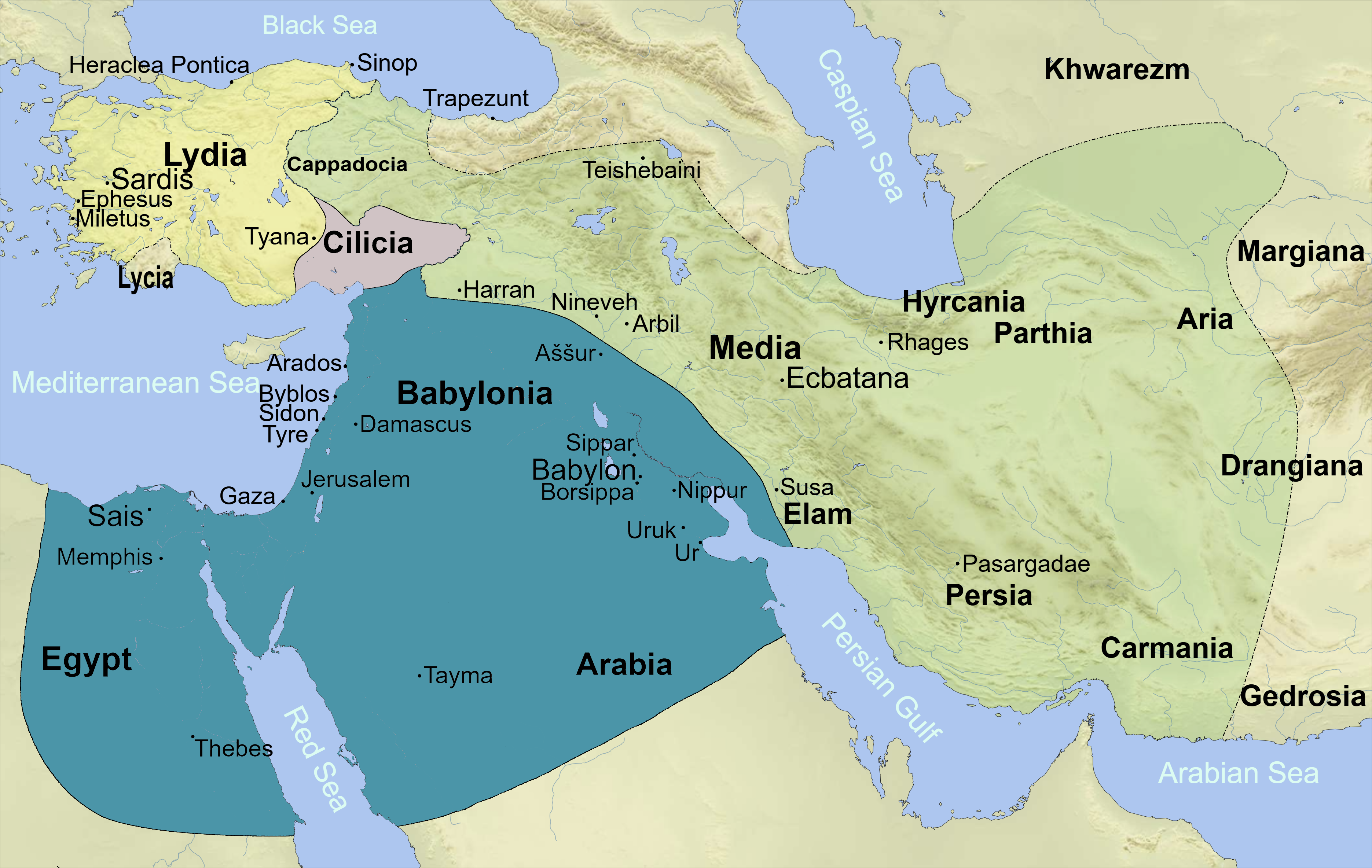 Source: BlueHypercane761, Neo-Babylonian Empire with neighboring powers, via Wikimedia Commons, CC0, https://commons.wikimedia.org/wiki/File:Neo-Babylonian_Empire_with_neighboring_powers.png
The map should not turn the guide into a geopolitical lecture. Its value is spiritual sobriety: Babylon is not only an inner mood, and it is not only ancient ruins. It is real human glory organized against God, and Isaiah teaches the soul to choose Zion over every city built by self-exaltation.
Spiritual Fruit 🍇
1. Learn to mistrust glamorous pride
Babylon shines before it collapses. Do not confuse brilliance with blessedness.
2. Hear how pride speaks inside the soul
“I will go up” is not only Babylon’s boast. It is the daily inner movement of self-exaltation.
3. Remember that God judges to make room for the poor
Isaiah does not end in spectacle. He ends in refuge. Help one neighbor obtain a meal, safe lodging, or practical protection. Poverty of spirit must not make actual poverty invisible.
4. Choose Zion over Babylon
The earthly city glories in itself. Zion is founded by the Lord. Every soul is being built somewhere.
Closing Meditation
Lord, cast down in us every proud ascent that competes with Your glory. Save us from admiring Babylon while secretly becoming like her. Found us in Zion, make us poor in spirit, and teach us to share bread and safety with the poor whom You shelter.
Glossary
- Babylon: The imperial city of proud domination, historically concrete and spiritually emblematic.
- Day of the Lord: God’s decisive visitation in judgment, here used with world-shaking force.
- Lucifer: Brenton’s traditional rendering in Isaiah 14:12; important to handle in context.
- Zion / Sion: The place the Lord founds and where the poor find refuge.
- Earthly city: Augustine’s term for the community built by love of self rather than love of God.1
Translation and Source Notes
This guide uses Brenton’s English Septuagint for embedded Scripture. The most important translation note is Isaiah 14:12, where Brenton reads Lucifer. The note keeps that wording visible but does not detach it from the passage’s explicit address to the king of Babylon.
The guide also preserves the project’s decision to keep Isaiah 14:24-32 inside the same note because those verses carry forward the same anti-imperial theological logic and end with Zion as refuge for the poor.
Sources
Primary sources
Isaiah 13-14, Brenton Septuagint.
St. Augustine, City of God 14.28, on the earthly city formed by love of self and the heavenly city formed by love of God.
Coptic Orthodox / pastoral sources
Fr. Bishoy Kamel, The Journey through Lent with Isaiah, especially the fourth-week use of Isaiah 14:30 and 14:32 in relation to the poor in spirit and the cross.
Direct Source Pages and Verification Links
Scripture text
- Brenton Septuagint, Isaiah 13: https://biblehub.com/sep/isaiah/13.htm
- Brenton Septuagint, Isaiah 14: https://biblehub.com/sep/isaiah/14.htm
Patristic source pages
- St. Augustine of Hippo, City of God 14, two cities and disordered love: https://www.newadvent.org/fathers/120114.htm
Geography and visual context
- OpenBible.info, all places mentioned in Isaiah, interactive map and KML: https://www.openbible.info/geo/preview/isa
- Project Gutenberg, Hurlbut Bible Atlas, public-domain biblical geography background: https://www.gutenberg.org/cache/epub/41140/pg41140-images.html
- Wikimedia Commons, Neo-Babylonian Empire with neighboring powers map, CC0: https://commons.wikimedia.org/wiki/File:Neo-Babylonian_Empire_with_neighboring_powers.png
Coptic lectionary provenance
- Lenten appointments follow the Coptic cycle and retained Matins witness; the Good Friday overlap follows the consulted Pascha working table. These witnesses do not have identical source authority.
Teaching Notes
Overall teaching emphases
- Why these chapters stay together: Chapter 13 announces Babylon’s overthrow; chapter 14 interprets it through taunt, descent, wider national warning, and Zion refuge.
- Where to linger: Isaiah 13:11, 14:4-5, 14:12-15, 14:24-27, and 14:32.
- Where to be careful: Teach 14:12-15 with both historical sobriety and spiritual depth. Do not erase Babylon’s king, and do not ignore the passage’s wider typological force.
- Pastoral warning: Some hearers are fascinated by demonic speculation but inattentive to pride in their own hearts. Isaiah is aiming at the latter.
- Show: Use the Neo-Babylonian map as a historical locator only after naming the caveat that it represents a later imperial frame. Then return to the spiritual choice between Babylon and Zion.
- Key phrases to say slowly: “I will destroy the pride of transgressors,” “How has Lucifer… fallen,” and “the Lord has founded Sion.”
Consolidated section teaching cues
Isaiah 13:1-5
- Key phrases: “Babylon does not own the field,” “the Lord of hosts commands the scene,” “history is not self-propelled.”
- Emphasize: Human power is never autonomous before God.
- Avoid: Teaching the mustering of nations as if God simply endorses violence. Isaiah is speaking about judgment and sovereignty, not about sanctifying conquest as such.
Isaiah 13:6-13
- Key phrases: “the Day of the Lord unmasks false stability,” “Babylon is self-glorifying power,” “the earthly city is built by the love of self.”
- Emphasize: Cosmic language here intensifies the theological meaning of judgment.
- Avoid: Treating the darkened heavens as only decoration. They signal the collapse of an order that seemed untouchable.
Isaiah 13:14-22
- Key phrases: “glamour ends in desolation,” “the glorious city becomes hollow,” “what pride builds is already unstable.”
- Emphasize: Isaiah is not indulging curiosity about destruction. He is exposing the end of arrogant splendor.
- Avoid: Turning the ruin imagery into spectacle. Its purpose is moral and theological, not sensational.
Isaiah 14:1-8
- Key phrases: “the fall of the oppressor becomes rest for the afflicted,” “creation breathes easier,” “judgment serves mercy.”
- Emphasize: Isaiah frames Babylon’s fall through the mercy given to God’s people.
- Avoid: Reading the taunt as petty mockery. It is liturgical relief after oppression.
Isaiah 14:9-20
- Key phrases: “handle this passage in layers,” “proud ascent ends in humiliating descent,” “Babylon’s king is still in view.”
- Emphasize: Keep the historical king of Babylon explicit even if you also note the broader typological tradition.
- Avoid: Flattening the passage either into only politics or only demonology.
Isaiah 14:21-27
- Key phrases: “the grammar of worldly arrogance,” “the Lord’s purpose stands over all nations,” “one empire is not the only lesson.”
- Emphasize: The transition to Assyria is not random. It universalizes the warning.
- Avoid: Treating 14:24-27 as throwaway verses detached from the taunt over Babylon.
Isaiah 14:28-32
- Key phrases: “empire is not the final subject,” “the Lord has founded Sion,” “the poor are the ones sheltered.”
- Emphasize: The prophetic goal is refuge in Zion, not fascination with imperial collapse.
- Avoid: Ending the lesson with Lucifer imagery alone. The chapter ends with the poor saved in Zion.
Footnotes
-
St. Augustine, City of God 14.28, trans. Marcus Dods, NPNF I.2: https://www.newadvent.org/fathers/120114.htm. ↩ ↩2
-
Fr Bishoy Kamel, The Journey through Lent with Isaiah, Fourth Week, introduction before the feast reflection; author-attributed pastoral booklet. ↩