


It is possible to sing to God and stop listening to Him. Amos enters that terrible distance between the sound of worship and the life of the worshipper. He names what people have learned not to notice: the poor sold for trifles, truth driven out of the courts, comfort untouched by another’s grief. Yet the voice that exposes them also says, “Seek ye me, and ye shall live.”
Amos is not a political tract with religious language added. He is a prophet of covenant worship. His central wound is that Israel can keep religious sound while losing repentance, mercy, truth in the gate, and fear of God. His accusations prepare the soul to stand before the Crucified One without excuses, and his final promise gives the fallen a hope they could not build for themselves.
Embedded Scripture is from Brenton’s English Septuagint (LXX).
A voice within real history (Amos 1:1-2)
- The words of Amos which came to him in Accarim out of Thecue, which he saw concerning Jerusalem, in the days of Ozias king of Juda, and in the days of Jeroboam the son of Joas king of Israel, two years before the earthquake.
- And he said, The Lord has spoken out of Sion, and has uttered his voice out of Jerusalem; and the pastures of the shepherds have mourned, and the top of Carmel is dried up.
The opening dates the word before it explains the wound. Amos speaks during the reigns of Uzziah of Judah and Jeroboam II of Israel, “two years before the earthquake.” He comes from Tekoa, Brenton’s “Thecue,” south of Jerusalem. The superscription in this translation says “concerning Jerusalem”; the commission later in the book explicitly sends him to Israel (Amos 7:15). We should hear both what this edition says and where the narrative takes him, rather than silently replacing its opening with more familiar wording.
The Lord’s voice begins from Zion, but its reach is not confined to one sanctuary. Shepherds’ pastures mourn and Carmel dries up. A landscape associated with life feels the force of the word. The prophet will speak about violence, markets, altars, and palaces because none lies outside the Creator’s care.
Amos and his world
The two kingdoms matter. Judah is the southern kingdom, with Jerusalem and the Davidic royal house; Israel is the northern kingdom, with Samaria and the royal sanctuary at Bethel. Amos crosses that boundary. In his answer to Amaziah he names his work with herds and sycamore fruit, then grounds his mission in the Lord’s command rather than court employment or hereditary prophetic office (Amos 7:14-15).
The book itself sets luxury beside injury: ivory houses, fine couches, desirable vineyards, dishonest scales, and people unable to obtain a just hearing. National confidence has become a way not to repent. Prosperity is not condemned simply because it is pleasant; it is exposed when it can no longer recognize the neighbor whose loss sustains it.
God’s earlier gifts make the refusal more painful. He brought Israel out of Egypt, gave the land, and raised witnesses among her children. Amos does not set justice against covenant or repentance against worship. He asks what those gifts were for if the people refuse the Giver’s likeness in their dealings with one another.
Iconography and Visual Teaching 🖼️
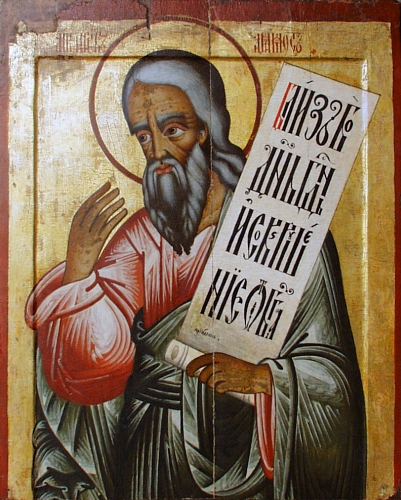 Source: Prophet Amos, Russian icon from the Kizhi iconostasis, Wikimedia Commons, public domain.
The haloed prophet holds an open scroll. Its inscription draws from Isaiah 13:6, not the Book of Amos: the Day of the Lord is near, with destruction from God. That detail protects us from mistaking the inscription for a quotation from Amos. It also places the image beside a warning Amos himself will press upon his hearers. The scroll presents the prophet as a bearer of a received word, not the owner of a private grievance.
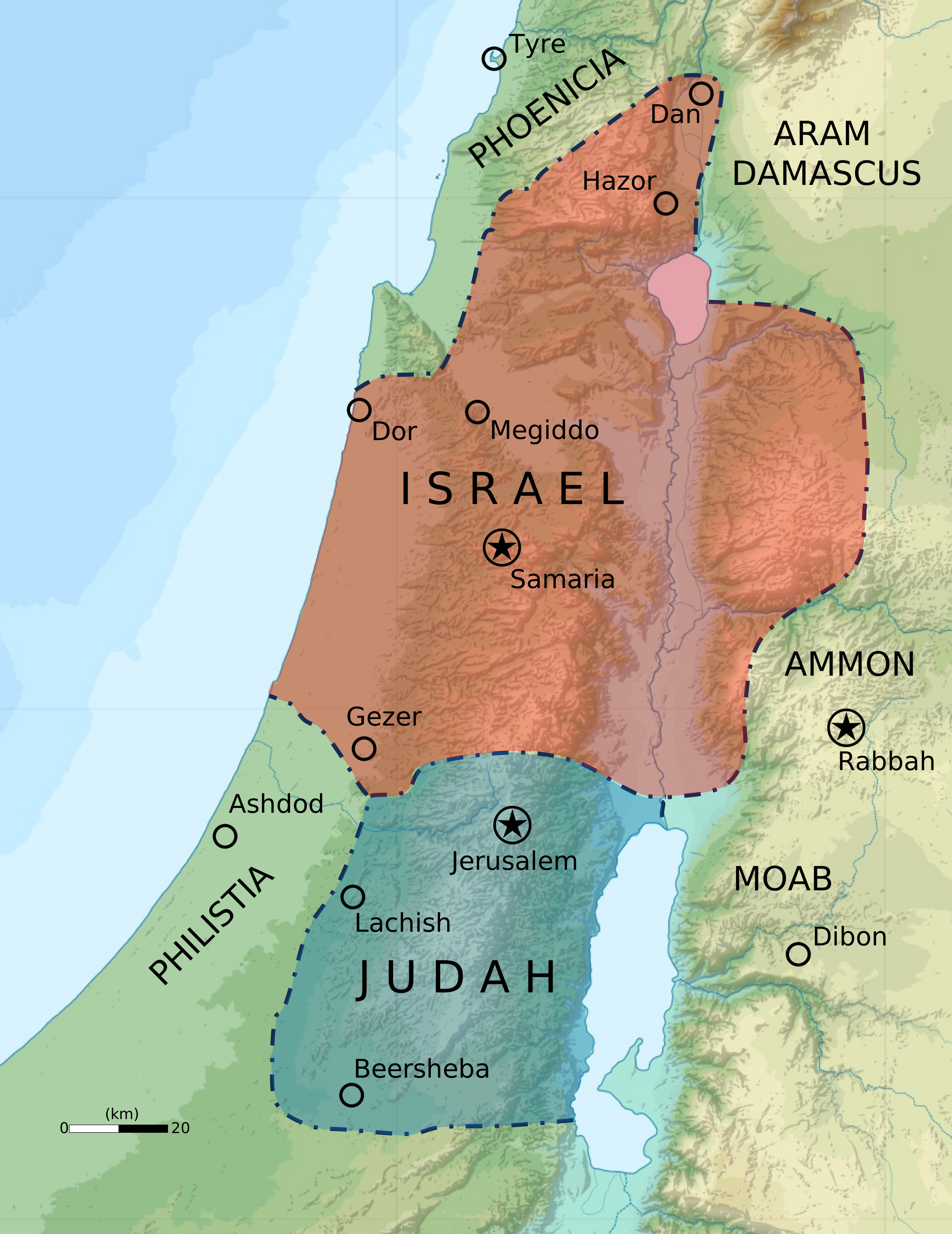 Source: Tobias Schäfer 87, Wikimedia Commons, CC BY 4.0.
The map gives a broad setting for the divided kingdoms and their neighbors. Judah, Israel, the coastal cities, and the eastern peoples are not abstract names in a list of accusations. The word crosses actual borders, then reaches the people who may have expected those borders to protect them.
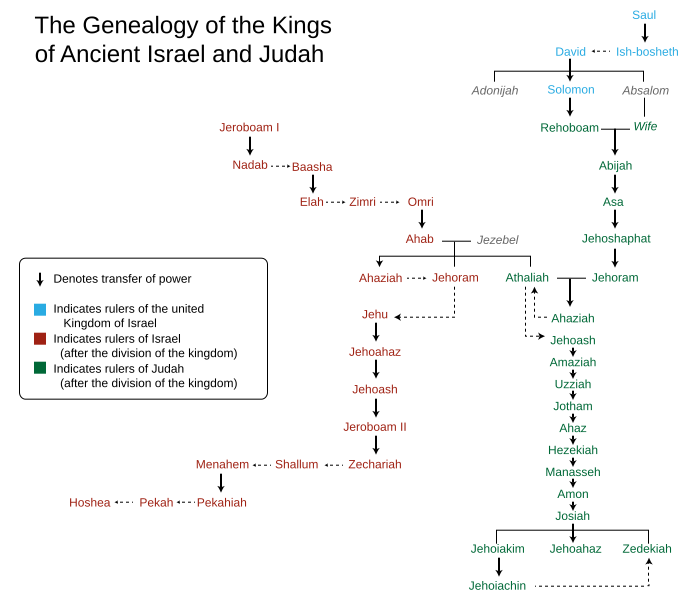 Source: Wikimedia Commons, genealogy of the kings of Israel and Judah, public domain.
The royal chart gives a different kind of orientation. Israel’s changing dynasties and Judah’s Davidic succession belong to the story behind the promise of David’s fallen booth. In the chart’s northern line, a horizontal arrow can mark a change of dynasty rather than parentage. Political continuity alone is not the hope Amos offers. At the end, God promises to raise what has fallen.
The movement of the book
Each chapter now has its own study, so that a vision, lament, or refrain can be heard at its own pace.
| Chapter | Movement | What to listen for |
|---|---|---|
| 1 | The Lord speaks against the nations’ cruelty | God’s judgment crosses borders; another people’s suffering is not outside His concern. |
| 2 | The accusation reaches Judah and Israel | The listener who agreed about others must now answer for himself. |
| 3 | The known people are called to account | Nearness to God is a gift that asks for a truthful response, not exemption. |
| 4 | “Yet ye returned not to me” | Repeated warnings uncover the tragedy of refusing a relationship, not merely a rule. |
| 5 | “Seek ye me, and ye shall live” | Worship and justice are reunited before the living Lord. |
| 6 | Comfort forgets Joseph | Good things become dangerous when they insulate us from the wounded. |
| 7 | The prophet intercedes and is resisted | Amos pleads for the very people he must confront. |
| 8 | The word once resisted becomes the word sought in vain | The unfair market, the darkened noon, and the famine of hearing belong together. |
| 9 | Judgment gives way to a promise God Himself accomplishes | No false refuge survives, yet Jacob is not utterly destroyed and the fallen booth is raised. |
The first two chapters contain eight judgment oracles, not an endless catalogue of foreign wrongdoing. Their movement is the point: five address the nations in chapter 1, then Moab, Judah, and Israel are named in chapter 2. The prophet gradually removes the safe position of the spectator.
The Church’s Voice in Worship ⛪
Amos is heard in Holy Pascha as a summons to repentance, truthful worship, and mercy before the Cross. The current working-source day-and-hour data in the lectionary package lists these selections:
- Amos 5:6-14: Eleventh Hour, under Tuesday Eve. A Monday Eve entry has the same reading identity and biblical service coverage; these labels should not be counted as two independently verified appointments.
- Amos 4:4-13: Wednesday Eve, Third Hour.
- Amos 3:1-11: Wednesday Eve, Sixth Hour.
- Amos 9:4-6 and Amos 9:8-10: Good Friday, Third Hour, two portions of one prophecy selection.
- Amos 8:9-12: Good Friday, Sixth Hour.
These current records derive from a working Katameros source, not Coptic Reader verification. The package separately retains the St. Mary Ottawa printed witness: it labels the chapter 3 and 4 readings Great Thursday Eve, gives a different chapter 9 selection, and lists Amos 5:18-27 at Wednesday Eve, Third Hour. Those are historical source witnesses, not additional current daily appointments.
In this package’s verse-addressed assignments, Amos appears in Holy Pascha and has no ordinary annual assignment. That describes the indexed readings, not every possible quotation of Amos in Coptic worship.
The spiritual force of the Pascha setting is searching. We can keep the feast and still resist the Lord before us. Darkness at noon draws our attention to the Crucifixion; the famine of hearing asks whether we will receive the word we are given. The appointed chapter 9 portions stop before the restored booth, but the whole book leads beyond presumption and judgment toward God’s act of restoration.
How to read Amos spiritually
Read Amos first against yourself. If the book becomes only a sermon about corrupt rulers, wealthy strangers, or political enemies, it has not yet reached the heart. Amos asks: where have I kept religious language while resisting repentance? Where have I loved worship as sound but not as obedience? Where have I wanted God’s day without wanting God’s examination?
This does not mean turning away from actual injustice. A victim should not have to carry the wrongdoer’s burden of confession. The call to examine ourselves must make us more willing to hear the harmed, protect the vulnerable, and repair what can be repaired. Likewise, Amos’s prophetic account of covenant judgment does not authorize us to explain another person’s illness, bereavement, or trauma as punishment.
Amos also guards us from moralism. The answer to empty worship is not activism without God. The answer is to seek the Lord and live. Justice in Amos is covenant truth lived before God: mercy to the poor, honest judgment, pure worship, repentance, and fear of the Lord.
Finally, read Amos toward Christ. The darkness at noon finds its deepest liturgical echo at the Cross. The famine of hearing the Word is answered by the Word Himself. The fallen booth of David is raised as Christ gathers Jews and Gentiles into one people called by His name. This is not a reason for contempt toward Israel. The apostles receive Israel’s Scriptures as the promise through which the nations are welcomed (Acts 15:13-18).
Glossary
- “LXX” / “Septuagint”: the ancient Greek scriptural tradition. “LXX” is its customary abbreviation.
- “Brenton”: Sir Lancelot Charles Lee Brenton, whose public-domain English Septuagint supplies the embedded readings. Its names and wording sometimes differ from Hebrew-based English Bibles.
- “Covenant”: the relationship God establishes with His people, carrying gifts, promises, and the call to faithful life.
- “Tekoa” / “Thecue”: Amos’s southern home, in Judah; Brenton uses the form “Thecue.”
- “Bethel” / “Bæthel”: a northern sanctuary whose royal protection becomes a point of conflict in Amos 7.
- “Day of the Lord”: God’s decisive intervention. Amos challenges the assumption that it guarantees the unrepentant hearer’s vindication.
- “Booth” / “tabernacle of David”: the fallen Davidic dwelling or royal house in Amos 9, received in Acts 15 as a restoration that includes the nations called by God’s name.
- “Holy Pascha”: the Church’s Holy Week observance of the Lord’s saving Passion and Resurrection; the references above preserve their source-specific day and hour labels.
Spiritual Fruit 🍇
- Let the word come home. When Amos names a sin you readily see in someone else, pause before agreeing. Ask where it has found shelter in you.
- Join prayer to a person’s need. Name someone whose loss you have grown used to. Pray for that person, listen, and choose one responsible act of help.
- Read the hard words with the intercessor. Amos pleads for Jacob before announcing judgment. Do not borrow his rebuke while refusing his prayer.
- Receive the ending as a gift. God raises the fallen booth. Repentance is not a project of making yourself worthy to be rescued; it is a truthful turning toward the One who gives life.
Teaching Notes
The book’s setting and movement
- Ask: why is it easier to hear God’s word as a spectator than as someone addressed?
- Emphasize: the chapter studies follow distinct movements without losing the book’s journey from accusation to restoration.
- Watch for: reducing Amos to partisan criticism, using suffering to accuse victims, or treating spiritual identity as exemption.
- Show: use the map for the two kingdoms, the icon for the prophet’s received word, and the royal chart only where the divided kingship clarifies Davidic hope.
Amos in Holy Pascha
- Ask: what changes when these warnings are heard while approaching the Crucified Lord?
- Emphasize: source labels and current working appointments are not the same as independently confirmed local practice.
- Watch for: counting the Monday/Tuesday Eve entries as two established occasions or presenting the historical Ottawa selections as current daily records.
- Connect: Amos 8’s noon-darkness and Amos 9’s restoration should be related without pretending the latter is included in the Good Friday Third Hour selection.
Sources
- Brenton, The Septuagint Version of the Old Testament, Amos, public-domain English translation; Amos 1 and Amos 7, for the superscription and commission.
- Acts 15:13-18, St. James’s use of Amos in the Jerusalem Council.
- @andraws/lectionary-data 1.3.5, reverse index and date-resolved readings. Current Amos records are working Katameros-source data not checked against Coptic Reader. St. Mary Ottawa’s 2018 Holy Pascha extracted text is retained separately as a historical printed witness. Package references identify selections; the embedded biblical text remains Brenton’s Septuagint.
- Prophet Amos icon, Kizhi iconostasis, Russian Orthodox tradition, public domain; the file identifies the scroll text as Isaiah 13:6.
- Kingdoms of Israel and Judah, Tobias Schäfer 87, CC BY 4.0, a broad geographical setting.
- Genealogy of the kings of Israel and Judah, public domain; arrows in Israel’s line can mark dynastic change rather than kinship.