
Israel remembers the Exodus as the story of her rescue. Amos makes her hear it as the beginning of a claim upon her life. The Lord who brought this family out of Egypt has not forgotten her; that is precisely why He will not leave her oppression unchallenged. His warning reaches from the city’s public violence to its sanctuaries and comfortable houses. Nothing loved by God becomes too familiar for God to examine.
Glossary
- Covenant: the relationship God establishes with His people, bringing gifts and a call to faithful life. In this chapter, deliverance is the ground of responsibility, not protection for wrongdoing.
- Samaria: the northern kingdom of Israel’s capital, where Amos exposes oppression joined to wealth and power.
- Bæthel: Brenton’s spelling of Bethel, the northern sanctuary named in verse 14. The altar cannot shelter the sins that worshippers refuse to surrender.
- Fowler: a person who catches birds; the trap in verse 5 belongs to Amos’s chain of images about warning and consequence.
- LXX and Brenton: “LXX” names the Septuagint, the ancient Greek translation of the Old Testament; Sir Lancelot Charles Lee Brenton translated it into English. Its wording is retained in the readings below.
The family brought out of Egypt (Amos 3:1-2)
- Hear ye this word, O house of Israel, which the Lord has spoken concerning you, and against the whole family whom I brought up out of the land of Egypt, saying,
- You especially have I known out of all the families of the earth: therefore will I take vengeance upon you for all your sins.
The accusation begins with a gift: God brought this family out of Egypt. The Lord’s knowledge of Israel is not the mere possession of information about her. He addresses a people whom He has drawn into a particular relationship. That is why “therefore” in verse 2 is so searching. Israel might expect special knowledge to mean special exemption. Amos says it means an account must be given.
Election is not favoritism without holiness. To be known by God is to be brought near, and nearness makes sin more serious, not less.
This is a hard word for church people. Baptism, liturgy, confession, fasting, hymnology, and Orthodox identity are gifts of mercy. They are not hiding places from repentance. The more God gives, the more love asks for a truthful response.
St. Paul brings the Exodus into Christian self-examination in 1 Corinthians 10:1-12. All passed through the sea and shared the gifts God gave, yet these gifts did not make idolatry harmless. Paul identifies the spiritual Rock with Christ and warns the person who thinks he stands to take heed. This is not a rejection of Baptism or the Eucharist; it is a rejection of using communion with Christ as an excuse for refusing His life. Nor does being known end in terror alone. In John 10:11-18, Christ knows His sheep and lays down His life for them. The One who knows us does not flatter the sin that destroys us; He gives Himself to rescue us from it. Our answer to Amos is neither religious self-confidence nor flight from God, but a truthful return to the Shepherd.
When the lion roars (Amos 3:3-8)
- Shall two walk together at all, if they do not know one another?
- Will a lion roar out of his thicket if he has no prey? will a lion’s whelp utter his voice at all out of his lair, if he have taken nothing?
- Will a bird fall on the earth without a fowler? will a snare be taken up from the earth without having taken anything?
- Shall the trumpet sound in the city, and the people not be alarmed? shall there be evil in a city which the Lord has not wrought?
- For the Lord God will do nothing, without revealing instruction to his servants the prophets.
- A lion shall roar, and who will not be alarmed? the Lord God has spoken, and who will not prophesy?
The questions draw the hearer into the logic of the warning. Companionship involves a relationship; a roar, a trap, and a trumpet are not empty sounds or accidents without consequence. In Brenton’s verse 3, the question concerns two people who “do not know one another,” carrying the chapter’s language of knowledge into the image of walking together. Israel cannot insist on the privileges of belonging to God while refusing the relationship His word requires.
Amos piles up questions: will a lion roar without prey, will a trumpet sound without alarm, will the Lord speak without revealing instruction to His prophets? The prophet is not speaking because he enjoys confrontation. “The Lord God has spoken, and who will not prophesy?” (Amos 3:8).
This matters for spiritual life. Sometimes we call correction harsh because we do not want to ask whether God is speaking through it. Not every harsh word is prophetic, but a true word from God must not be dismissed because it disturbs us.
That distinction also protects the vulnerable. A person’s anger, religious title, or claim to speak for God does not authenticate a rebuke. Correction must be tested for truth and for fidelity to Christ; humiliation, threats, coercion, and abuse are not made holy by calling them a lion’s roar. Receiving truthful correction never requires remaining in danger or surrendering access to protection and trustworthy help. Amos himself speaks against oppression, not in defense of an oppressor’s authority.
The “evil” in verse 6 is calamity or disaster in the city under judgment, not moral wickedness created by God. The Lord is not the source of the cruelty He condemns in verses 9-10. The question declares that the coming devastation is not beyond His sovereignty; it does not make the violent innocent. Within this prophecy, the trumpet and the prophet’s speech are mercy before the blow. Israel is being told the truth while she can still hear it.
Oppression exposed before witnesses (Amos 3:9-11)
- Proclaim it to the regions among the Assyrians, and to the regions of Egypt, and say, Gather yourselves to the mountain of Samaria, and behold many wonderful things in the midst of it, and the oppression that is in it.
- And she knew not what things would come against her, saith the Lord, even those that store up wrong and misery in their countries.
- Therefore thus saith the Lord God; O Tyre, thy land shall be made desolate round about thee; and he shall bring down thy strength out of thee, and thy countries shall be spoiled.
Foreign witnesses are summoned to the mountain of Samaria. Egypt, named at the opening as the place from which Israel was delivered, is now called to see what has happened among the delivered people. The contrast is painful: release from bondage has not kept Israel from creating misery for others. Amos’s “wonderful things” cannot be isolated from the oppression named in the same sentence; the spectacle is a city whose visible greatness conceals a grave disorder.
Verse 10 turns the language of storage against those who profit from wrong. They have accumulated not only possessions but misery. What looks like successful provision for the future has become evidence against them. This reaches ordinary decisions as well as palaces: a wage withheld, a debt manipulated, or a household’s comfort purchased by someone else’s exhaustion cannot become righteous simply because the beneficiaries give thanks for it.
Translation insight: “O Tyre”
Brenton’s verse 11 addresses “O Tyre”; the electronic Swete Greek text likewise names Tyre, while the Hebrew text announces an adversary surrounding the land. These are different wordings, not two names for the same city. Tyre is the coastal city already addressed in Amos 1:9-10, whereas Samaria is the setting of the accusation here. The surprising address does not narrate a new journey by Amos or make the preceding accusation about Tyre. Both forms speak of strength being brought down and possessions being spoiled. The secure center cannot make itself untouchable. The comparison establishes the difference, not exactly how it arose.
The Church’s Voice in Worship ⛪
The lectionary package’s current working Katameros-source data lists Amos 3:1-11 at Wednesday Eve, Sixth Hour of Holy Pascha. Its retained St. Mary Ottawa printed witness labels the passage Great Thursday Eve, Sixth Hour. That historical source label is not an additional current appointment; neither record is presented here as Coptic Reader checked.
Heard during the commemoration of the Passion, this accusation takes away the safety of judging only outsiders. Those brought near to God must hear what their nearness asks of them. Before the Crucified Shepherd, the proper response is not to admire Amos’s courage from a distance, but to confess where worship and advantage have coexisted with another person’s injury. The Cross shows both the seriousness of sin and the love with which Christ seeks the sinner; repentance need not hide the truth in order to hope for mercy.
What remains when false shelter falls (Amos 3:12-15)
- Thus saith the Lord; As when a shepherd rescues from the mouth of a lion two legs or a piece of an ear, so shall be drawn forth the children of Israel who dwell in Samaria in the presence of a foreign tribe, and in Damascus.
- Hear, O ye priests, and testify to the house of Jacob, saith the Lord God Almighty.
- For in the day wherein I shall take vengeance of the sins of Israel upon him, I will also take vengeance on the altars of Bæthel: and the horns of the altar shall be broken down, and they shall fall upon the ground.
- I will crush and smite the turreted-house upon the summer-house; and the ivory-houses shall be destroyed, and many other houses also, saith the Lord.
The shepherd’s rescue is a deliberately dreadful image. Two legs or a piece of an ear are not a flock restored to safety. They testify to how much has been lost. The comparison denies an easy escape for those who imagine that their position in Samaria guarantees survival in comfort. It should not be softened into a cheerful promise of preservation.
Judgment reaches the altars of Bethel as well as the houses of the powerful. The broken altar horns make visible the collapse of religious security; the destruction of ivory houses exposes the fragility of luxurious security. Sanctuary and residence cannot be kept in separate moral compartments. The same life that kneels at the altar goes home to the use of money, servants, neighbors, and power.
Amos does not teach contempt for beautiful worship or for a home. He condemns the confidence that either can make oppression safe. We need not wait until every support is removed to ask what we have been trusting. Confession is already a place to stop defending what cannot stand before God, and restitution is one way that confession becomes truthful in the life of an injured neighbor.
Iconography and Visual Teaching 🖼️
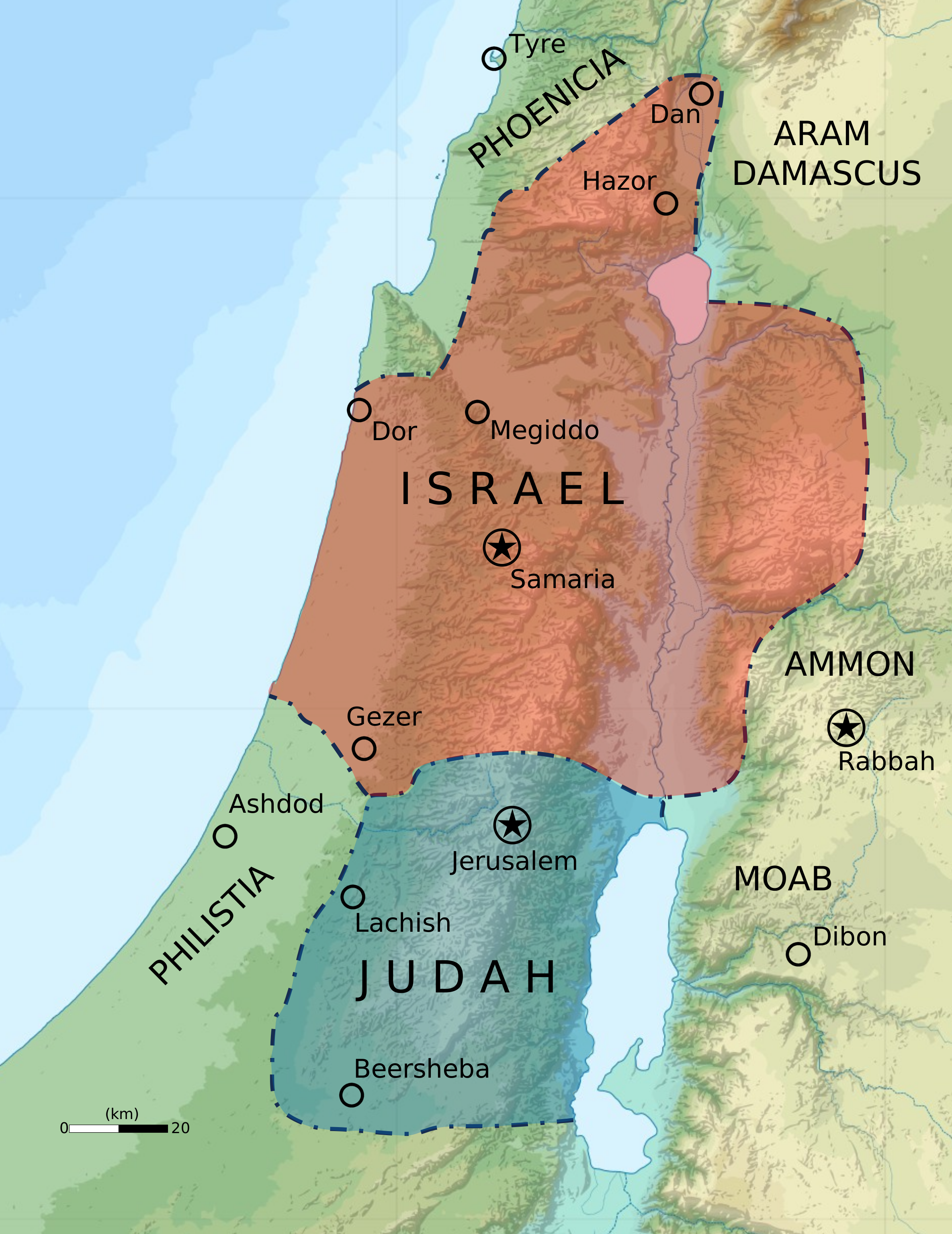 Source: Tobias Schäfer 87, Wikimedia Commons, CC BY 4.0.
The map shows the divided kingdoms within which Amos speaks. Samaria and Bethel belong to the northern setting of this accusation; Judah lies to the south. These are real centers of political and religious life, not interchangeable symbols for wicked people somewhere else.
Spiritual Fruit 🍇
Receive one gift of the Church with renewed responsibility. Before the next confession or Liturgy, name a concrete contradiction between what you receive from God and how you treat another person. Where repair is possible and safe, begin it: return what is owed, correct a dishonest account, or stop a demand that burdens someone without power to refuse.
Do not despise a true warning merely because it hurts your pride. Equally, do not call abuse a warning from God. The Shepherd who knows His sheep does not require us to confuse His voice with a predator’s. Seek truth with prayer, sound counsel, and the courage to name injury honestly.
Being known by God means that neither our hidden wrong nor our need for rescue is overlooked. Let that knowledge end the performance of innocence. Lord Jesus Christ, You know what I have concealed and whom I have wounded. Bring my worship and my conduct into the same light, and teach me to follow You without excuses.
Teaching Notes
The family brought out of Egypt (Amos 3:1-2)
- Ask: why does the Exodus increase Israel’s responsibility rather than cancel it?
- Connect: 1 Corinthians 10:1-12 addresses the Church with Israel’s warning; John 10:11-18 joins Christ’s knowledge of His sheep to His self-giving love.
When the lion roars (Amos 3:3-8)
- Ask: what makes a disturbing correction truthful, and what would make a religious rebuke abusive?
- Watch for: identifying the “evil” of calamity in verse 6 with God creating moral wickedness.
Oppression exposed before witnesses (Amos 3:9-11)
- Ask: what does a household or institution reveal if its accounts are read from the perspective of those who bear its costs?
- Watch for: silently replacing “O Tyre” with a familiar Hebrew-based rendering, or treating the two Pascha labels as proven separate occasions.
What remains when false shelter falls (Amos 3:12-15)
- Emphasize: the fragments in the shepherd’s mouth describe devastating loss, not comfortable exemption.
- Show: locate Samaria and Bethel on the map before discussing the paired judgment of altars and houses.
Sources
Embedded Scripture is from Brenton’s English Septuagint (LXX).
- Amos 3:1-15, Brenton, The Septuagint Version of the Old Testament; Amos 1:9-10 for the earlier address to Tyre.
- Amos 3:11, NKJV, for the comparison with Brenton’s “O Tyre.”
- 1 Corinthians 10:1-12; John 10:11-18, for Christian accountability and the Good Shepherd who knows His sheep.
- Electronic Swete Greek Amos 3 and Hebrew Amos 3, for the Tyre/adversary comparison.
- @andraws/lectionary-data 1.3.5, current working Katameros-source records and the separately retained St. Mary Ottawa Holy Pascha, Lent 1734 A.M. / 2018 A.D., extracted-text witness. The package has not marked these Amos assignments as Coptic Reader checked. Its references identify selections; the embedded Scripture remains Brenton’s Septuagint.
- Tobias Schäfer 87, Kingdoms of Israel and Judah (8th century BCE), CC BY 4.0.