


A bed, a song, a cup of wine: Amos names ordinary pleasures made into a sealed room. Outside it, Joseph is wounded. The chapter asks what happens when comfort no longer restores us for love, but trains us not to notice who is suffering.
Embedded Scripture is from Brenton’s English Septuagint (LXX).
Comfort that cannot mourn (Amos 6:1-7)
- Woe to them that set at nought Sion, and that trust in the mountain of Samaria: they have gathered the harvest of the heads of the nations, and they have gone in themselves.
- O house of Israel, pass by all of you, and see; and pass by thence to Ematrabba; and thence descend to Geth of the Philistines, the chief of all these kingdoms, see if their coasts are greater than your coasts.
- Ye who are approaching the evil day, who are drawing near and adopting false sabbaths;
- who sleep upon beds of ivory, and live delicately on their couches, and eat kids out of the flocks, and sucking calves out of the midst of the stalls;
- who excel in the sound of musical instruments; they have regarded them as abiding, not as fleeting pleasures;
- who drink strained wine, and anoint themselves with the best ointment: and have suffered nothing on occasion of the calamity of Joseph.
- Therefore now shall they depart into captivity from the dominion of princes, and the neighing of horses shall be cut off from Ephraim.
The wound in Amos 6 is not wealth alone. The wound is luxury joined to numbness. The people are not condemned because they have tasted wine, heard music, or rested on beds. They are condemned because comfort has made them unable to grieve with the wounded people of God.
This is why the chapter is spiritually dangerous for faithful readers. It is easy to denounce the rich in the text while protecting the small luxuries that make my own heart forgetful. Ease in Zion can live inside church life: prayer without urgency, fasting without compassion, service without tears, comfort without the poor.
The opening addresses Zion as well as Samaria. The reader cannot make the warning a defect of another city or another community. In verse 2, “Ematrabba” is Brenton’s form of Hamath the Great, and “Geth” is Gath. The tour of neighboring kingdoms punctures the belief that impressive territory makes a people secure. It is not a promise that a larger kingdom is a holier one.
Verse 3’s “false sabbaths” is also striking. The electronic Swete Greek text supports this wording; the Hebrew-based form instead speaks of bringing near the seat of violence. Read beside verses 4-6, Brenton’s phrase exposes observance joined to wrongdoing rather than renewed life before God. This is not a condemnation of the Sabbath or of bodily rest. The indictment is the ease that has stopped loving.
“Not grieved for Joseph”
Here “Joseph” names the northern people, especially associated with the tribes of Ephraim and Manasseh, Joseph’s sons. The wounded brother and the wounded people belong together in the image: to be ungrieved for Joseph is to lose family feeling in the covenant. It is to say, “I am well,” while the body is sick.
In the Church, this touches the Eucharistic conscience. We cannot receive one Body while remaining indifferent to members of that Body. The comfortable heart must be trained to notice again. This is one reason fasting is mercy. Fasting is not self-improvement. It is a school that teaches the satisfied heart to become awake, grateful, and generous.
This does not demand constant emotional intensity. Grief, exhaustion, illness, or depression can blunt feeling without destroying love. Amos confronts chosen indifference, not a wounded person’s inability to produce tears. Compassion can begin as a faithful act: making a visit, sharing a meal, paying attention, or asking what help is wanted.
Christ, the Brother who does not turn away
Christ answers Amos 6 by choosing poverty, humility, the Cross, and solidarity with the suffering. He is not at ease while Joseph is wounded. He becomes the rejected Brother and the true Joseph who feeds those who betrayed Him.
The Cross judges numb comfort because there God shows complete compassion. If I can stand before the Crucified and remain unmoved by suffering, Amos has not yet finished speaking to me.
Gems from the Fathers 💎
St. John Chrysostom gives a direct ascetical correction to wealth without mercy: “not because riches are a sin: the sin is in not distributing them to the poor, and in the wrong use of them.”1 This is exactly the balance Amos 6 needs. The issue is not resentment of possessions. The issue is a heart mastered by comfort and closed to mercy.
Chrysostom also says that riches are good “if they do not master their owners; if the wants of our neighbors be done away by them.”1 In Amos’s language, wealth becomes dangerous when it prevents grief over Joseph.
The houses that cannot protect (Amos 6:8-14)
- For the Lord has sworn by himself, saying, Because I abhor all the pride of Jacob, I do also hate his countries, and I will cut off his city with all who inhabit it.
- And it shall come to pass, if there be ten men left in one house, that they shall die.
- But a remnant shall be left behind, and their relations shall take them, and shall strenuously endeavour to carry forth their bones from the house: and one shall say to the heads of the house, Is there yet any one else with thee? And he shall say, No one else. And the other shall say, Be silent, that thou name not the name of the Lord.
- For, behold, the Lord commands, and he will smite the great house with breaches, and the little house with rents.
- Will horses run upon rocks? will they refrain from neighing at mares? for ye have turned judgment into poison, and the fruit of righteousness into bitterness:
- ye who rejoice at vanity, who say, Have we not possessed horns by our own strength?
- For behold, O house of Israel, I will raise up against you a nation, saith the Lord of hosts; and they shall afflict you so that ye shall not enter into Æmath, and as it were from the river of the wilderness.
The rooms of luxury become rooms of death. Great houses and small houses alike break open. The chapter’s closing movement removes the defenses that the opening pleasures had seemed to provide: neither a fine house nor a confident slogan can keep a corrupt people safe.
The silence around the Lord’s name in verse 10 belongs to this scene of terror. It is not a rule forbidding the afflicted to pray. Nor does the passage authorize us to interpret a bereavement, epidemic, or ruined home as evidence of its occupants’ particular guilt. Amos speaks a prophetic judgment over named wrongdoing; we do not inherit his authority to diagnose someone else’s suffering.
Brenton’s pair of questions in verse 12 joins horses on rock with their attraction to mares. The second differs from the familiar Hebrew-based question about plowing with oxen. The questions appeal to what creatures naturally do or cannot sensibly do; Israel, by contrast, has turned the proper work of justice into poison. Amos supplies the moral point in the verse itself: what should give life has become bitter and destructive. The claim of strength in verse 13 cannot undo that reversal.
“Æmath” in verse 14 is Hamath again, now in the closing announcement of affliction. The northward place name that appeared during the tour of kingdoms returns as a reminder that political reach is not an escape from God. The unfamiliar spelling does not introduce another place or a secret symbol.
Iconography and Visual Teaching 🖼️
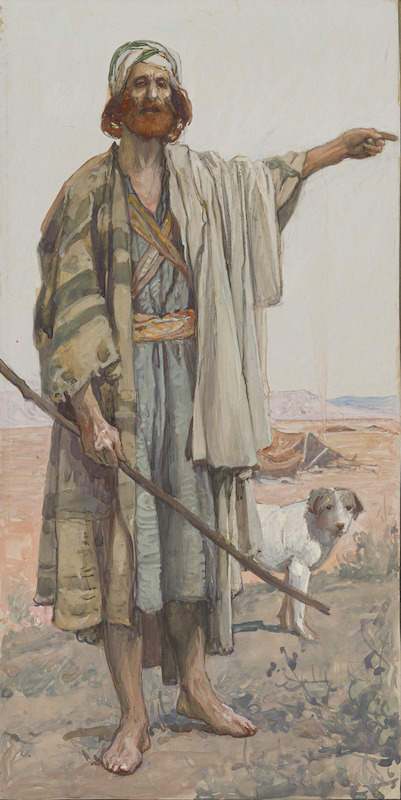 Source: James Tissot, Amos, Wikimedia Commons, public domain.
This is Western biblical art, not an Orthodox icon. It presents a solitary prophetic figure, a useful contrast to the insulated life described in the chapter. The painting is an artist’s imagining, not evidence of Amos’s appearance.
Glossary
- “LXX” and “Brenton”: the Septuagint is the ancient Greek scriptural tradition; Brenton supplies the English translation quoted here.
- “Zion” / “Sion”: Jerusalem’s sacred center; its appearance beside Samaria prevents the warning from being confined to the northern kingdom.
- “Ematrabba”: Hamath the Great, a Syrian city named in verse 2.
- “Æmath”: another Brenton spelling of Hamath in verse 14.
- “Joseph”: a name for the northern people, associated particularly with Ephraim and Manasseh.
- “Horns”: an image of power in verse 13; their boast treats strength as their own achievement and security.
- “Ascetic”: pertaining to spiritual training. Fasting here serves attention, gratitude, and generosity rather than contempt for the body.
Spiritual Fruit 🍇
- Ask what comfort has made you unable to notice. The danger is not only luxury. It is numbness.
- Let fasting restore attention. Choose a fast suited to your health and spiritual guidance, then let what it frees become a gift to someone else.
- Use possessions as mercy, not insulation. Wealth, time, privacy, influence, and emotional energy can all become walls against the needy. Open one door you can responsibly open.
- Return to Christ without forcing a feeling. Stand before the Cross, ask for a heart that can love, and make one small act of compassion while you wait for feeling to follow.
Teaching Notes
Amos 6:1-7
- Ask: what is the difference between rest that restores love and comfort that insulates us from it?
- Emphasize: Joseph is not an undefined symbol. The wound belongs to the northern people whose leaders are feasting.
- Watch for: class resentment, body contempt, or shaming a grieving or depressed person for emotional numbness.
- Connect: fasting, almsgiving, and the Eucharistic responsibility to care for members of one Body.
- Show: identify the Tissot image as Western art rather than an icon or a historical portrait.
Amos 6:8-14
Ask: why does Amos move from luxurious houses to houses that cannot protect their inhabitants?
Watch for: turning the silence in verse 10 into advice not to pray, or explaining another family’s loss as punishment.
Emphasize: the closing accusation is the corruption of judgment and righteousness, not an obscure geographical riddle.
Sources
- Brenton, The Septuagint Version of the Old Testament, Amos 6, public-domain English translation.
- Brenton Amos 6, electronic Swete Greek Amos 6, and Hebrew Amos 6, for the place names and translation comparisons. The comparisons identify these witnesses without reconstructing how each difference arose.
- Genesis 48:5 and Amos 6:7, for Joseph’s sons Ephraim and Manasseh and the northern setting.
- St. John Chrysostom, Homilies on First Corinthians, Homily XIII, §8, a thematic witness on wealth and mercy.
- James Tissot, Amos, public-domain Western biblical art.
Footnotes
-
St. John Chrysostom, Homilies on First Corinthians, Homily XIII, §8, on 1 Corinthians 4:10 (used thematically), https://www.ccel.org/ccel/schaff/npnf112.iv.xiv.html#iv.xiv-p36. ↩ ↩2