
Amos opens like a courtroom where everyone is ready to hear someone else condemned. Damascus, Gaza, Tyre, Edom, and Ammon stand accused, and the charges are not obscure religious offenses. They concern people made disposable by war, captivity, betrayal, and ambition. The Lord sees those whom successful nations have learned not to see.
This chapter begins a sequence of eight judgment oracles across Amos 1–2: Damascus, Gaza, Tyre, Edom, Ammon, Moab, Judah, and Israel. The movement is a tightening circle, not a neat compass route. It will reach God’s own people. For now, Amos makes one thing unavoidable: belonging to a powerful nation does not make cruelty right, and belonging outside Israel does not place a person’s suffering beyond God’s concern.
The voice that withers Carmel (Amos 1:1-2)
- The words of Amos which came to him in Accarim out of Thecue, which he saw concerning Jerusalem, in the days of Ozias king of Juda, and in the days of Jeroboam the son of Joas king of Israel, two years before the earthquake.
- And he said, The Lord has spoken out of Sion, and has uttered his voice out of Jerusalem; and the pastures of the shepherds have mourned, and the top of Carmel is dried up.
The opening fixes the prophecy in the reigns of actual kings and before a remembered earthquake. Yet neither king is the source of its authority. The Lord “has spoken out of Sion” and “has uttered his voice out of Jerusalem.” The pastures mourn and Carmel dries up. Judgment comes from God, not from the prophet’s temperament.
Worship and the world outside the sanctuary are not separate territories. The Lord whose presence His people confess also sees what rulers, armies, and traders do.
This keeps the book spiritually sane. Its severity is not permission to enjoy another person’s ruin. Later, the same Lord calls His people to seek Him and live (Amos 5:4). We must hear His exposure of evil as a summons to truth, not borrow His authority for our own anger.
Damascus: strength turned against the defenseless (Amos 1:3-5)
A translation difference to notice: Brenton’s Septuagint wording below describes violence against pregnant women. The Hebrew-based NKJV instead describes the threshing of Gilead with iron implements. These are distinct readings, not interchangeable quotations; the explanation here follows the displayed Brenton text.1
- And the Lord said, For three sins of Damascus, and for four, I will not turn away from it; because they sawed with iron saws the women with child of the Galaadites.
- And I will send a fire on the house of Azael, and it shall devour the foundations of the son of Ader.
- And I will break to pieces the bars of Damascus, and will destroy the inhabitants out of the plain of On, and will cut in pieces a tribe out of the men of Charrhan: and the famous people of Syria shall be led captive, saith the Lord.
The repeated formula, “For three sins … and for four,” sounds an accumulation, not an allowance to commit three offenses safely. Damascus is confronted with cruelty that God will not overlook. Its royal house, defenses, and public standing cannot protect it from the judgment announced here.
The violence against women is condemned, not endorsed. It must not be retold for shock or used to suggest that those harmed deserved it. A reader carrying memories of violence or pregnancy loss may pause and seek safe, trusted support. This oracle names perpetrators’ guilt; it does not give us grounds to diagnose an individual sufferer’s pain as punishment.
The movement from the defenseless to the royal house matters. A regime may treat the bodies of others as proof of its strength; God addresses the foundations on which that strength rests.
Gaza: captives are not possessions (Amos 1:6-8)
- Thus saith the Lord; For three sins of Gaza, and for four, I will not turn away from them; because they took prisoners the captivity of Solomon, to shut them up into Idumea.
- And I will send forth a fire on the walls of Gaza, and it shall devour its foundations.
- And I will destroy the inhabitants out of Azotus, and a tribe shall be cut off from Ascalon, and I will stretch out my hand upon Accaron: and the remnant of the Philistines shall perish, saith the Lord.
Gaza’s accusation concerns captivity carried onward into Idumea. The judgment then names other Philistine cities: Azotus, Ascalon, and Accaron. What appears to be a city’s profitable or strategic transaction is exposed before the Lord as wrongdoing against persons.
Brenton’s unusual phrase is “the captivity of Solomon.” Verse 9 similarly names “the prisoners of Solomon.” The Hebrew-based NKJV has the whole captivity delivered to Edom and does not name Solomon.1 Brenton gives no further historical identification here. What is clear is that prisoners are handed over and confined; their captors’ power does not make that right.
Something can be rewarded by a market or accepted by one’s peers and still be answerable to God. The captive is not a unit in another person’s success.
Tyre: a covenant of brethren forgotten (Amos 1:9-10)
- Thus saith the Lord; For three transgressions of Tyre, and for four, I will not turn away from it; because they shut up the prisoners of Solomon into Idumea, and remembered not the covenant of brethren.
- And I will send forth a fire on the walls of Tyre, and it shall devour the foundations of it.
Tyre’s accusation adds a remembered obligation to the captive-taking already named at Gaza. They “remembered not the covenant of brethren.” The wrong is not simply hostility between strangers. A bond that should have restrained their conduct has been set aside when it became inconvenient.
The phrase exposes a kind of forgetfulness that is moral, not merely mental. We can remember a relationship when we need help and forget it when fidelity costs us something.
Within a family, a parish, or a friendship, the practical test is whether our promises still govern us when the other person has less power. Keeping confidence must never mean concealing abuse; faithfulness protects persons rather than the reputation of those harming them.
Edom: anger kept to the end (Amos 1:11-12)
- Thus saith the Lord; For three sins of Idumea, and for four, I will not turn away from them; because they pursued their brother with the sword, and destroyed the mother upon the earth, and summoned up his anger for a testimony, and kept up his fury to the end.
- And I will send forth a fire upon Thaman, and it shall devour the foundations of her walls.
Idumea is Edom. Here the accusation moves from the pursuit of a brother to fury deliberately sustained. Brenton’s reference to the mother intensifies the destruction of the family bond. The ending, “kept up his fury to the end,” shows anger becoming something preserved rather than something resisted.
Not every movement of anger is this settled cruelty. Victims need not call evil good. But anger can become a loyalty we cultivate until another person’s destruction seems desirable. Amos exposes that hardening without asking the injured to surrender safety or justice.
In Christ, love of enemies does not mean assisting their violence. It means refusing to let their evil determine what we ourselves become. Repentance may begin by relinquishing the wish to see someone humiliated while still maintaining necessary boundaries and seeking truthful accountability.
Ammon: ambition at another person’s expense (Amos 1:13-15)
- Thus saith the Lord; For three sins of the children of Ammon, and for four, I will not turn away from him; because they ripped up the women with child of the Galaadites, that they might widen their coasts.
- And I will kindle a fire on the walls of Rabbath, and it shall devour her foundations with shouting in the day of war, and she shall be shaken in the days of her destruction:
- and her kings shall go into captivity, their priests and their rulers together, saith the Lord.
The motive is stated with terrible plainness: “that they might widen their coasts.” Here “coasts” means territorial borders. More land is sought through violence against those least able to resist. Amos names what the language of national expansion can conceal: the human cost is not incidental to God’s judgment.
These atrocities are charges against Ammon, never commands for God’s people to imitate. No graphic elaboration is needed to hear them. Those who have suffered violence are not the guilty party in this accusation, and the passage is not an explanation for every loss or calamity.
The oracle ends with kings, priests, and rulers going into captivity together. Rank and sacred office do not cancel accountability.
Amos leaves us with more than condemnation of distant nations. Before the Cross of Christ, the powerful do not possess a different kind of humanity from the wounded. The Lord who judges cruelty Himself enters human suffering and overcomes evil without making the vulnerable expendable. We cannot honor the Crucified while treating another person’s pain as an acceptable price for our advancement.
Geographical Significance ⛰️
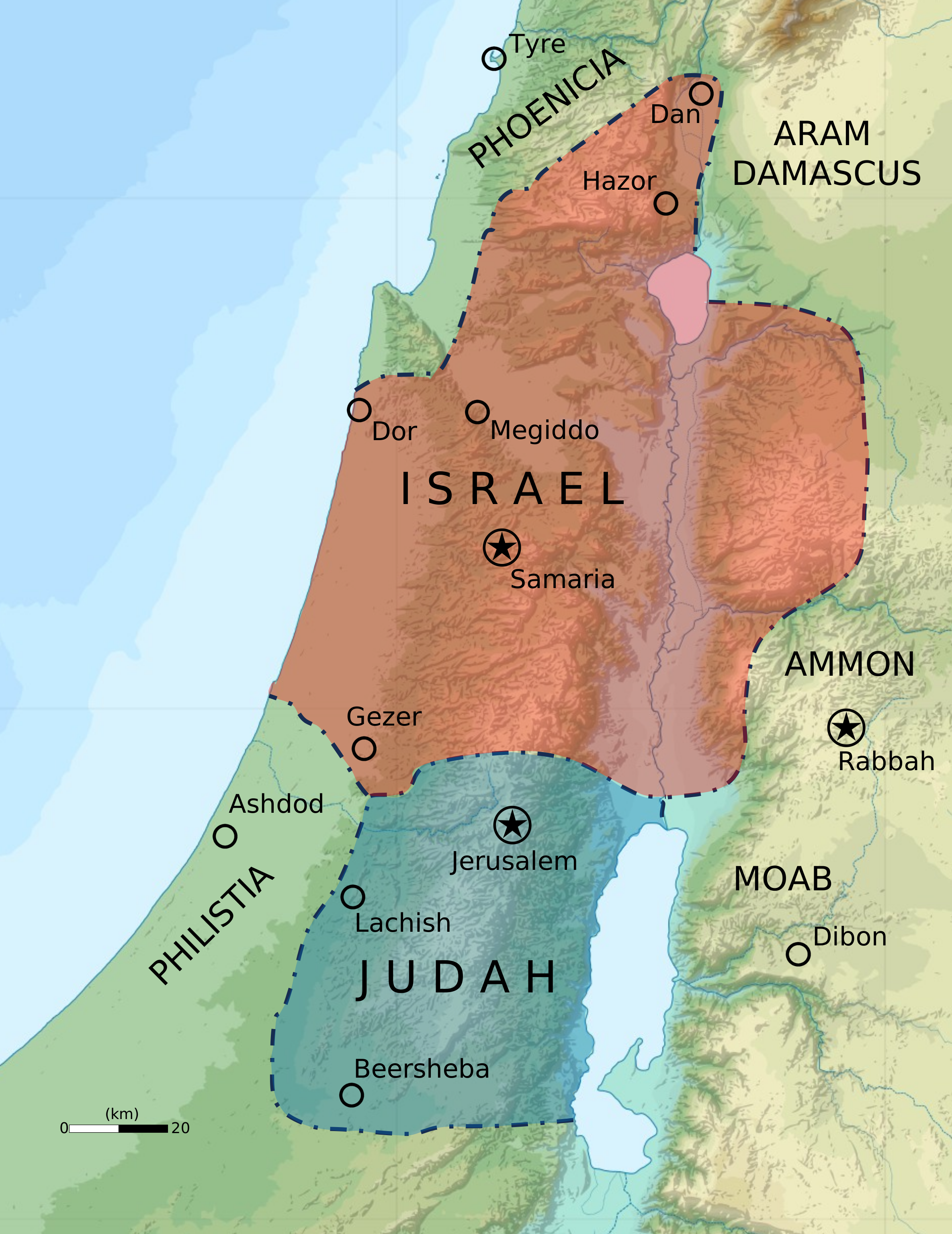 Source: Tobias Schäfer 87, Wikimedia Commons, CC BY 4.0.
Amos addresses Damascus in Syria, Philistine Gaza, coastal Tyre, Edom, and Ammon before chapter 2 names Moab, Judah, and Israel. The sequence does not simply follow the border. It narrows the distance between those being judged and those listening.
Glossary
- Septuagint / LXX: the ancient Greek Scriptures of the Old Testament. “LXX” is their customary abbreviation.
- Brenton: Sir Lancelot Charles Lee Brenton, whose English translation of the Septuagint supplies the embedded Scripture here.
- Oracle: a prophetic message presented as the Lord’s word. The five national judgments in this chapter continue with three more in chapter 2.
- Sion / Thecue / Galaad: Brenton’s forms of Zion, Tekoa, and Gilead.
- Idumea: Edom, named both as a destination for captives and as a nation under judgment.
- Covenant of brethren: a bond of brotherhood that makes fidelity an obligation, not a favor granted when convenient.
Spiritual Fruit 🍇
Let agreement become examination. When a passage exposes someone else’s cruelty, pause before agreeing too quickly. Ask where the same root lives in you: the convenient broken promise, the resentment carefully preserved, the gain accepted without concern for who pays its cost.
Recover the person hidden by the category. The captive, the foreigner, and the victim are not abstractions. In one decision this week, attend to the person with less power: honor a commitment, refuse humiliating speech, or offer practical help without demanding gratitude or disclosure.
Bring anger before Christ without pretending the wound is small. Prayer can name evil truthfully while asking not to become its servant. Forgiveness is not permission for renewed harm. The Cross gives courage to seek both protection for the wounded and repentance for the guilty, beginning with ourselves.
Teaching Notes
The voice that withers Carmel (Amos 1:1-2)
- Ask: what changes when judgment begins from God’s presence rather than the prophet’s personal grievance?
- Emphasize: explain the words actually displayed in verse 2 rather than substituting a familiar rendering about roaring.
Damascus: strength turned against the defenseless (Amos 1:3-5)
- Emphasize: distinguish Brenton’s accusation from the Hebrew-based threshing wording; neither warrants graphic elaboration.
- Watch for: suggesting that victims caused their suffering or that present-day disasters reveal particular victims’ guilt. Offer freedom to pause or step out.
Gaza: captives are not possessions (Amos 1:6-8)
- Ask: when can an accepted transaction still violate a person’s dignity?
- Watch for: silently replacing “the captivity of Solomon” with another translation, or inventing an event to explain the name.
Tyre: a covenant of brethren forgotten (Amos 1:9-10)
- Ask: what does a costly kept promise reveal that affectionate language alone cannot?
- Watch for: using loyalty or confidentiality to demand concealment of abuse.
Edom: anger kept to the end (Amos 1:11-12)
- Ask: how can we distinguish seeking justice from cultivating another person’s humiliation?
- Watch for: treating anger after injury as equivalent to the deliberate cruelty condemned here.
Ammon: ambition at another person’s expense (Amos 1:13-15)
- Ask: who becomes invisible when advancement is our overriding aim?
- Connect: Christ’s Cross exposes cruelty without authorizing revenge.
- Show: use the retained map to locate the peoples in the chapter, then continue verbally through Moab, Judah, and Israel. Explain that the inward circle is rhetorical, not a precise geographical circuit.
Sources
Embedded Scripture is from Brenton’s English Septuagint (LXX).
Amos 2, especially the turn toward Judah and Israel; Amos 5:4, the Lord’s call to seek Him and live.
NKJV, Amos 1, for the limited Hebrew-based translation comparisons at Amos 1:3, Amos 1:6, and Amos 1:9.
Tobias Schäfer 87, Kingdoms of Israel and Judah (8th century BCE), Wikimedia Commons, CC BY 4.0.