


David and Goliath is not a self-help story about defeating personal obstacles. It is a revelation of how God saves through apparent weakness and how the anointed one fights for a fearful people. The victory immediately exposes Saul’s deeper enemy: jealousy. David defeats Goliath in public, but Saul begins to fall inwardly through envy. These chapters belong together because the man who delivers Israel from an enemy outside the camp becomes the target of an enemy within it.
Lesson guide
Key phrases: the battle is the Lord’s; courage without armor; victory followed by jealousy. Emphasize: David points to Christ before he becomes an example for us. Avoid: using Goliath as a generic motivational metaphor.
Historical and Scriptural Context
This study uses the familiar English book names. In the Septuagint, 1-2 Samuel and 1-2 Kings form the four books of Kingdoms, so this book is 1 Kingdoms there.
David has been anointed in secret and brought into Saul’s service. In 16:21 he becomes Saul’s armour-bearer. The shorter Greek account passes directly from Israel’s terror in 17:11 to David’s offer in 17:32: the servant already beside the king steps forward when the king cannot. The longer account also tells of Jesse sending David from the sheep to his brothers. Both forms bear witness to the Lord’s deliverance, but they introduce David to the battle differently.
LXX text and the longer account
Embedded Scripture is from Brenton’s English Septuagint (LXX).
Brenton’s main text omits 17:12–31, 41, 50, 55–58 and 18:1–5, 9–11, 17–19, 30. These are differences in the account, not merely missing verse numbers. His Appendix supplies passages from the Alexandrine text. Here the selected supplement 17:16–31 preserves Jesse’s errand and Eliab’s accusation; 18:1–5 and 9–11 supply Jonathan’s covenant and Saul’s spear attack. Each supplement is identified beside its quotation. Other omitted passages are not inserted. The Rahlfs-based NETS omits 17:12–31, 41, 50, 55–58 and 18:1–5, 10–11, 17–19, 30, but retains 18:9. The phrase “shorter Greek account” therefore does not imply that every Greek edition has an identical list of omissions.1
Geographical Significance ⛰️
The Valley of Elah lies between the opposing armies. Israel stands on one ridge, the Philistines on the other, and Goliath issues his challenge across the space between them. David enters that space because he sees the battle under God. The valley becomes a school of vision: Saul sees weapons and rank; David sees defiance against the living God.
The Characters 👥
David is the anointed shepherd serving the reigning king. His courage grows from remembered deliverance, not from contempt for danger. Goliath, the Philistine champion from Geth, speaks as if his strength can determine Israel’s future. Saul receives David’s victory but resents David’s praise. Jonathan, Saul’s son, gives friendship where his father sees a rival. Eliab, David’s elder brother, claims to know the heart that God has already chosen. Michal, called Melchol in Brenton, loves David, while her father tries to make that love serve his plan. The women of Israel celebrate deliverance; Saul alone is responsible for turning celebration into grievance.
Fear before the champion (1 Samuel 17:1–11)
Brenton, main text.
- And the Philistines gather their armies to battle, and gather themselves to Socchoth of Judæa, and encamp between Socchoth and Azeca Ephermen.
- And Saul and the men of Israel gather together, and they encamp in the valley, and set the battle in array against the Philistines.
- And the Philistines stand on the mountain on one side, and Israel stands on the mountain on the other side, and the valley was between them.
- And there went forth a mighty man out of the army of the Philistines, Goliath by name, out of Geth, his height was four cubits and a span.
- And he had a helmet upon his head, and he wore a breastplate of chain armour; and the weight of his breastplate was five thousand shekels of brass and iron.
- And greaves of brass were upon his legs, and a brazen target was between his shoulders.
- And the staff of his spear was like a weavers’ beam, and the spear’s head was formed of six hundred shekels of iron; and his armour-bearer went before him.
- And he stood and cried to the army of Israel, and said to them, Why are ye come forth to set yourselves in battle array against us? Am not I a Philistine, and ye Hebrews of Saul? choose for yourselves a man, and let him come down to me.
- And if he shall be able to fight against me, and shall smite me, then will we be your servants: but if I should prevail and smite him, ye shall be our servants, and serve us.
- And the Philistine said, Behold, I have defied the armies of Israel this very day: give me a man, and we will both of us fight in single combat.
- And Saul and all Israel heard these words of the Philistine, and they were dismayed, and greatly terrified.
Goliath’s size and weapons are described in detail because intimidation works through visible measurement. Israel sees height, armor, spear, and challenge. Yet the demand in verses 8–9 goes beyond a display of force: one man will stand for many. By the terms he proposes, the defeated champion’s people will become servants of the victor’s people. David’s later courage matters because he accepts this burden on behalf of the fearful assembly.
Language insight: “four cubits and a span”
Brenton and the Rahlfs-based NETS both give Goliath “four cubits and a span” in 17:4. The familiar Hebrew-based reading gives six. Saul was conspicuously tall, standing head and shoulders above the people in 10:23, but Scripture gives no exact measurement for him. We cannot say that Saul and Goliath were the same height. The sharper contrast is between the king whose visible stature impressed Israel and the king who now cannot answer the challenge.1
David will face a real threat. Faith does not deny reality; it reads reality under God. The champion exposes the limits of the strength Israel had wanted in a king. He also prepares us to hear the promise that salvation can come through one faithful representative. Romans 5:12–21 carries that pattern beyond a military rescue: where Adam’s disobedience brought death, Christ’s obedience brings justification and life. David’s victory is a sign along the way, while Christ renews the human race at its root.
Lesson guide
Key phrases: intimidation works through visible measurement; one champion stands for many. Emphasize: faith does not deny reality. It reads reality under God. Avoid: mocking Israel’s fear or claiming that Saul’s exact height is known.
Jesse sends David and Eliab rejects him (1 Samuel 17:16–31)
Brenton, Appendix: selected Alexandrine supplement, absent from the main shorter account.2
- And the Philistine advanced morning and evening, and stood up forty days.
- And Jessae said to David, Take now to thy brethren an ephah of this meal, and these ten loaves, and run to the camp and give them to thy brothers.
- And thou shalt carry to the captain of the thousand these ten cheeses of milk, and thou shalt see how thy brethren fare, and learn what they want.
- And Saul himself and all the men of Israel were in the valley of the Oak, warring with the Philistines.
- And David rose early in the morning, and left the sheep to a keeper, and took and went as Jessae commanded him, and he came to the trench and to the army as it was going out to fight, and they shouted for the battle.
- And Israel and the Philistines formed their lines one opposite the other.
- And David deposited his burden in the hand of a keeper, and ran to the line, and went and asked his brethren how they Were.
- And while he was speaking with them, behold the Amessaean advanced, Goliath by name, the Philistine of Geth, of the armies of the Philistines, and he spoke as before, and David heard.
- And all the men of Israel when they saw the man fled from before him, and they were greatly terrified.
- And the men of Israel said, Have ye seen this man that comes up? for he has reproached Israel and has come up; and it shall be that the man who shall smite him, the king shall enrich him with great wealth and shall give him his daughter, and shall make his father’s house free in Israel.
- and David spoke to the men who stood with him saying, Shall it indeed be done thus to the man who shall smite that Philistine, and take away reproach from Israel? for who is this uncircumcised Philistine that he has defied the army of the living God?
- And the people spoke to him according to this Word, saying Thus shall it be done to the man Who shall smite him.
- And Eliab his elder brother heard as he spoke to the men, and Eliab was very angry with David and said, Why hast thou thus come down, and with whom hast thou left those few sheep in the wilderness? I know thy pride and the naughtiness of thine heart, for thou art come down to see the battle.
- And David said what have I done now? Have I no business here?
- And he turned from him towards another, and he spoke after the same manner; and the people answered him after the former manner.
- And the Words which David spoke were heard and were reported to Saul. And he took him to himself.
The longer account opens this selection with forty days of taunting. Fear becomes liturgical in its own dark way, repeated until the people are trained to tremble. David breaks that repetition by hearing the taunt in relation to the living God. The soldiers speak about reward; David asks who has dared to defy God’s army. His concern gathers the scattered attention of the camp back around the Lord.
Before he enters the battle, David carries bread. Jesse sends the younger son to care for his brothers, and David leaves the sheep with a keeper before obeying. Eliab’s accusation of negligence is contradicted by verse 20. His claim to know David’s pride also recalls Samuel’s earlier mistake about Eliab’s appearance in 16:6–7: men can misread both the outside and the inside. God knows the heart. David’s answer is brief; he turns away and continues the task. He neither lets contempt govern him nor spends the hour defending his reputation.
The sending of a son to his brothers recalls Jacob sending Joseph in Genesis 37:13–20. The resemblance is a biblical pattern of rejected brotherhood, not a claim that every detail means the same thing. John 1:11 brings its sorrow to Christ, who comes to His own and is not received by His own. The Lord’s faithfulness is not cancelled by rejection. In our own households and service, David’s calm gives a small but demanding beginning: finish the entrusted good without requiring everyone to approve of your motives.
Saint Caesarius of Arles, in Sermon 121, section 1, reads Jesse sending David to seek his brothers as a figure of the Father sending His Son to seek the lost sheep of Israel. His reading keeps the errand turned toward persons in need of rescue: Christ comes to find His brothers and bring them home.3
The Church’s Voice in Worship ⛪
The Coptic Katameros, the Church’s book of appointed readings, assigns 1 Samuel 17:16–54 and 18:6–9 among the prophecies for Friday of the Second Week of Great Lent. Its printed reading includes the forty days, Jesse’s errand, and Saul’s suspicious eye, using the longer account rather than only Brenton’s main text.4 In Lent, the forty days of taunting can be heard beside Christ’s forty-day fast and temptation in Matthew 4:1–11. Christ answers the tempter through obedience to His Father and the words of Scripture. This is a fitting contemplation of the appointment, not proof that the forty-day parallel is its only intended meaning. Fasting trains us to refuse the enemy’s account of what strength must be.
David refuses Saul’s armor (1 Samuel 17:32–40)
Brenton, main text.
- And David said to Saul, Let not, I pray thee, the heart of my lord be dejected within him: thy servant will go, and fight with this Philistine.
- And Saul said to David, Thou wilt not in anywise be able to go against this Philistine to fight with him, for thou art a mere youth, and he a man of war from his youth.
- And David said to Saul, Thy servant was tending the flock for his father; and when a lion came and a she-bear, and took a sheep out of the flock,
- then I went forth after him, and smote him, and drew the spoil out of his mouth: and as he rose up against me, then I caught hold of his throat, and smote him, and slew him.
- Thy servant smote both the lion and the bear, and the uncircumcised Philistine shall be as one of them: shall I not go and smite him, and remove this day a reproach from Israel? for who is this uncircumcised one, who has defied the army of the living God?
- The Lord who delivered me out of the paw of the lion and out of the paw of the bear, he will deliver me out of the hand of this uncircumcised Philistine. And Saul said to David, Go, and the Lord shall be with thee.
- And Saul clothed David with a military coat, and put his brazen helmet on his head.
- And he girt David with his sword over his coat: and he made trial walking with them once and again: and David said to Saul, I shall not be able to go with these, for I have not proved them: so they remove them from him.
- And he took his staff in his hand, and he chose for himself five smooth stones out of the brook, and put them in the shepherd’s scrip which he had for his store, and his sling was in his hand; and he approached the Philistine.
The anointed one serves the rejected one. David’s first words strengthen the heart of his lord. He offers himself without reproaching Saul for refusing the challenge. Saul sees a youth against an experienced warrior. David remembers a lion, a bear, and sheep he would not abandon. The difference is not between one man who measures and another who ignores evidence. They remember different evidence. Saul remembers Goliath’s training; David remembers the Lord’s deliverance.
Language insight: “remove this day a reproach”
In 17:36 Brenton and NETS both include David’s resolve to remove Israel’s reproach and his question about the challenger of the living God’s army. The standard Hebrew-based verse is shorter here. This gives David’s shepherding memory a public purpose: the God who delivered one sheep can deliver His people. His past is not a collection of private achievements. It has taught him whom to trust now.1
Saul clothes him in the king’s equipment. David tries to walk and then refuses what he has not proved. David will not fight the Lord’s battle while wearing Saul’s imagination of strength. He takes the means he knows: staff, sling, stones, and shepherd’s bag. Private faithfulness becomes public courage. This does not make equipment or preparation sinful. It exposes the temptation to borrow another person’s outward image when God calls for truthful obedience.
Ephesians 6:10–17 gives the Church armor suited to her actual battle: truth, righteousness, the gospel of peace, faith, salvation, and the word of God. Paul says that our struggle is not against flesh and blood. Second Corinthians 10:3–4 likewise distinguishes life in the flesh from warfare according to the flesh. For a Christian, refusing Saul’s armor means refusing deceit, coercion, and retaliation, not refusing prudent help or declaring other people to be Philistines.
Gems from the Fathers 💎: Five stones and one charity
Saint Augustine gives a spiritual reading of the stones in Sermon 32, sections 5–6. He identifies their number with the five books of Moses, then notices that David throws one stone. The unity that fulfills the law is charity, love made possible by grace. His next paragraph warns that an image does not always have the same symbolic meaning in every passage. This is an interpretation governed by context, not a universal numerical code.5
In his exposition of Psalm 143 LXX, Augustine expresses the same reading compactly: “David put five stones in his scrip, he hurled but one. The five Books were chosen, but unity conquered.”6 The point is larger than knowing five books by name. Scripture must become one obedient love. A person may quote many commandments while using them to justify hatred; charity gathers knowledge into service of God and neighbor.
Lesson guide
Key phrases: do not wear Saul’s armor; hidden faithfulness prepares public courage. Emphasize: David’s courage is God-centered, not ego-centered; Augustine’s reading is a particular spiritual interpretation. Avoid: turning this into “believe in yourself” or assigning every stone a required Christian practice.
The name of the Lord (1 Samuel 17:42–47)
Brenton, main text.
- And Goliath saw David, and despised him; for he was a lad, and ruddy, with a fair countenance.
- And the Philistine said to David, Am I as a dog, that thou comest against me with a staff and stones? [and David said, Nay, but worse than a dog.] And the Philistine cursed David by his gods.
- And the Philistine said to David, Come to me, and I will give thy flesh to the birds of the air, and to the beasts of the earth.
- And David said to the Philistine, Thou comest to me with sword, and with spear, and with shield; but I come to thee in the name of the Lord God of hosts of the army of Israel, which thou hast defied
- this day. And the Lord shall deliver thee this day into my hand; and I will slay thee, and take away thy head from off thee, and will give thy limbs and the limbs of the army of the Philistines this day to the birds of the sky, and to the wild beasts of the earth; and all the earth shall know that there is a God in Israel.
- And all this assembly shall know that the Lord delivers not by sword or spear, for the battle is the Lord’s, and the Lord will deliver you into our hands.
Goliath despises the boy and curses him by his gods. David answers with the name of the Lord. Sword, spear, and shield are real instruments, but they are not the final authority over Israel. Psalm 19:8 LXX, Psalm 20:7 (LXX Psalm 19:8) in Hebrew-based numbering, contrasts reliance on chariots and horses with remembering the Lord’s name. Proverbs 18:10 calls that name a strong tower. David’s confession is not a formula that compels God to grant every wish. He entrusts himself to the Lord whose people have been defied.
Language insight: “worse than a dog”
Brenton places David’s answer in brackets at 17:43; NETS also contains the reply. The words belong to the Greek form being read here, though they are absent from the familiar Hebrew-based exchange. They intensify David’s refusal to let Goliath’s contempt set the meaning of the encounter. They are not permission to insult an adversary during ordinary Christian disagreements.1
David’s confession in 17:47 answers Jonathan’s in 14:6: the Lord is able to save without the advantage of overwhelming numbers or equipment. Both give voice to Hannah’s song in 2:4 and 2:9, where the strong are brought low and human strength does not secure victory. The same confidence will help explain Jonathan’s love for David. Another person’s faith can be recognized as a gift to the whole people, rather than treated as competition for one’s own place.
Second Chronicles 20:15 gives the same divine reassurance to a frightened assembly: the battle belongs to God. Such words call us to obedient dependence, not to a claim that every conflict we start is the Lord’s cause. David’s speech concerns this deliverance of Israel. The Church’s struggle is directed against sin and the powers that enslave, and its weapons must remain those given by Christ.
The enemy’s own sword (1 Samuel 17:48–54)
Brenton, main text, whose sequence passes from verse 49 to verse 51.
- And the Philistine arose and went to meet David.
- And David stretched out his hand to his scrip, and took thence a stone, and slang it, and smote the Philistine on his forehead, and the stone penetrated through the helmet into his forehead, and he fell upon his face to the ground.
- And David ran, and stood upon him, and took his sword, and slew him, and cut off his head: and the Philistines saw that their champion was dead, and they fled.
- And the men of Israel and Juda arose, and shouted and pursued them as far as the entrance to Geth, and as far as the gate of Ascalon: and the slain men of the Philistines fell in the way of the gates, both to Geth, and to Accaron.
- And the men of Israel returned from pursuing after the Philistines, and they destroyed their camp.
- And David took the head of the Philistine, and brought it to Jerusalem; but he put his armour in his tent.
The stone penetrates the helmet itself. David then runs forward, takes Goliath’s sword, and completes the victory. Only afterward does the army rise and pursue. Israel does not win because every frightened soldier discovers a winner’s mindset. The Lord raises an anointed representative who stands where the people cannot stand. His victory becomes theirs.
This pattern reaches its fullness in Christ. In 1 Corinthians 15:20–28, Christ is the firstfruits of the resurrection: His rising opens the future of those who belong to Him, and death is the last enemy to be destroyed. In Hebrews 2:14–15, the Son shares our flesh and blood so that through death He destroys the one who holds the power of death and releases those enslaved by its fear. The enemy’s weapon becomes the sign of defeat. Colossians 2:15 describes the powers disarmed and exposed in Christ’s triumph. The Cross is not a fortunate accident after a failed ministry. In the place where evil expected final mastery, the incarnate Lord gives life.
Augustine’s reading of Goliath’s sword also reaches the lives of Christ’s members. In the same psalm exposition, he says that those formerly used to harm other souls can come to faith and turn their speech against the devil.6 A tongue once trained in ridicule can become an instrument of consolation. Past bondage need not dictate future service. Christ’s victory calls for the conversion of the very faculties through which we once helped evil.
The Church’s Voice in Worship ⛪
The Night of Apocalypse, or Bright Saturday, opens in the Coptic rite book with the instruction to chant Psalm 151 LXX. The psalm remembers the small shepherd, his anointing, the Philistine’s curse, and the enemy’s own sword. After it, the book directs a procession with the Psalter wrapped in white linen.7 David’s victory is therefore actually sung at the threshold of Pascha. The Christological meaning follows the Church’s confession of the Lord who descends into death and brings His people to life; the psalm is more than a distant memory of a battle.
The Coptic Resurrection hymn Pekhrestos Aftonf, “Christ is Risen,” gives this confession its own words: “Christ is risen from the dead; He who died trampled down death and upon those in the tombs bestowed eternal life.”8 This is the Coptic-language hymn in the Resurrection Liturgy tradition, distinct from the Greek “Christos Anesti” also sung in the Coptic Church.9 The victory promised in David’s rescue is fulfilled in the risen Lord, whose gift is life to those in the tombs.
Lesson guide
Key phrases: the battle is the Lord’s; the enemy’s own sword; life bestowed on those in the tombs. Emphasize: Christological fulfillment before moral application; Psalm 151 LXX’s actual Bright Saturday placement. Avoid: treating biblical battle as authorization for Christian violence or confusing the Coptic hymn with its Greek counterpart.
Jonathan’s covenant friendship (1 Samuel 18:1–5)
Brenton, Appendix: Alexandrine supplement, absent from the main shorter account.2
- And it came to pass when he had finished speaking to Saul, that the soul of Jonathan was knit to the soul of David, and Jonathan loved him as his own soul.
- And Saul took him in that day, and did not suffer him to return to his father’s house.
- And Jonathan and David made a covenant because he loved him as his own soul.
- And Jonathan stripped himself of his upper garment, and gave it to David, and his mantle and all he had upon him, even to his sword and to his bow, and to his girdle.
- And David went out whithersoever Saul sent him, and acted wisely, and Saul set him over the men of war, and he was pleasing in the eyes of all the people, and also in the eyes of the servants of Saul.
Jonathan loves David as his own soul and joins him in covenant. His gift of garment, mantle, sword, bow, and belt makes that love visible. The king’s son gives what identifies and equips him to the man whose gifts could provoke rivalry. The passage shows costly honor and solidarity. It does not explicitly say that the clothing exchange is a formal abdication or a legal transfer of the throne.
Jonathan has already confessed the Lord’s freedom to save in 14:6. In David he encounters that same trust. His love contrasts the fear that will make Saul see a deliverer as a threat. Holy friendship is love that does not need to possess the future. It can rejoice in another person’s vocation without pretending that every calling must be mine.
Philippians 2:5–8 gives Christian friendship its governing mind: Christ takes the servant’s way instead of using rank for self-advantage. Jonathan’s generosity offers a human likeness of that refusal of rivalry; it does not place him on the level of Christ’s divine nature or identify his gifts with the Incarnation. John the Baptist gives another creaturely expression in John 3:29–30: the bridegroom’s friend rejoices at the bridegroom’s voice and gladly accepts that Christ must increase. John 15:13–15 brings friendship to its fulfillment in the Lord who lays down His life and makes His servants friends. In Him, sharing another’s joy can become freedom from the need to be first.
Gems from the Fathers 💎: Friendship faithful to the good
Saint Ambrose uses Jonathan’s later fidelity to David to explain friendship that follows virtue rather than personal advantage. He writes: “So it was with Jonathan, who for his affection’s sake avoided not his father’s displeasure nor the danger to his own safety.”10 This is a witness to the friendship’s endurance, not a comment proving that the robe itself transferred kingship. Ambrose’s surrounding argument also insists that friendship must never require surrendering virtue. Loyalty is not a promise to conceal a friend’s wrongdoing; it is a readiness to seek his true good even when that costs us.
Praise becomes suspicion (1 Samuel 18:6–11)
Verses 6–8: Brenton, main text. Verses 9–11: Brenton, Appendix, Alexandrine supplement.2
- And there came out women in dances to meet David out of all the cities of Israel, with timbrels, and with rejoicing, and with cymbals.
- And the women began the strain, and said, Saul has smitten his thousands, and David his ten thousands.
- And it seemed evil in the eyes of Saul concerning this matter, and he said, To David they have given ten thousands, and to me they have given thousands.
Alexandrine supplement, absent from Brenton’s main text:
- And Saul eyed David from that day and onward.
- And it came to pass on the morrow that an evil spirit from God fell upon Saul, and he prophesied in the midst of his house. And David was playing on the harp with his hand, according to his daily custom. And Saul’s spear was in his hand.
- And Saul took his spear and said, I will smite David even to the wall. But David escaped twice from his presence.
The women’s song does not create Saul’s sin. It reveals it. Their praise exposes what already lives in him: insecurity, comparison, and fear of being diminished. The deliverance should belong to all Israel, including Saul. Instead, he receives another man’s honor as his own injury. The supplement makes that inward change visible: a suspicious eye becomes a spear aimed at the servant still playing music for him.
Language insight: “Saul eyed David”
The sentence in 18:9 is supplied from Brenton’s Appendix, but it is retained in the Rahlfs-based NETS main account. Its presence cannot be decided by treating “the Septuagint” as one uniform printed text. In either setting, the wording connects celebration to a settled way of seeing. Saul now watches for threat where he should recognize mercy. David has saved his people and continues to serve him.1
The reference to an evil spirit is not a diagnosis of every person who suffers psychological distress. This narrative joins Saul’s torment to the king’s refusal of correction and his violence; it does not let him shift responsibility for the spear to someone else. Neither spiritual care nor compassion for distress requires remaining within reach of an attacker. David escapes. Those in danger should seek safety and trustworthy help.
Wisdom 2:24 names the devil’s envy in the entry of death. Cain in Genesis 4 and Joseph’s brothers in Genesis 37 show how resentment of another’s good can become violence against the person who bears it. James 3:14–16 brings the warning into Christian communities: bitter envy and self-seeking produce disorder and evil. Mark 15:10 supplies the Gospel connection directly, when Pilate recognizes envy in those who have delivered Jesus to him. This concerns the responsible leaders in that event, not blame against the Jewish people as a whole. Christ’s goodness exposes the heart that wants to preserve its own greatness.
Gems from the Fathers 💎: Resenting the benefactor
Saint Basil’s Homily on Envy, section 2, names Saul as a man who turns David’s benefits into reasons for war against him. David’s music and military rescue should awaken gratitude; the envious heart feels more burdened by the benefactor’s strength than thankful for what it has received.11 This explains why another act of kindness alone cannot heal Saul’s passion. He must consent to repentance.
Saint Cyprian likewise traces Saul’s persecution to praise after Goliath’s defeat, then presses the warning upon the Church: “By this the bond of the Lord’s peace is broken; by this is violated brotherly charity.”12 Envy is not private discomfort harmless to everyone else. It can divide a parish, poison service, and make a person’s advancement more important than the good being done. First Clement 4 also names David’s persecution by Saul among the destructive effects of envy.13 These witnesses call for confession before wounded comparison becomes a settled refusal to love.
The Lord is with David (1 Samuel 18:12–16)
Brenton, main text.
- And Saul was alarmed on account of David.
- And he removed him from him, and made him a captain of a thousand for himself; and he went out and came in before the people.
- And David was prudent in all his ways, and the Lord was with him.
- And Saul saw that he was very wise, and he was afraid of him.
- And all Israel and Juda loved David, because he came in and went out before the people.
Saul removes David from his immediate presence and places him over a thousand. Yet David continues to go out and come in before the people. The repeated phrase describes a leader who shares their life and risk, while Saul’s fear isolates him. What began as release from the giant has become a contrast between prudent service and suspicious authority.
“The Lord was with him” in 18:14 recalls the servant’s description of David in 16:18 and returns in 18:28. The words are the center of his strength. His wisdom is not the ability to manage Saul’s feelings so perfectly that he can guarantee safety. He serves faithfully amid danger, and the people’s love grows. God’s presence does not mean that every good servant is spared persecution. It means that the king’s hostility cannot become the measure of David’s worth or the final ruler of his future.
Fr. Tadros Malaty, in his modern commentary on chapter 18, draws attention to the people loving a leader who goes out and comes in before them, instead of remaining apart in worldly splendor.14 This helps bring the verse into parish and household life. Responsibility is not proven by being inaccessible. The entrusted person becomes known through attention, shared labor, and willingness to bear trouble for others. In Christ, authority reaches its fullness in the Shepherd who gives His life for the sheep.
Michal’s love and Saul’s trap (1 Samuel 18:20–29)
Brenton, main text.
- And Melchol the daughter of Saul loved David; and it was told Saul, and the thing was pleasing in his eyes.
- And Saul said, I will give her to him, and she shall be a stumbling-block to him. Now the hand of the Philistines was against Saul.
- And Saul charged his servants, saying, Speak ye privately to David, saying, Behold, the king delights in thee, and all his servants love thee, and do thou become the king’s son-in-law.
- And the servants of Saul spoke these words in the ears of David; and David said, Is it a light thing in your eyes to become son-in-law to the king? whereas I am an humble man, and not honourable?
- And the servants of Saul reported to him according to these words, which David spoke.
- And Saul said, Thus shall ye speak to David, The king wants no gift but a hundred foreskins of the Philistines, to avenge himself on the king’s enemies. Now Saul thought to cast him into the hands of the Philistines.
- And the servants of Saul report these words to David, and David was well pleased to become the son-in-law to the king.
- And David arose, and went, he and his men, and smote among the Philistines a hundred men: and he brought their foreskins, and he becomes the king’s son-in-law, and Saul gives him Melchol his daughter to wife.
- And Saul saw that the Lord was with David, and that all Israel loved him.
- And he was yet more afraid of David.
Michal loves David. Saul sees an opportunity to put him in danger. His words about a “stumbling-block” reveal his intention, not her character. The daughter is not the author of the trap. The father uses her affection and his servants’ flattering assurances to hide a demand meant to bring David into Philistine hands. Beneath the language of marriage and honor lies a plan for another person’s death.
David’s question about becoming the king’s son-in-law shows his sense of the distance between his own standing and the royal household. Saul answers that distance with a bloody bride-price. The military world of the story explains the demand; it does not bless the use of a woman as a bargaining instrument, the mutilation of enemies, or killing as proof of worthiness for marriage. Christian discipleship cannot turn this episode into permission for cruelty, exploitation, or religiously excused violence.
Language insight: “a hundred men”
Brenton and the Rahlfs-based NETS give a hundred men in 18:27, matching Saul’s demand. The standard Hebrew-based account gives two hundred. Brenton’s 18:28 says that Saul sees the Lord’s presence with David and all Israel’s love for him; we should not silently replace this with the Hebrew-based wording about Michal’s love. The shorter Greek sequence concentrates the ending on a king who fears the man whom the Lord sustains and the people love.1
Saul’s plot casts a shadow forward. In 2 Samuel 11:15, David himself will order Uriah placed where the fighting is fiercest and then abandoned so that he dies. The man preserved from a king’s murderous scheme will later use royal power for a similar end. That warning belongs beside the victory. Past grace, anointing, and faithful service do not make anyone incapable of grievous sin. David is a type of the Deliverer without being a sinless deliverer. Christ alone gives Himself for His people without sacrificing them to His desires.
When authority makes a dangerous demand appear honorable, truthful love must resist the disguise. Refusing to help manipulate a marriage, conceal violence, or ruin a rival is not disloyalty to a household or ministry. It is fidelity to the God before whom both rulers and servants must answer.
Lesson guide
Key phrases: victory reveals hearts; Jonathan gives honor; Saul turns love into a trap. Emphasize: envy is Saul’s responsibility, and Michal is not blamed for his scheme. Avoid: treating Jonathan’s gift as proven abdication or David’s victory as immunity from future sin.
Iconography Connection 🖼️
Schindler’s painting is Western biblical art, not an Orthodox icon. The contrast between the armed champion and the young shepherd helps make the visible imbalance of the encounter clear. The orientation map places the valley between the opposing sides; it is a schematic, not a reconstruction of troop positions.
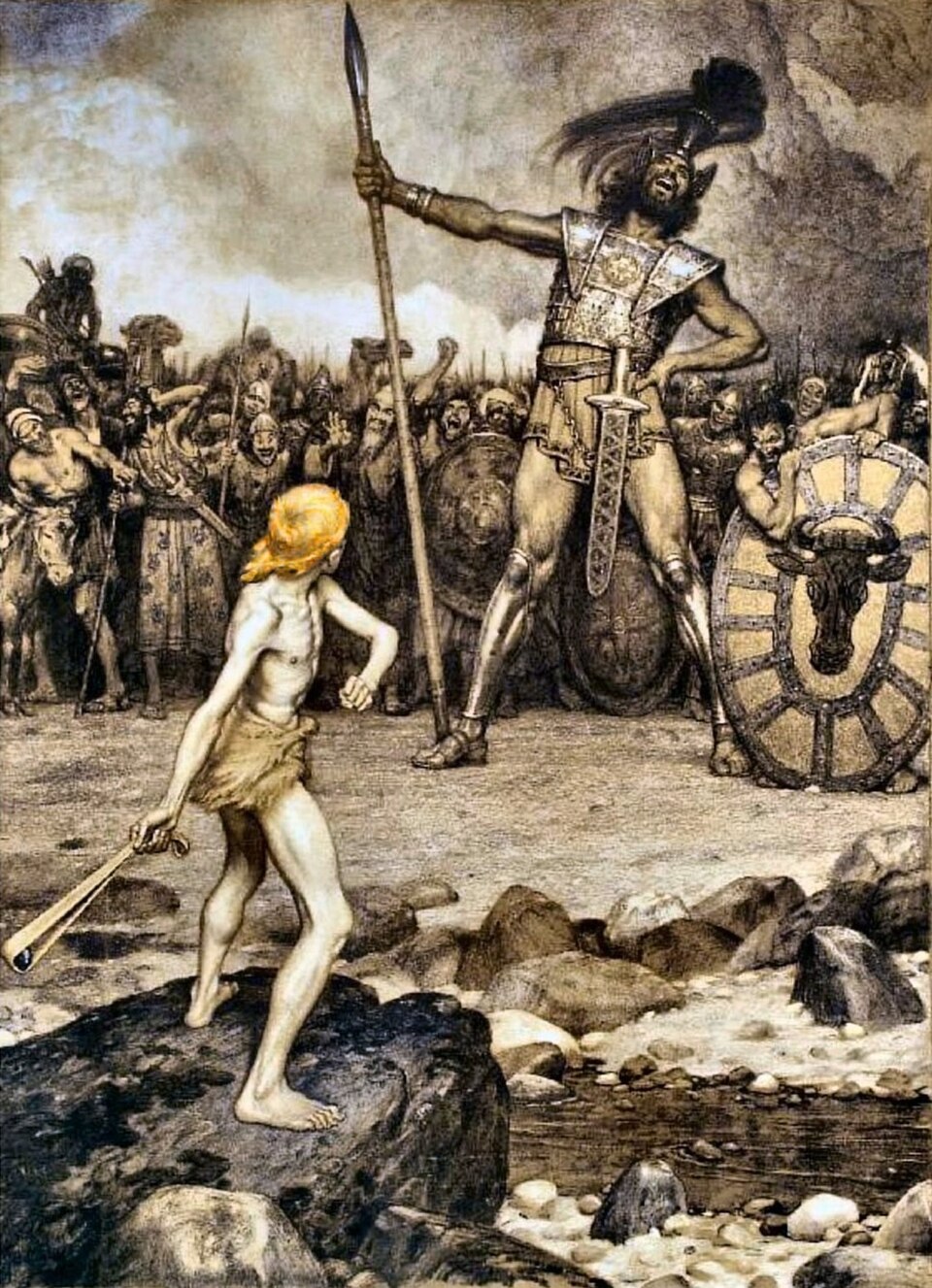 🔗 Osmar Schindler, David and Goliath, Wikimedia Commons.
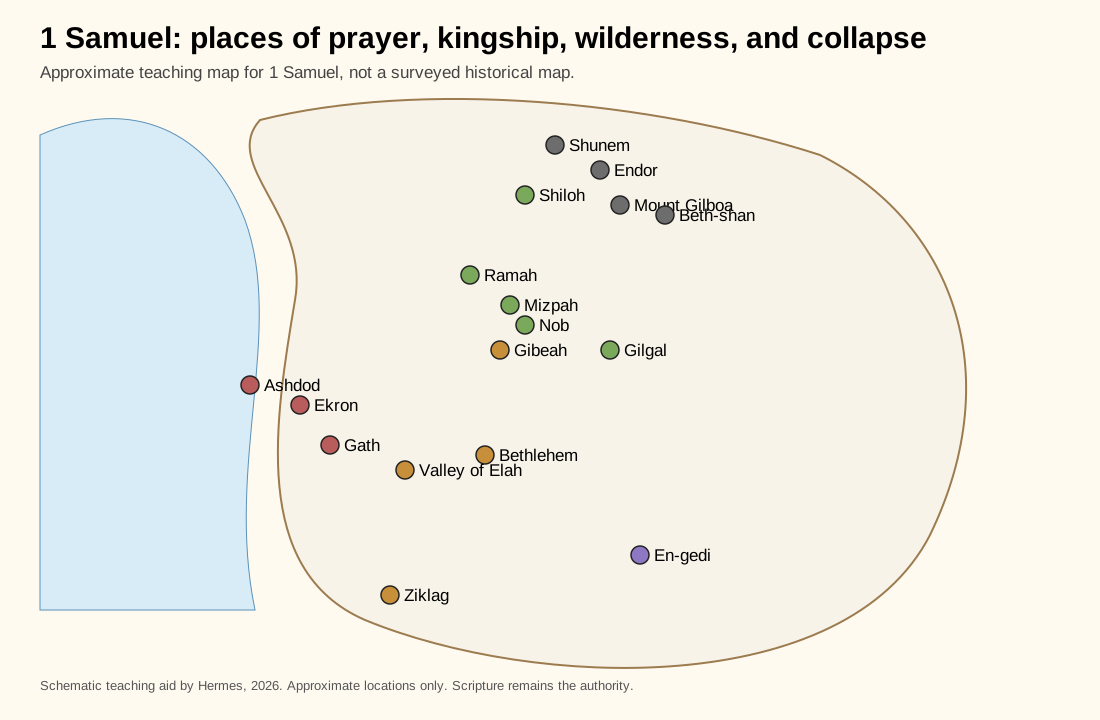 Schematic orientation map highlighting the Valley of Elah.
| In these chapters | Fulfillment and response in Christ |
|---|---|
| The fearful people receive one champion’s victory. | Christ’s obedience and resurrection bring life to those who belong to Him: Romans 5:12–21; 1 Corinthians 15:20–28. |
| David uses the enemy’s own sword. | Through death Christ releases those enslaved by fear of death: Hebrews 2:14–15. |
| Jonathan gives honor without rivalry. | Christ forms His friends in self-giving love: Philippians 2:5–8; John 15:13–15. |
| Saul turns deliverance into resentment. | Envy must be confessed before it destroys communion: James 3:14–16. |
| David will later imitate the scheme that endangered him. | A received calling still requires repentance; Christ remains the sinless Shepherd. |
Spiritual Fruit 🍇
-
Remember deliverance before rehearsing fear. David brings the memory of the lion and bear before Saul. When a fear repeats itself, name a concrete mercy God has already given, then bring the present need into prayer. Confidence in God can coexist with seeking help and admitting that a threat is real.
-
Lay aside the armor of appearances. Examine one place where you protect an image through exaggeration, retaliation, or control. Choose the truthful act that belongs to your calling: admit a mistake, finish hidden work, or ask for counsel. David’s tested service matters more than equipment that makes him look like someone else.
-
Receive Christ’s victory as a member of His people. Israel rises after David has won. Christian struggle begins from the Lord’s deliverance, received in Baptism and nourished in the Church’s prayer and Holy Communion. Before trying to master every weakness by force of will, turn to the crucified and risen Lord. Let thanksgiving support repentance rather than letting failure persuade you that the enemy owns your future.
-
Turn comparison into intercession. Saul’s wound opens when another person is praised. Notice whom you find difficult to congratulate. Pray for that person’s good by name, speak one truthful word of appreciation, and confess any wish to see the gift taken away. Jonathan’s love shows that another person’s calling can enlarge our joy instead of diminishing it.
-
Protect persons when power hides its purpose. Saul makes a trap sound like honor. Refuse participation in gossip, coercion, manipulative matchmaking, or a demand that puts someone at risk to preserve another person’s standing. Seek safe, trustworthy counsel when the pressure comes from someone with authority. Past success is no substitute for a heart that can still be corrected.
Lord Jesus Christ, You stood for us where we could not stand. Teach me to see the giant under Your name, not Your name under the giant. Strip away Saul’s armor from my soul and free my eyes from envy. Give me David’s trust and Jonathan’s love, and keep me thankful and repentant within Your victory.
Teaching Notes
Whole-study focus: One deliverance reveals two ways of receiving another’s good: Jonathan’s love and Saul’s envy. Keep Christ’s victory first, while letting David’s later sin protect the class from idealizing a human leader. Envy is diseased vision: it sees a rival where gratitude should see a gift.
Fear before the champion (1 Samuel 17:1–11)
- Ask: How does the champion’s challenge make one man’s battle the concern of all Israel?
- Watch for: Making faith a denial of danger or claiming Saul and Goliath have a measured equal height.
Jesse sends David and Eliab rejects him (1 Samuel 17:16–31)
- Ask: What has David already done that answers Eliab’s accusation about the sheep?
- Watch for: Treating the selected supplement as part of Brenton’s main text, or claiming the Lent appointment proves a single exclusive interpretation.
David refuses Saul’s armor (1 Samuel 17:32–40)
- Ask: What does David remember that Saul does not bring into the comparison?
- Watch for: Turning the stones into a universal code or treating prudent preparation as faithlessness.
The name of the Lord (1 Samuel 17:42–47)
- Ask: How does David’s confession repeat Jonathan’s trust in 14:6?
- Watch for: Using the Lord’s name to sanctify a conflict we have chosen or calling other people spiritual enemies.
The enemy’s own sword (1 Samuel 17:48–54)
- Ask: How do Hebrews 2:14–15 and Psalm 151 LXX deepen the meaning of the enemy’s own sword?
- Watch for: Confusing a typological parallel with approval of violence; distinguish the Bright Saturday psalm from the Resurrection hymn.
Jonathan’s covenant friendship (1 Samuel 18:1–5)
- Ask: What does Jonathan’s gift show about receiving another person’s calling?
- Watch for: Calling the robe a proven transfer of kingship or making friendship an excuse to protect wrongdoing.
Praise becomes suspicion (1 Samuel 18:6–11)
- Ask: What changes when Saul hears praise of the man who has helped him?
- Watch for: Blaming the women for his envy, diagnosing all distress as possession, or asking a threatened person to remain unsafe.
The Lord is with David (1 Samuel 18:12–16)
- Ask: Why might the people love a leader who goes out and comes in before them?
- Watch for: Equating God’s presence with immunity from hostility or outward success.
Michal’s love and Saul’s trap (1 Samuel 18:20–29)
- Ask: How does Saul disguise a plan for death as an invitation to honor, and how will David later repeat it?
- Watch for: Blaming Michal, normalizing the bride-price violence, or assuming anointing makes a leader unable to sin.
Sources
Brenton’s English Septuagint, 1 Samuel, chapters 17–18: 🔗 chapter 17 and 🔗 chapter 18; longer passages: 🔗 Appendix, passages supplied from the Alexandrine text.
Bernard A. Taylor, 1 Reigns, in A New English Translation of the Septuagint, introduction and 1 Samuel 16–18: 🔗 official NETS edition. Used for Rahlfs-based comparison, not as the translation of the displayed blocks.
Saint Augustine, Sermon 32, sections 3–8, and Exposition on Psalm 143 LXX, sections 1–2; Saint Caesarius of Arles, Sermon 121 1: 🔗 Latin Caesarius edition. Augustine: 🔗 Latin sermon and 🔗 English psalm exposition, headed Psalm 144 (LXX Psalm 143).
Saint Ambrose, On the Duties of the Clergy III.21.124 and III.22: 🔗 Book III.
Saint Basil the Great, Homily 11, On Envy, section 2: 🔗 Greek and English text. Used by paraphrase.
Saint Cyprian, On Jealousy and Envy, sections 5–8: 🔗 treatise; Saint Clement of Rome, First Letter to the Corinthians 4: 🔗 letter.
The Katameros of the Holy Lent, second edition, Saint Mary Coptic Orthodox Church, Ottawa (2003), Friday of the Second Week, printed pages 177–180: 🔗 copy hosted by the Coptic Orthodox Diocese of the Midlands.
Fr. Jacob Nadian, Rites of Pascha Week, Book 6, Night of Apocalypse, printed pages 9–10: 🔗 Bright Saturday rite book.
Pekhrestos Aftonf, “Christ is Risen” in Coptic, Resurrection Liturgy: 🔗 Coptic text, English translation, and recordings.
Fr. Tadros Y. Malaty, First Samuel (2004), chapters 17–18, a modern Coptic Orthodox commentary: 🔗 diocesan edition.
Osmar Schindler, David and Goliath: 🔗 Wikimedia Commons.
Footnotes
-
Brenton, 1 Samuel 17–18, 🔗 17, 🔗 18; Bernard A. Taylor, NETS 1 Reigns, introduction and 1 Samuel 17:4, 36, 43; 18:9, 27–28, 🔗 edition. ↩ ↩2 ↩3 ↩4 ↩5 ↩6
-
Brenton, Appendix, 1 Samuel 17 and 18, under “The Following Passages are Supplied From the Alexandrine Text,” 🔗 Appendix. ↩ ↩2 ↩3
-
Saint Caesarius of Arles, Sermon 121 1, in Opera, part I, Sermones, edited by Germain Morin (1953), printed page 505, Latin text; paraphrase, 🔗 edition. ↩
-
Katameros of Holy Lent, “Friday of the Second Week of the Holy Lent,” 1 Samuel 17:16–54 and 18:6–9, printed pages 177–180, 🔗 edition. ↩
-
Saint Augustine, Sermon 32 5–8, Latin text, 🔗 sermon. Section 5 joins the five books to the one charity that fulfills the law; section 6 requires attention to each image’s context. ↩
-
Saint Augustine, Exposition on Psalm 143 LXX 1–2, translated by J. E. Tweed, NPNF, First Series, volume 8; page headed “Psalm 144” (LXX Psalm 143), 🔗 text. ↩ ↩2
-
Fr. Jacob Nadian, Rites of Pascha Week, Book 6, “Night of Apocalypse,” printed pages 9–10: opening Psalm 151 LXX and subsequent procession with the Psalter, 🔗 rite book. ↩
-
Pekhrestos Aftonf, “Christ is Risen (Coptic),” Resurrection Liturgy; Coptic and English texts with recordings associated with the Resurrection and Holy Fifty Days, 🔗 Tasbeha hymn library. ↩
-
“Christ is Risen (Greek),” the Greek-language Resurrection Liturgy hymn sung in the Coptic Church, 🔗 Tasbeha hymn library. ↩
-
Saint Ambrose, On the Duties of the Clergy III.21.124; compare III.22.126–128 on friendship and virtue, translated by H. de Romestin, E. de Romestin, and H. T. F. Duckworth, NPNF, Second Series, volume 10, 🔗 Book III. ↩
-
Saint Basil the Great, Homily 11, On Envy 2, PG 31.376–377, 🔗 Greek and English text. ↩
-
Saint Cyprian, On Jealousy and Envy 5–6, translated by Robert Ernest Wallis, ANF, volume 5, 🔗 text. ↩
-
Saint Clement of Rome, First Letter to the Corinthians 4, translated by John Keith, ANF, volume 9, 🔗 letter. ↩
-
Fr. Tadros Y. Malaty, First Samuel (2004), chapter 18, section 3, on David going out and coming in before the people, 🔗 diocesan edition. ↩