


David leaves Saul’s camp with the king’s spear, not the king’s blood. Soon afterward, the man who prayed for deliverance begins to tell himself that death at Saul’s hands is certain. These chapters belong together because the mercy of chapter 26 and the anxious calculations of chapter 27 reveal the same heart. A spiritual victory is real, but it does not make tomorrow’s fear harmless. Christ heals both the hand that wants to strike and the heart that believes it has no way forward except compromise.
Lesson guide
- Key phrases: mercy repeated; fear-shaped strategy; survival is not the same as trust.
- Emphasize: David’s conscience is alive, but his fear still needs healing.
- Avoid: making David either flawless hero or total hypocrite.
Historical and Scriptural Context
This study uses the familiar English book names. In the Septuagint, 1-2 Samuel and 1-2 Kings form the four books of Kingdoms, so this book is 1 Kingdoms there.
David remains a fugitive, and Saul remains king. Chapter 24 has already shown David sparing Saul; chapter 25 has shown Abigail stopping David from shedding blood and the Lord subsequently striking Nabal. The renewed pursuit in chapter 26 makes mercy a decision David must choose again. Chapter 27 then carries him into Philistine protection and prepares the demand that he accompany Achish against Israel in 28:1-2.
Brenton’s names sometimes differ from familiar English forms: Echela is Hachilah, Geth is Gath, Sekelac is Ziklag, Abessa is Abishai, Abenner is Abner, and Anchus is Achish. The Scripture retains Brenton’s forms; the explanation generally uses the familiar names.
Geographical Significance ⛰️
Hachilah lies within the wilderness setting of Saul’s renewed pursuit near Ziph. Calling it enemy territory can obscure David’s grief: Saul is pursuing him within Israel, the inheritance from which he feels driven. Gath is Philistine territory and Goliath’s city. Ziklag becomes a refuge for David’s company and their families under Achish’s patronage. The danger changes from a pursuer outside David to an alliance that begins making claims upon him.
The Characters 👥
- David refuses vengeance, speaks from a safe distance, and then makes plans under the pressure of fear. His mercy deserves praise; the killings and concealment in chapter 27 require a separate moral judgment.
- Saul recognizes that David has valued his life. His confession is serious, but the history of renewed pursuit makes instant trust unsafe.
- Abishai is willing to accompany David into danger. His loyalty does not make his advice to kill Saul righteous.
- Abner commands Saul’s army but fails to guard the sleeping king. David’s appeal exposes the failure without carrying out the punishment he names.
- Achish offers protection and believes David’s misleading reports. What looks like freedom from Saul becomes dependence on another king.
A Betrayal Repeated and a King Asleep (1 Samuel 26:1-7)
- And the Ziphites come out of the dry country to Saul to the hill, saying, Behold, David hides himself with us in the hill Echela, opposite Jessemon.
- And Saul arose, and went down to the wilderness of Ziph, and with him went three thousand men chosen out of Israel, to seek David in the wilderness of Ziph.
- And Saul encamped in the hill of Echela in front of Jessemon, by the way, and David dwelt in the wilderness: and David saw that Saul came after him into the wilderness.
- And David sent spies, and ascertained that Saul was come prepared out of Keila.
- And David arose secretly, and goes into the place where Saul was sleeping, and there was Abenner the son of Ner, the captain of his host: and Saul was sleeping in a chariot, and the people had encamped round about him.
- And David answered and spoke to Abimelech the Chettite, and to Abessa the son of Saruia the brother of Joab, saying, Who will go in with me to Saul into the camp? And Abessa said, I will go in with thee.
- So David and Abessa go in among the people by night: and behold, Saul was fast asleep in the chariot, and his spear was stuck in the ground near his head, and Abenner and his people slept round about him.
The Ziphites again reveal David’s hiding place, and Saul brings three thousand chosen men after him. Repeated betrayal is one of this passage’s quiet wounds. David sends spies, confirms the threat, and then enters the camp with Abishai. He is neither imagining danger nor wandering blindly into it. Beside Saul’s head stands the spear that has already served Saul’s violence against David. The pursuer is now defenseless before the pursued.
The superscription of Psalm 54 (LXX Psalm 53:1-2) recalls the Ziphites reporting David to Saul. It belongs beside verse 1 as a prayer of betrayal answered by appeal to God. The title does not specify whether it concerns chapter 23 or chapter 26, so it cannot date the psalm to this night. Its prayer turns the injury Godward: “Save me, O God, by thy name” (LXX Psalm 53:3).
What the Greek text shows
At verses 5 and 7, Rahlfs has “λαμπήνη”, a covered carriage or chariot, matching Brenton’s “chariot” and NETS’s covered-chariot rendering. The Hebrew-based description of a camp enclosure should not silently replace the scene shown here. The Greek locates Saul asleep in a vehicle, surrounded by his men; it supplies no detailed plan of the camp.1
The Church’s Voice in Worship ⛪
Psalm 63 (LXX Psalm 62) gives another voice to wilderness danger. Its title places David in a wilderness, but does not identify this particular pursuit. Brenton’s title reads “Idumea”; Rahlfs reads “Judea”. Both the distinction and the limit matter: the psalm illuminates David’s situation without becoming a diary entry for chapter 26.2
The Agpeya, the Coptic Book of Hours, appoints Psalm 63 (LXX Psalm 62) at Prime, the First Hour. There the believer begins the day with thirst for God in a dry land and remembrance of His help through the night. Physical danger has not vanished; the heart learns to seek God’s presence before the day’s calculations take possession of it. This is a verified use of the psalm, not an appointment of these narrative chapters.3
Christological reading. Saul’s spear gives the scene its question: what will the righteous sufferer do when his enemy is powerless? David’s restraint begins to show the mercy fulfilled in Christ, who possesses authority without using it for private revenge. The Cross will reveal a greater victory than the defeat of an enemy: the giving of life for enemies.
Opportunity Is Not Permission (1 Samuel 26:8-12)
- And Abessa said to David, The Lord has this day shut up thine enemy into thine hands, and now I will smite him to the earth with the spear to the ground once for all, and I will not smite him again.
- And David said to Abessa, Do not lay him low, for who shall lift up his hand against the anointed of the Lord, and be guiltless?
- And David said, As the Lord lives, if the Lord smite him not, or his day come and he die, or he go down to battle and be added to his fathers, do not so.
- The Lord forbid it me that I should lift up my hand against the anointed of the Lord: and now take, I pray thee, the spear from his bolster, and the pitcher of water, and let us return home.
- So David took the spear, and the pitcher of water from his bolster, and they went home: and there was no one that saw, and no one that knew, and there was no one that awoke, all being asleep, for a stupor from the Lord had fallen upon them.
Abishai reads the open moment as permission to kill. David reads it under the commandment: who can strike the Lord’s anointed and remain guiltless? Opportunity is not permission. David accepts that Saul has been delivered into his hands, but refuses Abishai’s conclusion about what those hands should do.
Verse 12 identifies the sleep as coming from the Lord. Abishai is right that the moment is given; the narrative shows David making it an occasion of mercy rather than execution. To call it a test is an interpretation of that choice, not a separate divine command reported in the verse. Circumstances alone cannot authorize what conscience, formed by God’s word, forbids.
David names three ways Saul’s life might end: the Lord may strike him, his day may come, or he may fall in battle. The first recalls what has just happened to Nabal in 25:38; the third anticipates Saul’s death at Gilboa in chapter 31. The sequence makes the connection suggestive, though it does not say that David learned his words directly from Nabal’s death. David refuses to appoint himself the instrument of judgment.
He takes the spear and the pitcher of water. These become evidence without murder, proof that he could have killed Saul and chose otherwise. No hidden symbolic meaning is needed to see their force. David exposes Saul’s vulnerability without claiming the right to end his life. Respect for an anointed king does not make the king’s wrongdoing holy or require the injured person to remain within reach of him.
What the Greek text shows
The “stupor” in verse 12 is “θάμβος” in Rahlfs, a word for astonishment or amazement; the context describes everyone remaining asleep. Genesis 2:21 and 15:12 instead use “ἔκστασις” for the divinely given deep sleep. These are related scenes of human power suspended before God, but they do not share the same Greek noun. The resemblance can deepen wonder at God’s action; it cannot prove a precise verbal allusion.4
Gems from the Fathers 💎: Victory over Vengeance
St. John Chrysostom explicitly recalls David refusing to thrust the spear into Saul in Homilies on Acts, Homily 17, in its concluding exhortation. He distinguishes private revenge from the duty to help another person who is suffering wrong. David’s victory, in that reading, is over the passion seeking to master him: he “did not thrust the spear into him, the enemy he had in his power; but took his revenge upon the Devil.”5 The enemy’s wrongdoing has not become harmless. David has refused to let it turn his own hand into a weapon of hatred. Chrysostom’s wider exhortation is not a Christian license to imitate the violent acts he also discusses; protecting others and renouncing personal revenge belong together.
Christological reading. David leaves Saul alive; Christ gives His own life for enemies. The Lord Jesus conquers through the Cross rather than the spear and prays for those who crucify Him (Luke 23:34). Romans 12:17-21 gives the Christian consequence: refuse private vengeance, pursue peace so far as it depends on us, and overcome evil with good. Such mercy is active obedience, not an obligation to expose ourselves or others to renewed harm.
Lesson guide
- Key phrases: opportunity is not permission; evidence without murder.
- Emphasize: David refuses both naivete and vengeance.
- Avoid: treating every open door as God’s approval.
Truth from Safety and the Wound of Exile (1 Samuel 26:13-20)
- So David went over to the other side, and stood on the top of a hill afar off, and there was a good distance between them.
- And David called to the people, and spoke to Abenner, saying, Wilt thou not answer, Abenner? and Abenner answered and said, Who art thou that callest?
- And David said to Abenner, Art not thou a man? and who is like thee in Israel? Why then dost thou not guard thy lord the king? for one out of the people went in to destroy thy lord the king.
- And this thing is not good which thou hast done. As the Lord lives, ye are worthy of death, ye who guard your lord the king, the anointed of the Lord: and now behold, I pray you, the spear of the king, and the cruse of water: where are the articles that should be at his head?
- And Saul recognised the voice of David, and said, Is this thy voice, son David? and David said, I am thy servant, my lord, O king.
- And he said, Why does my lord thus pursue after his servant? for in what have I sinned? and what unrighteousness has been found in me?
- And now let my lord the king hear the word of his servant. If God stirs thee up against me, let thine offering be acceptable: but if the sons of men, they are cursed before the Lord, for they have cast me out this day so that I should not be established in the inheritance of the Lord, saying, Go, serve other gods.
- And now let not my blood fall to the ground before the Lord, for the king of Israel has come forth to seek thy life, as the night hawk pursues its prey in the mountains.
David crosses to the other side and speaks from a hill at a good distance. That distance is part of the mercy, not a failure of it. Truth from safety allows him to expose the danger without surrendering himself to it. He challenges Abner’s failure, asks why Saul pursues an innocent servant, and appeals for his blood not to be poured out. His declaration that the guards deserve death in verse 16 is an accusation of grave failure, not an execution he performs.
Verse 19 makes exile a wound in worship and belonging. To drive David from the Lord’s inheritance is, in his words, to say, “Go, serve other gods.” He does not announce his own intention to become an idolater. He names the pressure created when others force him away from the worshipping people. The loss is more than a home or a safer road; his place among God’s people is being attacked.
Psalms 42-43 (LXX Psalms 41-42) let that wound speak: the soul thirsts for the living God, remembers the worshipping procession, and asks for light and truth to bring it to God’s altar. Psalm 84 (LXX Psalm 83) longs for the courts of the Lord and values a day there above thousands elsewhere. These are prayers for communion, not proof that David composed them during this pursuit. A person cut off from communal worship by danger or displacement needs the Church’s help, prayer, and practical care, never blame for being forced away.
What the Greek text shows
Brenton’s “night hawk” in verse 20 represents “νυκτικόραξ”, the bird NETS renders as a long-eared owl. Here the Greek depicts a hunter seeking a life in the mountains. The Hebrew-based picture of seeking a flea and hunting a partridge differs from the displayed text. In this guide the force lies in predatory pursuit, not in an argument about David being as insignificant as a flea.1
Gems from the Fathers 💎: Mercy within Affliction
In Homilies on Acts, Homily 16, St. John Chrysostom directly cites David’s appeal in 26:19. He contrasts David’s humility and mercy under affliction with the later injury he inflicted in prosperity. He observes that “being in affliction, he spared even his enemies”.6 The point is watchfulness: relief from danger does not by itself heal the passions. This does not bless Saul’s persecution or oblige anyone to stay where harm is being done. God’s power to bring spiritual fruit from suffering leaves the wrongdoer’s responsibility intact.
Christological reading. Hebrews 13:12-14 brings this exile before Christ: Jesus suffers outside the gate to sanctify His people with His blood, and His disciples seek the city to come. David longs to return to the inheritance; Christ opens the eternal inheritance through His own rejection and sacrifice. In 1 Peter 2:21-23, the suffering Christ neither deceives nor retaliates, but entrusts Himself to the righteous Judge. His example joins truthful witness to mercy. It never turns a persecutor’s access to a victim into a sacred right.
A Confession, a Spear Offered Back, and a Final Blessing (1 Samuel 26:21-25)
- And Saul said, I have sinned: turn, son David, for I will not hurt thee, because my life was precious in thine eyes; and to-day I have been foolish and have erred exceedingly.
- And David answered and said, Behold, the spear of the king: let one of the servants come over and take it.
- And the Lord shall recompense each according to his righteousness and his truth, since the Lord delivered thee this day into my hands, and I would not lift my hand against the Lord’s anointed.
- And, behold, as thy life has been precious this very day in my eyes, so let my life be precious before the Lord, and may he protect me, and deliver me out of all affliction.
- And Saul said to David, Blessed be thou, my son; and thou shalt surely do valiantly, and surely prevail. And David went on his way, and Saul returned to his place.
Saul confesses that he has sinned, recognizes that David valued his life, and asks him to return. The confession deserves to be heard, but the repeated pursuit gives David reason to remain cautious. Remorse is not repentance. Repentance requires a changed course, not simply a powerful feeling or an accurate admission. We cannot see the whole of Saul’s heart from this speech, and the narrative does not provide a new period of shared life that would establish restored trust.
David offers the spear back by asking one of Saul’s servants to come and retrieve it. He does not approach Saul for a hand-to-hand return. The weapon Saul has used against him is available again, but David keeps the distance that has made his witness possible. Mercy and boundaries remain together even at the close of the encounter.
David asks the Lord to value his life as he has valued Saul’s. His hope rests in the Judge who sees righteousness and truth, not in the promise of a pursuer whose behavior has been unstable. This is their last recorded meeting. Saul’s last words to David in the narrative are a blessing, wishing him valiant action and success. Verse 25 does not explicitly promise the throne, and its blessing does not erase the danger already endured.
What the Greek text shows
Saul’s “I have been foolish” uses a form of “ματαιόω”, the verb behind Samuel’s verdict in 13:13. Rahlfs has “μεματαίωταί σοι” there and “μεματαίωμαι” here. The forms differ, but the shared verb links the prophet’s earlier judgment to Saul’s own acknowledgment. The king has finally spoken about his conduct in the language of the rebuke he once resisted.1
Christological reading. David places both lives before the Lord. Christ’s mercy brings the value of an enemy’s life into its fullness: He dies for sinners rather than treating their destruction as His vindication. Following Him means relinquishing private revenge while seeking truthful, accountable peace. Forgiveness can be offered before trust is restored; access and reconciliation require the safety and change that loving words alone cannot establish.
Lesson guide
- Key phrases: truth from safety; remorse is not repentance.
- Emphasize: boundaries and mercy can coexist.
- Avoid: teaching reconciliation as immediate restoration of trust.
A Sentence inside David’s Heart (1 Samuel 27:1-7)
- And David said in his heart, Now shall I be one day delivered for death into the hands of Saul; and there is no good thing for me unless I should escape into the land of the Philistines, and Saul should cease from seeking me through every coast of Israel: so I shall escape out of his hand.
- So David arose, and the six hundred men that were with him, and he went to Anchus, son of Ammach, king of Geth.
- And David dwelt with Anchus, he and his men, each with his family; and David and both his wives, Achinaam the Jezraelitess, and Abigaia the wife of Nabal the Carmelite.
- And it was told Saul that David had fled to Geth; and he no longer sought after him.
- And David said to Anchus, If now thy servant has found grace in thine eyes, let them give me, I pray thee, a place in one of the cities in the country, and I will dwell there: for why does thy servant dwell with thee in a royal city?
- And he gave him Sekelac in that day: therefore Sekelac came into possession of the king of Judea to this day.
- And the number of the days that David dwelt in the country of the Philistines was four months.
Chapter 27 begins with a sentence inside David’s heart. Shortly before it, David has asked the Lord to “deliver me out of all affliction” (26:24). Saul’s blessing and their separation follow in 26:25. Then David inwardly says, “Now shall I be one day delivered for death into the hands of Saul” (27:1). The blessing stands between the two statements; the contrast remains sharp without pretending they are adjacent verses. The voice that prayed has begun treating a feared future as certainty.
No inquiry of the Lord is narrated in chapter 27, and the chapter does not name Him. That narrative silence differs from the explicit inquiry in 23:2-4 and the renewed prayer in 30:7-8. It warrants attention, but cannot prove that David offered no private prayer during these months. The text presents his inward calculation, his departure, and its consequences rather than a divine direction to take this course.
This is David’s second flight to Achish of Gath, following the earlier encounter in chapter 21. Fear walks its old road. This time David brings six hundred men and their households, not just his own threatened life. Saul ceases to seek him, so the plan does bring relief. The problem is not that a hunted person seeks refuge. It is the narrowing conviction that this is the only good remaining, and the harmful means that follow under that conviction.
Achish grants Ziklag, and David gains a base outside the royal city. Verse 3 remembers Abigail as Nabal’s wife even while naming David’s two wives. Scripture’s report of the household does not make its arrangement a Christian model of marriage. The women and the other families are people whose lives now depend on David’s decisions, not background to the success of his strategy.
What the Greek text shows
Verse 7 gives “four months”, “τέσσαρας μῆνας” in Rahlfs, as in Brenton and NETS. The Hebrew-based reading gives a year and four months. The chronology here follows the four months actually displayed, rather than silently importing the longer interval.1
Gems from the Fathers 💎: Fear, Flight, and Thoughts Brought to Light
St. Severus of Antioch treats this exact transition in Letter 56 to Caesaria, after recalling David’s two acts of mercy toward Saul. He stages an imagined objection that David has forgotten God’s protection, then gives David an imagined answer defending the use of ordinary plans and flight. This is Severus’s rhetorical dialogue, not an extra speech recorded in Scripture. His actual argument resists condemning fear or escape in themselves: God’s servants may “flee and choose to suffer everything, and not betray God, and do aught that distresses him.”7 That qualification is vital here. Refuge may preserve obedience; it cannot make the killings and concealment of verses 9-11 righteous. Severus’s defense of flight and the narrative’s exposure of harmful conduct must both be heard.
St. John Cassian supplies a thematic witness, not commentary on Ziklag. In Conference 2, Abba Moses calls discernment the mother, guardian, and regulator of the virtues in chapter 4, and teaches in chapter 10 that it grows through humility and through bringing thoughts before tested, compassionate spiritual elders. “For a wrong thought is enfeebled at the moment that it is discovered”, he says in chapter 10.8 Chapters 12-13 also warn about an elder whose harsh response drives a struggling person toward despair. For a frightened reader, the path is honest disclosure to a trustworthy priest or mature helper, not surrender to shaming counsel. Qualified professional help and immediate safety measures remain appropriate when the danger requires them.
Christological reading. The true Son of David also receives refuge among the nations. In Matthew 2:13-15, Joseph takes the Child and His mother into Egypt in obedience to the angel’s warning. Flight there is obedience, not betrayal. The contrast with David’s later tactics concerns truth and innocence, not the act of seeking shelter. Isaiah 53:9 and 1 Peter 2:22 name the innocence of Christ and the absence of deceit in His mouth. Christ enters exile without deceit and stands among sinners without sharing their sin.
The Church’s Voice in Worship ⛪
The Coptic Church commemorates the Entrance of the Lord Christ into Egypt on Pashons 24, also called Bashans 24. The Synaxarion recalls the protective flight of Matthew 2 and reads Isaiah 19:1, the Lord’s coming into Egypt, through that feast.9 This gives a fitting Coptic setting for the comparison: refuge beyond Israel’s borders can belong to God’s saving work. The feast concerns Christ’s holy entrance, not an approval of David’s raids or an exact lectionary appointment of chapter 27.
Concealment Bought with Human Lives (1 Samuel 27:8-12)
- And David and his men went up, and made an attack on all the Gesirites and on the Amalekites: and behold, the land was inhabited, (even the land from Gelampsur) by those who come from the fortified cities even to the land of Egypt.
- And he smote the land, and saved neither man nor woman alive; and they took flocks, and herds, and asses, and camels, and raiment; and they returned and came to Anchus.
- And Anchus said to David, On whom have ye made an attack to-day? And David said to Anchus, On the south of Judea, and on the south of Jesmega, and on the south of the Kenezite.
- And I have not saved man or woman alive to bring them to Geth, saying, Lest they carry a report to Geth against us, saying, These things David does. And this was his manner all the days that David dwelt in the country of the Philistines.
- So David had the full confidence of Anchus, who said, He is thoroughly disgraced among his people in Israel, and he shall be my servant for ever.
The account becomes severe. David raids the Gesirites and Amalekites, takes property, and leaves neither men nor women alive. Verse 11 gives the motive for leaving no survivors to be brought to Gath: “Lest they carry a report to Geth against us”. Human beings are killed so that they cannot expose his conduct. Calling this only moral pressure would hide the people harmed and the concealment the text explicitly names.
David’s reports lead Achish to believe he has attacked Judah and its associated groups. Verse 12 records the result: Achish trusts David because he thinks David is permanently estranged from Israel. The ancient conflict with Amalek is part of the story’s setting; it does not cancel this stated motive or turn the killing of potential witnesses into a Christian pattern. The passage offers no divine command approving this policy. Christians may not invoke David to authorize violence, deceit, or the silencing of people who can report harm. Neither kingship nor spiritual gifts place a person beyond moral accountability.
Achish’s confidence is a trap. He concludes that David will be his servant forever, and in 28:1-2 requires him to accompany the Philistine army against Israel. The alliance that stopped Saul’s pursuit is beginning to claim David’s future. In chapter 30, Amalekites attack Ziklag and carry its people captive; the narrative specifically says they do not kill them. That later reversal keeps the cost before the reader, though it does not explicitly say the attack was revenge for these raids.
Christological reading. David’s mercy and his failure both lead us toward Christ, but in different ways. His restraint offers a partial likeness; his concealment reveals the distance between the servant and the sinless King. Christ preserves His people without treating other lives as disposable. In 1 Peter 2:21-23, His truthfulness and refusal of retaliation belong to the same obedience. We seek Him not to excuse our survival tactics, but to receive courage for truthful action, protection of the vulnerable, and repentance for harm already done.
Lesson guide
- Key phrases: a sentence inside David’s heart; relief can be spiritually complicated.
- Emphasize: fear can drive decisions that look strategic but weaken trust.
- Avoid: either condemning David simplistically or excusing deception as automatically righteous.
Glossary
- The Lord’s anointed: the king consecrated for his office. David’s reverence for that office does not approve Saul’s wrongdoing.
- Inheritance: the land and belonging granted to God’s people; in 26:19 David’s exclusion threatens his place in their worshipping life.
- Discernment: the tested ability to distinguish a faithful response from a passion disguised as good advice.
- Remorse and repentance: remorse feels or acknowledges wrong; repentance turns toward God in changed conduct.
- Type: a person or event that gives a partial likeness of the saving work fulfilled in Christ. The likeness does not make every action of the person holy.
Iconography Connection 🖼️
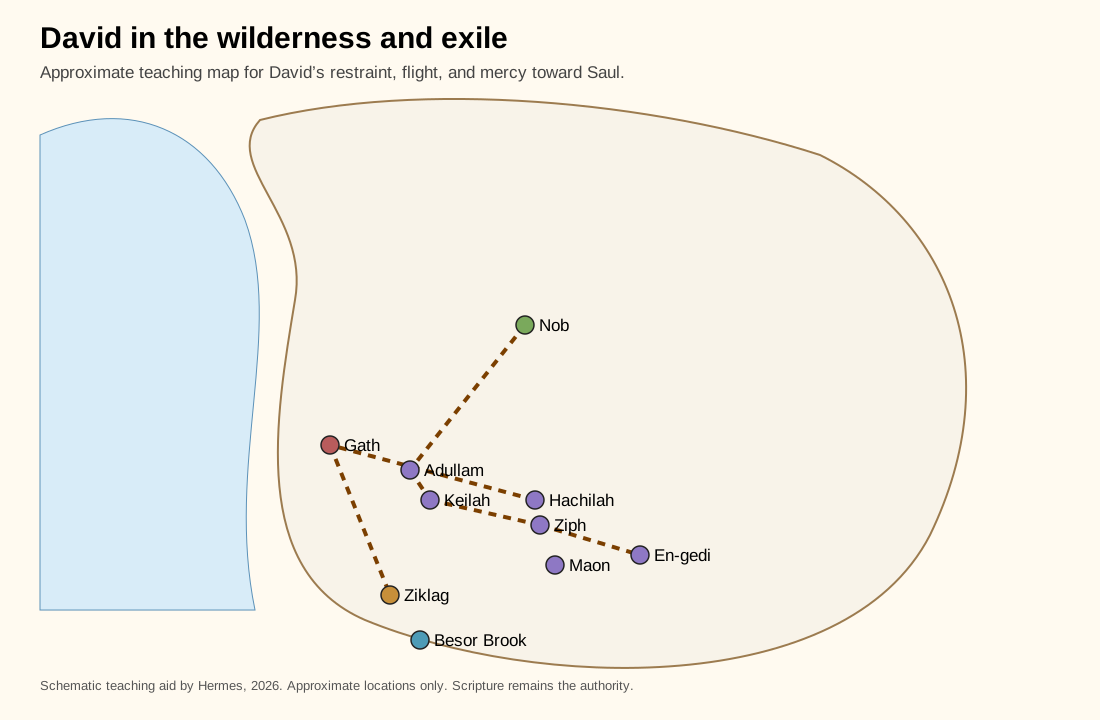 Approximate schematic teaching map by Hermes, 2026. Locations and connecting lines are illustrative.
| In these chapters | Fulfillment and correction in Christ | Fruit for the disciple |
|---|---|---|
| David refuses Saul’s spear (26:8-12). | Christ gives His life for enemies rather than avenging Himself. | Judge opportunities by obedience, not convenience. |
| David speaks from a distance (26:13-20). | Christ bears rejection and opens the lasting inheritance (Hebrews 13:12-14). | Join mercy to truth and the protection of those at risk. |
| Saul confesses; David remains apart (26:21-25). | Christ’s mercy calls for conversion, not performance. | Receive a confession without declaring trust instantly restored. |
| David seeks shelter, then conceals killings (27:1-12). | The Child finds refuge in Egypt; the sinless King has no deceit (Matthew 2:13-15; 1 Peter 2:22). | Seek safety without sacrificing another person’s life or the truth. |
Spiritual Fruit 🍇
-
Test the convenient opening. When an opportunity to humiliate or injure someone seems almost arranged for you, remember the spear beside Saul. Pause before acting, name the commandment that governs the decision, and pray for the freedom to obey it. An easy action can still be an evil one.
-
Practice mercy with a protected boundary. David’s distance in 26:13 lets him speak truth. Where remorse has been unstable, forgiveness need not grant renewed access. Seek the support of a trustworthy priest, qualified helper, or appropriate authority; immediate danger requires immediate protection, not a delay while another person promises to change.
-
Bring the inward sentence into prayer and counsel. Write down the prediction fear keeps repeating, and distinguish the known danger from the future you have declared certain. Pray Psalm 63 (LXX Psalm 62) at Prime for thirst for God and remembrance of His help. Share the thought with a wise, compassionate person. Watchfulness is not denial of danger; it is refusing to let fear become your only adviser.
-
Keep safety and truth together. Refuge is good, and protecting a household is a responsibility. Chapter 27 exposes a different step: harming others to preserve the appearance of safety. In confession, name concrete deceit or harm without hiding behind necessity; seek responsible amendment that protects those affected. Christ’s own flight to Egypt frees us from the false choice between reckless exposure and sinful survival.
-
Receive the mercy of the sinless King. David’s failures do not cancel the mercy he practiced, and his mercy does not erase the wrong he did. Bring both the real good and the real wound before Christ. Ask Him to preserve yesterday’s obedience and to heal the fear that has returned today.
The spear is still beside the sleeping king, and David’s hand can still choose. Across the hill, truth can be spoken without walking back into danger. At Ziklag, the heart needs a refuge deeper than concealment. Lord Jesus Christ, keep our hands from vengeance, bring our hidden thoughts into Your light, and make our search for safety faithful to the lives You love.
Teaching Notes
Whole-guide helps. Preserve the contrast between mercy and fear without turning flight itself into sin. Linger at Abishai’s counsel, David’s safe distance, and the transition through 26:24, 26:25, and 27:1. Compress uncertain geographical detail. The map is a schematic, not a measured route reconstruction. Allow discussion time to determine the pace rather than treating the retained audio duration as the length of this expanded lesson.
Pastoral and source cautions. No exact Coptic reading placement of 1 Samuel 26-27 is verified in the sources used here. The worship connections are the Agpeya psalm and the feast of Christ’s entrance into Egypt. Keep the text’s lethal concealment motive explicit; never use “the Lord’s anointed” to protect abusive authority or silence a report of harm. No symbolic interpretation of the spear and water is claimed.
A Betrayal Repeated and a King Asleep (1 Samuel 26:1-7)
- Ask: How does the prayer of Psalm 54 (LXX Psalm 53) change the way betrayal is carried before God?
- Watch for: Treating the psalm’s title as proof of this night’s date, or silently replacing the displayed chariot with a Hebrew-based camp description.
Opportunity Is Not Permission (1 Samuel 26:8-12)
- Ask: What makes David’s response different from Abishai’s, though both recognize that the moment has been given?
- Watch for: Making providence permission for revenge, or respect for the anointed a command to tolerate danger.
Truth from Safety and the Wound of Exile (1 Samuel 26:13-20)
- Ask: Why does David speak of exclusion from the inheritance as a threat to worship and belonging?
- Watch for: Demanding unsafe proximity as proof of forgiveness, or blaming displaced people for their loss of communal worship.
A Confession, a Spear Offered Back, and a Final Blessing (1 Samuel 26:21-25)
- Ask: What can Saul’s confession establish, and what would require changed conduct over time?
- Watch for: Claiming a hand-to-hand return of the spear or an explicit promise of kingship in verse 25.
A Sentence inside David’s Heart (1 Samuel 27:1-7)
- Ask: How do David’s spoken prayer and inward prediction differ, with Saul’s blessing between them?
- Watch for: Calling fear or flight automatically sinful, or presenting Severus’s imagined speeches as Scripture.
Concealment Bought with Human Lives (1 Samuel 27:8-12)
- Ask: How does the motive in verse 11 change our assessment of the policy and Achish’s confidence?
- Watch for: Excusing lethal concealment as strategy, making ancient conflict permission for Christian violence, or asserting an unreported revenge motive for chapter 30.
Sources
Embedded Scripture is from Brenton’s English Septuagint (LXX).
Brenton, The Septuagint Version, 1 Samuel 26-27; the biblical cross-references discussed in the guide include 1 Samuel 21, 23, 25, 28, 30-31; Psalms 41-42, 53, 62, 83 in LXX numbering; Isaiah 19:1 and 53:9; Matthew 2:13-15; Luke 23:34; Romans 12:17-21; Hebrews 13:12-14; and 1 Peter 2:21-23. Familiar MT Psalm numbers are paired with LXX numbers in the explanation.
Bernard A. Taylor, 1 Reigns, NETS, the introduction and chapters 13, 26-27, with Rahlfs-based CCAT Greek. Used for translation comparison, not as replacement Scripture. 🔗 NETS 1 Reigns · 🔗 CCAT 1 Samuel.
St. John Chrysostom, Homilies on Acts 16 and 17, concluding exhortations, NPNF1, volume 11, translated by J. Walker, J. Sheppard, and H. Browne, revised by George B. Stevens. Both explicitly discuss David and Saul; Homily 17 names the refusal of the spear. 🔗 Homily 16 · 🔗 Homily 17.
St. Severus of Antioch, Letter 56 to Caesaria, A Collection of Letters from Numerous Syriac Manuscripts, translated by E. W. Brooks, Patrologia Orientalis 12.2 (1915), pp. 163-166. A direct reading of 27:1-3 defending prudent flight; it does not discuss or approve the lethal concealment of 27:9-11. 🔗 Letter 56.
St. John Cassian, Conference 2, chapters 2, 4, 10-13, translated by C. S. Gibson, NPNF2, volume 11. A thematic witness on discernment, thoughts, and compassionate spiritual counsel. 🔗 Conference 2.
Agpeya, Prime, Psalm 63 (LXX Psalm 62); Coptic Reader, Synaxarion for Pashons 24, published by the Coptic Orthodox Metropolis of the Southern United States. 🔗 Prime · 🔗 Coptic Reader. Public Synaxarium parallels: 🔗 Bashans 24, Arabic · 🔗 Bashans 24, English roster.
Footnotes
-
Rahlfs-based CCAT, 1 Samuel 13:13; 26:5, 7, 20-21; 27:7, compared with Bernard A. Taylor’s NETS 1 Reigns. 🔗 Greek · 🔗 NETS. Hebrew-based comparison: 🔗 26:5 · 🔗 26:20 · 🔗 27:7. ↩ ↩2 ↩3 ↩4
-
Rahlfs-based CCAT, Psalms 53:1-2 and 62:1, with Brenton’s corresponding superscriptions. The former names the Ziphites; the latter has Judea where Brenton has Idumea. 🔗 Psalms Greek. ↩
-
Agpeya, Prime, First Hour, Psalm 63 (LXX Psalm 62). The Agpeya prints the liturgical number 62. 🔗 Prime. ↩
-
Rahlfs-based CCAT, 1 Samuel 26:12 and Genesis 2:21; 15:12. 🔗 1 Samuel · 🔗 Genesis. ↩
-
St. John Chrysostom, Homilies on Acts, Homily 17, concluding exhortation on anger, explicitly citing 1 Samuel 26:7; NPNF1, vol. 11, translation by J. Walker, J. Sheppard, and H. Browne, revised by George B. Stevens. 🔗 Homily 17. ↩
-
St. John Chrysostom, Homilies on Acts, Homily 16, concluding exhortation on affliction, citing 1 Samuel 26:19; NPNF1, vol. 11, translation by J. Walker, J. Sheppard, and H. Browne, revised by George B. Stevens. 🔗 Homily 16. ↩
-
St. Severus of Antioch, Letter 56 to Caesaria, A Collection of Letters from Numerous Syriac Manuscripts, translated by E. W. Brooks, Patrologia Orientalis 12.2 (1915), pp. 163-166. The quoted words occur in Severus’s imagined answer by David, p. 165. 🔗 Letter 56. ↩
-
St. John Cassian, Conference 2, chapters 4 and 10, Abba Moses on discernment and disclosure of thoughts; read with chapters 12-13 on a harmful elder and compassionate discernment. Translated by C. S. Gibson, NPNF2, vol. 11. 🔗 Conference 2. ↩
-
Coptic Reader, Coptic Orthodox Metropolis of the Southern United States, Readings > Liturgy > Synaxarion, Pashons 24, “The Commemoration of the Entrance of the Lord Christ into Egypt”. The entry cites Matthew 2:13 and Isaiah 19:1. 🔗 Coptic Reader. Public parallel: 🔗 Bashans 24, Arabic. ↩