


1 Samuel 25 shows David at one of his most dangerous moments: not when Saul hunts him, but when anger almost turns him into Saul. Nabal’s contempt wounds David’s honor, and David prepares to answer insult with blood. Abigail stands between wrath and slaughter with humility, courage, and theological clarity. The chapter teaches that restraint is not passivity. It is the saving work of God interrupting the passions before they become irreversible.
Lesson guide
- Key phrases: withheld from bloodshed; blessed be thy advice; vengeance refused.
- Emphasize: Abigail is not merely diplomatic. She becomes an instrument of God’s mercy to David.
- Avoid: romanticizing David’s anger or reducing Abigail to clever social management.
Historical and Scriptural Context
This study uses the familiar English book names. In the Septuagint, 1-2 Samuel and 1-2 Kings form the four books of Kingdoms, so this book is 1 Kingdoms there.
This chapter stands between two scenes in which David spares Saul. David spared Saul when Saul was above him, but will he spare Nabal when Nabal is beneath him? Nabal’s sneer at the “son of Jessæ,” his return of evil for good, and his king-like feast make him resemble Saul in miniature. Saul had admitted that David repaid good while he himself repaid evil (1 Samuel 24:18). David now makes the same complaint against Nabal, yet comes close to repeating Saul’s violence.
Samuel’s death removes the prophet who anointed David. The narrative does not say that grief caused David’s anger. It does show that spiritual testing continues after a holy elder dies, and that God’s correction can arrive through a person without prophetic office. Abigail will speak the truth David needs to hear.
Geographical Significance ⛰️
The displayed text places David in the wilderness of Maon, with Nabal’s flocks in Carmel in Judah (Joshua 15:55). This is not the northern Mount Carmel of Elijah’s confrontation. The shepherds’ testimony supplies the setting that matters most: David’s men had been a protective wall around them in the open country. Sheep-shearing provides the occasion for a request for food; no stated agreement gives David permission to punish refusal with slaughter.
The Characters 👥
- David: the Lord’s anointed, capable of mercy toward an enemy and of terrible anger toward a man who insults him. His willingness to receive correction will distinguish him from the folly he is about to imitate.
- Abigail: called “Abigaia” in Brenton, a woman of good understanding who joins truthful speech to courageous action. She neither excuses Nabal nor accepts David’s threatened violence as inevitable.
- Nabal: wealthy in flocks, harsh in conduct, and closed to counsel. Abigail herself connects his name with folly in verse 25; the narrative gives the explanation we need.
- The servants: witnesses to David’s earlier kindness and to their master’s refusal. Their appeal to Abigail shows the value of hearing people close to the threatened harm.
Understanding and hardness (1 Samuel 25:1-3)
- And Samuel died, and all Israel assembled, and bewailed him, and they bury him in his house in Armathaim: and David arose, and went down to the wilderness of Maon.
- And there was a man in Maon, and his flocks were in Carmel, and he was a very great man; and he had three thousand sheep, and a thousand she-goats: and he happened to be shearing his flock in Carmel.
- And the man’s name was Nabal, and his wife’s name was Abigaia: and his wife was of good understanding and very beautiful in person: but the man was harsh and evil in his doings, and the man was churlish.
The chapter begins with a funeral and then places two people side by side. Abigail has good understanding; Nabal is harsh and evil in his doings. His thousands of animals establish his wealth, but wealth says nothing about the wisdom needed to use it. The household possesses food and resources while lacking a master who will listen.
Abigail’s wisdom will become visible in what she does with those resources. Christ, the true Son of David, reveals the fullness of that generous wisdom: He gives His own life for others, rather than using His strength to make others pay for His wounded honor (1 Peter 2:23).
What the Greek text shows
The Greek adjective “κυνικός” (“kynikos”) in verse 3 means “dog-like,” behind Brenton’s “churlish.” It makes Nabal’s character, rather than his pedigree, the final note of the description. The Hebrew witness instead identifies him as a Calebite. These are different textual readings, not two meanings that should be combined into one Greek phrase. The moral contrast rests on the words both witnesses give: Abigail understands, while Nabal acts harshly.1
Gems from the Fathers 💎: Pride wounded by an insult
St Basil the Great, in Against Those Who Are Angry, section 6, distinguishes an immediate flare of rage from anger that settles into a lasting desire for retaliation. He traces the sting of an insult to the pride with which we regard ourselves, and directs the reader to Christ’s humility when struck. This is a thematic witness, not a commentary on Nabal. It helps us see how David’s real grievance becomes dangerous when injured dignity demands blood.2
Bread refused and swords drawn (1 Samuel 25:4-13)
- And David heard in the wilderness, that Nabal the Carmelite was shearing his sheep.
- And David sent ten young men, and he said to the young men, Go up to Carmel, and go to Nabal, and ask him in my name how he is.
- And thus shall ye say, May thou and thy house seasonably prosper, and all thine be in prosperity.
- And now, behold, I have heard that thy shepherds who were with us in the wilderness are shearing thy sheep, and we hindered them not, neither did we demand any thing from them all the time they were in Carmel.
- Ask thy servants, and they will tell thee. Let then thy servants find grace in thine eyes, for we are come on a good day; give, we pray thee, whatsoever thy hand may find, to thy son David.
- So the servants come and speak these words to Nabal, according to all these words in the name of David.
- And Nabal sprang up, and answered the servants of David, and said, Who is David? and who is the son of Jessæ? now-a-days there is abundance of servants who depart every one from his master.
- And shall I take my bread, and my wine, and my beasts that I have slain for my shearers, and shall I give them to men of whom I know not whence they are?
- So the servants of David turned back, and returned, and came and reported to David according to these words.
- And David said to his men, Gird on every man his sword. And they went up after David, about four hundred men: and two hundred abode with the stuff.
David’s request begins with courtesy and a wish for Nabal’s prosperity. His men had neither hindered the shepherds nor demanded anything from them. He asks for whatever Nabal’s hand can find and calls himself his son. Nabal responds by treating him as a runaway servant. The sneer denies the relationship David has offered and dismisses the good his men have done.
“My bread, my wine, my beasts” becomes the language of a heart that sees possession but not obligation. Luke 12:16-21 exposes the same closed circle in the rich fool’s plans for his crops, barns, and ease. The problem is not the existence of goods; it is that another person’s need has no place in their use. St John asks how God’s love can remain in someone who sees a brother in need and shuts his heart (1 John 3:17). Nabal’s refusal of food to the Lord’s anointed also brings the Christian reader before Christ’s judgment on hunger left unfed (Matthew 25:42). That warning tests our own generosity; it gives no permission to force another person’s gift.
David’s response is swift and terrifying: “Gird on every man his sword.” The man who would not lift his hand against Saul now prepares to kill a household over insult and withheld bread. This is how quickly the passions can change clothing. Yesterday restraint looked holy. Today anger calls itself justice. Four hundred armed men do not turn a wounded claim into a righteous one.
Christological and typological reading. Christ is the true King who is insulted and does not call down slaughter. He gives Himself as bread for the life of the world (John 6:51). David’s near failure makes us long for the Son of David, whose meekness is not weakness but perfect royal strength. Our service becomes freer when we receive that strength from Him instead of demanding that gratitude secure our worth.
What the Greek text shows
Brenton’s verse 6 blesses Nabal, his household, and his possessions with prosperity. The critical Greek uses forms of “ὑγιαίνω” (“hygiainō”), to be healthy or well, in that greeting. The Hebrew repeats “peace” three times, but that familiar threefold wording is not the English Scripture displayed here. The courtesy is real in both witnesses; the exposition should hear each in its own words.1
Gems from the Fathers 💎: Anger blinds counsel
St John Cassian explains in Institutes VIII.6 that anger obstructs the soul’s sight even when the angry person thinks the cause is valuable. His image makes David’s danger plain: having a reason for grievance does not restore the discernment that vengeance has darkened. “It makes no difference whether gold plates, or lead, or what metal you please, are placed over our eyelids, the value of the metal makes no difference in our blindness.”3
Lesson guide
- Key phrases: grief does not suspend testing; anger calls itself justice.
- Emphasize: David’s danger is interior before it becomes military.
- Avoid: presenting every sharp reaction to disrespect as righteous indignation.
A household warned and an oath spoken (1 Samuel 25:14-22)
- And one of the servants reported to Abigaia the wife of Nabal, saying, Behold, David sent messengers out of the wilderness to salute our lord; but he turned away from them.
- And the men were very good to us; they did not hinder us, neither did they demand from us any thing all the days that we were with them.
- And when we were in the field, they were as a wall round about us, both by night and by day, all the days that we were with them feeding the flock.
- And now do thou consider, and see what thou wilt do; for mischief is determined against our lord and against his house; and he is a vile character, and one cannot speak to him.
- And Abigaia hasted, and took two hundred loaves, and two vessels of wine, and five sheep ready dressed, and five ephahs of fine flour, and one homer of dried grapes, and two hundred cakes of figs, and put them upon asses.
- And she said to her servants, Go on before me, and behold I come after you: but she told not her husband.
- And it came to pass when she had mounted her ass and was going down by the covert of the mountain, behold, David and his men came down to meet her, and she met them.
- And David said, Perhaps I have kept all his possessions in the wilderness that he should wrong me, and we did not order the taking any thing of all his goods; yet he has rewarded me evil for good.
- So God do to David and more also, if I leave one male of all that belong to Nabal until the morning.
The servant confirms David’s earlier good conduct, then names the immediate danger: harm is determined against the whole house, and Nabal cannot be spoken to. Abigail listens where her husband refuses to listen. She sends food ahead and follows without telling him. The narrative describes a wise response to this crisis; it does not impose one strategy on every person living with danger.
The contrast between the “wall” in verse 16 and the oath in verse 22 is terrible. Men who protected the shepherds now threaten the household to which those shepherds belong. David says he has been repaid evil for good, then swears to leave no male alive. He is about to destroy innocent people along with the man who insulted him. A true account of what someone did to us can still become the beginning of a false justification for what we plan to do next.
Abigail’s prepared food answers a real lack, while her coming words will answer the deeper hunger for vindication. The apostolic command to overcome evil with good (Romans 12:17-21) reaches both the empty hand and the resentful heart. It does not mean ignoring danger. If you are threatened, seek safety and help from trusted people, a priest, or qualified services; immediate danger calls for immediate protection. No one is obliged to approach an armed or abusive person as Abigail did.
Christological and typological reading. The servants need protection from the very men who once protected them. Christ’s shepherding never turns those entrusted to Him into payment for His honor. Abigail’s intervention calls David back toward a kingship that serves life, and calls every person with authority to examine the harm that anger can inflict on those with less power.
Truthful intercession before bloodshed (1 Samuel 25:23-27)
- And Abigaia saw David, and she hasted, and alighted from her ass; and she fell before David on her face, and did obeisance to him, bowing to the ground
- even to his feet, and said, On me, my lord, be my wrong: let, I pray thee, thy servant speak in thine ears, and hear thou the words of thy servant.
- Let not my lord, I pray thee, take to heart this pestilent man, for according to his name, so is he; Nabal is his name, and folly is with him: but I thy handmaid saw not the servants of my lord whom thou didst send.
- And now, my lord, as the Lord lives, and thy soul lives, as the Lord has kept thee from coming against innocent blood, and from executing vengeance for thyself, now therefore let thine enemies, and those that seek evil against my lord, become as Nabal.
- And now accept this token of goodwill, which thy servant has brought to my lord, and thou shalt give it to the servants that wait on my lord.
“On me, my lord, be my wrong” opens a plea for mercy, not a denial of Nabal’s folly. Abigail says plainly what he is like and explains that she did not see David’s messengers. She takes the place of the petitioner without pretending that she caused his insult. Her humility includes truth. Most strikingly, she names the blood David intends to shed as innocent and his intended action as vengeance for himself.
Before David has answered, she speaks of the Lord as having kept him from that bloodshed. She addresses him as a man whom God can still restrain. Her confidence calls him to consent to the mercy already confronting him. The food she asks him to receive is for the men who attend him: the hands ready to kill can become hands receiving provision.
Paul’s willingness to place another’s debt on his own account (Philemon 18) offers a fitting biblical parallel to her plea. The comparison has limits: Abigail is asking for pardon and making peace, not performing an atoning sacrifice. Christ alone, who knew no sin, bears our sin for our reconciliation with God (2 Corinthians 5:21). The Cross saves us through the Son’s free self-offering; it cannot be used to assign an innocent spouse the blame for another person’s abuse.
Christological and typological reading. Abigail stands as an image of intercession. Her action points toward Christ’s saving work without equating David’s sinful anger with God’s judgment. The Church shares in Christ’s ministry of reconciliation when truthful speech, prayer, and practical mercy interrupt harm. Such intercession seeks the angry person’s repentance as well as the endangered person’s safety.
Gems from the Fathers 💎: Courageous counsel
St John Chrysostom recalls this event in Homilies on John LXI.4 while urging women to offer wise counsel: “a woman rescued Nabal from the slaughter.”4 He places her among women whose action preserved others. This brief direct recollection gives Abigail’s courage its proper dignity. It does not make a wife’s success in changing a dangerous man the measure of her faithfulness. David bears the responsibility to hear the truth and stop.
The Church’s Voice in Worship ⛪
In the Coptic Liturgy of St Basil, the Prayer of Reconciliation asks God to cleanse us from “the remembrance of evil entailing death,” and to make us worthy to greet one another with a holy kiss. The deacon then calls for that kiss and says, “Offer in order.” The prayer and kiss precede the anaphora, the Eucharistic prayer; the earlier Offertory has already taken place.5 Resentment cannot be treated as harmless baggage carried toward Holy Communion.
Matthew 5:23-24 joins reconciliation to the gift brought to the altar. Abigail’s provision before bloodshed has a fitting resonance with that demand for peace. Bread, wine, and a plea for mercy turn a road of threatened slaughter into an encounter where life can be spared. This is theological reflection, not an identification of her gift with the Eucharist or a verified liturgical assignment of the chapter. The Coptic lectionary evidence considered here does not verify an exact reading placement for 1 Samuel 25.
A sure house and the bundle of life (1 Samuel 25:28-31)
- Remove, I pray thee, the trespass of thy servant; for the Lord will surely make for my lord a sure house, for the Lord fights the battles of my lord, and there shall no evil be ever found in thee.
- And if a man shall rise up persecuting thee and seeking thy life, yet shall the life of my lord be bound up in the bundle of life with the Lord God, and thou shalt whirl the life of thine enemies as in the midst of a sling.
- And it shall be when the Lord shall have wrought for my lord all the good things he has spoken concerning thee, and shall appoint thee to be ruler over Israel;
- then this shall not be an abomination and offence to my lord, to have shed innocent blood without cause, and for my lord to have avenged himself: and so may the Lord do good to my lord, and thou shalt remember thine handmaid to do her good.
Abigail speaks to David in light of the man he is called to become. Jonathan had already told him that he would reign, and Saul had admitted that Israel’s kingdom would be established in his hand (1 Samuel 23:17; 24:21). Abigail now asks him to remember that future before choosing this night’s action. The Lord will make a sure house, so David must not build it on private vengeance. Her confidence is a summons to faithfulness, not a declaration that David can never sin.
The “bundle of life with the Lord God” places David’s threatened life inside God’s keeping. A bundle gathers and holds what might otherwise be scattered. The contrast is with the life of his enemies flung out from a sling. That weapon recalls David’s victory over Goliath, but the speech redirects confidence away from the hand that can strike and toward the Lord who preserves. The man who has trusted God in battle must also trust Him when restraint feels like losing.
For a Christian reader, the promise opens toward life hidden with Christ in God (Colossians 3:3) and the sheep whom no one can snatch from the Son’s or the Father’s hand (John 10:28-29). These are canonical resonances, not a claim that Abigail is describing the whole Christian doctrine of eternal life. They give the soul a better security than revenge. The person kept by God can leave another person’s final judgment with Him.
Verse 31 names the future burden she wants David to escape: innocent blood shed without cause and vengeance taken for himself. His coming kingship would not make that blood disappear. Receiving correction now preserves freedom to serve later. A lasting promise must teach us how to act today.
Christological and typological reading. David’s house will find its fulfillment in Christ, the King whose reign is secure and whose mercy has no divided purpose. Abigail helps preserve the earthly king from one sin; the true Son of David delivers His people from sin and death. The promise does not flatter David. It calls him away from the very conduct that contradicts his vocation.
What the Greek text shows
“Οἶκον πιστόν” (“oikon piston”), a faithful or secure house, appears in both 25:28 and the promise to the faithful priest in 2:35. In 2 Samuel 7:16 the related verb “πιστωθήσεται” (“pistōthēsetai”) says that the house will be made secure. The royal promise is a real connection, but all three verses do not contain an identical Greek phrase.6
A second distinction matters in verse 28. Brenton says “the Lord fights the battles of my lord.” Rahlfs’ Greek instead says that David, “my lord,” fights the Lord’s battle, as reflected in NETS. That critical wording recalls 17:47, where the battle belongs to the Lord; it also tests whether David’s present campaign belongs to Him. Both the displayed translation and this comparison direct David beyond private vengeance, but their grammatical subjects must remain distinct.6
Gems from the Fathers 💎: Discernment guards the good
In Conference II.4, St John Cassian records Abbot Moses’ teaching that zeal and strenuous effort cannot preserve the virtues without discernment: “For discretion is the mother of all virtues, as well as their guardian and regulator.”7 This is a thematic application to Abigail’s counsel. Her good understanding keeps gratitude, courage, and loyalty from being swept into David’s destructive resolve. Discernment asks not only whether we have served faithfully, but whether our next act will remain faithful to God.
Lesson guide
- Key phrases: wisdom moving before violence hardens; speak to the person’s vocation, not only his failure.
- Emphasize: Abigail’s humility includes truth.
- Avoid: using Abigail to tell vulnerable people to appease abusers. Her action is courageous, strategic, and time-bound, not a blanket rule.
The armed man accepts correction (1 Samuel 25:32-35)
- And David said to Abigaia, Blessed be the Lord God of Israel, who sent thee this very day to meet me:
- and blessed be thy conduct, and blessed be thou, who hast hindered me this very day from coming to shed blood, and from avenging myself.
- But surely as the Lord God of Israel lives, who hindered me this day from doing thee harm, if thou hadst not hasted and come to meet me, then I said, There shall surely not be left to Nabal till the morning one male.
- And David took of her hand all that she brought to him, and said to her, Go in peace to thy house: see, I have hearkened to thy voice, and accepted thy petition.
David blesses the Lord, Abigail, and her conduct. The correction reaches him while he is armed and surrounded by men ready to obey. He could defend his grievance, insist on his oath, or dismiss the person who interrupted him. Instead he says that she has hindered him from bloodshed and self-vengeance. He receives both the provisions and the plea, then sends her home in peace. His repentance takes the visible form of stopping.
The oath in verse 22 bound David’s pride to a wicked intention. It did not make that intention holy. His changed course contrasts with Saul’s threat against Jonathan under a rash oath (1 Samuel 14:24, 44-45) and with Herod, who lets his oaths become a reason to execute John the Baptist (Mark 6:26-28). Jephthah’s tragic vow in Judges 11:30-40 makes the danger still more painful. A sinful promise calls for repentance, not another sin committed to protect our consistency.
Christological and typological reading. David needs another person to recall him to mercy. Christ possesses that mercy perfectly and heals the will that has confused stubbornness with faithfulness. The word He gives us may arrive through someone we did not intend to hear. Humility receives the correction and makes the necessary change before demanding that the corrector speak more gently.
Gems from the Fathers 💎: A promise cannot make evil good
St Ambrose teaches in On the Duties of the Clergy III.12.76 that a person who has made a shameful promise does better to leave it unfulfilled than to carry out the wrong. His treatment of Herod in the next paragraph exposes the cruelty hidden beneath apparent loyalty to an oath: “this was considered an act of good faith when it really was an act of madness!”8 This thematic witness supports David’s decision to abandon slaughter. Ambrose’s treatment of Jephthah is more complicated: he condemns the rash vow but also expresses sympathy for its fulfillment and praises the daughter. His discussion should not be made to say that all these stories receive one simple patristic judgment.
Judgment entrusted and a divided household (1 Samuel 25:36-44)
- And Abigaia came to Nabal: and, behold, he had a banquet in his house, as the banquet of a king, and the heart of Nabal was merry within him, and he was very drunken: and she told him nothing great or small till the morning light.
- And it came to pass in the morning, when Nabal recovered from his wine, his wife told him these words; and his heart died within him, and he became as a stone.
- And it came to pass after about ten days, that the Lord smote Nabal, and he died.
- And David heard it and said, Blessed be the Lord, who has judged the cause of my reproach at the hand of Nabal, and has delivered his servant from the power of evil; and the Lord has returned the mischief of Nabal upon his own head. And David sent and spoke concerning Abigaia, to take her to himself for a wife.
- So the servants of David came to Abigaia to Carmel, and spoke to her, saying, David has sent us to thee, to take thee to himself for a wife.
- And she arose, and did reverence with her face to the earth, and said, Behold, thy servant is for an handmaid to wash the feet of thy servants.
- And Abigaia arose, and mounted her ass, and five damsels followed her: and she went after the servants of David, and became his wife.
- And David took Achinaam out of Jezrael, and they were both his wives.
- And Saul gave Melchol his daughter, David’s wife, to Phalti the son of Amis who was of Romma.
Nabal feasts “as the banquet of a king” while the household has narrowly escaped his folly and David’s rage. Abigail waits until he is sober before telling him. Her courage includes judgment about when speech can be heard. The account says that his heart dies within him and he becomes as stone; it gives no medical diagnosis. After about ten days, the Lord strikes him and he dies. Those days are part of the narrative, not a number to decode.
Ezekiel 36:26 offers a prayerful contrast: God promises to remove the heart of stone and give a heart of flesh. Nabal’s collapse is not itself Ezekiel’s diagnosis of spiritual hardness. Yet, hearing both texts, we can ask for a heart still able to hear correction before refusal becomes settled. The chapter does not invite us to enjoy Nabal’s death or use it to predict the death of someone who has harmed us.
David’s blessing in verse 39 includes gratitude that God delivered His servant from evil. He thanks God not only for judgment rendered, but for sin prevented. That is a prayer worth learning: Lord, thank You for the wrong You did not allow me to finish. In the following chapter David will name the possibility that the Lord may strike Saul (1 Samuel 26:10). Nabal’s end gives that conviction a concrete narrative precedent; Scripture does not state that this episode was its sole cause. Saul’s later confession of foolishness (26:21) strengthens the contrast without proving an identical Greek word for Nabal’s folly.
David’s marriage to Abigail does not erase the warning at the end. He also takes Achinaam, while Saul gives Melchol, David’s wife, to another man. The chapter records a household becoming divided, not an arrangement for Christians to imitate. Deuteronomy 17:17 forbids the king to multiply wives lest his heart turn away. David’s growing household already stands under that warning, even after he has received correction so well.
Christological and typological reading. David is a cracked type: a real bearer of God’s promise whose life still needs judgment and healing. Christ restores marriage to its beginning, the two becoming one flesh (Matthew 19:4-6), and loves the Church with the undivided self-offering of the Bridegroom (Ephesians 5:25-32). His fulfillment does not require us to excuse David’s failures. It lets us receive what is good in David while resting our hope in the King whose love is whole.
Lesson guide
- Key phrases: David receives correction while armed; folly is not harmless.
- Emphasize: teach both David’s repentance and the limits of imitating David’s household life.
- Avoid: turning Nabal’s death into vindictive satisfaction.
Iconography Connection 🖼️
Lucas van Leyden’s engraving is a Western biblical artwork, not an Orthodox icon. Abigail’s posture and the armed company make the crisis visible. David’s responsibility is to hear courageous correction; the image must never be used to pressure a vulnerable person to appease rage.
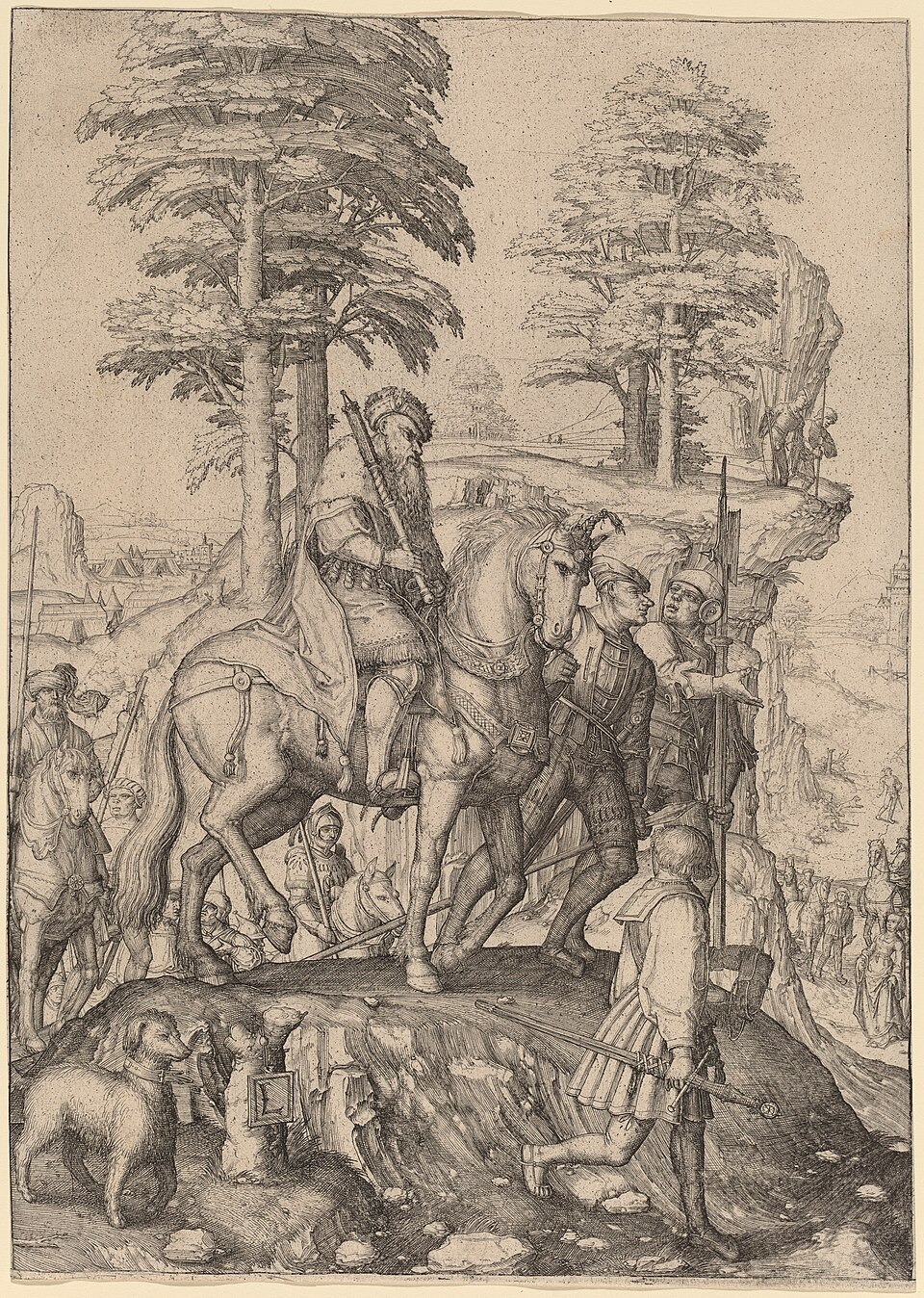 Lucas van Leyden, Abigail and David, in or before 1508, National Gallery of Art, Rosenwald Collection. Image: Wikimedia Commons, CC0. 🔗
| The chapter’s sign | What it reveals | Fulfillment and response in Christ |
|---|---|---|
| Bread refused and swords drawn | Wounded pride can turn service into a claim to punish | The Son of David gives life instead of exacting revenge |
| Abigail’s truthful plea | Mercy interrupts violence without calling evil good | Christ reconciles us; His Church practices truth joined to mercy |
| A sure house and the bundle of life | God’s keeping frees David from securing himself through bloodshed | Life hidden with Christ gives courage to entrust judgment to God |
| David receives correction; his household remains divided | Repentance can be genuine while further healing is still needed | The faithful Bridegroom perfects what the earthly king cannot |
Spiritual Fruit 🍇
-
Ask where anger is protecting pride rather than justice. David has received real ingratitude, but his response threatens people who did not insult him. Before sending the message or making the accusation, name the wrong plainly and name the harm your proposed response would do. Bring both before Christ.
-
Receive correction before the sword leaves the sheath. David’s greatness here is that he listens while armed. When a trusted person interrupts your reaction, pause long enough to ask whether God is using the interruption to save you from yourself. If you have promised to retaliate, retract the threat and seek help to make the change real.
-
Practice Abigail’s kind of courage without making safety expendable. She names folly, brings provision, and calls David back to his vocation. One attainable act is to tell the truth about a harmful plan and seek wise help for those endangered. Do not equate peacemaking with remaining accessible to abuse; protection and truthful boundaries can serve peace.
-
Let generosity break the circle of “my.” Nabal has food but sees no claim on it beyond his own feast. Set aside a concrete share of your goods or time for someone in need. Do it without using your gift to purchase gratitude or control the recipient.
-
Thank God for sins prevented. In evening prayer, recall an interruption that spared you an unkind word or a destructive act. Thank Him for that mercy, confess the intention that needed restraining, and ask for a heart that can hear. Before Holy Communion, pray the Prayer of Reconciliation with the resentment you are actually carrying in mind.
David is still armed when he begins to bless God. Nothing in Abigail’s words has made Nabal’s insult good, but the sword no longer has to answer it. Lord Jesus Christ, keep my life in Your hands and free my hand from vengeance. Give me courage to hear the truth, charity to feed the hungry, and gratitude for the mercy that stops me before I harm another.
Teaching Notes
Suggested timing: 10 minutes for context, 15 minutes for Nabal and David’s anger, 20 minutes for Abigail’s intercession, 10 minutes for David’s correction, and 10 minutes for Spiritual Fruit.
Whole-session guidance: Read Abigail’s speech and David’s answer slowly. Say the central warning plainly: David is saved from becoming Saul-like by receiving correction. Spend more time on verses 24-35 than on the closing marriage details, while keeping the royal-marriage warning clear. Use the engraving to identify who holds the weapons and who must change course. Preserve the central distinction: humility does not require pretending evil is good. The Coptic lectionary evidence considered here does not verify an exact reading placement for this chapter; the worship connection is with the Prayer of Reconciliation, not an asserted appointment.
Understanding and hardness (1 Samuel 25:1-3)
- Ask: What can this prosperous household provide, and what does its master lack?
- Watch for: Treating Nabal’s wealth as God’s approval, or mixing the Greek character description with the Hebrew Calebite reading.
Bread refused and swords drawn (1 Samuel 25:4-13)
- Ask: At what point does David’s claim of service become a demand to punish?
- Watch for: Calling David’s disproportionate reaction righteous indignation because Nabal’s insult was real.
A household warned and an oath spoken (1 Samuel 25:14-22)
- Ask: How does the testimony about a protective wall expose the wrong in David’s oath?
- Watch for: Suggesting that a threatened person must personally confront an armed aggressor to show faith.
Truthful intercession before bloodshed (1 Samuel 25:23-27)
- Ask: How does Abigail take the place of a petitioner while still naming both men’s wrongs?
- Watch for: Turning her plea into a rule that victims carry an abuser’s guilt, or treating her provisions as a Eucharistic institution.
A sure house and the bundle of life (1 Samuel 25:28-31)
- Ask: How does God’s promised future change what David should do that night?
- Watch for: Reading God’s keeping as permission to sin, or claiming an identical Greek phrase in all three house promises.
The armed man accepts correction (1 Samuel 25:32-35)
- Ask: What visible change shows that David has actually received the correction?
- Watch for: Teaching that a sinful oath must be fulfilled, or presenting Ambrose’s judgment on Jephthah without its complexity.
Judgment entrusted and a divided household (1 Samuel 25:36-44)
- Ask: Why can David thank God for a wrong he never completed, and what still needs healing in his life?
- Watch for: Vindictive pleasure at Nabal’s death, medical speculation, or treating David’s wives as a Christian model.
Glossary
- Discernment: judgment that distinguishes a faithful response from a passion disguised as duty.
- Intercession: pleading for mercy and peace on another’s behalf. Abigail’s intercession is human and limited; Christ’s is saving and perfect.
- Anaphora: the Eucharistic prayer of thanksgiving and consecration, following the Prayer of Reconciliation and kiss of peace in the Coptic Liturgy of St Basil.
- Type: a person or event that helps us recognize what is fulfilled in Christ. A type may be flawed; Christ is not.
Translation and Source Notes
Embedded Scripture is from Brenton’s English Septuagint (LXX).
All forty-four verses of the chapter are retained. Brenton’s names and phrasing remain in the Scripture blocks. The passage notes distinguish that translation from Rahlfs’ Greek and from the Hebrew witness where the difference affects interpretation. New Testament references are explained rather than used to replace the Old Testament wording.
Sources
Lancelot C. L. Brenton, The Septuagint Version of the Old Testament, 1 Samuel 25; biblical parallels discussed above: 1 Samuel 2:35; 14:24, 44-45; 17:47; 23:17; 24:18, 21; 26:10, 21; 2 Samuel 7:16; Judges 11:30-40; Ezekiel 36:26; Deuteronomy 17:17.
Alfred Rahlfs, Septuaginta (1935), 1 Samuel 25:3, 6, 28-29; 2:35; 17:47; 2 Samuel 7:16. CCAT/CATSS text: 🔗, 🔗.
Bernard A. Taylor, 1 Reigns, in A New English Translation of the Septuagint, used for comparison with the Greek, especially chapter 25. 🔗
Joshua 15:55, Carmel among Judah’s hill-country towns, Greek, Latin, and English witnesses. 🔗
Hebrew witness, 1 Samuel 25:1, 3, 6, displayed with the JPS translation at Sefaria. 🔗
New Testament parallels actually discussed: Luke 12:16-21; 1 John 3:17; Matthew 25:42; John 6:51; Romans 12:17-21; Philemon 18; 2 Corinthians 5:21; Matthew 5:23-24; Colossians 3:3; John 10:28-29; Mark 6:26-28; 1 Peter 2:23; Matthew 19:4-6; Ephesians 5:25-32, consulted in NKJV.
St Basil, St John Cassian, St John Chrysostom, and St Ambrose: the specific primary works and editions are identified in the notes below. Their use is thematic except for Chrysostom’s explicit recollection of Abigail.
The Coptic Liturgy of St Basil, Prayer of Reconciliation and Apostolic Kiss, text and service order; Fr Abraam D. Sleman’s reference edition. 🔗
Lucas van Leyden, Abigail and David, National Gallery of Art, Rosenwald Collection, image and rights record cited with the engraving above.
Footnotes
-
Rahlfs’ Greek, 1 Samuel 25:3, 6, CCAT/CATSS 🔗; Bernard A. Taylor, NETS, 1 Reigns, 1 Samuel 25:3, 6 🔗. Hebrew witness: 1 Samuel 25:3, 6 🔗. ↩ ↩2
-
St Basil the Great, Against Those Who Are Angry, section 6, PG 31, 368-372; thematic paraphrase, with Greek and English displayed at CatholicLibrary 🔗. ↩
-
St John Cassian, Institutes VIII.6; C. S. Gibson translation, NPNF, Second Series, vol. 11 🔗. ↩
-
St John Chrysostom, Homilies on John LXI.4, on John 10:22-24; NPNF, First Series, vol. 14, Charles Marriott translation 🔗. ↩
-
Coptic Liturgy of St Basil, Prayer of Reconciliation, followed by the Apostolic Kiss and the call “Offer in order,” Tasbeha’s Coptic, Arabic, and English text 🔗; service order in Fr Abraam D. Sleman’s St Basil Liturgy, Part II.6 and Part III.1 🔗. ↩
-
Rahlfs’ Greek, 1 Samuel 2:35; 17:47; 25:28 🔗, and 2 Samuel 7:16 🔗. Compare NETS, 1 Reigns, 1 Samuel 25:28 🔗. ↩ ↩2
-
St John Cassian, Conference II.4, Abbot Moses on discernment, C. S. Gibson translation, NPNF, Second Series, vol. 11 🔗. ↩
-
St Ambrose, On the Duties of the Clergy III.12.76-81, especially 77; H. de Romestin, E. de Romestin, and H. T. F. Duckworth translation, NPNF, Second Series, vol. 10 🔗. Compare I.50.264 for the warning about promises 🔗. ↩