


The king orders David’s death; the king’s son asks why innocent blood should be shed. That contrast holds these chapters together. Saul treats another man’s good as a threat to his house, while Jonathan learns to protect a friend even when his father calls that protection shameful. Friendship becomes holy here through truthful speech, practical shelter, and mercy that will outlive the farewell.
Lesson Guide
- Key phrases: envy becomes persecution; covenant friendship; love without possession.
- Emphasize: Jonathan’s love is costly and truthful.
- Avoid: romanticizing friendship while ignoring danger and truth.
Historical and Scriptural Context
This study uses the familiar English book names. In the Septuagint, 1-2 Samuel and 1-2 Kings form the four books of Kingdoms, so this book is 1 Kingdoms there.
David’s victories and place in Saul’s household have brought him close to the king, but closeness has ceased to mean safety. Chapter 19 follows several deliverances; chapter 20 establishes that David cannot simply return to the royal table. The chapters belong together because Jonathan’s first intercession must be tested against Saul’s renewed violence.
Geographical Significance ⛰️
The places are the king’s house, David’s house, Samuel’s prophetic company at Navath in Rama, and the field where Jonathan and David make their plan. The field becomes a place for truthful counsel outside Saul’s court. The narrative gives no measured itinerary, and the unfamiliar terms “ergab” and “argab” are retained in Brenton rather than made into a certain archaeological identification.
Iconography Connection 🖼️
Jonathan stands within Saul’s family, not outside its pressures: he is the king’s son, David’s friend, and Michal’s brother. The relationship diagram makes that divided loyalty visible.
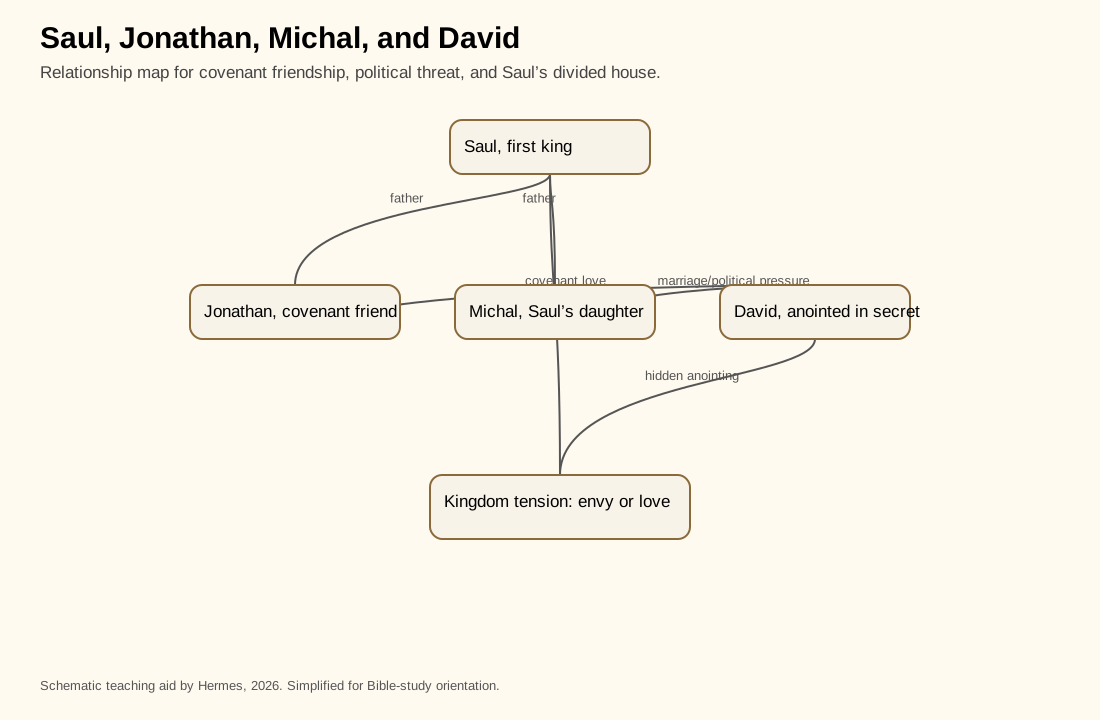 Teaching schematic based on the narrative relationships; not an ancient portrait or genealogy manuscript.
A son speaks for innocent blood (1 Samuel 19:1-7)
- And Saul spoke to Jonathan his son, and to all his servants, to slay David.
- And Jonathan, Saul’s son, loved David much: and Jonathan told David, saying, Saul seeks to kill thee: take heed to thyself therefore to-morrow morning, and hide thyself, and dwell in secret.
- And I will go forth, and stand near my father in the field where thou shalt be, and I will speak concerning thee to my father; and I will see what his answer may be, and I will tell thee.
- And Jonathan spoke favourably concerning David to Saul his father, and said to him, Let not the king sin against thy servant David, for he has not sinned against thee, and his deeds are very good.
- And he put his life in his hand, and smote the Philistine, and the Lord wrought a great deliverance; and all Israel saw, and rejoiced: why then dost thou sin against innocent blood, to slay David without a cause?
- And Saul hearkened to the voice of Jonathan; and Saul swore, saying, As the Lord lives, he shall not die.
- And Jonathan called David, and told him all these words; and Jonathan brought David in to Saul, and he was before him as in former times.
Saul’s command recruits both his son and his servants into murder. Jonathan refuses that invitation. First he warns David and arranges concealment; then he speaks to Saul about facts that Saul already knows. David has served faithfully, risked his life, and become the means of a deliverance wrought by the Lord. Jonathan’s question names the wrong precisely: killing him would be sin against innocent blood.
Intercession is neither flattery nor a family quarrel. Jonathan remains respectful enough to address his father as king while denying the king’s right to commit injustice. A Christian friend can imitate this joining of tenderness and truth: warn the endangered person, resist slander, and refuse to lend authority to harm.
Saul listens and swears that David will not die. Jonathan restores David to the court on the strength of that promise. The next verses will show why a spoken oath cannot by itself establish lasting safety. We can welcome a truthful promise while still looking for the changed conduct that should follow it.
The spear returns (1 Samuel 19:8-10)
- And there was again war against Saul; and David did valiantly, and fought against the Philistines, and smote them with a very great slaughter, and they fled from before him.
- And an evil spirit from God was upon Saul, and he was resting in his house, and a spear was in his hand, and David was playing on the harp with his hands.
- And Saul sought to smite David with the spear; and David withdrew suddenly from the presence of Saul; and he drove the spear into the wall; and David retreated and escaped.
David continues serving Israel in battle and Saul with music. His service does not cure Saul’s hostility. The spear in Saul’s hand and the harp in David’s hands bring the contrast into one room: David offers what once brought relief, and Saul turns again toward violence.
The phrase “an evil spirit from God” belongs to the narrative’s account of Saul under divine judgment. It does not make God morally evil, nor does it justify treating mental illness as guilt, demonic possession, or a prediction of violence. These verses give us Saul’s action and David’s escape, not a modern clinical diagnosis.
David withdraws. His refusal to strike back is compatible with decisive flight. Anyone facing abuse or threats may seek immediate safety and qualified help; prayer, forgiveness, and respect for another’s office do not require remaining within reach of the spear. Jonathan’s earlier hope has now met evidence that Saul’s promise did not hold.
A window opens in a watched house (1 Samuel 19:11-17)
- And it came to pass in that night, that Saul sent messengers to the house of David to watch him, in order to slay him in the morning; and Melchol David’s wife told him, saying, Unless thou save thy life this night, to-morrow thou shalt be slain.
- So Melchol lets David down by the window, and he departed, and fled, and escaped.
- And Melchol took images, and laid them on the bed, and she put the liver of a goat by his head, and covered them with clothes.
- And Saul sent messengers to take David; and they say that he is sick.
- And he sends to David, saying, Bring him to me on the bed, that I may slay him.
- And the messengers come, and, behold, the images were on the bed, and the goat’s liver at his head.
- And Saul said to Melchol, Why hast thou thus deceived me, and suffered my enemy to depart, and he has escaped? and Melchol said to Saul, He said, Let me go, and if not, I will slay thee.
Michal, called Melchol in Brenton, recognizes that delay will cost David his life. She lets him down through the window and delays the men sent to take him. Saul’s insistence that the supposedly sick David be brought on his bed shows how determined he is to kill. The rescue is concrete: a warning, an exit, and time gained for escape.
Brenton twice says “images” and “goat’s liver.” The Rahlfs-based Greek has the plural “kenotaphia” and “hēpar”, liver; NETS renders the former as a cenotaph, a memorial representation associated with a tomb. The Hebrew-based tradition instead speaks of “teraphim”, household images, and goats’ hair. These are different textual witnesses, not details to combine into one reconstructed prop. The Greek wording does not warrant a confident verdict about exactly how the disguise worked or what worship took place in David’s household.1
Michal’s claim that David threatened to kill her is her answer to Saul, not a threat independently narrated by the storyteller. Her escape strategy should neither turn David into a proven abuser on that evidence alone nor make every word spoken under fear into a model for ordinary truthfulness. The evident good is the preservation of a hunted life.
Psalm 59 (LXX Psalm 58) bears a title recalling Saul’s sending men to watch David’s house and kill him. The prayer takes danger seriously while turning toward God’s strength and mercy. It gives the endangered person words for fear without requiring a return to the dangerous house.2
The pursuers are stopped before Samuel (1 Samuel 19:18-24)
- So David fled, and escaped, and comes to Samuel to Armathaim, and tells him all that Saul had done to him: and Samuel and David went, and dwelt in Navath in Rama.
- And it was told Saul, saying, Behold, David is in Navath in Rama.
- And Saul sent messengers to take David, and they saw the assembly of the prophets, and Samuel stood as appointed over them; and the Spirit of God came upon the messengers of Saul, and they prophesy.
- And it was told Saul, and he sent other messengers, and they also prophesied: and Saul sent again a third set of messengers, and they also prophesied.
- And Saul was very angry, and went himself also to Armathaim, and he comes as far as the well of the threshing-floor that is in Sephi; and he asked and said, Where are Samuel and David? and they said, Behold, in Navath in Rama.
- And he went thence to Navath in Rama: and there came the Spirit of God upon him also, and he went on prophesying till he came to Navath in Rama.
- And he took off his clothes, and prophesied before them; and lay down naked all that day and all that night: therefore they said, Is Saul also among the prophets?
David tells Samuel what Saul has done. The account makes room for a harmed person to speak, seek shelter, and be believed. Samuel is present over the company of prophets, and three groups of messengers sent to capture David are overtaken by the Spirit and prophesy. Saul then comes himself, angry, but cannot carry his pursuit through on his own terms.
Saul’s stripping and prophesying expose the limits of his royal power. The Spirit interrupts him; the story does not announce that his hostility has been healed. The next chapter will disclose the continuing danger. Divine restraint and a person’s willing repentance are distinct, and a striking religious experience is no substitute for the latter.
At the same time, the text actually says that they prophesied. Saul’s subsequent wrongdoing does not entitle us to declare God’s action fraudulent. In the Church, spiritual gifts must be received with discernment and accompanied by humility, accountability, and repentance. A public gift never puts its bearer above examination or makes an endangered person obliged to trust him.
David’s deliverance prepares a Christian reader to recognize the persecuted anointed King. Christ too is hunted before His appointed hour, yet His saving work goes further: He freely gives His life rather than having it seized against His will. That fulfillment must not be used to require victims to make themselves available to violence.
Lesson Guide
- Key phrases: temporary conviction is not healed repentance; holy service does not guarantee safety.
- Emphasize: David is preserved without becoming vengeful.
- Avoid: telling abused or threatened people to stay in danger.
Friendship learns to hear the danger (1 Samuel 20:1-11)
- And David fled from Navath in Rama, and comes into the presence of Jonathan; and he said, What have I done, and what is my fault, and wherein have I sinned before thy father, that he seeks my life?
- And Jonathan said to him, Far be it from thee: thou shalt not die: behold, my father will not do any thing great or small without discovering it to me; and why should my father hide this matter from me? this thing is not so.
- And David answered Jonathan, and said, Thy father knows surely that I have found grace in thy sight, and he said, Let not Jonathan know this, lest he refuse his consent: but as the Lord lives and thy soul lives, as I said, the space is filled up between me and death.
- And Jonathan said to David, What does thy soul desire, and what shall I do for thee?
- And David said to Jonathan, Behold, to-morrow is the new moon, and I shall not on any account sit down to eat, but thou shalt let me go, and I will hide in the plain till the evening.
- And if thy father do in anywise enquire for me, then shalt thou say, David earnestly asked leave of me to run to Bethleem his city, for there is there a yearly sacrifice for all the family.
- If he shall say thus, Well, - all is safe for thy servant: but if he shall answer harshly to thee, know that evil is determined by him.
- And thou shalt deal mercifully with thy servant; for thou hast brought thy servant into a covenant of the Lord with thyself: and if there is iniquity in thy servant, slay me thyself; but why dost thou thus bring me to thy father?
- And Jonathan said, That be far from thee: for if I surely know that evil is determined by my father to come upon thee, although it should not be against thy cities, I will tell thee.
- And David said to Jonathan, Who can tell me if thy father should answer roughly?
- And Jonathan said to David, Go, and abide in the field. And they went out both into the field.
David’s opening questions insist on the distinction between guilt and being targeted. A persecutor’s determination does not prove that the hunted person has done wrong. Jonathan initially denies the danger: his father normally tells him everything, so he thinks the report impossible. The friendship is strong, but Jonathan’s knowledge is incomplete.
David explains why Saul could conceal the matter from his own son. Jonathan then asks what David needs and accepts a plan to test Saul’s response. His love becomes more truthful as he lets his friend’s testimony correct his confidence in his father. Jonathan begins with denial but does not remain there: covenant loyalty becomes more faithful by receiving truth.
David appeals to the “covenant of the Lord,” a pledged relationship accountable to God. His desperate offer that Jonathan himself should kill him if he is guilty is answered with refusal. It is not an instruction for distressed readers to harm themselves or submit to another’s violence.
The planned Bethlehem explanation conceals David’s actual hiding place. The story records a survival plan, not a blanket permission to invent falsehood for convenience. Nor should Jonathan’s test be turned into a demand that people facing credible threats first gather more proof, confront an abuser, or wait for a second attempt. Here love asks how it can help and protects David while the inquiry is made.
Mercy is pledged beyond the present crisis (1 Samuel 20:12-23)
- And Jonathan said to David, The Lord God of Israel knows that I will sound my father as I have an opportunity, three several times, and, behold, if good should be determined concerning David, and I do not send to thee to the field,
- God do so to Jonathan and more also: as I shall also report the evil to thee, and make it known to thee, and I will let thee go; and thou shalt depart in peace, and the Lord shall be with thee, as he was with my father.
- And if indeed I continue to live, then shalt thou deal mercifully with me; and if I indeed die,
- thou shalt not withdraw thy mercy from my house for ever: and if thou doest not, when the Lord cuts off the enemies of David each from the face of the earth,
- should it happen that the name of Jonathan be discovered by the house of David, then let the Lord seek out the enemies of David.
- And Jonathan swore yet again to David, because he loved the soul of him that loved him.
- And Jonathan said, To-morrow is the new moon, and thou wilt be enquired for, because thy seat will be observed as vacant.
- And thou shalt stay three days, and watch an opportunity, and shalt come to thy place where thou mayest hide thyself in the day of thy business, and thou shalt wait by that ergab.
- And I will shoot three arrows, aiming them at a mark.
- And behold, I will send a lad, saying, Go find me the arrow.
- If I should expressly say to the lad, The arrow is here, and on this side of thee, take it; then come, for it is well with thee, and there is no reason for fear, as the Lord lives: but if I should say thus to the young man, The arrow is on that side of thee, and beyond; go, for the Lord hath sent thee away.
- And as for the word which thou and I have spoken, behold, the Lord is witness between me and thee for ever.
Jonathan promises to report evil as well as good and to send David away in peace when necessary. His prayer that the Lord be with David as He was with Saul acknowledges that divine favor is not a family possession. Love can rejoice in God’s work beyond the place where we expected it to remain.
The request for mercy toward Jonathan and his house prevents the covenant from becoming a bargain for this week alone. He asks that future power remember a present friend. David’s later care for Jonathan’s son Mephibosheth, called Memphibosthe in Brenton’s 2 Samuel 9, gives that request a concrete sequel: remembered love becomes provision and a place at the king’s table.3
Verse 17 has a distinctive Greek shape. Brenton says that Jonathan “loved the soul of him that loved him”; the Rahlfs Greek and NETS also express reciprocal love. Hebrew-based translations commonly say that he loved David as his own soul. The displayed reading stresses the beloved as someone who also loves. Both belong to covenant affection, but the guide should not replace one wording with the other.1
The arrows make mercy practical. A word spoken to a boy can warn David without exposing him publicly. “The Lord hath sent thee away” joins providence to protective separation. Jonathan does not demand possession of his friend’s future or erase his own household’s needs; he seeks safety now and mercy for his family later.
Lesson Guide
- Key phrases: love seeks truth; covenant friendship costs status.
- Emphasize: Jonathan does not confuse loyalty with denial.
- Avoid: praising friendship that avoids hard truth.
At the table, succession becomes a weapon (1 Samuel 20:24-34)
- So David hides himself in the field, and the new month arrives, and the king comes to the table to eat.
- And he sat upon his seat as in former times, even on his seat by the wall, and he went before Jonathan; and Abenner sat on one side of Saul, and the place of David was empty.
- And Saul said nothing on that day, for he said, It seems to have fallen out that he is not clean, because he has not purified himself.
- And it came to pass on the morrow, on the second day of the month, that the place of David was empty; and Saul said to Jonathan his son, Why has not the son of Jessæ attended both yesterday and to-day at the table?
- And Jonathan answered Saul, and said to him, David asked leave of me to go as far as Bethleem his city;
- and he said, Let me go, I pray thee, for we have a family sacrifice in the city, and my brethren have sent for me; and now, if I have found grace in thine eyes, I will even go over and see my brethren: therefore he is not present at the table of the king.
- And Saul was exceedingly angry with Jonathan, and said to him, Thou son of traitorous damsels! for do I not know that thou art an accomplice with the son of Jessæ to thy shame, and to the shame of thy mother’s nakedness?
- For so long as the son of Jessæ lives upon the earth, thy kingdom shall not be established: now then send and take the young man, for he shall surely die.
- And Jonathan answered Saul, Why is he to die? what has he done?
- And Saul lifted up his spear against Jonathan to slay him: so Jonathan knew that this evil was determined on by his father to slay David.
- And Jonathan sprang up from the table in great anger, and did not eat bread on the second day of the month, for he grieved bitterly for David, because his father determined on mischief against him.
The empty seat brings David’s absence into view. Saul first supposes a matter of ritual uncleanness, then demands an explanation. The reference to purification belongs to Israel’s worship and meal customs; it is not evidence that holiness itself produces cruelty. The moral crisis is Saul’s decision to treat David’s life as expendable for a dynasty.
Saul humiliates Jonathan and shames his mother as he accuses him of being David’s accomplice. The insult is meant to make faithful friendship feel like disgrace. Its bodily language need not be elaborated into sexual spectacle. No parent, ruler, or church leader gains the right to shame a person’s family in order to secure obedience.
Jonathan asks the question that Saul cannot answer justly: “what has he done?” The spear is now raised against Saul’s own son. Jonathan knows that David’s report was true and leaves the table, angry and grieving. His grief is for David; his withdrawal resists the father’s wrongdoing. Holy love need not appear emotionally placid while innocent life is threatened.
Gems from the Fathers 💎
Saint John Chrysostom directly recalls Jonathan’s refusal to abandon David under Saul’s insults in Homily XXXIII on First Corinthians, section 2. He presents friendship with a fugitive as an honor rather than a disgrace. His point is the freedom of love from status anxiety, not an obligation to comply with every desire of a beloved person. He immediately gives that limit: “But when I say, all, do not suppose I mean things injurious also”.4 The warning belongs beside the praise. Love serves the person’s true good, so resisting harmful demands can be fidelity rather than betrayal.
The warning, the tears, and the peace (1 Samuel 20:35-42)
- And morning came, and Jonathan went out to the field, as he appointed to do for a signal to David, and a little boy was with him.
- And he said to the boy, Run, find me the arrows which I shoot: and the boy ran, and Jonathan shot an arrow, and sent it beyond him.
- And the boy came to the place where the arrow was which Jonathan shot; and Jonathan cried out after the lad, and said, The arrow is on that side of thee and beyond thee.
- And Jonathan cried out after his boy, saying, Make all speed, and stay not. And Jonathan’s boy gathered up the arrows, and brought the arrows to his master.
- And the boy knew nothing, only Jonathan and David knew.
- And Jonathan gave his weapons to his boy, and said to his boy, Go, enter into the city.
- And when the lad went in, then David arose from the argab, and fell upon his face, and did obeisance to him three times, and they kissed each other, and wept for each other, for a great while.
- And Jonathan said to David, Go in peace, and as we have both sworn in the name of the Lord, saying, The Lord shall be witness between me and thee, and between my seed and thy seed for ever - even so let it be.
Jonathan gives the agreed signal and urges haste. The boy knows nothing of the danger that the two friends understand. After he is sent away, David emerges and bows to Jonathan; the friends kiss and weep before parting. Their covenant survives a separation that their affection cannot prevent.
Brenton’s “for a great while” follows the Greek account of prolonged mutual weeping. The Hebrew-based reading often translated “until David exceeded” must not be imported here as a contest over which man wept more. The tears show grief, not a universal rule about how faithful people must display emotion. Some people weep openly; others grieve with few outward signs.1
“Go in peace” is possible because the Lord remains witness between them and their descendants. Peace does not mean that Saul has become safe. Love may tell the truth, protect life, and accept distance rather than insist on a reunion that would place the beloved at risk.
Christ’s words in John 15:12-15 give the Christian measure of friendship: He commands love after His own likeness and lays down His life for His friends. Jonathan’s costly protection is a real but partial resemblance. Christ freely accomplishes salvation; His words must never become pressure for compulsory self-erasure, concealment of abuse, or death-seeking. A friend who helps another stay alive is already acting against the logic of Saul’s spear.
Lesson Guide
- Key phrases: truth now requires separation; love without possession.
- Emphasize: farewell can be faithful.
- Avoid: making reconciliation mean physical closeness at all costs.
The text’s contrast What faithful love does Fulfillment and response in Christ Saul commands murder; Jonathan speaks of innocent blood Warns and intercedes Defends the endangered without sharing the persecutor’s hatred An oath fails; the spear returns Measures trust by conduct and protects life Joins forgiveness to discernment and safe boundaries Succession demands David’s removal; covenant asks enduring mercy Rejoices in another’s calling and remembers the household Receives Christ’s friendship and practices costly, truthful care The friends weep and part Keeps faith across distance Seeks peace without forcing unsafe proximity
Spiritual Fruit 🍇
- Confess envy before it commands others. When someone else’s gifts make you feel displaced, name the resentment in prayer and confession. Give thanks for one specific good God is doing through that person rather than feeding comparison.
- Let love become help. Jonathan warns, speaks, listens, and plans. Ask an isolated friend what is needed; offer a safe ride, a truthful witness, or contact with appropriate support rather than reassurance that dismisses danger.
- Allow facts to correct loyalty. A loved person’s office or relationship to you cannot settle every question. Listen without requiring a threatened person to prove worthiness for protection.
- Remember mercy beyond the farewell. Keep a promised responsibility when contact becomes difficult. Prayer, provision, and faithful remembrance can continue across distance, without demanding that unsafe relationships resume.
Lord, cleanse my love from possession. At the empty seat and in the field, teach me to hear the truth I would rather deny. Give me the courage to protect without controlling and to bless another’s calling without envy. Receive the grief that cannot yet speak, and keep Your peace between those who must part.
Teaching Notes
Whole-study care: Keep truthful friendship and the protection of life together. David’s flight is a legitimate act of protection. No discussion requires participants to disclose personal abuse, and immediate danger calls for immediate safety and appropriate help. The relationship schematic illustrates family pressure, not a rule that family loyalty outranks justice.
1 Samuel 19:1-7
- Ask: What facts does Jonathan bring to Saul, and why does he begin by warning David?
- Watch for: Equating respect for authority with participation in wrongdoing.
1 Samuel 19:8-10
- Ask: What changes in the meaning of Saul’s oath when the spear returns?
- Watch for: Treating service, forgiveness, or office as a guarantee of safety.
1 Samuel 19:11-17
- Ask: What is narrated about Michal’s rescue, and what is only her later claim?
- Watch for: Combining Greek liver and images with Hebrew hair and teraphim into one certain reconstruction.
1 Samuel 19:18-24
- Ask: How does the Spirit restrain Saul without the story announcing his repentance?
- Watch for: Making gifts proof of moral innocence or a reason to dismiss victims.
1 Samuel 20:1-11
- Ask: How does Jonathan move from initial denial toward practical help?
- Watch for: Requiring threatened people to conduct dangerous tests before receiving protection.
1 Samuel 20:12-23
- Ask: Why does Jonathan ask for mercy toward his household as well as David’s safety?
- Watch for: Turning costly friendship into compulsory self-erasure.
1 Samuel 20:24-34
- Ask: What does Jonathan’s question expose about Saul’s dynastic argument?
- Watch for: Expanding the insult into spectacle or confusing anger at injustice with hatred.
1 Samuel 20:35-42
- Ask: How can the friends part in peace while still grieving?
- Watch for: Making visible tears, physical closeness, or an unsafe reunion tests of faithfulness.
Sources
Embedded Scripture is from Brenton’s English Septuagint (LXX).
Brenton, 1 Samuel 19 and 20: 🔗 chapter 19, 🔗 chapter 20. The quoted range is complete: 19:1-24 and 20:1-42.
Rahlfs-based Greek and Bernard A. Taylor’s NETS 1 Reigns, for textual comparison, not as an interchangeable English edition: 🔗 Greek text, 🔗 NETS 1 Reigns.
John 7:30; 10:17-18; 15:12-15, NKJV, for Christ’s appointed hour, friendship, and freely offered life. No exact Coptic service appointment of these chapters is claimed.
Hebrew-based comparison, World English Bible, 1 Samuel 19:13,16; 20:17,41: 🔗 chapter 19, 🔗 chapter 20.
Footnotes
-
Rahlfs-based Greek, 1 Samuel 19:13,16; 20:17,41, compared with Taylor, NETS, the same verses: 🔗 Greek text, 🔗 NETS translation. ↩ ↩2 ↩3
-
Brenton, Psalm 58, title and concluding prayer, corresponding to Psalm 59 in Hebrew-based numbering: 🔗 Psalm 58. ↩
-
Brenton, 2 Samuel 9:1-13, especially the mercy shown for Jonathan’s sake and the table provision: 🔗 2 Samuel 9. ↩
-
Saint John Chrysostom, Homilies on First Corinthians, Homily XXXIII, section 2, NPNF First Series, volume 12, Oxford translation revised by Talbot W. Chambers: 🔗 homily on charity and Jonathan. ↩