


This narration is from a previous version of the study and may include a combined recording of multiple chapters.
“Come with us.” The invitation sounds like welcome before it speaks of blood. After the opening promise of wisdom, Proverbs places the soul between voices: father and mother offer instruction, sinners offer a common purse, and Wisdom calls openly at the gates. The decisive question is consent. Whose words are becoming the pattern of our life?
Historical and Scriptural Context
Proverbs 1:8-33 continues the opening instruction of the book. The setting is not a classroom but the moral life of a son being formed. Wisdom is passed through household instruction, then tested in public temptation, then proclaimed at the city gates. The passage moves from home to street to gate, showing that wisdom must govern both private formation and public life.
Scripturally, this passage belongs to the biblical pattern of two ways and two counsels. Psalm 1 warns against walking in the counsel of the ungodly. Deuteronomy sets life and death before Israel. Proverbs now gives the same choice in concrete form: do not consent to the way of sinners; listen when Wisdom calls.
Brenton Septuagint Note
Embedded Scripture is from Brenton’s English Septuagint (LXX). The inline numbers retain the Greek main text’s sequence, including its passage from verse 15 to verse 17.
| Passage | Brenton and the Hebrew-based KJV | Reading consequence |
|---|---|---|
| 1:9, 11-14 | KJV gives an “ornament of grace,” an ambush for the innocent, swallowing “as the grave,” and “one purse.” Brenton gives a crown, the just man hidden in the earth, Hades, and both a common purse and one pouch. | The Greek makes the promised honour, violent erasure, and counterfeit fellowship especially vivid. These are renderings and expansions, not a different moral command. |
| 1:16 | Brenton’s main text lacks the line; his note at 1:15 directs readers to the Appendix. KJV reads, “For their feet run to evil, and make haste to shed blood.” | This is a textual omission in the main Greek form, not a lost line to be silently supplied. The main reading is preserved below, without silently importing the Hebrew-based line. |
| 1:21-23 | KJV locates Wisdom at the chief concourses and city gates; the Greek also names walls and the gates of princes. KJV asks, “How long, ye simple ones, will ye love simplicity?” Brenton promises, “So long as the simple cleave to justice, they shall not be ashamed.” KJV’s “Turn you at my reproof: behold, I will pour out my spirit unto you” corresponds to the Greek’s reproof and “utterance of my breath.” | The Greek promise at 1:22 is genuinely different from the Hebrew question. The instruction remains urgent, while breath and speech give the promise its Greek form. The exact history behind these divergent readings is uncertain. |
| 1:27-32 | The Greek expands the descriptions of sudden ruin. KJV says the simple are killed by their “turning away”; Brenton says the wicked are slain “because they wronged the simple.” | The Greek explicitly judges harm done to vulnerable people; it is not permission to blame every sufferer for folly. |
| 1:33 | KJV has dwelling “safely”; Brenton has “confidence,” with the footnote “hope.” | The ending offers hope under God’s word, not a guarantee against every earthly loss. |
Brenton’s direction to the Appendix distinguishes his main reading from an alternative witness. The absent line resembles Isaiah 59:7, but resemblance alone cannot establish how the difference arose.
The first voice: faithful formation (Proverbs 1:8-9)
8 Hear, my son, the instruction of thy father, and reject not the rules of thy mother. 9 For thou shalt receive for thine head a crown of graces, and a chain of gold round thy neck.
Wisdom first comes through humble reception. “Hear” is not passive sound entering the ear. It means receive, obey, and let yourself be formed. The instruction of father and mother is pictured as beauty: a crown of graces and a chain of gold.
This matters because the soul often wants wisdom without submission. We want insight, but not instruction. We want discernment, but not correction. Proverbs begins with the ordinary holiness of being taught.
This is also why family life matters spiritually. The home is not a neutral place. It catechizes the heart. Children learn what is important not only from formal teaching, but from tone of voice, priorities, repentance, forgiveness, prayer, and what parents do when they are tired.
Honouring father and mother does not require consenting to wrongdoing or remaining exposed to abuse. The adornment belongs to faithful instruction. Where a household has wounded rather than protected, the Lord can give safe and truthful guidance through the Church and other trustworthy help. The command is a promise of formation, not a demand to call harm holy.
The second voice: sinful belonging (Proverbs 1:10-19)
10 My son, let not ungodly men lead thee astray, neither consent thou to them. 11 If they should exhort thee, saying, Come with us, partake in blood, and let us unjustly hide the just man in the earth: 12 and let us swallow him alive, as Hades would, and remove the memorial of him from the earth: 13 let us seize on his valuable property, and let us fill our houses with spoils: 14 but do thou cast in thy lot with us, and let us all provide a common purse, and let us have one pouch: 15 go not in the way with them, but turn aside thy foot from their paths: 17 for nets are not without cause spread for birds. 18 For they that are concerned in murder store up evils for themselves; and the overthrow of transgressors is evil. 19 These are the ways of all that perform lawless deeds; for by ungodliness they destroy their own life.
The temptation is not only violence. It is belonging. “Come with us.” “Cast in thy lot with us.” “Let us have one pouch.” Sin often offers communion without truth. It imitates fellowship while secretly teaching the soul to devour.
The passage exposes the lie of unjust gain. The wicked think they are storing up wealth, but they are storing up evil for themselves. They think they are removing the victim, but they are destroying their own life. This is one of Proverbs’ deepest patterns: sin is self-harm disguised as advantage.
The phrase “neither consent thou to them” is spiritually crucial. Temptation asks for agreement. The soul does not usually fall all at once. It first consents inwardly. It entertains the voice, imagines the gain, fears exclusion, and slowly calls darkness practical.
The net exposes the deceivers’ failure of sight. They have planned carefully for someone else’s loss and neglected the ruin gathering in their own life. That is why distance matters before the promise of gain becomes persuasive. Refusing a cruel circle early costs less than learning its language and then trying to forget it.
Wisdom cries publicly (Proverbs 1:20-23)
20 Wisdom sings aloud in passages, and in the broad places speaks boldly. 21 And she makes proclamation on the top of the walls, and sits by the gates of princes; and at the gates of the city boldly says, 22 So long as the simple cleave to justice, they shall not be ashamed: but the foolish being lovers of haughtiness, having become ungodly have hated knowledge, and are become subject to reproofs. 23 Behold, I will bring forth to you the utterance of my breath, and I will instruct you in my speech.
Wisdom is not hiding. She cries in the passages, broad places, walls, and gates. The problem is not that God leaves the soul without witness. The problem is that the soul learns to ignore the witness.
This public cry matters. Wisdom speaks in Scripture, conscience, confession, liturgy, parental formation, suffering, consequences, spiritual counsel, and sometimes through the wound of being exposed. The wise person recognizes the voice and turns. The foolish person treats reproof as an enemy.
The LXX phrase “utterance of my breath” is beautiful. Wisdom’s instruction is not dead information. It is breath and speech, living address. In Christian reading, we cannot help hearing an echo of the Spirit’s work, not because the verse is a simple proof-text, but because wisdom, breath, and instruction converge in the life-giving work of God.
The promise to the simple at verse 22 deserves its full weight. An unformed person can cleave to justice and be kept from shame. Wisdom’s public voice does not reserve hope for those with a polished past. It gives the still-teachable a place to stand.
Refused wisdom becomes judgment (Proverbs 1:24-33)
24 Since I called, and ye did not hearken; and I spoke at length, and ye gave no heed; 25 but ye set at nought my counsels, and disregarded my reproofs; 26 therefore I also will laugh at your destruction; and I will rejoice against you when ruin comes upon you: 27 yea when dismay suddenly comes upon you, and your overthrow shall arrive like a tempest; and when tribulation and distress shall come upon you, or when ruin shall come upon you. 28 For it shall be that when ye call upon me, I will not hearken to you: wicked men shall seek me, but shall not find me. 29 For they hated wisdom, and did not choose the word of the Lord: 30 neither would they attend to my counsels, but derided my reproofs. 31 Therefore shall they eat the fruits of their own way, and shall be filled with their own ungodliness. 32 For because they wronged the simple, they shall be slain; and an inquisition shall ruin the ungodly. 33 But he that hearkens to me shall dwell in confidence, and shall rest securely from all evil.
This is hard language. Wisdom laughs at destruction, not because God delights in human ruin, but because refused truth eventually exposes the absurdity of rebellion. The severity is medicinal before it is final: Wisdom wounds the illusion while repentance is still possible. The person who mocked correction discovers too late that correction was mercy.
The judgment here is not arbitrary. “They shall eat the fruits of their own way.” Sin ripens. Habits become character. Character becomes destiny. The soul that repeatedly refuses wisdom becomes less able to hear it.
This is why Proverbs speaks urgently. There is a time to turn. Reproof is painful, but it is safer than ruin. To be corrected while the heart is still soft is a gift.
The passage closes with hope: “he that hearkens to me shall dwell in confidence, and shall rest securely from all evil.” Biblical security is not the absence of all earthly trouble. It is the rest of a soul that is no longer ruled by the madness of sin.
This warning must never become permission to mock a sufferer. Neither illness nor disaster proves that a person rejected God, and a terrified penitent is not the hardened voice portrayed here. The urgent command is to hear the mercy offered now. Christ receives the one who comes to Him; the very desire to repent should be answered, not extinguished.
LXX Insight
The Greek “one pouch” exposes the attraction of a false communion. The invitation offers shared possessions before it reveals shared bloodguilt. Christian fellowship also shares goods, but to preserve the neighbour’s life; the conspirators share a purse to consume it. Belonging is judged by the good it serves.
The final word is more tender than its English “confidence” may suggest. Brenton’s note gives “hope,” which recalls Psalm 16:9 (LXX Psalm 15:9). Acts 2:26-31 receives that Psalm in the proclamation of Christ’s Resurrection. The proverb itself promises security to the hearer; read beside the apostolic Psalm, its hope reaches beyond immediate safety. Wisdom’s last word need not be the tomb into which the violent hoped to hide the just man.
Christological and Typological Reading
The literal warning concerns a conspiracy against an innocent person. Wisdom 2:12-20 supplies a canonical companion: the wicked resent the righteous man’s life and plan a shameful death for him. Acts 3:14 names Jesus as the Holy and Just One. These Scriptures, rather than an accusation against an ethnic people, illuminate the Christian hearing of Proverbs’ threatened just man.
Christ enters His Passion in sovereign, willing obedience. The conspirators do not gain mastery over Him; John 10:17-18 declares that He lays down His life and takes it again. Their design to erase the righteous is answered by the Resurrection. Every sinner who buys approval at the cost of another person’s dignity needs this judgment upon false fellowship, and every wounded person needs its promise that violence cannot have the last word.
Wisdom’s public cry also brings us before the Lord who taught openly and called people to repentance. His warning is mercy addressed to the living. A frightened penitent who longs to return should hear it as a reason to come now, not as a pronouncement that Christ has stopped receiving him.
Gems from the Fathers 💎
Clement of Alexandria addresses the fear that divine rebuke means God has ceased to love. In The Instructor I.8, he explains that the Word’s warnings seek a person’s release from error and captivity. His distinction is exact: “Now censure is a mark of good-will, not of ill-will. For both he who is a friend and he who is not, reproach; but the enemy does so in scorn, the friend in kindness.”1
This is a thematic help for the severity of Wisdom’s warning. The faithful hearer receives the call before the chosen road bears its bitter fruit. Clement’s account of God’s healing purpose never gives human beings permission to humiliate the wounded; a rebuke that protects the speaker’s pride while abandoning the neighbour has already lost the kindness he describes.
St. John Climacus likewise treats watchfulness as guarding the first movements of the heart.
The Church’s Voice in Worship ⛪
The following appointments distinguish the authority of each witness. CR means confirmed against retained Coptic Reader evidence; WS means a working Holy Pascha source; HIST means a historical or removed witness, not a current appointment.
- Wednesday of Pascha, Ninth Hour [CR]: Proverbs 1:11 to the end of the chapter, displayed as 1:11-35 in Coptic Reader. The biblical chapter ends at verse 33; there are no verses 34-35 to add here. Companions are Genesis 24:1-9, Numbers 20:1-13, Psalm 41:5-7 (LXX Psalm 40:6-8), and Matthew 26:3-16. Judas’ bargaining and the plot against Jesus expose the common purse of 1:13-14 in living action. The warning reaches every heart willing to exchange truth for advantage.
- Monday of the third week of Great Lent, Matins [CR]: Proverbs 1:20-33, with Isaiah 8:13-9:7, Psalm 32:1-2 (LXX Psalm 31:1-2), and Luke 19:11-28. The refusal of the king in Luke 19:14 gives a sharp echo of Wisdom’s rejected call. The Psalm’s blessing of forgiven sin also keeps the door of repentance before the hearer.
- Monday and Tuesday of Pascha, Ninth Hour [WS]: Proverbs 1:1-9. Verses 8-9 close that reading. Monday has Genesis 2:15-3:24; Tuesday has Genesis 6:5-9:7; both include Isaiah 40:1-5 and Matthew 21:23-27. Household instruction belongs with the large question of hearing God’s authority.
A former Wednesday Ninth Hour candidate, Proverbs 1:10-33, survives as [HIST] only. It is not the current Reader label.
Iconography Connection 🖼️
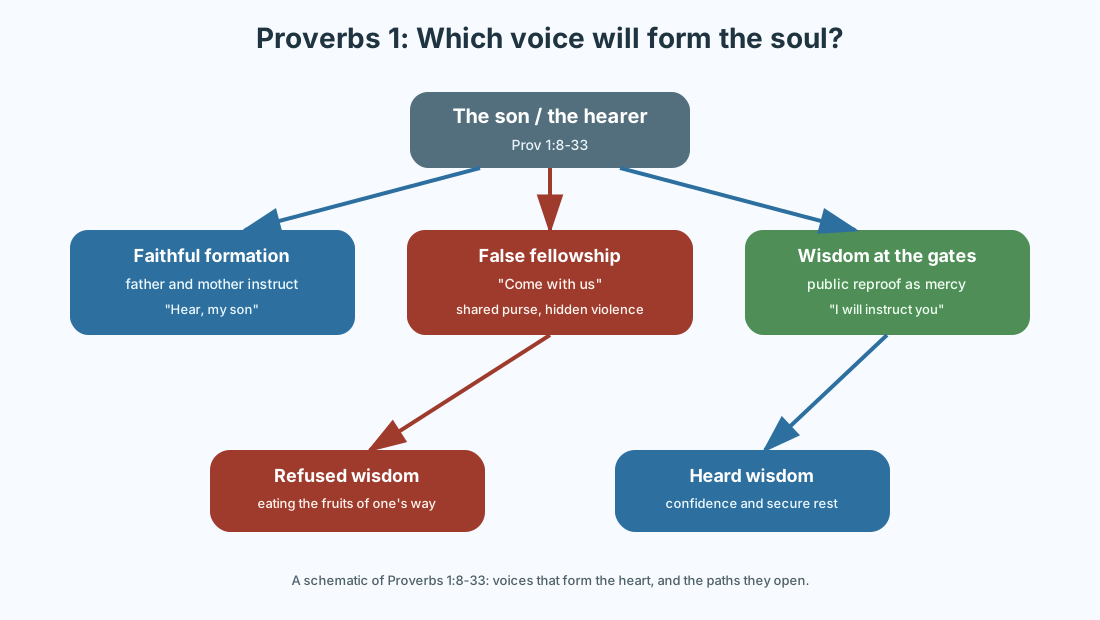
Two voices and two ways: household instruction, sinful persuasion, and Wisdom’s public call in Proverbs 1:8-33. Biblical schematic, not historical artwork or an icon.
The contrast is one of consent. Wisdom’s voice gives life to the hearer and the neighbour; the common purse binds people together by harm. An icon of Christ teaching gives this moral choice its Christian centre without turning poetic Wisdom into an independent goddess.
Spiritual Fruit 🍇
Name the fellowship you are purchasing. The words “Come with us” become dangerous when belonging requires contempt for someone else. Notice the conversation, message thread, or shared grievance that asks you to surrender truth to remain welcome. Refuse the next cruel remark without performing your own righteousness. A quiet departure can be an act of love for everyone involved.
Interrupt consent while it is still small. A first temptation is not yet the same as a chosen act. The danger grows when we begin rehearsing its defence. Stop the inward speech that calls dishonesty necessary or gossip concern, and bring the matter to prayer or trusted counsel before the explanation becomes a habit.
Receive Wisdom’s reproof as a call, not a verdict of hopelessness. Verses 24-31 describe the terrible harvest of refusal. If these words grieve you and make you long to return, answer that longing today. Christ’s mercy is not exhausted because the habit is old. Repentance begins by ceasing to bargain with what He has already exposed.
Protect the simple. In Greek 1:32, judgment falls on those who wrong them. Take particular care with a younger person’s trust, an employee’s dependence, a child’s need for belonging, or a friend’s confusion. Wisdom is measured partly by whether the vulnerable become safer around us.
Wisdom is still speaking at the gate. The purse that promised security cannot buy hope, but the Lord who was laid in the earth has risen. Turn toward His voice without waiting for a less complicated day. The next truthful word can already be the beginning of a different road.
Teaching Focus
False fellowship purchases belonging through harm. Read the warnings as calls to repentance and the conclusion as hope, never as permission to mock suffering.
Teaching Notes
The first voice: faithful formation (Proverbs 1:8-9)
- Ask: Why is instruction pictured as an adornment?
- Emphasize: Both father and mother share in faithful formation.
- Watch for: Parents’ authority cannot require participation in harm or sin.
- Connect: The WS reading of 1:1-9 bridges household teaching and the prologue.
The second voice: sinful belonging (Proverbs 1:10-19)
- Ask: What makes the common purse a counterfeit of fellowship?
- Emphasize: Consent can begin with the wish to belong.
- Watch for: Do not narrow the warning to obvious criminals or accuse an ethnic people.
- Connect: Wisdom 2:12-20 and the Pascha Gospel, Matthew 26:3-16.
Wisdom cries publicly (Proverbs 1:20-23)
- Ask: What does the Greek promise to the simple change about our hearing?
- Emphasize: Wisdom speaks openly and offers instruction.
- Watch for: Differentiate an involuntary thought from chosen agreement.
- Connect: The Spirit’s life-giving work without turning one poetic phrase into a proof-text.
Refused wisdom becomes judgment (Proverbs 1:24-33)
- Ask: What is the fruit of a repeatedly refused reproof?
- Emphasize: The conclusion offers hope to the hearer.
- Watch for: Do not tell a penitent that the desire to return has come too late.
- Connect: Psalm 16:9 (LXX Psalm 15:9), Acts 2:26-31, and the CR Lenten Gospel.
Single-session plan
Allow 55 minutes: 5 for the two voices and the numbering note, 8 for verses 8-9, 12 for verses 10-19, 10 for verses 20-23, 12 for verses 24-33, and 8 for the Pascha companions and a concrete response. Use the two-voices schematic to keep consent visible. Ground the Passion reading in Wisdom 2 and Acts 3, never in ethnic blame. The diagram is a schematic, not an icon.
Glossary
- Consent: The inward agreement of the will before outward action.
- Reproof: Corrective instruction. In Proverbs, reproof is a form of mercy when received humbly.
- Hades: The domain of death. In this passage it is used as an image of violent swallowing and erasure.
- Pascha: Holy Week and the Feast of Resurrection in Orthodox usage; in the Coptic Church, Pascha readings are arranged by day and hour.
- Wisdom personified: A poetic presentation of Wisdom as a woman calling publicly; Christian reading sees its fullness in Christ, the Wisdom of God, without flattening the poetry.
Translation and Source Notes
Embedded Scripture is from Brenton’s English Septuagint (LXX). Comparison wording is from the King James Version, a Hebrew-based English translation. The Brenton note distinguishes the main text, its footnotes, and alternative readings. New Testament connections interpret Proverbs within the Christian canon rather than replacing its literal counsel.
Clement’s discussion of divine reproof illuminates this passage thematically. The Christological argument rests on the biblical passages named above.
Sources
Biblical connections and patristic works are cited at the point of use.
Coptic readings: the Holy Pascha, Katameros, and retained Coptic Reader witnesses, with authority distinguished in the worship section.
St. John Climacus, The Ladder of Divine Ascent, ascetical teaching on discernment and watchfulness.
Footnotes
-
Clement of Alexandria, The Instructor I.8, ANF 2, translated by William Wilson. Containing text. ↩