


Previous-version recording covering the original combined study; the text below has been revised and split.
A soft tongue breaks bones. An enemy’s hunger becomes a claim upon our bread. A city loses its defenses when a person acts without counsel. Proverbs 25 teaches a strength that the hurried and resentful heart easily mistakes for weakness. It begins with sayings faithfully handed on and ends with the need to receive counsel ourselves. In between, wisdom becomes a word fitted to its hearer, a friendship that honors measure, and mercy offered without the secret wish to wound.
Historical and Scriptural Context
The heading names Solomon and the friends of Ezekias, the Greek form of Hezekiah, king of Judah. Their copying gives a later generation access to instruction already received. The chapter therefore concerns both the preservation of wisdom and the humility required to live by it.
Court, friend’s house, harvest, wounded body, and city wall give the sayings their settings. Public honor is tested by restraint; private friendship is tested by truthful speech and proportion. Romans 12:20 directly receives the enemy-feeding command, while Luke 14:7-11 takes up the wisdom of receiving a place rather than seizing it.
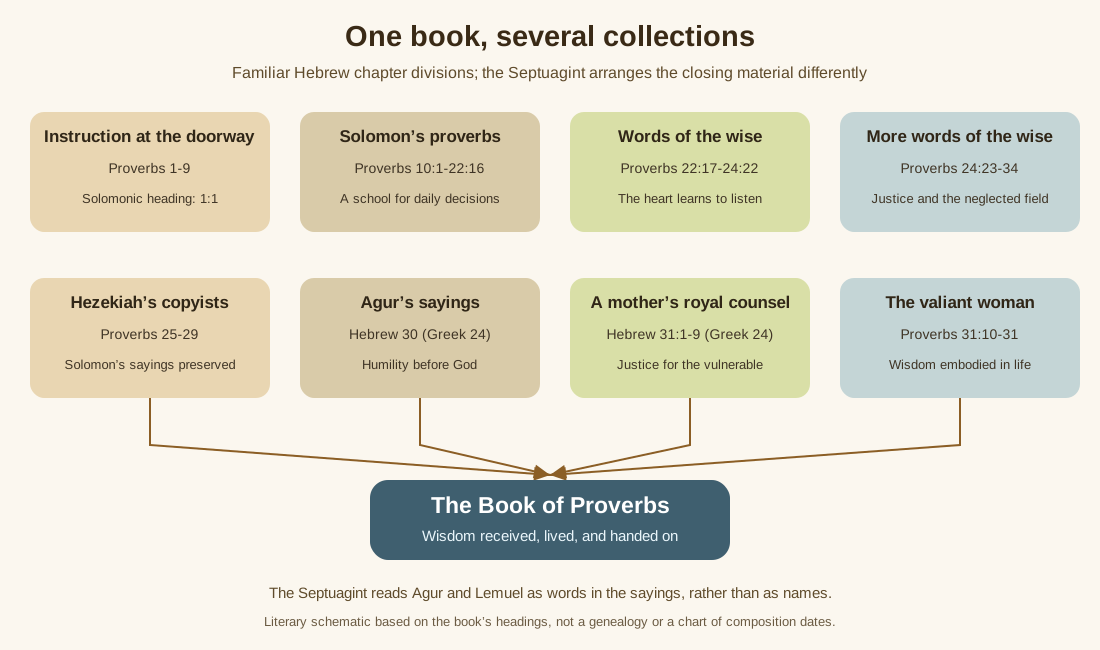
The collections of Proverbs and the transmission of Solomon’s sayings, including their preservation under Hezekiah. This is a literary diagram, not a family tree.
Brenton Septuagint Note
Brenton’s heading at 25:1 calls these Solomon’s “miscellaneous instructions.” His footnote offers another possibility: “genuine,” or beyond doubt. The alternative supports confidence in the sayings being preserved, but it remains Brenton’s proposed sense, not a second heading to insert into Scripture.
The additions 25:10a, on favor and friendship, and 25:20a, on grief eating inwardly like moth and worm, have no Hebrew counterparts here. They are separately numbered below.
| Passage | Brenton | Hebrew-based KJV |
|---|---|---|
| 25:2 | A king’s glory honors business. | A king’s honor searches out a matter. |
| 25:7-10 | Speak of what the eyes have seen; withdraw when a friend reproaches; enmity can become like death. | The prince is the one seen; debate with the neighbor and do not disclose a secret to another. The clauses are joined differently. |
| 25:11-12 | A golden apple and sardius set with gold. | Golden apples in silver settings, then a golden earring and wise reproof. |
| 25:14 | Winds, clouds, and rains are conspicuous, like boasting of a false gift. | The boaster is compared to wind and clouds without rain. The Greek does not print the absence of rain. |
| 25:19 | The wicked way and transgressor’s foot perish in trouble. | Trust in an unfaithful person is like a broken tooth or a foot out of joint. |
| 25:20 | Vinegar upon a sore and bodily trouble afflict the heart. | Removing a garment in cold weather and vinegar upon nitre picture songs sung to a heavy heart. |
| 25:23 | North wind raises clouds; an impudent face provokes the tongue. | “The north wind driveth away rain: so doth an angry countenance a backbiting tongue.” |
| 25:27 | Honor venerable sayings. | Searching one’s own glory is not glory. |
| 25:28 | The defenseless city pictures someone acting without counsel. | It pictures someone with no rule over his own spirit. |
These are differences between Greek and Hebrew formulations. Their individual causes are not established by comparing the English alone. Counsel and self-rule can illuminate one another, but the Greek ending must not be silently replaced by the Hebrew.
Hidden matters, royal humility, and quarrels that turn to death (Proverbs 25:1-10)
1 These are the miscellaneous instructions of Solomon, which the friends of Ezekias king of Judea copied out. 2 The glory of God conceals a matter: but the glory of a king honours business. 3 Heaven is high, and earth is deep, and a king’s heart is unsearchable. 4 Beat the drossy silver, and it shall be made entirely pure. 5 Slay the ungodly from before the king, and his throne shall prosper in righteousness. 6 Be not boastful in the presence of the king, and remain not in the places of princes; 7 for it is better for thee that it should be said, Come up to me, than that one should humble thee in the presence of the prince; speak of that which thine eyes have seen. 8 Get not suddenly into a quarrel, lest thou repent at last. 9 Whenever thy friend shall reproach thee, retreat backward, despise him not; 10 lest thy friend continue to reproach thee, so thy quarrel and enmity shall not depart, but shall be to thee like death. 10a Favour and friendship set a man free, which do thou keep for thyself, lest thou be made liable to reproach; but take heed to thy ways peaceably.
The Hezekian heading matters more than a historical footnote. Wisdom is not only spoken once. It is preserved, copied, tested, and handed on. The friends of Hezekiah are doing the work of faithful memory: rescuing Solomon’s instruction from neglect so that a later generation can still be formed by it. That belongs naturally to Orthodox life. Tradition is not stale repetition. It is living stewardship of words that still judge and heal the heart.
Verse 2 draws the theological center of the opening unit. “The glory of God conceals a matter” does not mean God is evasive. It means divine mystery is not conquered by curiosity. The king’s glory honors the business entrusted to him: human office must take visible affairs seriously and render truthful judgment. God’s glory is deeper. He gives enough light for obedience, but He is never reduced to material for control. Proverbs therefore begins this royal section by humbling both the ruler and the reader.
Verses 4-5 bind purification to rule. Dross must be beaten from silver before beauty appears. Wicked counsel must be removed from before the king before the throne prospers in righteousness. The ancient royal command in verse 5 is not a commission to Christians to kill opponents or impose belief by force. It is a warning that authority rots when corrupt influences are protected near its center. The same pattern governs the inner kingdom of the heart. If vanity, resentment, lust, or ambition sit beside the throne, outward discipline will not make the soul righteous.
Verses 6-7 strike at religious and social self-installation. It is better to be summoned upward than to push into a place and be publicly humbled. Christ receives this wisdom directly in Luke 14. The point is not etiquette. It is the death of the self that needs to be seen. A servant can seek importance in a role before learning to serve the Lord within it.
Verses 8-10 move from royal presence to quarrel. “Get not suddenly into a quarrel” is a precise warning against the adrenaline of being right. Brenton’s ending is unusually strong: quarrel and enmity can become “like death.” The opening Greek addition, 10a, offers the alternative: favor and friendship can release a person from the contest that wounded pride insists on continuing.
Christ is the true King who does not seize glory in the fallen way. He receives humiliation without losing truth. He knows what to answer and when to remain silent. In Him, humility is not social technique. It is royal holiness.
Wise words, measured sweetness, and the wounds of falsehood (Proverbs 25:11-20)
11 As a golden apple in a necklace of sardius, so is it to speak a wise word. 12 In an ear-ring of gold a precious sardius is also set; so is a wise word to an obedient ear. 13 As a fall of snow in the time of harvest is good against heat, so a faithful messenger refreshes those that send him; for he helps the souls of his employers. 14 As winds and clouds and rains are most evident objects, so is he that boasts of a false gift. 15 In long-suffering is prosperity to kings, and a soft tongue breaks the bones. 16 Having found honey, eat only what is enough, lest haply thou be filled, and vomit it up. 17 Enter sparingly into thy friend’s house, lest he be satiated with thy company, and hate thee. 18 As a club, and a dagger, and a pointed arrow, so also is a man who bears false witness against his friend. 19 The way of the wicked and the foot of the transgressor shall perish in an evil day. 20 As vinegar is bad for a sore, so trouble befalling the body afflicts the heart. 20a As a moth in a garment, and a worm in wood, so the grief of a man hurts the heart.
This unit is about fittingness. The images are deliberately beautiful at first: a golden apple, sardius, a refreshing fall of snow in harvest. Proverbs is teaching that speech has a moral shape and an aesthetic shape. A true word can still be ugly if it is badly timed, badly placed, or offered to an ear that refuses obedience. A wise word is not only accurate. It is fitted.
Verses 11-12 join the word and the listener. The wise word is beautiful “to an obedient ear.” That means receptivity is part of wisdom. Many people want wise words as decoration, ammunition, or confirmation. Proverbs wants an ear that can be instructed. The same sentence that heals a teachable soul may harden a proud one.
Verse 13 praises the faithful messenger because fidelity refreshes souls. Brenton says he “helps the souls of his employers.” This is more than efficient communication. A trustworthy messenger cools heat because he does not distort the word, insert himself into the message, or turn another person’s business into his own stage. In church life, family life, and ministry, this is a major spiritual discipline: carry the word faithfully, and do not make yourself the center of what you were entrusted to carry.
Verse 14 exposes the false gift. Brenton compares the boast to the conspicuousness of winds, clouds, and rains. The Hebrew makes the failed promise explicit by naming clouds without rain; the Greek stresses the display. False generosity is spiritually cruel because it awakens hope without intending mercy. It is the social form of vanity. Promise only what you can give, and then give it. The disappointed person bears the cost when our generosity exists chiefly in our own speech.
Verse 15 is one of Scripture’s great sayings on spiritual speech: “a soft tongue breaks the bones.” That is not softness as cowardice. It is meek strength. Hard bones can sometimes be moved only by a tongue that refused rage.
Verses 16-17 teach proportion through honey and friendship. Honey is good, but excess makes sweetness disgusting. A friend’s house is good, but unmeasured presence can turn nearness into burden. Proverbs is not making relationships cold. It is teaching chastity of presence. Even love must learn measure so that the other person is not consumed by our need to be near, needed, affirmed, or entertained.
Verse 18 then turns speech into weaponry. False witness is not harmless talk. It is club, dagger, and arrow. When the tongue abandons truth, it does not become neutral. It becomes armed.
Verse 20 closes the unit by moving from words to interior grief. Vinegar on a sore, moth in a garment, worm in wood: sorrow can eat inwardly. Proverbs knows that words and wounds do not vanish when the conversation ends. Christ speaks every word fittingly. He is sweet without indulgence, truthful without cruelty, and present without intrusion. In Him, speech becomes medicine rather than acid on an open sore.
Feeding enemies, guarded walls, and the government of the heart (Proverbs 25:21-28)
21 If thine enemy hunger, feed him; if he thirst, give him drink; 22 for so doing thou shalt heap coals of fire upon his head, and the Lord shall reward thee with good. 23 The north wind raises clouds; so an impudent face provokes the tongue. 24 It is better to dwell on a corner of the roof, than with a railing woman in an open house. 25 As cold water is agreeable to a thirsting soul, so is a good message from a land far off. 26 As if one should stop a well, and corrupt a spring of water, so is it unseemly for a righteous man to fall before an ungodly man. 27 It is not good to eat much honey; but it is right to honour venerable sayings. 28 As a city whose walls are broken down, and which is unfortified, so is a man who does anything without counsel.
Verses 21-22 are among the boldest moral commands in Proverbs: feed the enemy. This is not sentimentality. It is a refusal to let hatred become the soul’s government. St. Paul receives the verses directly in Romans 12:20, placing them inside the command to overcome evil with good. The hungry enemy has a bodily need that remains real even while our heart rehearses the injury. The command makes mercy concrete: bread, water, and the refusal to use need as leverage.
The “coals of fire” are not permission to perform kindness as disguised revenge. The point is not, “be nice so God can burn him later.” Mercy becomes a burning witness. It may soften the enemy into repentance, or it may expose the hardness that refuses mercy. Either way, the merciful person is rewarded because he refused to become an image of the injury.
Verse 23 is easy to miss. The north wind raises clouds, and an impudent face provokes the tongue. Some faces invite speech before any words are spoken. Proverbs is teaching that contempt has a liturgy: posture, face, tone, and glance can all summon conflict. The spiritual life therefore requires repentance not only for what the mouth says, but for what the face has already preached.
Verse 24 needs the same pastoral care earlier hard household sayings required. Proverbs is not teaching contempt for women. It is condemning the railing, contentious spirit that can turn shared life into exile. The same spiritual truth applies to men and women alike. A house becomes uninhabitable when speech is weaponized. A roof corner becomes preferable when the home has become a theater of accusation.
Verse 25 turns the tone. A good message from afar is like cold water to a thirsty soul. Hope and truth can refresh without flattery. That image belongs not only to ordinary friendship but to the Gospel itself, the glad message brought into a dry land.
Verse 26 warns that when the righteous collapse before the ungodly, the spring is corrupted. Brenton’s image is concrete: stopping a well and corrupting a spring. Private surrender has public consequence. If a righteous person yields truth, courage, or self-command before evil pressure, others lose water with him. This is not a call to swagger. It is a call to guard the spring.
Verse 27 balances the honey image with honor for venerable sayings. The soul must learn what to consume sparingly and what to honor deeply. Sweetness can become excess, but wisdom handed down through the saints deserves reverence.
Verse 28 closes the chapter with the governing image: a city without walls. The Greek names acting “without counsel,” whereas the Hebrew names lack of rule over one’s own spirit. The two readings belong together without being interchangeable. Counsel can interrupt the passion that feels like a command: show the message to a wise person before sending it; name the spending decision before committing to it; receive correction before defending yourself. A second truthful voice can become a repaired gate.
Christ prays for His enemies from the Cross. The Lord who commands us to give bread shows mercy while receiving their violence. He keeps the walls of holiness intact without becoming hard. He is the well that cannot be corrupted and the city that stands.
Enemy-love need not restore trust before repentance has borne fruit. Food can be sent through another person; a boundary can remain firm; criminal conduct can be reported. The command releases hatred without surrendering the neighbor to further harm.
LXX Insight
The city without walls in Brenton 25:28 is the person who acts without counsel. That is sharper than a general appeal to try harder at self-control. Passion often becomes most dangerous when it persuades us that no other voice is needed. Counsel gives truth an entrance before impulse carries the decision out. Receiving it repairs a gate.
The two Greek additions also widen the chapter’s account of friendship. Favor can set someone free from a quarrel, while grief can eat inwardly long after a conversation ends. A fitting word therefore takes account of a real hearer. It does not demand that grief disappear so the speaker can feel successful.
Christological and Typological Reading
Christ receives the low place willingly, without surrendering His lordship. The Gospel pattern of humility is therefore deeper than a strategy for promotion. We can let another person be honored because our life is held by Him, not secured by being seen.
The command to feed an enemy is fulfilled in the Lord’s freely offered love for sinners. At the Supper He washes the disciples’ feet while knowing the betrayal already at work (John 13:2-11). The hands that hold all things stoop to cleanse. His action does not call betrayal good; it shows that another person’s evil cannot force His love to become evil.
Romans 12:20-21 receives Proverbs 25:21-22 within the command to overcome evil with good. The good must remain good. Giving bread to purchase the pleasure of later punishment would keep the grudge alive beneath a pious act.
Gems from the Fathers 💎
St. John Chrysostom puts speech under the neighbor’s welfare, not the speaker’s appetite for victory: “It is for this that you have speech, it is for this you have a mouth and a tongue, that you may correct your neighbor.”1 His point in Homily 18 on Ephesians is that genuine care cannot simply watch another person go toward ruin. Beside Proverbs 25:18, the contrast is searching: the mouth made to help can become a club, dagger, or arrow.
On Romans 12:20-21, Chrysostom also directly addresses the danger of secretly vengeful kindness. Paul discourages the punitive intention, because “cherishing a grudge still would be being overcome of evil.”2 Mercy should deliver the giver from hatred as well as relieve the hungry person.
Palladius records an Egyptian example in the life of St. Moses the Ethiopian. Four robbers entered his cell. Moses restrained them and carried them to the brethren, asking, “Since I am not allowed to hurt anyone, what do you bid me do with these?”3 In the narrative they recognize the former robber, confess their sins, glorify God, and renounce the world. Repentance has changed what Moses does with his strength. He prevents harm without treating the attackers as people whose salvation no longer matters.
The Church’s Voice in Worship ⛪
No reading from Proverbs 25 appears in the Coptic lectionary data used for this site.
The Coptic Lakkan, the Liturgy of the Waters on Covenant Thursday, supplies a related service rather than a reading of this chapter. Its reference-tier evidence [REF] pairs Proverbs 9:1-11 with John 13:1-17, the washing of the feet. That Gospel action illuminates the enemy-feeding command: divine strength stoops to serve even within the company where betrayal is present. This is a connection through the companion Gospel, not an assignment of Proverbs 25 to the rite.
Approaching the Mysteries calls the heart away from double speech. We can receive mercy while admitting that a grudge remains to be healed. The point is neither to pretend forgiveness complete nor to make Communion a badge that excuses refusing it.
Iconography Connection 🖼️
The Washing of the Feet belongs naturally beside 25:21-22. John 13 makes the Lord’s knowledge of betrayal explicit while showing His humble service. His kneeling is sovereign love in action, not the helplessness of someone unable to resist. The image keeps mercy concrete: a basin, cleansing, and the Lord’s example. It does not require a victim to abandon safety or entrust himself again to an unrepentant aggressor.
Spiritual Fruit 🍇
Receive a place without making it a measure of your worth. Let someone else be recognized in a setting where you usually need to be noticed. Offer a hidden service to the Lord and resist announcing it afterward.
Fit the word to the hearer. Before advising someone in grief, listen long enough to understand what hurts. A true sentence can still be used impatiently. Ask whether your words relieve a burden or chiefly relieve your discomfort at being unable to fix it.
Give mercy without keeping the coal for yourself. If an enemy is in need, choose a safe and honest way to help. Do not rehearse how the kindness will shame him. Pray for his repentance and your own freedom from the wish to watch him suffer.
Repair one gate with counsel. Bring an impulsive decision to someone truthful before acting. State the detail most likely to weaken your case; otherwise you may be asking for permission rather than counsel.
The chapter ends with a city still capable of being guarded. You need not become hard to be safe, or gullible to be merciful. Ask Christ for the freedom to receive correction and the strength to give bread. His wisdom can make the same heart both open to love and unwilling to surrender to deceit.
Teaching Focus
Fitting speech and enemy-love require truthful counsel. Teach the Greek city image before joining it to the Hebrew emphasis on self-rule.
Teaching Notes
Hidden matters, royal humility, and quarrels that turn to death (Proverbs 25:1-10)
- Ask: What is preserved when wisdom is copied, and what humility is required to receive it?
- Emphasize: Brenton’s alternate “genuine” is a proposed sense, not a certainty.
- Watch for: Sanctifying the ancient execution command or making humility a technique for promotion.
- Connect: Luke 14 receives the contrast between seizing and receiving a place.
Wise words, measured sweetness, and the wounds of falsehood (Proverbs 25:11-20)
- Ask: When can a true word be poorly fitted to a grieving person?
- Emphasize: Linger at the inward grief of 20a; the false-gift weather image differs from the Hebrew.
- Watch for: Teaching no rain where Brenton prints rains, or turning counsel into intrusive advice.
- Connect: Christ’s truthful speech serves the hearer’s welfare.
Feeding enemies, guarded walls, and the government of the heart (Proverbs 25:21-28)
- Ask: How can kindness become revenge in religious clothing?
- Emphasize: Mercy can coexist with protective boundaries and truthful reporting.
- Watch for: Treating the Hebrew self-rule saying as the exact Greek wording, or using verse 24 against women.
- Connect: Romans 12, the Washing of the Feet, and Moses’ changed use of strength.
Single-session plan
60 minutes: heading, diagram, and textual differences, 10; 25:1-10a, 10; 25:11-20a, 15; 25:21-28 with Chrysostom and Moses, 18; counsel practice and prayer, 7. Show the collection diagram as literary transmission, not a genealogy. Give the grief image room before discussing advice. Preserve the distinction between a related Lakkan Gospel and a Proverbs 25 reading.
Glossary
- Ezekias: The Greek form of Hezekiah.
- Sardius: A precious reddish stone in the chapter’s jewelry images.
- Long-suffering: Patience that refuses to make anger its guide.
- Coals of fire: The proverb’s searching image accompanying enemy-love, never permission to nurse revenge.
- Counsel: Truthful guidance received before acting.
- Lakkan: A Coptic service of the waters, including the Covenant Thursday rite.
Translation and Source Notes
Embedded Scripture is from Brenton’s English Septuagint (LXX). Hebrew-based comparisons use the KJV. The comparison identifies differences in the witnesses; it does not by itself establish whether a particular difference arose in the translator’s Hebrew manuscript or in translation. The lettered Greek additions 10a and 20a are printed separately. The Lakkan connection uses reference-tier [REF] evidence for Proverbs 9 and John 13, not a direct reading of chapter 25. Palladius is read in Clarke’s 1918 translation; the narrative is his account rather than a new inference about every robber’s later life.
Sources
- Proverbs 25, Brenton’s English Septuagint.
- Proverbs 25, KJV, for the Hebrew-based comparisons.
- Luke 14:7-11; John 13:1-17; Romans 12:17-21.
- St. John Chrysostom, Homily 18 on Ephesians and Homily 22 on Romans, cited above.
- Palladius, Lausiac History XIX.3-4, cited above.
- Coptic lectionary and Lakkan reference-tier evidence, @andraws/lectionary-data 1.3.3.
Footnotes
-
St. John Chrysostom, Homily 18 on Ephesians, concluding moral exhortation on Ephesians 5:11, Gross Alexander translation, NPNF, First Series, vol. 13. Primary text. ↩
-
St. John Chrysostom, Homily 22 on Romans, on Romans 12:20-21, NPNF, First Series, vol. 11. Primary text. ↩
-
Palladius, Lausiac History XIX.3-4, W. K. Lowther Clarke translation (1918), pp. 87-88. Primary text. ↩