


This narration is from a previous version of the study and may include a combined recording of multiple chapters.
At the end of Proverbs, a mother tells a king what his power is for, and a woman’s open hands show what wisdom looks like. Neither voice can be dismissed as a private concern. The king must keep his judgment clear because the poor depend upon it; the household’s strength is proved by its generosity. The closing poem then gives the woman a voice of her own. In Brenton’s Greek reading, she is blessed and becomes the one who praises the fear of the Lord. The book’s first lesson has become a life that can give it praise.
Historical and Scriptural Context
The familiar chapter brings together two literary units: a mother’s royal instruction in 31:1-9 and a poem praising the capable, valiant woman in 31:10-31. The Hebrew poem is an alphabetic acrostic: each successive verse begins with the next letter of the Hebrew alphabet. The Greek does not preserve that alphabetical form, but retains the expansive portrait of work, trust, speech, strength, and mercy.
Brenton places the royal instruction at 24:54-62 and begins his chapter 31 at verse 10. The familiar references below keep the two units together while giving the actual Brenton coordinates. The court, marketplace, field, and household belong to one moral world. Wisdom must be heard where power judges and practiced where bread is made.
Lemuel and his mother. Hebrew names King Lemuel, whose identity is not securely established. The name is commonly understood as “belonging to God”; the Greek renders the heading in relation to God instead of preserving the name, and gives “oracular answer” where the KJV has “prophecy.” His mother remains the teacher. We do not need to identify her as a famous biblical queen to recognize the force of the scene: even the king must listen.1
The valiant woman. She is the poem’s active subject, making decisions, buying a field, trading, feeding, giving, and speaking. Her household includes servants, and her work belongs to an ancient household economy rather than one narrow modern arrangement. The praise must honor her agency without becoming a standard by which exhausted women are judged or men excuse their own failure to serve.
Brenton Septuagint Note
The primary references are the familiar Proverbs 31 numbers. 31:1-9 corresponds to Brenton 24:54-62. The second unit remains under Brenton 31:10-31. Two clauses within it appear in an order different from the Hebrew: the care of the household comes first, then the wise opening of the mouth. Below they are marked 27 (Brenton 31:26) and 26 (Brenton 31:27), preserving Brenton’s printed order while identifying the familiar Hebrew verses by their content.
- 31:1-5: Hebrew names Lemuel and calls the instruction “the prophecy that his mother taught him”; Greek makes the statement about words spoken by God. Greek verse 2 expands the mother’s appeal with the keeping of God’s words and “firstborn.” Hebrew verse 3 warns against giving strength to women and ways to what destroys kings; Greek speaks of wealth, mind, remorse, and adds doing all things and drinking wine with counsel. Hebrew verse 4 directly addresses Lemuel and forbids royal drinking; Greek names princes’ anger as a reason for abstinence. Hebrew verse 5 has forgetting the law; Greek has forgetting wisdom. The warnings share a purpose but differ in their stated reasons and details.
- 31:6-8: Hebrew gives strong drink to one ready to perish and wine to the heavy-hearted; Greek speaks of sorrow and pain. Hebrew verse 8 commands speech for the mute and those appointed to destruction; Greek commands opening the mouth “with the word of God” and judging fairly. Both readings reach the poor and weak explicitly in verse 9.
- 31:12, 16, 18: Hebrew says she does her husband good all her days, plants a vineyard, and perceives her merchandise to be good. Greek speaks of employing her living for his good, planting a possession, and learning by experience that working is good. Her active provision remains central.
- 31:21-22: Hebrew describes her lack of fear of snow, scarlet household clothing, tapestry, and her own silk and purple. Greek speaks of her husband’s freedom from anxiety when away because the household is clothed, double-textured clothing for him, and fine linen and scarlet for herself. The images concern provision and care, but they must not be exchanged unnoticed.
- 31:24-27: Brenton’s verse 24 carries the extra Greek line about heedful speech and governing the tongue. “Rejoices in the last days” in verse 25 corresponds to Hebrew “shall rejoice in time to come.” The household and speech sayings are then in the reversed order described above; Greek’s speech is “wisely, and according to law,” where Hebrew has “the law of kindness.”
- 31:28: Hebrew, KJV, “Her children arise up, and call her blessed”; Greek, “her kindness to them sets up her children for them, and they grow rich.” Her husband praises her in both. A Marian echo of Luke 1:48 therefore belongs specifically beside the Hebrew wording, not as a quotation of Brenton.
- 31:30: Hebrew, KJV, “a woman that feareth the LORD, she shall be praised”; Greek, “it is a wise woman that is blessed, and let her praise the fear of the Lord.” She is both blessed and a praising subject in the Greek. This difference shapes the close of the commentary.
- 31:31: Hebrew asks for the fruit of her hands and for her own works to praise her in the gates. Greek asks for the fruit of her lips and for her husband to be praised there. The Greek conclusion gives special prominence to speech and the household’s shared public life; it must not be used to deprive her of the honor just commanded.
These are ancient differences of translation and wording, alongside the Greek addition and transposition. Where the precise underlying Hebrew or cause remains uncertain, neither reading should be explained away by an invented history.
A mother teaches the king to hear the poor (Proverbs 31:1-9; Brenton 24:54-62)
1 (Brenton 24:54) My words have been spoken by God, the oracular answer of a king, whom his mother instructed. 2 (Brenton 24:55) What wilt thou keep, my son, what? the words of God. My firstborn son, I speak to thee: what? son of my womb? what? son of my vows? 3 (Brenton 24:56) Give not thy wealth to women, nor thy mind and living to remorse. Do all things with counsel: drink wine with counsel. 4 (Brenton 24:57) Princes are prone to anger: let them then not drink wine: 5 (Brenton 24:58) lest they drink, and forget wisdom, and be not able to judge the poor rightly. 6 (Brenton 24:59) Give strong drink to those that are in sorrow, and the wine to drink to those in pain: 7 (Brenton 24:60) that they may forget their poverty, and may not remember their troubles any more. 8 (Brenton 24:61) Open thy mouth with the word of God, and judge all fairly. 9 (Brenton 24:62) Open thy mouth and judge justly, and plead the cause of the poor and weak.
The chapter begins with an unusually elevated claim: “My words have been spoken by God.” The mother is not offering courtly preference or merely domestic advice. She presents this instruction as answerable to divine truth. Verse 2 intensifies the urgency with repeated address, son, firstborn, son of my womb, son of my vows, and asks in effect what he will actually keep. The issue is not whether he once heard wisdom, but whether he will guard the words of God.
Verse 3 then turns to counsel. The Brenton wording is striking: “Do all things with counsel: drink wine with counsel.” The point is not that wine becomes harmless by clever moderation. It is that rulers must not act impulsively at all. Even where an ordinary liberty exists, a king cannot live carelessly, because appetite quickly becomes public injustice. The warning about women must also be handled carefully. It does not authorize contempt for women. It warns that rulers must not surrender judgment, wealth, or soul to disordered desire. Lust distorts judgment, and so does emotional self-indulgence.
Verses 4-5 sharpen the point. Princes are prone to anger, so they must not cloud themselves further. Private indulgence becomes public injustice when a ruler can no longer judge the poor rightly. Sobriety protects the person who has no place at the ruler’s table but must live under his decisions. Every authority, including the authority of a parent or an employer, needs that examination.
Verses 6-7 acknowledge wine’s relief of sorrow and pain within the ancient setting. They do not make intoxication a treatment for depression or a Christian plan for the poor. The same counsel is insisting that the king remain capable of justice. Compassion should relieve suffering through appropriate care and practical support; it must never become a convenient way to leave another person numb while the injustice remains.
Verses 8-9 are the climax. Open thy mouth, and do it with the word of God. Open thy mouth, and plead the cause of the poor and weak. In the Brenton wording used here, just judgment is not merely loud advocacy. It is speech governed by God’s word rather than by passion, self-interest, or convenience. The poor do not test only private generosity. They test the justice of rulers and households. The king who opens his mouth with God’s word must be willing to hear the claim that costs his court something.
Christ fulfills this unit as the true King who never clouds judgment, never abandons the poor, and always speaks truth. He opens His mouth for the powerless, and in the Cross He identifies Himself with them.
The strength that can be trusted (Proverbs 31:10-17)
10 Who shall find a virtuous woman? for such a one is more valuable than precious stones. 11 The heart of her husband trusts in her: such a one shall stand in no need of fine spoils. 12 For she employs all her living for her husband’s good. 13 Gathering wool and flax, she makes it serviceable with her hands. 14 She is like a ship trading from a distance: so she procures her livelihood. 15 And she rises by night, and gives food to her household, and appointed tasks to her maidens. 16 She views a farm, and buys it: and with the fruit of her hands she plants a possession. 17 She strongly girds her loins, and strengthens her arms for work.
The valiant woman enters as a rarity, “more valuable than precious stones.” The chapter is not praising a performance image. It is praising tested trustworthiness. Her husband’s heart trusts in her. That is the first great sign of her worth, not glamour, not display, not mere sentiment, but reliable goodness. Verse 12, “she employs all her living for her husband’s good,” must be read inside this mutual household logic. It is not sanctified female erasure. It describes a life ordered toward the good of the shared house rather than toward the private cult of self.
Verses 13-17 make her virtue concrete. She works with her hands. She procures livelihood. She feeds a household. She evaluates a field and buys it. She plants. She strengthens her arms for labor. Proverbs therefore refuses the fantasy that wisdom is disembodied refinement. Wisdom has competent hands.
This also means the chapter must not be reduced to a weaponized checklist for women. The valiant woman is not being set up as a burden for male comfort or a measuring rod for shaming wives and mothers. She is a portrait of active, life-giving wisdom within the household economy of Israel. The spiritual principle extends more broadly: true virtue makes a shared life more stable, fruitful, and trustworthy.
The household’s trust also makes room for her judgment. She considers a field and buys it; the text does not pause to apologize for her competence. Her husband benefits from a person whose agency he can trust. A Christian marriage honors that personhood through mutual service. Shared good is impoverished when one spouse must become invisible so that the other may seem strong.
Christologically, this section opens toward both the Church and the faithful soul. The Church receives the word, bears fruit, feeds a household, and becomes fruitful in good works. In the Theotokos, the Church sees a unique created witness to receiving the Word: she truly bears the incarnate Son. This Marian connection is a Christian resonance, not the poem’s literal identification of its household woman. The chapter is not exhausted by Marian reading, but Mary shows how embodied obedience becomes blessedness.
The working hand that opens to the poor (Proverbs 31:18-27)
18 And she finds by experience that working is good; and her candle goes not out all night. 19 She reaches forth her arms to needful works, and applies her hands to the spindle. 20 And she opens her hands to the needy, and reaches out fruit to the poor. 21 Her husband is not anxious about those at home when he tarries anywhere abroad: for all her household are clothed. 22 She makes for her husband clothes of double texture, and garments for herself of fine linen and scarlet. 23 And her husband becomes a distinguished person in the gates, when he sits in council with the old inhabitants of the land. 24 She makes fine linens, and sells girdles to the Chananites: she opens her mouth heedfully and with propriety, and controls her tongue. 25 She puts on strength and honour; and rejoices in the last days. 27 (Brenton 31:26) The ways of her household are careful, and she eats not the bread of idleness. 26 (Brenton 31:27) But she opens her mouth wisely, and according to law.
This middle section keeps broadening the portrait. The valiant woman is not only industrious. She is generous. Verse 20 is crucial: she opens her hands to the needy. The household praised by Proverbs is therefore not a closed private success. Its goodness spills outward.
That matters for any reading of verses 21-24. Clothing, textile work, trade, honor in the gates, careful speech, all of these are not luxuries severed from righteousness. They are forms of stewardship when ordered toward life, stability, and mercy. A household can have structure, beauty, and provision without becoming vain. The proof is the open hand to the poor. Even the husband’s honor in the gates should be read this way. His public standing is not built on her invisibility, but on the shared fruit of a household ordered by trust, labor, and mercy.
The hand that works and the hand that gives are the same hand. This is the poem’s test of abundance. Her skill does not become a wall around private comfort; fruit reaches the person who has no share in the business. Provision is most truly wise when another household can breathe more easily because of it.
Brenton 31:24 and 31:27, the latter corresponding to familiar 31:26, add speech to labor. She opens her mouth heedfully and according to law. Wisdom in Proverbs has always been verbal as well as practical. Here the woman does not merely do much. She speaks rightly. Ordered speech is part of an ordered house.
Verse 25 is one of the chapter’s most memorable lines: she puts on strength and honor. Strength here is not masculine imitation, nor is honor mere social approval. It is the durable beauty of a life facing the future in truth. Brenton’s “last days” can also be received by Christians in the light of our final hope, while the poem itself is praising a strength able to meet what comes. The promise must never be used to accuse an anxious or grieving person of lacking virtue.
Christ again fulfills the substance. He gives His Church work to do, mouths to open in truth, goods to share, and the poor to receive as Himself. The faithful household becomes ecclesial when it is stable, generous, sober, and governed by truthful speech.
The candle that stays alight praises sustained care; it does not command a woman never to sleep. This is a poem of admiration, gathering the activities of a fruitful life into one portrait. Illness, disability, limited means, singleness, widowhood, or necessary rest do not place someone outside the fear of the Lord. A household that honors the poem will share its work and protect the worker, instead of using praise to obtain endless labor.
The wise woman who gives the final praise (Proverbs 31:28-31)
28 And her kindness to them sets up her children for them, and they grow rich, and her husband praises her. 29 Many daughters have obtained wealth, many have wrought valiantly; but thou hast exceeded, thou hast surpassed all. 30 Charms are false, and woman’s beauty is vain: for it is a wise woman that is blessed, and let her praise the fear of the Lord. 31 Give her of the fruit of her lips; and let her husband be praised in the gates.
The poem ends with praise spoken to a person whose life has become trustworthy. Brenton first names what her kindness does: it raises up her children, and they prosper. The Hebrew gives the memorable scene of the children rising to call her blessed. The difference matters when Christians hear an echo of Mary’s words in Luke 1:48 about generations calling her blessed. That echo belongs to the Hebrew line; it must not replace the Greek’s emphasis on kindness making a future possible for the children.
Verse 29 gives lavish admiration. The poem’s delight is personal, not a competition by which every other woman is dismissed as a failure. Love is allowed to praise the particular good it has received. Such praise becomes truthful when it names the person’s agency, rather than merely celebrating how useful she has been.
Charm and beauty cannot bear the final weight of a human life. Verse 30 does not condemn created beauty; it releases the woman from having to make appearance her lasting claim to love. The Hebrew places the woman who fears the Lord before the household’s praise. Brenton then gives her another action: “let her praise the fear of the Lord.” She is not only the object of admiration. She becomes the one who points beyond admiration to God.
The Greek verb in that clause, aineitō, is a command of praise: let her praise. Its object is the fear of the Lord. Thus the book that opened with the fear of the Lord as the beginning of wisdom ends with a wise woman praising that fear. Wisdom has become embodied enough to speak. The final honor does not leave her trapped inside everyone else’s assessment; her own voice declares the good from which her life has grown.
“Give her of the fruit of her lips” continues that recognition. In the Hebrew the hands and works receive the final emphasis; in Brenton the lips recall her heedful and lawful speech. Her counsel has fed a household just as surely as her hands have made cloth and food. She is to receive real honor, not a sentimental compliment offered in place of gratitude, rest, shared labor, or respect.
The last Greek clause praises her husband in the gates. It reflects the household’s shared public life within its ancient setting. It can never cancel the command “Give her,” nor transfer all credit for her wisdom to him. The right Christian response is to honor the woman the poem has made visible and to let her praise teach the whole household where its strength comes from.
LXX Insight
The Greek’s last verses give unusual weight to the woman’s speaking. Brenton includes heedful speech with the trade of 31:24, places wise opening of the mouth after careful household life, and ends with the fruit of her lips. Her skill and her voice belong together.
At 31:30, the Greek makes the change of agent explicit: the woman herself is to praise. In the Greek witness represented by Swete, the clause reads phobon de Kyriou hautē aineitō, “and let her praise the fear of the Lord.” The imperative addresses her through a third-person command. Her praise brings the reader back to Proverbs 1:7. The beginning of wisdom has become the confession of a wise life.2
Christological and Typological Reading
Christ is the just King whose attention to the poor is never clouded by appetite or the need to preserve His rank. His people learn to open their mouths for those who cannot secure a hearing and to open their hands to those who lack bread. The Church receives His life and is called to make it visible in this double generosity.
The valiant woman first remains the woman of the poem. A Christian Marian resonance widens rather than erases her. Mary receives God’s word in obedient faith and truly bears the incarnate Word. Luke 1:48’s blessedness can be heard beside the Hebrew 31:28; Brenton’s final emphasis contributes another likeness, a wise woman’s voice giving praise to the Lord’s holy fear. Mary is not merely an ideal of tireless feminine service. Her honor is inseparable from the identity of the Son she bears.
Gems from the Fathers 💎
St. Cyril of Alexandria: the woman honored because of the incarnate Son. In the first anathema appended to his Third Letter to Nestorius, Cyril binds the title Theotokos to the confession that Emmanuel is truly God. His concern is the one Christ, not a human figure associated externally with God. The received English translation reads:
“If anyone will not confess that the Emmanuel is very God, and that therefore the Holy Virgin is the Mother of God (Θεοτόκος), inasmuch as in the flesh she bore the Word of God made flesh [as it is written, The Word was made flesh] let him be anathema.”3
This is a Christological witness, not direct commentary on Proverbs 31. It keeps the Marian resonance centered on Christ. Mary’s obedience matters as the real obedience of a real human person; her title confesses that the One born from her is the divine Word Himself. The household woman of Proverbs retains her literal dignity, while the Church’s praise of the Theotokos leads beyond a moral ideal to the mystery of the Incarnation.
The Church’s Voice in Worship ⛪
No reading from Proverbs 31 appears in the Coptic lectionary data used for this site. Connections with the praise of the Theotokos, prayer for those in authority, and the sanctification of households are thematic, not claims of a particular appointed reading.
The chapter gives those connections moral substance. Reverence bears fruit in sober judgment, shared work, truthful speech, and open hands. The Church’s praise of holiness must never become admiration for an image while the person doing the hidden work remains unheard. The wise woman’s own praise turns honor toward God without making her voice disappear.
Iconography Connection 🖼️
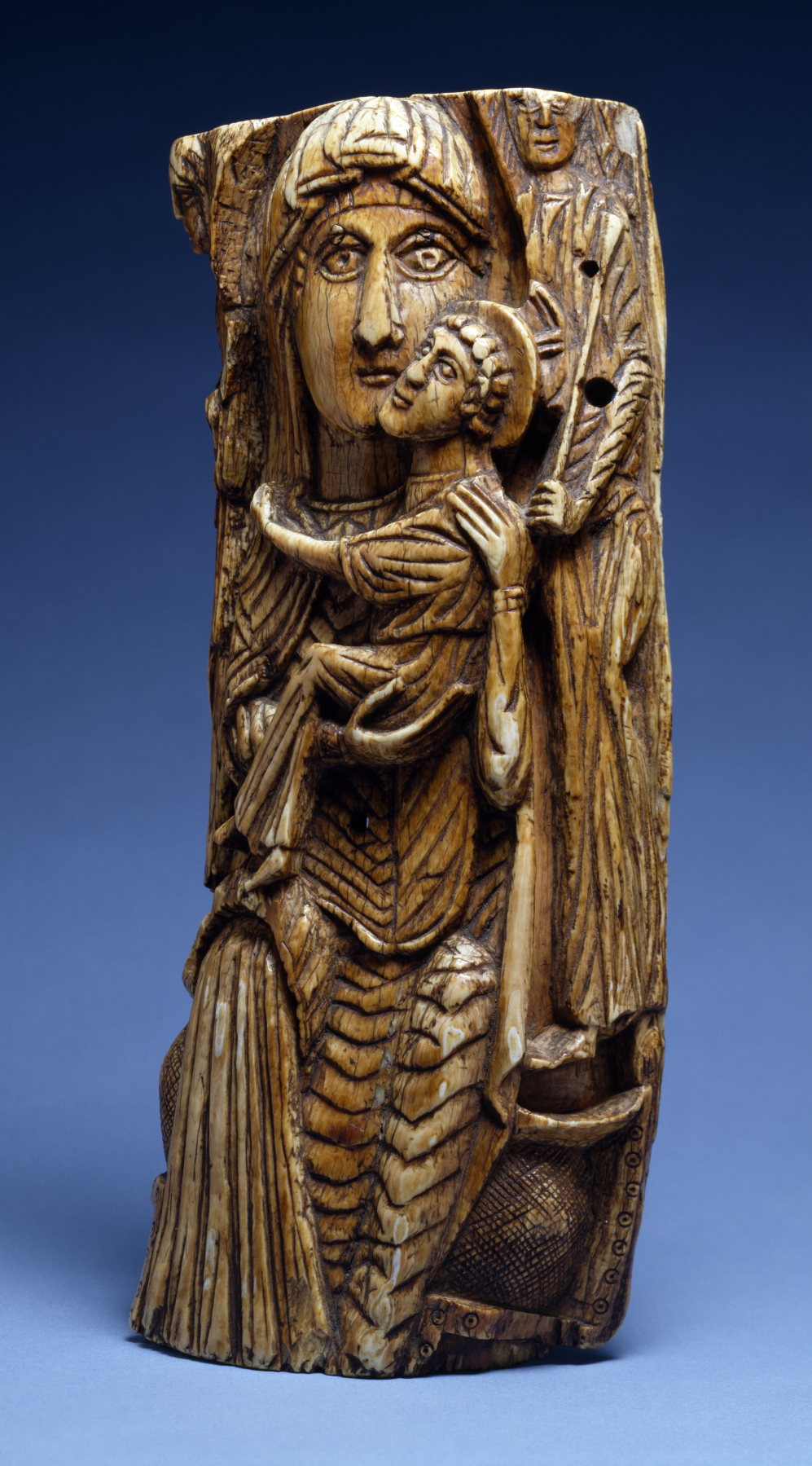
Source: Virgin and Child, Walters Art Museum, 71.297, public domain.
This ancient Coptic carved ivory devotional image, dated by the museum to the seventh or eighth century, shows the Child embracing His mother’s neck as she holds Him. It is a carved devotional icon, not a painted panel. The closeness of mother and Child directs the Marian reflection toward the actual Incarnation: the One whom Mary holds has truly taken flesh from her.4
The image is a Christian resonance beside Proverbs 31, not an exact illustration of its household poem. The valiant woman remains a real and active subject in the text. The Theotokos widens the contemplation toward faithful reception of the Word without replacing that woman or narrowing the chapter to a demand list for women.
Spiritual Fruit 🍇
Keep judgment clear for another person’s sake. Name one habit that leaves you less able to listen or less patient with someone who depends on you. It may involve drink, exhaustion, distraction, or the pleasure of being deferred to. Choose a real limit, and let the beneficiary be someone whose need previously arrived at an inconvenient time.
Honor the worker, not only the result. Gratitude can take the form of shared labor, protected rest, attention to judgment, and credit spoken where decisions are made. Thank the person whose work has become invisible through reliability. A home that praises a woman’s strength while refusing to lighten her burden has not yet understood the praise.
Let the hand that earns also give. Keep one part of household provision open to the poor, in proportion to what is possible. The gift may be money, food, time, practical skill, or help obtaining a fair hearing. Wisdom becomes public when another person’s need can cross our threshold.
Give careful speech the dignity of work. A home needs someone to arrange food, but it also needs someone to speak truth without contempt. Choose one habitual exaggeration, dismissive reply, or cutting joke to surrender. The fruit of the lips can nourish or wound; the wise woman teaches us to bring that power under God’s law.
Let admiration become praise of God. Receive the good in a faithful life without turning it into comparison. If your own work is limited by illness, grief, or circumstance, offer the good that is possible today. The fear of the Lord is not a reward for reaching an impossible schedule. It is the root from which faithfulness grows, and the wise woman herself teaches us to praise it.
The lamp burns beside work that has served real lives. The hands that held the spindle have opened to the poor, and the mouth opens now in praise. Lord, give our households that quiet strength, with rest for the weary and honor for those whose labor we have overlooked. Let our final word, like the wise woman’s, be thanksgiving before You.
Teaching Focus
Key phrases: Even a king must be taught. Wisdom has competent hands and a truthful voice. Honor the worker, not only the work. Let her praise the fear of the Lord. Emphasize: Preserve the woman’s agency, the Hebrew acrostic, the Greek praise-agent, and their distinct spiritual gifts. Avoid: Comparison, shame, one narrow model of femininity, or a Marian reading that erases the literal woman.
Teaching Notes
Single-session plan: 50 minutes: 6 for context and the Brenton note; 11 for 31:1-9; 8 for 31:10-17; 9 for 31:18-27; 10 for 31:28-31, the praise-agent, and Cyril; 6 for the Coptic devotional image, prayer, and one practical change. Show the mother and Child as a Christological resonance, not a literal portrait of the poem’s household.
The mother and the king (Proverbs 31:1-9; Brenton 24:54-62)
- Ask: Who bears the cost when our judgment is clouded?
- Emphasize: Maternal instruction governs public justice.
- Watch for: Misogyny or intoxication treated as a plan for the distressed.
- Connect: Christ the true King and advocate of the lowly.
Trustworthy strength (Proverbs 31:10-17)
- Ask: How does trust make room for another person’s agency?
- Emphasize: The woman acts, considers, buys, and provides.
- Watch for: A burden list for wives, or passivity excused in men.
- Connect: Embodied faithfulness in the Church.
Work, generosity, and speech (Proverbs 31:18-27)
- Ask: What would honoring the worker change in our home?
- Emphasize: The working hand opens to the poor; preserve Brenton’s household-then-speech order.
- Watch for: Endless labor, contempt for illness, or anxiety blamed as faithlessness.
- Connect: Christ receives the needy; wisdom bears fruit in speech.
Her voice of praise (Proverbs 31:28-31)
- Ask: What changes when the wise woman becomes the one who praises?
- Emphasize: Teach both the Hebrew praise of the God-fearing woman and the Greek woman praising holy fear.
- Watch for: Putting Hebrew children calling her blessed into the Greek, or taking her honor away.
- Connect: Luke 1:48 with the Hebrew wording; Cyril’s Christological rule for the Marian resonance.
Glossary
- Lemuel: The king named in the Hebrew heading, commonly understood as “belonging to God”; the Greek gives words spoken by God instead of retaining his name.
- Acrostic: A poem whose successive units begin with successive letters, here the Hebrew alphabet.
- Valiant / virtuous woman: The poem’s capable, trustworthy, generous woman, whose agency and speech embody wisdom.
- Theotokos: Mother of God or God-bearer; the title confesses the identity of her Son as the divine Word truly incarnate.
- Fear of the Lord: Reverent, obedient love before God, praised by the wise woman at the end of the Greek book.
- Household economy: The work of provision, trade, care, and stewardship within an ancient house.
Translation and Source Notes
Embedded Scripture is from Brenton’s English Septuagint (LXX). Hebrew comparisons use the KJV. Proverbs 31:1-9 is Brenton 24:54-62. The later poem retains Brenton’s order: household care at his 31:26, then wise speech at his 31:27. Familiar content labels are printed beside those coordinates so that neither order nor meaning is concealed.
The Greek’s changed praise-agent in 31:30 and its distinct 31:28 and 31:31 are retained throughout the interpretation. Marian connections are Christian resonance, with Luke 1:48 specifically paired with the Hebrew 31:28. The museum identifies the ivory as Egyptian, Coptic or Byzantine, seventh to eighth century, and a private devotional icon. The liturgical absence statement is limited to the Coptic lectionary data represented in version 1.3.3.
Sources
St. Cyril of Alexandria, Third Letter to Nestorius, Anathema 1, cited below.
Coptic lectionary data, version 1.3.3.
Footnotes
-
Strong’s Hebrew 3927, name entry and “(belonging) to God”; compare the Hebrew heading and Brenton 24:54 above. The name’s sense does not establish a particular historical identification of the king. ↩
-
Swete’s Greek text of Proverbs 31, especially 31:30, φόβον δὲ Κυρίου αὕτη αἰνείτω. The Greek clause supports the praise-agent; Brenton’s own printed boundaries govern the Scripture blocks. ↩
-
St. Cyril of Alexandria, Third Letter to Nestorius, Anathema 1, as printed in The Seven Ecumenical Councils, Council of Ephesus, NPNF, second series, vol. 14, Henry R. Percival edition, primary text. The Greek title Θεοτόκος is transliterated Theotokos in the commentary. ↩
-
Walters Art Museum, Virgin and Child, 71.297, ivory private devotional icon, Egyptian, seventh to eighth century; museum image CC0. The displayed image is the public-domain Commons reproduction credited in the caption. ↩