


This narration is from a previous version of the study and may include a combined recording of multiple chapters.
The land Israel is about to enter will drink rain from heaven. Its hills cannot be watered simply by repeating the labor remembered from Egypt. Moses turns that geographical difference into a lesson about receiving life from God. He speaks to people whose eyes have seen rescue and judgment, then asks what those memories will become in their homes, fields, and decisions. The chapter ends with two mountains that will make the consequences of covenant faithfulness public.
The memory entrusted to eyewitnesses (Deuteronomy 11:1-7)
1 Therefore thou shalt love the Lord thy God, and shalt observe his appointments, and his ordinances, and his commandments, and his judgments, always. 2 And ye shall know this day; for I speak not to your children, who know not and have not seen the discipline of the Lord thy God, and his wonderful works, and his strong hand, and his high arm, 3 and his miracles, and his wonders, which he wrought in the midst of Egypt on Pharao king of Egypt, and all his land; 4 and what he did to the host of the Egyptians, and to their chariots, and their cavalry, and their host; how he made the water of the Red Sea to overwhelm the face of them as they pursued after you, and the Lord destroyed them until this day; 5 and all the things which he did to you in the wilderness until ye came into this place; 6 and all things that he did to Dathan and Abiron the sons of Eliab the son of Ruben, whom the earth opening her mouth swallowed up, and their houses, and their tents, and all their substance that was with them, in the midst of all Israel: 7 for your eyes have seen all the mighty works of the Lord, which he wrought among you to-day.
Moses addresses the generation before him as the people who have seen the Lord’s mighty acts. The contrast with their children establishes responsibility: those who possess living memory must hand it on. The Red Sea and the fate of Dathan and Abiram belong in the same recollection. Deliverance does not place Israel beyond judgment; the Lord who overthrows oppressive power also judges rebellion within the camp.
This is communal remembrance, not a claim that every individual standing there personally witnessed each event as an adult. Moses speaks to Israel across its shared history. The people are to understand themselves through God’s acts rather than through an invented story of self-sufficiency. Love in verse 1 is bound to keeping His commandments because the remembered God is living and holy.
A family can hand on memories of God as gratitude or as self-congratulation. Tell children how mercy reached you, including where forgiveness was needed. A polished family legend that never admits repentance makes obedience sound like membership in a superior household. Moses’ memory leaves no room for that illusion.
A land under the Lord’s eyes (Deuteronomy 11:8-17)
8 And ye shall keep all his commandments, as many as I command thee to-day, that ye may live, and be multiplied, and that ye may go in and inherit the land, into which ye go across Jordan to inherit it: 9 that ye may live long upon the land, which the Lord sware to your fathers to give to them, and to their seed after them, a land flowing with milk and honey. 10 For the land into which thou goest to inherit it, is not as the land of Egypt, whence ye came out, whensoever they sow the seed, and water it with their feet, as a garden of herbs: 11 but the land into which thou goest to inherit it, is a land of mountains and plains; it shall drink water of the rain of heaven. 12 A land which the Lord thy God surveys continually, the eyes of the Lord thy God are upon it from the beginning of the year to the end of the year. 13 Now if ye will indeed hearken to all the commands which I charge thee this day, to love the Lord thy God, and to serve him with all thy heart, and with all thy soul, 14 then he shall give to thy land the early and latter rain in its season, and thou shalt bring in thy corn, and thy wine, and thine oil. 15 And he shall give food in thy fields to thy cattle; and when thou hast eaten and art full, 16 take heed to thyself that thy heart be not puffed up, and ye transgress, and serve other gods, and worship them: 17 and the Lord be angry with you, and restrain the heaven; and there shall not be rain, and the earth shall not yield its fruit, and ye shall perish quickly from off the good land, which the Lord has given you.
Verse 10 must be heard in full. The comparison concerns the manner of watering the land. Egypt evokes familiar irrigation and labor; the hills and plains of the promised land depend upon rain. Moses uses this contrast to expose the temptation to imagine that human management can guarantee life. Egyptian agriculture also depended on gifts beyond human control. The passage is not a verdict that Egypt’s soil or people are cursed.
For a Coptic Christian, the rest of Scripture makes this especially plain. Isaiah 19:25 calls Egypt God’s people, and Matthew 2:13-15 tells how Egypt shelters the Christ Child. The spiritual issue here is self-managed security against grateful dependence on heaven, not contempt for a land in which God has made His saving care known.
The Lord’s eyes remain upon the land throughout the year. That promise consoles a worried heart, but the verses also expose a heart swollen by abundance. The danger begins when full tables make the Giver seem unnecessary. Worship of other gods follows. The threatened drought belongs to the covenant warning addressed to Israel; it is not permission to diagnose every failed harvest, illness, or economic loss as proof of a particular sufferer’s sin. A Christian receives hardship with prayer and practical mercy, not confident accusations against the afflicted.
The Church’s Voice in Worship: River, seeds, and fruit
The Coptic Liturgy prays over the same needs that Moses names. In the Litany of the Waters the priest prays, “Graciously accord, O Lord to bless the waters of the river this year.” The service book appoints that seasonal litany from Paoni 12 to Paapi 9. From Paapi 10 to Tobi 10 it gives the prayer for the seeds, herbs, and plants; from Tobi 11 to Paoni 11 it gives the season of air and fruits.1
The Coptic Reader Matins service for Friday, March 13, 2026, reads Deuteronomy 10:12-11:28; the service for Friday, March 20, 2026, reads Deuteronomy 11:29-12:27. These continuous readings place the chapter’s call to love and its two mountains within the dated Lenten services.2
A Church formed beside the Nile still asks heaven for what sustains the earth. Irrigation and prayer are not rivals. Skill tends what God gives, and prayer refuses to confuse skill with the source of life. The litany goes on to ask for sustenance and forgiveness. Our dependence includes both bread and the mercy by which we can receive it rightly.
The word enters the household (Deuteronomy 11:18-21)
18 And ye shall store these words in your heart and in your soul, and ye shall bind them as a sign on your hand, and it shall be fixed before your eyes. 19 And ye shall teach them to your children, so as to speak about them when thou sittest in the house, and when thou walkest by the way, and when thou sleepest, and when thou risest up. 20 And ye shall write them on the lintels of your houses, and on your gates; 21 that your days may be long, and the days of your children, upon the land which the Lord sware to your fathers to give to them, as the days of heaven upon the earth.
These commands repeat the household instruction of Deuteronomy 6:6-9. Heart, hand, eyes, conversation, doorways, and daily time belong together. The word must be inwardly received and outwardly remembered. A child learns what a household trusts from its repeated habits as much as from formal explanations.
Begin with something possible: a short Scripture reading, prayer before sleep, or a truthful word about a decision that cost you something. The promise about children should encourage responsibility, not become a weapon against a parent grieving a child’s distance from the Church. Parents can teach, pray, repent, and love; they cannot replace another person’s freedom. The word kept in the heart will also teach patience.
Hold fast without turning the gift into entitlement (Deuteronomy 11:22-25)
22 And it shall come to pass that if ye will indeed hearken to all these commands, which I charge thee to observe this day, to love the Lord our God, and to walk in all his ways, and to cleave close to him; 23 then the Lord shall cast out all these nations before you, and ye shall inherit great nations and stronger than yourselves. 24 Every place whereon the sole of your foot shall tread shall be yours; from the wilderness and Antilibanus, and from the great river, the river Euphrates, even as far as the west sea shall be your coasts. 25 No one shall stand before you; and the Lord your God will put the fear of you and the dread of you on the face of all the land, on which ye shall tread, as he told you.
The command to cleave close to the Lord gives obedience its personal center. Israel is called to love Him and walk in His ways. Territorial promises address this particular people at this stage of its history. They cannot be converted into a Christian program of expansion or a guarantee that a faithful person’s plans will meet no resistance.
Christ’s call to abide in Him in John 15:1-8 gives the Christian form of this dependence. Fruit comes from communion with Him. Prayer, Scripture, sacramental life, and mercy are ways of remaining faithful within that communion. We can maintain religious habits while secretly trusting only our arrangements; cleaving to the Lord means letting His word judge those arrangements too.
Gems from the Fathers: The freedom of children
St. Irenaeus, in Against Heresies, IV.13.2, explains how Christ brings obedience into freedom. The body is to be purified through a soul set free by the Word. He writes: “But the Word set free the soul, and taught that through it the body should be willingly purified.”3
This is a Christian lens on obedience, not direct commentary on these territorial verses. Irenaeus refuses the choice between obedience and freedom. Children render obedience with a confidence that servants under constraint do not possess. Cleaving to God therefore matures as willing love, rather than shrinking into fear of losing every earthly advantage.
Two mountains make the choice visible (Deuteronomy 11:26-32)
26 Behold, I set before you this day the blessing and the curse; 27 the blessing, if ye hearken to the commands of the Lord your God, all that I command you this day; 28 and the curse, if ye do not hearken to the commands of the Lord our God, as many as I command you this day, and ye wander from the way which I have commanded you, having gone to serve other gods, which ye know not. 29 And it shall come to pass when the Lord thy God shall have brought thee into the land into which thou goest over to inherit it, then thou shalt put blessing on mount Garizin, and the curse upon mount Gæbal. 30 Lo! are not these beyond Jordan, behind, westward in the land of Chanaan, which lies westward near Golgol, by the high oak? 31 For ye are passing over Jordan, to go in and inherit the land, which the Lord our God gives you to inherit always, and ye shall dwell in it. 32 And ye shall take heed to do all his ordinances, and these judgments, as many as I set before you to-day.
Blessing and curse are placed before Israel as the serious consequences of listening or turning away. The opposing mountains will give that choice a public voice. Gerizim and Ebal stand beside Shechem, where Genesis 12:6-7 places Abram near the tree of Moreh when the land is promised. The later assembly will stand within an older history of gift.
Brenton’s “by the high oak” corresponds here to the location NKJV calls the terebinth trees of Moreh. That shared setting links promise, remembrance, and choice. A schematic can identify the two mountains without pretending to reconstruct every feature of the ancient scene.
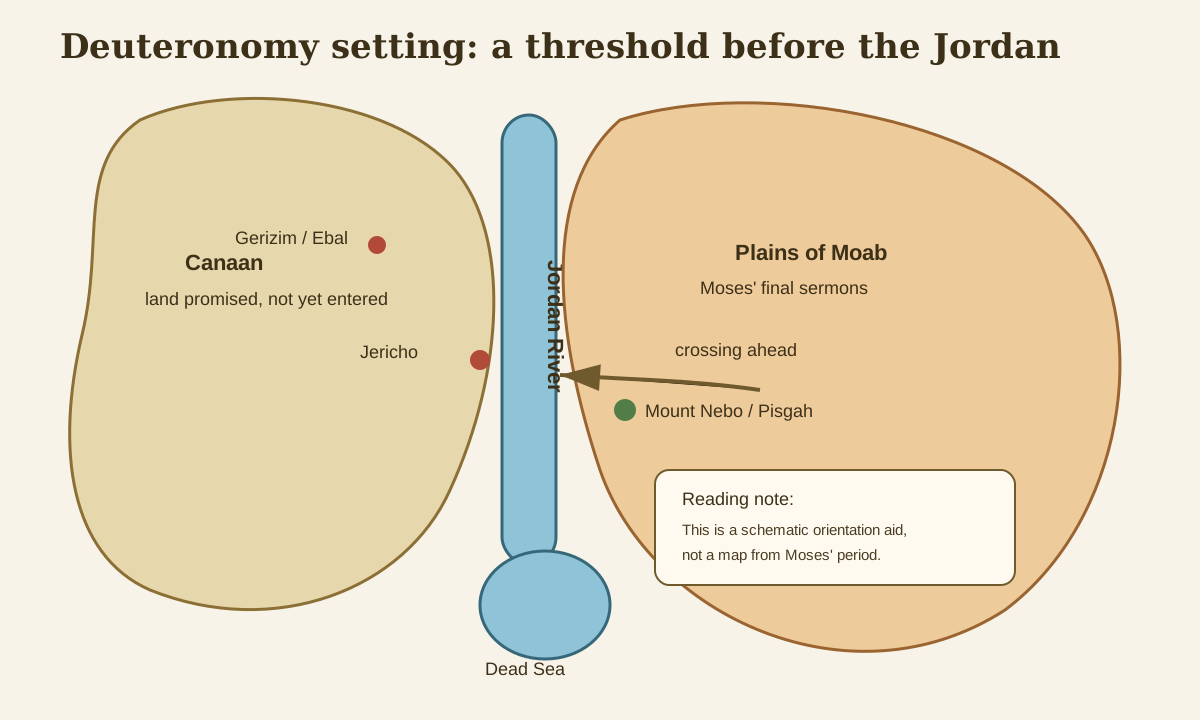 Original project geographical schematic. This is an orientation aid, not an ancient map.
Gerizim appears again in John 4:20-24, when the Samaritan woman speaks of worship on this mountain. Christ leads her from the dispute about mountain and Jerusalem to worship of the Father in spirit and truth. That conversation prepares the Christian reading of Deuteronomy 12, where the Lord chooses the place for His name. The fulfillment is communion with God in Christ, not indifference about whom or how we worship.
Spiritual Fruit
Give thanks for one provision that has begun to feel automatic. A salary, a meal, a working body, and another person’s labor can become invisible through familiarity. Gratitude makes dependence truthful without making us careless about work. Pray for those whose food and livelihood are threatened, and place something material beside the prayer.
Let one memory of mercy become speech in your home. It need not be impressive. An honest account of forgiven impatience or help received in need may teach more than a polished religious performance. If your household is wounded or divided, begin with a practice that does not require controlling anyone else: a short prayer, an apology, an act of patient service.
Stand mentally between the two mountains with the choice you have postponed. God’s word has not been given merely to decorate the doorway. Ask Christ for the grace to take the next obedient step. The land drinks from heaven, and the heart too must receive before it can bear fruit.
Teaching Notes
For the teacher
Keep Egypt’s agricultural comparison distinct from a judgment on Egypt. Do not turn drought into a way of blaming sufferers. The seasonal litany is a worship connection distinct from the dated Matins readings. Do not turn the verified 2026 services into an unqualified all-years sequence.
The memory entrusted to eyewitnesses (Deuteronomy 11:1-7)
- Ask: What kind of memory teaches gratitude without making a family proud?
- Watch for: Every individual assumed to have witnessed every event in the same way.
A land under the Lord’s eyes (Deuteronomy 11:8-17)
- Ask: Where does careful planning become the belief that we no longer depend on God?
- Emphasize: The river also receives its life from God; Isaiah’s blessing of Egypt and the Holy Family’s refuge protect the comparison from misuse.
- Watch for: Prosperity teaching or the diagnosis of a sufferer’s guilt from a failed harvest.
The word enters the household (Deuteronomy 11:18-21)
- Ask: Which modest household habit would make Scripture more familiar without becoming a performance?
- Watch for: Blame directed at parents for the free choices of adult children.
Hold fast without turning the gift into entitlement (Deuteronomy 11:22-25)
- Ask: How does obedience differ when it is offered with the confidence of a child?
- Emphasize: Irenaeus gives a thematic Christian reading of freedom and obedience, not a guarantee of earthly success.
Two mountains make the choice visible (Deuteronomy 11:26-32)
- Ask: How does the older promise at Shechem deepen the seriousness of the choice?
- Show: Use the geographical schematic on this page to identify Gerizim and Ebal; distinguish orientation from historical reconstruction.
- Connect: Follow the woman’s mountain in John 4 into the chosen-place question of Deuteronomy 12.
Sources
Embedded Scripture is from Brenton’s English Septuagint (LXX), Deuteronomy 11. References follow NKJV numbering. The dated Matins services cited below are confirmed for the named 2026 dates.
Footnotes
-
The Divine Liturgies of Saints Basil, Gregory and Cyril, Liturgy of St. Basil, seasonal litanies, pp. 105-107; service book. Coptic month names follow this edition. The printed text permits a combined form of the three litanies as well. ↩
-
Coptic Reader, Matins prophecies for March 13 and March 20, 2026, Deuteronomy 10:12-11:28 and Deuteronomy 11:29-12:27. The appointment evidence concerns these dates, not an unqualified all-years recurrence. ↩
-
St. Irenaeus of Lyons, Against Heresies, IV.13.2, translated by Alexander Roberts and William Rambaut, Ante-Nicene Fathers, vol. 1, direct text. ↩