


This narration is from a previous version of the study and may include a combined recording of multiple chapters.
Moses sees the land he will not enter. The Lord names the promise to Abraham, Isaac, and Jacob, and the prophet’s eyes receive its horizon. His life’s service is neither denied nor made complete by personal possession. The book ends with a death, a people allowed to mourn, and a successor ready to lead. Beyond that ending, the Gospel will show Moses alive in glory beside Christ.
Orientation
From the plains of Moab, Moses ascends Nebo, Brenton’s Nabau, to the summit of Pisgah, Phasga, opposite Jericho. The Lord shows him the inheritance across the Jordan. The Western Tissot artwork below is retained with its label; it depicts the poignancy of seeing from afar, rather than supplying an Orthodox icon of the final hope. Moses, Joshua, and the mourning people remain servants of the Lord who keeps His promise.
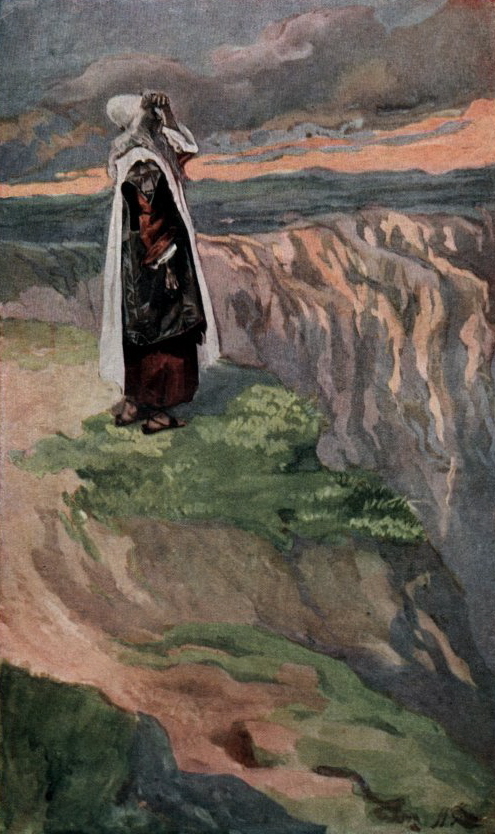 Source: Wikimedia Commons, James Tissot, Moses Sees the Promised Land from Afar, public domain. Western biblical artwork, not Orthodox iconography.
The promise seen from the mountain (Deuteronomy 34:1–4)
Scripture: Brenton Septuagint
1 And Moses went up from Araboth Moab to the mount of Nabau, to the top of Phasga, which is before Jericho; and the Lord shewed him all the mount of Galaad to Dan, and all the land of Nephthali, 2 and all the land of Ephraim and Manasse, and all the land of Juda to the farthest sea; 3 and the wilderness, and the country round about Jericho, the city of palm-trees, to Segor. 4 And the Lord said to Moses, This is the land of which I sware to Abraam, and Isaac, and Jacob, saying, To your seed will I give it: and I have shewed it to thine eyes, but thou shalt not go in thither.
The Lord shows the land and names His oath to the fathers. Moses sees more than fertile country: he sees God’s faithfulness extending beyond his own completed service. The same word grants the vision and sets the limit. He will not go in.
Deuteronomy 32:51 recalls the reason at the waters of strife, told in Numbers 20:1–13. The limit cannot be made into a claim that Moses was rejected altogether. God still speaks to him, honors his service, and permits him to behold the promise. Mercy and accountability stand beside each other.
A parent, teacher, or servant may labor for something that another person will complete. That can be painful without making the labor meaningless. We may receive a glimpse of fruit we will not possess, and entrust it to the Lord without trying to control its future. The promise is larger than one servant’s span of years.
The servant’s death and the hidden burial (Deuteronomy 34:5–7)
Scripture: Brenton Septuagint
5 So Moses the servant of the Lord died in the land of Moab by the word of the Lord. 6 And they buried him in Gai near the house of Phogor; and no one has seen his sepulchre to this day. 7 And Moses was a hundred and twenty years old at his death; his eyes were not dimmed, nor were his natural powers destroyed.
Moses dies as the servant of the Lord, by the Lord’s word. His eyes and natural powers are preserved; the chapter does not reduce his departure to the exhaustion of his usefulness. Human strength cannot remove our creaturely limit, and usefulness cannot become the measure of a person’s worth.
Language insight: “they buried him” and “He buried him”
Brenton and the Greek read ‘they buried him’; the Hebrew-based NKJV reads ‘He buried him’, commonly understood as the Lord. Both leave the grave’s location unknown. The Greek’s plural must not be silently replaced by a claim that Brenton explicitly names God as the one who buries Moses.1
Jude 1:9 mentions Michael the archangel disputing with the devil about Moses’ body and refusing a reviling accusation. It witnesses to the body’s mystery without supplying a new map of the burial or a full account of its circumstances. The restraint in Jude matters as much as the mystery: the archangel entrusts rebuke to the Lord.
The unknown grave cannot prove opposition to honoring saints or their relics. Nor does the chapter state that the grave was hidden to prevent a cult. That may be a spiritual reflection, but the text gives no such motive. We honor the servant and let the Lord remain Lord of the promise.
Gems from the Fathers: the honor of being God’s servant
St. Gregory of Nyssa, The Life of Moses, II.313–318, reflects directly upon this ending. At II.314 he treats the title ‘servant of Yahweh’ as Moses’ culminating honor; at II.315 he draws the purpose of the virtuous life into one phrase: ‘to be called servants of God by virtue of the lives we live’.2 This is an interpretation of service formed across a lifetime, not an explanation of the grave’s physical location. The title frees us from measuring a life by what its owner managed to possess. To belong to God in faithful love is already a glory beyond achievement.
Tears, the Spirit’s gift, and the next servant (Deuteronomy 34:8–9)
Scripture: Brenton Septuagint
8 And the children of Israel wept for Moses in Araboth of Moab at Jordan near Jericho thirty days; and the days of the sad mourning for Moses were completed. 9 And Joshua the son of Naue was filled with the spirit of knowledge, for Moses had laid his hands upon him; and the children of Israel hearkened to him; and they did as the Lord commanded Moses.
Israel weeps for thirty days. The narrative allows grief its stated time before naming Joshua’s readiness. Faith does not require the bereaved to behave as though the person never mattered. Continuing the work is not betrayal of the one who has died.
Joshua is filled with the spirit of knowledge, and Moses’ laying on of hands is given as its context. The people hear him and do as the Lord commanded Moses. Succession carries the received word forward; it is not a claim to invent a new covenant because the previous servant has departed.
Acts 6:6 and 1 Timothy 4:14 show laying on of hands in the Church’s commissioning and gift of ministry. They provide a scriptural continuity of prayer, appointment, and grace without making Joshua’s historical office identical to every Christian ministry. The Coptic Church ordains through the bishop’s laying on of hands.3 Ordination remains service of the Lord, and deacons serve the Lord rather than a merely human administrative system.
We can mourn a faithful shepherd while receiving the next servant with prayer. The gifts do not belong to one personality. A community’s memory should make it grateful, not incapable of hearing anyone else.
The incomparable prophet and the hope in Christ (Deuteronomy 34:10–12)
Scripture: Brenton Septuagint
10 And there rose up no more a prophet in Israel like Moses, whom the Lord knew face to face, 11 in all the signs and wonders, which the Lord sent him to work in Egypt on Pharao, and his servants, and all his land; 12 the great wonders, and the mighty hand which Moses displayed before all Israel.
The last words exalt Moses: known face to face, sent with signs and wonders, and mighty before all Israel. ‘Face to face’ names the extraordinary intimacy of his prophetic relation to the Lord; it should be heard with Exodus 33:11 and Exodus 33:20, where God’s speech and the limit upon seeing His face stand together. The final praise does not claim that a creature comprehends the divine essence.
Deuteronomy 18:15 promises a prophet like Moses and commands the people to hear him. The Christian fulfillment is proclaimed in Acts 3:22–26. At the Transfiguration, Matthew 17:1–8 places Moses and Elijah beside Jesus, and the Father’s voice says to hear the beloved Son. The servant is honored within the revelation of the Lord he served.
The Gospel gives a hope larger than an earthly crossing: Moses stands in glory with Christ. Hebrews 4:8–11 likewise distinguishes Joshua’s entry from the rest still promised to God’s people. We can honor the lawgiver and his successor without requiring either to be the final source of life. Christ brings the servants of God into communion that death cannot cancel.
The Church’s Voice in Worship
The Coptic Synaxarium remembers ‘The Departure of Moses the Prophet’ on Tout 8. This date of remembrance honors the Lord’s servant and can give Christian mourning the company of the Church’s memory. It does not establish Deuteronomy 34 as an appointed reading for that day.4
Glossary
- Nebo / Nabau: the mountain of Moses’ final view.
- Pisgah / Phasga: the summit associated with that view.
- Spirit of knowledge: the divinely given wisdom and readiness named in Joshua’s commission.
- Synaxarium: the Church’s calendar of commemorations and accounts of saints.
- Divine essence: what God is in Himself, beyond a creature’s exhaustive comprehension.
Spiritual Fruit
Entrust unfinished work. Name a responsibility you cannot complete alone or indefinitely. Make a practical provision for its continuation, then pray for the person who will carry it. Trusting God may include releasing control while the work still matters.
Allow grief to be faithful. Pray for those you have lost and speak their names with gratitude. Receive companionship rather than demanding solitary strength. Mourning is not a denial of the Resurrection.
Honor the servant, hear the Lord. Thank God for a person who taught you the faith. Follow the truth that person handed on, rather than defending every personal habit as sacred. Receive the next faithful servant with prayer instead of comparison.
The mountain gives Moses a view, and the Gospel gives us Moses beside Christ. Your unfinished service need not be the measure of God’s faithfulness. Bring Him the grief, the limit, and the labor you cannot keep. Remain His servant, and entrust the promise to the Lord who is Life.
Teaching Notes
Teacher guidance
Keep the Western artwork’s label and use it for the view from afar, then complete the account with the Transfiguration. Distinguish the Greek and Hebrew burial readings without inventing buriers. Treat Tout 8 as remembrance only, and Gregory’s reading as an interpretation of the title servant.
The promise seen from the mountain (Deuteronomy 34:1–4)
- Ask: What does Moses receive on the mountain even while his limit remains?
- Watch for: Erasing his accountability, or reading the limit as proof that his whole service failed.
The servant’s death and the hidden burial (Deuteronomy 34:5–7)
- Ask: What kind of honor does the title servant give at the end of a life?
- Watch for: Replacing Brenton’s plural burial wording, inventing a motive for the hidden grave, or making the passage anti-relic.
Tears, the Spirit’s gift, and the next servant (Deuteronomy 34:8–9)
- Ask: How can mourning and readiness for a new servant belong together?
- Watch for: Treating continued service as disloyalty to the dead, or turning laying on of hands into magic or merely human authorization.
The incomparable prophet and the hope in Christ (Deuteronomy 34:10–12)
- Ask: What does Moses’ presence at the Transfiguration reveal about the end of his service?
- Watch for: Making Moses a failed prophet, claiming exhaustive sight of God’s essence, or inferring a lectionary reading from the Synaxarium date.
Sources
Embedded Scripture is from Brenton’s English Septuagint (LXX). New Testament comparisons follow NKJV.
St. Gregory of Nyssa, The Life of Moses, II.313–318, especially II.314–315; translated by Abraham J. Malherbe and Everett Ferguson (Paulist Press, 1978), English edition.
Coptic Synaxarium, Tout 8, ‘The Departure of Moses the Prophet’: date of remembrance, not evidence of an appointed reading from this chapter.
No appointed Coptic lectionary reading from this chapter is known in the references consulted.
Footnotes
-
Deuteronomy 34:6 in Swete’s Greek text and Hebrew-based translations. ↩
-
St. Gregory of Nyssa, The Life of Moses, II.314–315, translated by Abraham J. Malherbe and Everett Ferguson (Paulist Press, 1978), English edition. ↩
-
CopticChurch.net, The Sacrament of Priesthood, opening paragraph, direct text. ↩
-
Coptic Synaxarium, Tout 8, ‘The Departure of Moses the Prophet’, Coptic Reader. The commemoration date is distinct from a lectionary appointment. ↩