


This narration is from a previous version of the study and may include a combined recording of multiple chapters.
Israel heard God speak and lived. That astonishing nearness is the foundation of Deuteronomy 4, and the danger is that the people will forget what they heard and manufacture something easier to manage. Moses calls them to guard the heart, teach their children, refuse idols, and keep the word they have received. He also speaks beyond future failure: even among the nations, a scattered people may seek the Lord and find Him. The consuming fire is also the God of pity.
Orientation
Moses is still east of the Jordan, speaking to the people who will enter without him. Horeb is remembered as the place of the assembly and divine speech. Baal Peor, Brenton’s Beelphegor, recalls Israel’s recent idolatry and its judgment in Numbers 25. The chapter concludes with cities of refuge and a transition into the Law’s renewed proclamation. Nearness to God must become both faithful worship and justice toward a neighbor.
Receive the word and know the God who is near (Deuteronomy 4:1-8)
1 And now, Israel, hear the ordinances and judgments, all that I teach you this day to do: that ye may live, and be multiplied, and that ye may go in and inherit the land, which the Lord God of your fathers gives you. 2 Ye shall not add to the word which I command you, and ye shall not take from it: keep the commandments of the Lord our God, all that I command you this day. 3 Your eyes have seen all that the Lord our God did in the case of Beel-phegor; for every man that went after Beel-phegor, the Lord your God has utterly destroyed him from among you. 4 But ye that kept close to the Lord your God are all alive to-day.
5 Behold, I have shewn you ordinances and judgments as the Lord commanded me, that ye should do so in the land into which ye go to inherit it. 6 And ye shall keep and do them: for this is your wisdom and understanding before all nations, as many as shall hear all these ordinances; and they shall say, Behold, this great nation is a wise and understanding people. 7 For what manner of nation is so great, which has God so near to them as the Lord our God is in all things in whatsoever we may call upon him? 8 And what manner of nation is so great, which has righteous ordinances and judgments according to all this law, which I set before you this day?
Hearing is directed toward doing, life, and inheritance. Israel must neither add to the word nor diminish it. The command protects God’s revelation from our wish to make it more convenient or more useful to our own authority. Revelation 22:18-19 similarly guards the words of its prophecy; that later warning does not turn every human explanation into a forbidden addition, but it exposes the presumption of altering a divine word while claiming to serve it.
Baal Peor gives the warning a recent history. Those who followed the idol were destroyed, while those who remained attached to the Lord are alive. The wisdom of the ordinances is then set before the nations. Israel’s distinction should become visible through a righteous life, not merely through a claim to possess a superior tradition.
Verse 7 reaches the heart of that distinction: the Lord is near whenever His people call upon Him. His holiness does not mean indifference. In the Gospel, Emmanuel is God with us (Matthew 1:23), and John 1:14 confesses the Word dwelling among us in the flesh. Deuteronomy’s nearness is not yet the full revelation of the Incarnation, but it prepares us to recognize that the Holy One gives access to Himself. Prayer answers His gift; it is not a technique for making an absent God attend.
Guard the heart and hand on what was heard (Deuteronomy 4:9-14)
9 Take heed to thyself, and keep thy heart diligently: forget not any of the things, which thine eyes have seen, and let them not depart from thine heart all the days of thy life; and thou shalt teach thy sons and thy sons’ sons, 10 even the things that happened in the day in which ye stood before the Lord our God in Choreb in the day of the assembly; for the Lord said to me, Gather the people to me, and let them hear my words, that they may learn to fear me all the days which they live upon the earth, and they shall teach their sons. 11 And ye drew nigh and stood under the mountain; and the mountain burned with fire up to heaven: there was darkness, blackness, and tempest. 12 And the Lord spoke to you out of the midst of the fire a voice of words, which ye heard: and ye saw no likeness, only ye heard a voice.
13 And he announced to you his covenant, which he commanded you to keep, even the ten commandments; and he wrote them on two tables of stone. 14 And the Lord commanded me at that time, to teach you ordinances and judgments, that ye should do them on the land, into which ye go to inherit it.
Moses names the heart as the place where memory can be lost. What the eyes have seen must not depart from the inner life. The people are to teach sons and grandsons, and verse 10 restores the purpose of the assembly: hearing God’s words, learning reverence throughout life, and teaching children. Religious memory must become an ordinary inheritance rather than a dramatic event admired and then forgotten.
The fire, darkness, blackness, and tempest speak of an encounter beyond Israel’s control. Yet the people receive words and commandments rather than a likeness they can reproduce. Even “face to face” in chapter 5 must be read with this account: it means direct divine address, not a claim that Israel saw and comprehended God’s essence.
Repetition in Scripture reading, prayer, feasts, and the Church’s remembrance can keep the heart awake. Anamnesis means remembrance, especially the worshiping remembrance of God’s saving acts. It should never be reduced to nostalgia. When we recall His mercy but refuse the command it carries, the facts remain in our mind while their life has departed from our heart.
No likeness at Horeb, no worship of the created heavens (Deuteronomy 4:15-20)
15 And take good heed to your hearts, for ye saw no similitude in the day in which the Lord spoke to you in Choreb in the mountain out of the midst of the fire: 16 lest ye transgress, and make to yourselves a carved image, any kind of figure, the likeness of male or female, 17 the likeness of any beast of those that are on the earth, the likeness of any winged bird which flies under heaven, 18 the likeness of any reptile which creeps on the earth, the likeness of any fish of those which are in the waters under the earth;
19 and lest having looked up to the sky, and having seen the sun and the moon and the stars, and all the heavenly bodies, thou shouldest go astray and worship them, and serve them, which the Lord thy God has distributed to all the nations under heaven. 20 But God took you, and led you forth out of the land of Egypt, out of the iron furnace, out of Egypt, to be to him a people of inheritance, as at this day.
The reason for vigilance is exact: Israel saw no similitude when the Lord spoke. Male and female figures, animals, birds, creeping things, fish, sun, moon, and stars all fall within the warning. The prohibition cannot be reduced to a dislike of one particular artistic style. God must not be identified with a form that His people invent or with the created heavens through which He orders life.
The sun and stars are gifts distributed among the nations, not powers to be worshiped. Astrology becomes a spiritual danger when it turns those gifts into masters of our choices or destiny. The Lord who brought Israel from the iron furnace of Egypt calls the people His inheritance. The furnace describes bondage and oppression, not an essential evil in the land or its people. Gratitude for deliverance should cure superstition and contempt alike.
Gems from the Fathers: Deuteronomy heard through the Incarnation
St. John of Damascus addresses these verses directly in the First Apology against Those Who Decry Holy Images. He cites Deuteronomy 4:12 and 4:15-17, then insists that adoration belongs to God alone. The invisible, uncircumscribed divine nature cannot be depicted. His answer turns on the Word’s real coming in the flesh: “When the Invisible One becomes visible to flesh, you may then draw a likeness of His form.”1 The icon confesses the person of the incarnate Son; it does not claim to enclose His divine essence.
John’s later paragraph joins this confession to the material means of salvation: “I worship the God of matter, who became matter for my sake, and deigned to inhabit matter, who worked out my salvation through matter.”2 His surrounding explanation preserves the unchanging divine nature and distinguishes the honor of created things from treating them as God. Wood and paint are not another deity. The Son’s body is real, and His union with our humanity does not turn the divine nature into a material object.
The warning remains necessary in Christian worship. An icon cannot be used as a charm for success or revenge, or as a substitute for repentance. The Incarnation establishes the truth confessed visually; Deuteronomy continues to judge the heart that would possess God rather than love Him.
Iconography connection
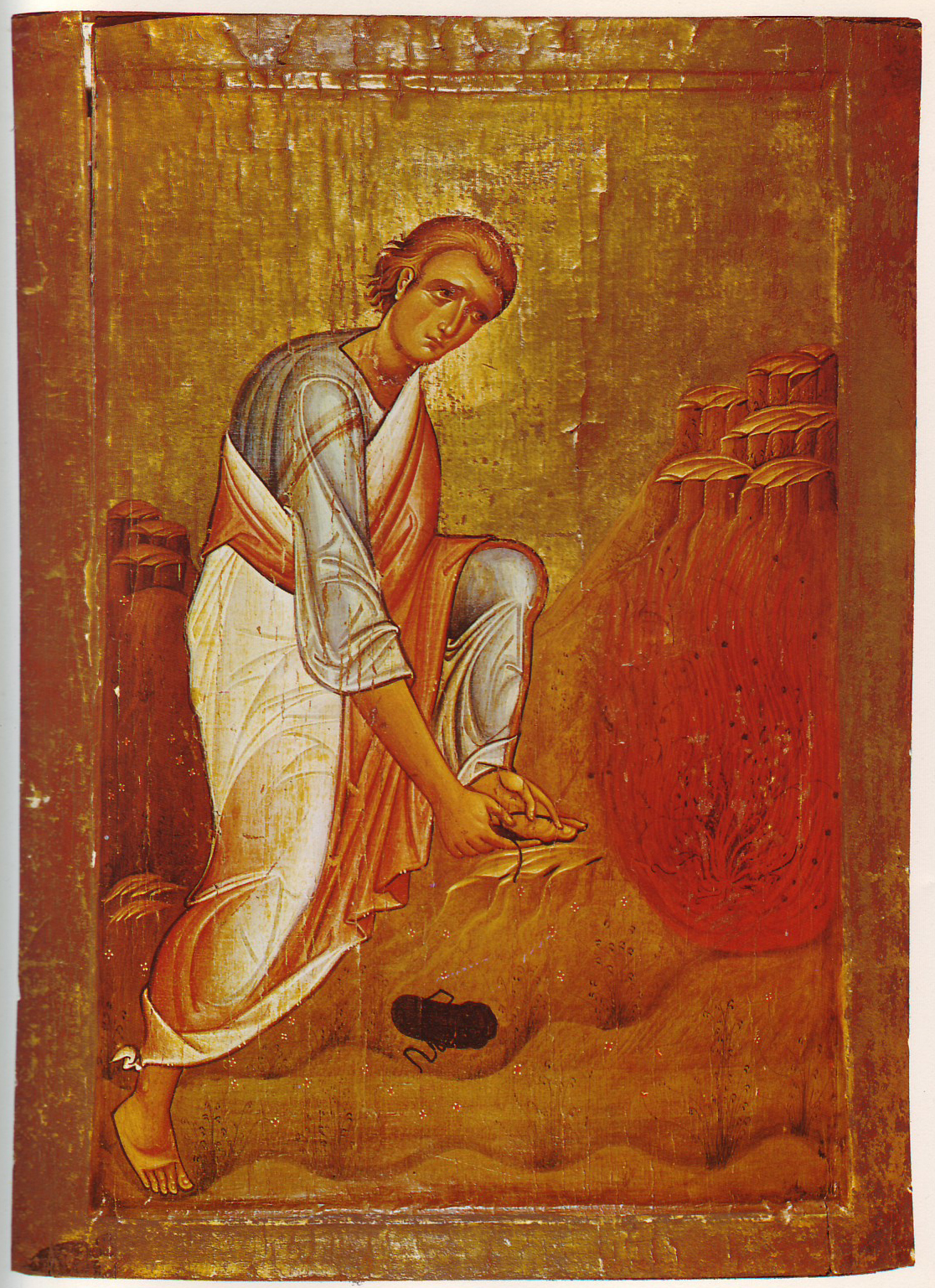 Pan-Orthodox icon of the Exodus 3 encounter, Sinai, 12th century; Wikimedia Commons, public domain.
This image depicts Moses’ earlier encounter at the burning bush, not the assembly described in Deuteronomy 4. It places the chapter’s remembrance within the same prophet’s history of divine calling. God addresses Moses and gives him a task; the holiness of the encounter resists his attempt to make his own adequacy the condition of obedience.
The Church’s Voice in Worship: The bush and the Incarnation
The Thursday Theotokia, a hymn concerning the Mother of God in the Coptic praises, reads the unconsumed bush as a figure of the Virgin from whom the Word took flesh. Its First Part begins:
The bush which Moses, has seen in the wilderness, and the fire that was in it, did not burn its branches.
- This is a symbol of Mary, the undefiled Virgin, which the Word of the Father, came and took flesh from her.3
The hymn’s interpretation belongs to the Exodus scene depicted above, not to a claim that Deuteronomy 4 narrates the bush. It gives the image a distinctly Coptic confession of the Incarnation: the Word truly receives flesh while remaining God. Reverence before the Holy One and gratitude for His nearness can therefore remain together.
The consuming fire and the promise beyond exile (Deuteronomy 4:21-31)
21 And the Lord God was angry with me for the things said by you, and sware that I should not go over this Jordan, and that I should not enter into the land, which the Lord thy God giveth thee for an inheritance. 22 For I am to die in this land, and shall not pass over this Jordan; but ye are to pass over, and shall inherit this good land. 23 Take heed to yourselves, lest ye forget the covenant of the Lord our God, which he made with you, and ye transgress, and make to yourselves a graven image of any of the things concerning which the Lord thy God commanded thee. 24 For the Lord thy God is a consuming fire, a jealous God.
25 And when thou shalt have begotten sons, and shalt have sons’ sons, and ye shall have dwelt a long time on the land, and shall have transgressed, and made a graven image of any thing, and shall have done wickedly before the Lord your God to provoke him; 26 I call heaven and earth this day to witness against you, that ye shall surely perish from off the land, into which ye go across Jordan to inherit it there; ye shall not prolong your days upon it, but shall be utterly cut off. 27 And the Lord shall scatter you among all nations, and ye shall be left few in number among all the nations, among which the Lord shall bring you. 28 And ye shall there serve other gods, the works of the hands of men, wood and stones, which cannot see, nor can they hear, nor eat, nor smell.
29 And there ye shall seek the Lord your God, and ye shall find him whenever ye shall seek him with all your heart, and with all your soul in your affliction. 30 And all these things shall come upon thee in the last days, and thou shalt turn to the Lord thy God, and shalt hearken to his voice. 31 Because the Lord thy God is a God of pity: he will not forsake thee, nor destroy thee; he will not forget the covenant of thy fathers, which the Lord sware to them.
Moses will die east of the Jordan, but the people must continue in obedience. The danger he names is forgetfulness after long settlement. Children and grandchildren, years of prosperity, and familiarity with the land can coexist with an idol at the center of life. The covenant’s gifts cannot protect a people who repudiate the Giver.
The Lord is a consuming fire and a jealous God. Jealousy here is His holy claim upon a relationship that false worship destroys. Hebrews 12:18-29 retains the language of consuming fire while leading believers to Christ the Mediator. Access through Him joins confidence with reverence.
Exile exposes the emptiness of the substitutes: manufactured gods cannot see, hear, eat, or smell. Yet “there” becomes the place of seeking. Even in the consequence of failure, the way back is open through turning and hearing. God’s pity is joined to the covenant He swore to the fathers. The ending of verse 31 makes hope rest on His fidelity rather than on the sinner’s ability to deserve a welcome.
Gems from the Fathers: The Creator exchanged for His creatures
St. Athanasius explains idolatry in On the Incarnation, 11.4-5, as the rejection of the knowledge God had graciously given. Human beings came to “serve the creature rather than the Creator”.4 This is a thematic witness to the chapter’s warning, not an exposition of these verses. Its searching force is that idolatry begins in a misdirected heart before it appears as an object of worship. The Word comes to restore knowledge of the Father, so repentance concerns whom we love and obey, not merely which objects we remove.
There is none beside Him (Deuteronomy 4:32-40)
32 Ask of the former days which were before thee, from the day when God created man upon the earth, and beginning at the one end of heaven to the other end of heaven, if there has happened any thing like to this great event, if such a thing has been heard: 33 if a nation have heard the voice of the living God speaking out of the midst of the fire, as thou hast heard and hast lived; 34 if God has assayed to go and take to himself a nation out of the midst of another nation with trial, and with signs, and with wonders, and with war, and with a mighty hand, and with a high arm, and with great sights, according to all the things which the Lord our God did in Egypt in thy sight. 35 So that thou shouldest know that the Lord thy God he is God, and there is none beside him.
36 His voice was made audible from heaven to instruct thee, and he shewed thee upon the earth his great fire, and thou heardest his words out of the midst of the fire. 37 Because he loved thy fathers, he also chose you their seed after them, and he brought thee himself with his great strength out of Egypt, 38 to destroy nations great and stronger than thou before thy face, to bring thee in, to give thee their land to inherit, as thou hast it this day. 39 And thou shalt know this day, and shalt consider in thine heart, that the Lord thy God he is God in heaven above, and on the earth beneath, and there is none else but he.
40 And keep ye his commandments, and his ordinances, all that I command you this day; that it may be well with thee, and with thy sons after thee, that ye may be long-lived upon the earth, which the Lord thy God giveth thee for ever.
Moses now asks Israel to consider the scale of what has happened. Has another nation heard the living God from fire and survived? Has God taken a people from another nation with such signs, strength, and deliverance? The answer leads to the chapter’s repeated confession: the Lord is God, and there is none beside Him.
The purpose of revelation is knowledge that reaches the heart. Verse 35 speaks of knowing; verse 39 adds considering in the heart that the Lord is God in heaven and on earth. The fire and voice are received as instruction. They give Israel reason to trust and obey when the remembered fire is no longer visible.
The love of the fathers, the choice of their descendants, and the deliverance from Egypt precede the command to keep the ordinances. Obedience answers mercy. “That it may be well with thee” places the commandments within God’s good purpose for life. It does not turn faithful conduct into a guarantee that every individual will escape suffering. It assures us that the Lord’s word is given for life, even when keeping it costs something.
Refuge and the Law set before the people (Deuteronomy 4:41-49)
41 Then Moses separated three cities beyond Jordan on the east, 42 that the slayer might flee thither, who should have slain his neighbour unintentionally, and should not have hated him in times past, and he shall flee to one of these cities and live: 43 Bosor in the wilderness, in the plain country of Ruben, and Ramoth in Galaad belonging to Gad, and Gaulon in Basan belonging to Manasse. 44 This is the law which Moses set before the children of Israel.
45 These are the testimonies, and the ordinances, and the judgments, which Moses spoke to the sons of Israel, when they came out of the land of Egypt: 46 on the other side of Jordan, in the valley near the house of Phogor, in the land of Seon king of the Amorites, who dwelt in Esebon, whom Moses and the sons of Israel smote when they came out of the land of Egypt. 47 And they inherited his land, and the land of Og king of Basan, two kings of the Amorites, who were beyond Jordan eastward. 48 From Aroer, which is on the border of the brook Arnon, even to the mount of Seon, which is Aermon.
49 All Araba beyond Jordan eastward under Asedoth hewn in the rock.
Moses separates three cities for the person who has killed unintentionally and without prior hatred. The distinction between accident and deliberate enmity matters. Reverence for the living God takes form in protection against unexamined revenge. The cities anticipate the fuller legislation in Deuteronomy 19.
The final verses locate the Law in the territory Israel has received. It is addressed to a delivered people in a real place. After the confession of God’s uniqueness, Moses begins arranging life so that the vulnerable may live. Right worship and truthful justice belong together; neither can replace the other.
Glossary
- Similitude: a likeness or represented form.
- Divine essence: what God is in Himself; it cannot be enclosed in an image or comprehended exhaustively.
- Incarnation: the eternal Son’s real coming as man.
- Anamnesis: remembrance of God’s saving acts, especially in worship.
- City of refuge: a protected destination for an unintentional manslayer pending proper justice.
Spiritual Fruit
Keep one mercy alive through obedience. Recall a particular help God has given. Join its remembrance to an act His word requires now. Thanksgiving that never changes conduct can become a beautiful form of forgetting.
Teach what the gift means. Tell a child, godchild, or younger servant one truthful account of God’s care, without exaggerating circumstances or presenting your preferences as His voice. Let the story lead toward prayer and obedience.
Refuse to make a god of what you can manage. Examine an attachment to control, money, reputation, or predictions about the future. Give up one practice that grants it authority over conscience. Before an icon, ask Christ for repentance rather than a result detached from His will.
Return from where you actually are. If failure has brought shame or loss, begin seeking God there. Confess the sin you know, ask for help, and receive the possibility of a changed life. The God of pity remembers the covenant when you cannot imagine how to repair yourself.
At Horeb there was a voice, and the people lived. In the Gospel the Word comes near in the flesh, bringing us to the Father. Stand before Him without inventing a likeness of His will that excuses your own. Let His mercy make the heart attentive again.
Teaching Notes
Teacher guidance
Keep the anti-idolatry warning intact while explaining icons through the Incarnation. Distinguish divine essence from the real humanity of the Son, and adoration from veneration. Let the promise of return in 4:29-31 prevent the warning from becoming despair.
Discuss: Receive the word and know the God who is near (Deuteronomy 4:1-8)
- Ask: How can God’s nearness change the way we approach prayer?
- Watch for: Religious explanation confused with permission to rewrite God’s word.
Discuss: Guard the heart and hand on what was heard (Deuteronomy 4:9-14)
- Ask: What helps a remembered mercy remain alive in a household?
- Emphasize: Remembrance includes continuing obedience, not nostalgia for an experience.
Discuss: No likeness at Horeb, no worship of the created heavens (Deuteronomy 4:15-20)
- Ask: What is the difference between receiving a created gift and allowing it to rule us?
- Show: Use the burning-bush icon on this page as an Exodus 3 image of Moses’ earlier calling, not a depiction of the Deuteronomy assembly.
- Watch for: Treating an icon as a charm or claiming that it represents God’s invisible essence.
Discuss: The consuming fire and the promise beyond exile (Deuteronomy 4:21-31)
- Ask: Why is the word “there” in 4:29 a source of hope?
- Watch for: Diagnosing someone’s affliction as proof of a particular sin.
Discuss: There is none beside Him (Deuteronomy 4:32-40)
- Ask: Why does the knowledge in this passage lead to commandments?
- Emphasize: The chapter’s climax joins God’s uniqueness, revelation, love, and the good of the people.
Discuss: Refuge and the Law set before the people (Deuteronomy 4:41-49)
- Ask: How does protecting an accused person belong to reverence for God?
- Connect: Deuteronomy 19 develops the distinction between unintentional killing and deliberate hatred.
Sources
Embedded Scripture is from Brenton’s English Septuagint (LXX), Deuteronomy 4. Biblical comparisons: Numbers 25; Matthew 1:23; John 1:14; Hebrews 12:18-29; Revelation 22:18-19; Deuteronomy 19.
St. John of Damascus, First Apology against Those Who Decry Holy Images, translated by Mary H. Allies (1898), pp. 6-9 and 15-16, direct text.
St. Athanasius, On the Incarnation, 11.4-5, direct text.
No Coptic lectionary placement is known for this chapter in the references used here.
Footnotes
-
St. John of Damascus, First Apology against Those Who Decry Holy Images, paragraph following his discussion of Deuteronomy 4:12, 15-19, translated by Mary H. Allies (London: Thomas Baker, 1898), pp. 8-9, direct text. The bracketed numbers in this edition are printed pages. ↩
-
St. John of Damascus, First Apology against Those Who Decry Holy Images, section 16, paragraph beginning “Of old, God the incorporeal and uncircumscribed was never depicted,” translated by Mary H. Allies (1898), pp. 15-16, direct text. ↩
-
Coptic Church, Thursday Theotokia (Watos), First Part, opening two stanzas, English and Coptic text. ↩
-
St. Athanasius, On the Incarnation, 11.4-5, translated by Archibald Robertson, Nicene and Post-Nicene Fathers, second series, vol. 4, direct text. ↩