


At the well of the oath, an old man stops before crossing into Egypt. Jacob has learned that Joseph is alive, yet joy does not remove the weight of leaving the land God promised his fathers. He offers sacrifice, and God answers the fear beneath the journey: ‘I will go down with thee.’ Genesis 46-47 holds that assurance beside reunion, bread, public responsibility, and a final burial oath. The family can receive Egypt’s shelter because the Lord accompanies them; they can leave their future in His hands because His promise reaches beyond that shelter.
The chapters belong together: the promise before departure becomes provision after arrival, while Jacob’s last request keeps the coming Exodus in view. Genesis 45 has restored the brothers to Joseph; Genesis 48 will show Jacob transmitting the promise to Joseph’s sons.
Geographical Significance ⛰️
Brenton’s ‘well of the oath’ is Beersheba, the place associated with Abraham and Isaac’s covenant history. The household leaves Chanaan, or Canaan, for Egypt. ‘Gesem’ is the spelling used in the displayed Scripture for the region commonly called Goshen; ‘Gessen’ appears in the accompanying schematic. Gesem will be used here. Brenton also names the city of Heroes and the land of Ramesses.
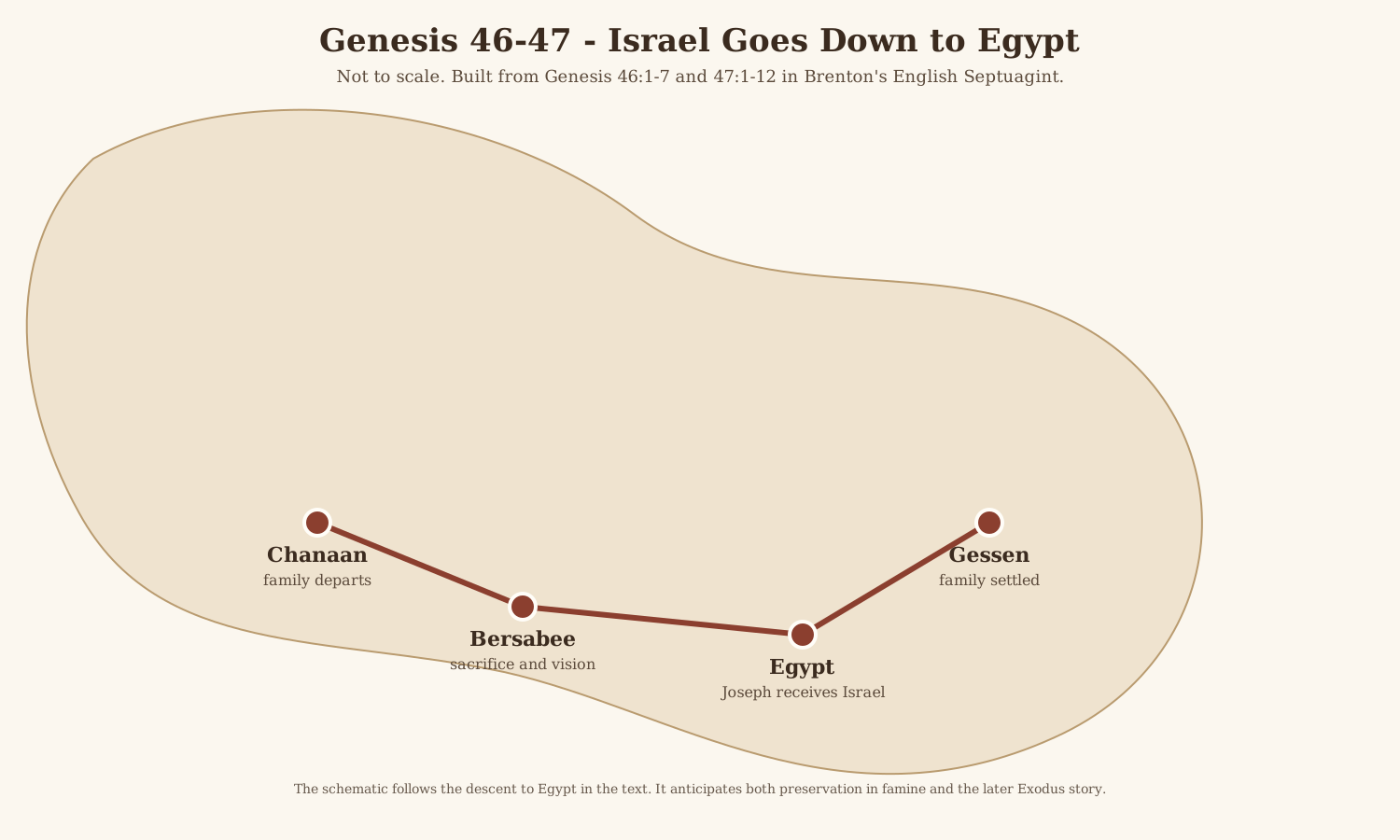 Source: Genesis 46:1-7 and 47:1-12 narrative schematic; not to scale.
The Lord accompanies the fearful traveler (Genesis 46:1-4)
1 And Israel departed, he and all that he had, and came to the well of the oath; and he offered sacrifice to the God of his father Isaac. 2 And God spoke to Israel in a night vision, saying, Jacob, Jacob; and he said, What is it? 3 And he says to him, I am the God of thy fathers; fear not to go down into Egypt, for I will make thee there a great nation. 4 And I will go down with thee into Egypt, and I will bring thee up at the end; and Joseph shall put his hands on thine eyes.
Jacob sacrifices to the God of Isaac before he takes the next step. His father had been told, ‘Go not down to Egypt’ during a famine (Genesis 26:2). Abraham’s earlier descent had endangered Sarah through concealment (Genesis 12:10-20), and the promise to Abraham included a long affliction for his descendants in a foreign land (Genesis 15:13-16). These memories make the command ‘fear not’ weighty. The account does not list Jacob’s private thoughts, but it gives a covenant history in which crossing this border calls for discernment. An earlier command to Isaac cannot simply be transferred to Jacob: he needs to hear what God is saying to him now.
God answers both the household’s future and the old man’s need. Egypt will be a place of multiplication; Joseph will be present at his father’s death. ‘I will bring thee up at the end’ reaches beyond the journey downward. Jacob will be carried back for burial, and Israel’s later deliverance will reveal how far the promise extends. The Lord’s presence accompanies His people through a history they cannot yet see.
The strongest comfort is ‘I will go down with thee.’ God gives Himself before Jacob knows all the consequences of obedience. Christians can bring a necessary move, a frightening treatment, or a change in family responsibility before Christ without pretending to know the outcome. Prayer seeks His presence and the wisdom to take the next faithful step.
Matthew 2:13-15 brings Egypt into the life of the incarnate Son. The angel commands Joseph to take the Child and His mother there; the family finds refuge from Herod, and Matthew hears the prophetic word, ‘Out of Egypt I called My Son.’ Christ enters the history of the people whose fathers He sustained. Jacob receives a promise of God’s accompaniment; in the Gospel the Word Himself truly lives our human vulnerability. Egypt shelters the Holy Family, and salvation comes through the Son who will lay down His life and rise again.
Isaiah 19:19-25 widens this hope: Egypt will know the Lord, turn to Him, and be healed. A land that becomes a place of bondage in Exodus is also named within God’s blessing. For Coptic Christians, Egypt belongs to the history of divine mercy as well as to the memory of oppression. That scriptural breadth keeps ‘Egypt’ from becoming a contemptuous name for an entire people.
Matthew is citing Hosea 11:1. Brenton’s Hosea reads ‘out of Egypt have I called his children’; Matthew hears the call fulfilled in the one Son in whom Israel’s history is gathered.
The Church’s Voice in Worship ⛪
The Coptic Synaxarium commemorates the Lord’s Entry into Egypt on 24 Bashans.1 Its invitation to rejoice because Christ honored the land makes the Gospel connection personal for the Church of Egypt. The Lord who promised to accompany Jacob has entered the land in our human life. Gratitude for that visit should become hospitality toward people seeking refuge and reverence for the Savior who took our frailty as His own.
A household remembered by name (Genesis 46:5-27)
5 And Jacob rose up from the well of the oath; and the sons of Israel took up their father, and the baggage, and their wives on the waggons, which Joseph sent to take them. 6 And they took up their goods, and all their property, which they had gotten in the land of Chanaan; they came into the land of Egypt, Jacob, and all his seed with him. 7 The sons, and the sons of his sons with him; his daughters, and the daughters of his daughters; and he brought all his seed into Egypt. 8 And these are the names of the sons of Israel that went into Egypt with their father Jacob—Jacob and his sons. The first-born of Jacob, Ruben. 9 And the sons of Ruben; Enoch, and Phallus, Asron, and Charmi. 10 And the sons of Symeon; Jemuel, and Jamin, and Aod, and Achin, and Saar, and Saul, the son of a Chananitish woman. 11 And the sons of Levi; Gerson, Cath, and Merari. 12 And the sons of Judas; Er, and Aunan, and Selom, and Phares, and Zara: and Er and Aunan died in the land of Chanaan. 13 And the sons of Phares were Esron, and Jemuel. And the sons of Issachar; Thola, and Phua, and Asum, and Sambran. 14 And the sons of Zabulun, Sered, and Allon, and Achoel. 15 These are the sons of Lea, which she bore to Jacob in Mesopotamia of Syria, and Dina his daughter; all the souls, sons and daughters, thirty-three. 16 And the sons of Gad; Saphon, and Angis, and Sannis, and Thasoban, and Aedis, and Aroedis, and Areelis. 17 And the sons of Aser; Jemna, Jessua, and Jeul, and Baria, and Sara their sister. And the sons of Baria; Chobor, and Melchiil. 18 These are the sons of Zelpha, which Laban gave to his daughter Lea, who bore these to Jacob, sixteen souls. 19 And the sons of Rachel, the wife of Jacob; Joseph, and Benjamin. 20 And there were sons born to Joseph in the land of Egypt, whom Aseneth, the daughter of Petephres, priest of Heliopolis, bore to him, even Manasses and Ephraim. And there were sons born to Manasses, which the Syrian concubine bore to him, even Machir. And Machir begot Galaad. And the sons of Ephraim, the brother of Manasses; Sutalaam, and Taam. And the sons of Sutalaam; Edom. 21 And the sons of Benjamin; Bala, and Bochor, and Asbel. And the sons of Bala were Gera, and Noeman, and Anchis, and Ros, and Mamphim. And Gera begot Arad. 22 These are the sons of Rachel, which she bore to Jacob; all the souls eighteen. 23 And the sons of Dan; Asom. 24 And the sons of Nephthalim; Asiel, and Goni, and Issaar, and Sollem. 25 These are the sons of Balla, whom Laban gave to his daughter Rachel, who bore these to Jacob; all the souls, seven. 26 And all the souls that came with Jacob into Egypt, who came out of his loins, besides the wives of the sons of Jacob, even all the souls were sixty-six. 27 And the sons of Joseph, who were born to him in the land of Egypt, were nine souls; all the souls of the house of Jacob who came with Joseph into Egypt, were seventy-five souls.
The wagons carry a family, its possessions, and its vulnerable generations. Joseph’s exaltation now serves people who cannot rescue themselves. God’s promise is taking the shape of a household with names, histories, and descendants, including Dinah and Sarah, Asher’s daughter. Er and Aunan are named with the notice of their deaths. Covenant memory preserves the truth about the family rather than turning it into an idealized ancestry.
The extended Joseph genealogy is important for the total. Beyond Manasses and Ephraim, verse 20 names Machir, Galaad, Sutalaam, Taam, and Edom: five additional descendants in this Greek enumeration. Verse 27 gives seventy-five for Jacob’s house, and Stephen uses that total in Acts 7:14. The familiar seventy belongs to a different textual enumeration. These are not two numbers to be repaired by inventing unnamed travelers. The displayed text itself contains an expanded genealogy, and the figures describe a household remembered across generations.2
Gems from the Fathers 💎: A genealogy longer than an arrival day
St. Augustine examines this very difficulty in The City of God XVI.40. Joseph’s great-grandchildren, he observes, could not all have been alive when Jacob first arrived. He therefore understands the entrance as a household history extending through Joseph’s lifetime, not as one day’s passenger list. His conclusion is explicit: ‘it does not mean one day, or one year, but that whole time as long as Joseph lived’.3 Joseph, who brought his father into Egypt, gives the household’s entrance its measure: the whole period of his life there gathers the generations into one history.
The names let us see something easily lost when we speak only of nations: God’s saving purpose includes people whose lives remain almost entirely unknown to us. Christian care must likewise reach beyond those whose stories attract attention. Remembering the sick, checking on an overlooked household, and providing for children are ways love becomes as particular as this list.
A living son and a place to dwell (Genesis 46:28-34)
28 And he sent Judas before him to Joseph, to meet him to the city of Heroes, into the land of Ramesses. 29 And Joseph having made ready his chariots, went up to meet Israel his father, at the city of Heroes; and having appeared to him, fell on his neck, and wept with abundant weeping. 30 And Israel said to Joseph, After this I will gladly die, since I have seen thy face, for thou art yet living. 31 And Joseph said to his brethren, I will go up and tell Pharao, and will say to him, My brethren, and my father’s house, who were in the land of Chanaan, are come to me. 32 And the men are shepherds; for they have been feeders of cattle, and they have brought with them their cattle, and their kine, and all their property. 33 If then Pharao call you, and say to you, What is your occupation? 34 Ye shall say, We thy servants are herdsmen from our youth until now, both we and our fathers: that ye may dwell in the land of Gesem of Arabia, for every shepherd is an abomination to the Egyptians.
Judah goes before the household, and Joseph comes to meet his father. The son who had once been reported dead appears alive and weeps abundantly on Jacob’s neck. The account gives tenderness time: power has not made Joseph ashamed of tears, and the years of separation are answered by an embrace. Jacob’s words, ‘After this I will gladly die, since I have seen thy face,’ express the rest that comes when a long grief meets a living person.
Simeon’s prayer in Luke 2:29-30 gives a Gospel comparison: ‘Lord, now You are letting Your servant depart in peace, According to Your word; For my eyes have seen Your salvation’. Jacob sees his son; Simeon receives the Child who is God’s salvation. The resemblance clarifies the greater fulfillment without making the two scenes identical. In Christ, consolation becomes a promise stronger than the death each man is ready to face.
Joseph then prepares his brothers to answer Pharaoh truthfully. Their work as shepherds is neither concealed nor abandoned to win acceptance. Egyptian disdain for shepherds makes Gesem a fitting place for their flocks and household. The practical provision also permits Israel to retain its way of life.
Love attends both the reunion and the arrangements afterward. Joseph can weep with his father and still think about pasture, livelihood, and the audience before Pharaoh. A restored relationship needs daily provision as well as a memorable embrace.
The pilgrim blesses the king (Genesis 47:1-12)
1 And Joseph came and told Pharao, saying, My father, and my brethren, and their cattle, and their oxen, and all their possessions, are come out of the land of Chanaan, and, behold, they are in the land of Gesem. 2 And he took of his brethren five men, and set them before Pharao. 3 And Pharao said to the brethren of Joseph, What is your occupation? and they said to Pharao, Thy servants are shepherds, both we and our fathers. 4 And they said to Pharao, We are come to sojourn in the land, for there is no pasture for the flocks of thy servants, for the famine has prevailed in the land of Chanaan; now then, we will dwell in the land of Gesem. And Pharao said to Joseph, Let them dwell in the land of Gesem; and if thou knowest that there are among them able men, make them overseers of my cattle. So Jacob and his sons came into Egypt, to Joseph; and Pharao, king of Egypt, heard of it. 5 And Pharao spoke to Joseph, saying, Thy father, and thy brethren, are come to thee. 6 Behold, the land of Egypt is before thee; settle thy father and thy brethren in the best land. 7 And Joseph brought in Jacob his father, and set him before Pharao; and Jacob blessed Pharao. 8 And Pharao said to Jacob, How many are the years of the days of thy life? 9 And Jacob said to Pharao, The days of the years of my life, wherein I sojourn, are a hundred and thirty years; few and evil have been the days of the years of my life, they have not attained to the days of the life of my fathers, in which days they sojourned. 10 And Jacob blessed Pharao, and departed from him. 11 And Joseph settled his father and his brethren, and gave them a possession in the land of Egypt, in the best land, in the land of Ramesses, as Pharao commanded. 12 And Joseph gave provision to his father, and his brethren, and to all the house of his father, corn for each person.
The brothers ask to sojourn because the famine has left their flocks without pasture. Pharaoh offers the best land and work for capable men. Joseph’s standing opens the court to the family, but Jacob brings something the court cannot confer: twice he blesses Pharaoh. The guest who needs bread can still give a blessing. Dependence on another’s resources does not erase a person’s dignity or calling before God.
Hebrews 7:7 states the principle, ‘the lesser is blessed by the better.’ Its immediate subject is Melchizedek blessing Abraham; it helps us notice the spiritual reversal here without turning Jacob into Pharaoh’s political superior. Pharaoh grants land, and Jacob blesses the giver. Christian gratitude can pray for a benefactor while remembering that every human authority stands under God.
Jacob calls his years a sojourn. He is one hundred and thirty, yet says they have been ‘few and evil’ beside his fathers’ years. Genesis has shown how much those days contain: family deception, exile, bereavement, and the loss he believed he had suffered in Joseph. A long life can still feel short and afflicted. Faith permits him to speak truthfully rather than produce a cheerful account for a powerful listener.
Gems from the Fathers 💎: Blessing that outlives visible success
St. John Chrysostom uses Jacob’s words to Pharaoh in Homily XXVI on Hebrews, section 1. He contrasts Jacob’s afflicted life with the blessing that would unfold in his descendants and in the world to come. After recalling ‘Few and evil have my days been,’ he asks: ‘Where then did the blessings come to their accomplishment, save in the [world] to come?’4 The question loosens the habit of judging God’s fidelity by a person’s present comfort. Jacob’s hardships are real; the promise is larger than the years in which he bears them.
Hebrews 11:13-16 develops this pilgrim hope toward a heavenly country prepared by God. The bread Joseph gives, ‘corn for each person,’ remains a genuine mercy along that road. In the Church, the Eucharist gives communion with the risen Christ while we are still awaiting the fullness of His Kingdom. The heavenly homeland makes earthly provision more precious as a gift, not less worthy of gratitude.
Bread, seed, and the cost of survival (Genesis 47:13-26)
13 And there was no corn in all the land, for the famine prevailed greatly; and the land of Egypt, and the land of Chanaan, fainted for the famine. 14 And Joseph gathered all the money that was found in the land of Egypt, and the land of Chanaan, in return for the corn which they bought, and he distributed corn to them; and Joseph brought all the money into the house of Pharao. 15 And all the money failed out of the land of Egypt, and out of the land of Chanaan; and all the Egyptians came to Joseph, saying, Give us bread, and why do we die in thy presence? for our money is spent. 16 And Joseph said to them, Bring your cattle, and I will give you bread for your cattle, if your money is spent. 17 And they brought their cattle to Joseph; and Joseph gave them bread in return for their horses, and for their sheep, and for their oxen, and for their asses; and Joseph maintained them with bread for all their cattle in that year. 18 And that year passed, and they came to him in the second year, and said to him, Must we then be consumed from before our lord? for if our money has failed, and our possessions, and our cattle, brought to thee our lord, and there has not been left to us before our lord more than our own bodies and our land, we are indeed destitute. 19 In order, then, that we die not before thee, and the land be made desolate, buy us and our land for bread, and we and our land will be servants to Pharao: give seed that we may sow, and live and not die, so our land shall not be made desolate. 20 And Joseph bought all the land of the Egyptians, for Pharao; for the Egyptians sold their land to Pharao; for the famine prevailed against them, and the land became Pharao’s. 21 And he brought the people into bondage to him, for servants, from one extremity of Egypt to the other, 22 except only the land of the priests; Joseph bought not this, for Pharao gave a portion in the way of gift to the priests; and they ate their portion which Pharao gave them; therefore they sold not their land. 23 And Joseph said to all the Egyptians, Behold, I have bought you and your land this day for Pharao; take seed for you, and sow the land. 24 And there shall be the fruits of it; and ye shall give the fifth part to Pharao, and the four remaining parts shall be for yourselves, for seed for the earth, and for food for you, and all that are in your houses. 25 And they said, Thou hast saved us; we have found favour before our lord, and we will be servants to Pharao. 26 And Joseph appointed it to them for an ordinance until this day; to reserve a fifth part for Pharao, on the land of Egypt, except only the land of the priests, that was not Pharao’s.
The account turns from a favored household to a country fainting with hunger. Money runs out first, then livestock is exchanged for bread. Finally the people have only their bodies and land to offer. Their plea joins two necessities: keep us alive now, and give seed so the land will bear food again. Joseph’s response addresses both. He provides seed and establishes a division of produce that leaves four parts for sowing and household food, with the fifth reserved for Pharaoh. Rescue must look beyond today’s ration to the possibility of tomorrow’s harvest.
The people say, ‘Thou hast saved us.’ That gratitude belongs in the reading. So does the cost: the land becomes Pharaoh’s, and verse 21 says Joseph brought the people into bondage. The priests retain their land because their provision comes from Pharaoh. Hunger exposes how differently people are protected within the same society. The narrative records an emergency arrangement that preserves lives while gathering property and labor into royal hands.
Language insight: ‘bondage’ and ‘cities’
Brenton’s verse 21 explicitly describes servitude. The NKJV at the same verse says Joseph moved the people into the cities.5 The two forms place different actions in the foreground; the commentary here follows the bondage wording actually printed. The surrounding verses in both forms still speak of land sold to Pharaoh and the people becoming his servants. The difference should neither be hidden nor used to make one isolated phrase carry the whole moral judgment.
Joseph acts decisively and preserves life. Yet the distress that prompts the people’s offer matters: consent given with starvation as the alternative is not ordinary economic freedom. Genesis lets rescue and dependence stand together: gratitude for lives saved, and honesty about what starvation forced people to surrender. Those who know debt, displacement, or insecure work can hear their gratitude and their vulnerability taken seriously.
Joseph’s bread also shows the limit of a human deliverer. Christ gives Himself as the Bread of Life (John 6), bringing us into communion rather than making hunger a means of possessing us. At the Eucharistic table we receive life from Him; in service we carry that mercy toward people whose bodies need food now. A parish’s assistance should protect dignity, avoid using need to demand control, and help a household regain the ability to provide for itself. Seed as well as bread belongs to the story.
Prosperity received, promise remembered (Genesis 47:27-31)
27 And Israel dwelt in Egypt, in the land of Gesem, and they gained an inheritance upon it; and they increased and multiplied very greatly. 28 And Jacob survived seventeen years in the land of Egypt; and Jacob’s days of the years of his life were a hundred and forty-seven years. 29 And the days of Israel drew nigh for him to die: and he called his son Joseph, and said to him, If I have found favour before thee, put thy hand under my thigh, and thou shalt execute mercy and truth toward me, so as not to bury me in Egypt. 30 But I will sleep with my fathers, and thou shalt carry me up out of Egypt, and bury me in their sepulchre. And he said, I will do according to thy word. 31 And he said, Swear to me; and he swore to him. And Israel did reverence, leaning on the top of his staff.
Israel increases greatly in Gesem. The assurance at Beersheba is already bearing fruit: the family receives a place to live and becomes more numerous. Jacob remains there seventeen years. Yet when death approaches he asks Joseph to enact ‘mercy and truth’ by carrying him to his fathers’ sepulchre. Receiving Egypt’s generosity has not made him forget Canaan. The final oath binds Joseph’s power to a son’s care for his father and to the household’s promised future.
The burial request is specific to Jacob’s covenant history. Christian hope in the resurrection does not depend on being buried in a particular country. Its spiritual lesson is a remembered belonging: gratitude for temporary shelter can live beside trust in a promise still awaiting fulfillment.
Language insight: ‘staff’ and ‘bed’
Brenton ends with Jacob doing reverence ‘leaning on the top of his staff.’ The NKJV of Genesis 47:31 has him bowing on the head of the bed. Hebrews 11:21 uses the staff wording: ‘By faith Jacob, when he was dying, blessed each of the sons of Joseph, and worshiped, leaning on the top of his staff.’6 Hebrews gathers the final reverence and the blessing of Joseph’s sons into its portrait of faith. The Septuagint form helps us hear the old man’s bodily dependence alongside his confident prayer. Faith can worship in a body that needs support.
Gems from the Fathers 💎: Reverence directed toward Joseph
In section 2 of the same Homily XXVI, Chrysostom interprets the bow as an act toward Joseph, anticipating the future honor of his descendants. He says that Jacob, though old, ‘“he bowed himself” to Joseph, showing the obeisance of the whole people which was to be [directed] to him’.7 He connects this with the brothers’ earlier bowing and the later ten tribes, including the kingship arising from Ephraim. The reader of Genesis can hear the dream that Jacob once rebuked: ‘shall indeed both I and thy mother and thy brethren come and bow before thee to the earth?’ (37:10). Now the father himself does reverence. Hebrews counts the bodily act as worship offered in faith; Chrysostom hears in it a prophecy enacted, for Jacob ‘not only spoke, but was even so confident about the future things, as to show it also by his act’.7
Jacob’s last dependence completes the chapter’s lesson about receiving mercy. He who blessed Pharaoh now asks his son for help. Dignity before God includes the freedom to need another person. Christ receives our frailty and leads us toward the Father’s house; caring for an elder’s wishes and bodily needs can become an ordinary, costly act of that love.
Spiritual Fruit 🍇
Take the next step after prayer. Jacob pauses at Beersheba before the move his household needs. Bring one actual transition before Christ, name the people affected, and ask for wisdom as well as courage. Seek counsel and make the practical preparations love requires. God’s presence gives a ground for obedience without pretending uncertainty has vanished.
Let reunion become provision. Joseph’s embrace is followed by arrangements for pasture, work, and food. Where a relationship has been restored, choose a dependable act that sustains it: a visit kept, help with a parent’s care, or a shared responsibility carried without complaint. Warm words become credible when they are joined to ordinary faithfulness.
Give assistance that preserves dignity. The famine account puts bread and seed together. When helping a person in need, listen for what would make tomorrow more secure as well as what would relieve today. Avoid attaching demands for loyalty, access, or control to the help you give. Christ’s generosity frees us to serve rather than possess.
Receive comfort without making it your final home. Jacob lives gratefully in Gesem while remembering the promise. Give thanks for a salary, a safe home, or support from others, then examine what you fear losing so much that it governs your obedience. In worship, receive the Kingdom Christ gives and let that belonging order the use of earthly gifts.
Care for the supported body. Jacob ends by leaning and asking. An elder who needs assistance remains a person capable of blessing, prayer, and meaningful choice. Ask about the care another person wishes to receive, respect it where possible, and offer help without humiliating dependence.
Lord Jesus Christ, accompany the household that must leave what it knows. Receive its fear, and give bread where hunger threatens life. Teach us to give seed for another person’s future and to bless those whose kindness sustains us. Keep Your promise before us when our strength is small. Amen.
Teaching Notes
The Lord accompanies the fearful traveler (Genesis 46:1-4)
- Ask: Why does Jacob need a fresh word from God when Isaac had once been forbidden to enter Egypt?
- Watch for: God answers with His presence before Jacob takes the next step. The earlier Egyptian journeys clarify the setting without supplying a record of every thought in Jacob’s mind.
A household remembered by name (Genesis 46:5-27)
- Ask: What changes when the seventy-five are read as an extended household genealogy rather than a single day’s passenger list?
- Watch for: The names in verse 20 carry the household beyond the first arrival. Augustine reads the list within the generations sustained through Joseph’s lifetime.
A living son and a place to dwell (Genesis 46:28-34)
- Ask: How do Joseph’s tears and his careful preparation of the brothers together show care for the family?
- Watch for: Joseph gives the reunion time for tears, then prepares a place and a livelihood for the family. Affection and dependable provision belong together.
The pilgrim blesses the king (Genesis 47:1-12)
- Ask: What can Jacob give Pharaoh while receiving land and food from Pharaoh’s kingdom?
- Watch for: Jacob blesses Pharaoh at both entrance and exit, in verses 7 and 10. The old pilgrim has something to give while receiving the king’s provision.
Bread, seed, and the cost of survival (Genesis 47:13-26)
- Ask: Why does the people’s request for seed matter alongside their immediate need for bread?
- Watch for: The people ask for seed as well as bread. Preserve both gratitude for lives saved and the burden of dependence imposed by famine.
Prosperity received, promise remembered (Genesis 47:27-31)
- Ask: How does Jacob’s request for ‘mercy and truth’ keep his prosperity in Egypt connected to the promise?
- Watch for: Hebrews presents worship in faith; Chrysostom reads prophetic obeisance toward Joseph. The link with the dream in 37:9-10 is an observation drawn from Genesis, not a quotation from Chrysostom.
Sources
Embedded Scripture is from Brenton’s English Septuagint (LXX). New Testament quotations are from NKJV.
Brenton, Genesis 46 🔗 and Genesis 47 🔗; Genesis 12:10-20; 15:13-16; 26:2; Isaiah 19:19-25; Hosea 11:1. Matthew 2:13-15; Luke 2:29-30; John 6; Acts 7:14; Hebrews 7:7; 11:13-16, 21.
St. Augustine, The City of God XVI.40, on the extended household enumeration; St. John Chrysostom, Homily XXVI on Hebrews 1-2, on Jacob’s afflicted years and final reverence. Direct quotations and edition details are cited below.
Translation comparisons: Genesis 47:21 🔗 and 47:31 🔗. ‘Bondage’ and ‘staff’ follow Brenton; ‘cities’ and ‘bed’ identify the NKJV forms of those Genesis verses.
Coptic Synaxarium, 24 Bashans, the Lord’s Entry into Egypt 🔗.
The narrative schematic accompanies Genesis 46:1-7 and 47:1-12; it is a visual summary rather than a reconstruction of a surveyed route.
Footnotes
-
Coptic Synaxarium, 24 Bashans, ‘The Commemoration of the Entry of the Lord Christ to Egypt,’ English text 🔗. The commemoration is distinct from a verified Genesis reading for the feast. ↩
-
Brenton, Genesis 46:20, 26-27 🔗. The five added descendants are Machir, Galaad, Sutalaam, Taam, and Edom. Augustine’s XVI.40 explains why an extended genealogy is not a same-day census; its transliterated names do not reproduce this list exactly. ↩
-
St. Augustine, The City of God XVI.40 🔗. Marcus Dods translation, Nicene and Post-Nicene Fathers, first series, vol. 2 (1887), edited by Philip Schaff; New Advent revision edited by Kevin Knight. ↩
-
St. John Chrysostom, Homily XXVI on Hebrews 1 🔗. Nicene and Post-Nicene Fathers, first series, vol. 14 (1889), the Oxford translation revised with introduction and notes by Frederic Gardiner. The page’s printed homily number is XXVI. ↩
-
Genesis 47:31, Brenton and NKJV comparison 🔗; Hebrews 11:21 uses the staff form. ↩
-
St. John Chrysostom, Homily XXVI on Hebrews 2 🔗, NPNF first series, vol. 14. His words concern the bow associated with Genesis 47:31. ↩ ↩2