


This narration is from a previous version of the study and may include a combined recording of multiple chapters.
The child has forgotten being carried; the Lord has not forgotten carrying him. Hosea 11 places that unequal memory at the center of Israel’s rebellion. Egypt once meant deliverance, but Assyria now threatens another bondage. Between the remembered rescue and the threatened ruin, God speaks of a love that neither excuses idolatry nor abandons His people to utter destruction. His holiness makes His mercy different from the mercy of wounded human pride.
Names and verse numbers
- Ephraim: a major northern tribe whose name often stands for the northern kingdom of Israel.
- Baalim: the plural form of Baal, naming the false gods to whom the people offer sacrifice.
- Adama and Seboim: Brenton’s spellings of Admah and Zeboiim, cities associated with the destruction of Sodom and Gomorrah in Deuteronomy 29:23.
- Recapitulation: the gathering up and faithful fulfillment of an earlier history. Here it describes Christ living Israel’s sonship faithfully, not erasing Israel from Hosea’s own setting.
- Brenton and LXX: Brenton’s English translation of the Septuagint, the ancient Greek Old Testament. Its wording and chapter divisions govern the Scripture below.
Following another Bible: Brenton’s Hosea 11:1 begins with the casting off of Israel’s king, material corresponding to the end of NKJV Hosea 10:15, and then continues into the childhood and Exodus remembrance of NKJV Hosea 11:1. Brenton Hosea 11 ends at verse 11; the accusation numbered NKJV Hosea 11:12 opens Brenton Hosea 12:1. The difference is a division of the text, not a missing verse.
The child who did not know his Healer (Hosea 11:1-4)
- Early in the morning were they cast off, the king of Israel has been cast off: for Israel is a child, and I loved him, and out of Egypt have I called his children.
- As I called them, so they departed from my presence: they sacrificed to Baalim, and burnt incense to graven images.
- Yet I bound the feet of Ephraim, I took him on my arm; but they knew not that I healed them.
- When men were destroyed, I drew them with the bands of my love: and I will be to them as a man smiting another on his cheek: and I will have respect to him, I will prevail with him.
The opening joins the downfall of a king to the remembrance of a child. Political collapse does not tell the whole truth about Israel: before any king could claim to secure the nation, the Lord loved and called His people. Yet the answer to His call was departure from His presence. Sacrifice and incense continued, but they were directed toward the images that displaced Him.
Verse 3 makes the wound painfully specific. Brenton reads, “Yet I bound the feet of Ephraim, I took him on my arm; but they knew not that I healed them.” The emphasis falls on care received without recognition. Israel has not created its own strength. The people can stand in rebellion only because they have first been sustained by the One they reject.
The “bands of my love” in verse 4 do not remove the difficulty of the following image of a man smiting another’s cheek. Brenton’s wording places love and severe confrontation together; it should not be silently replaced with the NKJV’s different picture of a yoke lifted and food given. Hosea exposes the seriousness of refusing God, but this image gives no parent, spouse, or spiritual leader permission to strike or humiliate someone and call it divine love. Human violence does not become holy by borrowing God’s voice.
Translation insight: “his children” and “My Son”
Brenton Hosea 11:1 says, “out of Egypt have I called his children.” Matthew 2:15 gives the familiar “Out of Egypt I called My Son” in his account of the Holy Family’s flight into Egypt. These are not identical English quotations. Hosea remembers Israel’s Exodus; Matthew identifies the deeper fulfillment in Jesus. The faithful Son enters His people’s history and brings it to its saving goal. This Christian reading follows Matthew’s own identification rather than pretending that Hosea’s immediate subject was never Israel.
Gems from the Fathers 💎: The Son and His people
Saint John Chrysostom considers the objection that Hosea’s words first concerned Israel. He does not deny that earlier reference. He explains that prophecy can have a fulfillment beyond the people of whom it first speaks: “This is a law of prophecy, that in many cases much that is spoken of one set of persons is fulfilled in another”.1 Matthew’s Christological reading is therefore not an excuse to forget the Exodus. The Son enters that history and fulfills its calling faithfully. See Matthew’s account of Egypt and Nazareth.
The Church’s Voice in Worship ⛪
Katameros witnesses join the beginning of this chapter to Hosea 10:12-15 at the Ninth Hour of a Holy Pascha night service. Their evening labels overlap: a Tuesday Eve witness gives Hosea 10:12-11:2, while a Monday Eve witness divides the material. These listings do not establish two independently confirmed annual appointments. Read with Hosea 10, the movement from sowing righteousness to God’s remembered love invites gratitude and return, not confidence in a religious identity left unexamined.
The fruit of refusing to return (Hosea 11:5-7)
- Ephraim dwelt in Egypt; and as for the Assyrian, he was his king, because he would not return.
- And in his cities he prevailed not with the sword, and he ceased to war with his hands: and they shall eat of the fruit of their own devices:
- and his people shall cleave fondly to their habitation; but God shall be angry with his precious things, and shall not at all exalt him.
Egypt and Assyria now name the world of failed refuge and foreign rule. The refusal to return to the Lord does not leave Ephraim independent. It places the people under another king. The power sought apart from God becomes bondage, while the cities cannot secure themselves by force.
“They shall eat of the fruit of their own devices” makes the judgment intelligible without making it comfortable. Their counsels are not merely opinions held in private; they produce a life that must be inhabited. Verse 7’s attachment to their habitation is therefore tragic beside the coming promise of restored houses in verse 11. A people can cling to the place where it feels secure while refusing the God who alone can establish it.
This is a warning about false trust, not a rule for diagnosing every captivity, displacement, or personal disaster as the victim’s fault. Hosea addresses the named covenant rebellion of Israel. The Christian hearer should examine his own refusals, not use the prophet to pronounce hidden judgments on someone else’s suffering.
The Holy One will not utterly abandon Ephraim (Hosea 11:8-9)
- How shall I deal with thee, Ephraim? how shall I protect thee, Israel? what shall I do with thee? I will make thee as Adama, and as Seboim; my heart is turned at once, my repentance is powerfully excited.
- I will not act according to the fury of my wrath, I will not abandon Ephraim to be utterly destroyed: for I am God, and not man; the Holy One within thee: and I will not enter into the city.
The questions address Ephraim by name. God is not speaking about an interchangeable rebellious population. The people whose destruction is threatened are the people He has loved. Adama and Seboim evoke devastation; Brenton’s “I will make thee as Adama, and as Seboim” is immediately followed by the turning of God’s heart and the refusal to abandon Ephraim to utter destruction. The movement must be heard across both verses, not reduced to either threat alone or easy reassurance.
“My repentance is powerfully excited” speaks of this merciful turning in language drawn from human experience. It does not mean that God has committed a sin and now confesses it. The text makes His compassion known, while “I am God, and not man” prevents us from treating Him as a larger version of our own unstable resentment.
“The Holy One within thee” is the ground of the refusal to destroy utterly. Holiness is not the enemy of mercy. God does not have to become less holy in order to love the sinful. Nor does mercy make the earlier warning unreal. Ephraim is called to abandon the rebellion that destroys life, precisely because the Holy One has not abandoned Ephraim.
The voice that gathers the scattered (Hosea 11:10-11)
- I will go after the Lord: he shall utter his voice as a lion: for he shall roar, and the children of the waters shall be amazed.
- They shall be amazed and fly as a bird out of Egypt, and as a dove out of the land of the Assyrians: and I will restore them to their houses, saith the Lord.
The lion’s voice now summons rather than merely terrifies. Egypt and Assyria, which framed the chapter’s bondage, become places from which the scattered return. The birds are not a picture of military strength. They are small, startled creatures brought home by a voice stronger than the powers that dispersed them.
The promise reaches ordinary habitation: “I will restore them to their houses.” God’s compassion is not left as a feeling in heaven. It seeks a people restored to life with Him. For Christians, Matthew’s reading of the Son called from Egypt gives this hope a personal center. We do not bring ourselves home by recovering an imagined innocence. We return in communion with the Son who is faithful where we have wandered.
Iconography Connection 🖼️
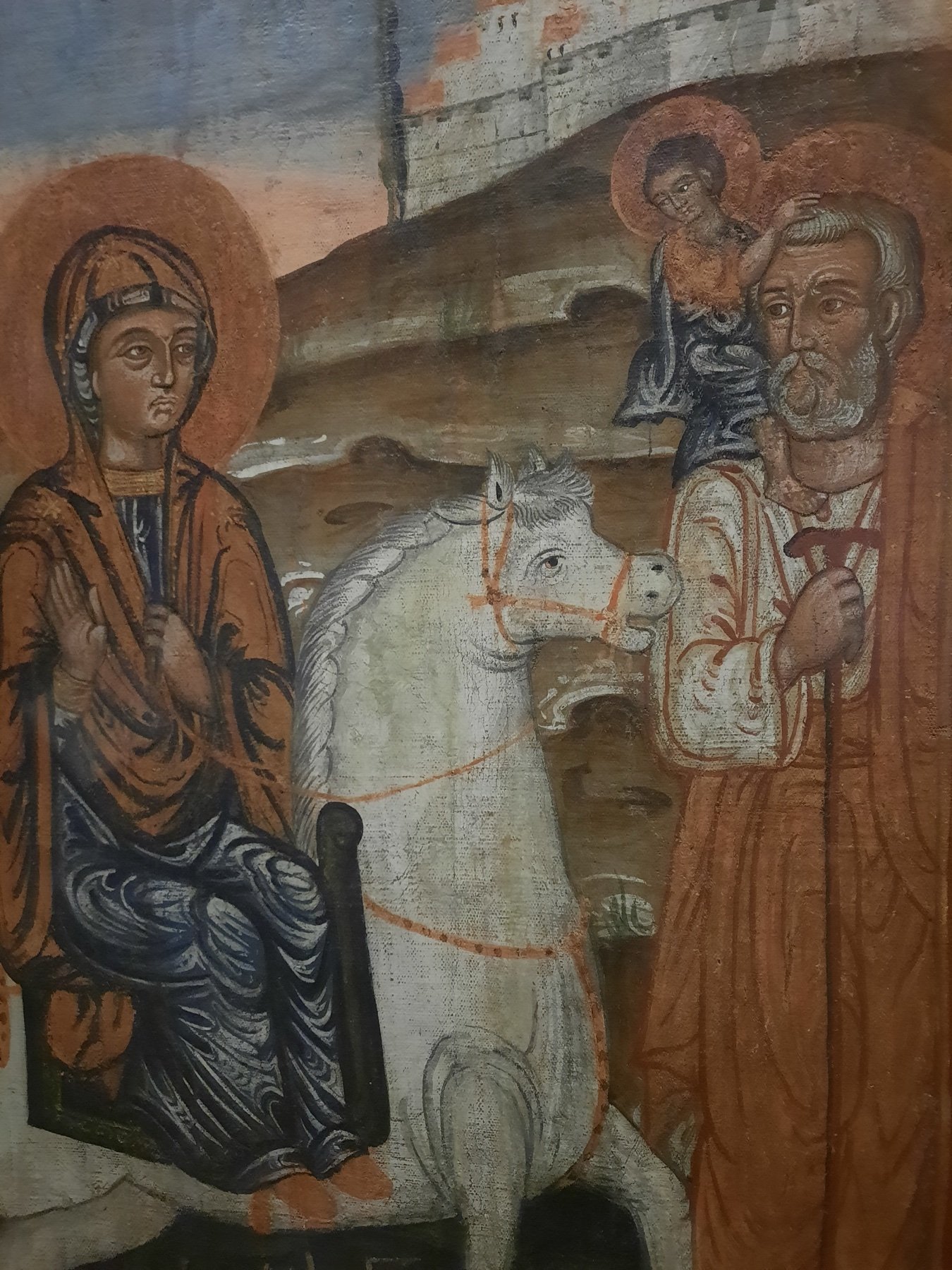 Source: Coptic icon of the Flight of the Holy Family into Egypt, Coptic Museum, 18th century, photograph by Ahmed Nagy, CC BY-SA 4.0, via Wikimedia Commons.
This Coptic icon belongs beside Hosea because Matthew receives the Exodus remembrance in the life of Christ. It depicts the Holy Family’s journey, not a scene in Hosea’s own life. The Lord who carried His people enters the vulnerability of childhood and is Himself carried and protected. The correspondence is not a replacement of God’s care by human self-rescue: it is the wonder that the Son comes among the children He wills to save.
Gems from the Fathers 💎: Egypt receives and gives
Addressing Christians who had come from Egypt, Saint Gregory the Theologian remembers “Christ my Lord, Who once was a fugitive into Egypt, and now is supplied by Egypt”.2 His address joins Egypt’s provision of grain with the spiritual nourishment of the Word. The land that sheltered Christ now bears witness to Him. This is more than an affectionate geographical memory: the gift received becomes a gift offered to others. A Church honored by the Lord’s coming is called to nourish, welcome, and serve.
Spiritual Fruit 🍇
Remember one mercy you have learned to describe as your own achievement. A person who cared for you, protection you did not arrange, or strength received in weakness may reveal how much of life began in being carried. Give thanks for it without pretending that every painful part of your past was itself good.
Name a counsel whose fruit you are already eating: a deception that requires further deception, a refusal to forgive that has narrowed prayer, or a substitute for God that now demands obedience. Bring the actual refusal to confession rather than offering only a general admission of weakness. The Lord’s remembrance of you makes truth possible.
If father-language brings wounds rather than consolation, let the distinction in verse 9 stand: God is not the human being who harmed you. His holiness does not require you to call cruelty love. Lord Jesus Christ, faithful Son, gather what has scattered in me. Teach me to recognize the hand that heals and to return without hiding.
Teaching Notes
The child who did not know his Healer (Hosea 11:1-4)
- Ask: what changes when rebellion is heard beside the memory of having been carried?
- Watch for: quoting “taught to walk” as Brenton’s wording, or using verse 4 to justify interpersonal violence.
- Connect: Matthew 2:13-15 receives Hosea’s Exodus memory in Jesus; distinguish the wording of the two passages.
The fruit of refusing to return (Hosea 11:5-7)
- Ask: why does refusing God’s kingship fail to produce independence?
- Watch for: using Israel’s specific accusation to assign guilt to every displaced or suffering person.
The Holy One will not utterly abandon Ephraim (Hosea 11:8-9)
- Emphasize: Brenton’s threat in verse 8 must be read with the merciful refusal of utter destruction in verse 9.
- Ask: how does “God, and not man” change the way mercy is understood?
The voice that gathers the scattered (Hosea 11:10-11)
- Ask: what does the promise of restored houses add to the language of compassion?
- Show: use the Coptic Flight-into-Egypt icon as Matthew’s reception of Hosea, not as a literal illustration of the prophet’s scene.
Sources
Embedded Scripture is from Brenton’s English Septuagint (LXX).
Brenton, Hosea 11, including the distinctive wording of verses 1, 3-4, and 8-9.
Hosea 10:15-12:14, NKJV, for chapter divisions and the comparison at Hosea 11:3-4.
Matthew 2:13-15, NKJV, for the Gospel’s reception of Hosea 11:1; Deuteronomy 29:23, Brenton, for Adama and Seboim.
Coptic Museum Flight-into-Egypt icon, Wikimedia Commons, photograph by Ahmed Nagy, CC BY-SA 4.0.
Footnotes
-
Saint John Chrysostom, Homilies on Matthew 8.5, primary text. The quoted fragment states his rule of prophetic fulfillment; his surrounding examples distinguish an initial subject from a later fulfillment. ↩
-
Saint Gregory the Theologian, Oration 34.1-2, On the Arrival of the Egyptians, primary text. The quoted fragment is in section 1; section 2 develops the Egyptians’ spiritual witness. ↩